Our readers keep the lights on and my smoothie glass nicely filled. As an Amazon Associate, I earn from qualifying purchases.
Specs are compiled from manufacturer listings and verified buyer reviews and can change over time — please confirm the key details on the product page before buying.
At seven, a child’s brain is a sponge ready for real challenges—yet most toys either bore them in an afternoon or demand a screen. The right pick turns their curiosity into hands-on problem solving—snapping circuits, building a dancing robot, or launching a self-assembled rocket. This guide cuts through the noise to find nine toys that teach while keeping a 7-year-old entertained.
I’m Mohammad Maruf — the founder and writer behind WellFizz. This guide is built by comparing the manufacturers’ published specifications and the patterns across verified customer reviews, so you get each pick’s real strengths and trade-offs instead of marketing spin.
Here’s the honest truth: the best educational toys for 7-year-olds are the ones kids return to again and again, and we’ve found the ones that earn that repeat play.
Our Picks at a Glance


How To Choose The Best Educational Toys For 7-Year-Olds
At seven, your child can follow multi-step instructions but still wants to play, not do homework. The best educational toys make learning feel like a game. As you compare, focus on three things: real educational value, how much it feels like play, and whether it holds up to daily use.
Match the challenge to the child
A toy that’s too easy gets abandoned; one that’s too hard frustrates. Look for kits with adjustable difficulty—like multiple skill levels or projects that range from simple to challenging. This lets the toy grow with your child instead of being outgrown in a week.
Beware the “one-and-done” build
Some kits are fun once, then sit on a shelf. The toys with the longest play life offer open-ended possibilities: multiple build configurations, rechargeable play, or a guidebook with dozens of challenges. Replayability is the biggest predictor of a toy earning its place.
Quick Comparison
| Model | Best For | Projects / Pieces | Age Range | Power Source | Amazon |
|---|---|---|---|---|---|
| Snap Circuits Jr. SC-100★ Best Overall | First circuits | 100+ projects | 8+ | Batteries | Amazon |
| Programmable Robot ToyTech Whiz | Programming basics | 50 actions | 4-10 | Rechargeable | Amazon |
| Snap Circuits Flight DeckHigh Flyer | Air pressure & flight | 5 projects | 8+ | Batteries | Amazon |
| Educational Insights Math Whiz | Math fact practice | 3 modes | 6-8 | 2 AAA batteries | Amazon |
| choopheme 10-in-1 STEM Kit | Construction vehicles | 10 models | 5-9 | None | Amazon |
| Smartivity Rocket Launcher | Physics in action | 1 build | 6-12 | None | Amazon |
| Qirptey STEM Building Blocks | Open-ended building | 125 pieces | 3+ | None | Amazon |
| Nat Geo Marble Run | Physics & motion | 95 pieces | 8+ | Motorized lift | Amazon |
| burgkidz Road Build Puzzle | Logic & spatial skills | 200+ puzzles | 4-8 | Wind-up cars | Amazon |
In‑Depth Reviews
1. Snap Circuits Jr. SC-100 Electronics Exploration Kit
Our pick — over 4.5★ from 29,000+ verified ratings; the strongest balance of quality and price.
The classic first-circuits kit that turns a 7-year-old into a builder of flying saucers and alarms.
If you buy one STEM toy this year, this is the one. The Snap Circuits Jr. SC-100 snaps together 100+ projects without a single tool—no soldering, no wires to strip, just numbered pieces that click onto a plastic grid. Your child can build a flying saucer that takes off, or a light-alarm that actually sounds. It’s the kind of toy where “one more project” becomes an hour of focused building.
The box measures 12 x 9.5 x 1.75 inches, making it easy to tuck on a shelf between play sessions, and the 30+ snap modules fit in the included storage board. Batteries are required, so grab some alkalines before wrapping it up. It’s officially rated for ages 8 and up, but parents report 5-year-olds following the color-coded diagrams with a little help—which means a 7-year-old can run with it fairly independently.
Buyers rave about the educational payoff: 2,300 reviewers cite learning value, with quality close behind at 1,800 mentions. As owners put it, the kit delivers “20+ hrs use, educational, easy-to-challenging projects.” Each manual walks from simple to more complex builds, so the difficulty scales as your child’s confidence grows. The only real gripe? A few pieces are fragile if snapped too hard—the trade-off for pieces small enough to teach real circuitry.
What wins families over
- 100+ projects from one box means months of play
- No tools or soldering—snap together and go
- Teaches real circuit basics at a 7-year-old’s pace
- Color-coded pieces make instructions easy to follow
Who should think twice
- Needs batteries, which aren’t included
- Small pieces require careful handling
- Some projects are listed online, which can pull kids toward screens
Grab it for: the child who asks “how does this work?” and loves building things that actually do something.
Look elsewhere if: your kid loses interest in anything without instant action or flashing lights.
2. Programmable Robot Toy
A dancing, talking robot that introduces real programming logic through play, not screens.
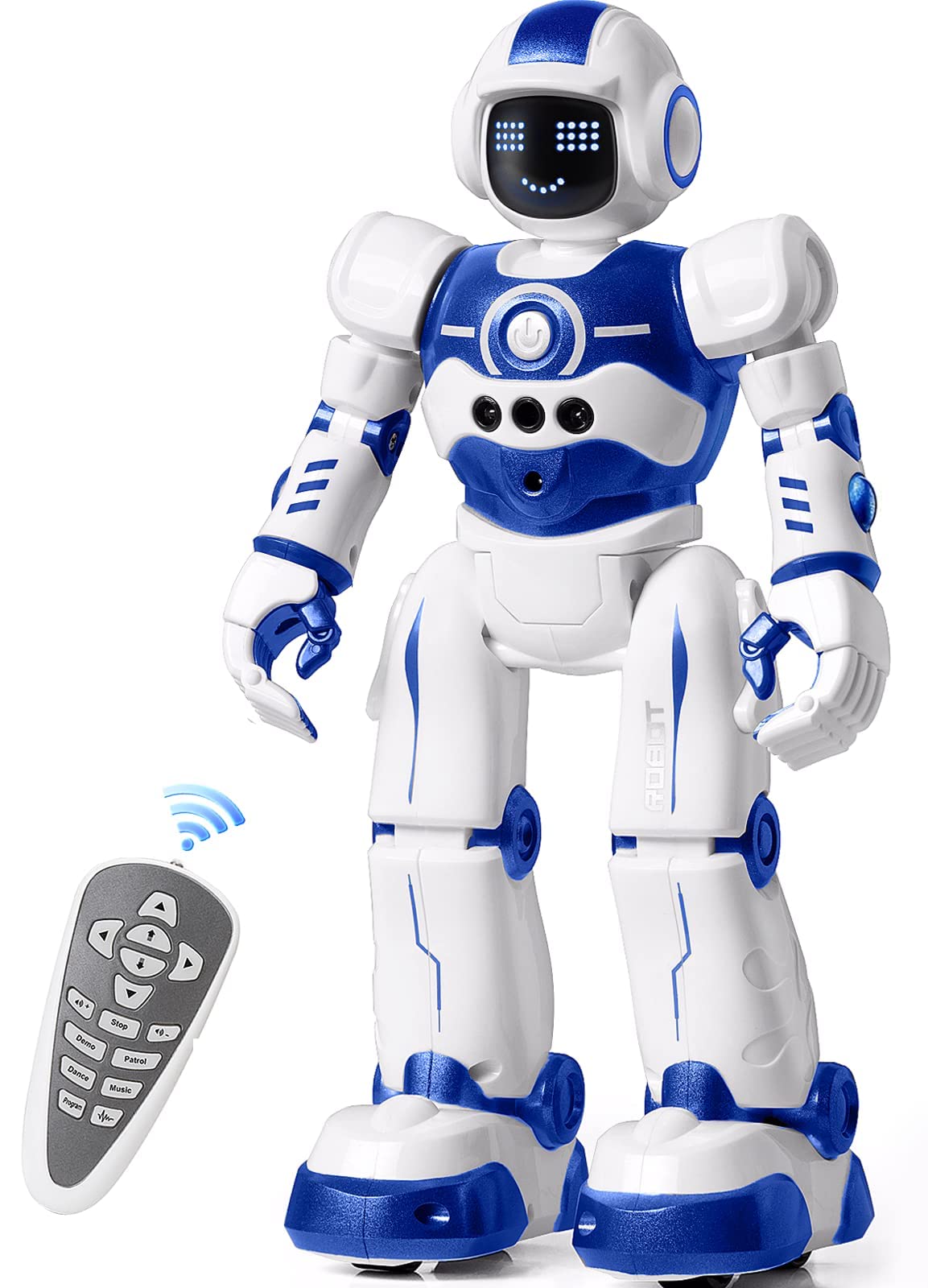
This robot stands 10.6 inches tall and brings the wow factor—its eyes light up with bright blue LEDs when it moves, and it can dance, sing, walk, and patrol. But the real magic is the programming mode: your child can input a sequence of up to 50 actions, and the robot plays them back step by step. It’s screen-free coding that teaches sequencing and logic the way a 7-year-old actually wants to learn.
You get two ways to control it: an infrared remote or hand gestures that make it slide forward, backward, left, and right. It also has an obstacle-avoidance mode for hands-free play. The built-in battery recharges in about 2 hours via USB and delivers roughly 60 minutes of playtime—enough for a solid session. Made from non-toxic ABS plastic, it’s built to survive the bumps of everyday play.
Quality is what owners praise most, with 52 buyers flagging the build quality as the standout feature. It’s a hit with kids as young as 3, but the advanced programming features keep 7-10-year-olds engaged. The honest catch is battery life: feedback is mixed, and some units struggle to recharge after a few days. One buyer’s pre-charged battery lasted 2 days, so plan to keep the USB cable handy from day one.
What makes it click
- 50-action programming teaches real sequencing logic
- Gesture control adds a second way to play
- Rechargeable battery saves money on replacements
- Sturdy ABS plastic survives drops and bumps
Where it stumbles
- Charger isn’t included—check your USB collection
- Battery life is mixed, with some units failing to recharge
- Struggles on thick carpet; best on hard floors
Reach for it if: your 7-year-old loves robots and wants to make one obey their commands.
Think twice if: you want a set-and-forget toy—this one needs occasional recharging and charging-cable management.
3. Snap Circuits Flight Deck STEM Kit
Five hands-on projects that launch paper airplanes and levitate balls to teach air pressure and flight.
If your 7-year-old is obsessed with “how do planes fly,” this is the kit that answers it with hands-on experiments. The Flight Deck builds circuits that launch paper airplanes, flying saucers, and balls into the air. It also includes a spinning wheel for creating artistic patterns and a fan that levitates balls—demonstrating air pressure in a way kids can see and touch.
It’s a compact kit at 6.3 x 2.5 x 8.5 inches, so it’s easy to store, but the five projects deliver solid replay value. The numbered, color-coded pieces snap together without tools, and the easy-to-follow directions let kids work independently. Note that batteries aren’t included, so keep that in mind before gifting.
Fun is the #1 thing owners mention—49 buyers call it out—with ease of use coming second at 22 mentions. A 7-year-old grandson “loved this” enough that the family ordered more. The recurring caveat is the paper-airplane launcher: several parents—and even adults—found it finicky to get right, so be ready to troubleshoot that one project. The other four are straightforward wins.
Why kids love it
- Five distinct projects teach different physics concepts
- No tools required—snap pieces together
- Clear directions let kids build independently
- Fits in a smaller storage footprint
Keep in mind
- Paper-airplane launcher is tricky, even for adults
- Batteries not included
- Fewer projects than the bigger Snap Circuits sets
Best for: a space-obsessed 7-year-old who wants to see science fly across the room.
skip it if: you want maximum project variety—the Jr. SC-100 above offers far more builds for about the same buy-in.
4. Educational Insights Math Whiz

A handheld math game that sneaks in arithmetic practice without your child realizing they’re learning.
This palm-sized game covers addition, subtraction, multiplication, and division—all the facts a 7-year-old is wrestling with in school. It has three modes: Drill Mode serves up progressively harder problems, Challenge Mode plays a number-elimination game, and Calculator Mode works as a standard calculator. Eight difficulty levels per skill mean it adapts as your child improves, from first-grade basics to fourth-grade multiplication.
It measures 2.5 x 8.5 x 6 inches and weighs just 0.28 kg, so it’s the easiest toy on this list to toss in a backpack for road trips, restaurants, or waiting rooms. The LCD screen is simple and readable, and two AAA batteries (not included) power it for a long stretch. It’s the rare educational toy that parents describe as “truly screen-free”—no videos, no games, just math.
Educational value leads here: 62 owners praise how it helps kids improve, and grandparents report their grandkids’ grades are rising because “they don’t seem to realize they are learning.” The honest caveat: a few units arrive with functionality issues, so buy from a seller with easy returns. But when it works, it drills math facts faster than flashcards—so your child masters them without the groan.
The smart parts
- Eight difficulty levels grow with your child
- Covers all four arithmetic operations
- Compact enough for car rides and classrooms
- Screen-free—no app or internet required
Watch for
- Requires 2 AAA batteries, not included
- Occasional units arrive with functionality problems
- Kids who hate math may resist a dedicated math toy
Choose it for: the child who needs extra math-fact fluency without another screen in their face.
Pass on it if: your 7-year-old already breezes through arithmetic—they may outgrow the challenge quickly.
5. choopheme 10-in-1 STEM Building Block Kit

Ten construction vehicles from 112 pieces—a builder’s dream that teaches engineering through real moving models.
For the child who loves bulldozers, cranes, and forklifts, this kit lets them build all of them—ten different models from a single 112-piece set. The models actually move, which is the payoff that keeps kids coming back. A 6-year-old grandson built it by himself and loved that he could make 10 different things from one box.
The pieces are plastic (not metal) and non-toxic, designed for ages 5-9, and come in a sturdy storage box for quick cleanups. The illustrated instruction booklet walks through each model step by step, which teaches following directions and problem-solving as much as the building itself. It’s a strong fit for the 5-7 range, with enough challenge to keep a 7-year-old engaged without needing constant adult rescue.
Quality is the biggest praise point—34 owners call it out—and the educational value follows at 30 mentions. The recurring feedback is that a 6-year-old could assemble it solo. The trade-off: the difficulty and instructions get mixed reviews, with some parents finding the assembly fiddly and bolts loosening during play. It’s a toy that may need occasional maintenance with the included screwdriver tools.
What builders love
- 10 different models from one 112-piece set
- Models actually move—instant gratification
- Sturdy storage box for easy cleanup
- Non-toxic plastic safe for younger kids
The friction points
- Bolts can loosen during active play
- Instructions get mixed reviews on clarity
- Some models are fiddly for younger builders
Grab it for: a construction-obsessed kid who wants to build something that rolls, lifts, and moves.
Look elsewhere if: your child prefers free-form building over following step-by-step instructions.
6. Smartivity DIY Rocket Launcher STEM Kit
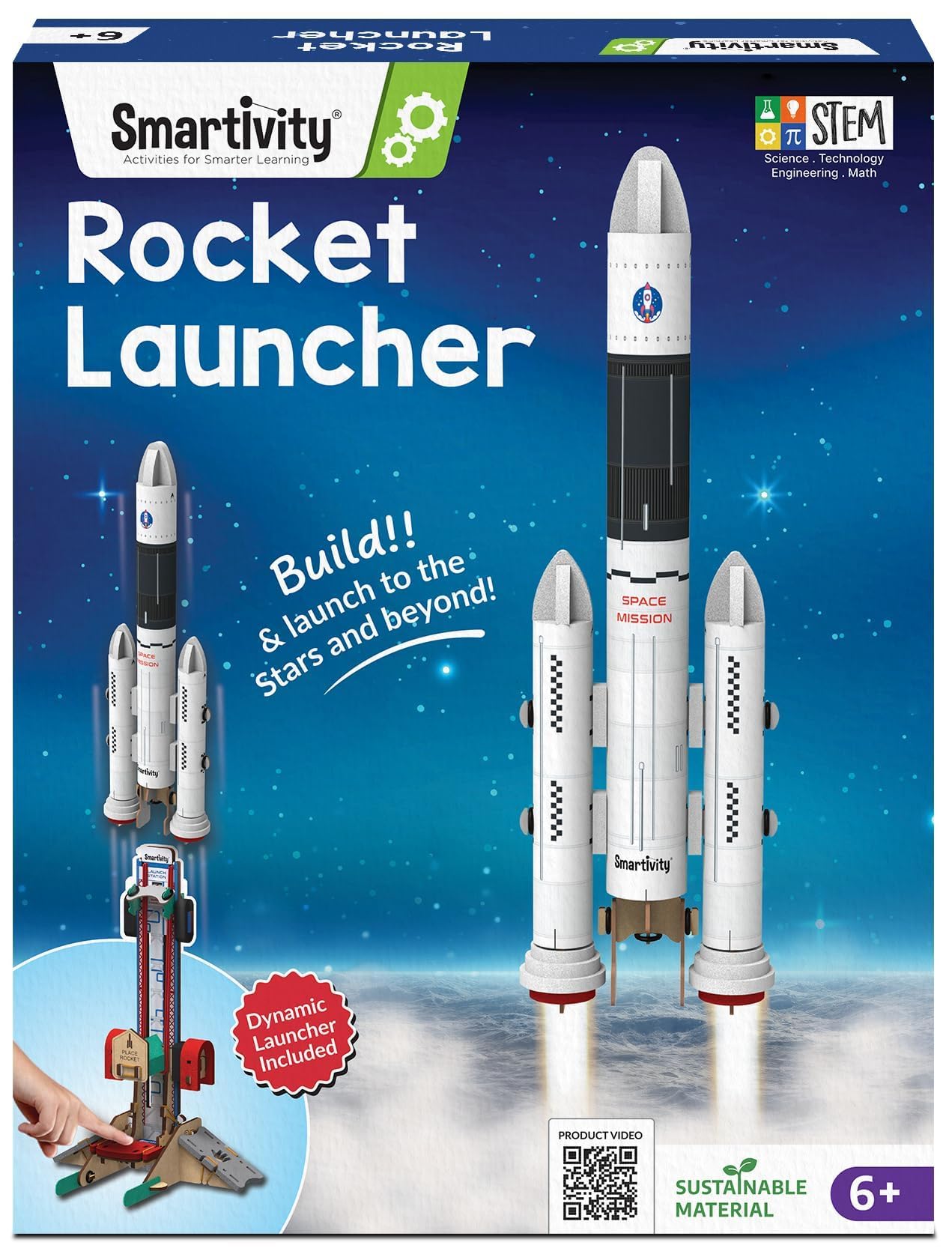
Build a real rocket, press the launch button, and watch it blast 10 feet—pure mechanical action, no batteries.
This kit delivers the most satisfying payoff-to-effort ratio on the list. Your child assembles a realistic rocket and launcher from precision-cut wooden parts, then presses the red button to launch the rocket up to 10 feet into the air. No batteries, no electricity—just pure mechanics. The 2025 Parents Choice Award winner teaches Newton’s Third Law of Motion through real launches.
The soft foam tip makes indoor launches safe, so your living room becomes mission control. Parents report a 7-year-old can build it with only light adult help—one sibling managed it with “quite a lot of fun” and minimal assistance. The instructions are consistently praised as some of the clearest in any assembly kit, and parts fit together smoothly yet tightly.
Fun is the top-mentioned aspect, with 14 owners calling it out, and the assembly earns mixed but mostly positive feedback. The rockets are relaunchable, so kids adjust angle and force to see how far they can go—every tweak is a mini physics lesson. The honest limit: the MDF build isn’t super durable for rough long-term handling, so it’s more of a “treasure it” toy than a “toss it around” one.
Why it rocks
- Launches 10 feet with pure mechanical power
- Safe to launch indoors with soft foam tip
- Clear, step-by-step instructions praised by owners
- Teaches real physics through repeat launches
The honest limits
- MDF parts aren’t built for rough handling
- Single build—no other configurations
- Assembly requires patience and care
Perfect for: the kid who loves space and the thrill of launching something they built with their own hands.
Not for: children who prefer instant gratification—this one requires a build session before the fun starts.
7. Qirptey STEM Building Toys

125 colorful pieces that build anything—from race cars to dinosaurs—with zero tools and zero screens.
This is the open-ended building set that keeps a 7-year-old’s imagination in the driver’s seat. The 125 pieces come in different colors and shapes, plus an idea booklet for models like race cars, robots, trucks, and dinosaurs. But the real value is the freedom: kids can ignore the booklet and build whatever they imagine, which is where creativity and problem-solving actually develop.
The pieces are non-toxic, odorless, and have rounded edges so you don’t worry about little hands. They snap together without tools, making it easy for younger siblings to join in. A sturdy toy box is included, which quietly teaches organization habits—a win for parents. It’s the kind of set owners describe as “endless opportunity for fun thru engineering,” with several families buying a second set because the first was so well-loved.
Quality is the huge winner here—71 owners single it out, the most of any aspect on this product—with enjoyment following at 40 mentions. It’s marketed for ages 3+, so a 7-year-old will find it accessible but still engaging. The trade-off is durability: feedback is mixed, with a few owners finding pieces that break easily under heavy use. It’s a “handle with reasonable care” toy, not an indestructible one.
The strengths
- 125 pieces for max open-ended creativity
- Tool-free assembly—great for independent play
- Storage box included for tidy cleanups
- Non-toxic with rounded edges for safety
Consider this
- Durability is mixed—some pieces break under rough play
- Idea booklet offers fewer guided builds than kits like Snap Circuits
- Younger-kid focus—may not challenge a precocious 7-year-old for long
Reach for it if: you want a toy that grows with your child’s imagination, not a scripted build.
Think twice if: your 7-year-old prefers structured challenges with clear end goals.
8. National Geographic Marble Run with Motorized Elevator

A motorized elevator that lifts marbles nearly 20 inches for endless, screen-free physics experiments.
This is the showstopper of the list. The motorized lift carries marbles up almost 20 inches and drops them onto your track, creating a perpetual motion machine that runs and runs. The 95-piece kit includes 61 construction pieces, 20 marbles, and a 14-piece spiral lift—everything you need to build mazes that teach gravity, momentum, and problem-solving.
It ships with a storage bag to keep all the pieces together, which is a thoughtful touch for a set this size. The included Learning Guide is packed with facts about physics and motion, so the learning is built into the play. Best of all, it’s compatible with other National Geographic marble runs, so you can expand it into a bigger maze as your child’s ambition grows. The motorized lift needs power, so keep that in mind.
Fun leads the reviews with 27 mentions, and age-appropriateness follows at 22—parents note 5-year-olds enjoy it while older kids dive into the engineering. A 9-year-old had something built within 15 minutes of opening the box. The honest concern is the motor: some buyers report it sounds strained and worry about longevity. Assembly also gets mixed feedback—the spiral elevator housing needs to be put together in numbered order, so pay attention to the tiny numbers.
What makes it great
- Motorized lift creates genuinely endless runs
- 95 pieces for massive, varied mazes
- Learning Guide teaches physics as you play
- Storage bag keeps pieces organized
Watch closely
- Motor longevity is an open question for some owners
- Spiral elevator assembly requires following numbered order
- Needs power for the lift—not a battery-free toy
Grab it for: a curious 7-year-old who loves building, experimenting, and watching cause-and-effect in action.
pass on it if: you want a quiet, low-maintenance toy—the motor and many pieces demand some setup care.
9. burgkidz STEM Road Build Puzzle

A teal logic board with 200+ challenges that teaches spatial reasoning through wind-up car races.
This one is pure logic training disguised as a race game. The large teal board comes with 14 track pieces, 2 start points, and 2 end points. The guidebook offers over 200 puzzles across 4 difficulty levels, so it scales from beginner to genuinely challenging. With 2 pull-back cars included, your 7-year-old builds a path, winds up the car, and watches it roll to the finish—if they solved the puzzle correctly.
It shines in three play modes: solo play, two-car relay, and two-player competitive racing. That makes it equally good for independent focus or family game night. The board’s studs work with major brick brands, so kids can build bridges and decorations to expand the track into a full playscape (bricks not included). A portable drawstring bag stores everything and makes it easy to take to playdates or on trips.
Gameplay is the runaway favorite here, with 44 owners praising how engaging it is, and educational value follows at 22 mentions. Parents report it develops problem-solving and critical thinking while keeping kids entertained for long stretches. The recurring friction: the track panels connect with thin plastic tabs that some found brittle, and a few 4-5 year olds figured out the early puzzles fast. It’s best suited to ages 4-8, with the higher levels keeping a 7-year-old genuinely challenged.
Why it works
- 200+ puzzles across 4 difficulty levels—real longevity
- Three play modes for solo or family fun
- Compatible with major brick brands for expansion
- Portable storage bag for travel
Fair warnings
- Track tabs are thin and can feel brittle
- Younger kids may breeze through early puzzles
- Bricks for expansion sold separately
Perfect for: the logic-loving 7-year-old who enjoys puzzles and racing cars in equal measure.
Not ideal if: you want a build-and-forget toy—the setup requires puzzle-solving every time.
Understanding the Specs
Projects vs. Pieces
Some toys advertise project counts (100+ projects), others piece counts (125 pieces), and they’re not the same thing. A high project count usually means guided, structured builds with clear outcomes—great for teaching following instructions. A high piece count with fewer guided projects means more open-ended creativity. For a 7-year-old, the ideal is a mix: enough guidance to build confidence, enough freedom to spark imagination.
Power Source and Replay Value
Toys run on batteries, rechargeable cells, pure mechanics, or wind-up power. Rechargeable toys save money long-term but add charging-hassle. Mechanical toys (like the rocket launcher) never need power but offer a single type of play. The key question is replay value: will your child return to this toy in a week, a month, a year? Look for adjustable difficulty levels or multiple configurations to boost that lifespan.
FAQ
What age is appropriate for Snap Circuits Jr. SC-100?
Are the robot toys suitable for a 7-year-old or too childish?
Do these STEM toys require batteries or electricity?
Which toy is best for a child struggling with math?
How long do these educational toys keep kids entertained?
Are building block STEM kits safe for younger siblings?
What’s the difference between Snap Circuits Jr. SC-100 and the Flight Deck?
Can the National Geographic marble run be expanded later?
Which toy is best for travel or car rides?
How do I choose between a building kit and a logic puzzle for a 7-year-old?
Final Thoughts: The Verdict
For most families, the educational toys for 7-year-olds winner is the Snap Circuits Jr. SC-100 because it delivers the most projects, the clearest learning payoff, and the longest play life from a single box. If you want a tech-forward pick that introduces programming logic through play, the Programmable Robot is a crowd-pleaser that earns top marks on quality. And for a screen-free dose of pure physics fun, the Smartivity Rocket Launcher turns building into an actual launch your 7-year-old will want to repeat all afternoon.
How We Picked
We do not accept paid placement. Every pick is matched to a real buyer and a real use-case; we do not hands-on test units.
Sources & Methodology
Specifications: manufacturer listings and product documentation. Review insights: verified customer reviews, as of August 2026. Pricing: not shown on this page (it changes often); check the current price via the retailer link.
As an Amazon Associate, WellFizz earns from qualifying purchases. This does not affect which products we feature.
Related Guides

Mo Maruf
I created WellFizz to bridge the gap between vague wellness advice and actionable solutions. My mission is simple: to decode the research and give you practical tools you can actually use.
Beyond the data, I am a passionate traveler. I believe that stepping away from the screen to explore new environments is essential for mental clarity and physical vitality.