Our readers keep the lights on and my smoothie glass nicely filled. As an Amazon Associate, I earn from qualifying purchases.
Specs are compiled from manufacturer listings and verified buyer reviews and can change over time — please confirm the key details on the product page before buying.
You want a game your child asks for by name, not one you have to beg them to open. The best educational games for kindergarten hide the lesson inside the fun, so screen time becomes family time and “I don’t want to do homework” becomes “Can we play one more round?”
I’m Mohammad Maruf — the founder and writer behind WellFizz. This guide is built by comparing the manufacturers’ published specifications and the patterns across verified customer reviews, so you get each pick’s real strengths and trade-offs instead of marketing spin.
Ready to find a game that actually gets played? These picks win on durability, replay value, and real skill-building. Here are the educational games for kindergarten that families and teachers keep coming back to.
Our Picks at a Glance


How To Choose The Best Educational Games For Kindergarten
Kindergarten is the bridge between playing and learning. The best games make that bridge invisible — kids think they’re playing, but they’re actually practicing skills they’ll use all year. Here’s what separates a game that gets played once from one that becomes a family favorite.
Look for adjustable difficulty
A game with only one skill level loses its magic fast. Your child will master it in a week, and then it sits on the shelf. The strongest picks offer multiple levels of play — think easy and challenge card decks, or skill levels that progress from Pre-Primer to Third Grade. This means the game stays relevant as your child’s skills grow, and older siblings can join in without getting bored.
Check what skill it actually builds
Some games teach new concepts, while others just review what’s already known. A great kindergarten game introduces a skill — like sounding out a CVC word or adding two numbers — and then gives your child repeated, fun practice with it. Look for games that name their educational objective clearly, whether that’s pattern recognition, addition and subtraction, or sight word mastery.
Consider the physical durability
Kindergarteners are not gentle. Cards get bent, pieces get thrown, and boards get stepped on. The games that last are made with thick, laminated cardstock, sturdy wooden blocks, or heavy-duty plastic pieces. If a game is flimsy, it won’t survive the enthusiasm of a five-year-old.
Quick Comparison
| Model | Best For | Core Skill | Players | Age Range | Amazon |
|---|---|---|---|---|---|
| Mathemagical World★ Best Overall | Math board game night | Addition & Subtraction | 2-4 | 5+ | Amazon |
| Walenty 250 Sight WordsBest Value | Writing & reading practice | Sight Words & Spelling | 1+ | 3+ | Amazon |
| Sight Word Stomp!Top Performer | Active gross-motor play | Sight Words | 2+ | 3-8 | Amazon |
| MORECOLL Workbook | Reusable handwriting practice | Letters, Numbers, Tracing | 1 | 3-7 | Amazon |
| Fenikso Matching Letter Game | Letter recognition & spelling | Spelling & Vocabulary | 2+ | 3-8 | Amazon |
| Gojmzo Wooden CVC Game | Hands-on phonics building | CVC Words & Phonics | 1+ | 3-7 | Amazon |
| Number Hunter | Quick math fact practice | Addition, Subtraction, Odd/Even | 2+ | 5-7 | Amazon |
| Coogam Matching Letter | Spelling and simple math combo | Spelling & Number Words | 1+ | 3-5 | Amazon |
| Numberblocks Race to Pattern Palace | Pattern recognition for TV fans | Patterns & Counting | 2-4 | 3-5 | Amazon |
In-Depth Reviews
1. Mathemagical World Math Board Game
Our pick — over 4.5★ from 950+ verified ratings; the strongest balance of quality and price.
Eight themed worlds turn addition and subtraction drills into a magical adventure kids request by name.
Its eight themed worlds make addition and subtraction practice feel like a new adventure every session. The board is packed with eight unique magic worlds — Desert Island, Dinosaur Island, Pirate Island, Zombie Island, Unicorn Island, Ice Island, Dragon Island, and Ninja Island — so each play session can feel like a brand-new journey. The board itself measures 14.57 x 9.65 x 1.5 inches, a substantial size that feels like a real event when you pull it out.
What makes it clever is the built-in flexibility. It includes two levels of difficulty and speed, plus it teaches the concepts of addition, subtraction, double and half. Homeschool parents have even adapted it for older kids by swapping in different dice — one family modified it for 8-year-old multiplication practice. It’s also marketed as OLSAT and COGAT prep for gifted and talented testing, so it pulls double duty as both a fun game and a test-readiness tool.
Buyers report it’s “an awesome game for kids and adults” that genuinely helps with addition and subtraction. The quality is consistently praised: a sturdy board, bright colors, a smooth surface, laminated rules, and a durable box. The only real caveat is the age balance — one test of ages 4-10 found the 4-year-old lost interest and the 10-year-old was bored, landing the ideal range around 5-7.
Why families love it
- Eight themed worlds keep replay value high
- Two difficulty levels grow with your child
- Sturdy, laminated board and box survive frequent play
- Teaches addition, subtraction, double, and half
Who should look elsewhere
- Best for ages 5-7; younger kids may lose focus
- Older kids above 8 may find the math too easy
- With 4 players, the game can drag a bit
Your best bet if: you want a math game that the whole family will actually enjoy playing together, not just the kindergartener.
Think twice if: your child is under 4 or over 8, since the challenge level is tuned for the kindergarten-to-early-elementary balance.
2. Walenty 250 Sight Words Flash Cards
A pocket-sized spelling and writing set that turns daily word practice into a reusable, mess-free routine.
For a budget-friendly price, this set packs 250 words, 5 levels, and 4 markers into one compact box. For a budget-friendly price, you get 250 sight words organized into 5 different learning levels, with each word paired with a sentence and a picture to lock in meaning. The cards measure 5.3 x 3.8 x 0.1 inches — compared to the Mathemagical board at 14.57 x 9.65 x 1.5 inches — making them perfectly sized for small hands to hold and manage independently.
What makes this set special is the writing component. It comes with 4 dry-erase markers, so kids can trace and write each word directly on the card, wipe it clean, and practice again. The cards are thick enough to resist bending, and the included 5 metal rings and drawstring bag keep everything organized and portable for car rides, restaurants, or airplane trips.
The educational value is the standout feature, with owners consistently praising how it teaches pre-k through 3rd grade kids. One pre-k parent says it’s a must-have for home study because the quality is so good. The erasable, reusable design means it’s not a one-and-done toy — it’s a learning tool that lasts through multiple grades and multiple children.
Smart buy for: parents who want a compact, portable, and reusable way to build reading and spelling skills without a big footprint or a big budget.
The only trade-off: flash cards aren’t a board game, so they work best as structured practice sessions rather than free-play entertainment.
3. Learning Resources Sight Word Stomp!
Dinosaurs that suction to cards turn sight word review into a full-body stomping adventure.
Its suction-cup stompers turn sight word review into a full-body, energy-burning activity. The set includes 4 colorful dinosaur stompers with suction cups that attach to word cards, so kids physically stomp, pick up, and read each word. It’s the rare reading toy that burns energy while building literacy — a win for parents of wiggly kids.
The educational range is genuinely impressive. It features 110 double-sided cards with 220 sight words, color-coded by difficulty level from Pre-Primer through Third Grade. That color-coding is a thoughtful touch — it lets you start your child on one level and progress them up as they gain confidence, and it makes differentiation easy in a classroom or homeschool setting with kids at different reading levels.
The quality holds up to enthusiasm. Owners note the sturdy rubber dinosaurs have strong suction cups, and the thick cardboard word discs stand up to repeated stomping. It’s earned a spot in Daily 5 centers, small groups, RTI instruction, and family game nights alike. As owners mention, it’s a “fun game for reviewing and learning sight words” that kids actively request.
What wins people over: the active, physical gameplay — kids are moving, stomping, and laughing while they internalize sight words without it feeling like drill work.
Who it’s not for: kids who prefer calm, seated activities; this game is built for movers and shakers.
4. MORECOLL Reusable Preschool Workbook
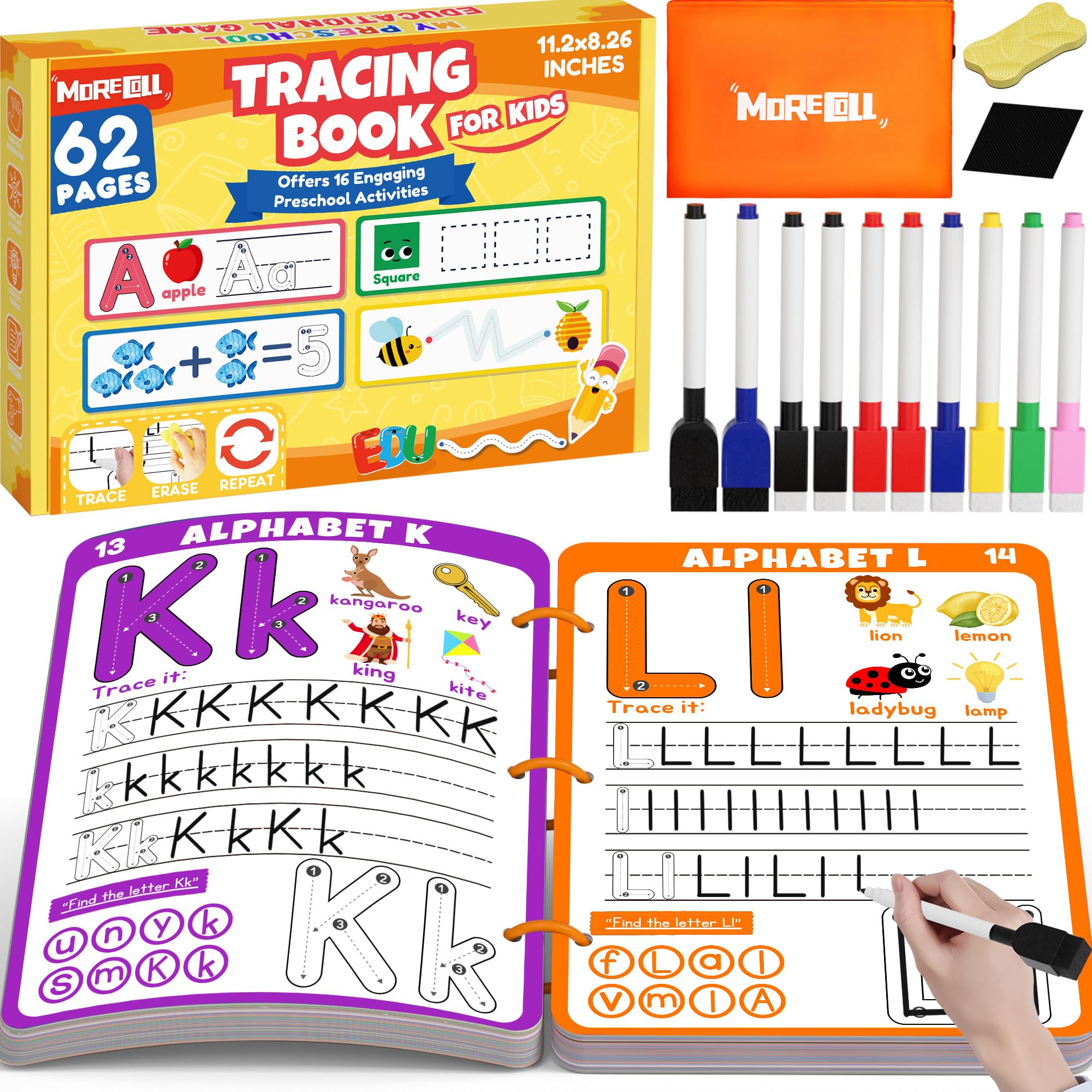
A wipe-clean workbook with 62 pages that replaces a stack of disposable worksheets with one reusable book.
Its 62 reusable pages cover 17 activity types, from tracing to simple math, in one wipe-clean book. The set includes 62 pages of activities, 10 dry-erase markers, 6 removable rings, a storage bag, a dry-erase cloth, and an eraser. The removable rings are a clever touch — you can sort pages, pull out just the ones you need, or let your child work through the book in any order.
Inside those 62 pages are 17 distinct activity types: traceable letters, number practice, name practice, weekly planner, alphabet tracing, shape tracing, body parts, pen control, simple addition and subtraction, shape coloring, color learning, family members, emotions, find how many, spot the difference, trains, and free drawing. The final page even gives tips on how to sit properly and hold a pen correctly — a detail that shows real thought about early handwriting development.
The materials are made for repeat use — waterproof, tear-resistant, and odorless pages with rounded, smooth edges. The dry-erase surface wipes clean easily, which is the feature parents rave about. One grandmother noted it kept her preschooler busy on a long car ride, doing most of the work independently. The quality is the single most-praised aspect, and it’s an ideal resource for children with autism or language delays who benefit from repeated, predictable practice.
Best for: parents who want a comprehensive, reusable handwriting and early-learning resource that grows with their child from ages 3-7.
Fair warning: this is a workbook, not a multiplayer game — it’s solo quiet-time learning rather than family game night entertainment.
5. Fenikso Matching Letter Game

A compact letter-matching tray that fits in a classroom cubby and delivers serious spelling practice.
Its straightforward matching tray and letter cubes deliver focused spelling practice in a compact 6.5-inch box. The set includes 1 tray, 8 letter cubes, and 30 cards that reveal 60 words (3 and 4-letter words). Kids look at the picture card, find the matching letters, and build the word in the tray. The design is straightforward enough that a 3-year-old can grasp it, but the challenge scales because you can hide the word with the card’s flap to make it harder.
It’s designed for 2 or more players, which makes it a natural parent-child activity. Playing together gives kids an understanding of how words work, and the picture card provides a visual clue about each word’s meaning. Beyond spelling, it builds memory skills, strategic thinking, sociability, and hand-eye coordination — all from a compact 6.5 x 6.1 x 1.6-inch box.
Its small footprint is a feature, not a flaw. Teachers specifically praise it as “a snap to store” in a classroom, and it works well as independent morning work. The game quality is the most-praised aspect, though some note the pieces are on the smaller side. It’s also note the choking hazard warning — this is not for children under 3 or anyone who still mouths objects.
Great pick for: classrooms, travel, or homes with limited storage that still want a genuinely effective spelling and letter-recognition tool.
Keep in mind: the pieces are small, so it’s not ideal for younger siblings who still explore things with their mouths.
6. Gojmzo Wooden CVC Word Spelling Game

Chunky wooden letters and self-checking cards make this the most satisfying hands-on phonics set here.
Its chunky wooden letters and self-checking cards make phonics practice a tactile, durable experience. It includes 50 double-sided phonics flash cards — a word on one side, a picture on the other — plus 53 wooden lowercase letter blocks and 5 wooden spelling boards, all in a sturdy storage box. The letter blocks are color-coded: 12 red vowels and 41 blue consonants, which subtly reinforces the vowel-consonant distinction every time your child plays.
The CVC (consonant-vowel-consonant) focus is exactly right for kindergarten readiness. These are the building-block words — cat, dog, sun — that children who know their letter sounds can sound out on their own. The picture side works as a self-check: build the word, flip the card, and see if the picture matches. This design lets kids practice independently without needing an adult to correct them.
Teachers have adopted this one for literacy centers because the wooden pieces hold up to daily classroom wear. The laminated flash cards are heavy-duty and thick enough not to bend, and the letter tiles are a decent size for toddler hands. One grandparent who bought it for a granddaughter reports it looks great in the classroom too. The most-praised aspects are the build quality and the educational value — it’s a multi-sensory toy that teaches reading, spelling, and phonics simultaneously.
The hands-on advantage
- Wooden blocks are sturdy and satisfying to handle
- Self-checking cards enable independent practice
- Color-coded vowels and consonants build phonics awareness
- Storage box keeps all pieces contained
Check before you buy
- Some sets arrive with missing letters — check contents early
- Letters q, y, and z are not included
Reach for this if: you want a durable, tactile phonics tool that kids can use independently and that will survive years of use.
Look elsewhere if: you prefer a competitive multiplayer game; this is best as a solo or guided learning activity.
7. Number Hunter Math Board Game
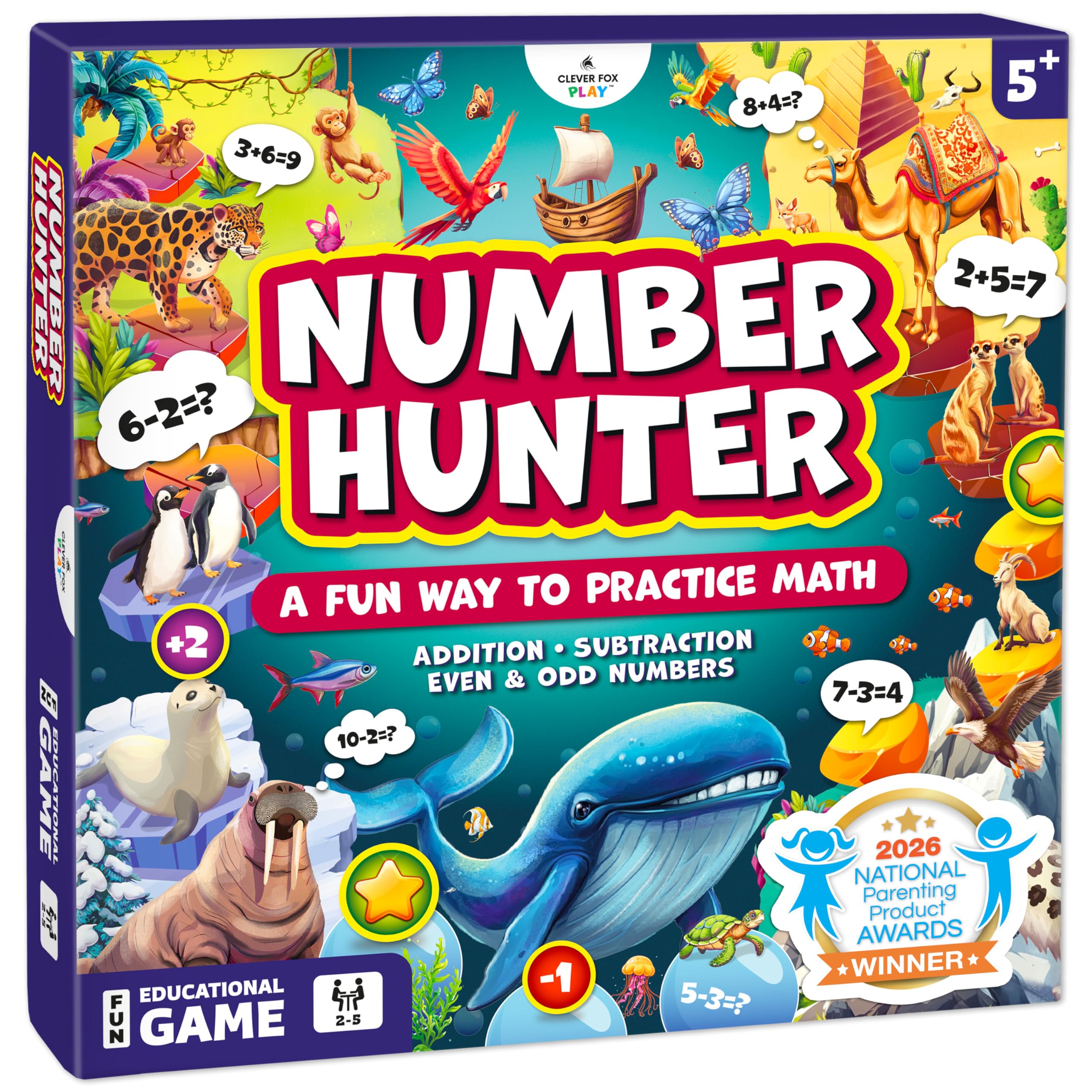
A fast-paced expedition game that drills math facts so smoothly kids don’t realize they’re practicing.
Number Hunter takes the classic roll-and-move board game formula and injects it with math at every turn. Players roll 2 number dice and 1 operation die, then add or subtract the numbers to figure out how many spaces to move. Land on a star tile and you draw a challenge card that demands a quick math fact or a fun physical action — one owner mentions kids jumping as part of the interactive fun.
It’s designed specifically for the 5-7 age range, which means the difficulty is tuned right where kindergarteners and first graders live. The game reinforces addition, subtraction, and even and odd numbers, all within a global expedition theme. There’s no reading required to play the core game, though an adult or older sibling may need to read the challenge cards aloud — a small trade-off for younger players.
The educational value is the aspect owners mention most, and the quality of the physical pieces earns strong praise too. It comes with a game board, 5 game pieces, 2 number dice, 1 operation die, 50 challenge cards, and game rules, all weighing in at 1.4 pounds. One 6-year-old reportedly wants to play it daily, and a parent of an 8-year-old on the autism spectrum found the counting pieces engaging. It’s a quick, no-prep game that fits well into family game night or homeschool math time.
Why it earns its spot: the three-dice mechanic makes every single turn a mini math problem, so kids get dozens of repetitions in a single session without complaint.
Who might skip it: kids under 5 who haven’t grasped basic counting yet, since the gameplay assumes some number fluency.
8. Coogam Matching Letter Game

One compact set that covers both spelling and early math, with a flap that lets kids self-check their work.
Its 52 activity cards cover both spelling and early math, making it a rare all-in-one learning set. The value pack includes 52 activity cards with both mathematical practices and spelling games, 11 letter dice, 20 number tiles with 3 mathematical symbols, 1 letter tray, and a drawstring bag. That means one box handles both letter-sound work and simple number equations — a rare combination that makes it a strong all-in-one for homeschool mama or classroom use.
The standout design feature is the holding frame’s flap. You can open it to show the word or close it to hide it, giving kids the freedom to attempt spelling independently and then check their own work. This self-confidence booster is exactly what emerging readers need — the chance to try, fail, and self-correct without an adult hovering. The cards include 3-letter CVC words that preschoolers can sound out on their own, building letter sounds, sight words, and vocabulary.
Building words with the letter dice is also fine-motor practice, which is a bonus for kindergarten readiness. The educational value is the most-praised aspect, with one parent noting their child went from knowing zero words to reading every word by month three of nightly play. It’s also marketed as helpful for kids with short attention spans, autism, or speech delays. The only minor gripe is the drawstring storage bag material — it does the job, but isn’t the most premium-feeling component.
Smart choice for: families who want one box that covers both reading and math, with a self-checking feature that builds independent learning.
The catch: the storage bag is basic — you may want your own container for long-term organization.
9. Numberblocks Race to Pattern Palace

For Numberblocks superfans, this officially licensed board game makes pattern recognition feel like a TV episode come to life.
If your child is obsessed with the global hit TV show Numberblocks, this game is an instant win before you even open the box. It’s officially licensed, which means the characters look exactly like they do on screen — a detail that matters enormously to young fans. The game board is inspired by the “Pattern Palace” episode, so kids move Numberblocks One through Four over bridges, through twists, and around turns to be the first to reach Pattern Palace.
The learning focus is pattern recognition, creation, and color recognition, with counting woven in. Kids use colored bridge tiles to create the patterns shown on their pattern cards. The set includes 40 pattern cards across two levels — 20 for beginners and 20 for a challenge deck — so it genuinely grows with your child. There’s also a dice popper, which adds a satisfying tactile element that kids love.
Its easy-to-learn rules and dice popper keep kids engaged for hours, as customers note. Owners note it’s easy for children to learn, keeps them entertained for hours, and is perfect for family game nights. The quality of the board and chunky pieces is consistently praised, and it’s sturdy enough for the 2-4 player age range it targets. One 4-year-old reportedly asks to play it every single day. The educational value and gameplay are the two most-praised aspects, though the rules can feel slightly complex for the very youngest players — an adult read-through helps on the first go.
Why kids love it
- Officially licensed Numberblocks characters
- Two levels of pattern cards for progression
- Dice popper adds a fun tactile element
- Teaches patterns, colors, and counting together
Consider this
- Rules take a moment to learn on first play
- Best for kids who know and love Numberblocks
Perfect for: the Numberblocks superfan in your house who will be thrilled to find their favorite characters in board game form.
Not the right fit if: your child isn’t familiar with the show — the magic is partly in seeing beloved characters come to life.
Understanding the Specs
Skill progression and difficulty levels
The best kindergarten games don’t assume a flat skill level. Look for games with multiple tiers — whether that’s color-coded word levels from Pre-Primer through Third Grade, or separate beginner and challenge card decks. This means the game can grow with your child over multiple years, and it allows siblings of different ages to play together fairly.
Physical durability and materials
Kindergarteners are rough on toys. Thick, laminated cardstock resists bending and survives spills. Wooden blocks stand up to daily use better than thin plastic. Games that include storage solutions — boxes, bags, rings — keep pieces from getting lost, which is often what actually kills a game’s lifespan. Check the materials list and prioritize games built for enthusiastic play.
FAQ
What skills should educational games for kindergarten focus on?
How do I know if a game is age-appropriate for my kindergartener?
Are reusable wipe-clean games worth the extra cost?
Can these games work for a child who is not yet reading?
What’s the difference between a “sight word” and a “phonics” game?
How long do these games keep a child’s attention?
Are these games suitable for classroom use?
How do I choose between a board game and flash cards?
Are there choking hazards I should be aware of?
Which game offers the most replay value over multiple years?
Final Thoughts: The Verdict
For most families, the educational games for kindergarten winner is the Mathemagical World game because it makes math practice genuinely fun with 8 themed worlds and 2 difficulty levels that grow with your child. If you want to build reading and spelling skills, grab the Walenty 250 Sight Words set for its reusable, write-and-wipe design. And for a child who needs to move while learning, the Sight Word Stomp! game turns reading practice into a whole-body adventure. These three cover the full spectrum — math, literacy, and active play — so you can pick based on your child’s biggest need and play style.
How We Picked
We do not accept paid placement. Every pick is matched to a real buyer and a real use-case; we do not hands-on test units.
Sources & Methodology
Specifications: manufacturer listings and product documentation. Review insights: verified customer reviews, as of August 2026. Pricing: not shown on this page (it changes often); check the current price via the retailer link.
As an Amazon Associate, WellFizz earns from qualifying purchases. This does not affect which products we feature.
Related Guides

Mo Maruf
I created WellFizz to bridge the gap between vague wellness advice and actionable solutions. My mission is simple: to decode the research and give you practical tools you can actually use.
Beyond the data, I am a passionate traveler. I believe that stepping away from the screen to explore new environments is essential for mental clarity and physical vitality.