Our readers keep the lights on and my smoothie glass nicely filled. As an Amazon Associate, I earn from qualifying purchases.
Specs are compiled from manufacturer listings and verified buyer reviews and can change over time — please confirm the key details on the product page before buying.
The ideal educational game for a six-year-old sneaks in reading or math practice without feeling like homework. The best picks ditch the worksheet feel entirely. They turn letter sounds and number facts into fast, hands-on fun kids choose on their own. This guide cuts through the clutter to spotlight nine standout games that earn their keep at home, in the classroom, and during family game night.
I’m Mohammad Maruf — the founder and writer behind WellFizz. This guide is built by comparing the manufacturers’ published specifications and the patterns across verified customer reviews, so you get each pick’s real strengths and trade-offs instead of marketing spin.
Each game below has been vetted for its ability to hold a six-year-old’s attention while building a concrete skill. This is the only list of educational games for 6 year olds you need to make a confident choice.
Our Picks at a Glance


How To Choose The Best Educational Games For 6 Year Olds
At age six, kids are typically in kindergarten or first grade. They are right at the cusp of reading fluency and basic math. The ideal game meets them at their current skill level and stretches them just a little further without causing frustration. The key is matching the game’s core mechanic to a child’s natural curiosity.
Match the Skill to the Child’s Need
A six-year-old might be working on phonics (the sounds that letters make) and sight words (common words memorized by sight, like “the” and “and”). Or they might be working on addition and subtraction, or starting to grasp logical sequences. Games that focus on one skill, like the sight-word swatting game, are incredibly effective for targeted practice. Others build broader cognitive muscles — think pattern matching, set collection, or spatial reasoning (understanding how objects fit together in space). These develop problem-solving skills that apply across subjects.
Prioritize Replay Value and Engagement
The best educational game is the one your child asks to play again. Look for designs with multiple difficulty levels, varied play modes, or a library of challenges (200+ challenges is a good sign for logic games). A game with a short, focused round — 15 to 30 minutes — respects a six-year-old’s attention span and leaves them wanting more. The physical setup matters too: smooth wooden tiles, laminated cards, and sturdy game boards mean the toy survives drops and spills.
Consider the Play Context: Solo, Sibling, or Classroom
Games that accommodate one to four players are versatile. A solo-friendly game lets a child practice independently. A 2-4 player game turns learning into a family or classroom event. The social element of taking turns, challenging a sibling, or celebrating a win can be a powerful motivator at this age. Also, think about portability: compact, battery-powered options are great for car trips and waiting rooms, while larger board games are a better fit for a dedicated game night.
Quick Comparison
| Model | Best For | Core Skill | Players | Key Component | Amazon |
|---|---|---|---|---|---|
| Learning Resources Sight Word Swat★ Best Overall | Reading Speed | Sight Words | 1-4 | 110 double-sided flies, 4 swatters | Amazon |
| Mathemagical WorldBest Math Adventure | Math Adventure | Addition & Subtraction | 2-4 | Eight unique magic world boards | Amazon |
| Cascadia JuniorBest Family Strategy Game | Pattern Matching | Spatial Logic | 2-4 | Habitat tiles, animal tokens | Amazon |
| Wooden CVC Word Spelling Games | Phonics & Spelling | Phonics (CVC) | 1 | 50 cards, 53 wooden letter blocks | Amazon |
| BenBen Spelling Games | Vocabulary Building | Spelling | 1-4 | 224 flashcards, 208 wood letter tiles, 2 dice | Amazon |
| Number Hunter Math Board Game | Math Skills & Movement | Addition, Subtraction, Odd/Even | 2-4 | Game board, 5 pieces, 50 challenge cards | Amazon |
| Educational Insights Math Whiz | Portable Math Practice | All Four Math Operations | 1 | Handheld LCD game, 8 difficulty levels | Amazon |
| Educational Insights Sight Word Slam | Screen-Free Word Practice | Sight Words | 1 | Handheld game, 185+ sight words | Amazon |
| Logical Road Builder Games | Critical Thinking | Logic & Spatial Awareness | 1-2 | 206 challenges, 2 PK cars, 1 base board | Amazon |
In‑Depth Reviews
1. Learning Resources Sight Word Swat A Sight Words Game
Our pick — over 4.5★ from 10,000+ verified ratings; the strongest balance of quality and price.
The game that turns reading practice into a buzzer-beating, swatting frenzy kids beg to play.
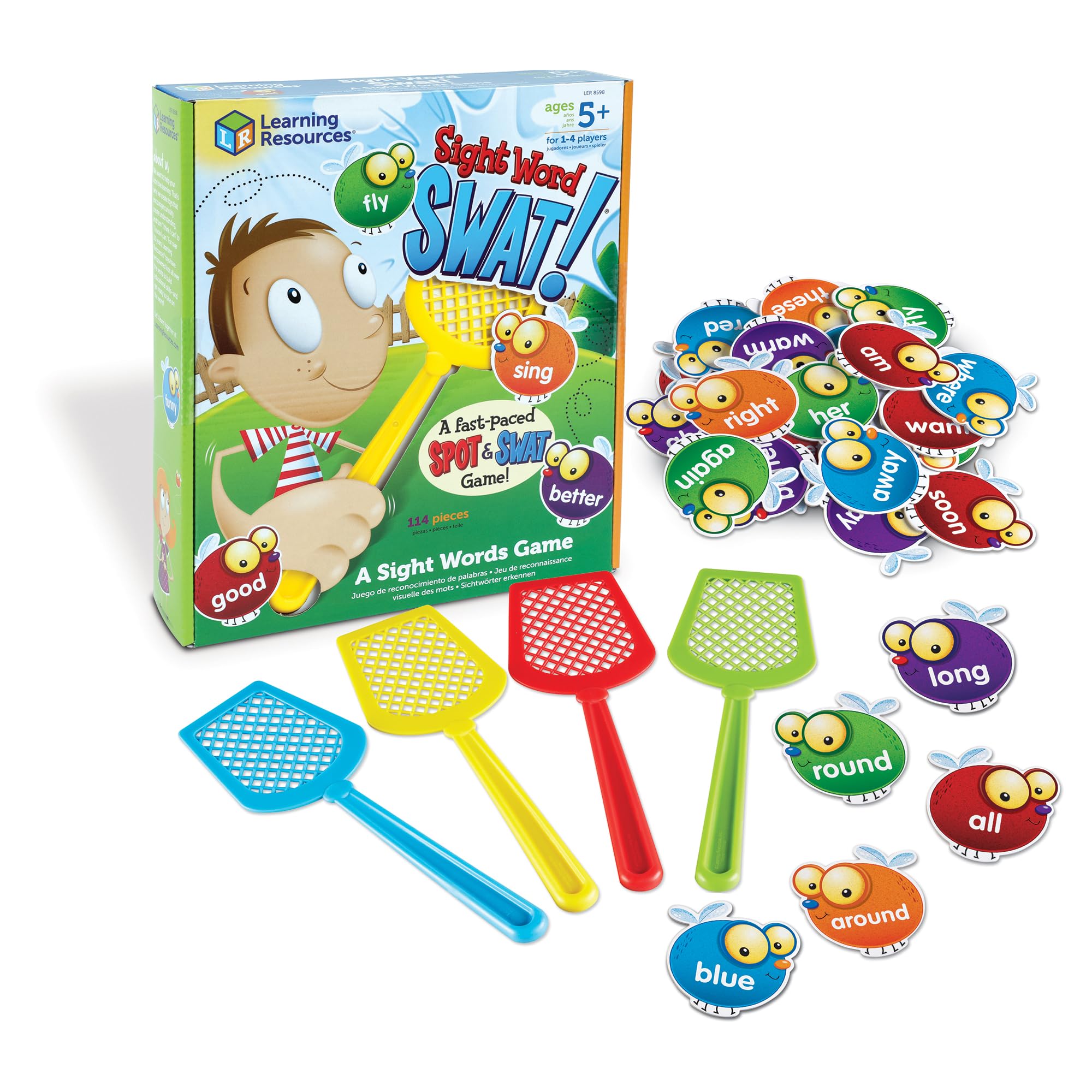
This is the crowd favorite for a reason. The premise is brilliantly simple: a sight word is called out, and the first player to swat the correct fly with their plastic swatter keeps it. It builds reading, spelling, and vocabulary skills through playful competition for up to four players at a time. The 110 double-sided flies are color-coded by grade level (Blue for Pre-Primer, Red for Primer, Green for First Grade, Orange for Second Grade, Purple for Third Grade), covering the top 220 Dolch sight words — the ones found most frequently in children’s books.
Buyers rave about the gameplay itself — it is the most-discussed aspect by a wide margin. The element of speed promotes confidence and reading fluency almost by accident, as kids race to be the first to recognize and swat the word. Owners consistently note that the pieces are thick and sturdy, built to withstand enthusiastic play. A quick 15-minute round can see a child scoring several words. The simple directions offer multiple play options, making it a favorite for both homeschool and classroom settings. The swatters have held up well through countless games, proving this is a toy built for the long haul. A few owners do note that cards may split over time, and the set includes only four swatters, which limits the player count.
Fun swatting action: 4.8 stars across more than 10,000 owners is an exceptional signal. The educational value ranks as the second most-praised aspect, proving this game genuinely teaches. Kids aged 4-6 reportedly score 36-37 words each, showing the game’s effectiveness in a single sitting. It is an ideal gift for holidays, birthdays, or any homeschool classroom must-have.
Fast sight words you want a high-energy, multiplayer game that turns sight word memorization into a competitive sport your child will choose over screen time.
Limited replay you are looking for a quiet solo activity or a game that teaches more than just sight words — this one is laser-focused on one skill.
2. Mathemagical World – Addition & Subtraction Math Board Game for Kids
A board game so clever it makes a 7-year-old request math practice as a reward.
Mathemagical World wraps addition and subtraction, along with the concepts of double and half, into a Candyland-style adventure across eight unique worlds: Dinosaur Island, Pirate Island, Unicorn Island, and more. The game includes two levels of difficulty and speed, so it grows with your child from kindergarten through second grade. The bright colors, laminated board, and sturdy box make it a joy to pull out for family game night.
What wins people over is that it feels like a pure adventure game, not a math lesson. The educational value is the second most-praised aspect. Many buyers report their children’s math skills improving dramatically in a short time. The game is also designed with Gifted and Talented test prep (OLSAT and COGAT) in mind, adding a layer of strategic thinking. One reviewer notes a 4-year-old “dominated” the game, making it his favorite, while a 7-year-old math and magic fan plays it twice daily as a homeschool reward. The sturdy components and quick gameplay are frequently praised. Some buyers do note that the game can lose appeal for a 10-year-old. With four players, the math might feel too easy for a 5.5 to 7-year-old, making the “balance” closer to ages 4.5 to 5.5.
Magical math practice: This is the most purely fun math game on the list, with a theme that captivates young imaginations. It is a fantastic tool for homeschool or family game night for the kindergarten to first-grade crowd.
Addition focus a child who loves imaginative themes (dinosaurs, pirates, unicorns) and needs to build confidence with basic arithmetic in a low-pressure, screen-free setting.
Small pieces your child is older than seven or already comfortable with multi-digit math; they might find the problems too easy.
3. Cascadia Junior, Board Game for Kids
A gorgeously simple puzzle that teaches pattern matching while parents genuinely enjoy playing it too.
Cascadia Junior is a standalone, junior version of the award-winning Cascadia game, designed for ages six and up. It plays in just 15 to 30 minutes and focuses on the core spatial puzzle of the original: players draft habitat tiles and animal tokens (bears, hawks, elk, salmon, and foxes) to build the most harmonious landscape. The game mechanics teach pattern building, set collection, and basic addition in a way that feels more like a relaxing art project than a competitive game.
Owners consistently use the word “exceptional” when describing the family appeal. Unlike the fast-paced Sight Word Swat, this game is a calm, strategic puzzle. The game is a total hit with kids aged four to eight, and adults report they would play it with a group of adults. It teaches pattern recognition and strategic decision-making without pressure. The “luxury cardboard” pieces are high quality, and the bright, colorful tiles are a joy to handle. It is a low-stress game where you can participate on a very basic level and still have fun, making it perfect for mixed-age family play.
Nature-themed strategy: This is the most elegant game on the list for building spatial reasoning and attention to detail. The Advanced Mode ensures it remains a challenge as the child grows.
Family friendly a family with a wide age range (4 to adult) who wants a screen-free, calming game that feels more like a satisfying puzzle than a frantic race. It is a true “buy once, play for years” game.
4. Logical Road Builder Games, STEM Family Board Game

A wind-up car and 206 path-building puzzles that quietly teach the fundamentals of logic and engineering.
This is a pure STEM (science, technology, engineering, math) puzzle. The goal is to build a continuous route on the base board using different track pieces, then wind up the car and watch it deliver a marble ball to the finish line. The game is Montessori-style, fostering logical reasoning, problem-solving, spatial awareness, and an understanding of cause and effect. With over 200 challenges and two PK cars, it offers an enormous amount of replay value that scales with difficulty as the child gets older.
The gameplay is the most praised aspect. Many owners call it one of the best toys they have bought recently. A three-year-old needs adult help to set up, but a four-year-old can assemble it independently. The large, colorful pieces are easy for small hands to handle, and the clear instructions make setup straightforward. Because it uses a wind-up mechanism, it requires no batteries. It is a fantastic tool for keeping kids away from electronic gadgets for long periods. The assembly experience is a mixed point — some find the plastic tabs thin and potentially brittle, and the track can misalign on soft surfaces like carpet, causing the cars to get stuck.
Builds logical paths: For a six-year-old who loves building, designing, and figuring out “how things work,” this is a goldmine. It is a solo-friendly logic puzzle that doubles as a fun parent-child bonding activity.
STEM learning a logical, visual-spatial learner who enjoys puzzles, building, and a challenge that requires patience and problem-solving.
Frustrating puzzles a child who prefers fast-paced action games or easily gets frustrated by trial-and-error puzzles; this one requires a calm, focused approach.
5. Number Hunter Math Board Game for Kids 5-7
Math equations get an action boost with challenge cards that make kids hop, balance, and think.
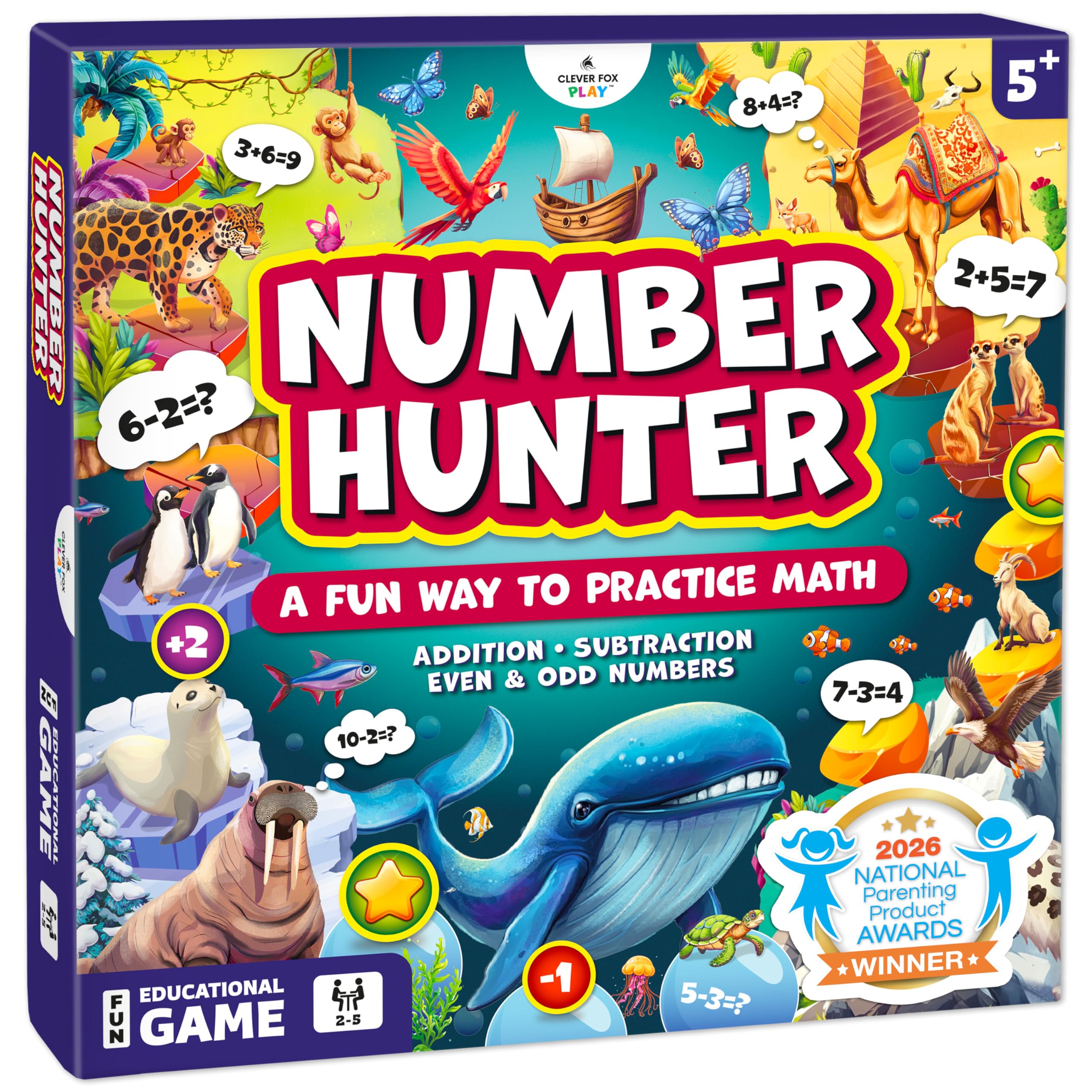
Number Hunter turns a simple dice-rolling race around the world into an interactive math lesson. Players roll the dice, add or subtract the numbers, and move forward. Land on a star tile, and you draw a challenge card that requires a fun physical action or an extra math problem. This combination of mental and physical activity is a perfect fit for the 5 to 7 age group, where kids have energy to burn. The game targets addition, subtraction, and even and odd numbers, building foundational STEM skills.
The set includes a game board, five game pieces, two number dice, one operation die, 50 challenge cards, and game rules. Owners consistently praise its high quality and durability. The game requires no prep and is fast-paced, making it a favorite for homeschooling and family game night. The challenge cards — featuring actions like hopping or balancing on one leg — are a standout feature that keeps kids engaged. Owners mention a six-year-old can improve math facts quickly with daily play. The main trade-off is that an adult is needed to read the challenge cards for a 5-6 year old, as the reading level on the cards is a bit higher than the math level.
Number hunting fun: This is the best choice for a wiggly six-year-old who needs to move. It turns math practice from a desk activity into a living room adventure.
Math engagement your child is a kinesthetic learner (someone who learns best by moving and doing) who struggles to sit still with flashcards and would rather solve a problem to win a chance to hop on one foot.
6. Educational Insights Math Whiz – Electronic Math Games

A handheld, screen-free tutor that builds math fact fluency from basic addition all the way to division.
The Math Whiz is a classic for a reason. It is a compact, portable electronic game that practices addition, subtraction, multiplication, and division. It offers three different games: a Drill mode that presents a progressively harder sequence of problems, a Challenge mode that plays like a numbers elimination game, and a standard Calculator mode. With eight difficulty levels per skill in Drill mode, it can serve a child from first grade through fourth grade. The LCD (Liquid Crystal Display) screen is clear, and the three modes of operation keep the gameplay from getting stale.
Parents and teachers lean on this for building math speed and accuracy. The educational value is the most praised aspect, followed closely by how much kids genuinely enjoy using it. It is a truly screen-free device that holds a child’s attention in the car, at a restaurant, or during quiet time. An owner noted it helped a 2nd grader with addition and subtraction and a 4th grader with multiplication, all from the same device. The main concern from the broader owner community is a small but notable rate of devices not working properly from the start or failing over time.
Electronic quiz mode
- Eight difficulty levels ensure years of use, adapting to a child’s progress from single-digit facts to multiplication tables.
- Compact and battery-operated (2 AAA, not included), it is a perfect travel companion for road trips and restaurant waits.
- The game-like feel and immediate feedback loops keep practice feeling like a challenge, not a chore.
Battery dependent
- Quality control is a minor concern — a few units arrive with functional issues, so buy from a seller with a good return policy.
- It is a solo activity by design, so it won’t replace the social fun of a multiplayer board game.
Best for… a child who loves to master facts and needs a portable, quiet option for independent math practice, especially for car rides or waiting rooms.
Instant feedback: if your child prefers tactile or social learning, a board game or card game will be a better fit than this handheld device.
7. Educational Insights Sight Word Slam – Kindergarten Learning Activities

An electronic “slam” button that makes mastering over 185 sight words feel like an arcade game.
Sight Word Slam is a digital twist on sight word practice. The device speaks a sight word, and the child must slam the correct button. It offers two game modes: Word Slam, where you find the word that matches what you hear, and Letter Slam, where you identify the missing letter in a word. The set includes four LCD windows and three pressable buttons, creating an interactive experience that feels more like a fast-paced quiz show than a learning tool. It requires 3 AAA batteries (not included).
The top praise is split evenly between its educational value and how much fun kids find it. One buyer reports that a 5-year-old nephew took it in the car to keep busy, finding it very durable through drops. The concept of reinforcing letter sounds and word recognition through a physical “slam” action is a hit with kinesthetic learners. However, the owner community is more mixed than on other picks. The main drawbacks are a computer-generated voice that mispronounces some sight words, and rounds that are only about 10 words long — too short for deeper practice. The limited word set (two levels) is best for pre-K to early first grade, becoming too easy for mid or late first graders.
Slam word recognition
- Portable and durable — one family reported it survived many drops without damage.
- The physical slam action is highly engaging for kids who dislike traditional flashcards or writing practice.
Flashy lights
- The voice quality and pronunciation issues can be confusing for a child just learning to read.
- Limited challenge ceiling — it is perfect for Pre-K and early kindergarten but won’t grow with a strong first-grade reader.
Active learning a reluctant early reader who needs a fun, portable way to build confidence with the most basic sight words through repetition and physical play.
Distracting sounds a child who is already reading full sentences or needs a deeper vocabulary challenge — they will outgrow it quickly.
8. BenBen Spelling Games, 224 Flashcards
A massive vocabulary kit with 224 cards and 208 wood tiles that scales from early phonics to advanced spelling.
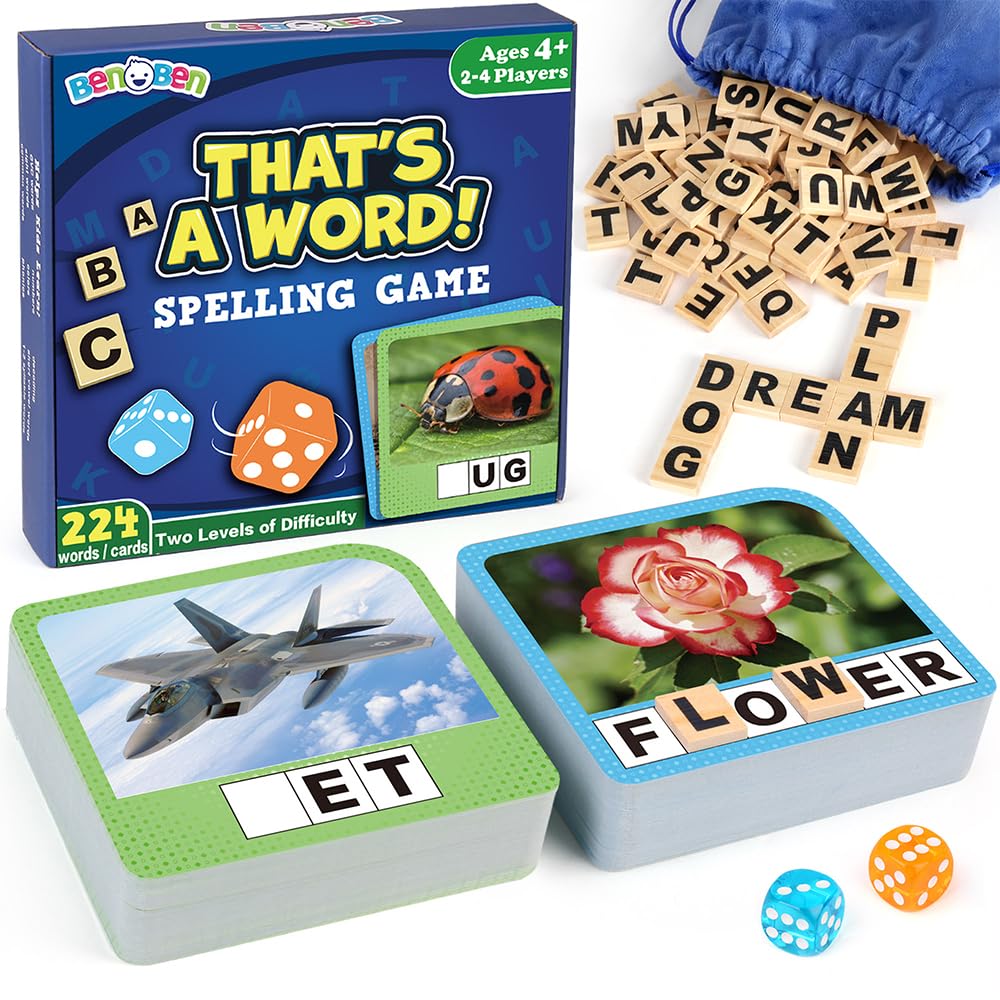
BenBen has packed an enormous amount of value into this set. It includes 224 double-sided phonic flash cards, 208 wood letter tiles (8 complete A–Z sets), 2 dice, and a velvet draw-string storage bag. The game offers four levels of play. Level 1 cards subtly show a missing letter to guide beginners, while the hard side of Level 2 cards hides the missing letter for a true spelling challenge. This built-in progression makes it a fantastic tool for both kindergarteners just starting and second graders looking to build vocabulary.
The game accommodates one to four players, and the manual includes directions for multiple play modes — sound out words, fill in the missing letter, or play a crossword game with the tiles. A reviewer mentions a 5-year-old who loves the game, with the caveat that before playing, children should be able to identify most letters. The high quality of the wooden tiles and the durable, laminated cardstock (each card is 4.7 x 4.35 inches with rounded corners) exceeds expectations. The set is also noted as being autism-friendly, easily adaptable for EL (English Learner), ABA (Applied Behavior Analysis), speech, or occupational therapy.
224 flashcard variety: For pure breadth of vocabulary practice in one box, nothing else on this list comes close. The 224 cards and 208 tiles create an almost endless number of combinations and games.
Vocabulary builder a child who is already comfortable with their letter sounds and ready to build a sturdy reading and spelling vocabulary. The multiple play modes prevent boredom and let you customize the challenge.
Storage needed a complete beginner who hasn’t yet mastered the alphabet — they will need to identify most letters before the game clicks.
9. Wooden CVC Word Spelling Games, Montessori Educational Learning Toys

A hands-on, wooden phonics kit that makes the “consonant-vowel-consonant” reading breakthrough feel like a puzzle.
This set is laser-focused on CVC words: consonant-vowel-consonant words like “cat” and “dog” that form the bedrock of early reading. It includes 50 double-sided phonics flash cards (one side shows the word, the other the picture), 53 wooden lowercase letter blocks (12 red vowels, 41 blue consonants, with Q, Y, and Z intentionally excluded as they are not used in the card words), 5 wooden spelling boards, and a sturdy storage box. The design is pure Montessori: self-checking, tactile, and visually clear.
The quality is the most-praised aspect. The laminated flashcards are heavy duty and thick enough that they will not bend. The wooden letter blocks are a decent size for small toddler hands and feel great. One reviewer reports a 4-year-old was having so much fun reading with this set, sounding out words from the card and spelling them with the blocks. The self-checking nature of the cards (picture on one side, word on the other) builds independent learning confidence. The main point of discussion is varied opinions on letter accuracy — some sets have been reported to have missing letters.
Wooden letter tiles: This is an essential tool for any child working on their very first three-letter words. The use of red vowels and blue consonants is a brilliant visual cue that helps cement the vowel concept early.
Spelling practice a preschooler or kindergartener who knows their letter sounds and is ready to start blending them into their first words. It is a gentle, confidence-building introduction to reading and spelling.
Understanding the Specs
Sight Word & Vocabulary Games
These games target high-frequency words — words like “the,” “and,” and “was” that appear most often in children’s books. Mastering them by sight is a shortcut to reading fluency, because a child no longer has to stop and sound out every single word. A game with a wider range of words — like 220 Dolch words — offers more depth. Look for a system with multiple difficulty levels, like color-coded cards, so the game grows with the child’s reading ability without them feeling like they have “finished” the game.
Math & Logic Games
These games build number sense and problem-solving muscles through different mechanics. Board games with dice and challenge cards make abstract concepts like addition, subtraction, and odd/even numbers into concrete, physical actions. Logic puzzles, meanwhile, require a child to plan, test, and adjust their route or pattern, fostering spatial awareness and critical thinking. A game with a very high number of challenges (200+) offers tremendous replay value, as each puzzle is a new problem to solve.
FAQ
What is the best type of educational game for a six-year-old who is just starting to read?
How many players does a typical educational game for six-year-olds support?
Can these games help a child with ADHD or autism?
What is a CVC word and why is it important?
What if my child finds the game too easy or too hard?
Are electronic games better than board games for learning?
How long does a typical round of an educational game last for a six-year-old?
Is it better to get a game that covers multiple subjects or just one?
Final Thoughts: The Verdict
For most people, the educational games for 6 year olds winner is the Learning Resources Sight Word Swat because it brilliantly combines a competitive, physically active game with the direct, measurable skill of sight word recognition. It holds the highest praise from the largest owner base for a reason: it works. If you want a math adventure that feels like pure magic, grab the Mathemagical World. And for elegant family strategy that parents will also love, the Cascadia Junior is the one to reach for.
How We Picked
We do not accept paid placement. Every pick is matched to a real buyer and a real use-case; we do not hands-on test units.
Sources & Methodology
Specifications: manufacturer listings and product documentation. Review insights: verified customer reviews, as of July 2026. Pricing: not shown on this page (it changes often); check the current price via the retailer link.
As an Amazon Associate, WellFizz earns from qualifying purchases. This does not affect which products we feature.
Related Guides

Mo Maruf
I created WellFizz to bridge the gap between vague wellness advice and actionable solutions. My mission is simple: to decode the research and give you practical tools you can actually use.
Beyond the data, I am a passionate traveler. I believe that stepping away from the screen to explore new environments is essential for mental clarity and physical vitality.