Our readers keep the lights on and my smoothie glass nicely filled. As an Amazon Associate, I earn from qualifying purchases.
Specs are compiled from manufacturer listings and verified buyer reviews and can change over time — please confirm the key details on the product page before buying.
The best educational games for 2 year olds don’t feel like schoolwork — they feel like hide-and-seek, pretend cooking, and noisy animal puppets. At this age, learning happens through touch, sound, and the thrill of discovery. You want something that holds a short attention span without needing a screen, building real skills like counting, color matching, and fine motor control through pure play.
I’m Mohammad Maruf — the founder and writer behind WellFizz. This guide is built by comparing the manufacturers’ published specifications and the patterns across verified customer reviews, so you get each pick’s real strengths and trade-offs instead of marketing spin.
Whether you are looking for a birthday gift, a quiet-time activity, or a way to introduce numbers and letters, these are the educational games for 2 year olds that actually survive sticky hands and short attention spans.
Our Picks at a Glance


How To Choose The Best Educational Games For 2 Year Olds
A two-year-old learns with their hands and their whole body. A toy that just sits there won’t cut it. You want something that invites touch, makes a noise when you press a button, or moves when you stack it. The best picks do more than one thing — they teach a color while also teaching a word, or they build a tower while also hiding a bear. Look for sturdy construction that can survive being dropped and chewed on. At this stage, safety matters more than complexity. Cards should be thick, edges should be rounded, and pieces should be too big to swallow.
The Skills That Matter Most at This Age
Two-year-olds are building the foundations for everything that comes next. Fine motor skills — the small hand movements that later help with writing — develop when a child grasps a wooden spoon, places a puzzle piece, or opens a sliding door on a toy. Language explodes at this age, so toys that name objects, animals, or colors give your child new words to try out. Social skills like taking turns and following simple rules start with games where you hide a bear and your child finds it.
Screen-Free vs. Battery-Powered
Both have a place. A battery-powered book that speaks words and plays sounds when a child touches a picture gives instant audio feedback, which helps with word association. A quiet felt book with buttons and zippers keeps hands busy without any noise at all — perfect for car rides or waiting rooms. The key is variety. You want a mix of electronic engagement and hands-on, open-ended play that lets your child explore at their own pace.
Durability and Size
Two-year-olds are not gentle. Cards and puzzle pieces need to be thick enough to survive being bent, thrown, and stepped on. Look for terms like “sturdy cardboard” or “thick felt” in the description. Pieces should be large enough that they are not a choking hazard. A good rule of thumb: if it fits entirely inside a toddler’s mouth, it is too small. Storage matters too — some games come in their own box or bag, which makes cleanup a teachable moment rather than a chore.
Quick Comparison
| Model | Best For | Play Style | Skill Focus | Piece Count | Amazon |
|---|---|---|---|---|---|
| LeapFrog Learning Friends 100 Words Book★ Best Overall | Vocabulary Building | Interactive Electronic Book | Words, Sounds, Bilingual | 1 book | Amazon |
| Learning Resources Peekaboo Learning JungleTop Performer | Fine Motor & Animal Recognition | Hide-and-Seek Puppet Set | Colors, Numbers, Matching | 10 pieces | Amazon |
| Peaceable Kingdom Where’s Bear?Best for Turn-Taking | Turn-Taking & Spatial Concepts | Stacking Block Hide-and-Seek | Object Permanence, Sorting | 6 nesting boxes + 1 bear | Amazon |
| Doctor Jupiter Now I Am 2 | All-in-One Developmental Kit | Multi-Activity Kit | Hand-Eye Coordination, Routines | 5 items (books, game, chart) | Amazon |
| Learning Resources Skill Builders Toddler Skills | ABCs & Counting Basics | Card & Manipulative Set | Letters, Numbers, Colors | 41 pieces | Amazon |
| Peaceable Kingdom Acorn Soup | Pretend Play & Counting | Recipe-Following Game | Counting, Vocabulary, Turn-Taking | 24 wooden ingredients + cards | Amazon |
| Sesame Street Cookie’s Counting Jar | Number Recognition & Songs | Electronic Counting Toy | Numbers, Fine Motor, Music | 12 pieces (jar + 10 cookies) | Amazon |
| JoyCat Farm Busy Book | Quiet-Time & Travel Play | Felt Activity Book | Fine Motor, Real-Life Skills | 15 activities | Amazon |
| QUOKKA 5X MEGASET Puzzles | Puzzle Matching & Logic | Self-Correcting Puzzle Set | Letters, Animals, Opposites | 5 boxes of puzzles | Amazon |
In‑Depth Reviews
1. LeapFrog Learning Friends 100 Words Book
Our pick — over 4.5★ from 95,791 verified ratings; the strongest balance of quality and price.
The talking book that turns everyday words into a game of touch, listen, and learn.
This is the crowd favorite for a reason. Touch the page, and the book says the word, plays a sound effect, or shares a fun fact — all in clear, friendly voices from Turtle, Tiger, and Monkey. It covers more than 100 age-appropriate words across categories like pets, animals, food, colors, and opposites. Each category is a little world your child can explore at their own pace. The light-up star button plays the Learning Friends theme song and a “My Favorite Word” feature, which gives toddlers a sense of ownership and choice. At 9.4 inches wide and 9.2 inches tall, it’s a substantial size that lies flat on a lap or table, and the pages are thick enough to survive enthusiastic page-turning.
The biggest advantage here is the full bilingual experience. Every word, song, and instruction can be heard in both English and Spanish, making this a natural tool for introducing a second language without any extra work from you. The sound quality is clear, not tinny, and the volume is appropriate for indoor play. A few owners note that the batteries (2 AA, included for demo) should be replaced fresh for regular use, but that is a minor note. The book is intended for ages 18 months and up, and it genuinely grows with your child — a one-year-old will enjoy pressing the pictures for sounds, while a three-year-old starts recognizing the written words.
Why it wins: Across tens of thousands of owners, this is the most reliable vocabulary builder for the toddler years. The bilingual mode is a rare bonus at this price point, and the durability means it will survive siblings and generous grandparents.
Grab this if: You want a screen-free electronic toy that builds vocabulary and can introduce Spanish from the start.
Think twice if: Your child is already past the word-recognition stage and needs deeper counting or puzzle skills — this is purely a language toy.
2. Learning Resources Peekaboo Learning Jungle Toddler – 10 Pieces
Five jungle animals hiding behind doors that teach colors, numbers, and tiny hand control.
Each of the five animal figures doubles as a finger puppet, so a child can slide them onto a tiny finger and act out stories. The real genius is the doors — each animal lives behind a colored door with a number on it. Your child learns to pull, slide, and open different mechanisms to reveal the animal inside. This builds fine motor skills (that small hand strength needed for writing later) while also teaching counting, colors, shape sorting, and matching. The doors are designed to detach easily rather than break off, which is a clever safety feature that also makes cleanup easier.
A mom who is also a speech therapist praised how the toy naturally teaches concepts like open/close, colors, numbers, animals, and sounds through pure play. What wins people over most is the quality of the build — 20 owners specifically single out the sturdy construction. At 10 x 6.75 x 3.75 inches, the set is compact enough for a toy shelf but substantial enough that a toddler can hold and interact with each piece. The educational value is broad: color recognition, numbers, animal names, and imaginative play all come from one toy. The occasional mention of doors popping off too easily is a trade-off for the safety-first design, but they snap right back on.
Best feature: Five toys in one — finger puppets, hide-and-seek, color matching, number practice, and fine motor work. It grows with your child from 18 months to preschool.
Reach for this if: You want something that teaches multiple skills through a single, engaging game. Great for the child who loves opening and closing things.
Consider another pick if: Your child prefers electronic sounds and songs over quiet, hands-on exploration.
3. Peaceable Kingdom Where’s Bear? The Hide and Find Stacking Block Game
Stack the boxes, hide the bear, then find it again — the simplest idea a two-year-old ever fell in love with.
This game combines two things toddlers cannot resist: stacking blocks and finding hidden objects. Six nesting boxes, each decorated like a room in Bear’s house, stack into a tower. You hide the small wooden bear under one of the boxes, and your child takes them apart to find it. Then you switch roles. It teaches object permanence (the bear still exists even when you can’t see it), spatial concepts like up, down, top, and bottom, and early problem-solving. The matching game on each box adds another layer — your child finds the picture that matches the room.
The quality of the paper blocks is what owners praise most — 25 people mention the build quality, and the wooden bear figurine is a nice tactile touch. At 7.09 x 7.09 x 4.33 inches, it stores neatly in its own box. The game includes five quick variations, so it doesn’t get stale quickly. Parents love that it encourages family play time without screens or batteries. The only honest trade-off is that the boxes are paper-based, not solid wood, so they will show wear if a child sits on them or chews the corners. Treat them as stacking blocks, not chew toys, and they hold up well.
What Kids Adore
- Hide-and-seek with a real wooden bear — the thrill never gets old
- Stacking and knocking over the boxes is half the fun
- Five different game variations keep it fresh
The Honest Trade-Off
- Paper boxes are not chew-proof; expect wear with aggressive play
- Some toddlers might need help understanding the hiding rules at first
Who this is for: The child who loves peekaboo and is ready for a simple, structured game with a grown-up.
Not ideal for: Heavy chewers or kids who still put everything in their mouth — the paper boxes won’t survive that.
4. Doctor Jupiter Now I Am 2
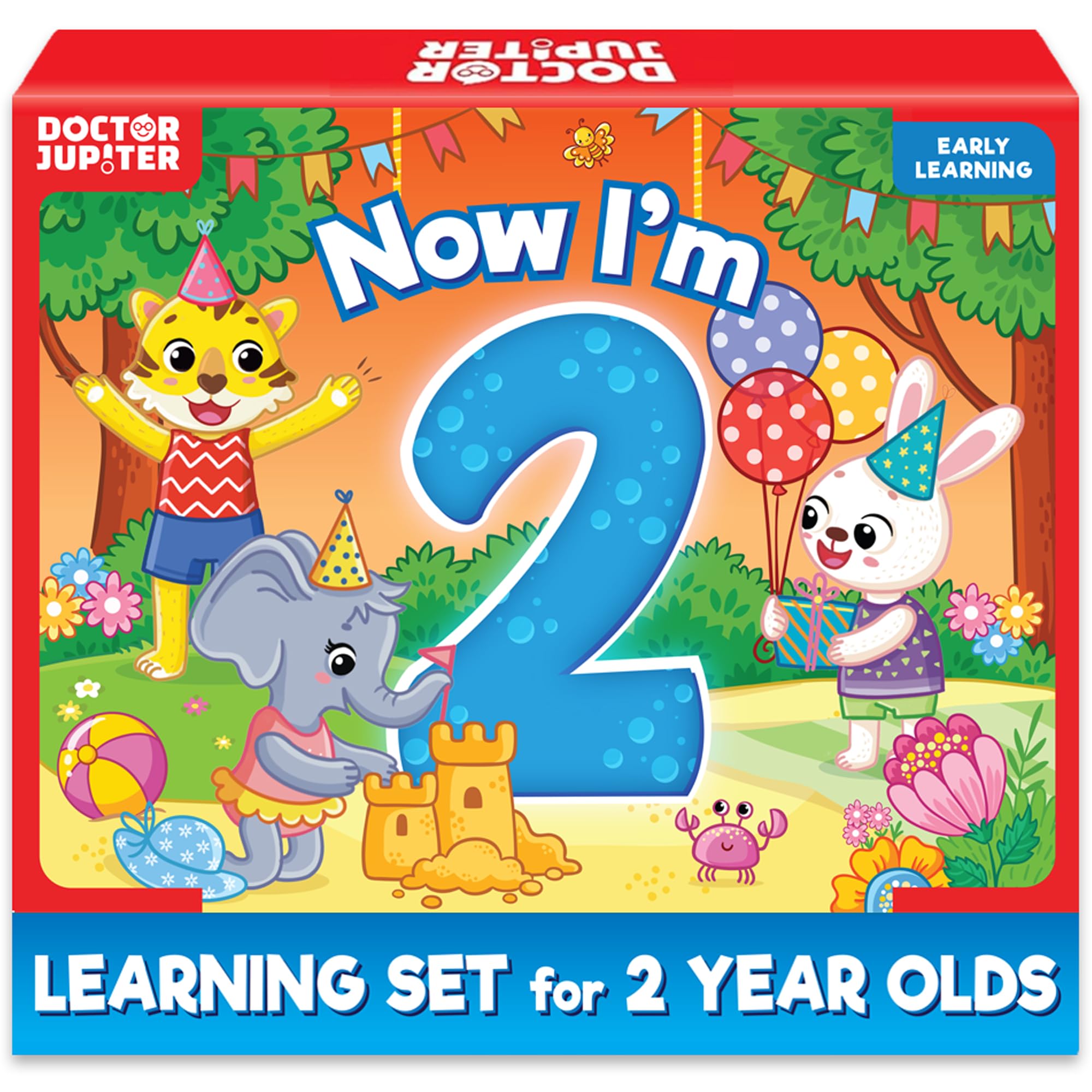
A whole birthday box of books, stickers, and a reward chart designed specifically for a child turning two.
This is less a single game and more a developmental kit. It includes two board books, a sticker activity, a reward chart, and a fine motor skills game. The reward chart is the standout feature — it turns mealtimes and daily routines into a visual, motivating game. Your child places a sticker on the chart each time they try a new food or complete a small task. This builds a sense of routine and independence at an age when “no” is a favorite word. The fine motor skills game involves hands-on manipulation that strengthens those tiny hand muscles. The entire kit is made from high-quality, non-toxic cardboard with rounded edges, so it is safe for little hands.
What owners love most is the pure fun factor — 19 buyers call it genuinely fun, and several mention that their children were “fully engaged” in each activity. The kit is designed for ages 2 and up and measures 12.8 x 9.4 x 1.4 inches, making it a substantial box. The trade-off is that a very determined toddler can work through the entire contents in a few days, as one owner noted their child “killed this box in about 2-3 days.” It is a set of consumable activities rather than an open-ended toy, so once the stickers are used and the books are memorized, you may need to supplement with other options.
The big idea: This celebrates the milestone of turning two with activities that build independence, routines, and fine motor skills. The reward chart is a surprisingly effective tool for picky eaters.
Perfect for: A birthday gift that feels special and comes with multiple activities in one box. Great for parents who want to introduce a reward system.
Consider something else if: You want a toy that lasts for months of open-ended play rather than a finite activity set.
5. Learning Resources Skill Builders Toddler Skills – 41 Piece Set

A bright, portable kit of cards and pieces that teaches letters, numbers, and colors through matching.
This 41-piece set is designed for the child who is ready to start recognizing letters and counting. It includes number pieces, colorful cards, and small manipulatives (little plastic pieces that your child places onto the cards to match shapes, colors, or numbers). The carrying case makes it easy to bring to grandma’s house or to a restaurant. The focus is on three core skills: the alphabet, counting up to basic numbers, and color identification. Each card presents a simple matching challenge — find the piece that goes with this picture — which builds problem-solving and concentration.
What owners appreciate most is how suitable it is for the 2-year-old age range — 16 buyers specifically mention it as a perfect fit. The pieces are bright and engaging, and one owner noted that their 2-year-old’s “favorite part was the numbers and matching the manipulatives to the cards!” The set is made of durable plastic, so it survives drops and spills better than paper cards. The honest limit is that the 41 pieces offer breadth rather than depth — you are introducing a wide range of concepts at a basic level rather than diving deep into any one skill. A few owners mention the box lacks a secure closure, so storing it without losing pieces requires a bit of care.
The Good Stuff
- Covers ABCs, numbers, and colors in one compact set
- Carrying case makes it a true on-the-go learning tool
- Bright colors and simple pieces hold a toddler’s attention
What to Know
- The box lid does not snap shut securely — plan your own storage
- Limited to basic concepts; your child will outgrow the depth fairly quickly
Reach for this if: You want a structured, portable way to introduce letters and numbers during travel or quiet time.
Skip if: Your child already knows their ABCs and is ready for more complex word or number activities.
6. Peaceable Kingdom Acorn Soup Game

A wooden spoon, a bunch of cute ingredients, and a squirrel who needs help making soup for winter.
This game takes the most basic toddler activity — pretend cooking — and gives it a simple structure. Your child draws a recipe card that shows a combination of wooden ingredients (acorns, berries, leaves) to drop into the box that doubles as a soup pot. You take turns rolling a die and following the recipe, which introduces counting, turn-taking, and following directions. The wooden ingredients are chunky and easy for small hands to grasp. The recipe cards are thick, sturdy cardboard that survives repeated use. The wooden spoon is a satisfying tool for stirring the imaginary soup.
The gameplay is what owners praise most — 51 buyers call it a winner for engagement. Kids love “feeding” the soup to their parents or siblings. The set includes 8 recipe cards, 24 wooden ingredients, a wooden spoon, and a parent guide. It measures 7.09 x 7.09 x 4.33 inches and weighs about 13.76 ounces. The quality of the cards and ingredients is consistently noted as excellent. The only recurring complaint is that the set includes only one spoon, which can be a problem if two children want to play at once (a kitchen spoon makes a fine substitute). A very small number of owners have reported receiving sets with missing parts, so check the contents when it arrives.
Why it works: It turns pretend play into a gentle lesson in counting, vocabulary, and patience. The ingredients are beautiful wooden pieces that feel great in small hands.
Great for: The toddler who loves to mimic cooking and wants a simple, structured game to play with a parent.
Not for: A child who is still putting everything in their mouth — the wooden pieces are safe but not meant to be gnawed on.
7. Sesame Street Cookie’s Counting Jar
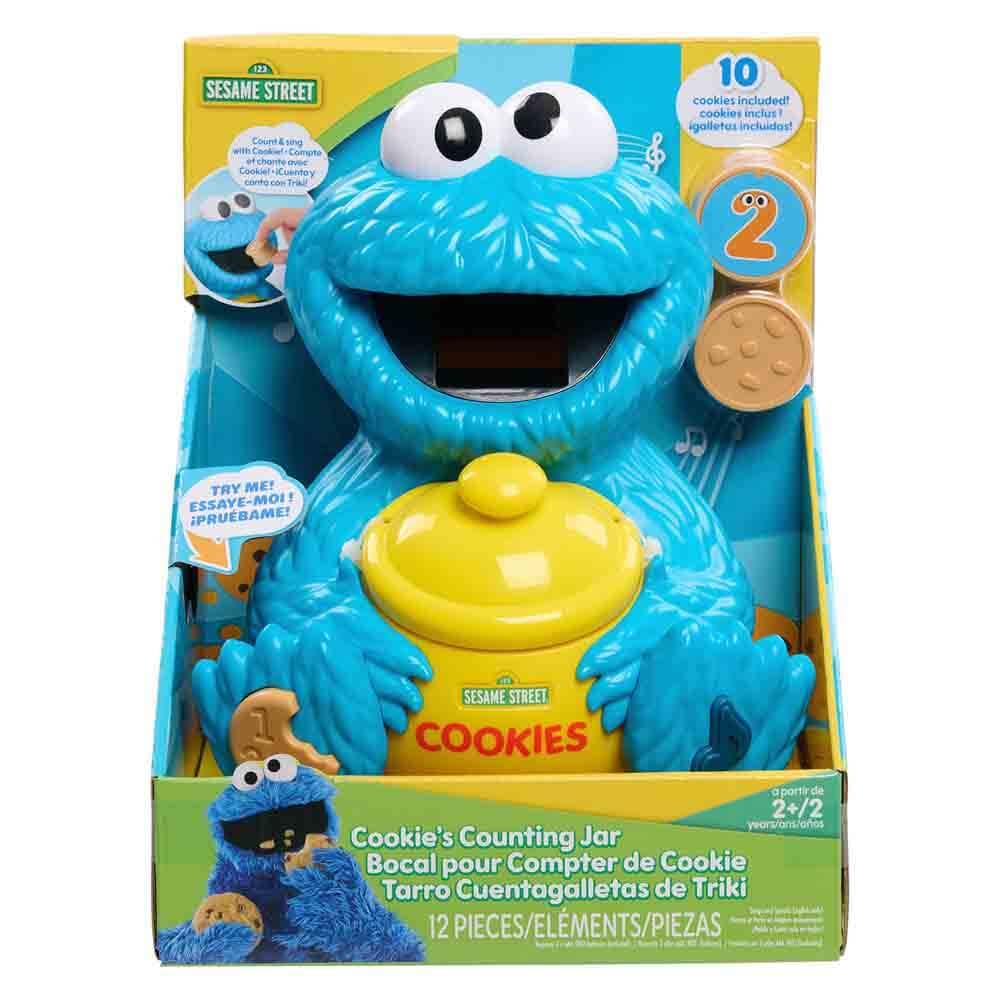
Cookie Monster eats the cookie and counts it — the most motivating counting lesson a toddler will ever get.
This is an electronic toy that turns counting into a feeding game. The set includes a Cookie Monster jar, a lid, and 10 chunky play cookies. Each cookie has a number on one side and that many chocolate chips on the other. Your child pushes a cookie into the slot in Cookie Monster’s mouth, and he counts each one up to ten. There is also a button that prompts kids to find specific numbers — if your child picks the right one, Cookie Monster says “Good job!” or “Thank you.” A separate button plays “Who Stole the Cookie From the Cookie Jar” for musical fun. The jar is 7.65 inches tall, a perfect size for small hands to hold and feed.
What owners love most is the quality — 50 buyers praise the build. The plastic is durable, the lid stays on securely, and the voice is clear and recognizable as Cookie Monster. The educational value is genuine: 23 owners note that it teaches numbers and hand-eye coordination without feeling like a lesson. The cookies are slightly small (one owner describes them as “a little small”), so keep an eye on younger siblings who might try to mouth them. A consistent observation is that the lid stability is mixed — some owners find it secure, others find it pops off when dropped. The toy requires 3 AAA batteries, which are included.
What Toddlers Love
- Feeding cookies to Cookie Monster is endlessly entertaining
- The counting and “good job” sounds reinforce number skills
- Two play modes: counting practice and number recognition
A Few Notes
- Cookies are small enough to lose easily — keep the jar in one spot
- Lid stability is hit or miss depending on how it is handled
Perfect for: The Sesame Street fan who needs a playful introduction to numbers 1 through 10.
Skip if: You prefer quiet, non-electronic toys or your child is prone to losing tiny pieces.
8. JoyCat Farm Busy Book for Toddlers 1-3

A soft, quiet book with 15 farm-themed activities that keep little hands busy without any noise at all.
This is a felt activity book designed for screen-free, independent play. Each page features a different hands-on task inspired by everyday life: buttoning, zipping, lacing, matching, and recognizing farm animals and plants. The entire book is made of soft felt with strong stitching, and all movable pieces are attached with non-removable strings, so nothing gets lost. The farm theme is charming and consistent — your child “helps” the farmer by matching crops, zipping up the barn, or lacing the fence. It is lightweight (0.3 kg) and compact at 8.27 x 8.27 x 1.57 inches, easily fitting into a diaper bag or backpack.
The activity count is what wins people over — 55 owners specifically praise the number of engaging pages. At ages 1 to 3, the book covers a wide developmental range: a one-year-old will enjoy the textures and flaps, while a three-year-old will master the buttons and zippers. The quality of the felt is noted as thick and durable, with one owner saying “it will go back to its shape” even after bending. The portability is a huge plus, with 26 owners calling it perfect for car rides, airplanes, and restaurants. The occasional downside is that some pieces, while attached, are still small enough to be a concern for very young children who might pull at them — though the non-removable design mitigates this.
The big advantage: Zero batteries, zero noise, zero lost pieces. It is a calming, independent activity that works anywhere from a church pew to a plane seat.
Reach for this if: You need a quiet, portable, mess-free activity for restaurants, car rides, or waiting rooms.
Not ideal if: Your toddler prefers electronic sounds and songs over quiet tactile exploration.
9. QUOKKA 5X MEGASET Puzzles for Toddlers 3-5
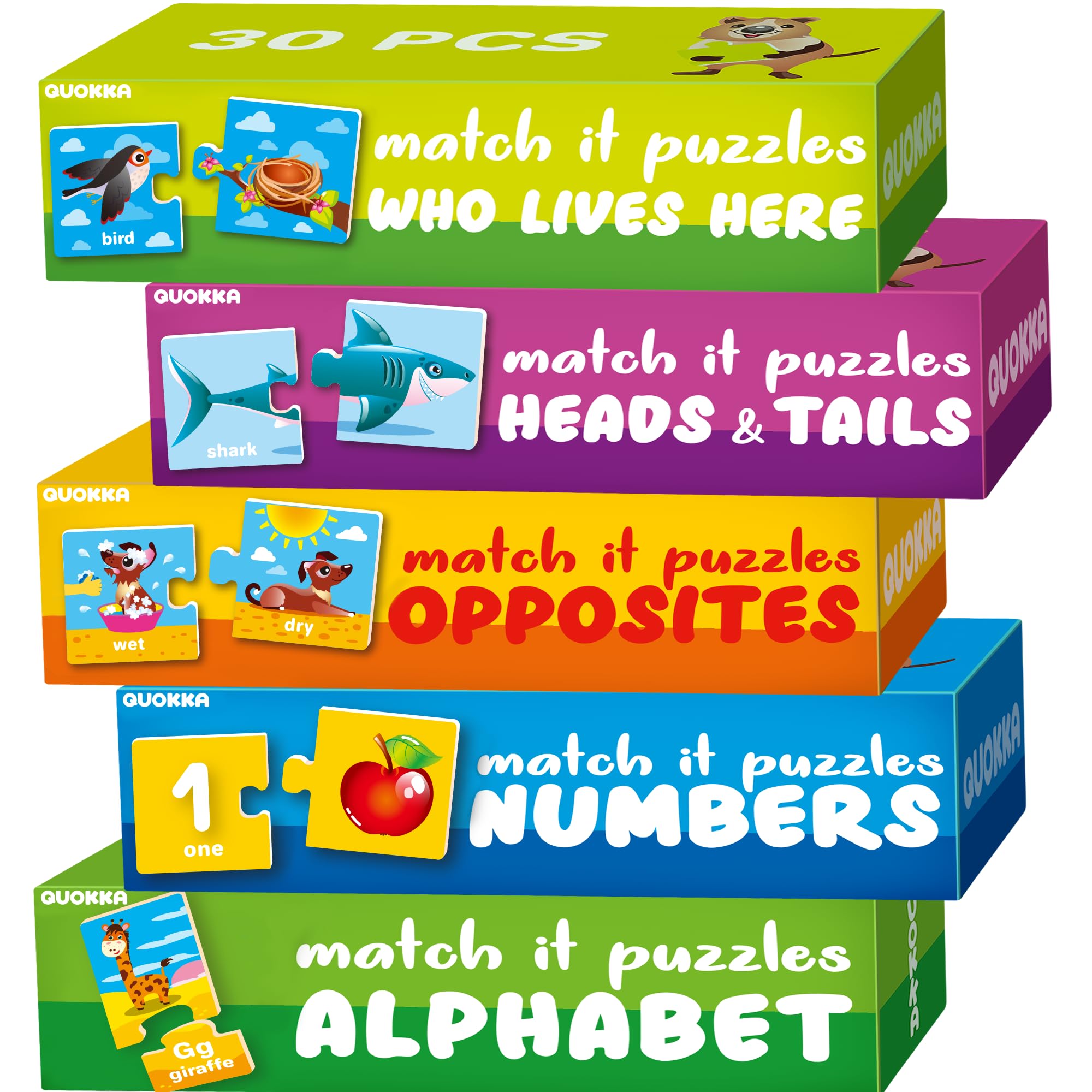
Five boxes of two-piece puzzles covering numbers, animals, opposites, and ABCs — one big set for early matching.
This is a substantial puzzle collection. It comes in 5 separate boxes, each focused on a different learning category: numbers, animals, opposites, ABCs, and a matching game. Each puzzle is a two-piece card that your child connects — a classic self-correcting format where the pieces only fit the correct match. This teaches logical thinking and patience because the child gets immediate feedback (it either fits or it doesn’t). The puzzle pair size is 2.5 x 5 inches, which is a good size for small hands to manipulate. The cardboard is thick and sturdy, designed to hold up to repeated use.
The educational scope is broad: animal recognition, letter recognition, matching skills, and logical thinking are all covered. Owners find it fun and educational, with several mentioning it as a great screen-free activity. The set is designed for ages 1 to 3, but the manufacturer suggests it works up to age 6 for more advanced matching. The honest trade-off is the size of the pieces — 14 owners specifically note that the pieces are too small. At 2.5 inches long, each card is manageable but can be lost easily, and some parents wish the pieces were bigger for younger toddlers. The opposites puzzles in particular can be a bit abstract for a 2-year-old to grasp without help.
The Big Draw
- Five themed boxes in one set = lots of variety without buying five separate products
- Self-correcting pieces teach problem-solving without frustration
- Thick cardboard stands up to enthusiastic play
The Honest Catch
- Pieces are on the small side — easy to lose under a couch or in a bag
- Opposites category may be too abstract for a brand-new 2-year-old
Great for: The child who loves matching games and needs plenty of variety across different subjects.
Look elsewhere if: Your toddler still drops or throws small objects — these pieces will scatter fast.
Understanding the Specs
Play Style: Electronic vs. Hands-On
Electronic toys like the LeapFrog book or Cookie’s Counting Jar use sounds, lights, and speech to give your child immediate audio feedback when they touch or press something. This is great for vocabulary and number recognition because the toy “talks back.” Hands-on toys like the JoyCat busy book or the Acorn Soup game use physical manipulation — buttons, zippers, stacking, and sorting — which builds fine motor skills and problem-solving without any batteries. Neither is better; a mix of both gives your child a balanced learning experience.
Piece Count and Choking Hazards
A 41-piece set sounds notable, but more pieces also means more things to lose and more potential choking hazards for a 2-year-old. The general safety rule is that anything that fits entirely inside a toilet paper tube is too small for a child under 3. Look for sets with chunky pieces (like the wooden ingredients in Acorn Soup or the 10 cookies in the Counting Jar) that are too big to swallow. Sets with very small puzzle pieces, like the QUOKKA Megaset, require close supervision or are better saved for older toddlers.
FAQ
What is the best educational game for a 2 year old who already knows basic words?
How long does a typical game session last for a 2 year old with these toys?
Are these games suitable for a 2 year old who still puts things in their mouth?
Which game is best for teaching a 2 year old to take turns?
Can these games help with speech delay?
Are any of these games suitable for travel or car rides?
Do these games require batteries?
What is the difference between a busy book and a puzzle set for a 2 year old?
How do I clean these toys?
Which game is best for a 2 year old who loves animals?
Final Thoughts: The Verdict
For most buyers, the educational games for 2 year olds winner is the LeapFrog Learning Friends 100 Words Book because it combines vocabulary building, bilingual learning, and durable design in a single interactive toy that tens of thousands of families have rated highly. If you want a hands-on toy that builds fine motor skills and teaches multiple concepts through play, grab the Learning Resources Peekaboo Learning Jungle. And for a classic family game that teaches turn-taking and object permanence, the Peaceable Kingdom Where’s Bear? is the one to reach for.
How We Picked
We do not accept paid placement. Every pick is matched to a real buyer and a real use-case; we do not hands-on test units.
Sources & Methodology
Specifications: manufacturer listings and product documentation. Review insights: verified customer reviews, as of July 2026. Pricing: not shown on this page (it changes often); check the current price via the retailer link.
As an Amazon Associate, WellFizz earns from qualifying purchases. This does not affect which products we feature.
Related Guides

Mo Maruf
I created WellFizz to bridge the gap between vague wellness advice and actionable solutions. My mission is simple: to decode the research and give you practical tools you can actually use.
Beyond the data, I am a passionate traveler. I believe that stepping away from the screen to explore new environments is essential for mental clarity and physical vitality.