Our readers keep the lights on and my smoothie glass nicely filled. As an Amazon Associate, I earn from qualifying purchases.
An EDC tourniquet sits in your pocket, pack, or pouch for months or years without notice, but when seconds separate life from death, only a device built for instant one-handed deployment and reliable occlusion matters. The difference between a lifesaver and a liability lies in the windlass material, buckle design, and how many rotations it takes to stop the bleed.
I’m Mohammad Maruf — the founder and writer behind WellFizz. I’ve spent hundreds of hours analyzing the mechanical specs, real-world application reports, and CoTCCC recommendations to find which tourniquets earn their place in a daily carry setup.
Whether you are building a trauma kit or pocket-sized first aid, choosing the best edc tourniquet means matching your carry profile to a device that will work the first time, every time.
How To Choose The Best EDC Tourniquet
An EDC tourniquet must balance compact form factor against the mechanical advantage needed to occlude a femoral artery. Three specs separate a daily-carry lifesaver from a bulky range bag relic.
Windlass Material & Locking Mechanism
The windlass is the rod you twist to apply tension. Metal windlasses — aluminum or stainless steel — resist snapping under high torque and survive repeated training cycles. Polymer windlasses shave weight but may deform in extreme cold or under repeated stress. A locking mechanism that secures the windlass in place (like a clip or tri-ring lock) prevents accidental unwinding during movement.
Band Width & Buckle Design
Wider bands (1.5 inches) distribute pressure more evenly, reducing localized tissue damage while achieving occlusion at lower rotational force. The buckle must allow single-handed strap cinching without snagging. Look for a rugged buckle with a slack-indicator wedge, which visually confirms the band is tight before you begin windlass turns.
Compact Profile & Carry Method
An EDC tourniquet should fit flat against your body or inside a waist-pack without printing. Sub-1-inch thickness and under 4 ounces are the sweet spot. Avoid oversized windlass knobs or protruding clips that catch on pocket edges. Every millimeter matters when the device lives on your belt line or in a front pocket.
Quick Comparison
On smaller screens, swipe sideways to see the full table.
| Model | Category | Best For | Key Spec | Amazon |
|---|---|---|---|---|
| SOF Tourniquet Gen 5 (TacMed) | Premium | One-handed reliability | 3.7 oz · 1.5” performance band | Amazon |
| SOFTT-W Tourniquet (Coyote Tan) | Premium | Military-grade durability | Aluminum windlass · heavy nylon | Amazon |
| SAM XT Extremity Tourniquet | Premium | Auto-locking buckle | 4 oz · TRUFORCE Buckle | Amazon |
| Snakestaff Systems ETQ Gen 2 | Mid-Range | Ultra-compact carry | 1.44 oz · 1” width | Amazon |
| TMT Tactical Mechanical Tourniquet | Mid-Range | Wider band comfort | 2.9 oz · speed buckle | Amazon |
| SWAT-T Tourniquet 2-Pack | Budget | Multi-use / lightweight | 0.8 oz each · stretch design | Amazon |
In‑Depth Reviews
1. SOF Tourniquet Generation 5 (TacMed Solutions)
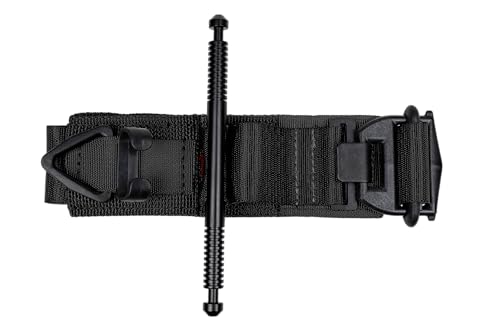
The SOF Gen 5 is the gold standard CoTCCC-recommended tourniquet, redesigned with a performance compression band that glides through the rugged buckle for snag-free one-handed operation. The 1.5-inch wide webbing and slack-indicator wedge eliminate guesswork — when the wedge disappears under the band, you’re tight enough to start windlass turns. The result is fewer rotations needed to achieve occlusion compared to narrower designs.
Weighing 3.7 ounces and measuring only 5 x 2.25 x 2 inches, it fits standard IFAK pouches and front pockets without bulk. The windlass is a high-strength composite that withstands repetitive training cycles, though some users prefer metal for extreme cold confidence. The clear area for marking application time is a nice touch for documentation during transport.
Paramedics and military medics consistently rate this as their daily carry because it balances speed of application with mechanical reliability. The rugged buckle holds the band at any engagement angle, which matters when you’re applying the device with one hand on your own thigh in a stress position.
Why it’s great
- Slack-indicator wedge speeds proper application
- CoTCCC approved and battle-tested by elite forces
- Lightweight yet robust for daily carry
Good to know
- Composite windlass less durable than metal under extreme cold
- Some users find the buckle stiff when new
2. SOFTT-W Tourniquet – Coyote Tan

The SOFTT-W is the windlass version of the classic SOF Tactical Tourniquet, featuring a high-strength aluminum rod that provides reliable torque without flexing. The metal windlass is a key advantage for anyone training repeatedly or operating in sub-zero environments where plastic components can become brittle. The tri-ring lock secures the windlass firmly once tightened.
Heavy-duty nylon webbing with reinforced stitching gives this device a rugged feel that matches military-issue standards. It includes a Tourniquet Retention Assistance Clip (TRAC) that helps stabilize the device during buddy-aid application. At 5 x 2 x 2 inches and under 4 ounces, it stows more easily than a standard CAT tourniquet, making it a favorite for compact IFAK setups.
Users with 8+ years of medic experience rate this alongside the CAT as the two best tourniquets available, often preferring the SOFTT-W for its smaller form factor and metal windlass. The desert tan color is a cosmetic bonus for those building a matching gear set.
Why it’s great
- Aluminum windlass resists snapping under extreme torque
- TRAC clip aids stabilization during buddy-aid
- Compact form factor fits smaller pouches
Good to know
- No slack-indicator wedge like the Gen 5
- Slightly more expensive than comparable composite models
3. SAM Medical SAM XT Extremity Tourniquet

The SAM XT sets itself apart with the patented TRUFORCE Auto-Locking Buckle, which clicks when the preset circumferential force is reached, eliminating slack before you touch the windlass. This audible and tactile confirmation reduces user error — a critical advantage when stress, adrenaline, or limited training compromises technique. The protocol is simple: Click, Twist, Secure.
An aluminum metal windlass rod replaces the plastic alternatives found on many tourniquets, delivering dependable torque in extreme conditions without risk of snapping. The TRUFLEX plate evenly distributes pressure across the limb, which helps reduce pinch-point pain and tissue damage during prolonged application. At 4 ounces and 7.5 x 2.75 x 1.5 inches, it’s slightly longer than some due to the locking stubs, but still fits most trauma kits.
CoTCCC recommended and field-proven by military and EMS, the SAM XT is ideal for buyers who want a mechanical safety net — the auto-locking buckle acts as a second set of eyes during application. Some users find the extra length less convenient for pocket carry, but for kit-based EDC it’s a top contender.
Why it’s great
- TRUFORCE buckle auto-removes slack with an audible click
- Metal windlass with durable TRUFLEX pressure plate
- CoTCCC recommended for military and EMS use
Good to know
- Longer profile may not fit all compact pouches
- Auto-locking mechanism can feel stiff initially
4. Snakestaff Systems ETQ Gen 2
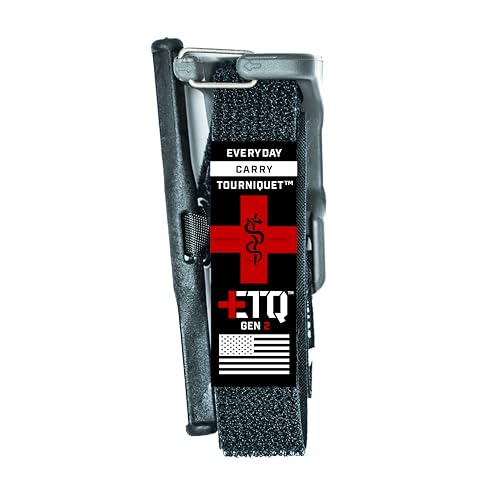
The ETQ Gen 2 was built from the ground up for everyday carry — it’s the lightest and thinnest tourniquet in this lineup at just 1.44 ounces and 3 x 4 x 0.5 inches. That profile slides into a front pocket, slim waist-pack, or even a wallet-style organizer without creating a bulge. The 1-inch band width sacrifices some surface area for compactness, but the tradeoff is a device you’ll actually carry daily instead of leaving in the car.
Made in the USA, the ETQ uses a friction-based windlass system that is simple to operate with one hand once you train the motion. The gray color blends with most kit configurations, and the slim dimensions make it ideal for backpacking first aid kits, college dorm setups, or gym bags where space is at a premium.
This is a purpose-built EDC tool for those who prioritize “carry-ability” above all else. It pairs well with tourniquet holders or belt holsters, and its low weight means you won’t feel it during a full day of wear. While it lacks the band width of premium models, it outperforms generic elastic band-style tourniquets by a wide margin.
Why it’s great
- Ultra-light 1.44 oz design disappears in a pocket
- Thin enough for wallet-style organizers
- Made in the USA with compact carry as priority
Good to know
- 1-inch band requires more rotation for occlusion
- Fewer customer reviews than established military brands
5. TMT Tactical Mechanical Tourniquet (Safeguard Medical)

The TMT is a CoTCCC-viable alternative designed to address shortcomings in earlier tourniquet designs. Its standout feature is a wider band that achieves occlusion at lower pressure, reducing the risk of tissue damage and improving patient comfort during prolonged transport. The speed buckle with Velcro backup gives you a middle-ground feel between the CAT and SOF-T families.
Weighing 2.9 ounces with dimensions of 5 x 2 x 2 inches, the TMT is slightly lighter than the SOF Gen 5 due to its all-polymer construction. The non-metal design avoids corrosion and is lighter on the belt, though some users prefer metal windlasses for extreme cold reliability. Self-application is manageable with practice, and the wide strap makes one-handed use smoother than narrower designs.
Medics who train regularly appreciate the TMT’s faster application curve compared to standard windlass models. The TRAM RAM attachment adds utility for junctional injuries when used as part of a RAMPART system, though most EDC users won’t need that feature. For the price point, it delivers premium-like band width at a mid-range cost.
Why it’s great
- Wider band occludes at lower pressure
- Lighter than all-metal designs at 2.9 oz
- Velcro-backed speed buckle for quick application
Good to know
- All-polymer construction less durable in extreme cold
- Thinner strap than some windlass models
6. SWAT-T Tourniquet 2-Pack (Safeguard Medical)
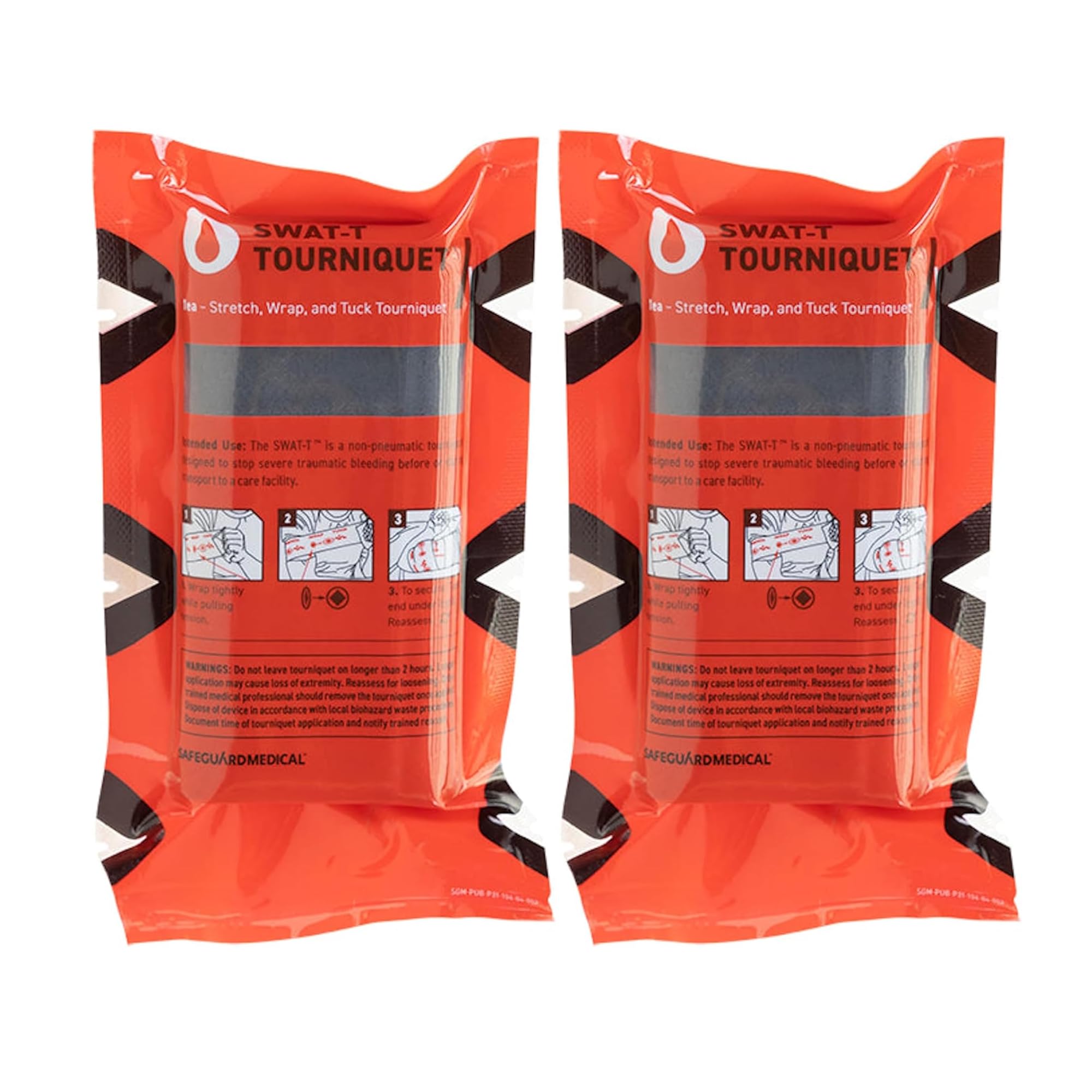
The SWAT-T (Stretch, Wrap, And Tuck) operates on a fundamentally different principle than windlass tourniquets. It’s a wide elastic band that you stretch, wrap around the limb, and tuck to secure — no mechanical rod required.
The stretch design means it can also serve as a pressure bandage for packed wounds, giving it multi-use versatility that windlass models cannot match. Self-application on arms is more challenging than with a windlass, but on legs and for buddy-aid scenarios it works efficiently. The elastic material causes less tissue damage than a narrow windlass band, which matters for prolonged care.
Check the packaging for shelf-life information — newer units have improved UV-resistant bagging for extended storage. This is not a replacement for a CoTCCC-approved windlass tourniquet for adult femoral occlusion, but as a lightweight backup or for smaller patients it’s a smart addition to any well-rounded EDC medical kit.
Why it’s great
- Extremely lightweight at 0.8 oz each
- Multi-use as tourniquet and pressure dressing
- Great for kids, dogs, and smaller limbs
Good to know
- Hard to self-apply on upper arms
- Less stopping power than windlass models on large adults
FAQ
Can a compact 1-inch tourniquet occlude a femoral artery?
How long can a tourniquet stay on before causing permanent damage?
Should I practice with my EDC tourniquet before carrying it?
Final Thoughts: The Verdict
For most users, the best edc tourniquet winner is the SOF Tourniquet Generation 5 because its 1.5-inch performance band, slack-indicator wedge, and CoTCCC approval deliver a proven balance of speed, reliability, and compactness. If you want a metal windlass for extreme cold confidence, grab the SOFTT-W. And for an ultra-light pocket-friendly backup that disappears into any bag, nothing beats the Snakestaff ETQ Gen 2.

Mo Maruf
I created WellFizz to bridge the gap between vague wellness advice and actionable solutions. My mission is simple: to decode the research and give you practical tools you can actually use.
Beyond the data, I am a passionate traveler. I believe that stepping away from the screen to explore new environments is essential for mental clarity and physical vitality.