Our readers keep the lights on and my smoothie glass nicely filled. As an Amazon Associate, I earn from qualifying purchases.
Specs are compiled from manufacturer listings and verified buyer reviews and can change over time — please confirm the key details on the product page before buying.
Every day, millions of plastic water bottles end up in landfills — but the alternative at your kitchen sink can be just as convenient and far more sustainable. You want water that tastes clean without the guilt of single-use plastic, and the right filter makes that happen without a complicated installation or a hefty monthly bill.
I’m Mohammad Maruf — the founder and writer behind WellFizz. This guide is built by comparing the manufacturers’ published specifications and the patterns across verified customer reviews, so you get each pick’s real strengths and trade-offs instead of marketing spin.
if you need a countertop pitcher, a faucet-mounted system, or a gravity-fed tank, these nine filters deliver cleaner water with less waste. Here is how to find the best eco-friendly water filter for home that fits your tap, your fridge, and your daily routine.
Our Picks at a Glance


How To Choose The Best Eco-Friendly Water Filter For Home
An eco-friendly water filter should reduce bottled-water use, use sustainable materials, and have replaceable cartridges that minimize waste. The right choice depends on your tap water quality, kitchen space, and daily household water usage.
Filter Type and Installation
Pitcher filters (like Brita or Waterdrop glass models) sit on your countertop or fridge shelf and require no plumbing. Gravity-fed countertop tanks (Waterdrop King Tank, Purewell) hold two gallons or more, filter without electricity, and work well for families. Under-sink systems (Waterdrop TST-UF) hide away and deliver filtered water straight from your faucet. Reverse osmosis countertops (DREO) offer the deepest filtration but need a power outlet and produce some wastewater.
Filtration Performance and Certifications
Look for NSF/ANSI certifications that verify real-world performance. NSF 42 covers chlorine, taste, and odor reduction. NSF 53 tackles heavy metals like lead and mercury. NSF 372 confirms lead-free materials. If PFAS or PFOA/PFOS are a concern, choose a filter that specifically lists those reductions — only a few models here cover them.
Filter Lifespan and Waste Impact
A longer-lasting filter means fewer cartridges to throw away. Pitcher filters typically last 40 to 100 gallons (roughly one to two months). Gravity systems can run 1,000 to 6,000 gallons. Under-sink and RO filters stretch 6 to 24 months. Also check if the housing is reusable and if the cartridges are recyclable — some brands now use bioplastics or coconut-shell carbon.
Material Safety and Build
BPA-free plastic is the standard in most pitchers. Glass pitchers avoid plastic contact entirely but are heavier. Stainless steel gravity tanks are durable and dishwasher-safe components are easier to keep clean. Avoid any model that mentions a filter compartment made from unnamed plastic if you are trying to minimize microplastic exposure.
Quick Comparison
| Model | Best For | Type | Capacity | Filter Life | Amazon |
|---|---|---|---|---|---|
| BRITA Style Eco Green★ Best Overall | Stylish daily pitcher | Pitcher | 2.4 L | 4 weeks / 150 L | Amazon |
| Hydros 64 oz PitcherFastest Filtration | Fast fill-up | Pitcher | 64 oz (8 cups) | — | Amazon |
| Brita Metro 6-CupCompact Fit | Compact fridge fit | Pitcher | 6 cups | 2 months / 40 gallons | Amazon |
| OEMIRY OM-CF04 | Countertop alkaline | Faucet-mount / countertop | 8,000 gallons | 12 months | Amazon |
| Waterdrop PT-09W Glass | Glass pitcher | Glass pitcher | 10 cups | 2 months | Amazon |
| Waterdrop TK-A Gravity | Family gravity tank | Gravity countertop | 2.25 gallons | 6,000 gallons (carbon) | Amazon |
| Purewell PW-KS 2.25G | Precision UF filtration | Gravity countertop | 2.25 gallons | 6 months / 3,000 gal per filter | Amazon |
| Waterdrop TST-UF Under Sink | Hidden under-sink | Under-sink | 8,000 gallons | 6–24 months | Amazon |
| DREO RO Countertop | Deepest purification | RO countertop | 5 L + 2 x 1.1 L pitchers | 6–12 months | Amazon |
In‑Depth Reviews
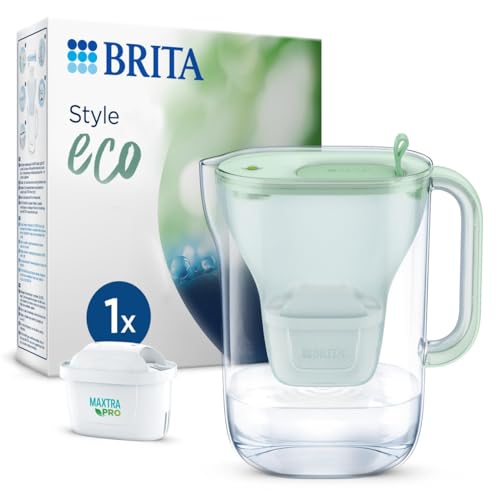
1. BRITA Style Eco Green Water Filter Jug (2.4 L)
Our pick — over 4.5★ from 550+ verified ratings; the strongest balance of quality and price.
The bio-based pitcher that cuts CO2 without cutting corners on taste.
The BRITA Style Eco Green earns its spot because it cuts petroleum-based plastic with every refill — its jug, funnel, lid, and flap are made from 60% bio-based plastic using a mass-balance approach (a method that allocates renewable raw materials to the product). It holds 2.4 liters and uses the Maxtra Pro all-in-1 cartridge, which contains natural activated carbon and ion-exchange beads to reduce limescale, chlorine, lead, copper, and traces of herbicides and pesticides if present in your tap water. Buyers report the water tastes incredible and that the filter handles hard water buildup — one owner says, “We have a hard water where we live and limescales is Keep building up in our kettle,” and the filter handles it.
The Smart Light sensor on the lid tracks filtered time and volume, so you get a reminder when the cartridge needs changing. At 0.69 kg it feels solid but not heavy, and its dimensions (4.13″L x 9.41″W x 10.75″H) fit most standard fridge doors.
The single cartridge lasts 150 liters or about four weeks. That replacement cycle is shorter than some gravity systems, so you will need to buy cartridges regularly. But the eco materials, the intuitive filter-change light, and the strong owner satisfaction make this the one to beat for everyday home use.
Why owners love it
- 60% bio-based plastic body reduces virgin plastic use visibly
- Smart Light indicator removes guesswork on filter changes
- Four-stage filtration tackles limescale, chlorine, lead, copper, and trace organics
- Dishwasher-safe (except the Smart Light) for easy cleaning
What to keep in mind
- Cartridge replacement needed every 4 weeks (150 L) — ongoing cost to factor in
- 2.4 L capacity means refills for larger households
- Filter compartment and cartridge housings are plastic, not fully bio-based
Grab it if: you want the most sustainable mainstream pitcher with certified filtration and a clever change reminder that actually works.
Think twice if: you need a month-plus filter life or a glass body — the cartridge changes come fairly often.
2. Hydros 64 Ounce Water Filter Pitcher
A pitcher that fills faster than most — without the carbon footprint of disposable plastics.
Hydros built this 64-ounce (eight-cup) pitcher around a patented Fast Flo Filter that uses natural coconut shell carbon. The maker claims it filters five times faster than the competition, and owners consistently agree that the water flow is noticeably quick. The filters are NSF 42/Class 1 rated, independently tested to remove 99% of sediment and 90% of chlorine, plus fluorine and other chemicals that cause bad taste. Buyers call it “my favorite water filter pitcher so far,” praising the easy-to-use filters and the compact, attractive design.
At just 0.39 kg, the Hydros is the lightest pitcher here — at 0.39 kg versus the BRITA at 0.69 kg — and the sturdy rubber base and handle add grip and protection. The filters are recyclable and the BPA-free lining means no plastic leach into your water. The ergonomic shape fits most refrigerator shelves.
The main trade-off is taste consistency. While many owners love the flavor, a few report a plastic-like taste even after following the prep instructions. The small basin (2–3 oz) also requires a slow trickle if you fill carefully. For a single person or couple who want fast filtration without the bulk, this is a smart, lightweight choice.
Who it suits: Anyone who refills their pitcher multiple times a day and values speed over raw capacity. The fast flow really does save waiting time.
The honest caveat: Taste feedback is mixed — a small number of owners notice a transient plastic flavor. If your tap water is extra sensitive, you may want to try a few initial flushes first.
3. Brita Metro Water Filter Pitcher 6-Cup
A six-cup pitcher that squeezes into tight fridge shelves and small dorm fridges.
The Brita Metro is built for people who do not have a half-empty gallon of space in their refrigerator. Its dimensions (4.82″L x 10.04″W x 10.1″H) make it one of the narrowest pitchers here, and owners consistently praise its compact size — that’s the aspect that gets the most mentions by far. It uses Brita’s Standard filter to cut chlorine taste and odor, plus reduces copper, cadmium, and mercury impurities. The easy-fill locking lid stops spills when you pour.
One filter lasts 40 gallons or about two months, and switching from bottled water can replace up to 1,800 single-use plastic bottles a year, according to Brita. The included filter indicator takes the guesswork out of replacement. Owners say “Used it daily and work great,” and many note it pairs perfectly with a Keurig coffee maker for better-tasting coffee.
The catch is capacity. At six cups (1.4 liters), this is really a one-person pitcher — a few owners mention it is too small for a family and wish they had gone with the eight-cup version. The plastic body is BPA-free but still plastic, so it is not the most eco-advanced material choice. For a solo drinker or a tight fridge, though, it is tough to top the fit.
What fits
- Six-cup capacity fits small fridges, dorm rooms, and office desks
- Replaces up to 1,800 plastic bottles per year per the brand
- Change Filter Indicator on the lid takes out the guesswork
- Easy-fill locking lid prevents spills during pouring
What doesn’t
- Too small for a household of two or more — expect frequent refills
- Plastic body, not glass or bio-based, if that matters to you
- Filter durability gets mixed marks; a few owners mention cracks over time
Reach for this if: your fridge shelf is narrow, you live alone, and you want a simple, trusted Brita filter with an indicator light.
Look elsewhere if: you need to serve two or more people — the six cups run out fast.
4. OEMIRY OM-CF04 Countertop Alkaline Water Filter

A faucet-mounted system that delivers alkaline water for a full year on one filter.
The OEMIRY OM-CF04 connects directly to your standard faucet (included adapters cover most thread sizes) and switches between tap and filtered water with a twist. It uses advanced alkaline multi-stage filtration to reduce up to 99% of chlorine, taste, and odor, plus fluoride, heavy metals, and other contaminants, while retaining beneficial minerals like potassium, calcium, sodium, and magnesium. The maker says the flow reaches up to 1.6 gallons per minute — you can fill an 8 oz cup in about two to three seconds.
The filter lasts up to 12 months or 8,000 gallons, whichever comes first. That is a standout lifespan in this roundup — only the gravity tanks outlast it. The ABS housing is environmentally friendly, and the system produces zero wastewater and requires no electricity. Owners consistently call it a workhorse, praising the easy installation and the clean, great-tasting water that removes mineral tastes from well water.
There are a couple of important fit notes. This system does NOT reduce TDS (total dissolved solids), so if you are after that, you need a different model. And it is only compatible with standard faucets — not pull-type, hand-held, spray-type, or sensor faucets. A few owners mention minor dripping after shutoff, so keep a drip tray handy.
The value angle: One filter covers an entire year for most households, which means less cartridge waste and fewer trips to the store. The 8,000-gallon capacity is exceptional at this price point.
Who should skip it: If you have a pull-out or spray faucet, this won’t fit. Check your faucet type before ordering.
5. Waterdrop PT-09W 10-Cup Glass Water Filter Pitcher

The glass pitcher that finally lets you ditch plastic — but be ready for the weight.
Waterdrop’s PT-09W replaces a plastic Brita-style pitcher with a high-quality glass body that is non-toxic, sustainable, and easier to clean than plastic. The glass construction is the top-praised aspect among owners — 31 buyers single it out as the best thing about this pitcher. It uses a 5-stage filtration process with advanced carbon fiber, ion exchange resin, and an activated carbon block to reduce chlorine, mercury, copper, cadmium, PFOA/PFOS, and sediment. The filter is certified against NSF/ANSI 42 (chlorine, taste, odor), NSF/ANSI 53 (mercury reduction), and NSF/ANSI 372 (lead-free materials).
The filter lasts up to 100 gallons or about two months, with a flow rate of 8.5 oz per minute — filling an 8 oz cup in under a minute. Owners say it eliminates chlorine taste and smell completely, and that “works great. Water tastes better and I’ve eliminated plastic bottles and the related concerns.” The 10-cup capacity (8.1″L x 5.9″W x 9.72″H) serves a small family.
The honest trade-off is weight. At 1.69 kg, this pitcher is noticeably heavier than plastic alternatives, and owners warn that you will need to reconfigure fridge shelves if you keep it inside. The filter compartment and filter itself are plastic, so it is not entirely plastic-free. Do not put it in the dishwasher — hand-wash only.
Why it stands out
- Real glass body eliminates plastic contact — the most-praised feature
- NSF/ANSI 42, 53, and 372 certified filter for reliable contaminant reduction
- Reduces PFOA/PFOS, a benefit not all pitchers offer
- Fast flow at 8.5 oz/min fills a cup in under a minute
What to weigh
- Heavy at 1.69 kg — may not suit everyone for daily lifting
- Filter compartment and cartridge are plastic, not glass
- Hand-wash only — no dishwasher-safe convenience
- Does not reduce TDS if that is your goal
Go for it if: you want to stop drinking from plastic containers and are willing to handle a heavier pitcher for the benefit of glass.
skip it if: you need something lightweight for frequent pouring or you want a fully plastic-free filtration path (the cartridge housing is still plastic).
6. Waterdrop TK-A Gravity Water Filter System (2.25G)

A stainless steel gravity system that serves a family of four without a single watt of electricity.
The Waterdrop King Tank holds 2.25 gallons of water in its upper chamber, fed through two black carbon filters made from natural coconut activated carbon. It reduces up to 99% of chlorine (lab-tested), improves taste and odor, and — because it runs on gravity — requires no power at all. That makes it equally at home in a kitchen, an RV, or during an emergency. The two included carbon filters can handle up to 6,000 gallons, and optional fluoride filters extend coverage to 1,000 gallons.
Water taste is the most-discussed aspect among owners — 84 buyers call it out. They consistently report crisp, refreshing water with no chlorine aftertaste. Setup takes about 40 minutes, and owners say it is straightforward with no prior plumbing experience needed.
A few owners mention occasional leakage if the unit is filled to the absolute max. The system does NOT reduce TDS, and it is important to note that this is not a Berkey product — Waterdrop is an independent brand. For a household that goes through a lot of water and wants no-plumb, no-power convenience, the King Tank delivers the best cost-per-gallon in this lineup.
The big picture: 2.25 gallons ready at all times, no electricity, stainless steel body, and the filter pair lasts years for most families. The upfront cost is higher, but the per-gallon running cost is the lowest here.
One nuance: Fill the top chamber carefully to avoid leaks. And if you are looking for TDS reduction, this system won’t do it.
7. Purewell PW-KS 2.25G Gravity Water Filter System

A gravity filter with a 0.01-micron membrane that catches far more than carbon alone can.
Purewell’s PW-KS stands apart from other gravity tanks because its 3-stage filtration catches particles as small as 0.01μm (0.01 micrometers, or 10 nanometers) — that is 0.01μm, compared with the 0.2-micron filters many competing gravity systems use. The stages include a hollow fiber UF membrane (ultrafiltration membrane that blocks bacteria and viruses), a silver ion membrane (which inhibits microbial growth), and an activated carbon block. This means it can intercept rust, sediment, organic matter, heavy metals, and even 99.99% of minuscule materials while still achieving a flow rate of 4 gallons per hour. The stainless steel body houses 2.25 gallons, and a transparent water level window lets you check how much is left without opening the lid.
The two black carbon filters each serve up to 3,000 gallons (6,000 total), with a recommended replacement every six months. No electricity is needed — it works purely on gravity, making it versatile for indoor and outdoor use. Customers note that “the taste of water immediately” improved, and that the system eliminated the need for bottled water within weeks. Setup takes about 10 minutes.
The initial priming of the filters takes a while, and the first few cycles produce a slower flow until the filters fully saturate. Actual capacity is slightly less than 2.25 gallons because the filters displace some volume. If you want the most thorough particle reduction from a gravity system, this is the one.
Why it wins on purity
- 0.01μm UF membrane catches far more than standard carbon gravity filters
- Transparent water level window eliminates guesswork
- Stainless steel body, no electricity, zero wastewater
- 6,000-gallon total filter life cuts replacement waste drastically
What to know
- Initial filter priming takes time and the first cycles are slow
- Filters displace some volume — actual daily capacity is under 2.25 gallons
- Does NOT reduce TDS, so mineral content stays the same
Choose it for: the best particle-filtration in a gravity system — the 0.01-micron UF membrane is a genuine step up from standard carbon-only tanks.
Consider something else if: you need instant flow from the first pour; this one requires patience during the first couple of uses.
8. Waterdrop TST-UF 0.01μm Under Sink Water Filter System

An under-sink system that hides away and delivers filtered water at tap speed.
The Waterdrop TST-UF fits under your sink and connects directly to your cold water line (3/8″ or 1/2″ NPT threads) — no drilling, no separate faucet needed. It uses a 3-stage filtration process with a precision 0.01-micron ultrafiltration membrane, plus layers that reduce chlorine, heavy metals, and odors. The flow rate reaches up to 1.59 GPM, filling an 8 oz cup in about 2.3 seconds. That is .
The build quality is a standout. The housing is made from lead-free 304 stainless steel with a thick sealing ring — owners consistently praise it as well-made and heavy-duty, especially compared to plastic under-sink filters that can crack over time. Installation is the most-praised aspect (117 buyers call it out), with most setups taking around 10 minutes using the included quick-connect hoses, Teflon tape, and wrench.
Filter lifespans are generous: the PP filter lasts 6–8 months, the UF filter lasts a year, and the CT filter stretches 12–24 months, depending on water quality. The system does NOT reduce TDS, and it is only designed for municipal tap water — not well water. A few owners note that the push-connect fittings can cause anxiety about leaks, and blue clips are tricky to install correctly. For a permanent, out-of-sight solution with near-instant flow, this is the most practical upgrade.
Why it is worth it: You get restaurant-level flow speed (1.59 GPM) with a filter that lasts up to two years on one of its stages. The stainless steel housing means no plastic degradation over time.
Who it is not for: If you have well water, non-standard faucet threads, or zero DIY confidence — the push connectors require a careful hand.
9. DREO Reverse Osmosis Water Filter Countertop
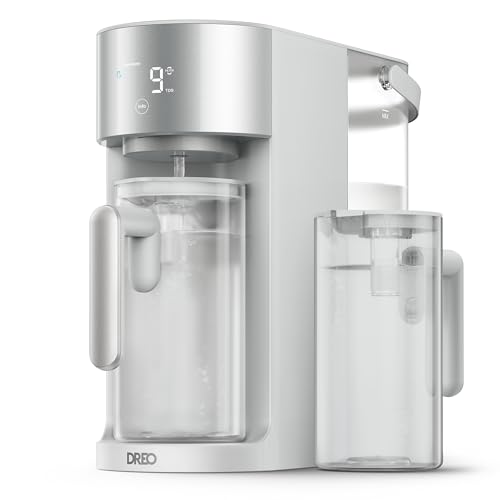
The countertop RO system that strips out 1,000+ impurities while showing you real-time TDS readings.
DREO’s RO water filter is the only reverse osmosis unit in this roundup, and it delivers the deepest purification available here. Tested by SGS against NSF/ANSI 58 Standards, the 7-in-1 RO filter removes up to 99.99% of 1,000+ impurities including PFOA, PFOS, chlorine, fluoride, and more. A real-time TDS meter and filter-life monitor sit on the front panel, so you can see the raw water TDS and the pure water TDS side by side. Reviewers point out readings dropping from 400–500 ppm to 30–40 ppm — .
Installation is genuinely plug-and-play: no plumbing, no drilling. The footprint measures 15.7″L x 6.7″W x 13.4″H, and it comes with a 5-liter tank plus two 1.1-liter auto-fill pitchers. The system achieves a 3:1 pure-to-drain ratio, meaning less water waste than older RO units. The auto-fill sensor refills the pitchers hands-free, and the self-cleaning function flushes internal tubes to keep water fresh.
The filter lasts 6 to 12 months and twists in and out in seconds. Owners love the water quality — that is the most-praised aspect (110 mentions) — and note it makes noticeably better coffee and tea. The main drawbacks are the ongoing filter cost (about for two replacements) and that the unit is best suited for one to two people; heavy users will find themselves refilling the 5-liter tank more often than they would like. It also produces some wastewater (the 3:1 ratio means for every 3 cups of clean water, 1 cup goes to drain). For class-leading contaminant removal without a permanent install, this is the strongest choice.
what separates it
- SGS-tested to NSF/ANSI 58 standards — removes 99.99% of 1,000+ contaminants
- Real-time TDS display shows raw vs. pure water TDS live
- 3:1 pure-to-drain ratio
- Auto-fill pitchers and self-cleaning cycle for nearly zero maintenance
Considerations
- Filter replacements cost roughly per pair — factor that into your budget
- 5-liter tank + two pitchers suit 1–2 people; larger families will refill often
- Some wastewater (1 cup drain for every 3 cups clean)
- ABS plastic body — no glass or stainless option
Best for: anyone who insists on the purest possible water and wants to see the proof on a digital display. The TDS drop is dramatic compared to any pitcher.
Reconsider if: you have a household of four or more, or if you want to avoid ongoing filter costs — the initial filter purchase is higher than any pitcher or gravity system.
Understanding the Specs
Filter Type and Filtration Depth
Pitcher filters use activated carbon and ion exchange resins to reduce chlorine, taste, odor, and some heavy metals. They do not remove TDS (total dissolved solids) — the minerals that give water its body. Gravity systems with ultrafiltration (UF) membranes have a pore size around 0.01 microns, which can catch sediment, rust, and even some bacteria, but still retain beneficial minerals. Reverse Osmosis (RO) uses a semi-permeable membrane to remove almost everything, including dissolved solids, fluoride, and PFAS — but it produces some wastewater and strips out all minerals, which is why some units add a remineralization stage.
NSF/ANSI Certifications and What They Mean
NSF/ANSI 42 covers aesthetic effects like chlorine taste and odor reduction. NSF/ANSI 53 covers health-related contaminants like mercury, cadmium, and copper. NSF/ANSI 58 specifically applies to RO systems. NSF/ANSI 372 confirms the product is lead-free. A filter certified against these standards has been independently tested to meet the claimed reduction percentages. If a filter lists a reduction claim without the corresponding NSF certification, treat it as a manufacturer claim, not a verified one.
FAQ
Do eco-friendly water filters remove microplastics?
Will a countertop water filter fit my faucet?
How do gravity water filters work without electricity?
What does TDS mean and should my filter reduce it?
How much does it cost to maintain an eco-friendly water filter over a year?
Are glass water filter pitchers better than plastic ones?
What is the difference between Brita Maxtra Pro and standard Brita filters?
How do I know when to change my water filter?
Final Thoughts: The Verdict
Across the board, the eco-friendly water filter for home winner is the BRITA Style Eco Green because it pairs the most sustainable pitcher material (60% bio-based plastic) with proven Maxtra Pro 4-stage filtration and an intuitive filter-change light — all while reducing CO2 compared to bottled water. If you want hidden convenience and tap-speed flow, grab the Waterdrop TST-UF under-sink system — its stainless steel build and 1.59 GPM flow make it the best long-term upgrade. And for deepest purification with visible proof, the DREO RO countertop is the one to reach for — its real-time TDS display and 99.99% contaminant removal set a new standard for countertop filtration.
How We Picked
We do not accept paid placement. Every pick is matched to a real buyer and a real use-case; we do not hands-on test units.
Sources & Methodology
Specifications: manufacturer listings and product documentation. Review insights: verified customer reviews, as of July 2026. Pricing: not shown on this page (it changes often); check the current price via the retailer link.
As an Amazon Associate, WellFizz earns from qualifying purchases. This does not affect which products we feature.
Related Guides

Mo Maruf
I created WellFizz to bridge the gap between vague wellness advice and actionable solutions. My mission is simple: to decode the research and give you practical tools you can actually use.
Beyond the data, I am a passionate traveler. I believe that stepping away from the screen to explore new environments is essential for mental clarity and physical vitality.