Our readers keep the lights on and my smoothie glass nicely filled. As an Amazon Associate, I earn from qualifying purchases.
Specs are compiled from manufacturer listings and verified buyer reviews and can change over time — please confirm the key details on the product page before buying.
Giant play blocks made from wood, cardboard, or foam let kids build forts and towers without filling up landfills with plastic. The real challenge is finding a set that is sturdy enough to actually build with, safe for young children, and honestly eco-friendly — not just marketed that way. This guide sorts through the green claims to find the real standouts.
The winner for most homes is the Teacher Created Resources Easy-Stack because it combines compostable cardboard with surprising strength. These blocks hold up to 150 pounds, which means a child or even an adult can sit on a finished structure without crushing it, and buyers report them lasting for years of daily classroom play.
Here is your manual to the best eco-friendly giant play blocks that parents and teachers actually trust.
Our Picks at a Glance


How To Choose The Best Eco-Friendly Giant Play Blocks
The first decision is material — wood, cardboard, or foam. Each one changes how the blocks feel, how long they last, and where you use them. Here is what matters most for a truly green purchase.
Material & Sourcing
Look for solid natural wood like beech or rubberwood from sustainably managed forests. Some makers use untreated wood with non-toxic paints or stains. Cardboard blocks are often made from recycled corrugated fiber, making them a fully compostable option at the end of their life. Foam blocks, while washable, are typically made of polyurethane, a plastic-like material that is harder to recycle.
Safety & Certifications
Non-toxic finishes are non-negotiable for children under three who put everything in their mouths. GREENGUARD Gold Certified means the product has been tested for thousands of chemical emissions and VOCs (volatile organic compounds — airborne chemicals that can off-gas from paints, glues, and synthetic materials). ASTM F963 is the U.S. standard for toy safety, covering sharp edges, small parts, and toxicity. Always check the age range — some sets contain small half-cylinders that can be a choking hazard for children under three.
Size & Durability
Giant blocks need to be large enough to build a fort a child can crawl inside. Look for pieces at least 6 inches long. Wooden blocks should have smooth, splinter-free edges. Cardboard blocks should hold at least 150 pounds if a child sits or stands on them. Foam blocks need a high-friction surface so structures do not slide apart mid-build.
Quick Comparison
| Model | Best For | Material | Piece Count | Dimensions (Largest) | Amazon |
|---|---|---|---|---|---|
| Migargle Wooden Building Blocks | Classic home play | Natural wood | 32 | 7 x 12 x 2 in | Amazon |
| Teacher Created Resources Easy-Stack | Classrooms & durability | Cardboard | 24 | 12 x 6 x 3 in | Amazon |
| Lillian Vernon Primary Building Bricks | Budget-friendly forts | Cardboard | 24 | 9 x 4 x 2 in | Amazon |
| National Geographic Jumbo Blocks | Imaginative castle builders | Cardboard | 40 | — | Amazon |
| Cartboatoy 48-Pack | Larger group play | Cardboard | 48 | — | Amazon |
| HABA Wooden Building Blocks | Babies & toddlers | Beech wood | 26 | 1.75 x 1.75 in | Amazon |
| ECR4Kids Hollow Wooden Blocks | Long-term classroom investment | Hardwood | 18 | 15.75 x 8 x 4 in | Amazon |
| RIWI Giant Foam Blocks | Safe, room-filling structures | Polyurethane foam | 24 | 28 x 8 x 4 in | Amazon |
In‑Depth Reviews
1. Migargle Large Wooden Building Blocks Set
Our pick — over 4.5★ from 800+ verified ratings; the strongest balance of quality and price.
A 32-piece tower of natural wood that toddlers clutch, crash, and carry.
The Migargle set uses non-toxic paint and smooth edges so it is safe for kids ages 3 and up. Each block measures 3 to 4 inches across — owners mention the satisfying heft. Reviewers mention the initial strong chemical smell fades quickly, leaving solid wood that makes a satisfying crash sound when knocked down. The set’s edges are smoother than many cheaper wooden block sets, according to parent feedback.
It comes with a drawstring storage bag, though a few owners found the bag handle ripped within 48 hours. Some wished for more than 32 pieces and ended up buying two sets. The half-cylinder shapes can be a choking risk for very young children under one, so this set is best suited for the 3-plus range.
The Wooden Workhorse
- Sturdy, non-toxic natural wood with smoothed edges
- Diverse shapes — cubes, cylinders, arches, and triangles — fuel creative towers and castles
- Included storage bag makes cleanup simple
The Real-World Trade-Offs
- The storage bag handle is fragile and may tear within days
- Half-cylinders present a choking hazard for children under 1
- Some families find 32 pieces insufficient for larger builds
A confident choice for: Parents who want a classic, eco-friendly wooden block set for indoor play that will last through multiple kids. If you need a truly giant block that a child can crawl inside — these are standard-sized 3-4 inch pieces, not room-filling giants like the ECR4Kids hollow blocks below.
2. Teacher Created Resources Easy-Stack Cardboard Blocks 24 Piece Set
Cardboard blocks tough enough for a grown-up to stand on.
These corrugated blocks hold up to 150 pounds, which makes them stand out from cheaper cardboard competitors like the Lillian Vernon blocks that lack a published weight rating. The set includes three sizes — 12 x 6 x 3 inches for the largest, 6 x 6 x 3 inches for the mediums, and 6 x 3 x 3 inches for the smallest — in four colors each. As buyers put it: “Very sturdy and easy to assemble.” The wipe-clean surface makes maintenance simple, a big win for classrooms. One teacher reported these have withstood daily play and knocking down for four years in a classroom.
Assembly is straightforward but takes some time — a few owners noted it requires patience, and the blocks take up significant storage space when not in use. Stepping directly on a block can crush it, but a roll of tape fixes any minor tears.
Built for the long haul: These are not a one-season toy — teachers and parents alike report them holding up for years of rough play.
Best for: Preschools, daycares, and parents who want a block set that can handle daily abuse. Buckle up for 30 to 60 minutes of folding before the first play session.
3. Lillian Vernon Primary Building Bricks
American-made cardboard bricks that are strong enough for an adult to stand on.
These 24 blocks are cut from tough corrugated cardboard and sized at 9 x 4 x 2 inches each — big enough to build a fort a toddler can crawl inside. The durability wins over parents — 52 owners call it out as the main strength. They are designed for ages 18 months and up, which is younger than the Migargle set’s 3-plus recommendation. Multiple customers note the blocks are “fun to play with and very sturdy.”
The catch is size consistency. Some owners note these blocks come in only one size, while the original version had a mix of sizes that made building more interesting. A few also report uneven folding that prevents bricks from locking together perfectly. At 9 x 4 x 2 inches, they are smaller than the Teacher Created Resources blocks, which measure 12 inches.
The Strength
- Sturdy enough for adults to stand on — verified by multiple owners
- Light enough for toddlers to carry and stack
- Made in the USA from domestic cardboard
The Limitations
- Single-size blocks limit creative variety compared to multi-size sets
- Uneven folding reported in some batches
- Smaller than the “jumbo” expectation for some buyers
Reach for this if: You want an affordable entry-level cardboard block set for a toddler who is just starting to stack. Shop the Teacher Created Resources set instead if you need multiple sizes for varied construction projects.
4. National Geographic Kids Jumbo Cardboard Building Blocks 40-Piece Set
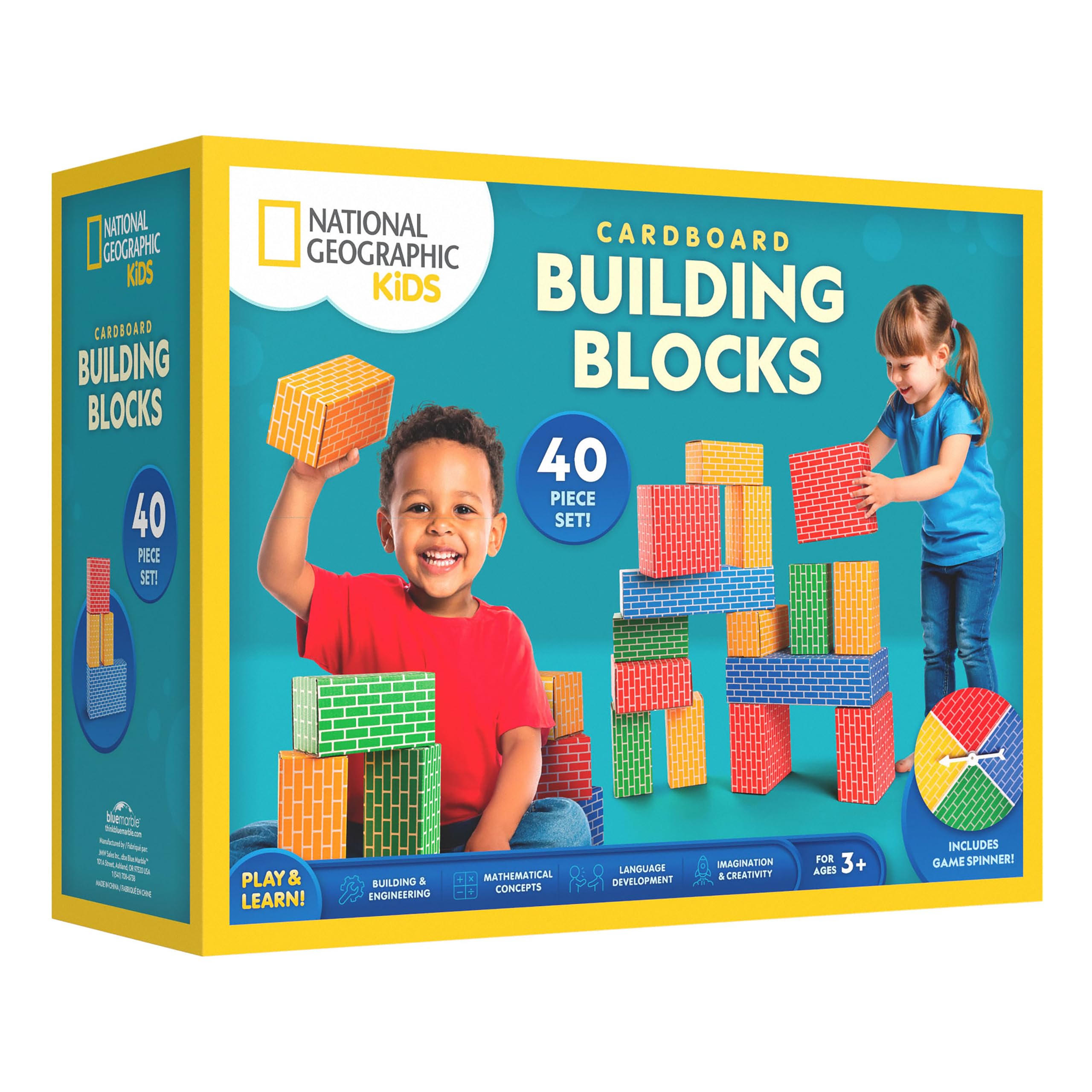
A 40-piece cardboard castle kit that held up to eighteen 2-4 year olds.
This set comes with blocks in three sizes plus a game spinner and activity cards that turn building into a lesson in engineering and storytelling. The blocks have printed-on window and torch details that spark princess-and-dragon scenarios. One owner reported an 18-child play session and the blocks held up fine. A 40-pound toddler stepping on them is no problem, according to buyer reports.
Assembly is the sticking point — some say it takes about an hour to put together, and it is a two-person job if you want to move fast. The blocks are flat-packed and need folding, and a few owners mention the assembly instructions could be clearer. Two sets are needed for a truly substantial castle, according to a buyer.
Smart play, slower setup: The included activity cards make this a stealth STEM toy, but you will need to set aside an evening for folding before the kids can play.
Ideal for: Families who want guided educational prompts along with free building — the spinner adds a fun twist for parties. If you are short on assembly patience, this set requires an hour of folding before first use, so the Teacher Created Resources set assembles faster.
5. Cartboatoy 48-Pack Cardboard Building Blocks
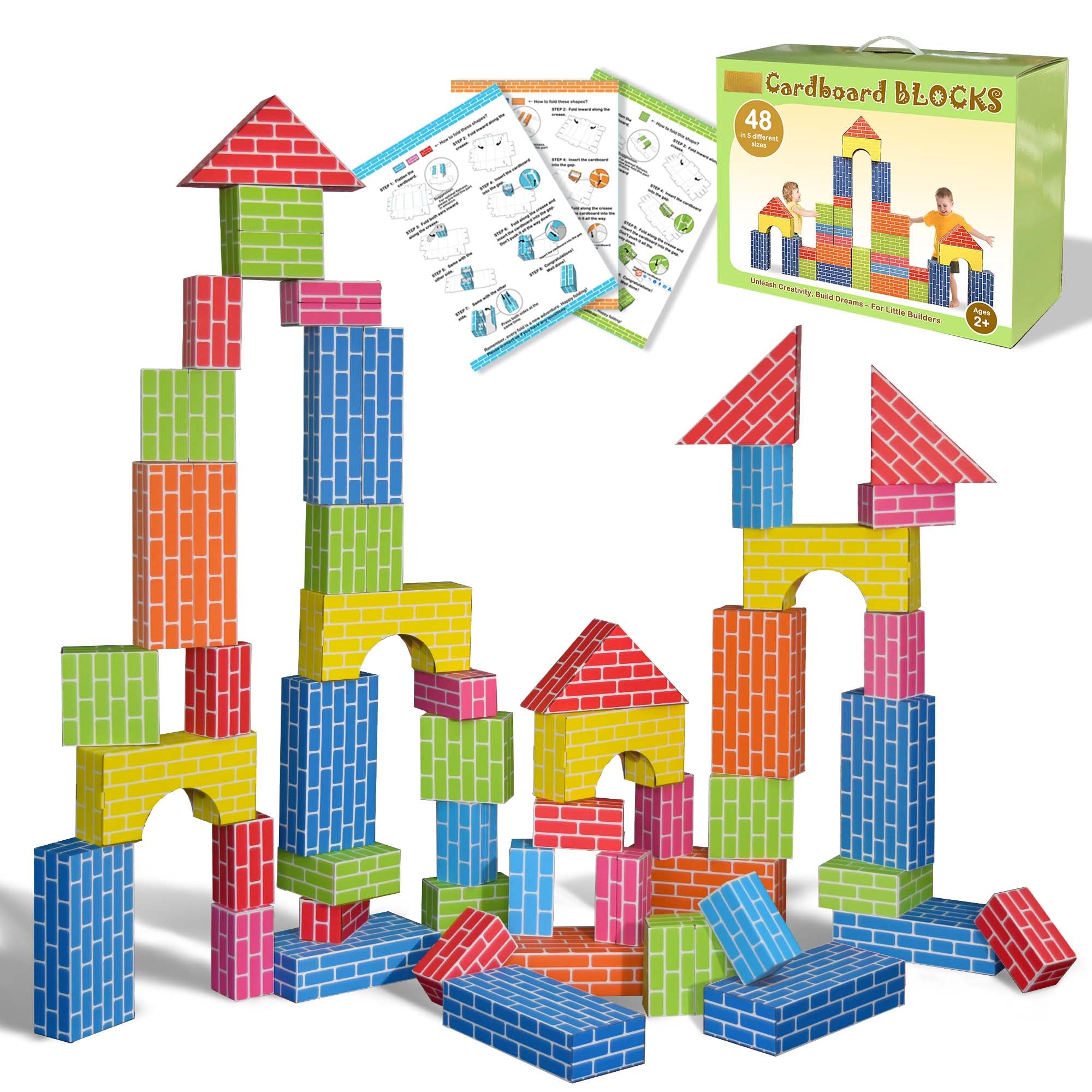
48 pieces of heavy-duty cardboard for kids who need more blocks.
This set is for families who found the 24-piece sets too small. With 48 blocks in multiple sizes and colors, a child can build a fort large enough to crawl inside. The cardboard is heavy-duty and the wipe-clean surface makes maintenance easy. Buyers consistently report the blocks are super durable — one owner specifically wrote they plan to buy more sets. The 5.5-pound total weight is light enough for a child to carry individual blocks.
Building them takes a few minutes of figuring out the folding technique, but owners say it becomes easy quickly. The blocks are flat-packed, so they take up almost no storage space when disassembled. A few owners wished for different shapes beyond rectangles and squares, like arches or triangles.
The Quantity Win
- 48 pieces is enough for two kids to build simultaneously
- Heavy-duty cardboard withstands daily toddler play
- Non-toxic with easy wipe-clean surfaces
The Shape Constraint
- Only rectangular blocks — no triangles, arches, or cylinders
- Initial assembly requires a few minutes of learning the fold pattern
Best for: Families with multiple children who need enough blocks for shared building projects — the 48 count beats the 24-piece Lillian Vernon set for sibling play. Look to the National Geographic set if you want specialty shapes like triangles for roofs.
6. HABA Wooden Building Blocks 26 Piece Set

Solid beech wood from German forests, sized for tiny hands that chew on everything.
These blocks are made of natural, untreated beech wood sourced from sustainable forests in Germany. The standard size is 1.75 by 1.75 inches — much smaller than “giant” but perfectly proportioned for a 9-month-old to grip and teethe on. Owners specifically note these blocks do not chip or splinter like some competing brands, which is crucial for babies who mouth their toys.
The set includes 26 pieces: 6 square blocks, 10 rectangles, 4 triangles, 2 bridges, and 4 columns. A fabric tote with handles makes storage easy. The big trade-offs are the size — these are standard unit blocks, not room-filling giants like the ECR4Kids hollow blocks — and the price, which some owners call “spendy” for 26 pieces. But the quality is consistently praised as excellent, and they are compatible with other standard block sets.
Perfect for: Babies 12 months and older who are still mouthing toys — the smooth, untreated wood is low-maintenance. Skip these if you are looking for giant blocks. These are standard unit blocks, not jumbo-sized.
7. ECR4Kids Hollow Wooden Building Block Set, 18-Piece

Hollow hardwood blocks with GREENGUARD Gold Certification for the safest indoor air.
These are the heavyweight champions of sustainable construction play. The largest rectangle measures 15.75 x 8 x 4 inches — genuinely giant pieces that let children build structures they can crawl into, unlike the standard-sized Migargle blocks. The hollow design makes them lighter than solid wood of the same size, and if a tower falls, the hollow blocks are less likely to hurt anyone. They are GREENGUARD Gold Certified, which means they meet the strictest standards for low chemical emissions — no VOCs (volatile organic compounds) off-gassing into your child’s playroom.
At 36 pounds total for the set, these are heavy blocks. That is a feature for stability — structures stay standing — but it means a preschooler may struggle to carry the largest piece. A few owners mention the price feels steep at first, but note that the blocks have lasted for years in both home and childcare settings. The two flat boards included feel like filler to some owners, but the rounded edges and inset fasteners show careful design.
The Investment
- GREENGUARD Gold Certified — among the safest toy blocks for indoor air quality
- Hollow design balances stability with safety during tower collapses
- Heirloom durability — reviewers point out years of daily use
The Weight Reality
- 36 pounds total set weight is heavy for young children to manage
- Price point is high — this is a serious investment
- Some owners find the two flat board pieces less engaging than additional blocks
Best for: Schools, daycares, and families who want the absolute safest, most durable wooden blocks that will last for a decade. The 36-pound total weight is a genuine limitation for small children, so look to the Teacher Created Resources cardboard blocks if you need something a 2-year-old can carry.
8. RIWI Giant Foam Building Blocks, 24-Piece Set
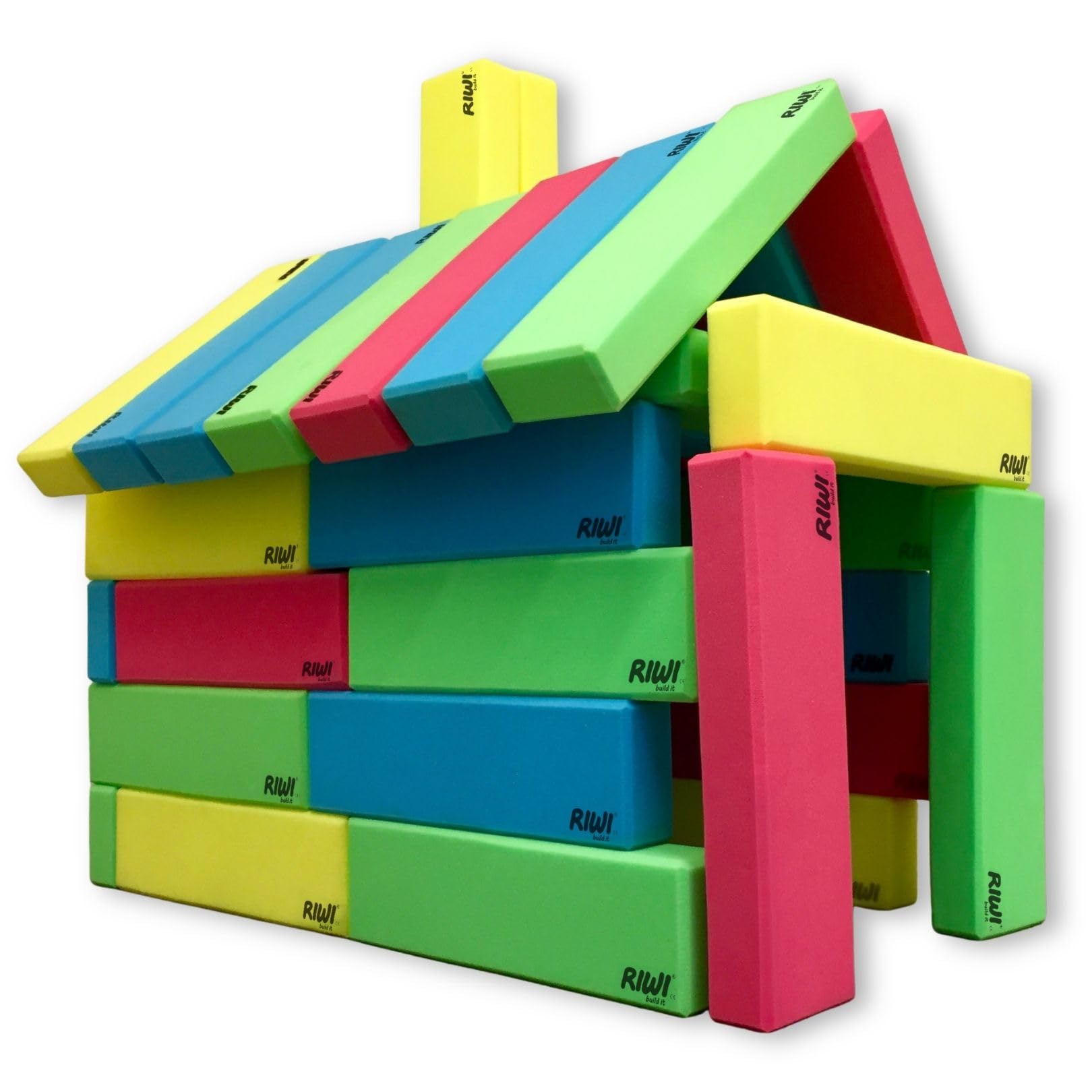
28-inch foam blocks you can toss in the washing machine.
These are the true giants — each block measures 28 x 8 x 4 inches, so a child can build walls taller than themselves. The high-density foam with a high-friction surface helps structures stay together, and the blocks can support up to 240 pounds, meaning kids can sit and climb on them. They are ASTM F963 Certified for toy safety, with soft edges and no hard parts. For washability, no other set in this guide competes — spills, dirt, and germs wash right out.
The downsides are real: pet hair and lint stick to the foam surface like crazy, and there is disagreement among owners about long-term durability. Some say the blocks are sturdy, while others find the foam tears with rough play. They arrive vacuum-sealed, and the creases fade within a few hours to days. The polyurethane foam is harder to recycle at end of life than the wood or cardboard options.
The Jumbo Advantage
- 28-inch blocks create genuinely room-filling structures
- Machine washable — a huge plus for daycare and classroom hygiene
- Supports up to 240 pounds for safe climbing and sitting
The Foam Quirks
- Pet hair and lint stick stubbornly to the foam surface
- Durability concerns — some shoppers say tearing with aggressive play
- Polyurethane foam is harder to recycle at end of life than wood or cardboard
The standout spec here: machine washing is a genuine machine washing is a genuine advantage for shared toys in preschools for shared toys in preschools. If you have pets that shed, the foam is a lint magnet. And if you want a zero-waste end-of-life option, wood or cardboard is more eco-friendly.
Understanding the Specs
Material & Certifications
The material determines the block’s lifespan, weight, and end-of-life disposal. Wooden blocks can last for decades and are often compostable at the end of their life, especially untreated beech wood. Cardboard blocks are fully recyclable and often made from recycled content, but they can wear out faster. Foam blocks are durable and washable but are typically made from polyurethane, which is difficult to recycle. Certifications like GREENGUARD Gold test for off-gassed chemicals called VOCs (volatile organic compounds), ensuring the blocks do not release harmful fumes into your home. ASTM F963 is the basic U.S. toy safety standard that tests for sharp edges, small parts, and toxicity.
Piece Count vs. Build Size
More pieces do not always mean bigger structures — the size of each individual block matters more. A 24-piece set with blocks measuring 12 inches long lets a child build a fort they can crawl into. A 48-piece set of 3-inch blocks only builds small towers. When reading listings, look at the largest block dimension, not just the total piece count. Also consider how many children will play at once — two kids building together generally need at least 30 pieces to avoid fighting over the same brick.
FAQ
What does eco-friendly mean for giant play blocks?
Are wooden blocks safer than cardboard or foam?
How big do giant blocks need to be for a toddler to crawl inside a fort?
How do I clean cardboard blocks without ruining them?
What is GREENGUARD Gold Certification and why does it matter?
Can cardboard blocks hold a child’s weight?
How many blocks do I need for a 3-year-old and a 5-year-old to play together?
Are untreated wooden blocks safe for babies who chew on them?
How long does assembly take for cardboard blocks?
Can I compost cardboard blocks when they wear out?
Final Thoughts: The Verdict
The Teacher Created Resources Easy-Stack wins for most people because it combines the eco-friendly compostability of cardboard with a 150-pound weight rating and classroom-tested durability that spans years. If you want solid natural wood that ages like furniture, grab the ECR4Kids Hollow Wooden Block Set with its GREENGUARD Gold certification for the cleanest indoor air. And for the truly room-filling, machine-washable experience, the RIWI Giant Foam Blocks are the one to reach for.
How We Picked
We do not accept paid placement. Every pick is matched to a real buyer and a real use-case; we do not hands-on test units.
Sources & Methodology
Specifications: manufacturer listings and product documentation. Review insights: verified customer reviews, as of July 2026. Pricing: not shown on this page (it changes often); check the current price via the retailer link.
As an Amazon Associate, WellFizz earns from qualifying purchases. This does not affect which products we feature.
Related Guides

Mo Maruf
I created WellFizz to bridge the gap between vague wellness advice and actionable solutions. My mission is simple: to decode the research and give you practical tools you can actually use.
Beyond the data, I am a passionate traveler. I believe that stepping away from the screen to explore new environments is essential for mental clarity and physical vitality.