Our readers keep the lights on and my smoothie glass nicely filled. As an Amazon Associate, I earn from qualifying purchases.
The difference between a standard heart rate sensor and a medical-grade ECG reading on your wrist is the difference between seeing the smoke and catching the spark. Consumer wearables have flooded the market with optical heart rate tracking, but only a watch equipped with an FDA-cleared electrocardiogram can capture the specific electrical signature of atrial fibrillation when symptoms are fleeting. That single capability separates a fitness accessory from a personal health monitor that could alert you to a condition requiring medical attention.
I’m Mohammad Maruf — the founder and writer behind WellFizz. I’ve spent hundreds of hours analyzing the sensor configurations, certification statuses, and real-world ECG accuracy of the leading smartwatches on the market to determine which models deliver recordings clear enough for clinical review.
Whether you’re monitoring for a known condition or taking a proactive approach to cardiac wellness, knowing the features that make an ECG watch reliable is essential before spending your money. This guide breaks down the top contenders so you can confidently choose the best ecg watches for your specific health and lifestyle needs.
How To Choose The Best ECG Watch
Selecting an ECG watch involves more than comparing processor speeds or app ecosystems. The core decision revolves around sensor accuracy, regulatory clearance, and how seamlessly the data integrates into your healthcare routine. Below are the critical factors that separate a useful health tool from a costly gadget.
Regulatory Certification and Clinical Validity
The most important distinction among ECG watches is whether the ECG feature has received FDA clearance or an equivalent international certification. Watches with this clearance have been tested against standard clinical 12-lead ECGs and proven to detect atrial fibrillation with a statistically significant level of accuracy. Models that lack this clearance may offer an ECG-like reading, but the data lacks the regulatory backing that physicians trust for preliminary screening.
Electrode Design and Recording Protocol
All single-lead wrist-based ECGs require the user to touch a specific point on the bezel or crown with the opposite hand to complete the circuit. The quality of the recording depends heavily on the electrode material, the surface area of the contact point, and the watch’s ability to filter out motion artifact. Watches with larger, dedicated electrode zones on the case tend to produce cleaner traces with fewer failed readings.
Battery Life and Charging Speed
An ECG watch is only useful if it is worn and charged consistently. Since irregular heart rhythms can occur at any time, a watch that needs daily charging creates a gap in monitoring coverage. Models with multi-day battery life reduce the chance that you will remove the device during a critical window. Fast charging also matters — a watch that can recover enough power during a morning shower is more likely to stay on your wrist overnight.
Data Export and Physician Sharing
The ultimate value of an ECG recording lies in its ability to inform a clinical decision. Look for watches that generate a PDF report containing the raw ECG waveform, the device’s automated classification (sinus rhythm, AFib, inconclusive), and any associated symptoms you logged during the reading. The companion app should allow you to email this report directly to your physician or export it to a personal health record system.
Quick Comparison
On smaller screens, swipe sideways to see the full table.
| Model | Category | Best For | Key Spec | Amazon |
|---|---|---|---|---|
| Apple Watch Series 10 GPS 46mm | Premium Smartwatch | iPhone users wanting FDA-cleared ECG + sleep apnea detection | ECG app, Blood Oxygen, sleep apnea notifications | Amazon |
| Apple Watch Series 9 GPS 45mm | Premium Smartwatch | Proven ECG performance with S9 chip reliability | ECG app, irregular rhythm notifications, IP6X | Amazon |
| Samsung Galaxy Watch Ultra 47mm | Rugged Premium | Android users demanding durability and blood pressure monitoring | ECG app, BP monitoring, 590mAh battery, 10ATM | Amazon |
| Garmin Venu 3S 41mm | Mid-Range | Users wanting ECG + advanced sleep coaching and Body Battery | ECG app, Body Battery, 10-day battery, AMOLED | Amazon |
| Google Pixel Watch 4 41mm LTE | Mid-Range | Android users wanting Gemini AI and Fitbit ECG integration | ECG app via Fitbit, 40-hour battery, dual-frequency GPS | Amazon |
| Fitbit Sense 2 | Mid-Range | Stress management with cEDA and ECG for AFib assessment | ECG app, cEDA sensor, SpO2, 6+ day battery | Amazon |
| Garmin Forerunner 970 | Premium | Serious runners and triathletes needing ECG + training metrics | ECG app, running economy, 15-day battery, multi-band GPS | Amazon |
| Withings Scanwatch Nova | Premium Hybrid | Users wanting analog style with ECG and 30-day battery | ECG, SpO2, 30-day battery, stainless steel case | Amazon |
| SOUYIE Men’s Luxury Smart Watch | Budget | Budget-conscious users wanting basic heart health tracking | HR, BP, SpO2 tracking, 1.43″ AMOLED, 400mAh battery | Amazon |
In‑Depth Reviews
1. Apple Watch Series 10 GPS 46mm

Apple’s most advanced wearable to date brings a 30 percent larger display, a thinner aluminum case, and the same FDA-cleared ECG app that clinicians rely on for preliminary atrial fibrillation screening. The Series 10 captures a single-lead ECG in 30 seconds by touching the Digital Crown, automatically classifying the rhythm as sinus, AFib, high/low heart rate, or inconclusive. The new Vitals app aggregates overnight metrics — heart rate, respiratory rate, wrist temperature — alongside sleep stage data to flag potential health trends.
The sleep apnea detection feature, cleared by the FDA, uses the accelerometer to track breathing disturbances over multiple nights, adding another layer of cardiac-respiratory monitoring. Battery life reaches roughly 36 hours with typical use, and fast charging delivers 80 percent capacity in about 30 minutes, minimizing the time the watch spends off your wrist. The always-on Retina display remains readable in direct sunlight, and the IP6X dust resistance combined with 50-meter water resistance means it handles trail runs and pool swims equally well.
For iPhone users who want the most comprehensive ECG ecosystem — including PDF export from the Health app, irregular rhythm notifications, and seamless physician sharing — the Series 10 sets the standard. The only real limitation is the need for an iPhone XS or later; Android users are locked out entirely.
Why it’s great
- FDA-cleared ECG app with clear waveform PDF export for physician review
- New sleep apnea detection adds respiratory monitoring to cardiac data
- Faster charging reaches 80% in roughly 30 minutes for overnight wear continuity
- Lighter, thinner design improves comfort for 24/7 health tracking
Good to know
- Requires an iPhone XS or later — no Android compatibility at all
- Battery life still struggles to reach two full days without a mid-day top-up
- Blood Oxygen app is disabled on newer units sold in the US due to patent issues
2. Apple Watch Series 9 GPS 45mm

The Series 9 remains an excellent ECG-equipped smartwatch even after the Series 10 launch, largely because its core health sensor suite — ECG, blood oxygen, and irregular rhythm notifications — is identical to its successor. The S9 chip powers a brighter always-on display and enables the double-tap gesture for one-handed operation, which is useful when you are holding a coffee or walking the dog. The ECG recording process is unchanged: rest your arm on a table, touch the Digital Crown, and wait 30 seconds for a trace that the Health app classifies automatically and stores as a PDF.
The 45mm case houses a crack-resistant Ion-X glass display that has proven durable in daily wear, and the IP6X dust resistance and 50-meter water resistance allow worry-free use in rain or the pool. Battery life holds at roughly 18 hours of normal use, which means daily charging remains necessary. The included three-month Apple Fitness+ trial adds value if you plan to use the workout features alongside the cardiac monitoring.
For users who want a proven, slightly more affordable entry into Apple’s ECG ecosystem without sacrificing any clinical recording capability, the Series 9 is a smart choice. You lose the Series 10’s faster charging and sleep apnea detection, but the ECG trace quality is identical.
Why it’s great
- Identical FDA-cleared ECG sensor and algorithm as the Series 10
- Double-tap gesture allows one-handed operations during ECG recordings
- Proven durability with crack-resistant glass and IP6X dust resistance
- Blood Oxygen sensor still active on all units sold in the US
Good to know
- Battery life requires daily charging — overnight gaps in monitoring are possible
- No sleep apnea detection feature that the Series 10 offers
- iPhone XS or newer is mandatory; no Android pairing available
3. Samsung Galaxy Watch Ultra 47mm LTE
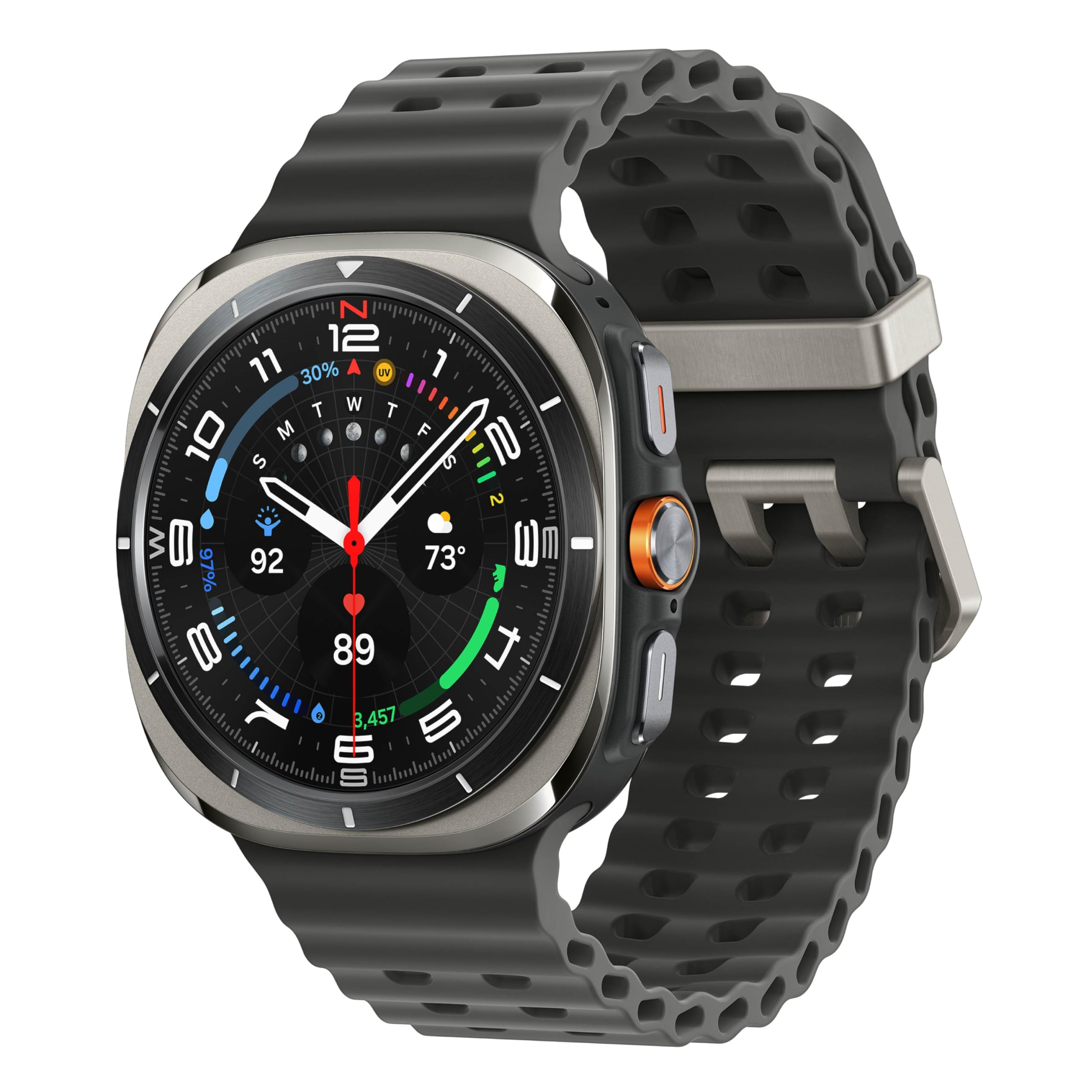
Samsung’s most rugged wearable combines a titanium casing and 10ATM water resistance with the Samsung Health Monitor app, which includes both an FDA-cleared ECG tool and a blood pressure monitoring feature that requires calibration with a traditional cuff. The ECG recording works the same way as Apple’s — rest your arm, touch the Home button, and wait for the 30-second trace — but Samsung’s implementation also allows you to manually log symptoms such as dizziness, shortness of breath, or palpitations directly alongside the waveform.
The 590mAh battery delivers roughly 60 hours of typical use, which is significantly longer than Apple’s 36-hour ceiling. In battery-saver mode, the Ultra stretches to several days, reducing the monitoring gaps caused by frequent charging. The dual-frequency GPS provides accurate route tracking for outdoor activities, and the new Energy Score feature aggregates sleep, activity, and heart rate data into a single readiness number. The 47mm case is large and heavy — it sits prominently on the wrist and may not suit users with smaller wrists.
Android users who want FDA-cleared ECG and blood pressure monitoring in a case that survives ocean swimming and trail abuse will find the Galaxy Watch Ultra compelling. The rotating bezel is physical rather than digital, giving satisfying tactile feedback during menu navigation.
Why it’s great
- FDA-cleared ECG and blood pressure monitoring in a single device
- Titanium casing and 10ATM water resistance for extreme durability
- 590mAh battery lasts roughly 60 hours with typical use
- Manual symptom logging alongside ECG waveform for clinical context
Good to know
- 47mm case is bulky and may feel heavy on smaller wrists
- Blood pressure monitoring requires periodic calibration with a standard cuff
- Adds another subscription layer for advanced sleep coaching features
4. Garmin Venu 3S 41mm

Garmin’s Venu 3S takes a different approach by offering an ECG app that integrates directly with the Garmin Connect ecosystem, allowing you to view your heart rhythm data alongside sleep scores, Body Battery energy monitoring, and stress tracking. The ECG feature, cleared by the FDA, records a 30-second trace when you hold two fingers on the bezel — a slightly different electrode position than the crown-based approach used by Apple and Samsung. The resulting waveform is stored as a PDF that can be exported for physician review.
The 41mm case is smaller and lighter than most premium ECG watches, making it a strong option for users with smaller wrists. Battery life reaches up to 10 days in smartwatch mode, which is exceptional for a watch with an always-on AMOLED display and continuous heart rate monitoring. The morning report feature summarizes overnight health metrics and HRV status each day, giving you a snapshot of recovery readiness. The Venu 3S also supports wheelchair mode, tracking pushes instead of steps for users who need that accessibility option.
For users who want ECG capability without sacrificing sleep tracking depth or multi-day battery life, the Venu 3S strikes an excellent balance. The smartphone voice assistant integration works with both iPhone and Android, and the music storage feature allows offline playback from Spotify and other services.
Why it’s great
- FDA-cleared ECG with easy PDF export from Garmin Connect
- 10-day battery life minimizes charging gaps for continuous monitoring
- 41mm case fits smaller wrists comfortably
- Body Battery and HRV data provide context for ECG readings
Good to know
- ECG recording requires two fingers on the bezel, not a crown touch
- No irregular rhythm notifications — ECG is on-demand only
- Screen protector recommended due to glass bezel vulnerability
5. Google Pixel Watch 4 41mm LTE

The Pixel Watch 4 represents Google’s most polished wearable yet, integrating Fitbit’s FDA-cleared ECG algorithm directly into the Pixel ecosystem. The ECG recording process is identical to Fitbit’s established method — open the Fitbit ECG app on the watch, rest your arm on a flat surface, and touch the crown with your opposite hand for 30 seconds. The Fitbit app stores the waveform and automatically classifies the rhythm as sinus, AFib, or inconclusive, and you can export a PDF report for your doctor from within the app.
The 41mm domed design features a polished silver aluminum case and an iris silicone band, with a display that is crisp and bright in direct sunlight. Battery life reaches up to 40 hours with always-on display enabled, and the new side charging dock delivers 15 hours of battery in roughly 15 minutes — enough to cover an overnight charging gap quickly. The built-in Gemini AI assistant allows hands-free question answering and message composition, and the LTE version keeps you connected without a phone nearby.
Android users who want Fitbit’s clinically validated ECG alongside Google’s AI-powered assistant and fast charging will find the Pixel Watch 4 a compelling package. The Fitbit Premium subscription, included for the first three months, adds deeper sleep and readiness analytics that complement the ECG data.
Why it’s great
- Fitbit’s FDA-cleared ECG algorithm proven in clinical studies
- Fast charging delivers 15 hours of battery in about 15 minutes
- Gemini AI assistant provides hands-free interaction for quick ECG logging
- LTE connectivity for ECG recording without a nearby phone
Good to know
- Battery life is roughly 40 hours — still requires every-other-day charging
- LTE model adds monthly carrier fees for independent connectivity
- ECG data relies on the Fitbit app, not native Google Health services
6. Fitbit Sense 2

Fitbit’s Sense 2 distinguishes itself with the continuous electrodermal activity (cEDA) sensor, which measures stress-related sweat gland activity on your wrist and pairs that data with the FDA-cleared ECG app for a more complete picture of cardiac health under stress. The ECG recording process is straightforward — open the ECG app, hold your fingers on the stainless steel ring around the housing, and wait 30 seconds. The Fitbit app categorizes the result and stores the waveform as a PDF you can share with a physician.
The 40mm case is comfortable for all-day and all-night wear, and the battery life of over six days with typical use means fewer charging interruptions to your monitoring schedule. The built-in GPS tracks outdoor workouts without needing your phone, and the sleep tracking provides a Sleep Score alongside detailed stage analysis. The Daily Readiness Score tells you whether your body is recovered enough for a hard workout or needs rest, which is helpful for balancing exercise with cardiac health management.
Users who are particularly concerned about the interplay between stress and heart rhythm will find the cEDA sensor a unique addition that no other ECG watch offers. The three-month Google Health Premium membership included with the Sense 2 unlocks deeper analytics and personalized coaching.
Why it’s great
- FDA-cleared ECG combined with unique cEDA stress tracking
- Over six days of battery life reduces monitoring gaps
- Daily Readiness Score helps balance exercise with cardiac recovery
- Comfortable 40mm case suits smaller wrists for overnight wear
Good to know
- ECG is on-demand only — no passive irregular rhythm notifications on this model
- Charging connector prongs can become clogged over time
- Some advanced analytics require a Fitbit Premium subscription after trial
7. Garmin Forerunner 970

The Forerunner 970 is Garmin’s premier running and triathlon watch with an FDA-cleared ECG app that records a 30-second trace when you hold two fingers on the metal bezel. The ECG waveform integrates into Garmin Connect alongside a staggering depth of training metrics — running economy, step speed loss, ground contact time, and wrist-based running power — allowing serious athletes to correlate their heart rhythm data with performance load. The sapphire lens and titanium bezel provide exceptional scratch resistance for daily training abuse.
Battery life is extraordinary: up to 15 days in smartwatch mode and up to 26 hours in GPS mode, making it the longest-lasting ECG watch in this guide. The built-in LED flashlight is surprisingly useful for early morning or late-night runs, and the full-color onboard maps with multi-band GPS ensure accurate navigation on unfamiliar routes. The Training Readiness score combines sleep quality, recovery, training load, and HRV status to tell you when it is safe to push hard and when you should rest.
Dedicated runners and triathletes who want both FDA-cleared ECG capability and professional-grade training analytics will find the Forerunner 970 unmatched. The learning curve is steeper than a consumer smartwatch, but the depth of data justifies the investment for performance-oriented users.
Why it’s great
- FDA-cleared ECG integrated with professional training metrics
- 15-day battery life in smartwatch mode avoids charging gaps entirely
- Sapphire lens and titanium bezel resist scratches from trail use
- Built-in LED flashlight adds safety for low-light runs
Good to know
- ECG is on-demand only — no passive AFib notifications
- Steep learning curve for navigating the training analytics
- Running economy metrics require optional HRM-Pro chest strap
8. Withings Scanwatch Nova
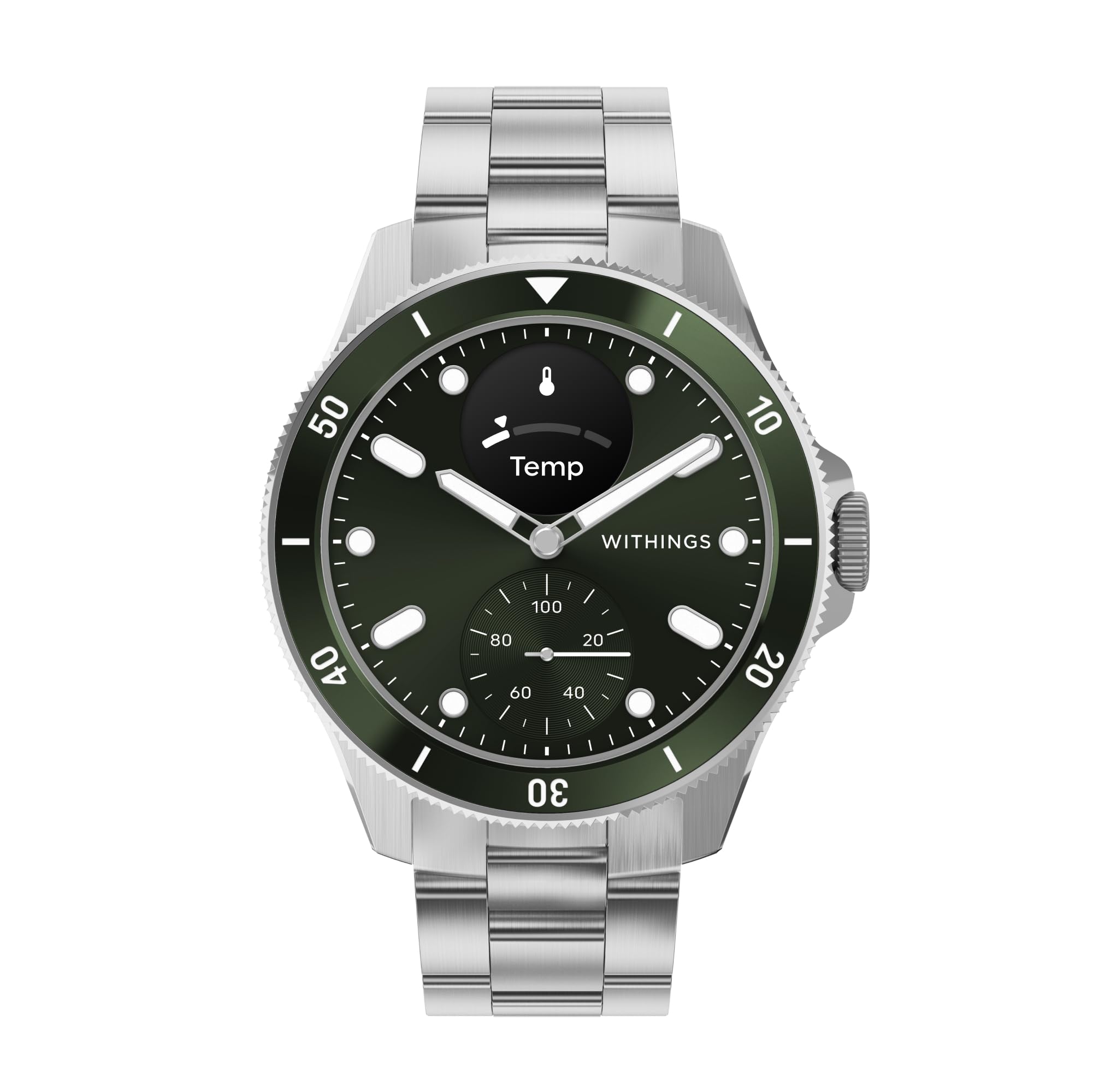
Withings takes a fundamentally different approach by hiding an FDA-cleared ECG sensor inside a traditional analog watch with a stainless steel case and sapphire glass, appealing to users who want medical-grade heart monitoring without the look of a full smartwatch. The ECG recording requires you to touch the crown with your opposite hand, and the small digital display shows your heart rate and the ECG status. The Withings app stores the waveform, classifies it as sinus rhythm, AFib, or inconclusive, and allows PDF export for physician sharing.
The 30-day battery life is the longest of any ECG watch reviewed here, achieved because the analog hands and digital components draw minimal power. The watch also tracks overnight heart rate, SpO2 via a red sensor on the back, and sleep stages, assigning a Sleep Quality Score each morning. The connected GPS uses your phone’s location to map outdoor walks and runs. The hybrid design includes a stainless steel bracelet and an extra FKM rubber band in the box, giving you two style options.
Users who appreciate traditional watch aesthetics but need FDA-cleared ECG capability and hate frequent charging will find the Scanwatch Nova a perfect fit. The trade-off is a minimal feature set — there is no workout coach, GPS, or AI assistant — but the battery endurance and classic appearance are unmatched.
Why it’s great
- FDA-cleared ECG inside a traditional analog watch design
- 30-day battery life is the longest of any ECG watch available
- Sapphire glass and stainless steel case offer premium durability
- Includes both stainless steel band and FKM rubber strap
Good to know
- No passive AFib notifications — ECG is on-demand only
- No onboard GPS, workout coach, or music storage
- Sleep tracking can misinterpret quiet rest as sleep
9. SOUYIE Men’s Luxury Smart Watch

SOUYIE offers an entry-level wearable with a 1.43-inch AMOLED display and a 466×466 resolution that exceeds many premium smartwatches in pixel density, yet it lands at a budget-friendly price point. The watch tracks heart rate, blood pressure, and blood oxygen continuously via optical sensors, and it provides sleep stage analysis. It does not, however, include an FDA-cleared ECG sensor — the health monitoring is based on photoplethysmography and bioimpedance, which can indicate trends but cannot produce the kind of clinical-grade electrical trace needed for AFib diagnosis.
The dual-band package includes both a metal bracelet and a silicone strap, giving two distinct looks for business and casual settings. The 400mAh battery delivers roughly 7 to 10 days of use, which is respectable for a watch with an always-on AMOLED panel. The watch supports Bluetooth calling, voice assistant access, and notifications from major messaging apps, and the 100-plus sport modes cover most common activities.
For buyers on a tight budget who want a bright AMOLED display, long battery life, and basic heart rate trending, the SOUYIE provides solid value. Just be aware that it cannot replace a medically cleared ECG device — if your primary need is atrial fibrillation detection, you will need to step up to one of the certified models in this guide.
Why it’s great
- Brilliant 466×466 AMOLED display that rivals watches costing several times more
- Includes both metal and silicone bands for versatile styling
- 7-10 day battery life reduces charging frequency
- 100+ sport modes cover a wide range of activities
Good to know
- No FDA-cleared ECG sensor — optical HR only
- Sleep tracking can be inconsistent, sometimes reporting rest as sleep
- No tap-to-pay or onboard music storage
FAQ
Can an ECG watch replace a visit to a cardiologist?
How often should I take an ECG reading with my smartwatch?
Why do some ECG watches require me to touch the crown while others use the bezel?
Final Thoughts: The Verdict
For most users, the best ecg watches winner is the Apple Watch Series 10 GPS 46mm because it combines an FDA-cleared ECG app with sleep apnea detection, fast charging, and the most seamless physician-sharing workflow via the Health app. If you want extreme durability and blood pressure monitoring on Android, grab the Samsung Galaxy Watch Ultra 47mm LTE. And for the longest battery life and a traditional analog appearance, nothing beats the Withings Scanwatch Nova.

Mo Maruf
I created WellFizz to bridge the gap between vague wellness advice and actionable solutions. My mission is simple: to decode the research and give you practical tools you can actually use.
Beyond the data, I am a passionate traveler. I believe that stepping away from the screen to explore new environments is essential for mental clarity and physical vitality.