Our readers keep the lights on and my smoothie glass nicely filled. As an Amazon Associate, I earn from qualifying purchases.
Specs are compiled from manufacturer listings and verified buyer reviews and can change over time — please confirm the key details on the product page before buying.
The problem with shooting earmuffs is simple: the best ones let you hear conversation and footfalls, then slam the door shut on a gunshot — instantly. A pair that only muffles everything equally leaves you isolated on the range, unable to hear commands or buddies. This guide cuts through the noise to find the electronic pairs that actually balance protection with awareness, tested by thousands of real owners.
I’m Mohammad Maruf — the founder and writer behind WellFizz. This guide is built by comparing the manufacturers’ published specifications and the patterns across verified customer reviews, so you get each pick’s real strengths and trade-offs instead of marketing spin.
Whether you are a weekend plinker, a competitive shooter, or a range safety officer, you need a pair that vanishes on your head and reacts faster than you can blink. Here is the most honest breakdown of the best earmuffs for shooting you will find anywhere, based on what tens of thousands of owners actually experience.
Our Picks at a Glance


How To Choose The Best Earmuffs For Shooting
Choosing the right pair starts with knowing what you will be doing most: static range practice, hunting in the field, or competitive shooting where you need to hear range commands. The three specs that matter most are your Noise Reduction Rating (NRR), the speed of the sound-activated compression, and the physical profile of the ear cups.
Noise Reduction Rating (NRR) — The Safety Floor
NRR (Noise Reduction Rating, measured in dB) tells you how much noise the earmuff physically blocks. For shooting, you want an NRR of at least 22 dB — anything lower risks long-term hearing damage from repeated rifle and pistol fire. A 23 dB rating is the most common balance: it allows for slim cups that do not interfere with your gun stock while still keeping your ears safe. If you are shooting indoors or using a caliber above.308, you may want to double up with foam earplugs underneath.
Sound-Activated Compression — The Reaction Time
This is the feature that makes electronic earmuffs smart. Tiny microphones pick up ambient sound and play it through internal speakers at a safe level, so you can hear conversations. When a loud gunshot hits the microphone, the circuitry compresses that sound to a safe level (usually to below 82 dB) in milliseconds. The best pairs do this in under 0.02 seconds — fast enough that your ear drums never feel the full blast. A slow or poor compression circuit can let a sharp crack through, which is both painful and dangerous.
Low-Profile Ear Cups and Cheek Weld
If you shoot rifles, the shape and thickness of the ear cup is critical. Bulky cups push off your shooting glasses or bump into the stock when you try to get a good cheek weld — the contact between your cheek and the stock that gives you a stable sight picture. Slim, low-profile cups with cutaways are designed to leave room for the stock, so you can stay in position without breaking your seal. Passive earmuffs with high NRR ratings (like 30 dB) tend to have deeper cups that can get in the way, which is why many shooters prefer electronic muffs with a 22-23 dB NRR and a slim build.
Quick Comparison
| Model | Best For | NRR (dB) | Profile | Power | Amazon |
|---|---|---|---|---|---|
| Walker’s Razor Slim Electronic Muff★ Best Overall | Best Overall | 23 | Ultra Low-Profile | 2x AAA | Amazon |
| Floriogra Electronic Ear ProtectionPremium Pick | Premium Pick | 23 | Low-Profile | 2x AAA | Amazon |
| Caldwell E-Max ProBest Value | Best Value | 23 | Low-Profile | 2x AAA | Amazon |
| Walker’s TACTI Grip Series | Secure Fit | 23 | Low-Profile | 2x AAA | Amazon |
| M300A Ear Protection | Compact Pick | 23 | Low-Profile | 2x AAA | Amazon |
| Howard Leight Leightning L3 | Max Protection | 30 | Full-Size | None (Passive) | Amazon |
| Howard Leight Impact Sport | Hunting / Field | 22 | Low-Profile | 2x AAA | Amazon |
| EARMOR M32 Plus Tactical Headset | Tactical / Comms | 22 | Tactical | 2x AAA | Amazon |
| Walker’s FireMax Rechargeable | Rechargeable | 23 | Low-Profile | Rechargeable | Amazon |
In‑Depth Reviews
1. Walker’s Razor Slim Electronic Muff
Our pick — over 4.5★ from 84,790 verified ratings; the strongest balance of quality and price.
The crowd favorite that proves you can protect your hearing without losing the conversation.
Nearly 85,000 owners have made this the most-reviewed electronic earmuff on the market, and the consensus is clear: it just works. The ultra low-profile ear cups are the defining feature here — they are slim enough that when you shoulder a rifle, the cup does not bump the stock and break the seal. This is the pair that solves the cheek weld problem without thinking about it. The sound-activated compression operates in the critical 0.02-second range, clamping down on the blast while the two hi-gain omnidirectional microphones keep range commands and buddy chatter clear.
Buyers report testing these with a 9mm and finding “perfect attenuation, no discomfort.” The compression is fast enough that a.44 Magnum at close range gets tamed to a thump rather than a crack. Some owners note the directional sound from the mics has a slight artificial feel, and that larger ears may feel fatigue after a couple of hours. The sound-dampening composite housing shrugs off being dropped or soaked, and the 3.5mm audio jack lets you pipe in a radio or music if you want. For sheer value and proven performance, this is the one that beats everything else at its price tier.
Why It Wins the Range
- Ultra slim cups clear rifle stocks easily
- Sound-activated compression handles magnum calibers without pain
- Tens of thousands of owners confirm the durability and battery life
Honest Limitations
- Directional audio can feel slightly artificial with noticeable latency
- Larger ears may need a break after a couple of hours
Reach for these if: you want the most proven, best-selling electronic muff for general range use that does not interfere with your rifle stock.
Think twice if: you need passive protection for extreme indoor noise — here, double up with foam plugs underneath.
2. Floriogra Electronic Ear Protection
Amplifies a deer’s footfall in the thicket, then silences the shot before you hear it.
What sets Floriogra apart is the 5X sound amplification. The low-end frequencies get a boost, so you hear rustling leaves and distant movement with unnatural clarity — a real advantage when you are hunting rather than standing on a flat range. The active protection kicks in when noise exceeds 82 dB, reducing it to a safe level within 0.01 seconds. Owners who tested this with a.223 and.556 report they “could feel the blast but not hear it,” which is exactly the goal.
The ear cups are slim with cutaways for stock clearance, and the headband is both telescopic and padded, keeping the weight at just 0.6 pounds. That IPX4 water resistance rating means rain or sweat will not kill the electronics. The single-knob volume control is easy to find even with gloves on. While a few owners mention the durability is mixed over the long term, the overwhelming feedback (with functionality being the most-praised aspect by 82 mentions) is that these work extremely well, with the noise protection coming in as the second most-praised feature. For a premium feel at a mid-range entry point, this is a strong contender.
Why Hunters Love It
- 5X amplification makes faint sounds — footsteps, leaves — clearly audible
- Active compression kicks in at 0.01 seconds, faster than most reflexes
- Lightweight at 0.6 lbs with a comfortable telescopic headband
Honest Limitations
- Long-term durability has a few mixed owner reports
Grab these for: hunting scenarios where hearing faint ambient sounds gives you an edge, plus reliable all-day comfort.
Pass if: you want the absolute lowest price for a simple range muff — this is more feature-rich than strictly budget.
3. Caldwell E-Max Pro Electronic Hearing Protection
A solid, no-nonsense electronic muff that delivers quality without the premium price tag.
The Caldwell E-Max Pro hits the essential checklist: a 23 dB NRR, low-profile ear cups, dual microphones for stereo sound, and an audio input jack. Owners consistently praise the build quality and the noise cancellation — it effectively makes the range “a blast now” because you can hear instructions clearly while the loud reports are fully suppressed. For a shooter on a budget, this gets you electronic protection without cutting corners on safety.
The catch is that the controls are molded-in buttons rather than a knob, which some owners find annoying to adjust without taking the muffs off. There is also a split in the feedback on comfort for long sessions; one owner called them “not great for long shooting sessions,” while another loved the all-day feel. The quality is the top positive aspect (10 mentions), followed by noise cancellation (6 mentions). For the price, you get a functional pair that does its job — just be aware the buttons take some getting used to, and plan for comfort breaks if your range day stretches past a couple of hours.
Why It’s a Smart Buy
- Solid build quality and effective noise cancellation at a budget-friendly price
- Dual microphones deliver clear stereo sound for range commands
Honest Limitations
- Molded buttons are harder to use by feel than a knob
- Comfort for long sessions is mixed among owners
Pick this if: you want a reliable electronic muff for occasional range trips without spending more than necessary.
Skip if: you need all-day comfort for competitive or professional use — the buttons and comfort may frustrate.
4. Walker’s TACTI Grip Series

The silicone-clad headband that stays planted when you pivot and swing.
The headline feature here is the Tacti-Grip silicone composite headband. It uses a metal wireframe covered in a durable rubber sheath, so the muffs do not slide around when you are moving dynamically — shooting around barriers, transitioning between targets, or stalking game. The core electronics are the same proven Walker’s platform: 23 dB NRR, two hi-gain omnidirectional microphones, and a 0.02-second sound-activated compression that instantly squashes gunshots.
The gel earpads are a welcome upgrade. Owners mention the comfort is excellent, with many saying the quality is the top reason they bought these (46 mentions). The noise cancellation allows you to have a conversation and shoot without removing the muffs — “flawless instant dampening,” as one owner put it. The biggest recurring complaint is the lack of an auto shut-off, which means you can drain the AAA batteries if you forget to power down. A few owners also note the rubber coating can get tacky after years of use. If you need muffs that stay put during active shooting, this is the pair.
Why It Grips
- Rubber-coated headband resists slipping during dynamic movement
- Quality build with 46 mentions as the top positive aspect
- Gel earpads provide comfort for extended wear
Honest Limitations
- No auto shut-off — batteries drain if left on
- Rubber coating can become tacky over time
Ideal for: competition shooters and hunters who move between positions and cannot have their muffs sliding around.
Not for: those who want a set-and-forget muff with automatic power management.
5. M300A Ear Protection For Gun Range
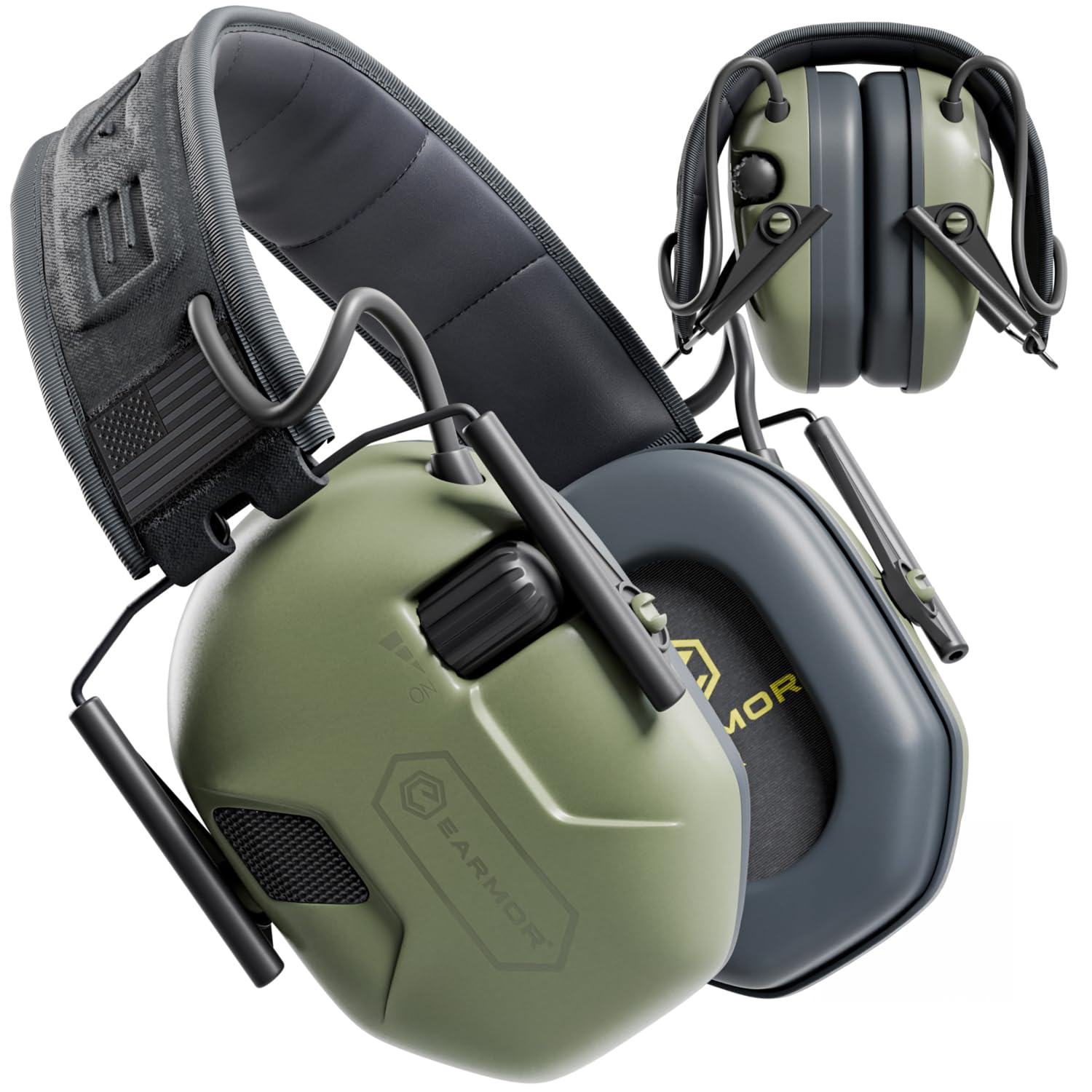
A compact, ergonomic build that folds small and resists the elements with IPX5 protection.
The M300A stands out for its ergonomic gel cushions and IPX5 waterproof construction. If you shoot in wet conditions or sweat heavily, this rating means rain and moisture will not take out the electronics. The 23 dB NRR is on par with the rest of the electronic field, but the real trick is the three awareness modes — you can tune how much ambient sound comes through, letting you dial in the balance between protection and awareness for your specific environment.
Owners highlight the comfort as a top positive (7 mentions), especially when worn with glasses — a common pain point with other muffs that press the frames into your head. The functionality also earned 7 mentions as a top aspect, with the adjustable noise cancellation being a specific favorite. The sound quality gets mixed reviews; some owners find the internal speakers slightly loud or lacking clarity. There is also a note that clamping force is high, which can break the seal on glasses for some users. For a compact, rugged option that stows easily, this is a solid choice.
Why It Fits
- IPX5 waterproof rating handles rain and heavy sweat
- Ergonomic gel cushions are comfortable with glasses
- Three awareness modes let you tune ambient sound
Honest Limitations
- Sound quality receives mixed feedback — some find it slightly loud
- High clamping force can break the seal on some glasses
Best for: shooters who need a weather-resistant, compact muff that puts comfort with glasses first.
Consider alternatives if: sound fidelity and a gentle clamp are your top priorities.
6. Howard Leight by Honeywell Leightning L3

The highest noise reduction rating on this list — a 30 dB passive fortress for extreme noise.
If you need raw, uncompromising noise reduction, the Leightning L3 offers a 30 dB NRR — significantly higher than the 22-23 dB of the electronic muffs here. This is a passive muff, meaning no batteries, no microphones, no sound amplification. It uses Howard Leight’s patented Air Flow Control technology, which reduces sound across all frequencies without making the ear cups bulkier than necessary. The result is a quiet, comfortable seal that owners describe as excellent for shooting and even for blocking out neighbor noise for sleeping.
The super-soft ear cushions are designed to eliminate the “squeezing” sensation on the head, and the steel wire headband snaps into place for a custom fit. Owners note the ear cups are wide, which means they are not low-profile — they can interfere with shouldering a long gun. This is the trade-off: you get the best protection on this list, but you lose the slim profile and the ability to hear range commands. The wide cups and the fact that it is passive make it best for shooters who prioritize maximum sound blocking over communication or stock clearance.
Why It Blocks Everything
- 30 dB NRR — the highest protection in this guide
- Super-soft cushions eliminate head squeezing pressure
- Steel wire headband is durable and adjustable
Honest Limitations
- Wide, full-size cups can interfere with rifle stock clearance
- Passive only — you cannot hear conversations without removing them
Reach for this if: you shoot indoors or use loud calibers where maximum protection matters more than communication.
Skip if: you need to hear range commands or want a low-profile cup for rifle shooting.
7. Howard Leight Impact Sport Earmuffs

A legendary field muff with natural directional audio and a 350-hour battery life.
The Impact Sport is a classic for a reason: it uses built-in directional microphones that amplify sounds up to a safe 82 dB, then automatically shuts off amplification when a loud noise arrives. This gives you more natural listening than omnidirectional mics — you can tell which direction a command or an animal is coming from. The 22 dB NRR is adequate for outdoor use, but owners warn it is not enough for loud indoor ranges without foam earplugs underneath.
The low-profile ear cups are designed for stock clearance, and the compact folding design makes it easy to stow in a range bag. The auto shut-off feature kicks in after 4 hours of inactivity, preserving the 350-hour battery life. Build quality is a massive highlight — with 5,400 positive mentions, it is the most-praised aspect by a wide margin. Some owners mention headaches when wearing these with eye protection for extended periods, which is often solved with gel ear pad replacements. For outdoor shooting and hunting, this is a battle-tested workhorse that has been in production for years.
Why It’s a Legend
- Directional microphones provide more natural spatial awareness
- 350-hour battery life with 4-hour auto shut-off
- Low-profile design with compact folding storage
Honest Limitations
- 22 dB NRR may need foam plug backup for indoor or high-caliber shooting
- Some owners experience headaches with prolonged wear and eye pro
Best for: outdoor hunters and range shooters who value battery life, directional audio, and a proven track record.
Not ideal for: indoor ranges or users who want passive maximum-block protection — the 22 dB NRR is a floor, not a fortress.
8. EARMOR M32 Plus Tactical Headset

Tactical comms performance at a fraction of the alternatives.
The M32 Plus is built for shooters who need radio communication. It uses a true military-spec U94 connector (not the civilian version), and it works with Kenwood-type (2-pin) and Motorola-type radios. You need a matching Push-To-Talk (PTT) adapter for radio use, but once set up, the removable boom mic (left side only) delivers clear transmission. Without the mic, it functions as a standard electronic hearing protection headset with dual ambient microphones and a 22 dB NRR.
The silicon gel ear pads and cushioned headband get consistent praise for all-day comfort — owners rate comfort a 10/10. The battery life is rated up to 60 hours with a 4-hour auto shut-off, and an IPX5 waterproof rating handles rain. The sound amplification enhances ambient sounds beyond natural hearing, then mutes gunshots effectively. A few owners note the plastic feels less premium than competitors, and the sound profile can feel “flat” compared to higher-end headsets. But for the price, it is constantly compared favorably to headsets costing three times as much.
Why Teams Choose It
- True military U94 connector for radio comms (requires PTT adapter)
- Comfort score of 10/10 from owners, with gel ear pads
- Up to 60-hour battery life with IPX5 weather resistance
Honest Limitations
- Plastic build may feel less premium than headsets
- Sound profile described as “flat” by some owners
Ideal for: tactical shooters, airsoft teams, or anyone needing radio integration without spending +.
Pass if: you do not need comms — simpler electronic muffs like the Walker’s Razor are cheaper and sound better for pure hearing protection.
9. Walker’s FireMax Rechargeable Earmuffs
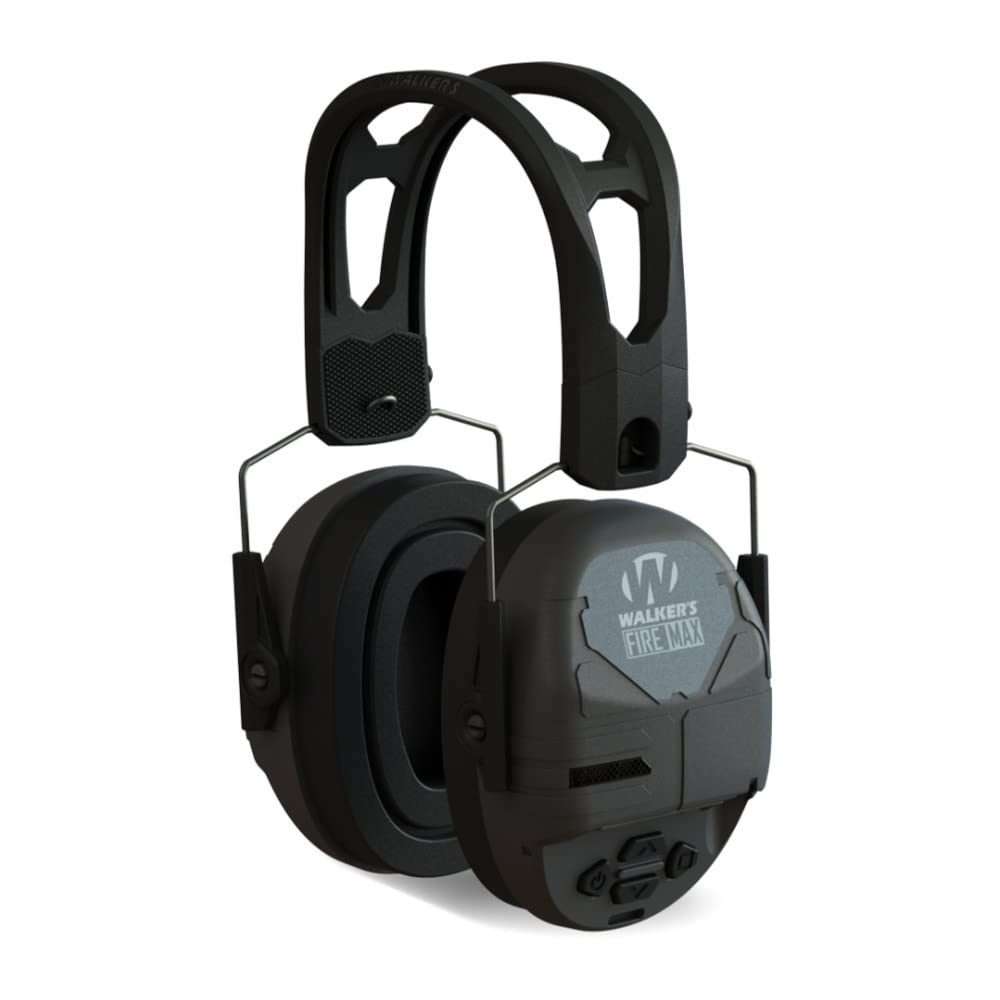
Ditch the AAA hunt — a 200-hour rechargeable battery that lasts all season.
The FireMax solves the battery problem permanently. It packs an internal 2000mAh rechargeable battery that delivers up to 200 hours of use, and it charges via USB-C. No more buying packs of AAA batteries or wondering if your muffs will die mid-session. The rest of the package is classic Walker’s: 23 dB NRR, low-profile design, cooling gel ear pads, and a rubber Tacti-Grip headband for secure fit.
What makes the FireMax unique is the digital sound processing. It has four frequency modes (normal, clear voice, high frequency, and boost), letting you tailor the ambient sound to your environment. The digital soft-touch buttons are easier to use than the molded buttons on some competitors. Owners rave about the comfort in hot weather — the gel pads do not trap sweat like foam, and the low-profile cups clear rifle stocks well. The clamp is snug, so some find it a bit tight at first, but it breaks in. The only real downsides are the price (it is the most expensive pair here) and a faint background hiss that some units exhibit. If you want to stop worrying about batteries, this is the one.
Why It’s a Game-Changer
- Internal 2000mAh battery lasts up to 200 hours on a charge
- USB-C charging and low-battery voice alert eliminates guesswork
- Four frequency modes for tailored ambient sound
Honest Limitations
- Premium price point compared to AAA-powered alternatives
- A faint hiss is present on some units
Best for: shooters who want a rechargeable, low-maintenance solution and value the convenience of USB-C.
Skip if: you are on a tight budget or prefer the simplicity of replaceable AAA batteries.
Understanding the Specs
Noise Reduction Rating (NRR)
The NRR is a single decibel number that tells you how much sound the earmuff physically blocks. For shooting, 22 dB is the minimum safe floor, and most electronic muffs sit at 23 dB. A 30 dB NRR (like the passive Howard Leight Leightning L3) blocks more sound but usually means bulkier ear cups that can interfere with shoulder-mounted rifles. The real-world protection you get is roughly half the NRR number — so a 23 dB muff effectively cuts sound by about 11-12 dB. That is enough to turn a 140 dB gunshot into a safe 128-129 dB, which is well inside the safe listening range.
Sound-Activated Compression (Attack Time)
This is the speed at which the electronic circuit clamps down on a loud sound. A good muff reacts in under 0.02 seconds (20 milliseconds). The Floriogra model claims 0.01 seconds, which is faster than the blink of an eye. If the attack time is too slow, a fraction of the gunshot’s peak energy reaches your ears before the compression kicks in, which defeats the purpose. You cannot feel the attack time — you just notice that you never hear the full bang, only a muffled thump.
FAQ
What is the difference between passive and electronic earmuffs?
Can I wear electronic earmuffs with glasses or sunglasses?
Are electronic earmuffs safe for indoor shooting ranges?
How long does the battery last on electronic shooting earmuffs?
What does “low-profile” mean for shooting earmuffs?
Can I use shooting earmuffs for other loud activities like woodworking or lawn mowing?
What is the difference between NRR and SNR?
Do I need a specific PTT adapter for the EARMOR M32 Plus to work with my radio?
Final Thoughts: The Verdict
If you want one dependable pick, the best earmuffs for shooting winner is the Walker’s Razor Slim Electronic Muff because it balances proven protection, ultra low-profile design, and a price that makes it a no-brainer for anyone who owns a gun. If you want the convenience of never buying batteries again, grab the Walker’s FireMax Rechargeable. And for tactical shooters needing radio comms, the EARMOR M32 Plus is the one to reach for.
How We Picked
We do not accept paid placement. Every pick is matched to a real buyer and a real use-case; we do not hands-on test units.
Sources & Methodology
Specifications: manufacturer listings and product documentation. Review insights: verified customer reviews, as of July 2026. Pricing: not shown on this page (it changes often); check the current price via the retailer link.
As an Amazon Associate, WellFizz earns from qualifying purchases. This does not affect which products we feature.
Related Guides

Mo Maruf
I created WellFizz to bridge the gap between vague wellness advice and actionable solutions. My mission is simple: to decode the research and give you practical tools you can actually use.
Beyond the data, I am a passionate traveler. I believe that stepping away from the screen to explore new environments is essential for mental clarity and physical vitality.