Our readers keep the lights on and my smoothie glass nicely filled. As an Amazon Associate, I earn from qualifying purchases.
Construction zones produce a relentless wall of sound—jackhammers, concrete saws, heavy equipment—that can permanently damage hearing in minutes. The right earmuff doesn’t just reduce volume; it must stand up to sweat, dust, and hard hat interference while delivering a consistent noise reduction across the frequency range that matters on site.
I’m Mohammad Maruf — the founder and writer behind WellFizz. I’ve spent hundreds of hours cross-referencing ANSI S3.19 test reports, analyzing decibel attenuation curves, and comparing real-world user feedback across heavy-construction, demolition, and carpentry environments to find what actually protects hearing over a full shift.
Whether you’re working near a pile driver or running a framing nailer all day, you need protection that stays comfortable, seals properly with glasses, and won’t slip off your head when you’re bent over rebar. This guide to the best ear protection for construction breaks down the models that deliver on those promises.
How To Choose The Best Ear Protection For Construction
Construction hearing protection must balance high attenuation with field durability. A muff that works for lawn mowing may fail on a job site where dirt, heat, and head protection are constant factors. The choices below directly impact how well your ears stay safe through a full workday.
Noise Reduction Rating vs. Real-World Attenuation
The NRR number printed on the box is measured in lab conditions with a perfect seal. On a real construction site, gaps from safety glasses, sweat, or hair reduce that number by 30 to 50 percent. Double-shell designs and thick foam-filled cushions close to NRR 30 or higher give you a safer margin in the field.
Cup Size and Depth for Compatibility
Oversized cups not only fit over your ears without pinching—they also allow you to wear in-ear monitors or foam plugs underneath for double protection. The extra space prevents the muff from pressing the plug deeper into the ear canal, which can cause discomfort or reduced attenuation over time.
Headband Design and Hard Hat Clearance
Behind-the-head models like the 3M Peltor Optime series free up the top of your skull for hard hats and face shields. Over-the-head designs with slim-profile headbands also work if the band sits low enough to avoid the hat’s suspension. A retractable, wide headband can also reduce hot spots when worn for consecutive hours.
Quick Comparison
On smaller screens, swipe sideways to see the full table.
| Model | Category | Best For | Key Spec | Amazon |
|---|---|---|---|---|
| ProCase Extra Large SNR 37dB | Mid-Range | Large heads & all-day comfort | NRR 30 dB, SNR 37 dB | Amazon |
| 3M Peltor Optime 105 Behind-Head | Premium | Heavy industrial use with hard hat | Double-shell, NRR 29 dB | Amazon |
| ClearArmor Safety Earmuffs | Premium | Budget-conscious, dual-pack value | SNR 31.5 dB | Amazon |
| DeWalt DPG62-C Interceptor | Mid-Range | Adjustable fit for smaller heads | Adjustable headband, yellow shell | Amazon |
| 3M H7B Peltor Optime 101 Behind-Head | Budget | Hat compatibility & light work | Behind-head, NRR 26 dB | Amazon |
In‑Depth Reviews
1. ProCase Extra Large SNR 37dB Noise Cancelling Headphones

The ProCase delivers a rare combination—professional-grade attenuation with an extra-large cup that actually accommodates larger heads and over-ear in-ear monitors. The imitation leather seal paired with thickened noise-dampening foam hits ANSI S3.19 certification at NRR 30 dB, which puts it in the range of much more expensive industrial muffs. Several users with larger head sizes reported that they could wear these comfortably over a baseball cap without the band slipping or pinching.
Field reviews from table saw and lawn tractor operators confirm that the muffling effect is effective enough to prevent ear fatigue for hours, while still allowing awareness of deeper machinery sounds—a safety plus on a busy site. The retractable headband and impact-resistant shell add durability for being tossed into a tool bag between shifts.
Where the ProCase really separates itself is in the depth of the ear well. Builders who double-up with foam earplugs underneath found no pressure pushing the plugs deeper, maintaining full isolation. The only common note is that deeper bass tones from very large engines still come through somewhat, which is typical for any passive muff at this price tier.
Why it’s great
- Extra-large cups eliminate ear pinching for big heads
- High NRR 30 dB rating with soft, breathable foam padding
Good to know
- Imitation leather seals may wear faster in hot, sweaty conditions
- Deep bass frequencies still audible from heavy equipment
2. 3M Peltor Optime 105 Behind-the-Head Earmuff
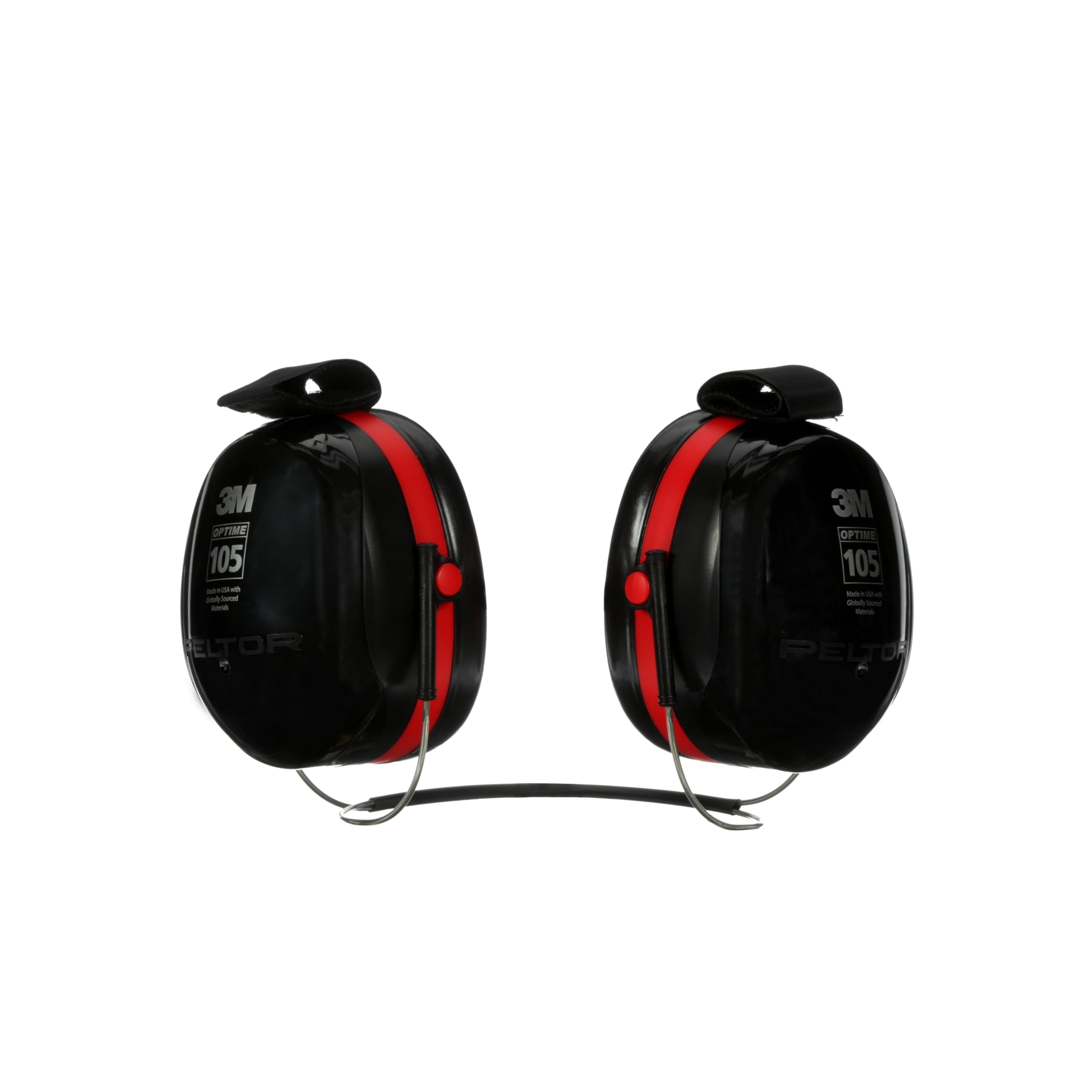
The Optime 105 is engineered for the dirtiest, loudest environments in construction—think boiler rooms, concrete breakers, and quarry operations. Its double-shell technology physically separates the cup layers to dampen vibration more effectively than single-wall muffs, achieving an NRR between 27 and 30 dB depending on the attachment style. The stainless-steel hardware resists bending and warping even when exposed to constant vibration and high heat.
User reports from heavy industry confirm this model survives six years of daily use, with only the foam cushions needing periodic replacement via a hygiene kit. The behind-the-head design is the clear winner for anyone wearing a hard hat or a welding shield, since there’s no top band to interfere with suspension webbing. The seal remains tight even with safety glasses temples breaking the foam line—an area where many lower-rated muffs fail.
One trade-off is that the behind-head band can feel loose on smaller craniums, so workers with smaller head sizes may need to cinch the neckband or switch to the over-head version. For large-headed users with hat sizes over 7 5/8, this model is one of the few that fits without pressure points. An included top strap allows conversion to over-head style for hard hat integration.
Why it’s great
- Double-shell construction provides superior high-frequency noise blocking
- Behind-the-head design clears hard hat suspension completely
Good to know
- May feel loose on smaller heads; requires careful band adjustment
- Replacement cushions sold separately, not included
3. ClearArmor Comfortable Ear Protection that Works

ClearArmor punches well above its price tier with an SNR rating of 31.5 dB and a fit that accommodates both small and large head circumferences. The cups are light enough to wear for extended periods without neck fatigue, and the clamping force is moderate—firm enough for a good acoustic seal but not so tight that it causes temple headaches. Users with sensory sensitivities and those with congenital ear differences reported this model works where others cause pain.
At the shooting range and on construction sites, testers found the ClearArmor cancels 80 to 90 percent of gunfire and machinery noise. The one catch is that wearing glasses reduces the seal, which is true for any passive muff but more noticeable at this pressure level. For workers who double up with foam plugs, the combination delivers near-laboratory level attenuation.
It’s not built to the same industrial spec as the 3M double-shell muffs—the plastic feels lighter and less rugged for daily abuse around sharp rebar or concrete forms. But for general construction, site walkthroughs, or as a backup pair stored in a gang box, it’s hard to beat the noise reduction per dollar. Many buyers noted the value of getting two units in one purchase, making it a solid choice for teams or multi-site workers.
Why it’s great
- High SNR rating with comfortable moderate clamping force
- Exceptional value with strong noise reduction at this price level
Good to know
- Lighter plastic shell less durable for heavy daily site abuse
- Seal reduces noticeably when wearing safety glasses
4. DeWalt DPG62-C Interceptor Protective Safety Earmuff

The DeWalt Interceptor is the most adjustable model in this lineup, with an over-head headband that slides down to fit smaller heads—women, younger apprentices, anyone who finds standard muffs too loose. The bright yellow shell serves a dual safety function, making the wearer more visible around moving equipment and backed-up vehicles. Build quality is signature DeWalt: tough ABS plastic that can take drops from scaffolding without cracking.
Noise reduction is adequate for mowing, table saws, and light demolition but it doesn’t reach the same NRR as the ProCase or the 3M Optime 105. Several users noted that after a couple of hours the clamping pressure can cause ear soreness on larger heads, so this is better suited for intermittent use or for operators with smaller head circumferences. The headband collapses for compact storage, which is useful for workers who share lockers or gang boxes.
Where this muff excels is compatibility with hearing aids and in-ear monitors. The cup depth is generous enough to fit over most behind-the-ear hearing devices without feedback or pressure. If you need a muff that works for a mixed-gender crew or for a job site where the hard hat is the priority, the Interceptor’s slim profile and adjustability make it a solid middle-ground choice.
Why it’s great
- Best adjustability in class for smaller heads and hearing aids
- Bright yellow shell improves visibility for site safety
Good to know
- Clamping pressure may cause ear fatigue on larger heads over time
- NRR rating lower than top-tier competition
5. 3M H7B Peltor Optime 101 Behind-the-Head Earmuff

The Optime 101 is the lighter-duty sibling of the 105, designed for situations where you need quick on-off capability and absolute compatibility with a hard hat or sombrero-style headwear. With an NRR of 26 dB, it doesn’t match the high-decibel attenuation of the double-shell models, but it’s still within OSHA’s acceptable range for most construction noise environments when properly worn. The behind-the-neck band keeps the top of your head completely free, which is why construction crews working under hard hats have relied on this design for years.
Feedback from users on demolition sites and generator rooms confirms that the seal stays tight around the ear even when the band is behind the neck, and the foam cushions remain comfortable through a full day. The pink/green color combos are easy to spot on a crowded tool bench. One of the most repeated positives is that the Optime 101 works well with hearing aids worn behind the ear, making it a top choice for older tradespeople who need both amplification and protection.
The trade-off for the behind-head convenience is that the band can start to hurt the back of the skull after several hours, especially for those with prominent occipital bones. And at NRR 26, it’s not the best choice for extreme noise environments like near a pile driver or inside a concrete batch plant—you’d want to step up to the 105 or use earplugs underneath. For general framing, roofing, or operating a skid-steer, it’s a perfectly capable, comfortable option.
Why it’s great
- Behind-the-head design frees the top for hard hats and caps
- Comfortable fit with hearing aids and in-ear monitors
Good to know
- Band can cause pressure discomfort on the back of the head during long shifts
- Lower NRR rating not ideal for extreme high-decibel environments
FAQ
Can I wear these with a hard hat?
How do I know if the seal is tight enough?
Final Thoughts: The Verdict
For most construction workers, the best ear protection for construction winner is the ProCase Extra Large SNR 37dB because it offers the highest NRR rating in this group with a proven extra-large fit that eliminates the most common comfort complaint—pinched ears. If you need a hard hat compatible muff built for years of heavy industrial abuse, grab the 3M Peltor Optime 105 Behind-Head. And for a budget-friendly backup pair that delivers surprising noise reduction for the price, nothing beats the ClearArmor Safety Earmuffs.

Mo Maruf
I created WellFizz to bridge the gap between vague wellness advice and actionable solutions. My mission is simple: to decode the research and give you practical tools you can actually use.
Beyond the data, I am a passionate traveler. I believe that stepping away from the screen to explore new environments is essential for mental clarity and physical vitality.