Our readers keep the lights on and my smoothie glass nicely filled. As an Amazon Associate, I earn from qualifying purchases.
Specs are compiled from manufacturer listings and verified buyer reviews and can change over time — please confirm the key details on the product page before buying.
A race weekend is ear-shattering. At the loudest spots on a Formula 1 track, peak noise hits almost 140 decibels — enough to cause permanent hearing damage in seconds. Choosing the right ear protection for auto racing is not about comfort alone; it is about knowing which decibel rating matches the noise level you will actually face in the stands, the pit lane, or the driver’s seat.
I’m Mohammad Maruf — the founder and writer behind WellFizz. This guide is built by comparing the manufacturers’ published specifications and the patterns across verified customer reviews, so you get each pick’s real strengths and trade-offs instead of marketing spin.
Whether you are a spectator at a NASCAR event or a driver strapped into a screaming cockpit, picking the right ear protection for auto racing means matching the NRR (Noise Reduction Rating) to your environment and balancing it with comfort, radio compatibility, and helmet fit.
Our Picks at a Glance


How To Choose The Best Ear Protection For Auto Racing
The difference between a good day at the track and permanent tinnitus depends on three decisions: how much noise you need to block, if you need to talk to your crew, and how the gear fits under a helmet. Here is what separates the choices.
Match the NRR to Your Spot
The Noise Reduction Rating tells you how many decibels the gear takes off the incoming sound. A spectator in the grandstands 50 feet from the track faces a different threat than a driver in a closed cockpit. At a race where peaks hit 140 dB, you want at least 22 to 25 dB of reduction just to bring the level under the 85 dB safe threshold. For sustained exposure, higher numbers like 31 or even 37 dB give you a much bigger safety margin.
Passive, Custom, or Electronic
Passive earmuffs are the simplest — foam and plastic that physically block sound with no batteries. Custom-molded earplugs, like the Decibullz, shape to your ear canal for a leak-free seal and pack a very high NRR in a tiny package. Electronic headsets add microphones and speakers so you can hold a conversation or hear a race scanner, then clamp down instantly when the engine roar hits. Drivers and crew chiefs lean electronic; spectators save money with passive muffs or plugs.
Helmet Compatibility
A full-over-the-head earmuff design pushes against a racing helmet and often breaks the seal, letting noise in. That is where behind-the-head models shine — they wrap around the back of your skull and leave the crown clear for the helmet shell. If you are a driver, a behind-the-head headset is almost mandatory. Spectators wearing a cap or no hat at all can use standard over-the-head earmuffs comfortably.
Communication Needs
If you are a driver talking to a spotter or a crew chief coordinating a pit stop, you need a headset with a dynamic noise-canceling microphone and a 5-pin universal radio port. Models from Rugged Radios plug directly into Baofeng, Kenwood, and Motorola two-way radios. If you are a fan who just wants to hear the race scanner through a 3.5 mm audio jack, an electronic earmuff with an aux input is enough.
Quick Comparison
| Model | Best For | NRR | Type | Radio / Audio | Amazon |
|---|---|---|---|---|---|
| Shooting Ear Protection NRR 26dB★ Best Overall | Budget spectator | 26 dB | Passive earmuffs | None | Amazon |
| Decibullz Custom Molded EarplugsAlso Great | High-NRR in-ear fit | 31 dB | Custom-molded plugs | None | Amazon |
| Alpine Racing Pro EarmuffSpectator Favorite | Spectator comfort | 22 dB | Passive earmuffs | None | Amazon |
| Floriogra 3 Pack | Value multi-pack | SNR 34 dB | Passive earmuffs | None | Amazon |
| Elgin Rumble Wired Earbuds | Wired audio + protection | 27 dB | In-ear earbuds | 3.5 mm, mic | Amazon |
| DECIBEL DEFENSE Ear Muffs | Highest passive protection | 37 dB | Passive earmuffs | None | Amazon |
| Rugged Radios H41 Headset | Driver radio comms | 24 dB | Electronic BTH headset | 5-pin radio + 3.5 mm | Amazon |
| Walker’s FireMax Earmuffs | Rechargeable electronic | 23 dB | Electronic earmuffs | 3.5 mm, USB-C | Amazon |
| Rugged Radios Racing Headset | Pro driver radio kit | 24 dB | Electronic BTH headset | 5-pin radio + 3.5 mm | Amazon |
In‑Depth Reviews
1. Shooting Ear Protection NRR 26dB (Hocazor)
Our pick — over 4.5★ from 400+ verified ratings; the strongest balance of quality and price.
The budget-friendly passive earmuff that punches above its weight with a 26 dB NRR and a foldable carry bag
For the spectator who wants reliable noise blocking without spending much, this Hocazor pair delivers a solid 26 dB NRR in a low-profile, foldable design. The composite ABS shell and rubber coating are certified under ANSI S3.19-1974 and CE EN352-1 — the same standards the premium muffs meet. What wins people over is the noise cancellation and protection, with 24 and 23 owners respectively calling them out as top features. The slim ear cups keep weight low and avoid interfering with a cheek weld if you are also shooting or using binoculars at the track.
The 360-degree rotatable ear cups and retractable steel wire adjust to fit most head shapes, and the foldable design slips into the included carry bag. Owners use them for drag races, shooting practice, and yard work. One owner with a 7 5/8 hat size confirmed they fit comfortably. The value proposition is clear: you get a certified 26 dB NRR for a very accessible price, with a design that stores easily.
The mixed area is the fit — some owners found them a great fit while others say they are too tight. The high-density foam padding and padded headband help with comfort, but the clamping force may feel firm if you have a larger head. For the price, these are a no-regret purchase for the occasional race-goer.
Solid Entry-Level: 26 dB NRR, ANSI/CE certified, foldable, and light enough to carry anywhere — a genuine value for the spectator who does not need radio or electronic features.
One Fit Note: The clamping pressure runs firm; some heads will find the fit tighter than preferred, and there is no XL option.
2. Decibullz Custom Molded Earplugs, 31dB Highest NRR
The custom-molded plug that delivers a 31 dB NRR and stays put for hours
These are the earplugs that make the highest noise reduction rating in this lineup — 31 dB — a number 19% higher than the 26 dB of standard shooting earmuffs. The secret is the thermoplastic mold that you heat in boiling water, shape to your own ear canal, and cool until it locks into a perfect fit. Once set, the plug eliminates the wiggle that lets noise leak past standard foam or silicone tips. Buyers report that the consistent reduction across frequencies from 125 Hz through 8 kHz keeps engine roar muted without making you feel isolated from the world.
The trade-off is the process. Molding takes about 10 minutes of careful work, and if your ear canals are very narrow, the standard internal channel can feel tight. The 31 dB rating is achieved with the included foam tips, not the silicone flanges, so you need to use the correct set for full protection. A few owners with large ear canals found the silicone tips slipped out, but the majority say the custom shape “never hurts, never falls out.”
At the track, these plugs are ideal for the driver or the mechanic who needs a low-profile fit that slides under a helmet or ear cup without interference. They also work as a concert or travel plug, reducing street noise to roughly 14 dB and concert levels to around 64 dB — a level you can comfortably listen through for up to six hours. The included pouch keeps them clean in a race bag.
Custom-Fit Edge
- Industry-leading 31 dB NRR — the highest in the comparison
- Re-moldable if you miss the first attempt
- Comfortable for long wear, stays in place even during physical motion
The Molding Catch
- Requires 10-minute DIY molding process with boiling water
- Standard channel may be narrow for some ear canals
- Top attenuation only when using the foam tips, not the silicone flanges
Grab these if: you want the absolute highest decibel cut without bulky earmuffs, and you are willing to spend 10 minutes molding them to your ears.
Think twice if: you need to communicate over a two-way radio — these are pure plugs with no microphone or speaker.
3. Alpine Racing Pro Earmuff F1
Dutch-engineered earmuffs built specifically for the F1 grandstand experience
Alpine designed these specifically for race spectators, and the engineering shows. The 22 dB NRR is sufficient to bring a 140 dB track peak down to a safe level, and the low-pressure fit means you can wear them for an entire race day without your ears aching. At just 250 g — roughly half the weight of a typical over-ear muff — they are light enough to hang around your neck during the walk to the parking lot. The adjustable and foldable design tucks into the included F1 travel bag.
The catch is that 22 dB is the lowest NRR in this lineup. For a single race event it is adequate, but for repeated exposure at loud tracks like Daytona or Bristol, a higher-rated model gives more safety margin. A few units arrived with visible cracks in the plastic headband joint, which suggests the material can be fragile if packed roughly. On the positive side, the premium materials are silicone-free — good for anyone with allergies — and easy to wipe clean after a dusty day at the track.
Where the Alpine earns its spot is comfort. The soft, sustainable materials create a seal without clamping pressure, and owners mention they work well for sound-sensitive children and adults with sensory sensitivities. If you are a fan who wants a dedicated race-day muff rather than a multi-purpose industrial tool, this is a refined choice.
Grandstand-Ready: 22 dB NRR, foldable, lightweight at 250 g, and designed to sit comfortably all day — ideal for the spectator who prioritizes comfort over maximum noise cancellation.
One Real Concern: The 22 dB rating is the lowest in this comparison; for the loudest tracks, you may want to double up with earplugs underneath.
4. Rugged Radios H41 Behind-the-Head Racing Headset

Driver-grade behind-the-head headset that puts clear radio comms inside a full-face helmet
This is the headset that crew chiefs and drivers reach for because of its behind-the-head design — the band wraps around the back of your skull instead of sitting on top, so a racing helmet fits cleanly over it without breaking the acoustic seal. The 24 dB NRR protects your ears while the dynamic noise-canceling microphone transmits your voice clearly even at wide-open throttle. A 3.5 mm audio jack lets you plug in a race scanner or phone, and the 5-pin universal radio port connects to Baofeng, Kenwood, Motorola, and many other two-way radios.
Owners praise the build quality — many report three years of solid racing use with no failures. The tension is designed to hold firmly against your head, which is exactly what you want under a helmet, but a few found the flat rigid headband less comfortable than a rounded spring design. The mic boom is sturdy and adjustable, though some Baofeng handhelds need a Kenwood 2-pin adapter and a microphone swap for ideal audio levels. Once that is sorted, the audio is described as excellent.
The 24 dB NRR is a mid-range number — enough for the cockpit but not the highest in this list. For extreme noise environments, some drivers double these with foam plugs underneath. The H41 is a purpose-built tool for the person who needs to talk and listen while racing, not a budget spectator muff.
Team-Channel Ready
- Behind-the-head shape fits under a racing helmet without seal breakage
- Dynamic noise-canceling mic cuts through engine noise for clear radio transmission
- 5-pin universal port works with most major two-way radio brands
Comms Setup Note
- May require a Kenwood 2-pin adapter and mic swap for best audio with Baofeng radios
- Flat rigid headband feels less comfortable than rounded spring alternatives to some users
Reach for this if: you are a driver or crew member who needs reliable two-way radio communication under a race helmet.
Look elsewhere if: you are a spectator who just needs basic noise blocking — a passive earmuff offers more NRR for less money.
5. DECIBEL DEFENSE Ear Protection, 37 dB NRR Ear Muffs

The 37 dB passive juggernaut for the loudest environments where batteries are not an option
This is the highest-rated passive earmuff in the entire comparison — 37 dB NRR, a figure that outpaces every other product here by a wide margin. The design is pure function: thick dBTech foam, a padded headband, and a snug fit that creates a tight acoustic seal. The crowd favorite aspect here is comfort, with over 1,700 owners mentioning it positively, followed closely by noise cancellation with 1,600 mentions. The fit intentionally runs tight to improve the seal, and if it feels too firm, the brand suggests stretching it gently over the box overnight.
Owners mention this muff eliminates the low-frequency drone from zero-turn mowers that other muffs could not block — the same kind of drone you hear from a racecar engine. At the track, a 37 dB reduction turns a 140 dB roar into a barely audible 103 dB, which is a huge safety buffer. The foldable design makes storage easy, and the lack of batteries means it always works. It comes in two sizes: Regular fits most adults and teens ages 10 and up, while XL adds extra extension for larger heads.
The one trade-off is that the clamping force is noticeable. A few owners found the fit too tight for extended wear, and the lack of electronics means no radio or audio input. If you want pure, no-maintenance sound blocking with the most aggressive NRR possible, this is the one.
Maximum Protection: 37 dB NRR — the industry-leading number — with all-day comfort in a passive, battery-free design that is ready for the loudest tracks or workshops.
Not For Everyone: The snug fit is intentional for sealing, but some heads find it too tight; there is no audio jack for radio or music.
6. Walker’s Rechargeable FireMax Electronic Earmuffs
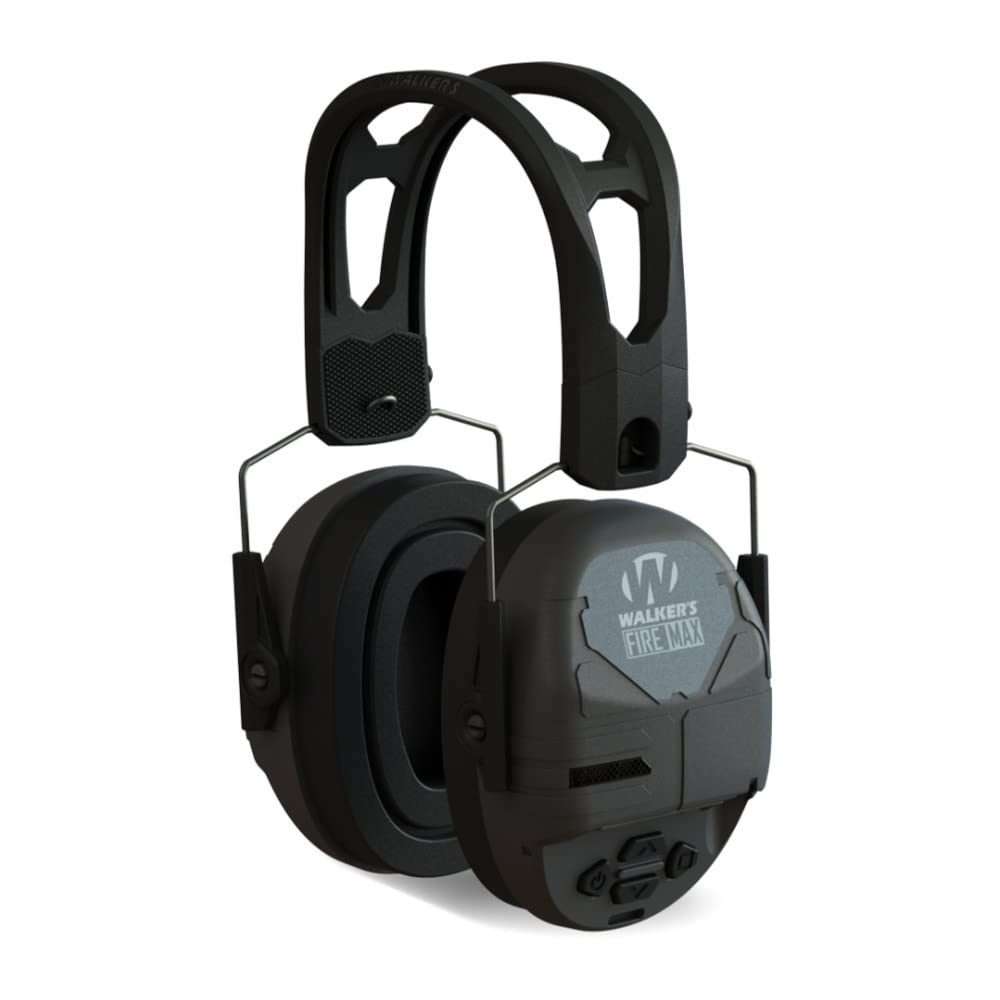
Electronic muffs with 200 hours of rechargeable battery and four sound frequency modes
Walker’s FireMax brings modern electronics to the race track. The 23 dB NRR is a mid-range figure, but the real draw is the situational awareness: two omnidirectional microphones amplify ambient sounds so you can hear a crew chief’s command or a conversation between the roar of engines, while sound-activated compression instantly blocks harmful peaks. Four frequency modes let you tailor the sound profile for the track, the range, or general yard work.
The internal 2000 mAh rechargeable battery delivers a claimed 200-hour run time, and the USB-C charging is convenient. Cooling gel ear pads help manage sweat on a hot race day, and the low-profile design keeps the cups slim enough that they do not interfere with a rifle stock — or, in a racing context, a helmet skirt. Owners note that the default mode allows you to hear youth shooters asking questions while perfectly blocking shotgun blasts, which translates directly to hearing a spotter while the cars howl past.
The clamping force is snug — intentionally so for a good seal — and the 23 dB NRR is not the highest available. For an indoor track or a very loud open-wheel car, you may want to pair these with foam plugs underneath. The investment is real, but the rechargeable convenience, the audio input for a race scanner, and the four listening modes make this a versatile pick for the enthusiast who wants protection without isolation.
Smart Listening
- 200-hour rechargeable battery with USB-C charging — no AAA hunting
- Omnidirectional mics with 4 frequency modes for situational awareness
- Cooling gel ear pads improve comfort in heat
Protection Ceiling
- 23 dB NRR is mid-range; double up with plugs for extreme noise
- Snug clamping force; runs large for smaller heads
Best for: the enthusiast who wants electronic features — ambient listening, audio input for a scanner, and rechargeable battery — in a low-profile package.
skip it if: your top priority is the highest possible NRR; passive muffs from Decibel Defense or Decibullz offer stronger protection for less money.
7. Elgin Rumble Wired Earplug Headphones, 27 dB NRR
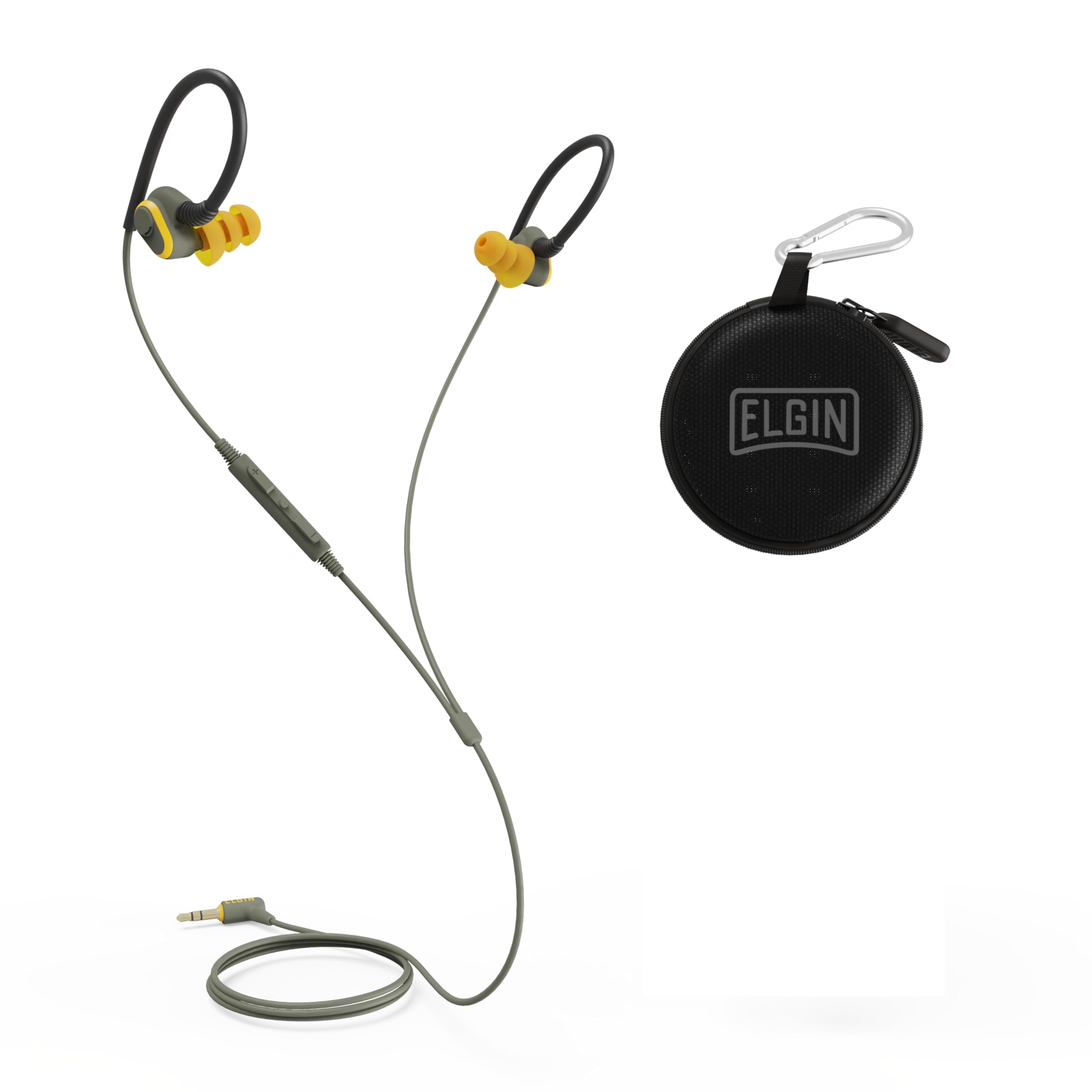
Wired earbuds that blend a 27 dB NRR with a built-in mic and IP67 toughness
These are not just hearing protection — they are functional earbuds that let you listen to a race scanner, take a phone call, or talk to your passenger while blocking 27 dB of engine noise. The 48-inch Kevlar-reinforced cable survives the abuse of a machine shop, and the IP67 rating means dust and water are no concern. At the track, customers note these work “even better than the fancy earbuds from racing catalogs” and that they “tune out deep rumble and vibration” effectively.
The sound quality is the top positive aspect, with owners specifically praising the noise cancellation. The in-line controller gives you volume adjustment and one-touch access to Siri or Google Assistant. The trade-off is fit: a few owners found the earbuds tend to slide out of their ears, and the noise reduction, while solid, is not as deep as a custom-molded plug like the Decibullz. For a very loud shop or track, some recommend using over-ear protection on top.
Where the Elgin wins is value. You get a functional audio headset with serious noise reduction, a microphone, and near-indestructible build quality for a very accessible price. The 27 dB NRR is strong enough for most racing environments, and the ability to hear a caller or a scanner without removing your protection is a genuine advantage.
Dual-Purpose: Wired earbuds with 27 dB NRR, Kevlar-reinforced cable, IP67 water/dust resistance, and a microphone — the pick if you need audio and protection in one.
One Thing to Know: Fit is not universal; some ears will find the seal looser than a custom-molded plug, and the noise reduction is not as deep as the top-rated passive muffs.
8. Rugged Radios Racing Headset with Adaptor Cable

The complete radio-communication package for driver-to-crew clarity in a Mazda Miata or a NASCAR stock car
This is the version of the Rugged H41 that comes pre-packaged with the adaptor cable for Baofeng and Kenwood two-way radios, saving you the adapter hunt that the standard H41 sometimes requires. The behind-the-head design is identical — 24 dB NRR, dynamic noise-canceling microphone, built-in 3.5 mm audio jack, and a 5-pin universal radio port. The coiled cable is sturdy and keeps tangle-free connections in the tight space of a cockpit.
Owners call it “very professional” and note it works wonderfully in cars as small as a Mazda Miata, where the combination of extreme noise and tight quarters demands a compact solution. A Daytona International Speedway staff member writes that these headsets work great for race-day operations at any level — local track or NASCAR. The mic cancels background noise so effectively that you can hold a clear phone call with a passenger in the car.
The 24 dB NRR is adequate for most racing applications but not extraordinary. For a driver in a very loud open-cockpit car, the protection is a baseline; adding foam earplugs underneath is common practice. The included adapter cable makes this essentially a plug-and-play solution for the most common race radios, which removes the biggest frustration with aftermarket comms gear.
Race-Ready Comms
- Includes the adapter cable for Baofeng and Kenwood radios — no extra parts needed
- Behind-the-head profile fits comfortably under a full-face racing helmet
- Dynamic noise-canceling mic delivers clear voice transmission over engine noise
One Note
- 24 dB NRR is a baseline protection level; very loud environments may need doubling with earplugs
- Coiled cable length is adequate but some wish it extended slightly farther
Reach for this if: you are a driver or spotter who wants a complete, ready-to-run radio headset kit with proven compatibility for Baofeng and Kenwood two-way radios.
Think twice if: you only need noise blocking without communication — a higher-NRR passive muff costs far less.
9. Floriogra 3 Pack Noise Reduction Ear Protection, SNR 34dB

The three-pack that lets a whole family or crew protect their ears without buying individual sets
If you are taking a group to the race track, this Floriogra bundle gives you three pairs of passive earmuffs with a single-number rating (SNR) of 34 dB — a metric similar to NRR that indicates strong noise reduction. The high-density sponge padding and skin-friendly imitation leather create a comfortable acoustic seal, and a specially designed hole in the bottom allows the sponge to slow-rebound for a customized fit. The 360-degree rotatable pins and retractable steel wires adjust to almost any head size.
Owners highlight the effective noise reduction and the price as the top reasons to buy. One owner specifically mentioned using them at a “drag strip” with good results. The folding design and included carry bag make storage simple, and having three pairs means you can leave one in the garage, one in the workshop, and one for guests. The build quality is described as surprising for the price, and they work well for shooting, lawn mowing, and woodworking in addition to racing.
The one fit limitation: if you have a larger-than-normal head, these might not fit. The cups are spacious, but the headband adjustment has a ceiling. The SNR 34 dB is an advertised European rating, while the ANSI NRR equivalent is typically a few decibels lower — still a strong protection level. For a group outing, this pack is a smart way to ensure everyone leaves the track with their hearing intact.
Group Protection
- Three pairs in one box — enough for family or crew
- SNR 34 dB provides strong sound reduction
- Foldable design with carry bag for easy transport and storage
Fit Ceiling
- Larger-than-normal heads may not fit comfortably
- SNR rating is a European metric; ANSI NRR equivalent may be slightly lower
Best for: race fans bringing a group — three affordable pairs with strong SNR 34 dB protection for the whole crew.
pass on it if: you have an unusually large head or need electronic features like radio communication or ambient listening.
Understanding the Specs
Noise Reduction Rating (NRR)
This is the single most important number for ear protection for auto racing. NRR tells you how many decibels the gear subtracts from the noise around you. At a race track where peak levels hit 140 dB, you want at least a 22 dB reduction to bring the sound below the 85 dB threshold where hearing damage starts. A higher NRR, like 31 or 37 dB, gives you a much wider safety margin, especially if you are exposed for the full race weekend. The number is measured in a lab, so real-world protection is typically a few dB lower, but it is the best comparison tool you have.
Passive vs Electronic
Passive earmuffs and plugs use foam and dense materials to physically block sound waves. They never need batteries, they always work, and they often offer the highest NRR ratings. Electronic muffs add microphones and speakers — they amplify quiet sounds so you can hear conversation or a race scanner, then instantly compress or block harmful noise above a set threshold. This lets you stay aware of your surroundings without removing your protection. For drivers and crew chiefs who need two-way radio communication, electronic headsets are essential. For spectators, passive gear is simpler and more affordable.
Behind-the-Head vs Over-the-Head
Over-the-head earmuffs have a band that sits across the top of your skull. They are comfortable for general use, but they push against a racing helmet and often break the seal, letting dangerous noise in. Behind-the-head models wrap around the back of your skull instead, leaving the crown completely clear for the helmet shell. If you are a driver, a behind-the-head headset is not a preference — it is the only design that seals properly under a helmet. Spectators wearing a ball cap or no hat can use either style comfortably.
ANSI and CE Certifications
ANSI S3.19-1974 and CE EN 352-1 are standards that verify an ear protection product has been tested and actually reduces noise to its claimed NRR. Products without these certifications may still work, but you have no independent verification. Every product in this guide that lists a NRR number carries at least one of these certifications, which is your assurance that the decibel rating on the box matches what was measured in the lab. Always look for one of these marks when buying ear protection for auto racing.
FAQ
Will standard over-the-head earmuffs fit under a racing helmet?
What is the difference between NRR and SNR ratings?
Can I wear earplugs and earmuffs together for extra protection?
How do I know which NRR rating I need for a race track?
Are electronic earmuffs worth the extra cost for auto racing?
Will custom-molded earplugs like Decibullz work for auto racing?
How long do passive earmuffs typically last?
Do I need a special headset if I already own a Baofeng or Kenwood two-way radio?
Can I use ear protection for auto racing for shooting or concerts?
Final Thoughts: The Verdict
For the majority of shoppers, the ear protection for auto racing winner is the Decibullz Custom Molded Earplugs because it delivers the highest NRR in the lineup — 31 dB — in a custom-fit package that slides under any helmet and never hurts or falls out. If you want the absolute highest passive protection and do not need radio communication, grab the DECIBEL DEFENSE Ear Muffs at 37 dB NRR. And for driver-to-crew radio communication that fits under a racing helmet, the Rugged Radios H41 Behind-the-Head Headset is the one to reach for.
How We Picked
We do not accept paid placement. Every pick is matched to a real buyer and a real use-case; we do not hands-on test units.
Sources & Methodology
Specifications: manufacturer listings and product documentation. Review insights: verified customer reviews, as of July 2026. Pricing: not shown on this page (it changes often); check the current price via the retailer link.
As an Amazon Associate, WellFizz earns from qualifying purchases. This does not affect which products we feature.
Related Guides

Mo Maruf
I created WellFizz to bridge the gap between vague wellness advice and actionable solutions. My mission is simple: to decode the research and give you practical tools you can actually use.
Beyond the data, I am a passionate traveler. I believe that stepping away from the screen to explore new environments is essential for mental clarity and physical vitality.