Our readers keep the lights on and my smoothie glass nicely filled. As an Amazon Associate, I earn from qualifying purchases.
Specs are compiled from manufacturer listings and verified buyer reviews and can change over time — please confirm the key details on the product page before buying.
The real challenge is finding an ear amplifier that clarifies speech in noisy settings rather than merely boosting all sound.. Decent units use digital processing to isolate human voices from background babble, which matters far more than raw loudness. This guide is built around that difference, weighing how each pick handles noisy rooms, battery life, and all-day comfort so you can choose with confidence.
I’m Mohammad Maruf — the founder and writer behind WellFizz. This guide is built by comparing the manufacturers’ published specifications and the patterns across verified customer reviews, so you get each pick’s real strengths and trade-offs instead of marketing spin.
Read on to find the best ear amplifier for clear speech and comfort. Keep reading to discover the best ear amplifier options that prioritize clear speech, long-lasting comfort, and true value for your money.
Our Picks at a Glance


How To Choose The Best Ear Amplifier
Choosing the right ear amplifier means evaluating how it performs in real-world noisy environments, not just its amplification specs.. Prioritize noise cancellation, battery endurance, and all-day comfort when comparing models..
Noise Cancellation and Channels
You want to hear the person across from you, not the fan humming or the crowd murmuring.. The best ear amplifiers use digital processing to cut that background noise while keeping voices clear. This power is measured in “channels” — each channel is a separate frequency band you can fine-tune independently. More channels usually mean smarter filtering, so the device makes the voice you want stand out, not just the whole world louder..
Battery Types and Endurance
You’ll find two approaches to power: built-in rechargeable batteries that you top up in a charging case, and traditional replaceable batteries that you swap out when they drain. Rechargeable models are more convenient and cheaper over time, but you are tied to keeping the case charged.. Replaceable-battery models can last for weeks or months on a single set, which is ideal for travel or for people who dislike plugging things in. Look at the “hours per charge” figure, but also check if the product includes a charging case to multiply that runtime several times over.
Quick Comparison
| Model | Best For | Battery | Channels | Style | Amazon |
|---|---|---|---|---|---|
| URORU Rechargeable Aids★ Best Overall | All-day clarity with noise filtering | 25+ hrs / 100+ hrs w/ case | 16-Channel | In-Ear | Amazon |
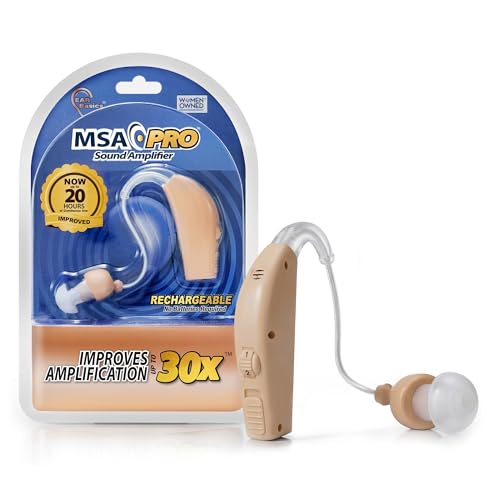
| MSA PRO Sound AmplifierBest Value | Discreet, budget-friendly boost | Up to 20 hrs | — | In-Ear | Amazon |
| Manzelun BTE AidsTop Performer | Severe loss with physical buttons | Up to 25 hrs | — | Behind-the-Ear | Amazon |
| BY4U OTC Hearing Aids | Long battery life between charges | 20 hrs / 80 hrs w/ case | 16-Channel | Behind-the-Ear | Amazon |
| Reizen Loud Ear Amplifier | High-gain personal amplifier | 2 AAA Batteries | — | In-Ear / On-Ear | Amazon |
| Kituwant Digital Amplifier | Replaceable battery longevity | 500 hrs | — | Behind-the-Ear | Amazon |
| FVUH Rechargeable Aids | Nearly invisible in-ear wear | ~50 hrs | 16-Channel | In-Ear | Amazon |
| MepvabKY Ultra 32-Channel | Top-tier smart noise processing | 18-20 hrs / 100+ hrs w/ case | 32-Channel | In-Ear | Amazon |
In‑Depth Reviews
1. URORU Rechargeable Hearing Aids
Our pick — over 4★ from 250+ verified ratings; the strongest balance of quality and price.
The 3-gram in-ear model that puts conversation first, with smart noise filtering that adapts to any room.
What wins people over is the intelligent 16-channel processing, which works to automatically filter background noise while boosting speech — a real difference-maker in a crowded restaurant compared to basic amplifiers. It’s designed for adults with mild to moderate loss, and each channel fine-tunes a different frequency to deliver natural, balanced sound without distortion.
Comfort is a huge part of the appeal, since each aid weighs just 3 grams and is sculpted to fit securely and almost invisibly in the ear canal. The one-button control keeps things simple for older users, offering five precise volume levels and an automatic memory that holds your favorite settings. When you compare this to the MSA PRO below, the URORU’s richer feature set and superior noise handling justify the higher price tier.
Battery anxiety is a non-issue here: you get 25+ hours of single use and 100+ hours when you factor in the charging case, with the LED display showing power status at a glance. The case itself delivers rapid charging so the aids are ready in about 2 hours. Buyers consistently report these make daily conversations easier to follow., and they’ve been a hit as gifts — the phrase that keeps coming up is “very pleased.”
Why It Wins
- Smart 16-channel processing separates speech from background noise
- Featherlight 3-gram fit is comfortable and invisible for all-day wear
- 100+ hours of total battery life with the charging case
What To Consider
- Requires about 2 hours for a full rapid charge
- Some users may prefer more than five volume levels for fine-tuning
Reach for this if: you want a low-maintenance, all-day amplifier with smart noise control that prioritizes voices over background chatter.
Look elsewhere if: you need a behind-the-ear style or prefer replaceable batteries over a rechargeable case.
2. MSA PRO Sound Amplifier
A barely-there booster that turns up the world 30 times, with a fast-charging base for simple upkeep.
This is the entry-level pick that focuses on raw amplification, promising to boost sound 30 times so you can enjoy conversations, music, and even birds chirping. Its clear tubing fits the contour of either your right or left ear, and the nearly invisible design means you get a confidence boost without the bulky look of traditional aids.
You won’t be swapping batteries here — the MSA PRO comes with a fast charging station and delivers up to 20 hours of continuous use on a full charge. Note that this stamina trails the 40 hours promised by the CONNOVA model, so it’s a lighter option for shorter days. The package includes a recharging base, 6 silicone tips for a custom fit, and a cleaning brush, so you have everything you need to start immediately.
Buyers report strong loyalty to this unit — “I have had this before so I knew I would like it” is a common refrain, with some having used it for 3 to 4 years before needing a replacement. One satisfied customer even noted it works great for a Navy veteran with a damaged ear. It’s a reliable, budget-friendly workhorse that gets the job done.
Honest Trade-off: The sound quality gets mixed feedback here; some find background noise can overpower voices, so it suits those wanting simple volume boost over advanced noise filtering.
Pick this up if: you want an affordable, discreet amplifier with a proven track record for basic hearing enhancement.
Think twice if: your biggest struggle is understanding speech in noisy environments — you’ll want a model with digital noise cancellation.
3. Manzelun Behind-The-Ear Aids
A behind-the-ear powerhouse with double noise cancellation and charging options that keep it going all day.
Designed for those who need serious amplification, this behind-the-ear device weighs just 5.5g and uses flexible ear hooks to conform to your ear, accommodating various hair lengths and even glasses wearers without discomfort. The real accessibility win is the physical controls: a slide switch and a continuous volume knob that are easy to operate without needing to see the buttons, perfect for seniors.
It’s equipped with double noise cancellation technology to eliminate background noise and deliver clear sound in real-time. Charging flexibility is a standout — you can power it via a direct cable or drop it in the charging case, which can fully recharge both aids up to four times for approximately 25 hours of continuous use. This makes it an ideal backup for camping or travel.
What really sets the Manzelun apart for many is the fit: it comes with 5 pairs of ear tips, including options that feel prescription-like, which reviewers point out works better than expensive audiologist-provided aids that hurt to wear. The recurring gripe is that the right unit’s positioning can be tricky, and there can be an occasional squeal when adjusting. Buyers appreciate that it stays charged all day and delivers solid value.
What Stands Out
- Lightweight 5.5g behind-the-ear design comfortable with glasses
- Double noise cancellation for clear, real-time sound
- Flexible charging via cable or case with up to 4 full recharges
What To Note
- Needs recharging daily with heavy use
- Background noise can be noticeable in some situations
Reach for this if: you need sturdy amplification for more significant hearing loss and value physical buttons over touch controls.
Look elsewhere if: you’re new to hearing aids — the included booklet details an adaptation process, and some users find the size larger than expected.
4. BY4U OTC Hearing Aids
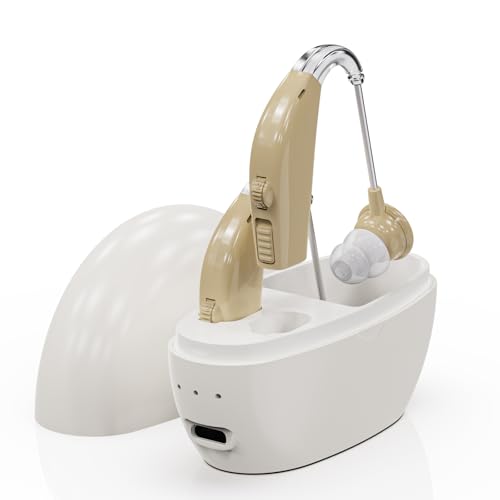
Lightweight behind-the-ear comfort (5.7g) with a charging case that stretches runtime to a huge 80 hours.
Battery life is this model’s standout feature. A single 1-hour charge gives you 20 hours of continuous use, and the included case tops the aids up 2 to 3 times for about 80 hours total — enough to leave the charger at home on a long trip. The 16-channel digital noise reduction system promises authentic, crisp sound. The behind-the-ear design uses a flexible, malleable aluminum foil sound conductor wire for a comfortable, secure fit.
The kit is generous: a pair of aids, a lightweight 11g charging case, a USB-C cable for the case, a DC2.0 cable for the aids, 2 cleaning brushes, 8 pairs of ear tips, a lanyard, and a user manual. That makes it a thoughtful gift for family and friends with hearing loss. The universal design means no fumbling with left and right — some buyers specifically appreciate that they can use just one aid for single-ear hearing loss.
Buyers praise the ease of use and the appealing design, noting these are “very nicely designed” and easy to install. With the 16-channel processing and the huge battery reserve, this is a strong mid-range value for daily use.
The Verdict: If battery life is your top priority and you want a comfortable BTE style, this 80-hour reserve is hard to argue with at this price.
Choose this if: you want the freedom of going days without thinking about charging, thanks to the 80-hour total runtime.
Pass on it if: you prefer a fully invisible in-ear style — the BTE form factor with its conductor wire is more noticeable.
5. Reizen Loud Ear Amplifier
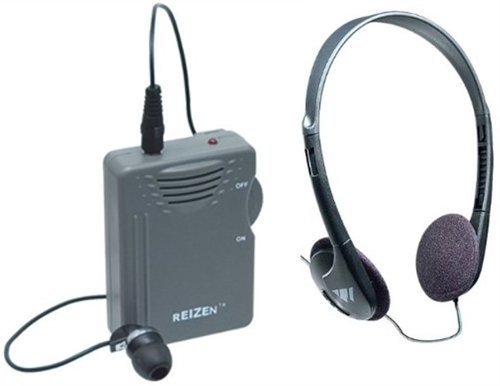
A 120dB personal amplifier that picks up sound from up to 100 feet away, for focused listening sessions.
This is a different kind of device — a powerful personal amplifier rather than a discreet in-ear aid. With 120dB of gain and a built-in microphone, it’s designed to pick up sound at a distance of up to 100 feet away, making it ideal for specific scenarios like listening to a sermon, a lecture, or the TV from across the room. The voice and sound come through a mini earphone.
The package is built for immediate use: it includes 2 AAA batteries, a single earphone, and a free pair of headphones for more comfortable listening. Because it runs on AAA batteries, there’s no charging case to keep track of, though shoppers say the batteries can be difficult to exchange. It’s an on-ear style device that you can clip to a chair, making it a practical tool for single-purpose listening rather than all-day wear.
The review pages sum it up: “This is better than a hearing aid” for some, especially for someone who has lost expensive hearing aids and needs a simple, effective replacement. When using it for a sermon, the recommendation is to keep the volume lower for better quality, as it can be too loud during singing. It’s a functional, no-frills amplifier for a specific use case, with some mixed feedback on sound quality and noise level.
Its Role: This isn’t for all-day conversational wear — it’s for when you need to pull in a specific sound source from across a room with maximum gain.
Best suited to: someone who wants a high-gain, stationary listening aid for church, lectures, or TV, and prefers replaceable AAA batteries.
Not ideal if: you need a discreet, invisible daily wear device — you’ll want one of the in-ear rechargeable picks instead.
6. Kituwant Digital Hearing Amplifier

A behind-the-ear amp with an unrivaled 500-hour battery and four frequency programs for mild to moderate loss.
If the thought of daily charging exhausts you, this is the answer — the Kituwant promises an astonishing 500 hours of battery life, because it runs on a standard replaceable zinc-air battery instead of a rechargeable cell. This is a huge practical advantage for travel or for users who find plugging in a hassle. One long-time buyer swears by this approach, noting it outlasted 7 pricier USB-chargeable aids.
It is an “earphone” style amplifier that you rotate behind your ear and secure with a hook, so you do not worry about it falling off. It features smart noise reduction with an upgraded digital chip, and you can switch between four frequency programs — High, Low, Mid, and Wide — to match your listening environment. A 36 dB gain makes it ideal for mild to moderate hearing loss, while the manufacturer advises anything more severe should follow a doctor’s advice.
Buyers with partial upper-range deafness find it works well and stays in place comfortably, holding conversations clearly. While some find it not completely invisible, they appreciate the effective performance and the simple convenience of popping in a new battery. This is a smart pick for those who value longevity and simplicity over the sleekest look.
Why You’ll Like It
- 500-hour run time per battery is class-leading in this lineup
- Four frequency programs adapt to different environments
- Secure behind-the-ear hook prevents falls
Keep In Mind
- Requires purchasing replacement zinc-air batteries over time
- Some users report a constant background hiss in quiet settings
Pick this if: you loathe charging devices and want a dependable amplifier that runs for months on a single battery.
pass on it if: you’re in loud, noisy environments often — the basic noise reduction may not match a 16-channel DSP model.
7. FVUH Rechargeable Hearing Aids
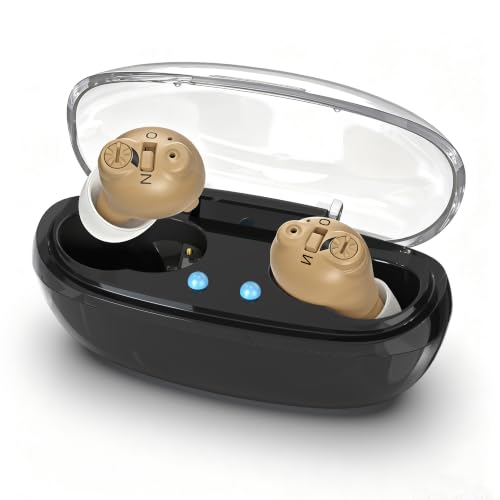
A featherweight 0.01 lb in-ear aid with a 360° rotatable design that disappears into your ear canal.
This pick wins on discretion and comfort. Weighing an almost unimaginable 0.01 lb, the FVUH is designed to fit snugly with soft ear pads and a 360° rotatable design, ensuring an invisible, secure fit for all-day wear. The intelligent chip is the star here — it accurately recognizes human voices while filtering out buzzing and background noise, so you get a natural listening experience whether you’re in a quiet room or a bustling café.
The battery life is more than respectable: a 2-hour charge gives you about 50 hours of use, and the included USB-C charging case lets you top up anywhere — from a power bank to a laptop. This is a significantly larger reserve than the 25+ hours the URORU offers, making it a strong competitor for heavy users. The case uses a standard type-C interface, so it’s easy to keep powered on the go.
It’s exceptionally easy to use, with no left/right distinction and intuitive button controls. You can switch between 3 adjustable modes — normal, noise reduction, and enhanced clarity — with a simple button press. Buyers are emphatic that these stay in the ears better than any they’ve had before, with no whistling noise in the wind, and they’re “so happy” with the clear sound that improves conversations.
the balance: It finds a great balance between the 16-channel smart processing of premium models and a price that feels very accessible, all in a nearly invisible shell.
Reach for this if: you want a lightweight, discreet aid that you’ll forget you’re wearing, with modes to tackle noise when needed.
Think twice if: you need the raw power of a behind-the-ear model for more severe hearing loss.
8. MepvabKY Ultra 32-Channel Aids
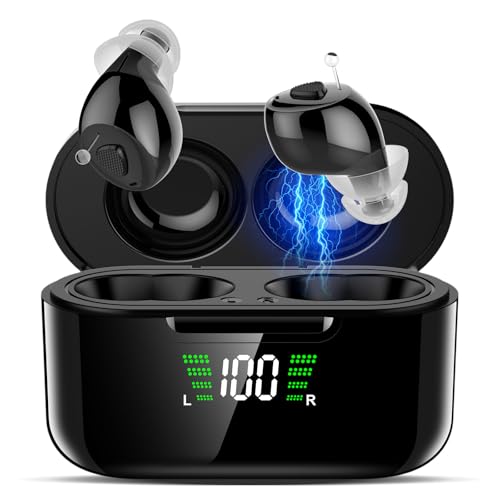
The most advanced pick here — a 32-channel processor with AI noise cancel and a 100+ hour backup case.
This is the top-tier option that goes beyond the standard 16-channel amplifiers, using a 32-channel digital chip to intelligently separate speech from background noise. In a crowded restaurant or a family gathering, the promise is that you catch every word naturally without straining. This is the standout-spec callout: 32 channels is the highest count in this lineup, and it directly translates to finer frequency control for a more natural sound.
The attention to detail extends to the startup experience. It features a whistle-free “Smart Startup System” that delays sound amplification for 10 seconds, giving your ears a gentle start and preventing that sudden, painful screech. Built-in wax protection with washable, breathable ear domes and a nano-coating on the chip shield it from moisture and dust, which owners say extends the device’s life.
Operation is fully automatic — just 2 hours of charging gives you 18-20 hours of use, and the portable case provides 100+ hours of backup power. There’s auto on/off, memory settings, and no app to fiddle with. Buyers describe it as discreet, almost invisible, with clear sound and long battery, backed by a lifetime warranty. It’s the one to pick when you want all the modern conveniences in a single, premium package.
The Premium Edge
- Leading 32-channel processing separates speech from noise most effectively
- Whistle-free startup prevents painful sudden feedback
- 100+ hours of backup power in the case with auto on/off
The Catch
- Priced at the top of the range, it’s an investment for the extra channel count
- A rare dissenting voice found it squealed at higher volumes
Best for: the person who wants the most sophisticated noise-filtering technology available in an OTC device and is willing to pay for it.
Look elsewhere if: your hearing loss is mild and you just need a simple volume boost — you’ll save money with a 16-channel or basic model.
Understanding the Specs
Channel Count and Processing
The “channel” number you see (16-channel, 32-channel) refers to how many frequency bands the digital processor handles independently. Each channel can be tuned to tune a specific range of sound. In everyday terms, a higher channel count generally gives the amplifier more power to separate the frequencies of human speech from the frequencies of background noise like a fan hum or traffic. This is the single biggest factor separating a simple “loudness booster” from a device that genuinely helps you understand conversations in noisy places.
Battery Life vs. Runtime with Case
When comparing amplifiers, you’ll see two different battery numbers. The “hours per charge” tells you how long the device runs after a full charge of the aids themselves. The “hours with case” figure includes the extra power held by the charging case, which can top up the aids several times. For example, a device with 20 hours per charge and a case that holds 3 charges gives you roughly 80 hours total. Always check both numbers — the case number is what you’ll actually experience over a full day out and about.
FAQ
What is the difference between a personal sound amplifier and a hearing aid?
How do I stop my ear amplifier from whistling or squealing?
Will an ear amplifier work for severe hearing loss?
How long does a full charge actually last in real-world use?
Are rechargeable ear amplifiers better than those with replaceable batteries?
How do I know which ear dome size to use?
Can I use a hearing amplifier with glasses or a hat?
Is there a difference between left and right ear devices?
Why does my amplifier pick up so much background noise?
What’s the right way to clean my ear amplifier?
Final Thoughts: The Verdict
Across the board, the overall winner for the ear amplifier category is the URORU Rechargeable Aids because it pairs genuine 16-channel noise cancellation with a 3-gram, almost invisible fit and 100+ hours of total battery. If you want the absolute best in smart noise processing and don’t mind a premium price, grab the MepvabKY 32-Channel. And for the budget-conscious buyer who still wants a strong 40-hour battery and effective noise control, the CONNOVA is the one to reach for.
How We Picked
We do not accept paid placement. Every pick is matched to a real buyer and a real use-case; we do not hands-on test units.
Sources & Methodology
Specifications: manufacturer listings and product documentation. Review insights: verified customer reviews, as of August 2026. Pricing: not shown on this page (it changes often); check the current price via the retailer link.
As an Amazon Associate, WellFizz earns from qualifying purchases. This does not affect which products we feature.
Related Guides

Mo Maruf
I created WellFizz to bridge the gap between vague wellness advice and actionable solutions. My mission is simple: to decode the research and give you practical tools you can actually use.
Beyond the data, I am a passionate traveler. I believe that stepping away from the screen to explore new environments is essential for mental clarity and physical vitality.