Our readers keep the lights on and my smoothie glass nicely filled. As an Amazon Associate, I earn from qualifying purchases.
Specs are compiled from manufacturer listings and verified buyer reviews and can change over time — please confirm the key details on the product page before buying.
If you’re starting a podcast, the worst mistake is buying a cheap condenser mic that picks up your PC’s hum, the dog barking downstairs, and every echo in the room. A dynamic microphone fixes that by only capturing sound from the direction it’s pointed — straight at your mouth — so your voice sounds clean and broadcast-ready even in a totally untreated room. USB dynamics now deliver that broadcast-grade rejection without an audio interface or XLR cabling.
I’m Mohammad Maruf — the founder and writer behind WellFizz. This guide is built by comparing the manufacturers’ published specifications and the patterns across verified customer reviews, so you get each pick’s real strengths and trade-offs instead of marketing spin.
Your pick hinges on your room’s noise level and your recording setup, not just the price. A noisy room demands strong off-axis rejection; broadcast clarity needs a mic that flatters your voice.
Our Picks at a Glance


How To Choose The Best Dynamic USB Microphone For Podcasting
Before you compare specs, understand the one thing that separates these mics from everything else on your desk: a dynamic capsule ignores off-axis sound. You speak into it, and it hears you; the air conditioner two feet away might as well not exist. That’s why podcasters switch to dynamics when their recordings start echoing like a bathroom.
Match the pickup pattern to your room
Most dynamic podcast mics use a cardioid pattern, which means it captures sound in a heart-shaped zone in front of the capsule and rejects noise from the sides and rear. A hypercardioid pattern (found on some pricier mics) narrows that zone even further, giving you even more rejection of room echo but demanding you stay on-axis — meaning you can’t lean back or turn your head without your volume dropping.
Decide between USB-only and hybrid XLR
A USB-only mic is plug-and-play but locks you out of upgrading to a pro audio mixer later. A hybrid mic with both USB and XLR outputs costs a bit more but future-proofs your rig: you can plug into your computer today, then move to an interface or a portable PA system when you grow. Almost every serious pick on this list is hybrid for exactly that reason.
Don’t ignore the extras that matter daily
Zero-latency headphone monitoring lets you hear yourself in real time, keeping your pacing natural. Tap-to-mute prevents a hot mic from broadcasting your coffee sips. A foam windscreen or pop filter tames the plosive “p” and “b” blasts that ruin a take. Check the mounting: some ship with a heavy desktop stand, others require a separate boom arm purchase.
Quick Comparison
| Model | Best For | Connectivity | Pickup Pattern | Weight | Amazon |
|---|---|---|---|---|---|
| Shure MV7+★ Best Overall | Top-tier broadcast sound with auto leveling | USB-C & XLR | Cardioid | 3.6 lbs | Amazon |
| FIFINE AM8PROTBest for Gamers | Gamers and streamers wanting RGB and a boom arm | USB & XLR | Cardioid | — | Amazon |
| Samson Q2UBudget Champion | Beginners on a tight budget | USB-C & XLR | Cardioid | — | Amazon |
| MAONO PD200W | Wireless freedom and duo podcast setups | Wireless, USB & XLR | Cardioid | 1.32 kg | Amazon |
| MAONO PD400X | Studio-level EQ control via software | USB & XLR | Cardioid | — | Amazon |
| Samson Q9U | High-resolution 24-bit/96kHz recording | USB-C & XLR | Cardioid | 800 g | Amazon |
| Audio-Technica AT2040USB | USB-only simplicity with hypercardioid rejection | USB | Hypercardioid | 600 g | Amazon |
| HyperX FlipCast | Console and PC gamers wanting plug-and-play | USB-C & XLR | Dynamic | — | Amazon |
| RØDE PodMic USB | Rugged all-metal build with DSP effects | USB-C & XLR | Cardioid | 896 g | Amazon |
In‑Depth Reviews
1. Shure MV7+ USB-C & XLR Podcast Dynamic Mic
Our pick — over 4.5★ from 550+ verified ratings; the strongest balance of quality and price.
The broadcast standard that auto-adjusts its own gain so your voice stays level even when you lean in or back away.
The MV7+ is the most complete dynamic package you can buy, and it earns the top spot with on-board DSP (digital signal processing — a built-in chip that cleans your audio before it ever reaches your computer). Its Auto Level Mode adjusts gain in real time based on your distance and voice volume, so a host who gestures wildly or turns to grab a coffee never suffers a sudden volume drop. That same chip runs a real-time denoiser that filters out ambient sound, fan noise, and room echo, and the virtual pop filter kills harsh plosives without a foam ball in sight.
It is noticeably bulkier than the sub- USB mics on this list — at 3.6 pounds with the all-metal body and adjustable desktop stand, it’s a piece of gear you clear desk space for, not a travel accessory. Buyers who switched from a condenser like the Yeti Nano report the difference immediately: in their words, “there was too much background noise” on the old mic, and the MV7+ simply erased it. The LED touch panel cycles through 16.8 million color hues, so you can match your setup’s aesthetic or set it to pulse, and tapping it anywhere mutes you instantly.
Connectivity is where it future-proofs you: you get both USB-C and XLR, meaning you can plug straight into a laptop today or into a pro audio interface when you expand to a multi-host studio. The MOTIV Mix app lets you fine-tune EQ, add studio-quality reverb, and customize the LED look — all without touching a physical knob. The only real downside is that the software adds a layer of complexity some buyers ignore entirely; for the price, expect to spend ten minutes learning it.
What wins people over
- Auto Level Mode keeps your volume consistent without manual tweaking
- Real-time denoiser removes fan noise and room echo in the mic itself
- USB-C and XLR both included, so you can upgrade your rig later
- Zero-latency headphone monitoring so you hear yourself in real time
What to weigh first
- Heavier and larger than budget USB mics; needs a sturdy desk spot
- The MOTIV Mix app adds a learning curve some owners skip entirely
Reach for this if: you want a set-and-forget broadcast mic where the hardware does the noise rejection for you, not your post-editing.
Look elsewhere if: you want a tiny mic you can toss in a bag — this one demands a permanent desk position.
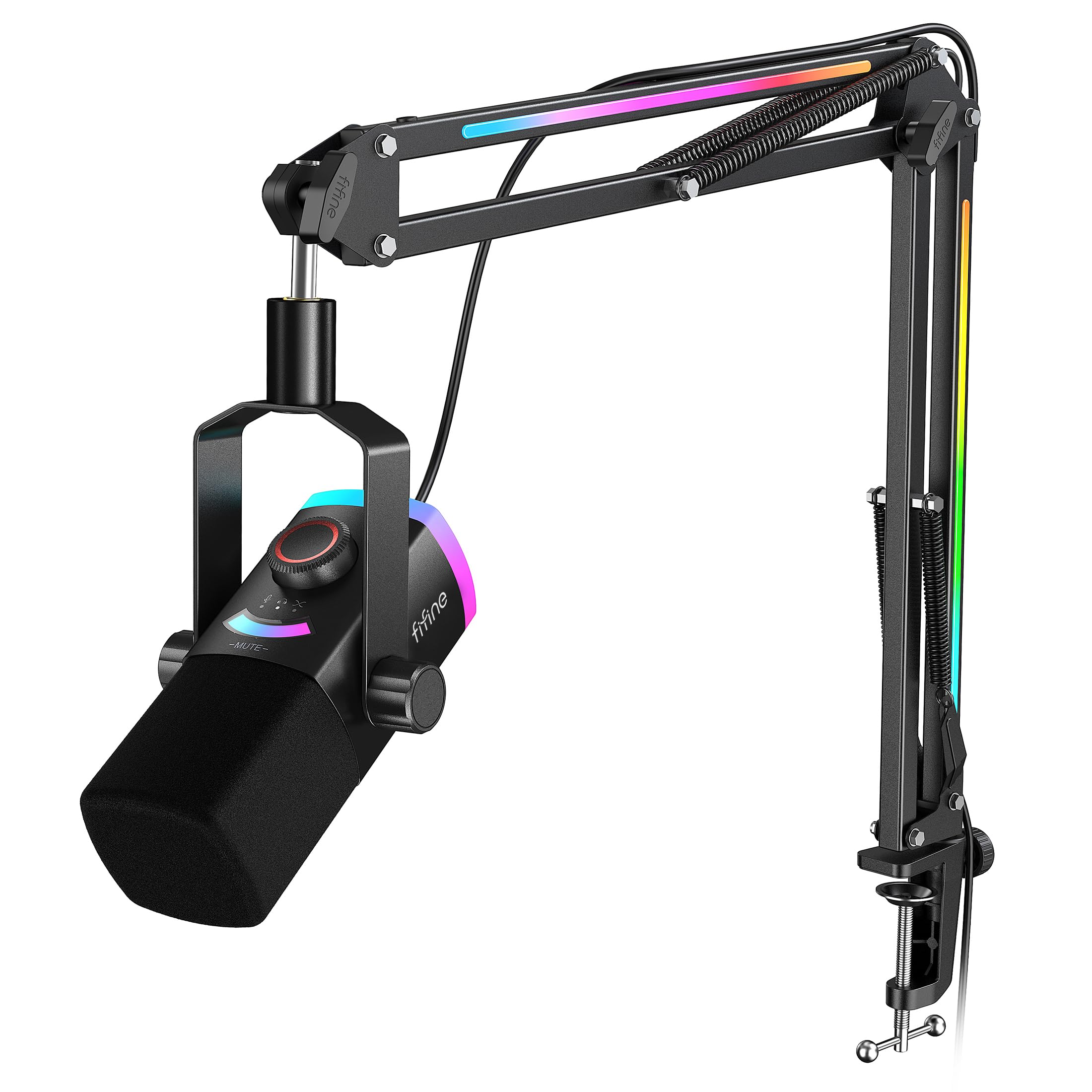
2. FIFINE AmpliGame AM8PROT Gaming Microphone Kit
A complete streamer rig with RGB, a boom arm, and a dynamic capsule that cuts through game audio without the clicks.
The AM8PROT is built for the gamer who wants the whole kit, not just a mic. It ships with a thickened boom arm that minimizes wobble noise, a foam windscreen that disperses airflow, and an 8.2ft USB cable — so the moment it’s clamped to your desk, you’re recording. The dynamic XLR microphone with cardioid pattern plus a 75dB SNR (signal-to-noise ratio — how much cleaner your voice is versus the background hiss) rejects low noise and interference caused by multiple devices running simultaneously, which is exactly the multi-PC chaos most desks deal with.
Tap-to-mute with a visible LED panel is the feature streamers rave about most, preventing hot-mic moments during intense FPS games where you’d otherwise yell “no no no” straight to an audience. The silent 3-in-1 knob handles gain and headphone volume in one smooth scroll, and the Mix Control lets you balance game audio against your commentary in real time. The RGB system offers 240+ combos across both the mic and the boom arm, with beat modes that pulse the lights to horror game soundtracks.
On the audio side, the 48kHz/24bit capture gives you rich, warm vocal reproduction that one reviewer noted made a real difference over a headset — and the background noise rejection is the thing owners point to most, with feedback noting it “removes breathing and household sounds.” The software has a slight learning curve, and most owners suggest minor EQ adjustments via the FIFINE Genie app to shape the tone to your voice, but the plug-and-play USB-C setup means you can jump from a desktop to a PS5 party to a USB-C laptop in seconds.
The streamer-first setup
- Boom arm and windscreen included, so no extra gear needed
- Tap-to-mute with LED indicator prevents hot-mic blunders
- USB and XLR both work; XLR is ready when you upgrade
- 240+ RGB combos that pulse to your game audio
Setup notes
- The mic cable can be fiddly to route inside the arm
- Tap-to-mute is sensitive; a light tap on the wrong spot mutes you
Grab it for: a one-box streamer kit where the arm, lights, and noise rejection all arrive together.
Think twice if: you want a plain, discreet mic — the RGB is always part of the personality here.
3. Samson Q2U USB/XLR Dynamic Microphone Pack
The entry-level classic that proves a real dynamic capsule can fit a budget without sacrificing the XLR future.
The Q2U is the mic that has launched a thousand podcasts, and its massive owner base is the proof. It’s a dynamic handheld microphone with both XLR and USB-C outputs, so it plugs directly into any computer with a USB-C interface for instant recording, or into an audio interface when you’re ready to go pro. The cardioid pickup keeps your voice front and center while rejecting background noise from the sides, which is exactly what a beginner in an untreated room needs most. Buyers consistently call out the “clear, warm sound” as a huge upgrade from a cheap headset, and the dual connectivity is the reason it’s still recommended years after launch.
Included in the pack are the tripod desktop stand, tripod extension for standing height, mic clip, windscreen, USB-C cable, and XLR cable — everything you need to start recording from the start. The size on the stand fits neatly on a standing desk, which was a specific win for one owner using a Mac mini. It’s note the included tripod is on the flimsy side and can pick up desk thumps; most owners eventually swap to a boom arm, and the mic’s standard threading makes that an easy upgrade.
The honest trade-off at this price: it’s a great value, not a flawless one. After a year, some buyers report low output volume that requires gain boosting — which raises the noise floor and needs a filter in your recording app. It’s sensitive to keyboard and mouse clatter, so it rewards good technique, speaking close and on-axis. A few note occasional PC detection hiccups, but the durability record is strong, with one unit surviving multiple drops over two years. If you’re just starting out and want to learn podcasting without spending big, the Q2U is the safest entry point in this entire list.
Why beginners love it
- USB-C and XLR both included, so you can grow your setup later
- Complete pack: stand, clip, windscreen, and both cables in the box
- Genuine dynamic capsule rejects room noise on a budget
- Durable enough to survive drops, per long-term owners
Know before you buy
- The tripod stand is weak and can transmit desk vibrations
- Output can run low; you may need a gain boost and a filter
Choose it when: you’re starting from zero and want the cheapest real dynamic with a clear upgrade path.
Pass it by if: you want a plosive-proof mic without buying a separate pop filter later.
4. MAONO PD200W Hybrid Wireless Podcast Microphone
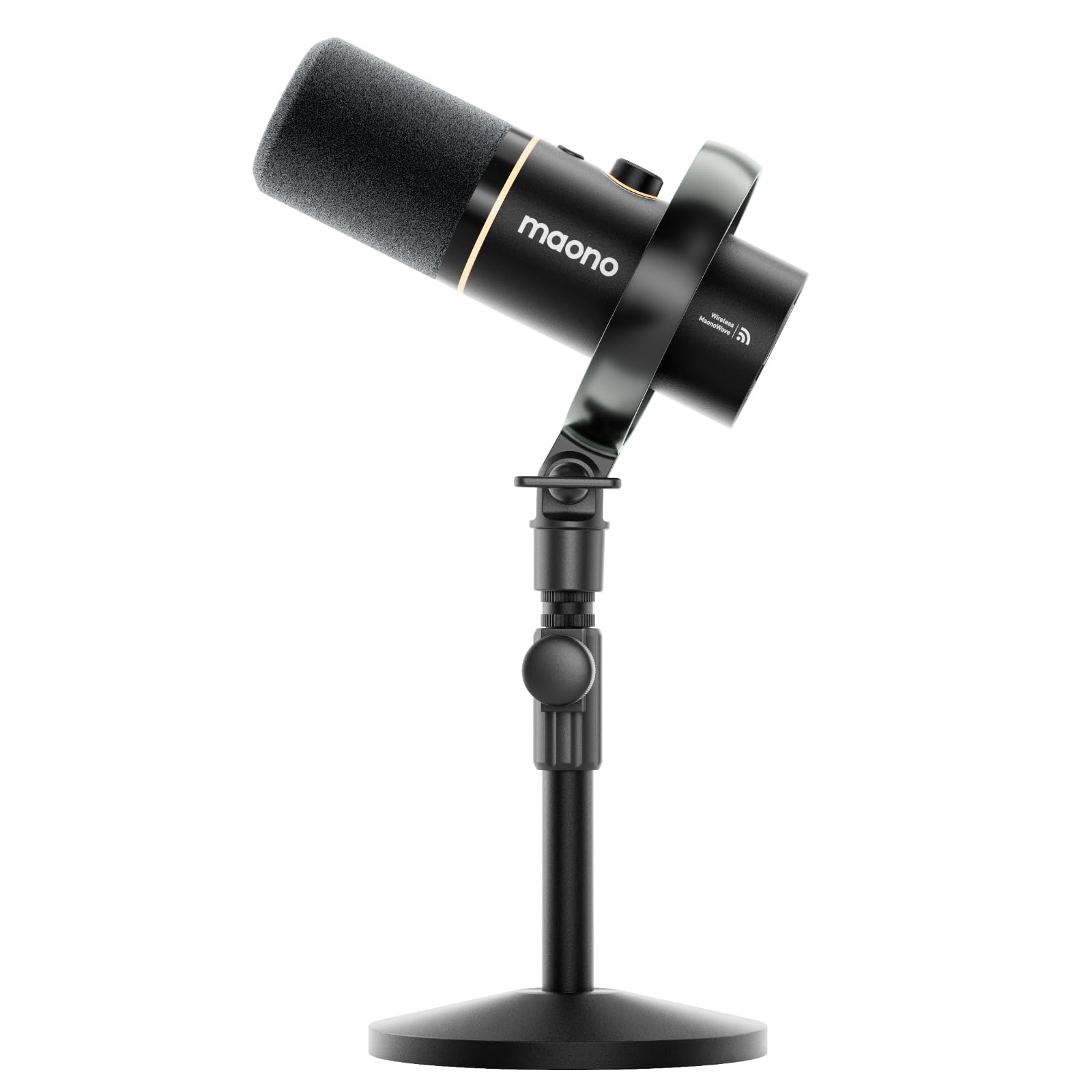
The only mic here that cuts the cable entirely, letting you roam a room during an interview while recording to your camera.
The PD200W is the wildcard of this list because it does something no other pick can: it works completely wirelessly. It offers three connection modes — wireless for maximum freedom, USB for plug-and-play on a phone, tablet, or computer, and XLR for a pro-level setup with an audio interface. That wireless mode runs on a stable 60m range, which is huge for walking around a room while recording, and up to 60 hours of battery life (with RGB off) means a week of podcasting between charges. The 30mm dynamic capsule delivers studio-quality vocal reproduction with a cardioid pickup, an ultra-clean 82dB signal-to-noise ratio, and handling up to 128dB SPL without distortion — so loud laughter or a shout never clips.
The killer feature for interview shows is that the PD200W supports a single receiver connecting two wireless desktop mics for duo podcasts or interviews, recording each mic to its own track so you can edit with precision. It also captures audio and video in perfect sync directly on the camera, eliminating post-production alignment — though you’ll need to buy the camera and Lightning accessories separately. The three-stage noise cancellation keeps your voice rich and focused even without a soundproof booth, which was the feature that won over a classroom user who needed to capture a teacher and most students clearly.
Set your sound via the MaonoLink app, which offers 4 master-tuned preset modes plus precise EQ and reverb adjustments for a personalized profile. The 1.32 kg metal body and sturdy adjustable desktop stand give it a premium feel, and it survived drops in one owner’s testing. The main gripe from owners is the battery needing a recharge roughly twice a week if you run it hard with RGB on, and the box ships without a USB-C to USB-C cable — plan for a quick cable buy if you use it that way.
The freedom factor
- True wireless mode with a 60m range for roaming interviews
- Two mics pair to one receiver, each recording its own track
- Audio and video sync directly on camera, no post-alignment
- 60 hours of battery life with RGB off
Reality checks
- Camera receiver and Lightning accessories are sold separately
- No USB-C to USB-C cable in the box
Reach for this if: you do guest interviews or like recording outside a desk setup and want to ditch cables.
Choose wired instead if: you never move from your chair — a fixed USB mic gives you the same audio for less.
5. MAONO PD400X Dynamic USB/XLR Podcast Mic

The studio-shaped dynamic that gives you pro EQ control through software while the metal body absorbs desk thumps.
The PD400X is for the podcaster who wants to shape their voice, not just capture it. It’s a dynamic capsule with a cardioid polar pattern designed to reject unwanted background noise for “perfect recordings in imperfect rooms,” which is exactly the pitch for home studios without acoustic treatment. The unique 3-in-1 digital knob adjusts mic gain, headphone volume, and monitor mix in one scroll, and the touch mute key has an LED indicator so you always know your live status. The body is solid metal with a heavy stand, giving it a premium weight that owners consistently note feels far more expensive than it is.
The real depth is in the MAONO Link app. In Standard Mode you select your preferred vocal tone and distance from the microphone; in Advanced Mode you can adjust mic gain, monitor mix, EQ, limiter, and compressor. That’s the kind of granular control you’d normally only get from a dedicated audio interface, and here it’s all built in. One owner who compared it directly to a Shure SM7B on a friend’s rig said it sounded better through the XLR output — high praise for a mic at this price tier. The included kit is complete: desktop stand base, USB A-to-C cable, XLR-to-XLR cable, and wind foam.
The catch is that functionality gets mixed reviews. It works flawlessly for most owners, but a subset hit issues — one had a USB-C port fail, and MAONO’s customer service replaced it quickly even out of warranty, which speaks well for the brand. A few note it still picks up background noise if you don’t position it right, and running it through the software’s USB path can color the sound; the XLR route bypasses that entirely. For a home studio that wants broadcast polish without the Shure price tag, this is the smart money pick.
The studio toolkit
- Full EQ, limiter, and compressor via the MAONO Link app
- 3-in-1 knob handles gain, headphone volume, and monitor mix
- Solid metal body with a heavy, stable stand
- USB and XLR both included, with a windscreen in the box
Watch these points
- Functionality is mixed: a few owners hit USB port failures
- Positioning matters; background noise creeps in if you drift off-axis
Buy it for: the same broadcast sound as mics costing five times as much, with on-board EQ to dial in your voice.
skip it if: you want a zero-configuration plug-and-play mic and won’t open the software.
6. Samson Q9U XLR/USB Dynamic Broadcast Microphone
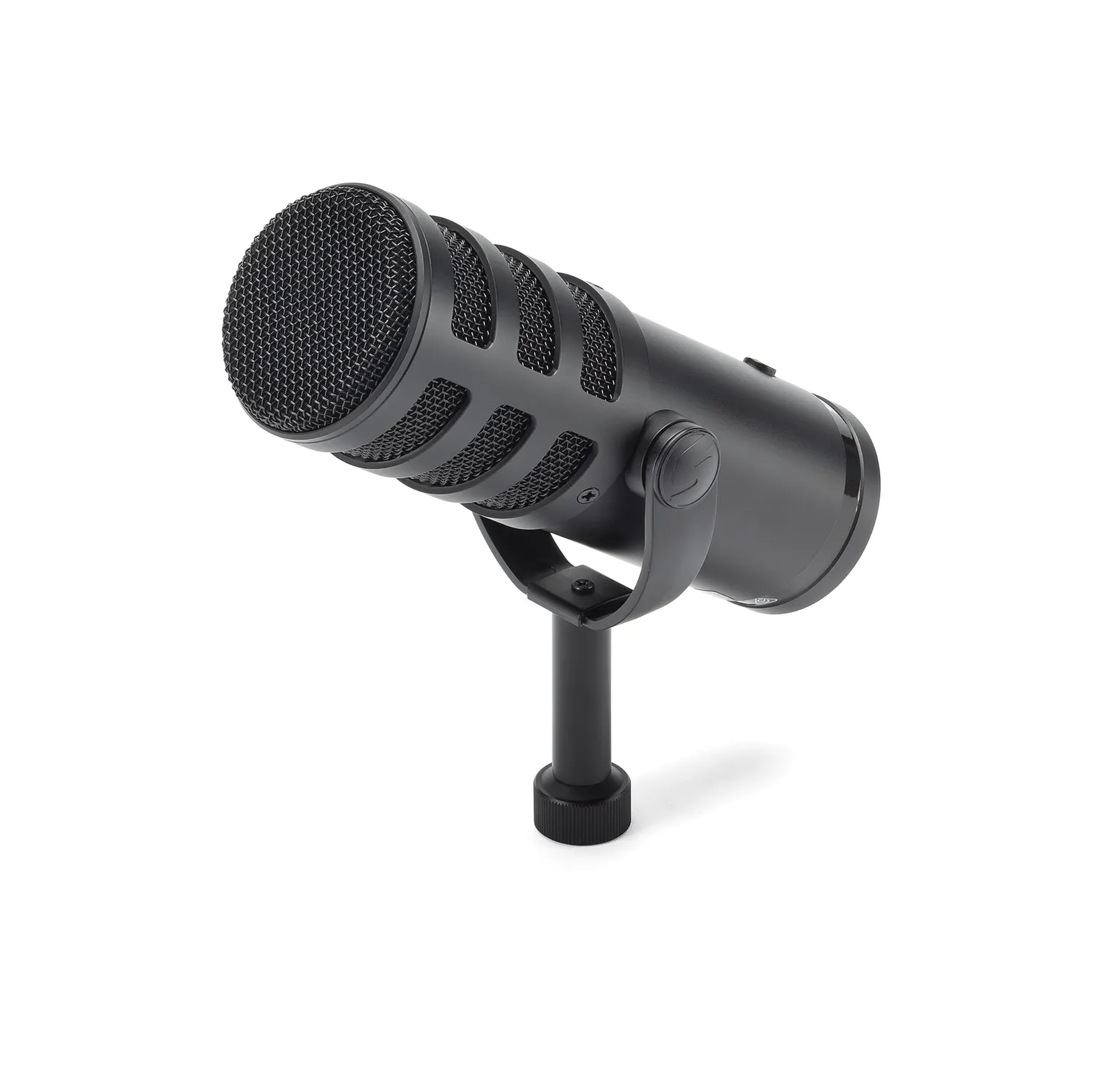
A broadcast workhorse with 24-bit/96kHz resolution and a built-in shock mount that erases desk rumble.
The Q9U is the most “studio” of the mid-range picks here, offering a 24-bit/96kHz analog-to-digital converter for high-definition digital recordings directly to your Mac or Windows computer with no driver downloads. That resolution means your audio carries more headroom and less digital harshness than the 48kHz standard — useful if you’re doing voiceover work where editing subtle dynamics matters. The modern dynamic capsule with a neodymium magnet provides plenty of output to work with any mixer or audio interface without needing an external gain device, which is a hidden cost-saver for people building a professional rig.
Two details make it special for daily use. First, the internal pneumatic shock mount isolates the capsule from mechanical noise, so knocking your desk mid-recording doesn’t send a thump into the track. Second, the dual-layer windscreen minimizes popping and plosives for a crisp broadcast sound, and a cardioid polar pattern keeps your voice front and center with excellent off-axis rejection. The zero-latency headphone monitoring lets you hear yourself in real time, and the onboard mute switch quickly silences both the XLR and USB outputs at once.
Buyers who have run it daily for two years across live streaming, podcasting, and gaming call it a great value, with some ranking it above the Shure MV7 and SM7B for warmth — notable praise from a very vocal owner base. The honest downsides: it ships without a stand, mounting adapters, or an XLR cable (only USB-C cables are included), so budget for mounting hardware. It’s also heavy at 800g and requires a sturdy arm. Windows 11 users may need to adjust their system volume — one owner runs theirs at 78% — but it’s bus-powered, so no extra wall wart needed.
Broadcast credentials
- 24-bit/96kHz USB recording with plug-and-play simplicity
- Internal shock mount kills desk rumble and mechanical noise
- Zero-latency headphone monitoring for real-time voice check
- Neodymium capsule drives mixers without external gain
Out-of-box surprises
- No stand, mounting adapter, or XLR cable included
- Heavy at 800g; a flimsy arm will sag
Pick it for: high-resolution voice work where 24-bit/96kHz fidelity and built-in shock isolation earn their keep.
Look elsewhere if: you want a complete desk setup without buying a boom arm and XLR cable separately.
7. Audio-Technica AT2040USB Dynamic USB Microphone

The no-fuss USB dynamic that narrows its pickup with a hypercardioid pattern to reject even more room echo.
The AT2040USB is for the podcaster who wants the classic Audio-Technica broadcast sound without any cables or interfaces, ever. It’s USB-only — plug it in and it works — and the dynamic broadcast capsule gives you that warm, contained radio tone. what separates it technically is the hypercardioid pickup pattern, which is narrower than the standard cardioid found on most of this list. That tighter zone focuses on your voice and minimizes room noises and echo even more aggressively, which is a real advantage in reflective, uncarpeted rooms where standard cardioids still catch slap-back.
The physical controls are refreshingly simple. A two-state LED indicator ring lights blue when the mic is powered on and red when muted, so your guest always knows their status from across the desk. The silent soft-touch mute button provides reliable muting without a mechanical click, and the built-in headphone jack with a high-output amplifier delivers real-time monitoring with clean sound. The stainless-steel enclosure gives it a premium 600g weight that feels far sturdier than its compact 5.72 x 2.05 x 2.05-inch footprint suggests.
Owners who use it daily for zoom calls and podcasts praise the clean output and low noise, and one noted it captures the most important frequencies of a low-pitch voice without getting bassy like other mics. The honest knock is the built-in DAC and amp: one owner found the headphone monitoring treble-heavy and lifeless compared to an external interface, though the recording itself was excellent. It’s also heavy for its size — a mic stand with a weak grip will struggle to hold it. This is the purest “it just works” pick on the list, best for someone who never wants to think about XLR or gain stages.
The simple-life advantages
- Hypercardioid pattern rejects echo better than standard cardioid
- USB plug-and-play, no interface or drivers required
- LED ring shows mute status in red and powered state in blue
- Stainless-steel build feels premium for the size
Trade-offs to know
- USB-only means no upgrade path to XLR mixers down the road
- Built-in headphone amp is a weak point for monitoring
Choose it when: you want the cleanest USB-only setup and need maximum room-echo rejection in a small space.
Think twice if: you plan to grow into an audio interface — this mic can’t follow you there.
8. HyperX FlipCast Streaming XLR/USB Dynamic Microphone
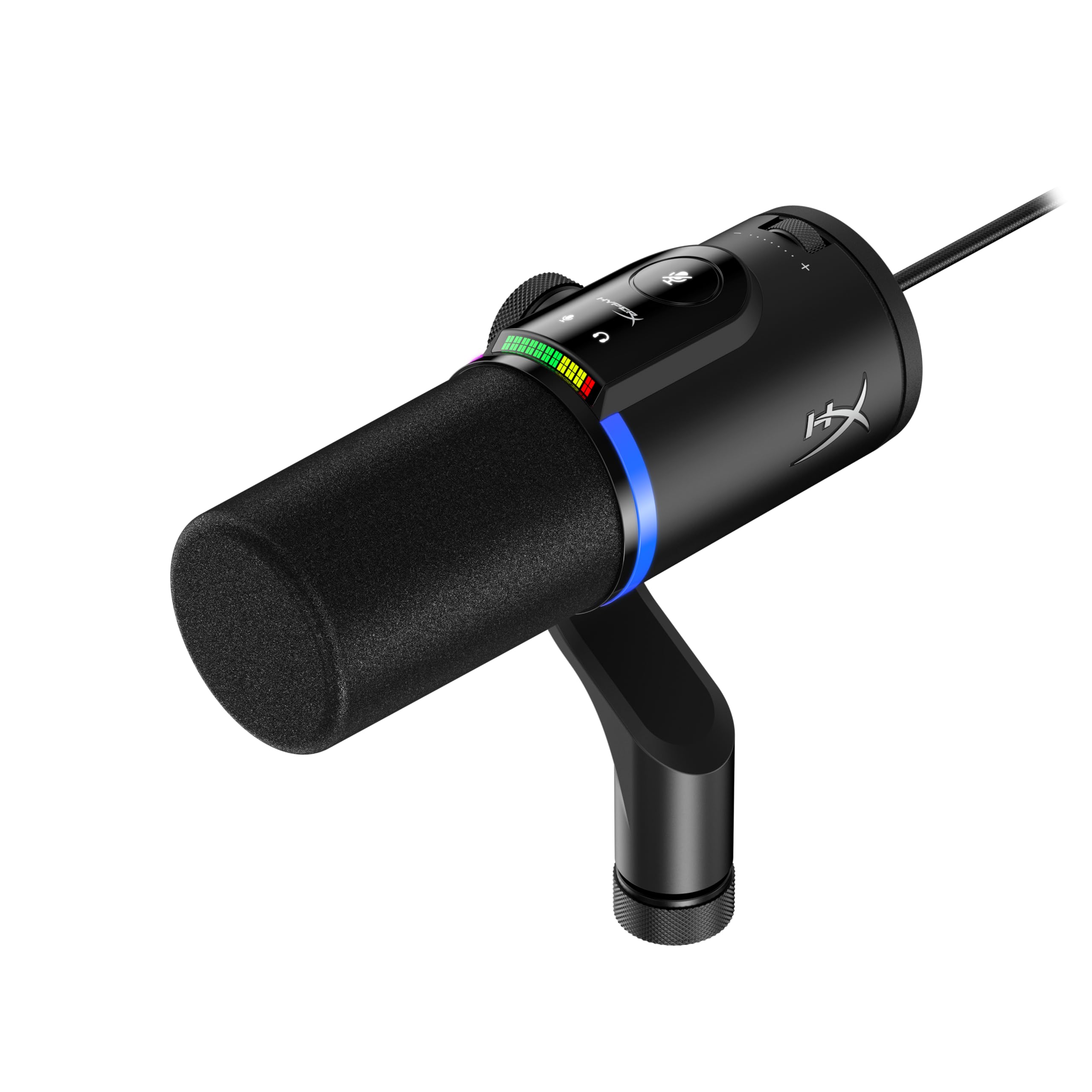
The plug-and-play dynamic that slides onto a boom arm in seconds and works with PlayStation, Switch, and dual-PC rigs.
The FlipCast is HyperX’s first entry into the broadcast dynamic space, and it nails the console-to-PC handoff that gamers actually need. It’s a broadcast-quality XLR/USB dynamic microphone with USB-C plug-and-play connectivity that works from the start with PC, MacOS, PlayStation, and Nintendo Switch — which matters if you record a podcast but also jump into party chat on console. The dynamic capsule picks up crisp highs and deep lows while ignoring background distractions, and the aluminum enclosure keeps it light enough to swing on any standard arm.
Setup flexibility is the headline. The universal mic mount threading uses a 5/8″ standard with a swivel arm, and a 3/8″ thread adapter is included for extra versatility — so it fits nearly every boom arm or stand you already own. For the dual-PC streamer, the XLR output lets you connect to audio mixers or studio decks right from the start, and the USB-C path handles the chat computer. Onboard filters help you find your sound at the flip of a switch: a high-pass filter reduces low-frequency background noise, while a presence boost pushes your vocals to shine through with extra clarity.
The multifunction wheel on the front adjusts mic gain, headphone volume, and monitor mix, with a raised LED meter so you can keep track of levels at a glance. Tap-to-mute prevents accidental transmissions, and the HyperX NGENUITY software open up auto-level mode, custom EQ profiles, and adjustable LED ring colors. Owners call it a “premium feel without the premium price,” with one noting they get compliments on how great it sounds after a month of daily use. The small caveat, repeated across owners: make sure you install the NGENUITY app to get the full feature set — the mic works without it, but you leave the custom EQ on the table.
Multi-device strengths
- Works with PC, MacOS, PlayStation, and Nintendo Switch from the start
- 5/8″ standard mount plus a 3/8″ adapter fits any arm
- High-pass filter and presence boost at the flip of a switch
- Raised LED meter tracks gain, headphone volume, and mix
Small print
- NGENUITY software needed for auto-level and custom EQ
- No stand is included in the box — plan on an arm
Reach for it if: you flit between a console and a PC rig and want one dynamic mic that follows you everywhere.
Choose a kit instead if: you don’t already own a boom arm and want a desktop stand included.
9. RØDE PodMic USB Dynamic Broadcast Microphone

A rugged all-metal broadcast mic with the legendary APHEX processors built in for instant radio polish.
The PodMic USB takes RØDE’s beloved XLR-only PodMic and adds USB-C connectivity, plus the kind of internal DSP (digital signal processing — a chip that shapes your audio before it reaches the computer) that usually lives in expensive rack gear. The headline is the inclusion of the legendary APHEX Aural Exciter and Big Bottom processors, accessible via the RØDE Central companion app. These are the classic tools broadcast engineers used to add clarity and depth to voices, and here they’re built into the mic itself — you can sound like you spent thousands on outboard processing with a single toggle.
The build is classic RØDE: solid, all-metal construction with a rugged design rated for years of daily professional use. The 896g weight gives it a reassuring heft that owners consistently describe as “truly premium construction,” and the white finish of this version is a genuine departure from the sea of black mics on this list. Inside, an internal shock mount reduces knocks and vibration, while a built-in pop filter and the included external pop filter work in tandem to tame plosives for natural, clear voice reproduction. The integrated headphone port offers zero-latency monitoring with a dedicated volume control.
As a USB mic it’s plug-and-play on a Mac, and the XLR output keeps it compatible with traditional audio interfaces and mixers — so it grows with you. Audio quality earns high praise, with several owners ranking it near the Shure SM7B at roughly half the price once you add an EQ curve. The honest issues: the companion software has a rough reputation, and one owner found it incompatible with Discord — though the fix is simple: set your preferences via the app, then delete it, and the mic retains its settings. The sound quality also gets genuinely mixed reviews, with a few owners reporting output that runs too low and needs a gain boost in their recording software.
The pro polish
- APHEX Aural Exciter and Big Bottom processors built into the DSP
- All-metal construction built for daily professional use
- Internal shock mount plus dual pop filters tame noise and plosives
- USB-C and XLR both included for future mixer upgrades
Watch these
- Companion software has glitches and Discord incompatibility
- Sound output is mixed in reviews; some units run quiet
Grab it for: a broadcast-grade metal body and APHEX studio processing without buying an external processor.
Pass if: you want a zero-friction software experience — the app here needs patience.
Understanding the Specs
Polar Pattern and Room Rejection
The polar pattern is the shape of the microphone’s listening zone. Cardioid means the mic hears mostly what’s in front of it and rejects sound from the sides and rear — perfect for a single host at a desk. Hypercardioid narrows that zone further for even better echo rejection, but it punishes you if you drift off-axis. For a dynamic mic, this is the spec that decides whether your room sounds like a studio or a bathroom.
USB vs XLR and the Hybrid Advantage
USB mics plug straight into your computer and work instantly, no interface needed. XLR mics require an audio interface or mixer but give you a cleaner analog signal path and the option to upgrade your preamp later. Hybrid mics with both outputs cost a bit more but let you start on USB and move to XLR as your studio grows — which is why so many serious podcasters make the hybrid their first real mic.
Signal-to-Noise Ratio and SPL
Signal-to-noise ratio (SNR) tells you how much cleaner your voice is compared to the background hiss — a higher number like 82dB is excellent. SPL handling is the loudest sound the mic can take before distorting; a 128dB limit means a shout or a laugh track won’t clip. Both matter if you record loud, animated shows with multiple hosts.
Extra hardware worth caring about
An internal shock mount isolates the capsule from desk thumps and knocks. Zero-latency headphone monitoring means you hear yourself with no delay, which keeps your pacing natural. A pop filter or foam windscreen tames plosive “p” and “b” blasts. And if a mic ships without a stand, factor in the cost of a boom arm — some do, and it’s easy to underestimate.
FAQ
Why should I pick a dynamic mic over a condenser for podcasting?
What is the difference between USB and XLR on a podcast mic?
Does a dynamic mic really remove background noise completely?
What does cardioid polar pattern mean in plain English?
Do I need an audio interface with a USB podcast microphone?
What is zero-latency headphone monitoring?
Will a dynamic USB mic work with my PS5 or Nintendo Switch?
How long does a dynamic podcast microphone last?
What is the difference between the Shure MV7+ and the RØDE PodMic USB?
Is a heavier microphone automatically better quality?
Final Thoughts: The Verdict
For most podcasters, the dynamic usb microphone for podcasting winner is the Shure MV7+ because it delivers a broadcast-grade dynamic sound with a real-time denoiser and auto leveling that does the work for you — you just press record and talk. If you want the deepest control over your voice tone, grab the MAONO PD400X for its app-driven EQ and compressor. And for a true wireless interview setup with a camera-sync receiver, the MAONO PD200W is the one to reach for.
How We Picked
We do not accept paid placement. Every pick is matched to a real buyer and a real use-case; we do not hands-on test units.
Sources & Methodology
Specifications: manufacturer listings and product documentation. Review insights: verified customer reviews, as of August 2026. Pricing: not shown on this page (it changes often); check the current price via the retailer link.
As an Amazon Associate, WellFizz earns from qualifying purchases. This does not affect which products we feature.
Related Guides

Mo Maruf
I created WellFizz to bridge the gap between vague wellness advice and actionable solutions. My mission is simple: to decode the research and give you practical tools you can actually use.
Beyond the data, I am a passionate traveler. I believe that stepping away from the screen to explore new environments is essential for mental clarity and physical vitality.