Our readers keep the lights on and my smoothie glass nicely filled. As an Amazon Associate, I earn from qualifying purchases.
Specs are compiled from manufacturer listings and verified buyer reviews and can change over time — please confirm the key details on the product page before buying.
You did not get into woodworking to breathe sawdust all day. The right dust collector can pull the fine particles that a shop vac leaves behind, protecting your lungs and keeping your shop floor clean. But not every “dust collector” actually captures the dangerous smaller stuff — and that is where most buyers get tripped up.
I’m Mohammad Maruf — the founder and writer behind WellFizz. This guide is built by comparing the manufacturers’ published specifications and the patterns across verified customer reviews, so you get each pick’s real strengths and trade-offs instead of marketing spin.
The air in your workshop is the one tool you cannot upgrade later. That is why we focused on filtration rating, airflow, and real-world owner experiences to find the best dust collector for woodworking that actually keeps your shop clean while staying affordable.
Our Picks at a Glance


How To Choose The Best Dust Collector For Woodworking
Picking a dust collector means understanding how much air it moves (CFM) versus how well it filters out the harmful particles (micron rating). A unit that moves 600 cubic feet of air per minute is useless if it pumps fine dust right back into your shop. Look at both numbers together, not just the highest airflow on the box.
Airflow (CFM) and Static Pressure
CFM (cubic feet per minute) tells you how much air the unit moves. More is better, but only if the filter does not choke the airflow. A machine rated for high CFM with a restrictive filter will underperform. For a single tool like a table saw or planer, 500 to 800 CFM is a solid target. For a whole-shop system, you want 1,000 CFM or more. Static pressure (measured in inches) tells you how well the unit pulls air through long hoses and small ports — higher static pressure is better for long runs of ductwork.
Filtration — The Micron Rating
The micron rating is the most important health spec on any dust collector. A 5-micron bag catches visible sawdust but lets the dangerous fine particles through — the stuff that actually damages your lungs. A 1-micron filter traps nearly all of those particles. If you work with MDF or any hardwood that produces fine sanding dust, a 2-micron or 1-micron filter is not optional. Canister-style filters (pleated cartridges) generally outperform cloth bags at capturing the smallest particles.
Single-Stage vs. Two-Stage Cyclonic
Single-stage collectors pull debris straight into the impeller and then into the bag. They work fine for most hobby shops but can clog with long planer shavings. Two-stage cyclonic units separate the heavy chips into a drum before the air reaches the filter, so the filter stays cleaner and you maintain airflow for much longer. The trade-off is higher cost and a larger footprint. If you run a planer or jointer regularly, a cyclone saves you from constantly shaking out the filter bag.
Quick Comparison
| Model | Best For | Airflow (CFM) | Filtration | Motor Power | Amazon |
|---|---|---|---|---|---|
| JET Vortex Cone DC-1100VX-CK★ Best Overall | Overall Quality + 2-Micron Canister | Competitive CFM | 2-Micron Canister | 1-1/2 HP | Amazon |
| WEN DC3474Top Value | Budget-Friendly Small Shop | 600 CFM | 5-Micron Bag | 7.4-Amp Induction | Amazon |
| POWERTEC DC5371Tight Filtration Pick | Wall-Mounted Fine Filtration | 560 CFM | 1-Micron Bag | 1 HP | Amazon |
| SHOP FOX W1727 | Portable 800 CFM Performance | 800 CFM | 2.5-Micron Bag | 1 HP | Amazon |
| Shop Fox W1685 | High-Volume Whole Shop | 1,280 CFM | 2.5-Micron Bag | 1-1/2 HP | Amazon |
| JET JCDC-1.5 Cyclone | Two-Stage Cyclonic + 1-Micron Filter | High CFM | 1-Micron Canister | 1-1/2 HP | Amazon |
In‑Depth Reviews
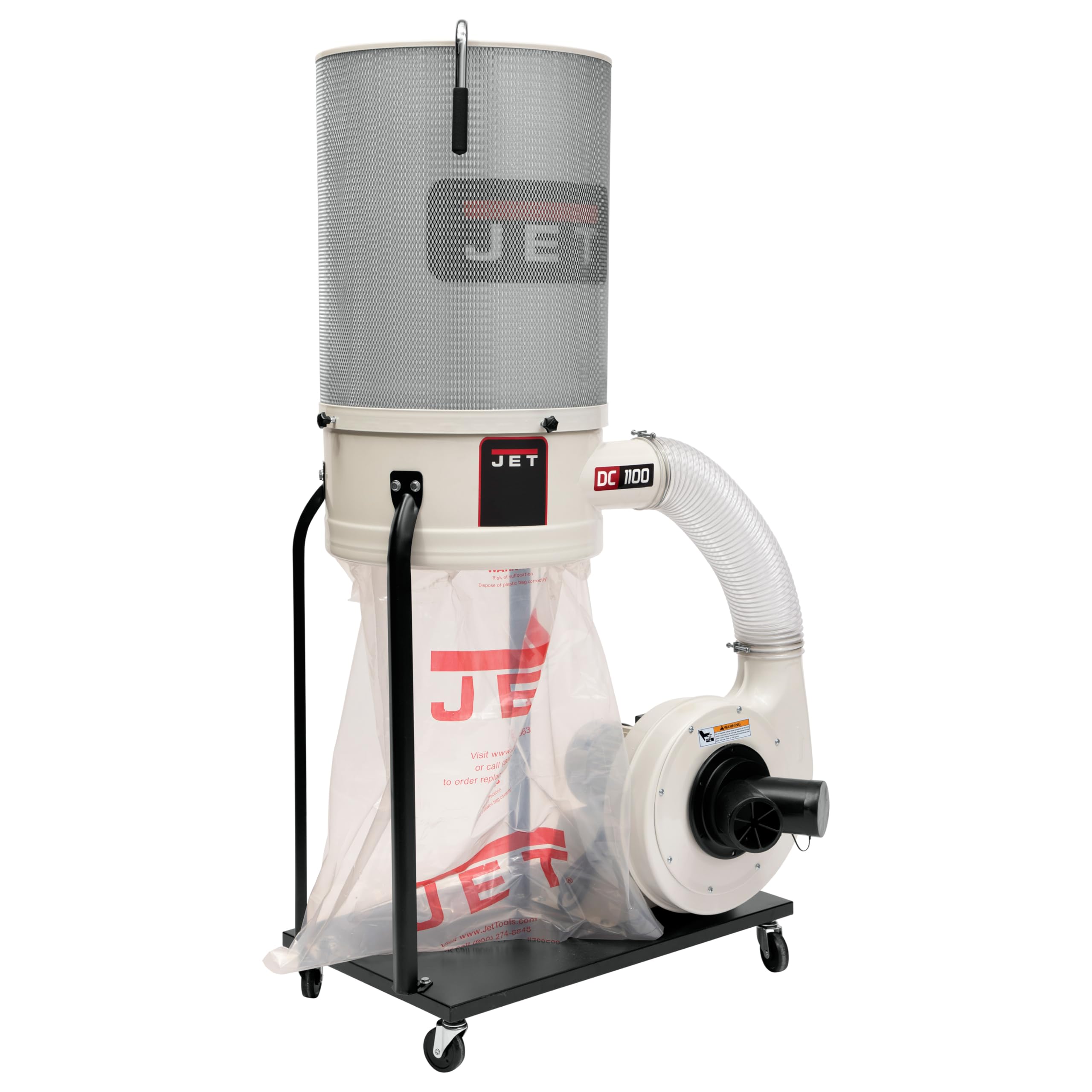
1. JET Vortex Cone Dust Collector with 2-Micron Canister Filter, 1-1/2 HP (DC-1100VX-CK)
Our pick — over 4.5★ from 150+ verified ratings; the strongest balance of quality and price.
The workshop workhorse that filters fine enough to breathe easy and moves enough air for a planer, jointer, and table saw.
The single biggest reason this JET collector earns the top spot is its 2-micron canister filter. That is a full leap in health protection compared to the 5-micron bag on the budget-friendly WEN below — a 2.5x tighter filtration spec that captures the fine dust your lungs never should. Buyers report it runs at roughly 75 dB at 3 feet (a low hum, not a shop-vac shriek), and the Vortex Cone technology keeps the filter from clogging early so your suction stays strong. The permanently lubricated 1-1/2 HP motor is rated for continuous duty — meaning you can leave it running for an entire day in the shop without worrying about overheating.
What owners love most is the cyclone-like chip separation: the majority of heavy debris drops into the lower bag while the canister catches only fine dust. That cuts down the number of times you have to clean the filter dramatically. The unit rolls on four casters, which makes moving it between tools simple. A few owners mention that with a planer taking heavy cuts, the filter can let a little fine dust back into the air — so wearing a mask on long planing days is still smart. The build quality draws mixed feedback (some parts feel sturdier than others), but the overall verdict is a collector that outpaces a shop vac in both suction and quiet operation.
Why This Pick Wins
- 2-micron canister filter captures fine woodworking dust that 5-micron bags let through
- Vortex Cone prevents filter clogging, keeping CFM high between cleanings
- Noticeably quieter than a shop vac — owners describe it as a pleasant hum
- Moves more air than any shop vac, making it effective on planers and jointers
One Honest Trade-off
- Some fine dust can still escape under heavy planer use; a respirator is still a good companion
- Build quality receives mixed reviews — some components feel better than others
Reach for this if: you want professional-grade filtration (2-micron) in a mobile single-stage unit that handles a full workshop of tools without breaking down.
Think twice if: your budget is tight and you only need to capture coarse sawdust from a single tool — the WEN below will save you significant money and still handle that job well.
2. WEN Woodworking Dust Collector, 7.4-Amp Induction Motor with 15-Gallon Bag (DC3474)
The entry-level upgrade that doubles your airflow while cutting noise in half compared to a shop vac.
For around a fifth of the JET’s price, this WEN unit moves 600 CFM through its 9-inch impeller — significantly more air than any shop vac, and it draws only 480 watts of power versus a typical vac’s 1,000 watts. The noise level sits at 72 dB, which owners describe as quiet enough to carry on a conversation over. The 4-inch dust port matches standard hoses from most woodworking tools, and you can either roll it around on swivel casters or mount it to the wall.
The trade-off is the 5-micron bag. That spec (5.0 microns) is a five-times-coarser filter than the 1-micron bag on the POWERTEC unit below, meaning fine sanding dust will pass right through. Several owners swap to an aftermarket DustRight 5-micron bag or add a canister filter to close that gap. The casters do not lock, so the unit can roll across the floor when you pull the starter cord — a minor annoyance that a few owners fixed with locking casters. The stock bag’s zipper has also been known to fail after about 10 months of regular use. For a small shop running one tool at a time, this unit is a huge step up from a shop vac, but planer shavings can clog the inlet if you push deep cuts.
What Makes It a Great Start
- 480W power consumption vs. 1,000W on a shop vac — half the electricity for 4x the airflow
- 72 dB operation is genuinely workshop-conversation quiet
- Rolls or wall-mounts — flexible placement for a small garage shop
Where It Cuts Corners
- 5-micron bag lets fine dust through; budget for a replacement bag right away
- Non-locking casters let the unit drift on startup — a simple fix with aftermarket casters
- Bag zipper can wear out within a year of daily use
Buy it if: you are moving up from a shop vac on a tight budget and only run one tool at a time — just swap the bag immediately for better filtration.
skip it if: you work with MDF or fine sanding dust that needs sub-2-micron filtration; the WEN bag alone will not protect your lungs.
3. POWERTEC 1 HP, 560 CFM Wall Mount Dust Collector with 1 Micron Dust Collector Bags (DC5371)
A compact wall-mount that filters down to 1 micron, making it the fine-dust champion in a small footprint.
This POWERTEC unit delivers a 1-micron reusable cloth bag as standard — the same fine-filtration level that the budget-friendly WEN above misses by a factor of five and that matches the JET canister’s capturing ability. At 35.5 pounds, it is also nearly 6 pounds lighter than the WEN (which weighs 41.1 pounds), making wall mounting genuinely one-person doable. The airflow is 560 CFM through a 4-inch inlet, and the 1 HP induction motor runs at 3,450 RPM. Owners who hooked it to a 12-inch sander report finding “no dust around my sander at all” — exactly the outcome fine filtration promises.
The catch is real-world consistency. Effectiveness and build quality score well in reviews, but suction power and dust collection performance split buyers evenly — some say it is powerful and quiet, others report weak airflow that loses out to a basic 6-gallon shop vac. The mounting hardware is not great: owners describe it causing vibration that needs reinforcement. Noise is also mixed, with some calling it “amazingly quiet” and others rating it as loud as a table saw. If you get a properly built unit, the 1-micron filtration is a genuine health upgrade for a small garage shop. If you happen to receive a dud, the return is straightforward.
Best for the hobbyist who values filtration above all else: the 1-micron bag stops fine dust that standard bags let through, and the wall-mount saves floor space.
The honest inconsistency: units vary in suction power from the start; the mounting hardware can cause vibrations; noise levels are unpredictable between units.
Choose this for: a compact, wall-mounted setup with health-grade filtration, provided you are comfortable with some variability in build quality.
Look elsewhere if: you need guaranteed high suction and consistent noise levels; the Shop Fox W1727 offers a more predictable 800 CFM experience.
4. SHOP FOX Portable W1727 1 HP Dust Collector

The 800 CFM portable that captures nearly all the dust from a cabinet saw and runs on a standard 120V outlet.
It is still a 1 HP machine running on 9 amps at 120V (pre-wired for 110V), meaning it does not need a dedicated 240V circuit. The 2.5-micron bag sits in the middle of the filtration spectrum: finer than the WEN’s 5-micron bag but coarser than the POWERTEC’s 1-micron bag. Owners who use it with cabinet and miter saws report capturing “approximately 99% of the dust” — an excellent real-world result. The noise level measures roughly 82.5 dB, which is quieter than a shop vac (around 102.5 dB) and similar to a busy table saw.
Where the W1727 really shines is its mobile base and practical layout. It rolls easily, the bag change is straightforward, and it includes a handy floor-level vacuum port for cleanup. The downsides are predictable at this price point: the cart construction gets called flimsy by some owners, and the 2.5-micron bag is not fine enough for sanding dust. Several owners have run it for five years without issues, simply replacing the bag with a trash compactor bag for cheap maintenance. For a small-to-medium shop running table saw, router table, and miter saw, this is the performance balance before jumping to a 1-1/2 HP unit.
The defining strength: 800 CFM on a standard 120V circuit with a proven track record over five years for many owners.
The honest gap: the 2.5-micron bag is fine for coarse dust but will not catch fine sanding particles; the cart feels less solid than the price suggests.
Grab this if: you need portable 800 CFM performance for table saws and jointers on a standard outlet without paying for a 240V upgrade.
Pass if: you specifically need sub-2-micron filtration for sanding and MDF work — the Shop Fox will still release fine particles into your shop air.
5. Shop Fox W1685 1-1/2 HP Dust Collector

The 1,280 CFM monster that pulls shavings from a foot away — ideal for a 3 HP jointer or 13-inch planer.
This is the machine you buy when the 800 CFM units leave you wanting more. The Shop Fox W1685 moves roughly 1,280 CFM — a 60% increase over the W1727 and more than double the WEN’s 600 CFM. It runs on a 1-1/2 HP motor that draws around 16 amps, meaning you need a dedicated 15-amp or 20-amp circuit (a 15-amp breaker will trip if anything else shares it). The 6-inch interior hose diameter and two 4-inch inlets let you run multiple tools, though the static pressure of 10.1 inches means it competently pulls through longer duct runs. Owners describe the suction as strong enough to pull small wood pieces from 4 inches away.
The trade-off is quality control. Several customers note missing bolts during assembly (six M8 bolts instead of fourteen), impeller housing holes drilled 1-3/8 inches off, and no lock washers included. The upper bag bracket is flimsy, and there is no dedicated handle for moving the unit — though the steel construction (93 pounds) makes it feel solid once assembled. The 2.5-micron bag filtration is the same as the W1727, fine for chips but not for sanding dust. A pre-separator is strongly recommended by owners to reduce how often you empty the bag. For a serious home shop running heavy planing and jointing, the raw CFM is tough to top at this price, but plan on spending an afternoon sorting out the hardware.
The Airflow Advantage
- 1,280 CFM handles multiple tools and long hose runs with ease
- Steel body and 93-pound weight give it a solid, durable feel once assembled
- Two 4-inch inlets allow simultaneous connection to a jointer and planer
The Assembly Toll
- Missing bolts and misaligned holes are common from the start; prepare for extra work
- Flimsy upper bag bracket — plan on reinforcing it or adding a pre-separator
- 2.5-micron bag still lets through fine sanding dust; upgrade to a canister for lung safety
Buy it for: maximum CFM on a single-stage machine that can serve a jointer, planer, and table saw simultaneously in a medium-to-large home shop.
Hesitate if: you are not comfortable drilling replacement holes or sourcing missing hardware — the assembly experience is rougher than the performance deserves.
6. JET Vortex Cone Dust Collector, 5-Micron Bag Filter, 1-1/2 HP (DC-1100VX-5M)

The two-stage cyclone that drops heavy chips into a 20-gallon drum before the air even hits the filter.
This is the only true two-stage cyclone dust collector in this lineup, and it changes the game for anyone tired of cleaning filters. Heavy debris drops into a 20-gallon steel drum before ever reaching the filter, meaning the pleated canister sees only fine dust and stays clean for much longer. The filter itself captures particles down to 1 micron and below — the finest filtration of any unit here, matching the POWERTEC’s 1-micron bag but in a much more efficient two-stage design. The 1-1/2 HP motor runs on standard 115V (20 amps), so no special circuit is needed, and a radio frequency remote control works from up to 50 feet away, letting you turn the system on from anywhere in the shop.
The performance is outstanding: shoppers say it runs at 79 dB (noticeably quieter than the 1 HP unit it replaced) and clears debris that previous systems could not handle. A table saw hooked to this collector produces “almost zero” visible dust. The double-paddle manual cleaning system lets you knock dust off the pleated filter without removing it. The assembly experience is the biggest downside — several buyers report holes misaligned by 90 degrees, requiring drilling, and the assembly process can take over two hours. The cost is also substantial: roughly double the 2-micron JET canister unit above. For serious woodworkers who want the best filtration and the lowest maintenance, this cyclone is the endgame.
Why It’s the Endgame
- Two-stage cyclone means the filter stays clean for weeks, not days — heavy chips never reach the pleats
- Filters down to 1 micron and below — the healthiest air of any collector in this guide
- Wireless remote control up to 50 feet away; runs on standard 115V (no 230V needed)
- 20-gallon steel drum is far easier to empty than a cloth bag
The Assembly Hurdle
- Motor and filter holes are frequently misaligned — plan on drilling custom holes
- Assembly takes most owners at least 1.5 to 2 hours, even with two people
- Significant price premium over single-stage units; best for dedicated workshop setups
Buy this if: you want the absolute best dust collection solution for your home workshop — 1-micron filtration, cyclone efficiency, and a remote control in one package.
Hold off if: your shop only runs one or two tools occasionally; the 1-1/2 HP single-stage JET with a canister filter gives you 80% of the performance at half the price.
Understanding the Specs
CFM — How Much Air It Moves
CFM (cubic feet per minute) measures the volume of air the collector pulls. A unit with 600 CFM can handle one tool well. At 800 to 1,200 CFM, you can run a planer or jointer through a long hose. Above 1,200 CFM, you are looking at whole-shop ductwork. But CFM means little if the filter is too fine — a high CFM motor paired with a restrictive filter will underperform. Look for the CFM rating with the filter installed, because that is the real-world performance.
Micron Rating — What Stays in the Bag vs. Your Lungs
A 5-micron bag catches visible sawdust but lets through most of the fine particles that cause respiratory issues. A 2-micron filter (like the canister on the JET DC-1100VX-CK) traps significantly more of the dangerous respirable dust. A 1-micron filter (like the POWERTEC bag or the JET cyclone’s pleated canister) approaches HEPA-level protection. If you sand, route MDF, or work with any material that produces fine particles, do not settle for a 5-micron bag — upgrade to at least 2 microns for your own safety.
FAQ
Is a two-stage cyclone dust collector worth the extra money?
Can I use a dust collector with a standard 120V household outlet?
How often do I need to change or clean the filter bag on a dust collector?
Will a 600 CFM dust collector handle a planer or jointer?
What is the difference between a bag filter and a canister filter?
How loud are these dust collectors compared to a shop vac?
Can I wall-mount a dust collector to save floor space?
Do I need a separator between my tool and the dust collector?
Final Thoughts: The Verdict
For most buyers, the dust collector for woodworking winner is the JET Vortex Cone DC-1100VX-CK because its 2-micron canister filter and reliable 1-1/2 HP motor cover a full workshop’s needs without requiring a 230V circuit. If you want the most CFM for the dollar and have a jointer or planer dominating your workflow, grab the Shop Fox W1685 and plan on a canister filter upgrade. And for a truly dust-free shop with near-zero filter maintenance, the JET JCDC-1.5 Cyclone is the one to reach for — just budget for assembly time and a 20-amp outlet.
How We Picked
We do not accept paid placement. Every pick is matched to a real buyer and a real use-case; we do not hands-on test units.
Sources & Methodology
Specifications: manufacturer listings and product documentation. Review insights: verified customer reviews, as of July 2026. Pricing: not shown on this page (it changes often); check the current price via the retailer link.
As an Amazon Associate, WellFizz earns from qualifying purchases. This does not affect which products we feature.
Related Guides

Mo Maruf
I created WellFizz to bridge the gap between vague wellness advice and actionable solutions. My mission is simple: to decode the research and give you practical tools you can actually use.
Beyond the data, I am a passionate traveler. I believe that stepping away from the screen to explore new environments is essential for mental clarity and physical vitality.