Our readers keep the lights on and my smoothie glass nicely filled. As an Amazon Associate, I earn from qualifying purchases.
Specs are compiled from manufacturer listings and verified buyer reviews and can change over time — please confirm the key details on the product page before buying.
If your shop-vac has been doing double duty as a dust collector, you already know the pain: the ear-splitting shriek every time you flip the switch, the fine dust that still settles on everything, and the constant clogging when a planer spits out a pile of shavings. A dedicated dust collector for home use changes that entirely — it moves much more air, runs at a lower, more tolerable pitch, and captures the fines your lungs actually care about. The trick is matching the machine to your real shop space and your actual tools, not to a spec sheet.
I’m Mohammad Maruf — the founder and writer behind WellFizz. This guide is built by comparing the manufacturers’ published specifications and the patterns across verified customer reviews, so you get each pick’s real strengths and trade-offs instead of marketing spin.
The list below walks through everything from budget-friendly entry-level units to premium shop-grade machines. Whether you are outfitting a one-car garage or a dedicated wood shop, the right dust collector for home balances air volume, filter fineness, noise level, and footprint without blowing your budget.
Our Picks at a Glance


How To Choose The Best Dust Collector For Home
The right dust collector for you is the one that matches your tool size, your shop layout, and your tolerance for noise and fine dust. Here are the three most important specs to get right before you buy.
Airflow Capacity (CFM)
CFM stands for cubic feet per minute — the volume of air the machine moves. A higher CFM means it pulls chips and dust from a planer or table saw more effectively. Small benchtop tools need around 400–500 CFM, while larger stationary machines often need 700–800 CFM or more. If the CFM is too low for your tool’s port size, you will see chips piling up right under the blade.
Filter Micron Rating
This number tells you how small a particle the filter can catch. A 5-micron bag stops visible sawdust but lets fine, lung-irritating particles pass through. A 2-micron or 1-micron filter catches much more of the dangerous fine dust. Many owners eventually upgrade to a pleated canister filter (often 1 micron or better) because it captures more fines and never clogs like a bag can.
Motor Type and Noise Level
Brushed motors (common on budget models) are louder and wear out faster. Induction motors (found on mid-range and premium units) are quieter, last longer, and run at a lower tone that is far less fatiguing. Noise level is measured in decibels (dB) — a difference of just a few dB is significant because the scale is logarithmic. A 72 dB induction motor sounds dramatically more pleasant than an 85 dB shop vac.
Quick Comparison
| Model | Best For | CFM | Filter Micron | Motor HP | Amazon |
|---|---|---|---|---|---|
| JET DC-1100VX-CK★ Best Overall | Premium Shop Grade | — | 2 | 1-1/2 | Amazon |
| WEN DC3401Space Saver | Budget Entry | 660 | 5 | 5.7A | Amazon |
| BUCKTOOL DC30A-1Best Value | Wall-Mount Value | 550 | 2 | 1 | Amazon |
| WEN DC3474 | Induction Motor Value | 600 | 5 | 7.4A | Amazon |
| Shop Fox W1826 | Compact Wall-Mount | 537 | 2.5 | 1 | Amazon |
| BUCKTOOL DC50 | Auto-Start Convenience | 750 | 2 | 1.2 | Amazon |
| POWERTEC DC5371 | 1 Micron Filtration | 560 | 1 | 1 | Amazon |
| Rikon 60-105 | Quiet Small Shop | — | 2 | 1 | Amazon |
| Delta 50-723T2 | Mid-Range Versatility | 750 | 2 | 1 | Amazon |
| Shop Fox W1666 | High Air Volume | 1550 | 2.5 | 2 | Amazon |
| Grizzly G0548ZP | Industrial Canister | — | 1 | 2 | Amazon |
In‑Depth Reviews
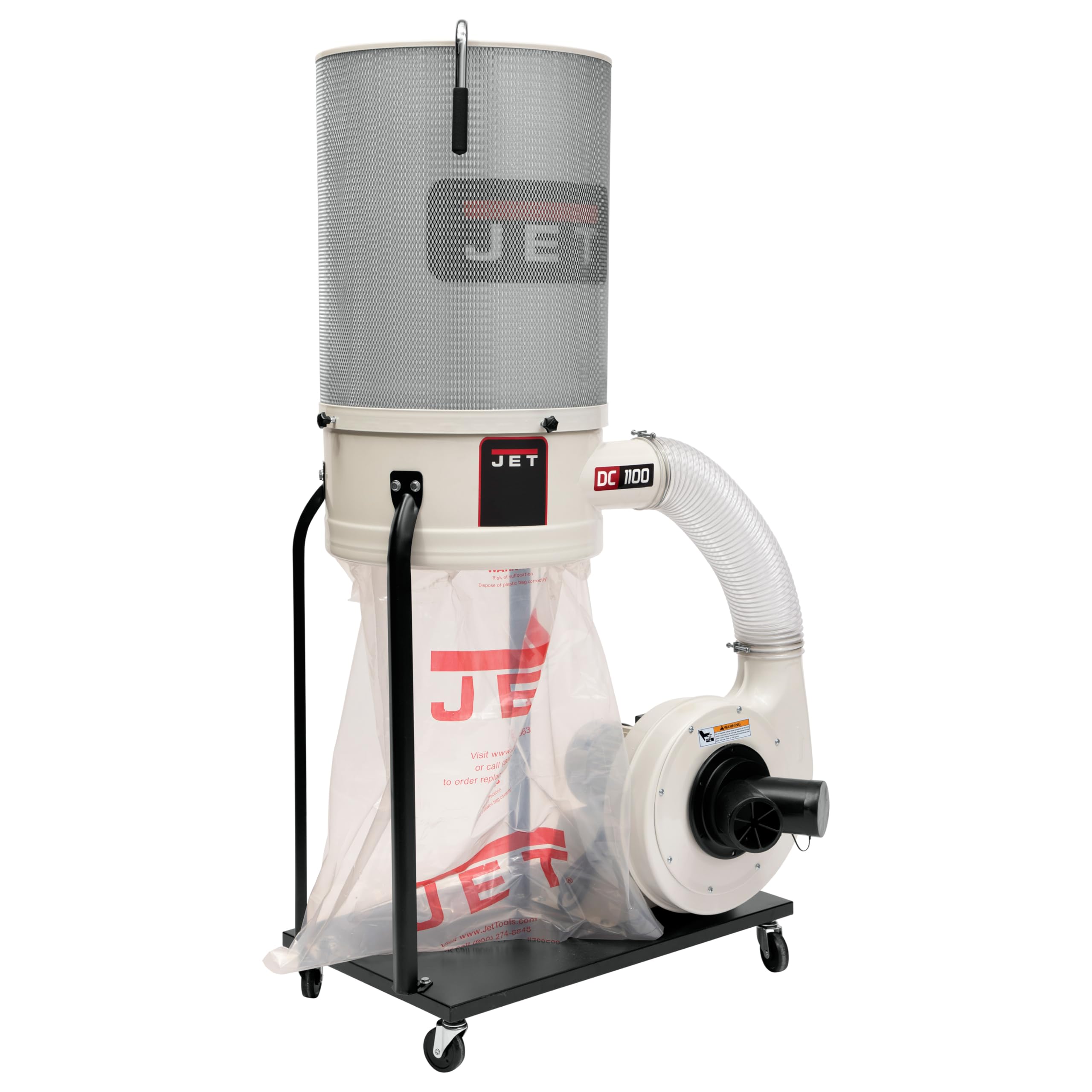
1. JET Vortex Cone Dust Collector with 2-Micron Canister Filter, 1-1/2 HP, 115/230V 1Ph (DC-1100VX-CK)
Our pick — over 4.5★ from 150+ verified ratings; the strongest balance of quality and price.
The shop-grade workhorse that is quieter than a shop vac and filters air you can actually breathe.
What wins people over here is the noise profile. At roughly 75 dB at 3 feet, this unit produces a low hum rather than the high-pitched scream of a shop vac. That lower tone makes hours in the shop far less fatiguing. The 1-1/2 HP induction motor is permanently lubricated and rated for continuous duty, which means you can run it all day without worrying about overheating. The Vortex Cone technology improves chip separation inside the bag, so the canister filter stays clear longer and you are not changing bags as often.
The 2-micron canister filter is the standout feature — it traps the fine dust that standard 5-micron bags let right through. Owners running planers, jointers, and table saws report excellent suction from the dual inlets. Assembly takes about an hour with two people, and the four swivel casters make it easy to roll around a medium-sized shop. The one caveat a few owners flag is that the fine dust can still escape in very small amounts without a HEPA upgrade or a pre-separator like a Dust Deputy, but for most home shops the built-in filtration is a major step up from a bag-only system.
Why Owners Love It
- Quiet operation — the low hum is far less annoying than a shop vac’s whine
- 2-micron canister filter catches fines the lungs notice
- Vortex Cone keeps the filter from clogging prematurely
- Dual inlets let you run two tools with a splitter
What to Know
- Fine dust may still escape without a HEPA upgrade or pre-separator
- Heavy enough that you will appreciate the casters
Your Best Move If: You run a planer, jointer, or table saw in a garage shop and want real filtration without earplugs.
Think Twice If: Your budget is under and you only run a single benchtop tool — a smaller unit may be plenty.
2. WEN Woodworking Dust Collector, 5.7-Amp Motor with 12-Gallon Bag, Mobile Base, and Optional Wall Mount (DC3401)
The entry-level favorite that packs 660 CFM into a compact, wall-mountable frame.
This WEN moves more air than several pricier options — 660 cubic feet per minute from a 5.7-amp motor and a 6-inch impeller. The 4-inch dust port connects directly to most benchtop planers and table saws, and the compact footprint with an onboard carrying handle means you can tuck it away or take it to a job site. The 12-gallon collection bag uses a zippered closure for quick emptying, and the optional wall mount is a genuine space-saver for a one-car garage shop.
The crowd favorite is the value proposition — owners consistently call it “great for the price” and note it outperforms a standard shop vac on both air volume and noise. The trade-off is durability. A recurring thread in owner experience is motor or switch failure within months, though WEN’s customer service has a reputation for sending replacement parts quickly when contacted. The 5-micron bag is fine for visible sawdust but lets fine particles through, which is why several owners add a dust separator or upgrade to a finer filter.
Why It is Popular
- 660 CFM at this price point is tough to top
- Carrying handle and wall mount make it genuinely portable
- 12-gallon zippered bag is easy to empty
What to Watch
- 5-micron bag passes fine dust — plan on a finer filter or a cyclone add-on
- Reported switch and motor durability issues require a responsive customer service call
Reach for This If: You need a capable first dust collector on a tight budget and have space to wall-mount it.
Pass If: You want low-maintenance reliability for daily heavy use — consider the induction motor models instead.
3. BUCKTOOL 1HP 6.5AMP Wall-mount Dust Collector with Remote Control and 2-micron Dust Filter Bag (DC30A-1)
A wall-mount that arrives with a 2-micron bag and a remote — two upgrades the budget WEN skips.
The BUCKTOOL delivers 550 CFM from a 1 HP induction motor, which is inherently quieter and more durable than a brushed motor. The 2-micron cloth bag is a meaningful step above the 5-micron bags that come with many entry-level machines — it catches a higher percentage of the dangerous fine particles. The included 49-foot remote control lets you turn the unit on and off without walking across the shop, which is a genuine time-saver when your hands are covered in sawdust.
Buyers report quick assembly — under 10 minutes — and praise the wheels that make it easy to move even in wall-mount mode. It handles a 13-inch planer or a 6-inch sander well, though heavy planer shavings can clog the bag inlet when it is nearly full. The build quality draws mixed opinions: the motor and impeller are solid (metal, not plastic), but some of the hardware like bolts and the remote fob feel less premium. For a single-tool shop, this is a very strong middle-ground pick.
Why It Stands Out
- Comes with a 2-micron bag — better fine-dust filtration than any 5-micron unit
- Remote control is genuinely useful for small shops
- Quick assembly in under 10 minutes
The Catch
- Planer shavings can clog the inlet when the bag is near full
- Some hardware feels cheap for the price
This Is For You If: You want the convenience of a remote and a 2-micron bag right from the start for a small workshop.
Skip If: You need higher CFM for multiple machines or a very quiet unit — the induction motor here is still audible.
4. WEN Woodworking Dust Collector, 7.4-Amp Induction Motor with 15-Gallon Bag (DC3474)

The induction motor makes this the quietest WEN — 72 dB instead of the usual shop vac scream.
That is the headline here: you get 600 CFM through a 9-inch impeller, and you can actually hear yourself think. The 15-gallon collection bag is larger than the 12-gallon bag on the budget WEN, and the unit is compatible with both rolling and wall-mount setups.
The consensus among owners is that this is a “quiet and powerful” upgrade from a shop vac. A few note that the 5-micron bag leaks fine dust, so a replacement with a 1-micron or canister filter is a common upgrade path. The non-locking casters can let the unit roll away on startup, but that is easily fixed with locking casters from the hardware store. For anyone running a single tool like a table saw or planer, this is a substantial improvement over the budget WEN without jumping to premium pricing.
Why It is Worth It
- 72 dB is genuinely quieter than any shop vac
- Wall-mountable with included hardware
What to Fix
- 5-micron bag lets fine dust through — budget for a finer filter
- Non-locking casters let it drift on startup
Buy This If: You want induction-motor quietness and 600 CFM for a single stationary tool in a garage shop.
Look Elsewhere If: You need higher CFM for a 2HP-class planer or jointer — the 7.4-amp motor tops out here.
5. Shop Fox W1826 Wall Dust Collector, 2.5 Micron Filtration

Over 100 owners call out its performance — the most-praised aspect of any wall-mount in this list.
The Shop Fox W1826 uses a 1 HP motor that draws 7 amps at 110V and pushes 537 CFM through a 4-inch intake. It is pre-wired for 110V but can be rewired to 220V if you want better starts. The 2.5-micron cloth bag is a solid step above basic 5-micron bags, and the bottom zipper makes emptying easier than pulling the whole bag off. At just over 50 pounds, wall mounting requires a sturdy stud or bracket, but the compact footprint saves valuable floor space.
What owners consistently say is that this unit is a “great improvement over a shop vac” for capturing chips and dust from a table saw, radial arm saw, or miter station. The noise is lower pitched and less irritating than a vac. A common tip from experienced owners is to remove the safety grate at the inlet — it can clog with planer or jointer shavings — but you should never run the machine without a hose attached if you remove it. The packaging can arrive with minor cosmetic damage, but the unit itself is solid and reliable.
Why People Pick It
- Performance is the #1 praised aspect — over 100 owners highlight it
- Wall-mount saves floor space in a tight shop
- 2.5-micron bag filters better than entry-level 5-micron options
One Thing to Know
- Inlet safety grate can clog with planer shavings — a minor modification solves it
- Slightly louder than induction motor units
Reach for This If: You need a reliable wall-mount that won’t eat up garage floor space and you value performance per dollar.
Consider Another If: You need to run a planer and a drum sander simultaneously — the 537 CFM handles one tool at a time.
6. BUCKTOOL 750 CFM Auto-Start Dust Collector, 1.2HP 13-Gallon Capacity (DC50)
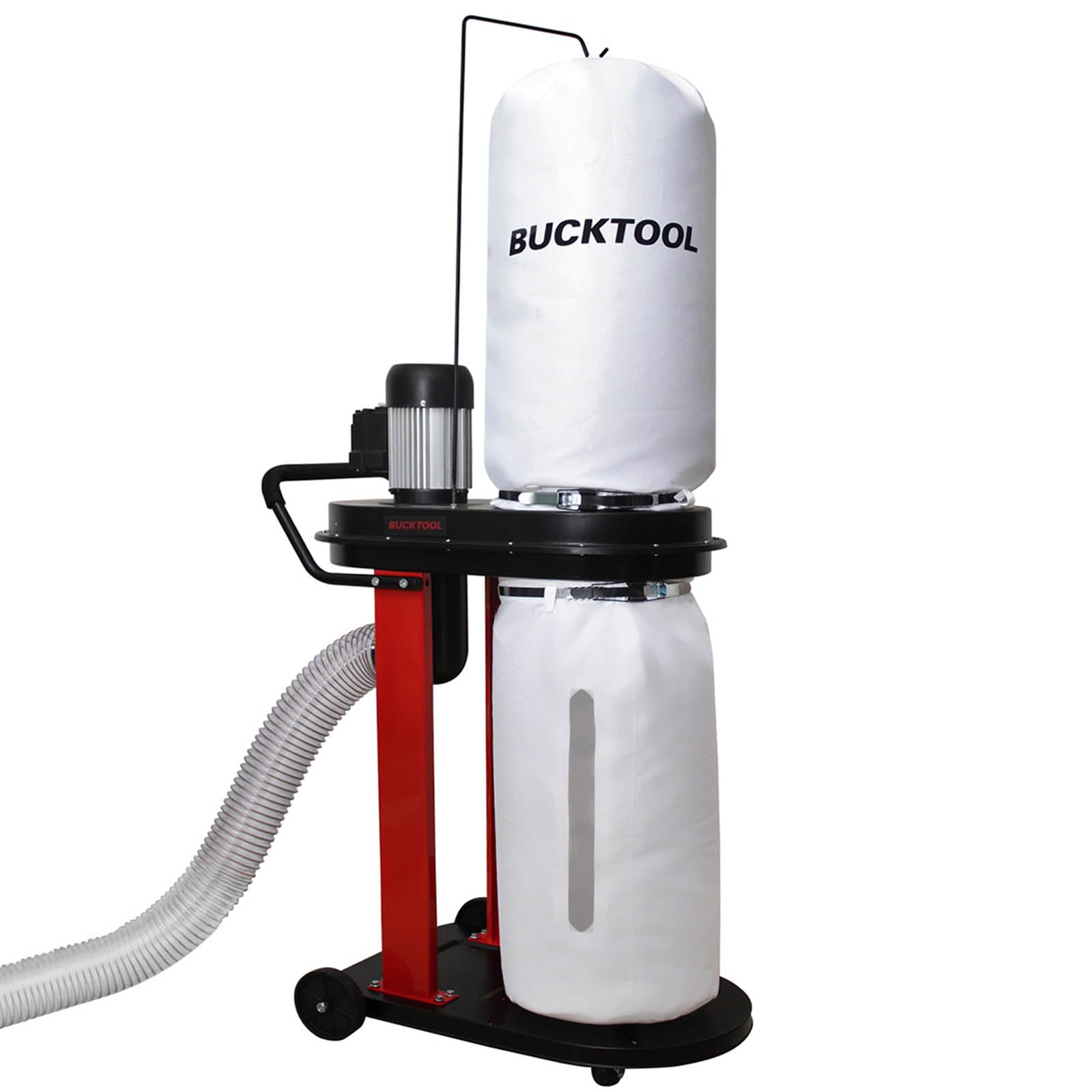
An auto-on feature that syncs with your power tool — plug in and it starts when you start cutting.
The auto-start function is the defining feature here. You plug your tool (up to 7 amps) into the outlet on the unit, and the dust collector turns on automatically when you fire up the saw or planer. That eliminates the habit of forgetting to turn on dust collection until after you have already made a dusty cut. The 1.2 HP motor delivers 750 CFM of airflow at 3450 RPM, making it one of the stronger performers in the mid-range tier. It comes with both a cloth 2-micron upper filter bag and a plastic lower collection bag, plus five reducer rings and a flexible 5-foot hose.
The build quality earns praise — heavy-gauge steel construction throughout — and owners who run planers and drum sanders report that the auto-start alone is worth the upgrade. Assembly is straightforward, though one bolt point (the Rivnut for the upper bag mast) may require a trip to the hardware store for a washer and nut. A few owners reported weak suction from the start, often traced to a 90-degree coupler that restricts airflow; removing that coupler restored full performance.
What Makes It Special
- Auto-start eliminates the “I forgot to turn it on” problem
- 750 CFM is strong for a 1.2 HP unit
- All-metal construction feels built to last
What to Check
- Auto-start is rated for tools up to 7A — check your tool’s draw
- Remove the restrictive 90-degree coupler for full airflow
Grab This If: You want the convenience of auto-start and 750 CFM for a planer or drum sander in a medium-sized shop.
Skip If: You need the absolute quietest operation — this unit is comparable to a shop vac in sound level.
7. POWERTEC 1 HP, 560 CFM Wall Mount Dust Collector with 1 Micron Bag (DC5371)

A 1-micron filter bag from the start — the finest stock filtration in this entire list.
The POWERTEC DC5371 comes with a reusable 1-micron cloth bag, which catches the particles that most 5-micron bags miss entirely. That makes it a strong choice if respiratory health is your primary concern. The bag includes a built-in window so you can see the fill level without opening it, and an easy-dust disposal zipper at the bottom. The Vortex Base design in the housing guides airflow to reduce turbulence .
At 560 CFM from a 1 HP induction motor, the airflow is adequate for a single benchtop tool like a 12-inch sander or a small planer. Owners confirm it keeps dust off the floor and out of the air around a sander. The trade-off is that the inlet grate can clog with large chips, and the suction is noticeably less than larger units. The 80 dB noise level is moderate — comparable to a table saw. For a hobbyist who wants fine filtration without a canister upgrade, this is a focused option.
Why It Stands Out
- 1-micron bag catches the dangerous fine dust right from the start
- Bag window tells you when to empty without guessing
- Vortex Base design helps keep airflow consistent
What to Know
- 560 CFM limits it to one tool at a time
- Inlet grate can clog with larger shavings from a planer
This Is Your Pick If: Filtering fine dust is your number one priority and you run just one or two small tools.
Pass If: You need to clear heavy planer chips — the 560 CFM and inlet grate design are better suited to sanders and saws.
8. Rikon 1Hp Portable Dust Collector (RIK-60-105)

A small-shop favorite that owners describe as a bass whoosh instead of a shop vac scream.
The Rikon 60-105 uses a 1 HP motor with a 2-micron cloth bag and is designed specifically for small shops. Owners consistently call it “quiet and powerful,” praising the low-frequency hum that is far less fatiguing than a standard shop vac. It rolls on casters and can be wall-mounted, making it flexible for tight layouts. The 2-micron bag provides decent fine-dust capture, and the bag itself lasts a long time between changes.
A common praise point is that it works exceptionally well as a dedicated dust collector for a single machine — especially a SawStop table saw or a laser engraver used as an exhaust. The steel impeller blades are durable, but they also mean any small object sucked in can cause damage, so using a pre-separator or screen is a good idea. A few owners note that the on/off switch can fail after repeated use, which is a known weak point. For a small garage shop running one tool at a time, this remains a very popular and capable choice.
Why Owners Recommend It
- Quiet “bass whoosh” noise profile is easy to work around
- Perfect for single-machine dust collection or laser exhaust
- 2-micron bag is a good balance of airflow and filtration
One Concern
- On/off switch reported to fail after moderate use
- Steel impeller can be damaged by sucked-up debris
Reach for This If: You have a small shop and want a quiet, reliable dust collector that can be dedicated to one primary tool.
Consider Another If: You need to run multiple tools on a trunk line — the 1 HP motor is best for single-machine duty.
9. Delta 1‑HP Dust Collector (50-723T2)

A 1 HP unit that delivers 750 CFM — higher air volume than many 1 HP competitors.
The Delta 50-723T2 punches above its 1 HP rating with a maximum airflow of 750 CFM, making it effective for surface planing, jointing, and table saw work. The 2-micron filter bag has a sewn-in snap ring that eliminates the need for clamps, which makes bag changes faster and less frustrating. The 9.5-inch steel impeller is sturdy, and the unit runs on 120V (pre-wired) with the option to switch to 240V for better starting torque.
Owners with 20-by-24-foot shops report excellent results running a 4-inch hose from machine to machine. The motor is described as powerful and the suction as strong for a 1 HP unit. The loudest complaint is the noise level — it is noticeably louder than some competing induction motor units. Another recurring note is the lack of included instructions, though assembly is intuitive enough to figure out. The lower chip bag can be fiddly to install solo, but the overall build quality is solid for the price.
Why It Earns Its Spot
- 750 CFM is strong for a 1 HP motor
- Snap-in filter bag ring makes bag changes tool-free
- Dual-voltage motor (120V/240V) for flexibility
The Downsides
- Louder than induction motor competitors
- No instruction manual included in the box
This Is a Great Fit If: You want high CFM at 1 HP and prefer a brand with a long service history.
Look Elsewhere If: Low noise is your priority — the induction motor units are noticeably quieter.
10. Shop Fox W1666 — 2 HP Dust Collector

A 2 HP workhorse pushing 1550 CFM — enough air volume to run a 6-inch trunk line to five machines.
The Shop Fox W1666 is a significant step up in power. Its 2 HP motor moves 1550 cubic feet per minute, which is enough to handle a planer, jointer, table saw, and sander through a ducted system. The steel impeller is durable, and the unit filters down to 2.5 microns. Assembly takes about two hours, and the included casters let you roll it into position. The powder-coated finish resists scratches and dust buildup.
Owners who upgraded from 1.5 HP units report a noticeable improvement in suction and static pressure, especially on tools like a jointer or a shaper. The machine is loud enough that hearing protection is recommended, but the noise is a lower-pitched drone compared to a shop vac. A common upgrade is to add a pleated canister filter for better fine-dust capture and less backpressure. The wheels are the weakest point — they are small and cheap for a 95-pound machine — but easily replaced. After a decade of use, many owners still rate it highly for value and reliability.
What Owners Love
- 1550 CFM handles a multi-machine ducted system with ease
- Steel impeller is tough enough for years of chips and shavings
- Filters to 2.5 microns — a solid step before a canister upgrade
What to Plan For
- Wheels are cheap — budget for replacements if you move it often
- No 240V plug included despite the motor being dual-voltage
- Loud enough that hearing protection is needed
Choose This If: You are setting up a dedicated ducted system for a medium-to-large shop and want the highest CFM per dollar.
Consider Something Smaller If: You only run one or two tools and don’t want the weight and noise of a 2 HP machine.
11. Grizzly Industrial G0548ZP — 2 HP Canister Dust Collector with Aluminum Impeller

A 2 HP canister machine with a 1-micron filter and a built-in cleaning handle — industrial filtration for serious woodworkers.
The Grizzly G0548ZP uses a 2 HP motor with an aluminum impeller, paired with a spun-bond polyester canister filter rated at 1 micron. That 1-micron filtration is the finest in this list, capturing nearly all visible and fine dust particles. The standout feature is the cleaning handle on top of the canister — a half-turn shake mechanism that knocks dust off the filter pleats and drops it into the collection bag. That means the filter stays clear and the suction remains consistent without removing and beating the bag.
Owners confirm the suction is “stronger than anything they have experienced” and that the unit runs quieter than a shop vac. The 126-pound weight means this is a stationary machine — you set it in a corner and run ducting to your tools. The build quality is generally excellent, though a couple of owners note that the rectangular blower-to-filter connection limits how you can orient the inlet. Bag retainers are basic and may benefit from small clamps. For a dedicated home shop with three or four machines, this is the closest you get to professional-grade filtration.
Why It is the Top Dog
- 1-micron canister filter is the finest in this roundup
- Cleaning handle keeps the filter clear without disassembly
- Quieter than a shop vac despite the 85 dB rating
What to Consider
- Very heavy at 126 pounds — plan for a permanent location
- Rectangular inlet limits rotation options for tight spaces
- Bag retainers benefit from aftermarket clamps
This Is Your Endgame If: You want the best air quality in your shop and don’t mind a permanent installation.
Pass If: You need portability or only run one or two tools — the 126-pound weight and 2 HP motor are overkill.
Understanding the Specs
CFM and Static Pressure
CFM (cubic feet per minute) tells you how much air the unit moves. More is better for capturing chips, but static pressure (measured in inches of water) tells you how strongly it pulls through a long hose or a separator. A machine with 550 CFM is fine for a short 4-inch hose to a single tool. For a 25-foot trunk line feeding five machines, you want 1200 CFM or more.
Filter Micron Rating
The micron rating measures the smallest particle the filter catches. A 5-micron bag stops visible sawdust but lets fine, lung-penetrating dust pass. A 2-micron bag catches much more. A 1-micron canister filter (like on the Grizzly or POWERTEC) is the best option for indoor air quality. Real-world reviews consistently recommend upgrading to at least a 2-micron filter or a pleated canister for health reasons.
Induction vs Brushed Motor
Brushed motors (found on budget units like the WEN DC3401) are louder, draw more current, and wear out faster. Induction motors (found on the WEN DC3474, BUCKTOOL, JET, and most premium units) are quieter, run cooler, and can operate continuously without damage. The difference in daily comfort is significant — a 72 dB induction motor is far less fatiguing than an 80 dB brushed motor.
Bag vs Canister Filter
Cloth bags are standard on most single-stage collectors. They are cheap and easy to replace, but they clog over time, reducing airflow. Canister filters (like the JET and Grizzly) have pleated polyester media that provides more surface area, so they clog slower and can be cleaned. If you are sensitive to fine dust or plan to run the collector for hours at a time, a canister filter is the upgrade worth saving for.
FAQ
Can I use a shop vac instead of a dust collector for home use?
A shop vac has high static pressure but low air volume (typically 100–150 CFM). A dust collector moves 400–1500 CFM, which is what you need to capture chips from a planer or table saw before they pile up. A shop vac will clog fast with planer shavings and is much louder. For any tool with a 4-inch dust port, a real dust collector is the right tool.
How much CFM do I need for a planer or jointer?
A 12-inch benchtop planer needs about 400-500 CFM at the tool port. A full-size 15-inch planer needs 700-800 CFM. If you add a dust separator or long hose runs, add 20-30% more CFM to compensate for pressure loss. The BUCKTOOL DC50 at 750 CFM is a good match for a 15-inch planer with a short hose.
What does the micron rating mean on a dust collector filter bag?
The micron rating is the size of the smallest particle the bag catches. A 5-micron bag catches the sawdust you can see but lets fine particles (under 5 microns) pass into the air. A 2-micron bag catches about 99% of visible dust and most of the fine dust. A 1-micron canister filter catches nearly everything, making it the best choice for indoor air quality.
Is a wall-mount dust collector better than a rolling cart?
Wall-mounts save floor space and are ideal for small garages or single-tool setups. Rolling carts are better if you move the collector between machines or have a larger shop. The Shop Fox W1826 and BUCKTOOL DC30A-1 both offer wall-mount options with wheels for occasional movement, giving you the best of both layouts.
Can I use a dust collector with a laser engraver or 3D printer?
Yes, but you need to check two things. First, the airflow volume — a 1 HP unit like the Rikon 60-105 is popular for laser fume extraction because it moves enough air to clear smoke through a window vent. Second, the filter — laser fumes often require a HEPA or charcoal filter. Standard cloth bags will not capture toxic fumes, only particulate. For 3D printer fume extraction, a smaller unit with a fine filter is usually sufficient.
Do I need a dust separator (cyclone) ahead of the collector?
Not strictly, but it helps a lot. A separator like a Dust Deputy catches 80-90% of the chips and shavings before they reach the main filter bag. That means the filter stays clear longer, suction stays strong, and you empty the small separator bucket instead of the big filter bag. Owners of the JET and WEN units frequently add one for this reason.
How loud is a typical dust collector compared to a shop vac?
A shop vac typically runs at 85-90 dB. A dust collector with an induction motor runs at 72-80 dB. The decibel scale is logarithmic, so 72 dB is not just 13% quieter — it sounds dramatically less harsh. Owners consistently report that a 72 dB dust collector is comfortable to be around for hours, while a shop vac is fatiguing after a single cut.
Can I run multiple tools at once with one dust collector?
You can, but only if the CFM rating is high enough. A 2 HP unit like the Shop Fox W1666 (1550 CFM) can handle two tools simultaneously through a 6-inch trunk line. A 1 HP unit (500-750 CFM) should run one tool at a time. Using blast gates on each branch lets you direct all the airflow to one machine, which works well even with smaller collectors.
How often do I need to empty the collection bag?
That depends on how much you use it and what tools you run. A 12-gallon bag on a WEN DC3401 fills quickly with planer shavings — you may empty it after every serious planing session. A 15-gallon bag lasts longer, but the real standout is emptying the bag when it is about half full. A full bag restricts airflow and reduces suction dramatically, so frequent emptying keeps performance high.
Can I add a HEPA filter to a dust collector later?
Yes, many owners do. The JET DC-1100VX-CK accepts aftermarket HEPA canister filters. The WEN units can be upgraded to a WEN fine dust filter or a third-party canister. The Grizzly already has a 1-micron canister. Adding a HEPA-level filter (0.3 micron) is the most effective way to improve air quality, but it usually costs as much as the machine itself.
Final Thoughts: The Verdict
For most buyers, the best dust collector for home is the JET DC-1100VX-CK because it delivers the quiet operation, 2-micron canister filtration, and 1-1/2 HP motor that handle a planer, jointer, and table saw without the screaming of a shop vac. If you want a value-oriented induction motor pick with 600 CFM, grab the WEN DC3474. And for a shop that needs high air volume for a ducted system, the Shop Fox W1666 at 1550 CFM is the one to reach for.
How We Picked
We do not accept paid placement. Every pick is matched to a real buyer and a real use-case; we do not hands-on test units.
Sources & Methodology
Specifications: manufacturer listings and product documentation. Review insights: verified customer reviews, as of July 2026. Pricing: not shown on this page (it changes often); check the current price via the retailer link.
As an Amazon Associate, WellFizz earns from qualifying purchases. This does not affect which products we feature.
Related Guides

Mo Maruf
I created WellFizz to bridge the gap between vague wellness advice and actionable solutions. My mission is simple: to decode the research and give you practical tools you can actually use.
Beyond the data, I am a passionate traveler. I believe that stepping away from the screen to explore new environments is essential for mental clarity and physical vitality.