Our readers keep the lights on and my smoothie glass nicely filled. As an Amazon Associate, I earn from qualifying purchases.
Specs are compiled from manufacturer listings and verified buyer reviews and can change over time — please confirm the key details on the product page before buying.
You ride a machine that refuses to pick a lane — pavement on the way out, fire roads and rock gardens on the way back. The wrong tire means washing out in a corner or chewing through rubber in a season. This guide ranks six dual purpose motorcycle tires by owner experience and the specs that decide trail grip versus highway wear.
I’m Mohammad Maruf — the founder and writer behind WellFizz. This guide is built by comparing the manufacturers’ published specifications and the patterns across verified customer reviews, so you get each pick’s real strengths and trade-offs instead of marketing spin.
You’re after rubber that hooks up in the dirt without feeling like a handful on the highway, so here are the dual purpose motorcycle tires that owners actually trust mile after mile.
Our Picks at a Glance

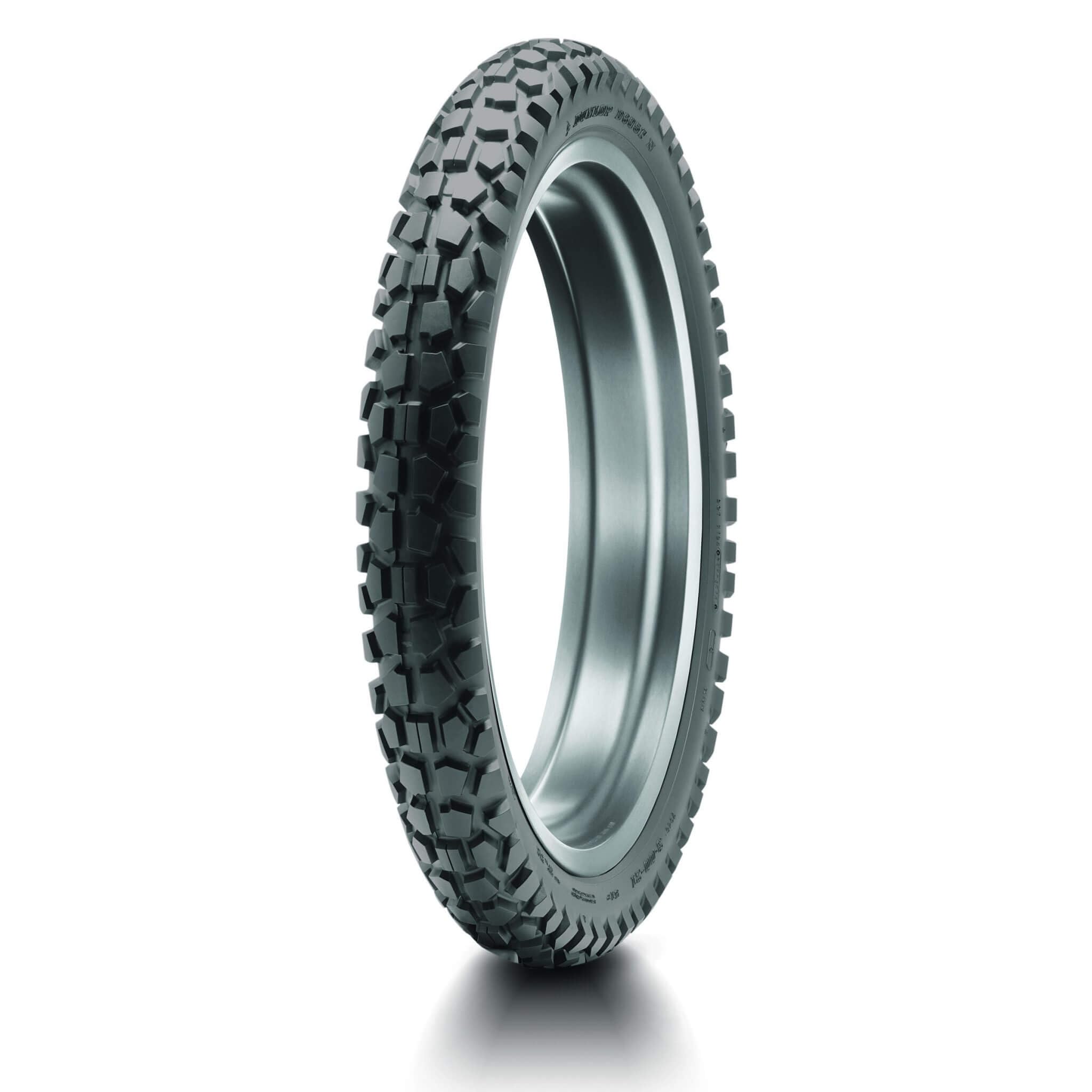
How To Choose The Best Dual Purpose Motorcycle Tires
Dual purpose tires must balance grip on loose gravel with stability at highway speeds—two demands that pull in opposite directions. The tread pattern dictates whether the tire excels on dirt or pavement.
Nail Down Your Road-to-Dirt Ratio First
Manufacturers print this split right on the sidewall, like “90% dirt / 10% road.” A tire with tall, aggressive knobs will chew through mud and rocks but hum and squirm on pavement. A more street-leaning tread with smaller blocks will be smooth and quiet on asphalt but struggle in deep gravel. Your road-to-dirt ratio is the single biggest predictor of tire satisfaction.
Check the Load Index and Ply Rating
Your bike, your gear, and your body all add up to a number the tire has to carry safely. The load index tells you the maximum weight a single tire can support — for example, a load index of 64 typically means 617 pounds. For heavier adventure bikes or fully loaded camping trips, you need a higher load index and a stiffer carcass, which is where ply rating comes in. A 6-ply or 10-ply sidewall resists punctures and holds its shape under heavy loads, but it also makes the tire harder to mount by hand.
Tube Type vs Tubeless
Many dual sport tires are tube-type, meaning they need an inner tube to hold air, which is standard on spoked wheels. Tubeless tires seal directly against the rim, which is common on cast wheels and easier to repair on the trail with a plug kit. If your bike has spoked rims, you’ll almost certainly be running tubes regardless of the tire you pick.
Quick Comparison
| Model | Best For | Max Pressure | Weight | Load Capacity | Amazon |
|---|---|---|---|---|---|
| Kenda Trakmaster K760★ Best Overall | Rocky trails & gravel | 33 psi | 11.6 lb | 617 lb | Amazon |
| Dunlop D605 FrontTrail Tamer | All-around value riding | 56 psi | — | — | Amazon |
| Dunlop D606 Front | Off-road dominant riding | — | 10 lb | — | Amazon |
| Shinko 705 Series | Highway + light dirt | 41 psi | 14 lb | 639 lb | Amazon |
| Tusk Waypoint Set | Adventure touring | — | — | — | Amazon |
| Tusk Dsport Set | Aggressive off-road | — | — | 992 lb | Amazon |
In‑Depth Reviews
1. Kenda Trakmaster K760 DOT Rear Tire
Our pick — over 4.5★ from 200+ verified ratings; the strongest balance of quality and price.
A DOT-approved rear tire that turns rocky trails and sugar sand into easy terrain.
This DOT-approved tire keeps aggressive knobs for off-road bite while staying street-legal. It’s a DOT-approved 90% dirt / 10% road tire, so you get the street-legal stamp for the pavement sections and tall, aggressive knobs that hook up on varying terrain when you leave it. The 617-pound load capacity with a load index of 64 means it handles a fully geared-up dual sport without flinching.
Owners praise its grip on rocks and gravel, with bystanders commenting on the traction. On a 75-mile off-road test through tough, twisty trails and jumps, it took everything without complaint. Buyers report: “Showing very little wear afyer about 20 miles in the rocky terrain” — even after hard miles, the knobs hold their edge.
You get rock-solid grip on trails and decent road manners, but the soft compound (a rubber blend that grips well but wears quicker) means pavement miles will wear it faster than a street-biased tire. It also gives up some traction to pure off-road rubber in the sloppiest conditions — exactly what you’d expect from any DOT-rated (street-legal) tire. Buyers praise the quality and traction in the rocks most, and at 4.8 stars across 200+ owners, this is the value king that performs above its class.
What Owners Rave About
- Exceptional grip on rocks and gravel terrain
- Street-legal DOT approval at a budget-friendly price
- Tough knobs that show minimal wear after rocky miles
Consider This Before Buying
- Soft compound wears quicker on long pavement stretches
- Less traction in deep mud than pure off-road tires
- Road durability trails its off-road toughness
Reach for it if: your week is mostly dirt and gravel with a legal road hop between trails.
Look elsewhere if: you log heavy highway miles and need rubber that shrugs off asphalt wear.
2. Dunlop D605 Front Dual Sport Tire
A 6-ply front end that’s more aggressive than you’d expect, and owners absolutely love it.
Dunlop built this front tire for the rider who treats pavement as the connector between the real riding. The full tread depth pattern is designed for rigorous off-road use, gripping everything from hard-packed fire roads to soft single-track, yet it stays versatile enough for street travel. The 56 psi maximum pressure rating is notably high — at 56 psi versus the Kenda Trakmaster’s 33 psi — giving you room to stiffen it up for highway runs.
The 6-ply construction (six layers of rubber and fabric) resists punctures and holds its shape on rocky trails where thinner carcasses would give up. Owners on DR650s report it lasting well while gripping both dirt and pavement. One rider who swaps between road and trail constantly found they “work extremely good on the road and better off road they are more aggressive than I usually like but they are awesome and look awesome” — aggressive, sure, but that aggression translates to confidence when the pavement ends.
The consensus on this one is simple: it fits well, it’s great value, and riders on dual-sport or enduro bikes swear by it. The only real note is that delivery can be slow, which has nothing to do with the rubber itself. If you want a front tire that doesn’t flinch when the road turns to trail, this is a strong mid-range pick.
Fit-First Front End: Owners consistently praise how easily it mounts and how well it suits dual-sport and enduro machines like the Yamaha XT250.
Aggression Bonus: The more aggressive tread than expected is exactly what trail-biased riders want in a front hoop.
3. Dunlop D606 Dual Purpose Front Tire

A 10-pound front that’s been the trail standard for years, with highway manners that surprise.
This is the front tire for riders who spend 90% of their time off-road and only tolerate the road to get there. It’s a 6-ply, 21-inch rim tire that weighs just 10 pounds — a full 4 pounds lighter than the Shinko 705 below — which means less unsprung weight for your suspension to manage on the trail. Owners run it on KLR650s, DR650s, and Hawk 250s, and the versatility is the biggest talking point.
The 90% off-road bias shows in the knobby tread, but it holds its own on pavement. Owners mention getting it balanced transformed the ride: “this one i got Balanced and it made a huge difference at 55 and above” — highway stability that improves dramatically with a proper balance job. Heavy highway use does wear it faster, but owners note it still has good overall hook-up when you need it.
The nuance is durability: some customers note quick scalloping at half-life, where the knobs start wearing unevenly, and one noted speed wobble above 75 mph on a heavy DR650. If you’re a front-heavy, highway-cruising adventure rider, that’s the trade-off. But for trail-first riders who accept that the road is just the commute, this remains a favorite for good reason.
Trail-Proven Strengths
- Excellent hook-up on dirt, rocks, and mixed terrain
- Light 10 lb weight eases steering effort on trails
- Versatile enough for track days and dual-sport duty
Fair Warning
- Highway miles accelerate tread wear
- Can scallop unevenly at half-life
- May wobble at speeds above 75 mph on heavier bikes
Choose it if: your riding is 90% dirt and you want a proven front tire that hooks up.
skip it if: you’re a highway commuter who needs a smoother, longer-wearing street blend.
4. Shinko 705 Series Front/Rear Tire

The adventure tire that laughs at potholes and still feels planted at 80 mph on a loaded KLR.
If your “off-road” is mostly graded gravel, fire roads, and the occasional grassy slope, the Shinko 705 is the smart pick. It’s the heaviest tire here at 14 pounds, and that weight buys you a tougher carcass and a 639-pound load capacity — the highest in this lineup, compared to the Kenda Trakmaster’s 617 pounds. The aggressive tread pattern delivers excellent wet and dry adhesion, and the compound resists tearing when you do venture off the pavement.
Owners on KLR650s and KTM ADV 250s report remarkable longevity — one rider put 30,000 km on a KTM ADV 250 and the rubber still looked great after a year. Another ran the first set for 8,000 miles with more than 50% tread left, only replacing the rear after a bolt puncture. The grip earns praise on loose dirt, back roads, and wet pavement, with one owner noting it handled steep inclines in wet grass without drama.
The trade-off is mud: the smooth, tightly packed lugs (the tread blocks) don’t self-clean well, so deep mud will have you paddling. A few owners also note the ride is less plush than pricier sport-touring rubber. But if you want a tire that does 80% road, 20% dirt and lasts forever, the value here is genuinely tough to top — quality is the most-praised aspect by a wide margin.
Mileage Monster: Owners routinely report 8,000 to 30,000 km of life, making this one of the longest-wearing picks in the class.
Mud Disclaimer: The tight tread pattern that makes it smooth on highways is exactly why it struggles in deep mud.
5. Tusk Waypoint Adventure Tire Set

A front-and-rear set that needs a break-in period, then grips like a much pricier pair.
This is a complete adventure tire package — a 90/90-21 front and 130/90-18 rear in tube-type construction — designed for riders who split their time between blacktop and backcountry. The 6-ply bias construction gives you sturdy sidewalls that resist pinch flats on rocky trails, and the DOT compliance keeps you legal on the street. The aggressive knobs provide traction in tough conditions while the rubber compound is engineered for long-lasting wear.
Owners praise the tread design, with one DRZ400S rider particularly liking the pattern. The tires handle rain and temps as low as 34 degrees on pavement with confidence. For winter mountain riders, these got through a full season of cold-weather riding without complaint. The rocky trail performance earns consistent praise, and the set offers solid value for a pair of quality adventure hoops.
The one thing to know: the tread takes time to break in. Owners note the handling and braking feel slightly unsettling for the first few rides until the rubber scrubs in — after that, grip improves noticeably on road and off. Mounting is easier than expected for a stiff 6-ply, so DIY installers won’t dread the job. If you want a ready-made adventure pair that just works, this is the set.
Predictable Package: Reviewers point out consistent performance and handling once the tread breaks in, making it a dependable all-rounder.
Break-In Patience: The first few rides feel slightly unsettled in braking and handling until the tread scrubs in.
6. Tusk Dsport Adventure Tire Set

A 10-ply, 992-pound-capable set that extreme enduro riders and KLR owners both swear by.
This is the tire for riders who take their dual sport to places that would make a trail bike nervous. The 10-ply construction is the stiffest in this lineup — it’s built to shrug off punctures and hold its shape under brutal loads, with a 992-pound load capacity that dwarfs everything else here. The tall knobbies provide exceptional grip in the toughest off-road conditions, and the compound is designed for long wear on and off the road.
The proof is in the use: riders run these through highly technical extreme enduro terrain — climbing, descending, jumping, crashing — and the tires hold up with good bite. The durability is the headline, with owners calling them the longest-lasting dual sport tires they’ve used. On pavement they perform well up to 80 mph, and the set fits a 2024 CRF300L with no power change. The aggressive look is a bonus that riders appreciate.
The honest notes: the factory balance isn’t great — shoppers say needing 3+ weights on the front, and balancing is essential for speeds over 45-55 mph. The knobbies buzz on pavement, and there’s a slight new-tire wiggle before they settle. Sand performance on heavy bikes like the KLR650 is mediocre. But for aggressive off-road riders who want a tough, long-wearing set, this is the one.
Built-Tough Strengths
- Massive 992 lb load capacity for heavily loaded bikes
- 10-ply carcass resists punctures on rocky terrain
- Hold up through extreme enduro use without chunking
Ride Realities
- Poor factory balance needs extra weights up front
- Knobbies buzz noticeably on pavement
- Mediocre sand performance on heavier machines
Pick this if: you ride technical terrain and need a tire that survives abuse for a long time.
Think twice if: you want a smooth highway cruiser without the need to balance the front wheel carefully.
Understanding the Specs
Load Index and Load Capacity
The load index is a number that maps to the maximum weight a single tire can safely carry — a load index of 64 typically means 617 pounds, while 65 means 639 pounds. This matters most on heavy adventure bikes or when you’re packing for a multi-day camping trip, because exceeding the rated load risks overheating the tire and premature failure. The highest capacity in this group is the Tusk Dsport set at 992 pounds, making it the obvious choice for fully loaded big-bore adventure bikes.
Ply Rating and Stiffness
Ply rating tells you how many layers of material reinforce the carcass — a 6-ply tire is stiffer and more puncture-resistant than a 4-ply, while a 10-ply is the toughest of all. The trade-off is that stiffer tires are harder to mount by hand and ride harsher on pavement. For rocky trails and heavy loads, a higher ply rating is worth the wrestle; for lighter bikes and mostly-road riding, a 4-ply is easier to live with.
FAQ
What does DOT approval mean for a dual sport tire?
Will a 90/90-21 front tire fit my bike?
How do I know if I need a tube-type or tubeless tire?
What pressure should I run in my dual sport tires?
How long do dual purpose motorcycle tires last?
Is the Shinko 705 good in mud?
What is the difference between a 6-ply and a 10-ply tire?
Can I use the Dunlop D606 front with a different rear tire?
Final Thoughts: The Verdict
For most riders, the dual purpose motorcycle tires winner is the Kenda Trakmaster K760 because it pairs proven, street-legal grip with a price that’s hard to argue with — the crowd favorite at 4.8 stars. If you want maximum highway mileage with light off-road duty, grab the Shinko 705. And for aggressive adventure riding where durability matters most, the Tusk Dsport with its massive 992-pound load capacity is the one to reach for.
How We Picked
We do not accept paid placement. Every pick is matched to a real buyer and a real use-case; we do not hands-on test units.
Sources & Methodology
Specifications: manufacturer listings and product documentation. Review insights: verified customer reviews, as of August 2026. Pricing: not shown on this page (it changes often); check the current price via the retailer link.
As an Amazon Associate, WellFizz earns from qualifying purchases. This does not affect which products we feature.
Related Guides

Mo Maruf
I created WellFizz to bridge the gap between vague wellness advice and actionable solutions. My mission is simple: to decode the research and give you practical tools you can actually use.
Beyond the data, I am a passionate traveler. I believe that stepping away from the screen to explore new environments is essential for mental clarity and physical vitality.