Our readers keep the lights on and my smoothie glass nicely filled. As an Amazon Associate, I earn from qualifying purchases.
Specs are compiled from manufacturer listings and verified buyer reviews and can change over time — please confirm the key details on the product page before buying.
You already know a dual fuel inverter generator can run on gasoline or propane, giving you fuel flexibility when every station runs dry. What you actually need to sort out is which one delivers enough clean power for your home, your RV, or your job site without drowning out your neighbors’ conversations. This guide covers ten dual fuel inverter generators from 2,200 to 12,000 watts to help you match wattage, runtime, and noise to your needs.
I’m Mohammad Maruf — the founder and writer behind WellFizz. This guide is built by comparing the manufacturers’ published specifications and the patterns across verified customer reviews, so you get each pick’s real strengths and trade-offs instead of marketing spin.
Whether you are protecting sensitive electronics during a storm or running an RV air conditioner off-grid, choosing the right best dual fuel inverter generator depends on matching your peak power needs with realistic runtime expectations and a noise level your household can live with.
Our Picks at a Glance
How To Choose The Best Dual Fuel Inverter Generator
Choose your power size first, then decide how much quiet and which fuel matters to you. A 2,200-watt unit runs a fridge and some lights, while a 12,000-watt unit can handle an entire home with a central air conditioner. Inverter technology means the engine speed adjusts to the load, which saves fuel and keeps the noise down. Dual fuel gives you the option of propane, which stores indefinitely and burns cleaner, or gasoline, which delivers slightly more peak power. Look for a carbon monoxide (CO) sensor for safety and parallel ports if you might want to pair two units later.
Power Output: Peak vs. Running Watts
Peak (or surge) watts handle the extra jolt a motor needs to start — a refrigerator compressor or an RV air conditioner. Running (or rated) watts are what the generator sustains continuously. Add up the running watts of everything you plan to power at once, then add the single largest motor starting surge. A 4,400-watt peak / 3,600-watt running generator powers most RV essentials and a few home circuits.
Noise Level and Enclosure
Inverter generators are quieter than conventional open-frame models because the engine can throttle down under light load. Most enclosed inverter models in this list fall between 53 dBA and 64 dBA, which is quieter than a normal conversation. A fully enclosed design also helps meet campground and residential noise ordinances.
Fuel Efficiency and Runtime
Propane typically delivers longer runtime per tank than gasoline at the same load, but you sacrifice about 10 percent of peak wattage. A generator with a 1.6-gallon gas tank might run 11 hours, while a 7.9-gallon tank can stretch past 19 hours. Economy Mode (sometimes called Eco or ESC) lowers the engine speed when demand is low, stretching every drop further.
Quick Comparison
| Model | Best For | Peak Watts (Gas) | Runtime at 25% Load | Noise Level | Amazon |
|---|---|---|---|---|---|
| Westinghouse iGen12000DFc★ Best Overall | Whole-home backup | 12,000W | 19 hrs | 64 dBA | Amazon |
| PowerSmart MB5040DC (1.6 gal)Budget Champion | Budget home backup | 4,400W | 11 hrs | 76 dBA | Amazon |
| PowerSmart MB5040DC (quiet)Quiet Runner | Quiet residential backup | 4,400W | — | 59 dBA | Amazon |
| Pulsar PG2200BiS | Light camping / charging | 2,200W | 8 hrs | 60 dBA | Amazon |
| Westinghouse iGen2550DFc | RV travel / light backup | 2,550W | 12 hrs | 52 dBA | Amazon |
| BILT HARD 4500W | Camping / national parks | 4,500W | — | 58 dBA | Amazon |
| Champion 2500-Watt | Ultra-quiet propane use | 2,500W | 25 hrs (propane) | 53 dBA | Amazon |
| ERAYAK 4500W | Home backup / auto-switch | 4,500W | 16 hrs | 58 dBA | Amazon |
| WEN DF360iX | Small RV / electronics | 3,600W | — | Conversation-quiet | Amazon |
| AIVOLT 4300W | RV / remote start | 4,300W | 34 hrs (propane) | 53 dBA | Amazon |
In‑Depth Reviews
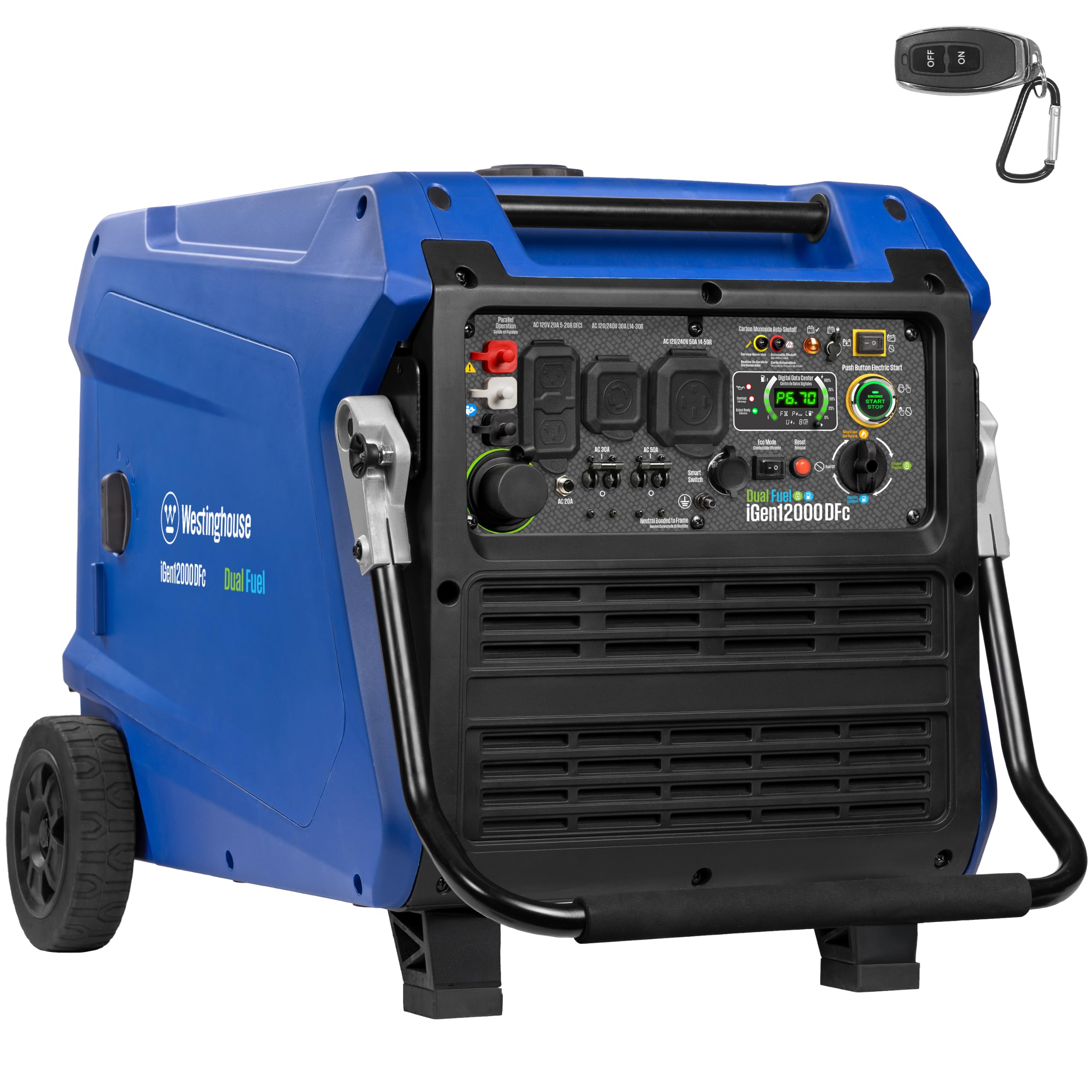
1. Westinghouse 12000 Peak Watt Dual Fuel Portable Inverter Generator (iGen12000DFc)
Our pick — over 4.5★ from 650+ verified ratings; the strongest balance of quality and price.
The whole-home powerhouse that starts from the couch and runs for 19 hours straight.
This generator powers your fridge, lights, Wi-Fi, and central air as if the grid never failed. At 12,000 peak watts on gasoline and 9,000 running watts, the iGen12000DFc powers an entire household through a 50-amp transfer switch outlet. The 457 cc engine delivers that power at just 64 dBA — quiet enough for neighborhood use. Owners confirm it runs a 2,700-square-foot home without strain and even charges a Tesla at 20 to 25 miles per hour through the 50-amp outlet.
The 7.9-gallon fuel tank gives you that 19-hour runtime at 25 percent load, which means you sleep through the night without a refill. The inverter technology matches engine speed to demand and can cut fuel consumption by up to half compared to a conventional generator. A remote start key fob works from 50 feet away, and the LED data center shows fuel level, power output, remaining runtime, and lifetime hours. The included battery, 12-volt charger, propane regulator kit, oil, funnel, and tool kit mean you can have it running within an hour of unboxing. The carbon monoxide (CO) sensor automatically shuts down the engine if it detects unsafe levels.
The trade-off is sheer size: at 187 pounds with wheels, you are not tossing this into a truck bed by yourself. Buyers also note the included engine oil is too thick for temperatures below 23°F and recommend switching to 5W-30 synthetic after the five-hour break-in period.
What wins people over
- Quiet operation gets the most praise by far — 269 owners single it out
- Build quality and easy setup are the next most-discussed strengths
- Remote start with 50-foot range from the key fob
- Transfer switch ready with both 50A and 30A outlets
What to know before buying
- At 187 lbs, plan on a permanent spot or a sturdy dolly
- The included 10W-30 oil is not suitable below 23°F
Who this is for: homeowners who want whole-house backup without the permanent installation of a standby unit — this one powers the entire panel from a transfer switch.
Think twice if: you need a generator you can lift into an SUV or carry to a campsite; this is a wheel-it-to-position machine only.
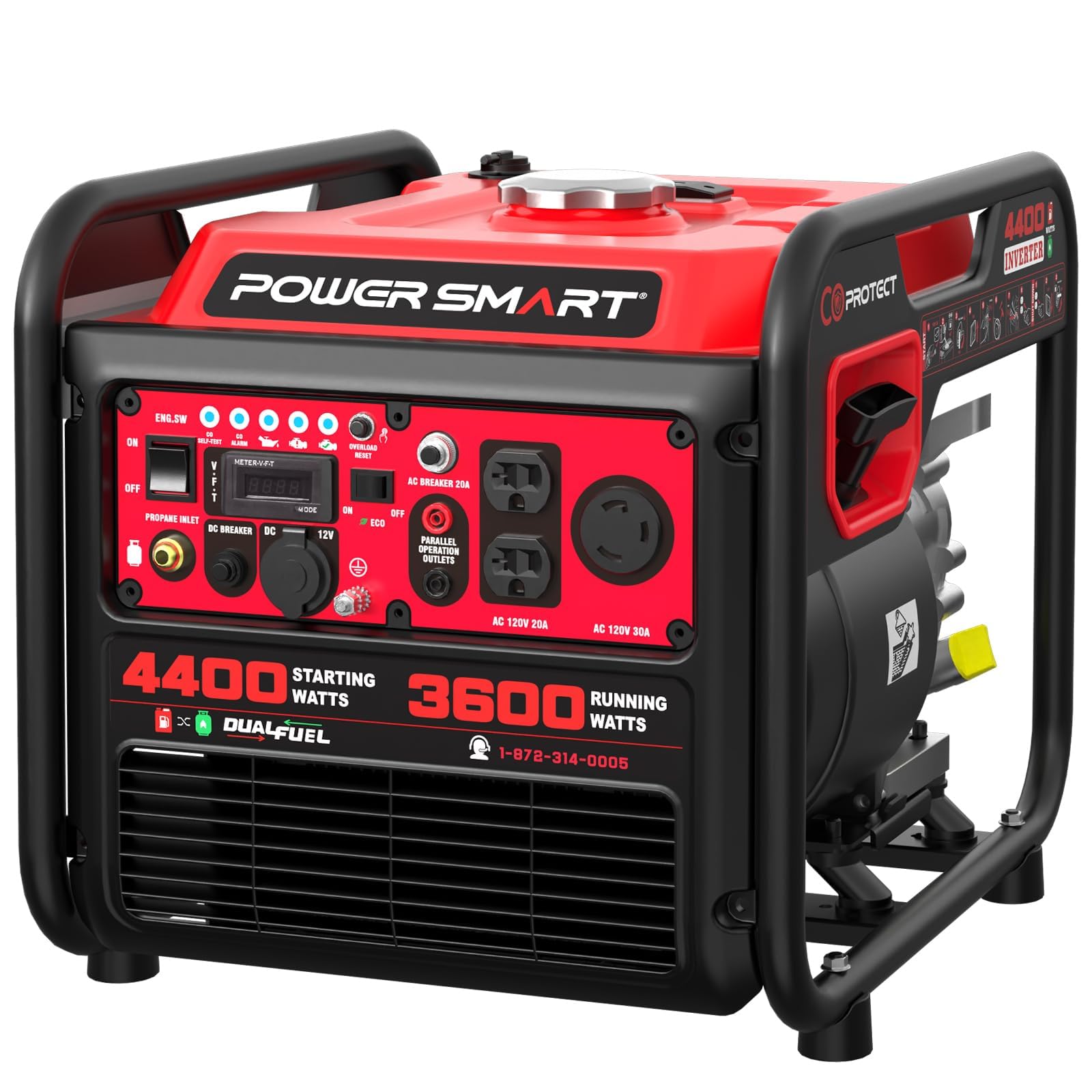
2. PowerSmart 4400-Watt Dual Fuel Portable Inverter Generator (MB5040DC)
This 61-pound generator powers an RV camper on a budget.
This is the most affordable entry point into dual-fuel inverter power that can still handle real appliances. The 223 cc engine delivers 4,400 peak watts and 3,600 running watts on gasoline — enough for a camper’s air conditioner, fridge, fan, and lights simultaneously. The 1.6-gallon fuel tank provides 11 hours of runtime at 25 percent load, and the built-in CO sensor shuts down the generator if carbon monoxide builds up. At 61.3 pounds, you can lift this one into a truck bed or carry it to a job site.
Buyers running a 3,500-watt camper rig confirm the generator provides the needed 3,800 watts, and the 76 dBA noise level from 23 feet is manageable for residential use. The EPA-compliant 4-stroke engine includes low-oil shutdown and overload protection. The recoil start is straightforward, though owners note the choke position is opposite of what the sticker shows — a half-choke position gives the easiest start. Running on propane requires the included hose and regulator.
A small batch of owners experienced quality-control issues, including a faulty oil sensor and a gas leak near the carburetor. Most units run reliably, but the handful of negative reports suggest checking for fuel leaks on the first run and bypassing the oil sensor if it triggers falsely.
Why it sells so well
- Lowest price for a 4,400W dual-fuel inverter with CO protection
- Light enough at 61.3 lbs for one person to load and move
- Compact 19.3 x 16.9 x 16.5 inch footprint stores easily
What to watch
- Build consistency varies — inspect the carburetor area and oil sensor before heavy use
- At 76 dBA it is louder than enclosed inverter models
Pick this if: you need a reliable backup generator for an RV or small home loads and your budget caps at entry-level pricing.
skip it if: you plan to run the generator every week for years — the budget-tier components may not hold up to constant use the way a premium model would.
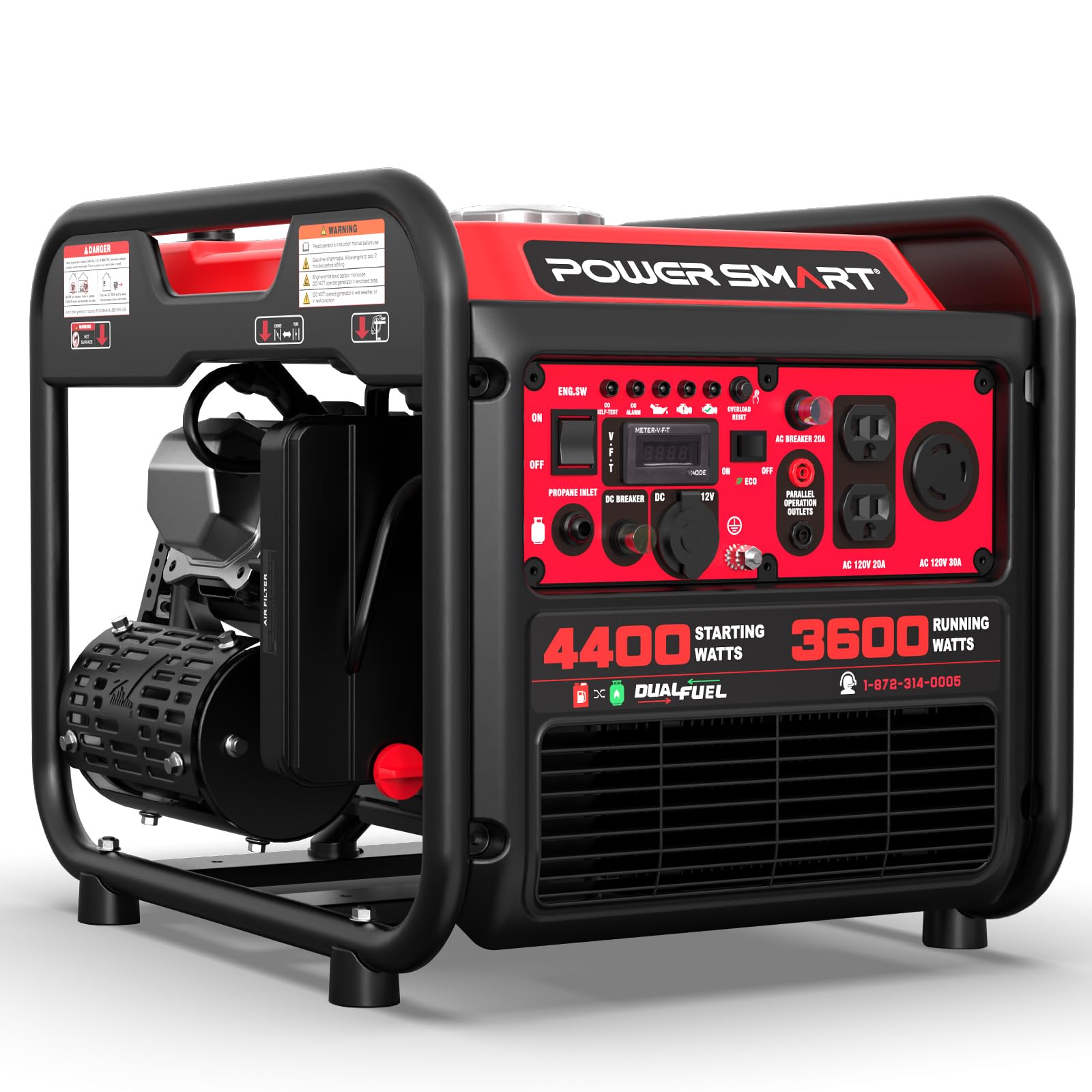
3. PowerSmart 4400-Watt Dual Fuel Portable Generator with Inverter Technology (59 dBA)
Nearly the same power as the budget model but 17 dBA quieter for residential peace.
This PowerSmart variant shares the same 4,400 surge / 3,600 running watt core, but it wraps everything in a more sound-dampened enclosure that cuts noise to 59 dBA at 23 feet at 25 percent load — quiet enough for suburban backyards where loud generators draw complaints. On propane, it delivers 4,000 surge and 3,300 running watts. The total harmonic distortion (THD) stays below 3 percent, so smartphones, laptops, and other sensitive electronics get clean, stable power without risk of damage.
The outlet selection covers the essentials: two three-prong 120-volt 15-amp household outlets, one 120-volt 30-amp RV outlet, one 12-volt DC outlet, and parallel ports so you can combine two units for more power. The CO sensor, low-oil shutdown, and overload reset provide the safety net you expect from a modern inverter generator. Buyers report the construction looks solid, the starter fires reliably, and the noise is acceptable for the power class.
The honest trade-off is that noise perception is subjective — several owners note the 59 dBA rating is measured at 23 feet at partial load, and the generator is louder at full load or close range. A few also report the manual fuel gauge reads slightly off, so track runtime yourself.
What owners appreciate most
- 59 dBA at partial load keeps the peace in residential areas
- Dual-fuel flexibility with propane for cleaner storage
- Sturdy metal frame and straightforward maintenance access
The honest downsides
- Noise climbs noticeably at full load or close range
- Fuel gauge accuracy is hit or miss
Choose this one for: a home backup situation where neighbors are close and you need the generator to be as unobtrusive as possible.
Look elsewhere if: you want a unit that stays genuinely whisper-quiet under a heavy load — consider a fully enclosed premium model instead.
4. Pulsar 2,200W Portable Dual Fuel Quiet Inverter Generator (PG2200BiS)

This lightweight charger starts on the fourth pull and handles 1,400 watts of load.
If your need is recharging battery banks, powering a campsite, or running a few sensitive electronics, this 80 cc single-cylinder generator keeps things simple. It delivers 2,200 peak / 1,800 running watts on gasoline and 2,000 peak / 1,600 running watts on LPG. The 60 dBA noise level makes it campground-friendly, and at 19.7 x 11.2 x 17.9 inches with a built-in carrying handle, it stows in a closet or the back of an SUV. Owners load-test it to 1,400 watts without issue, powering computers, a truck camper, or recharging a solar battery bank in about an hour.
The dual-fuel setup gives you a 1.18-gallon gas tank for 8 hours at half load, or a 1-pound LPG tank for about 75 minutes. Two 120-volt 15-amp outlets and a 5-volt USB port cover the basics. Parallel sockets let you pair two units for double the output. The propane starting can be fussy — several owners find it takes five or six pulls after the diaphragm in the adaptor has sat — but a simple trick of sucking on the engine-end of the hose unsticks it.
The compromise is power: this is strictly for small loads. It struggles with a 1,300-watt power station pull and won’t run an RV air conditioner. Buyers also note the manual lists a 12-volt charger that is not included, so check the package contents.
What makes it a great value
- Easily portable at under 40 lbs with a carrying-case design
- Quiet 60 dBA operation suits campgrounds and neighborhoods
- Inverter power with stable sine wave protects electronics
Where it falls short
- Propane starting can be finicky after storage without the diaphragm trick
- Too small for RV AC or large appliances
Reach for this if: you need a compact, quiet generator to top off battery banks, run a laptop, and keep a fridge cold during short outages.
Pass it by if: your list includes an air conditioner, a well pump, or any motor over 1,500 starting watts.
5. Westinghouse 2550 Peak Watt Super Quiet Portable Inverter Generator (iGen2550DFc)

This 42-pound generator runs an RV air conditioner and charges batteries all night on propane.
This Westinghouse strikes the most portable balance between power and quiet in the lineup. At 42.4 pounds and 52 dBA, it is light enough to carry with one hand and quiet enough to run beside a tent without waking anyone. The 2,550 peak / 1,900 running watts on gasoline (with a propane option) power an RV air conditioner, charge a BLUETTI battery bank, or keep a sleep apnea machine running, as owners confirm. The 1.16-gallon gas tank delivers up to 12 hours of runtime on Economy Mode, which throttles the engine to match the load.
The outlet panel includes an RV-ready TT-30R 30-amp outlet, two 120-volt 20-amp household outlets, and two USB ports. The CO sensor provides automatic shutdown protection. Westinghouse backs it with a 3-year limited service, labor, and parts warranty. Setup is minimal — add oil and fuel, or connect the included propane hose, and you are running. Owners praise the tool-less access to the spark plug and air filter for maintenance.
The handful of negative reports involve units that arrived defective and would not start on either fuel, and the customer support callback time of 48 hours frustrated those owners. The majority of buyers have no issues, but it is worth testing immediately on delivery.
What the crowd loves
- Reliability is the top praise — 321 owners call it out
- Noise level is the second most-discussed strength, and 52 dBA is genuinely low
- Light enough at 42.4 lbs for one person to lift and move
- Dual fuel with propane means no gummed-up carburetor
What to watch for
- An occasional defective unit slips through — test on delivery
- Customer support callback can take two days
Best for: RV owners who need a generator that can run the AC, stay quiet at a campsite, and weigh under 45 pounds.
Not ideal if: you need more than 1,900 running watts for home backup — this is an RV and light-duty companion only.
6. BILT HARD 4500W Dual Fuel Gas & Propane Generator
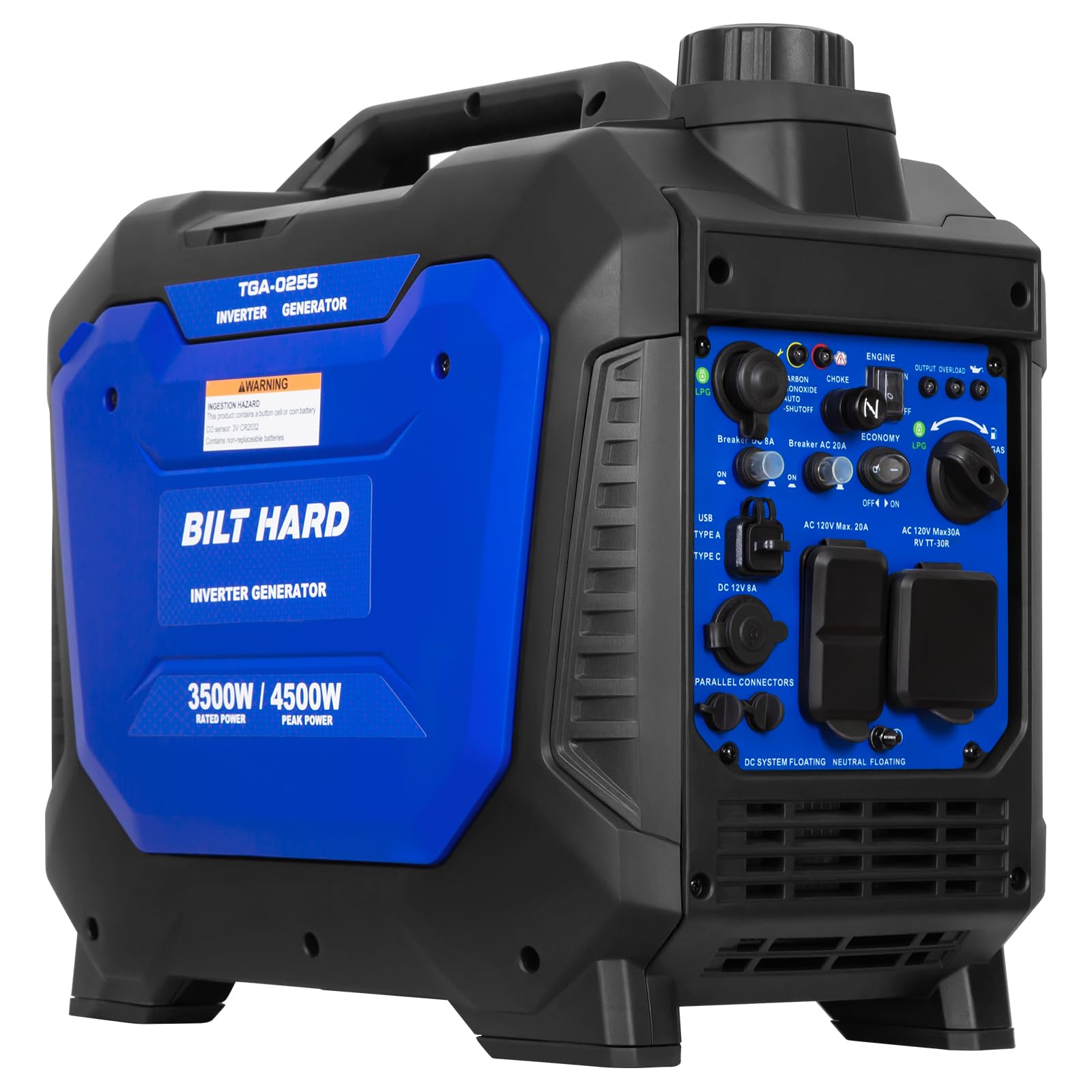
This fully enclosed 141 cc generator meets national park noise limits at half the cost of premium brands.
BILT HARD designed this one for campsites where noise restrictions apply. The 58 dBA rating at 23 feet is conversation-friendly, and the fully enclosed case reduces sound enough to satisfy national park requirements. The 141 cc engine produces 4,500 peak / 3,500 running watts on gasoline and 4,150 peak / 3,200 running watts on propane. The inverter power keeps THD below 3 percent, safe for laptops and phone chargers. A 120-volt 30-amp RV outlet, a 20-amp duplex receptacle, dual USB ports, and a 12-volt 8-amp DC output cover the typical hookups.
ECO mode adjusts engine speed to save fuel and quiet the unit further. The CO sensor auto-shuts the engine if carbon monoxide builds up. Parallel capability lets you pair two units with a sold-separately kit. Owners mention easy starts, good fuel consumption, and a quiet operation that compares favorably to premium brands at roughly half the price. One reviewer noted 4.5 hours of runtime on 56 ounces of gas at light load.
A few owners experienced quality-assurance hiccups — a loose wire clip that prevented starting and a severed stepper motor wire that killed the ECO switch. The company responded to both cases quickly, sending replacement parts or credits. No engine oil is included, so pick up a bottle of 5W-30 before your first start.
Who this fits: campers and RV owners who want a quiet, fully enclosed inverter generator that respects park noise limits without spending premium money.
The honest catch: QA issues on a small number of units mean you should test everything (ECO mode, all outlets, the CO sensor) during your first 30 minutes of run time.
7. Champion Power Equipment 2500-Watt Dual Fuel Portable Inverter Generator

This 53 dBA generator runs 25 hours straight on a single propane tank connection.
Champion brings its reputation for reliable propane performance into a compact inverter package. The 79 cc engine delivers 2,500 starting / 1,850 running watts on gasoline and 1,665 running watts on propane. The headline number here is the 25 hours of runtime on propane at 25 percent load — more than double the gasoline runtime of most comparably sized units. That makes it the go-to for long-duration backup when you have a steady supply of 20-pound propane tanks. The gasoline runtime is still respectable at 11.5 hours.
The CO Shield auto shutoff system protects against carbon monoxide buildup. The covered 120-volt 15.4-amp duplex outlet provides clean electricity below 3 percent THD, plus a 12-volt regulated automotive-style outlet. A parallel kit (sold separately) lets you pair it with another Champion inverter or power station. The noise level sits at an ultra-quiet 53 dBA from 23 feet, which is lower than a normal conversation. Customers note easy 15-minute setup with no tools required, a third-pull start, and the ability to run a fridge, deep freeze, and box fan for eight hours on one gallon of gas.
Propane starting reliability earns mixed feedback — some units start perfectly on propane, while others require multiple pulls. Champion’s 3-year limited warranty and free lifetime technical support offer a solid safety net for any issues.
Best use case: extended off-grid stays or emergency backup where you want to run on propane for days without refueling anxiety.
Consider before buying: the propane-start inconsistency means some owners struggle on the first few pulls; a few units arrived with a defective ignition coil that required warranty service.
8. ERAYAK 4500W Dual-Fuel Portable Inverter Generator
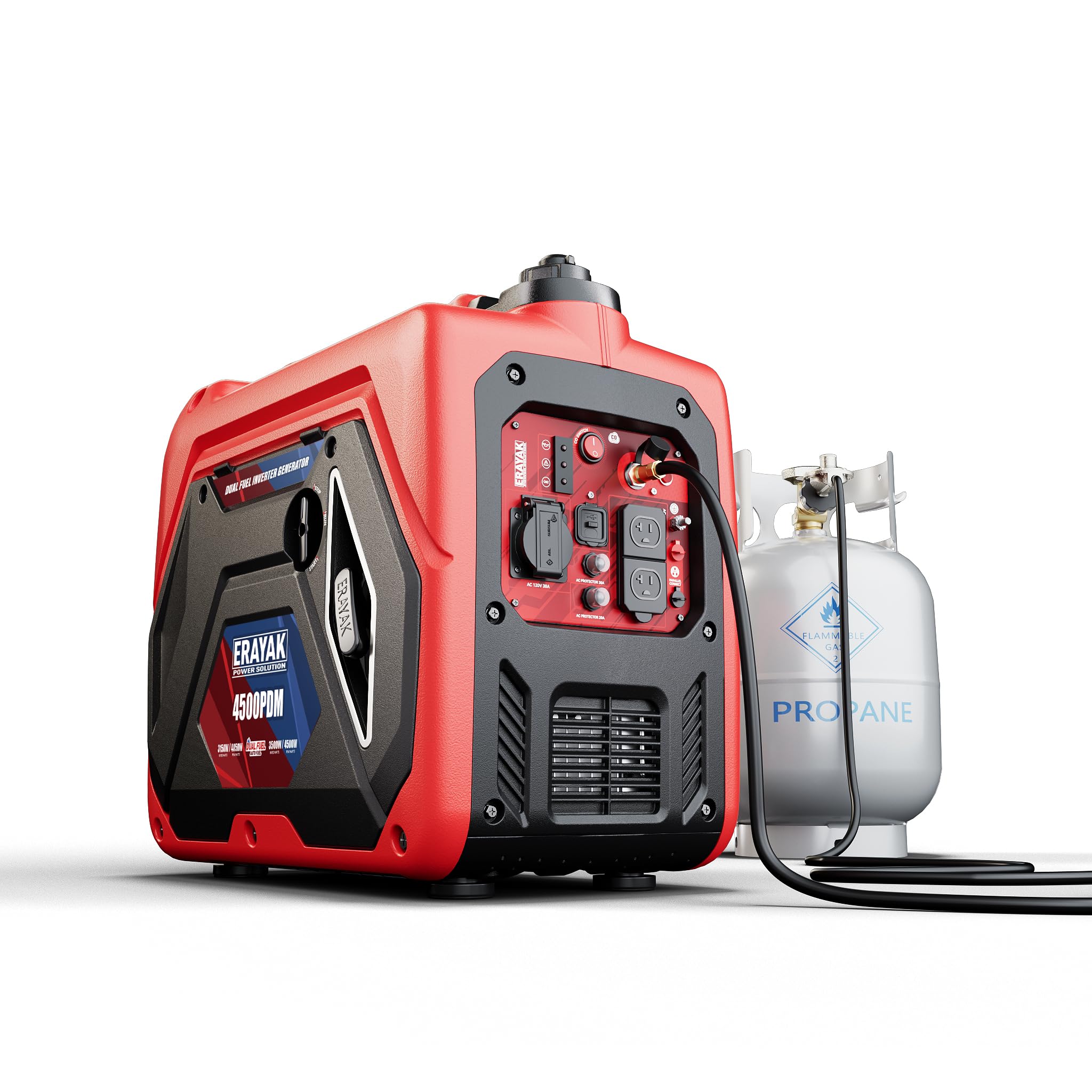
This 54-pound inverter auto-switches to propane when gas runs dry to prevent power loss.
ERAYAK stands out with a gas priority system that automatically switches from propane to gasoline when the propane tank empties, keeping your appliances running without a manual intervention. The 4,500 peak / 3,500 running watts on gasoline and 4,050 peak / 3,150 running watts on propane come from a 4-stroke engine with pure sine wave inverter technology. The total harmonic distortion (THD) is an impressively low 0.2 to 1.2 percent, so the power is exceptionally clean for sensitive electronics.
The 2.25-gallon gas tank delivers up to 16 hours at 25 percent load, and connecting a propane tank extends runtime beyond 20 hours. The Electronic Speed Control (ESC) Mode tune fuel consumption under lighter loads. At 58 dBA from 23 feet at quarter load, it is quiet enough for residential use. The outlet panel includes two 120-volt 20-amp outlets, a 30-amp L5-30P RV outlet, USB-A at 5 volts and 2.1 amps, and an 18-watt USB-C. The CO sensor and circuit breaker protection on all outlets cover safety. The kit includes a 30-amp conversion plug (TT-30R), a propane connecting pipe, and a tool kit.
Build quality is the most-cited positive, with owners praising the sturdy feel and easy 15-minute setup. A few reviewers point out the generator failed on propane after initial use, and the noise level at full load is louder than the 58 dBA partial-load rating suggests. The wheel kit also struggles on rough ground.
The standout features
- Auto-switch between propane and gasoline prevents power interruptions
- Exceptionally clean power at 0.2% to 1.2% THD
- Light at 54 lbs for a 4,500W inverter generator
- Includes USB-C, a TT-30R adapter, and maintenance tools
What to watch
- Propane-only mode had failure reports on a small number of units
- Noise at full load is higher than the partial-load rating
Pick this if: you want the convenience of fuel auto-switching for home backup when you might not be around to switch hoses.
pass on it if: you need a reliable propane-only runtime without any potential carburetor issues — test the propane mode immediately after setup.
9. WEN 3600-Watt Dual Fuel RV-Ready Portable Inverter Generator (DF360iX)

The 50-pound inverter that blankets a small RV with clean, quiet power and starts on the first pull.
WEN packs 3,600 surge / 2,900 running watts on gasoline and 3,500 surge / 2,600 running watts on propane into a 49-pound frame with a conversation-quiet noise level. The CO Watchdog Sensor automatically shuts down the generator if carbon monoxide reaches dangerous levels. The fuel shut-off valve lets you run the carburetor dry before storage, preventing the gumming that plagues seasonal generators. The pure sine wave inverter power is safe for smartphones, laptops, and tablets.
The outlet panel includes two three-prong 120-volt receptacles, one TT-30R RV receptacle, one 12-volt DC receptacle, and two 5-volt USB ports. The tool-free LPG quick-connector makes switching to propane fast. Shoppers say no issues running on propane for days, easy starting on both fuels, and a low-frequency sound that is less annoying than higher-pitched generators. The digital display shows volts, frequency, runtime, watt utilization, and fuel level. The 3-year warranty backs the purchase.
The most common gripe is that both 20-amp outlets hold plugs loosely, so a heavy cord may sag out. The 30-amp RV plug location sits behind a plastic panel that can vibrate loose. The included LPG hose has an extra regulator that prevents direct connection to some camper propane systems.
Why owners trust it
- Reliability is the top praise — 137 owners call it a solid performer
- Noise level and build quality are the next most-discussed strengths
- Light 49-lb frame with a comfortable carry handle
- Fuel shut-off prevents carburetor issues during storage
Small annoyances
- 20-amp outlets have a loose fit for standard plug prongs
- RV plug location can vibrate loose without a tie-down
Best for: small RV owners and home backup users who want a lightweight, reliable generator that runs clean power for days on propane.
Pass if: you need the outlets to hold heavy-gauge extension cords securely — the loose fit may require a small cable tie fix.
10. AIVOLT 4300W Dual Fuel Inverter Generator
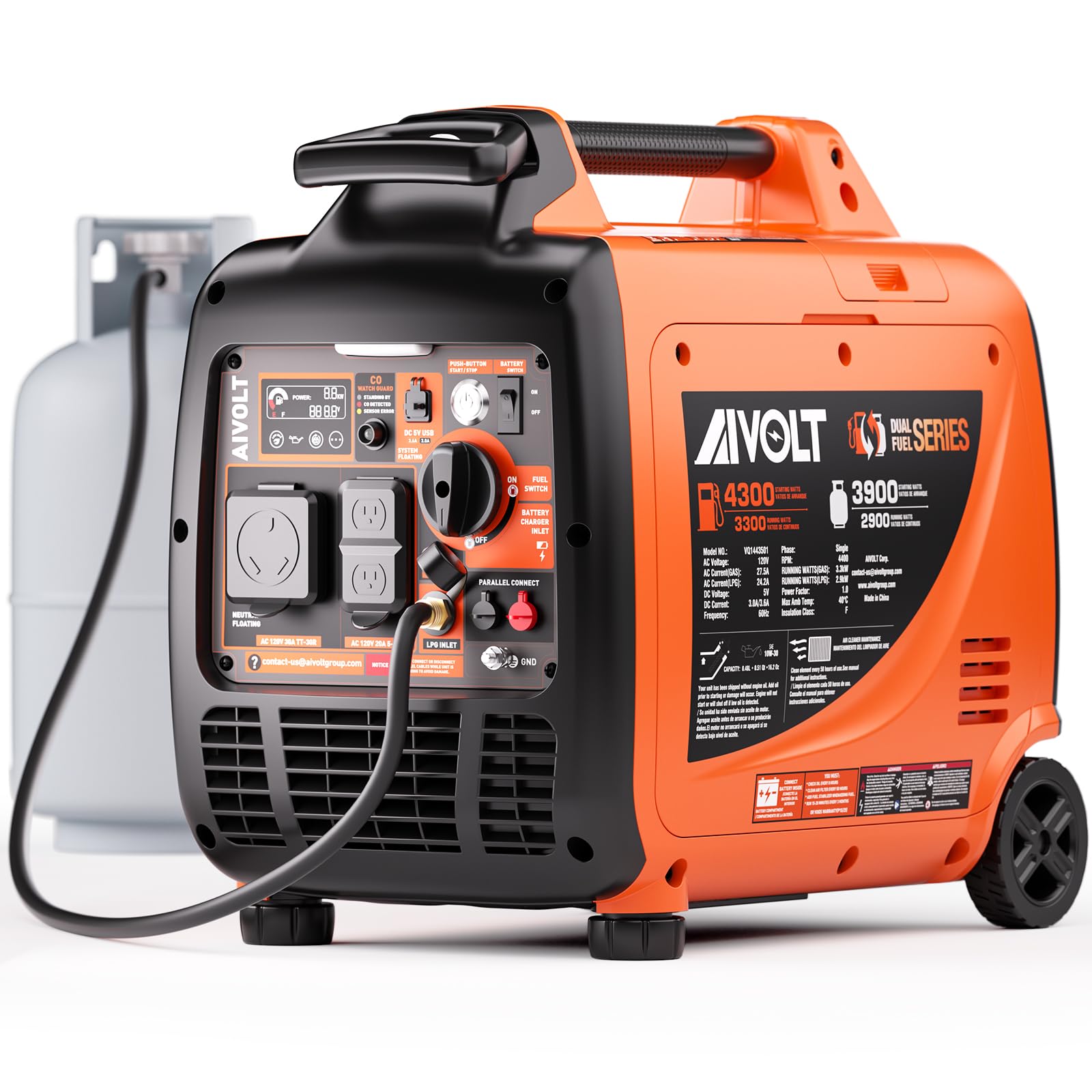
The 64-pound generator with a key fob so you fire it up from inside the RV without leaving the couch.
AIVOLT brings electric and remote start to the mid-range inverter class. The key fob remote lets you start or stop the generator from inside your RV or house — ideal for cold mornings or noisy campgrounds where you want to minimize time outside. The 4,300 peak / 3,400 running watts on gasoline (power numbers confirmed from the item details) power an RV rooftop air conditioner, a microwave, and general appliances. On propane, the runtime stretches to 34 hours at 25 percent load, the longest propane runtime in this comparison. The gasoline runtime is 11.5 hours.
The 53 dBA noise level from 23 feet is lower than a normal conversation. The telescoping handle and built-in wheels make the 64-pound unit glide over rough terrain. The dedicated 30-amp outlet provides RV-ready power, and the CO auto-shutoff meets UL2201 and EPA certification standards. Parallel capability lets you pair a second unit for larger loads. The 2-year warranty provides post-purchase support.
The most serious concern is a small batch of units with a carburetor defect that causes fuel to pour from the overflow immediately. AIVOLT’s customer service issued full refunds within 12 hours for those cases and told owners to dispose of the defective unit. The other notable pattern is that the generator has a thermal safety mode that prevents restarting until it cools down for about an hour — frustrating if you need to refuel and restart quickly.
What makes it unique
- Key fob remote start works from inside the RV
- 34-hour propane runtime is class-leading
- 64 lbs with telescoping handle and wheels for easy movement
- Quiet 53 dBA for campground and residential use
What to know
- Carburetor defects reported on a small number of units
- Cool-down period of up to an hour before restarting
Choose this if: you want the convenience of remote starting and the longest propane runtime for extended RV trips or emergency backup.
Think twice if: you need to shut down and restart quickly during a storm — the thermal cooldown delay means you wait an hour between runs.
Understanding the Specs
Total Harmonic Distortion (THD)
THD is a measure of how clean the electrical sine wave is. Utility grid power is very clean, and sensitive devices like smartphones, laptops, and medical equipment expect that same quality. Inverter generators in this list produce THD below 3 percent, which is safe for all modern electronics. A THD above 5 percent can cause buzzing, overheating, or damage to sensitive circuits over time.
Parallel Capability
Parallel capability means you can connect two identical inverter generators with a special parallel kit (sold separately) to double your available power. For example, two 2,500-watt units can combine to power a 5,000-watt load. This is useful if you buy a smaller generator now and want to scale up later for a larger RV or more home circuits.
FAQ
Can a dual fuel inverter generator power a whole house?
Is propane or gasoline better for a dual fuel generator?
How many hours will a generator run on a 20-pound propane tank?
What is the difference between peak watts and running watts?
Do I need a transfer switch for a generator?
How quiet is 53 dBA compared to a normal conversation?
Can I run my generator on propane immediately after unboxing?
What is the difference between a conventional generator and an inverter generator?
How do I maintain a dual fuel inverter generator?
Will a 4,400-watt generator run an RV air conditioner?
Final Thoughts: The Verdict
For most people, the best dual fuel inverter generator winner is the Westinghouse iGen12000DFc because it delivers whole-home power at 12,000 peak watts with 19-hour runtime, quiet 64 dBA operation, and a remote start key fob — all in a single unit that connects directly to a 50-amp transfer switch. If you want a lightweight RV companion with the lowest noise level, grab the Westinghouse iGen2550DFc at 52 dBA and 42.4 pounds. And for the best propane runtime and remote start convenience, the AIVOLT 4300W runs 34 hours on a propane tank and lets you fire it up from inside the RV.
How We Picked
We do not accept paid placement. Every pick is matched to a real buyer and a real use-case; we do not hands-on test units.
Sources & Methodology
Specifications: manufacturer listings and product documentation. Review insights: verified customer reviews, as of July 2026. Pricing: not shown on this page (it changes often); check the current price via the retailer link.
As an Amazon Associate, WellFizz earns from qualifying purchases. This does not affect which products we feature.
Related Guides

Mo Maruf
I created WellFizz to bridge the gap between vague wellness advice and actionable solutions. My mission is simple: to decode the research and give you practical tools you can actually use.
Beyond the data, I am a passionate traveler. I believe that stepping away from the screen to explore new environments is essential for mental clarity and physical vitality.