Our readers keep the lights on and my smoothie glass nicely filled. As an Amazon Associate, I earn from qualifying purchases.
Specs are compiled from manufacturer listings and verified buyer reviews and can change over time — please confirm the key details on the product page before buying.
When the grid goes down, your dual fuel generator is the difference between a minor inconvenience and a real crisis. The best dual fuel generator for you runs everything you need without waking the neighborhood, starts when you need it, and lets you choose between gasoline and propane based on what you have on hand.
I’m Mohammad Maruf — the founder and writer behind WellFizz. This guide is built by comparing the manufacturers’ published specifications and the patterns across verified customer reviews, so you get each pick’s real strengths and trade-offs instead of marketing spin.
We break down the top dual fuel generators by real-world performance, from whole-house backup behemoths to quiet RV companions, so you can match the right machine to your power needs and fuel preferences.
Our Picks at a Glance
How To Choose The Best Dual Fuel Generator
Choosing a dual fuel generator starts with one honest question: what are you actually going to power? A coffee truck has different needs than a 40-foot fifth wheel, and a whole-house backup during a hurricane is a different job than weekend camping. Your wattage needs, noise tolerance, and fuel preferences will point you to the right machine.
Start With Watts, Not Price
The single most important number is your starting (surge) wattage — the burst of power needed to kick on a refrigerator compressor or an air conditioner motor. Your running (rated) wattage is what the generator sustains. Add up the running watts of everything you plan to run simultaneously, then add the single largest starting wattage spike. That total is your minimum.
Decide Between Inverter and Open-Frame
Inverter generators produce clean power (low THD), which is safe for laptops and TVs, and they run quieter by adjusting engine speed to load. Open-frame units are louder and produce dirtier power, but they cost less and are simpler. For sensitive electronics, an inverter is the safer choice.
Gasoline vs. Propane: The Real Trade-Off
Gasoline gives you more peak wattage and longer runtime on a single tank, but it degrades over time and clogs carburetors. Propane never goes bad, stores indefinitely, and burns cleaner, but you get slightly less power and need to keep a tank on hand. The best dual fuel generator makes switching between them painless.
Quick Comparison
| Model | Best For | Peak Watts (Gas) | Fuel Tank | Weight | Amazon |
|---|---|---|---|---|---|
| Westinghouse iGen12000DFc★ Best Overall | Whole-home backup | 12,000 W | 7.9 gal | 187.4 lbs | Amazon |
| Champion 201417Top Performer | Large home backup | 11,000 W | — | 205.1 lbs | Amazon |
| Generac iQ5200 DFQuiet Power | RV and home backup | 5,200 W | — | 107 lbs | Amazon |
| PowerSmart MB5040DC (Inverter) | Quiet, portable value | 4,400 W | 1.6 gal | 61.29 lbs | Amazon |
| AIVOLT 4300W | Quiet RV camping | 4,300 W | — | 64 lbs | Amazon |
| WEN DF680iX | EV charging + RV | 6,800 W | — | 99.2 lbs | Amazon |
| Champion 4250-Watt | RV and tailgating | 4,250 W | — | 79 lbs | Amazon |
| A-iPower GXS5000RD | Jobsite and home | 5,000 W | 6.3 gal | 124 lbs | Amazon |
| WEN DF360iX | Lightweight RV power | 3,600 W | — | 49 lbs | Amazon |
| PowerSmart MB5040DC (Generator) | Budget home backup | 4,400 W | — | 68 lbs | Amazon |
| Westinghouse 4000-Watt | Quiet, portable backup | 4,000 W | 1.69 gal | 59 lbs | Amazon |
In‑Depth Reviews
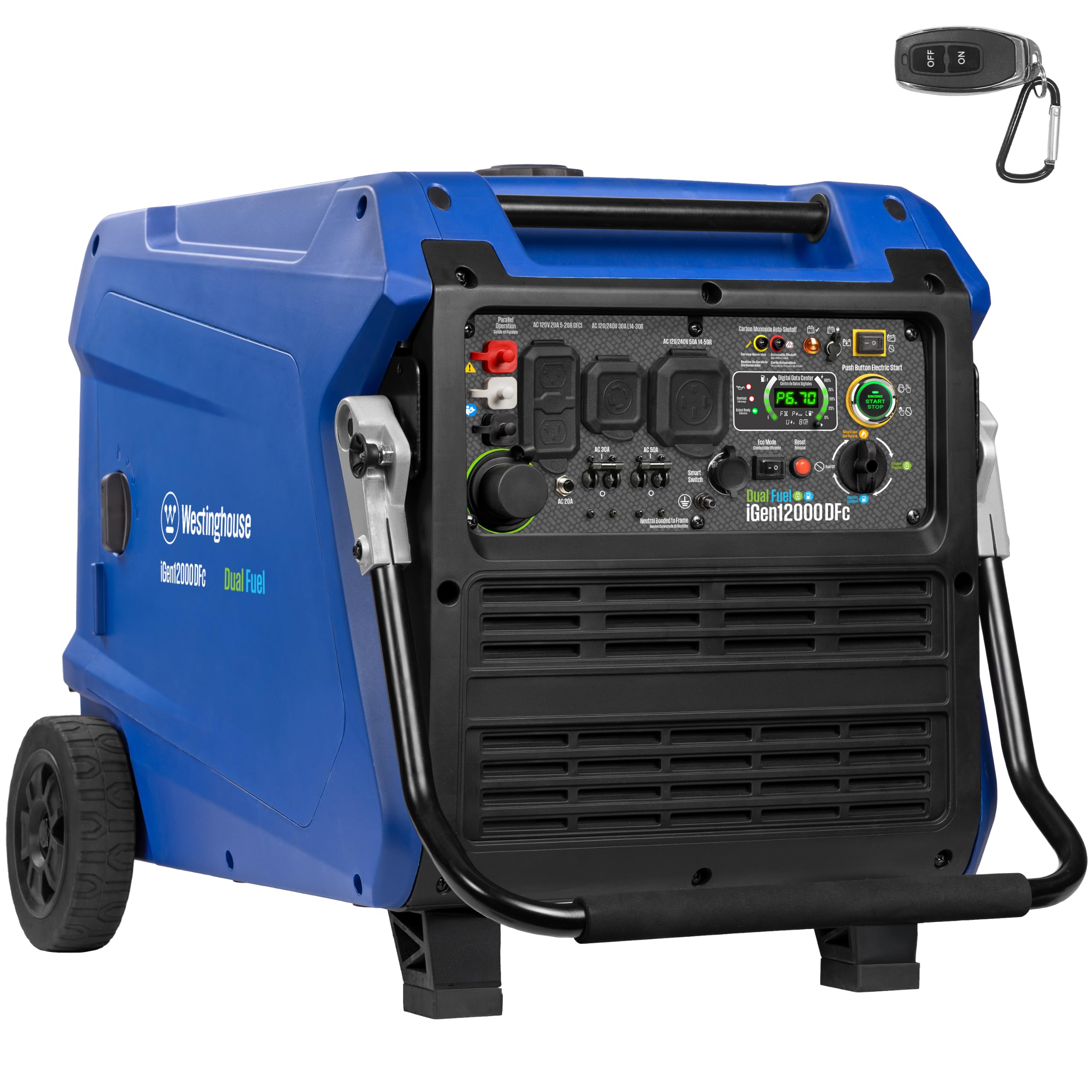
1. Westinghouse 12000 Peak Watt Dual Fuel Portable Inverter Generator
Our pick — over 4.5★ from 650+ verified ratings; the strongest balance of quality and price.
The whole-house powerhouse that sips fuel, starts from your couch, and keeps your electronics safe.
With 12,000W peak and 9,000W running on gasoline, it powered a full house including a heat pump and dryer without strain, according to owners. With 12,000W peak and 9,000W running on gasoline, it powered a full house including a heat pump and dryer without strain, according to owners. That’s nearly three times the peak output of the PowerSmart 4400-Watt inverter (12,000W vs 4,400W), making it a different class of machine entirely.
Its 64 dBA noise rating matches a normal conversation. A heavy-duty 457cc engine, Eco Mode, and insulation keep it down to as low as 64 dBA — the same rating as a normal conversation. Owners rave about the remote start key fob and the LED data center that shows fuel level, power output, and remaining run time in real time. And with a 7.9-gallon tank, it ran for 10 hours a day, 4 days a week for one owner without complaint.
The catch is the size. At 187.4 pounds, this is not a machine you toss in the back of a truck — it’s nearly three times the weight of the 68-pound PowerSmart. It’s also a serious investment. But buyers report it’s worth it: “Charges Tesla at 20-25 mi/hr via 14-50R” is how one owner sums up its versatility. It’s transfer switch ready and parallel capable, so you can double output if you ever need it.
Why Owners Love It
- Inverter tech keeps THD at or below 3%, safe for your laptop, TV, and phone
- 19 hours of runtime at 25% load on one 7.9-gallon tank
- Low oil shutdown and CO sensor for confidence
The Trade-Off
- 187.4 lbs means it lives on its wheels, not in your arms
- Included oil isn’t rated for below 23°F; needs 5W-30 synthetic after burn-in
Your pick if: you want whole-house backup that runs everything, quietly, and you don’t mind a permanent spot in the garage.
Look elsewhere if: you need something you can lift or move frequently — this is a 187-pound commitment.
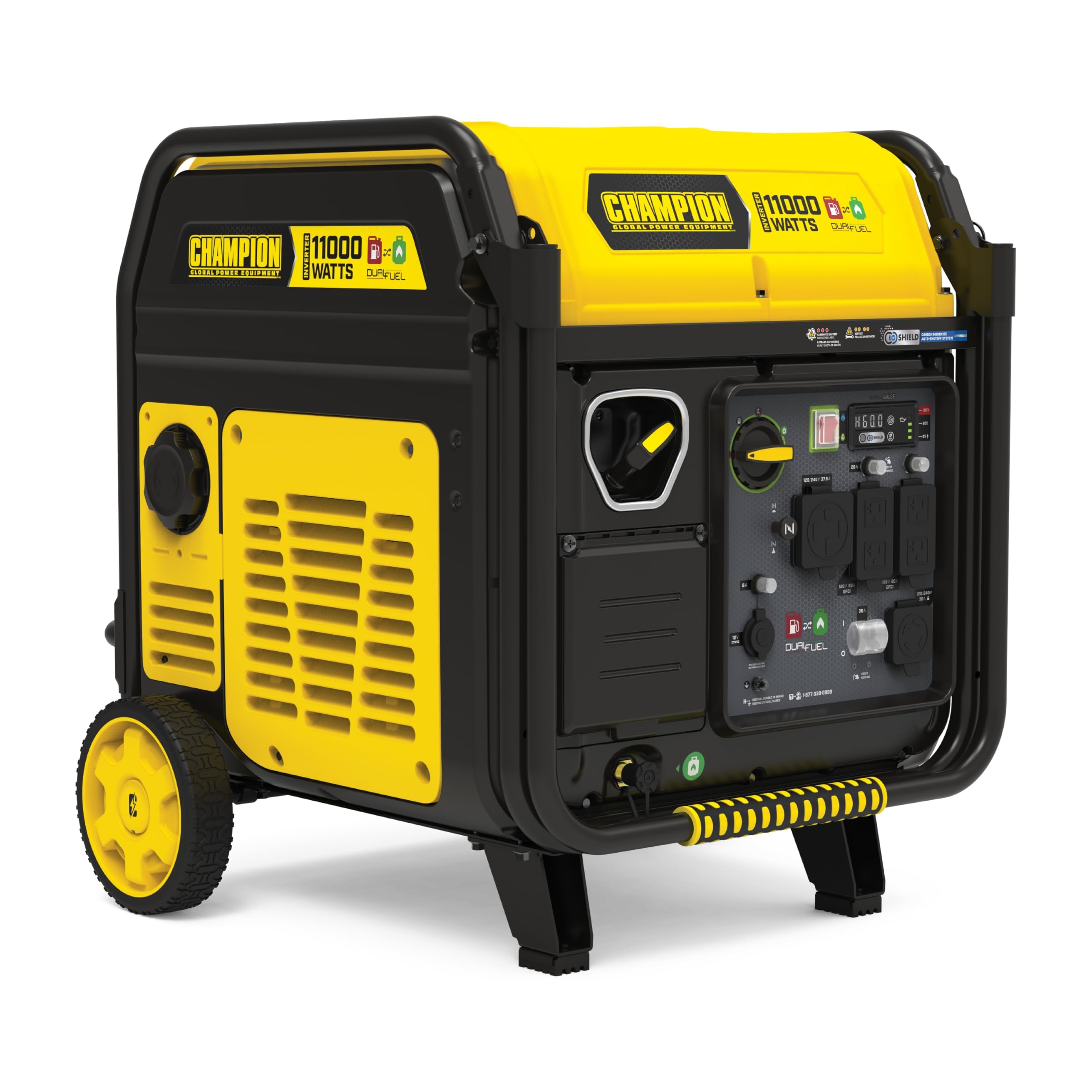
2. Champion Power Equipment 11,000-Watt Electric Start Dual Fuel Portable Inverter Generator
A 459cc titan that powers a whole house while staying quieter than your old contractor-grade clunker.
Champion’s biggest inverter plays in the same league as the Westinghouse but brings its own flavor. With 11,000 starting watts and 9,000 running watts on gasoline, it runs a full house — owners mention powering entire homes with no worry, including a 4-ton HVAC with a soft start. The 459cc engine includes Cold Start Technology, which is a genuine lifesaver when an ice storm kills the power at 20°F.
Owners upgrading from open-frame units report it’s “a lot quieter by far” at 64 dBA. Owners who upgraded from open-frame generators describe this as “a lot quieter by far,” and at 64 dBA from 23 feet, it’s at conversation level. The CO Shield auto shutoff and the 37.5A 240V outlet make it a serious home backup tool, not just a camping toy. And with a 3-year limited warranty plus free lifetime tech support, the safety net is real.
It’s heavy — 205.1 pounds — but the wheel kit makes it manageable on flat ground. The electric start with included battery means no pull-cord wrestling, and owners say it fires up easily on propane. Customers note running a full 6-hour propane break-in under 50% load with stable voltage and frequency, powering electronics, fridges, and freezers the whole time.
What Stands Out
- Cold Start Technology for reliable winter cranking
- 120/240V 37.5A outlet for serious whole-home loads
- Quiet 64 dBA with a sturdy 459cc engine
The Catch
- 205.1 lbs — plan a permanent spot or a very sturdy dolly
- No 50A breaker built in, so you’ll need one at the inlet
Ideal for: homeowners who want whole-house power on demand and value quiet, reliable starts in freezing weather.
Not for: anyone who needs to move their generator around regularly — this one stays put.
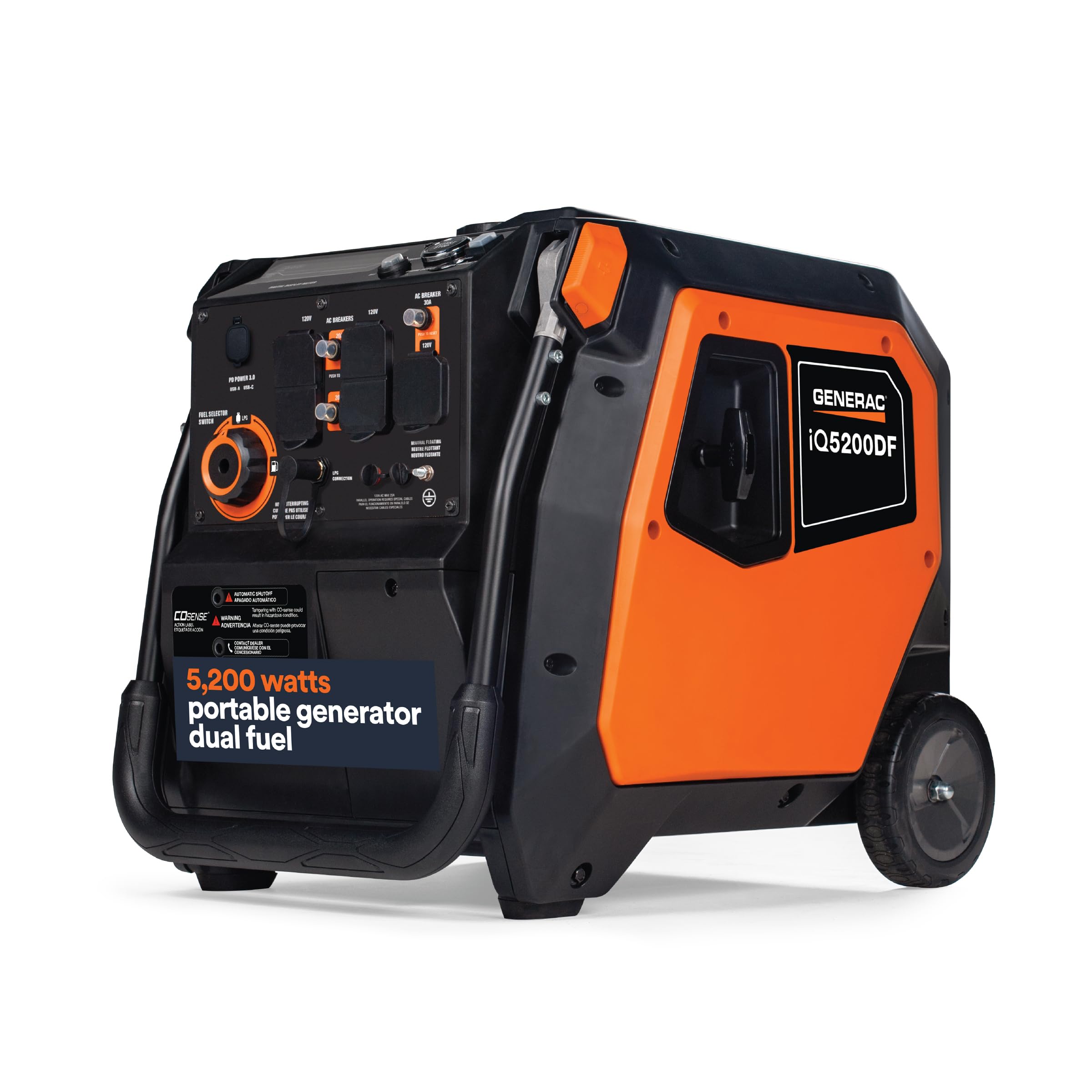
3. Generac 5,200 Watt Dual-Fuel Portable Inverter Generator
The trusted brand name that runs a 40-foot camper for 33 hours straight, then sits quietly at home.
Generac brings its home-standby reputation to a portable inverter that’s genuinely easy to live with. At 107 pounds with never-flat wheels and a folding handle, it’s manageable for one person to move — a far cry from the 205-pound Champion. Reviewers point out running a 40-foot camper without issue for 33 hours, which tells you the reliability story the brand is known for.
Economy Mode, push-button electric start, and COsense auto-shutdown set it apart. Economy Mode cuts fuel use and noise, and you get up to 9 hours on gas at 50% load, or 15 hours at 25% load. Push-button electric start with an included battery means no pull-cord struggle, and the COsense technology auto-shuts the unit down if dangerous CO builds up. The LED display shows real-time power output and fuel level.
On the fuel side, it runs on gasoline (3,900W running / 5,200W starting) or liquid propane (3,500W / 4,700W). The clean power — less than 3% THD — protects your laptops and phones. There’s even a USB-A and USB-C port for direct device charging, which is rare at this level.
The Best Bits
- Never-flat wheels and folding handle for easy transport
- Thin-profile design runs 33 hours on a 40-ft camper
- USB-A and USB-C ports for direct charging
Worth Knowing
- 107 lbs is still a workout for some users
- Handle can rattle on rough ground — a quick wedge fixes it
Best suited for: RV owners and homeowners who want a reliable, feature-rich inverter they can actually move.
Think twice if: you’re on a tight budget — this is a premium pick with a matching reputation.
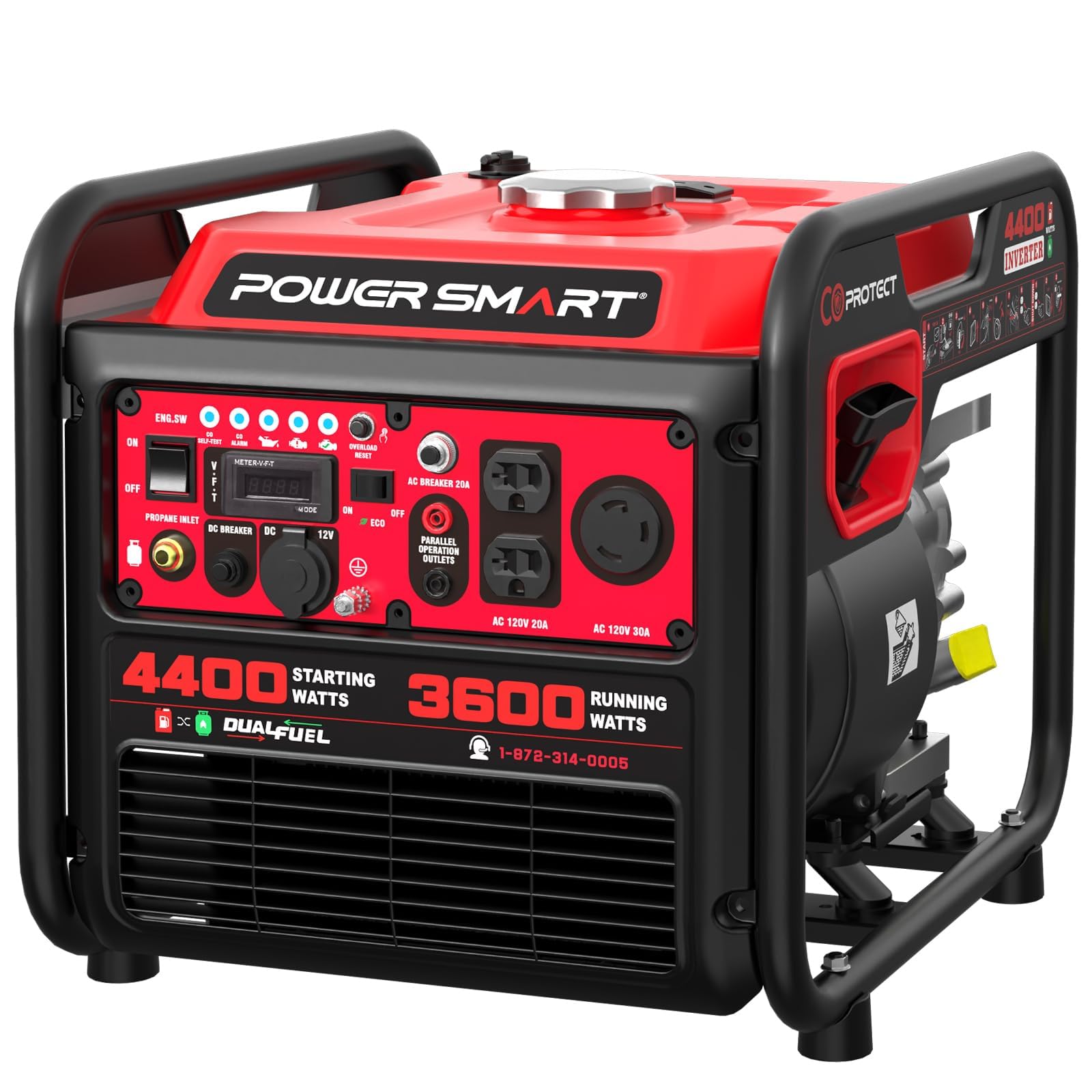
4. PowerSmart 4400-Watt Dual Fuel Portable Inverter Generator
A 61-pound featherweight that punches way above its weight and runs a 13.5 BTU AC at 7,000 feet.
At 61.29 pounds, it’s easy to lift into a truck bed and store in a corner. At just 61.29 pounds with a compact 19.3 x 16.9 x 16.5-inch footprint, it’s easy to lift into a truck bed and store in a corner. Shoppers say it runs a 13.5 BTU air conditioner effectively at 7,000 feet — impressive for something this light.
The dual fuel design gives you 4,400W starting and 3,600W rated on gas, or slightly less on propane. The 1.6-gallon tank delivers 11 hours of runtime at 25% load, which for the weight is remarkable. The EPA-compliant 223cc 4-stroke engine includes CO detection, low oil shutdown, and overload protection — the full safety suite.
Buyers report it “runs great on gas or propane” and handles power outages by running a freezer and two refrigerators. It’s also a favorite for camping trips, where the 76 dB noise level at 23 feet won’t disturb neighbors. One owner’s advice: use a dolly for transport, because at 61 pounds it’s liftable but not exactly easy over rough ground.
What Shines
- 61.3 lbs with a compact footprint — genuinely portable
- 11 hours of runtime on a 1.6-gallon tank
- Full safety suite with CO sensor and low oil shutdown
The Hiccups
- Choke works opposite of the sticker label — get used to it
- An occasional unit arrives with carburetor issues; test it early
Reach for this if: you want a genuinely portable inverter that runs an RV AC or a few home essentials without breaking your back.
Look elsewhere if: you need 240V output — this is a 120V-only machine.
5. PowerSmart 4400-Watt Dual Fuel Portable Generator with Inverter Technology
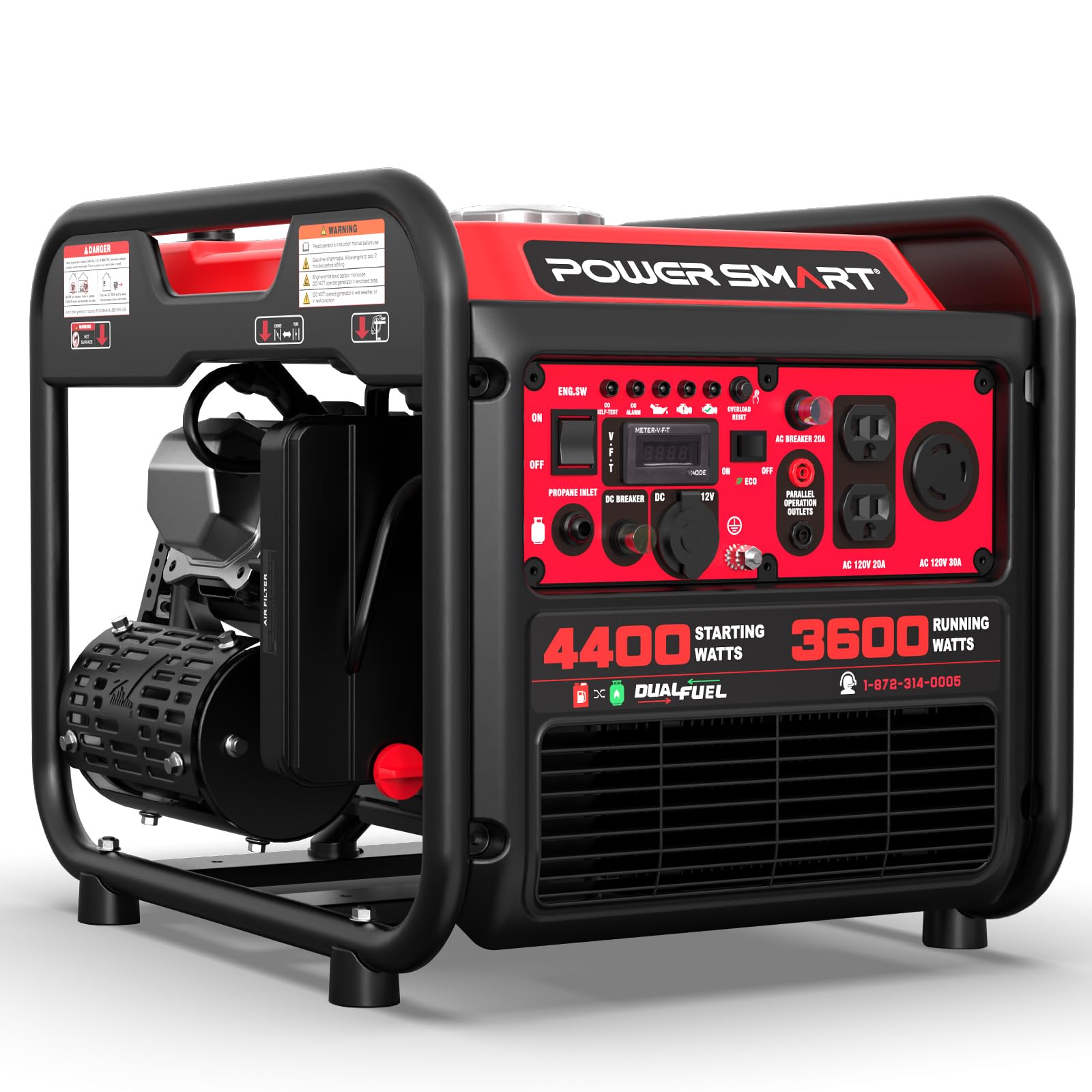
The storm-season hero that ran four straight days powering a fridge, TV, microwave, and heater.
When an ice storm is bearing down, this is the generator people grab. Owners mention it arrived days early, started on the third pull cold, and then ran 4+ days straight powering a fridge, TV, microwave, and heater. It delivers reliable starts and sustained power for multi-day outages at a budget-friendly price., and it does it at a budget-friendly price that undercuts the name brands.
The dual fuel design means you can run it on gasoline (4,400 surge watts, 3,600 rated watts) or propane (4,000 surge, 3,300 rated). The inverter tech keeps THD below 3%, so your smartphones, iPads, and computers are safe from dirty power. At 59 dBA from 23 feet at 25% load, it’s quiet enough for residential use.
You get three ways to plug in: a 12V DC outlet for small devices, two 120V 15A receptacles for standard tools, and a 120V 30A receptacle for heavier loads like an RV. The CO auto shutdown (a sensor that kills the engine if carbon monoxide builds up) and low oil shutdown (which stops the engine before oil runs dry) add real confidence. Owners note it’s louder at full load — 76 dBA — but for outages and jobsite work, that’s a fair trade for the price. It ships with a wrench and is pre-assembled, so you can start using it right away.
Owners Rave About
- Reliable starts — 1-2 pulls even after sitting
- Runs 5.5-6.5 hours per tank, 8 hours at light load
- Clean power under 3% THD for electronics
Minor Gripes
- Front cover must come off to check oil — owners leave it off
- All outlets are 120V; no 240V option here
Your pick if: you want maximum reliability per dollar for home backup and don’t need to move it far.
Not ideal if: you want a lightweight machine — this is a solid 68 pounds.
6. WEN 6800-Watt Dual Fuel RV-Ready Electric Start Portable Inverter Generator

The EV-owner’s backup plan that charges your car while it powers your shed, all on a 224cc engine.
This WEN is built for a specific crowd: electric vehicle owners who need a low-power Level 2 charging source during outages. The bonded-neutral 240V configuration provides that charging capability, and buyers confirm it works. It’s also a serious RV companion — customers note running both AC units on a 37-foot fifth wheel with lights and TVs on without breaking a sweat.
The numbers tell the story: 6,800 surge watts and 5,100 rated watts on gasoline, with a dual-fuel design that also runs on propane at 6,000 surge / 4,500 rated. The 224cc engine starts easily with electric start, and the CO Watchdog sensor shuts it down automatically if dangerous carbon monoxide levels are detected.
Portability is decent for the power class at 99.2 pounds, with onboard wheels and a telescoping pull handle. One owner ran a 40-pound propane tank for two full weekends at a cabin, noting it was “inaudible at 100 yards” in Eco Mode. The six-foot LPG regulator hose gives you flexibility in where you place the tank.
Why It Earns Its Place
- 240V output enables Level 2 EV charging
- Runs two RV AC units simultaneously with lights and TVs
- Tool-free LPG quick-connector for fast fuel switching
The Fine Print
- 120V outlets are inactive in 240V mode
- No battery trickle-charge connector to keep the start battery topped up
Best for: EV owners and large-RV users who need 240V power without buying a 200-pound beast.
skip it if: you never need 240V — the smaller, cheaper WEN covers 120V jobs fine.
7. AIVOLT 4300W Dual Fuel Inverter Generator
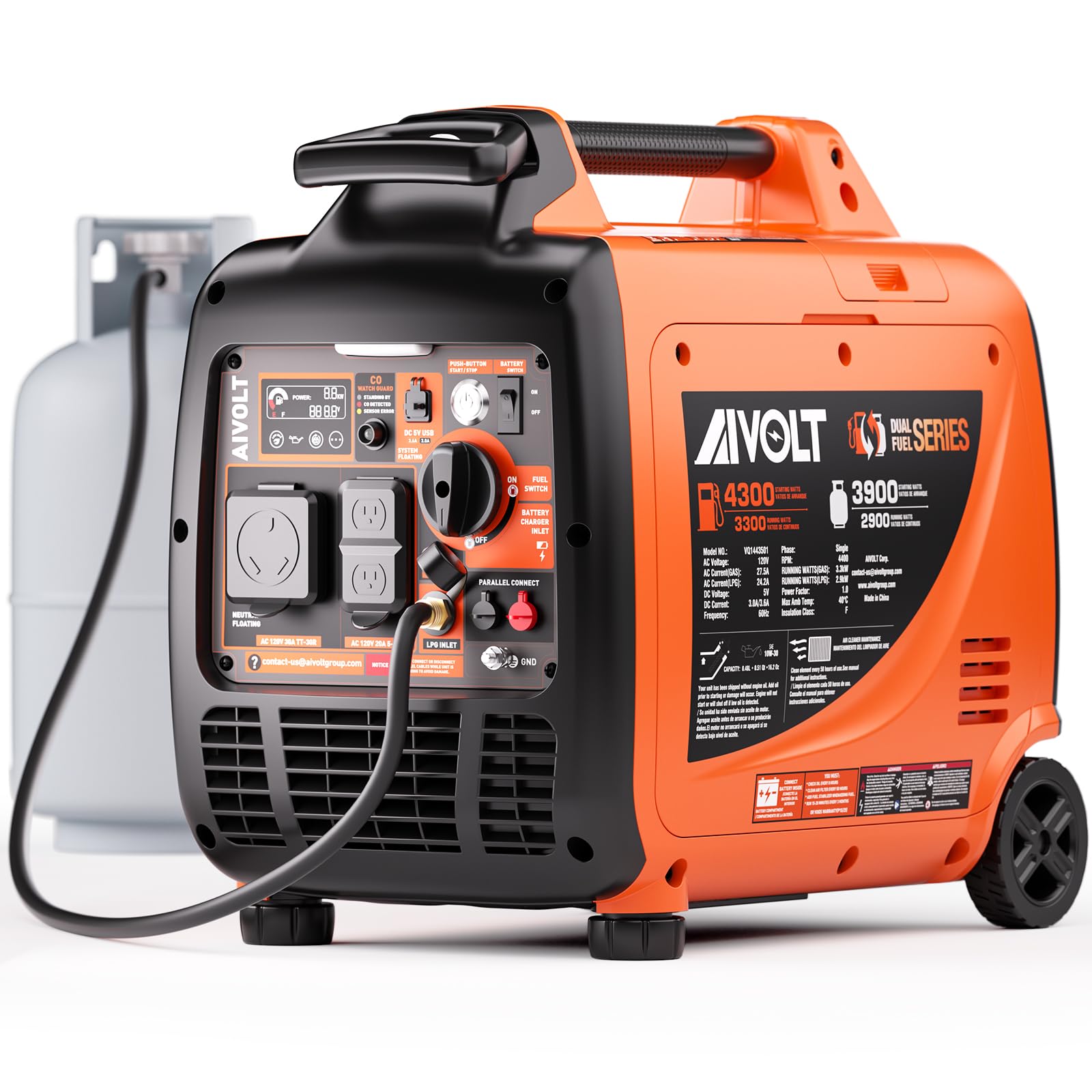
A 64-pound glider with a telescoping handle that whispers at 53 dBA and starts from your RV couch.
If quiet is your obsession, the AIVOLT is the loudest whisper in this lineup. At 53 dBA — lower than a normal conversation — it’s the quietest generator on this list, and owners confirm it runs a camper AC all night on propane without disturbing anyone. The remote start key fob means you fire it up from inside the RV.
The 64-pound weight with built-in wheels and telescoping handle makes it genuinely easy to move, which owners love for camping. The dual fuel flexibility is a highlight: 11.5 hours on gasoline and 34 hours on propane at 25% load. That 34-hour propane runtime is the best in this lineup and a real answer to fuel anxiety on extended trips.
It’s UL2201 and EPA certified with CO auto-shutoff and low oil protection. The 30A outlet powers air conditioners and microwaves with clean electricity. Reviewers point out it handles a 34-foot camper perfectly and powered a full food truck kitchen on 89 octane. The trade-off: some buyers found real-world noise higher than stated — 72-73 dB at 5 feet — so temper expectations on the whisper-quiet claim.
The Highlights
- 53 dBA rating — quietest on this list
- 34-hour propane runtime for long trips
- 64 lbs with wheels and telescoping handle
Be Realistic
- Owners measured 72-73 dB at 5 feet — quieter than most, but not silent
- A rare unit shuts down under heavy load; test your loads early
Pick this if: you camp or RV and want the quietest, lightest option with a 34-hour propane runway.
Pass if: you need to run heavy 240V loads — this is a 120V-focused machine.
8. Champion Power Equipment 4250-Watt Dual Fuel RV Ready Portable Open Frame Inverter Generator

The off-grid companion that powered Starlink, computers, and an AC for two flawless weeks.
Champion’s 4250-watt inverter has a loyal following among RV owners who need reliable, clean power without the premium price tag. The 224cc engine delivers 4,250 starting watts and 3,500 running watts, which proved enough for two straight weeks of off-grid RV living — running Starlink, a computer, a printer, and a small AC (though not all simultaneously).
The dual fuel design is a storage-friendly choice: propane avoids the fuel deterioration that plagues gasoline left in a tank. Shoppers say it starts reliably via the pre-loading recoil starter, and the large gas tank delivers up to 22 hours of runtime on gasoline. At 64 dBA with Quiet Technology, it’s great for tailgating and campgrounds.
It includes a propane hose, oil, and funnel from the start. It comes with a propane (LPG) hose worth real money, plus engine oil and a funnel. The parallel capability means you can connect two units with the optional ParaLINK kit for more power. One owner’s honest note: rated output is optimistic — treat it as a 3,000-watt machine for planning purposes, and it’ll never leave you stranded.
Standout Features
- Up to 22 hours runtime on gasoline
- Includes propane hose, oil, and funnel from the start
- Quiet 64 dBA with 224cc engine
Known Quirks
- 30A outlet doesn’t fully secure TT30 RV plugs
- Fuel gauge can stick — Champion replaces it free
Reach for it if: you want a trusted inverter for RV life that runs on both fuels and won’t break the bank.
Look elsewhere if: you need 240V output — this is strictly a 120V machine.
9. A-iPower 5000-Watt Remote Start Dual Fuel Portable Generator
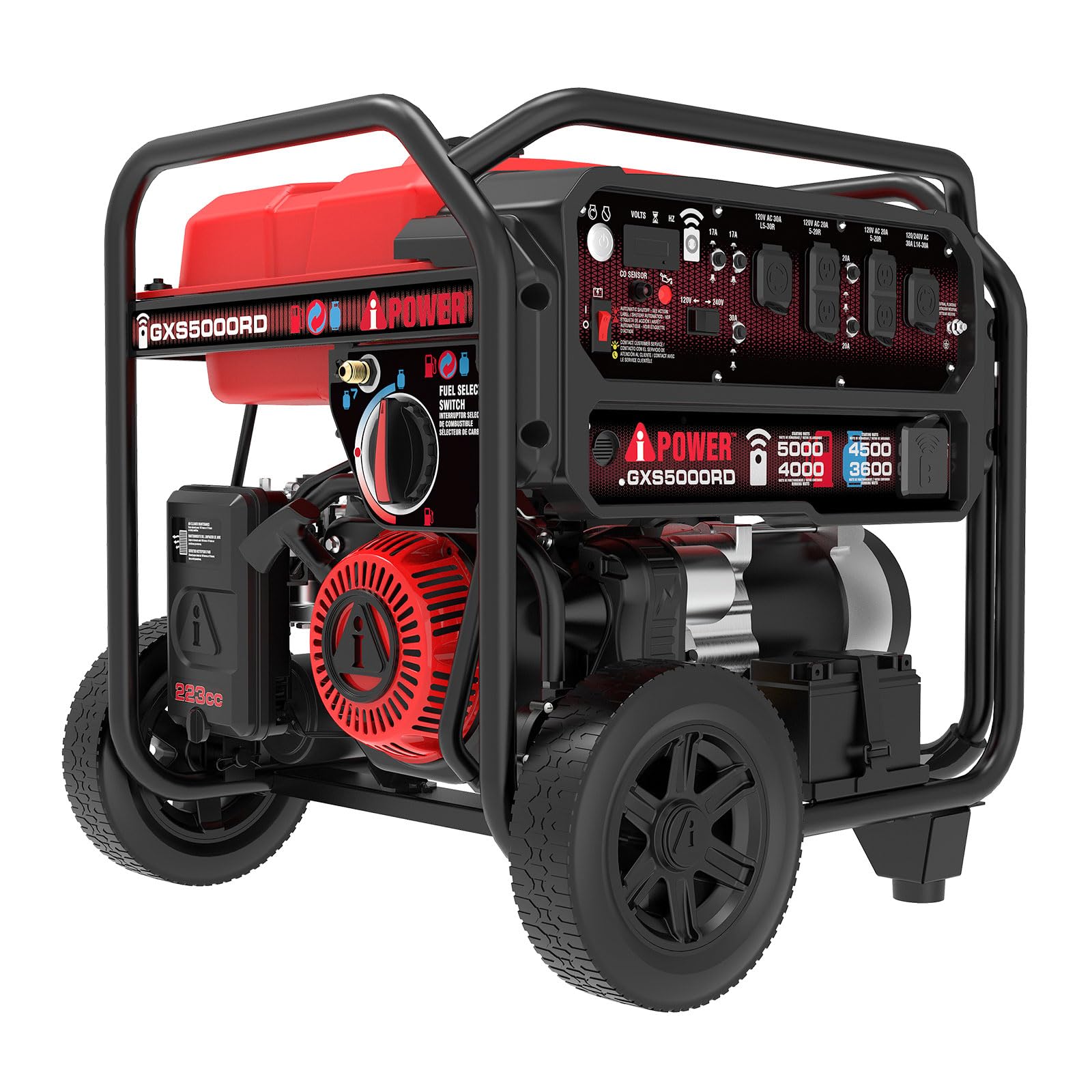
A hurricane-season veteran that ran 80 straight hours through Irma, powering a 12K BTU AC the whole way.
This A-iPower is built for people who treat generators as serious tools. The 223cc OHV engine with a cast-iron sleeve delivers 5,000 starting watts and 4,000 running watts on gas, which handled a 6kW load including a 3.5-ton AC and a 2HP pump without breaking a sweat. One owner ran it for 80 hours straight through Hurricane Irma.
Three starting options — remote fob, electric push button, and recoil pull — mean you’re never stuck without a way to crank it. The 6.3-gallon tank delivers up to 20 hours of runtime at 25% load on gasoline, or 18.5 hours on a standard 20-pound propane tank. The control panel includes a CO sensor indicator light, data center display, and remote fob storage.
Output options are extensive: two 5-20R duplex 20-amp 120V outlets, an L5-30R 30-amp 120V outlet, and an L14-30R 120/240V 30-amp twist lock. That 240V capability is a differentiator at this price point. Owners praise the clear manual and quick setup, with a nod to its automatic idle control that saves fuel when loads drop.
Why It’s Worth It
- 20-hour runtime on a 6.3-gallon gas tank
- All three starting methods: remote, button, and recoil
- 120/240V twist-lock outlet for flexible wiring
The Downside
- 124 lbs is heavy for frequent moving
- Frequency runs 4% high (62.5Hz), which can cycle some UPS units
Best for: homeowners and job sites that need 240V output and the convenience of remote start.
Think twice if: you’re sensitive to frequency drift on sensitive UPS gear — this runs a touch hot.
10. WEN Quiet and Lightweight 3600-Watt Dual Fuel RV-Ready Portable Inverter Generator

The 49-pound weekend warrior that’s “very quiet at 50% power or less” and runs a small RV with ease.
This is the generator you grab when portability is non-negotiable. At just 49 pounds, it’s the lightest dual fuel inverter on this list, and owners describe it as “easy to move around and lightweight considering the output.” It delivers 3,600 surge watts and 2,900 rated watts on gas while staying light enough to carry one-handed.
WEN’s dual-fuel design runs on gasoline or propane (3,500 surge / 2,600 rated), with a tool-free LPG quick-connector that makes fuel switching genuinely easy. The CO Watchdog sensor auto-shuts the unit down if dangerous carbon monoxide levels are detected. Buyers report it’s “quiet, reliable, and perfect for RV or emergencies,” powering a small RV without issue.
The panel shows volts, frequency, runtime, wattage percentage, and fuel gauge. It includes a TT-30R RV receptacle, two three-prong 120V outlets, a 12V DC receptacle, and dual 5V USB ports. One owner ran a 10,800 BTU AC on it, though they noted the runtime on a 20-pound propane tank was closer to 6 hours than the claimed 14 — worth knowing for trip planning.
Why It Wins Fans
- 49 lbs — easiest to lift and store in this class
- Three-year warranty included
- Clean inverter power for laptops and phones
Small Frustrations
- 20A outlets hold plugs loosely
- Propane runtime is shorter than the optimistic claim
Pick it for: small RVs, tailgating, and emergency phone-and-fridge backup where weight rules everything.
Pass if: you need to run big loads — this is a light-duty machine by design.
11. Westinghouse 4000 Peak Watt Super Quiet Dual Fuel Portable Inverter Generator
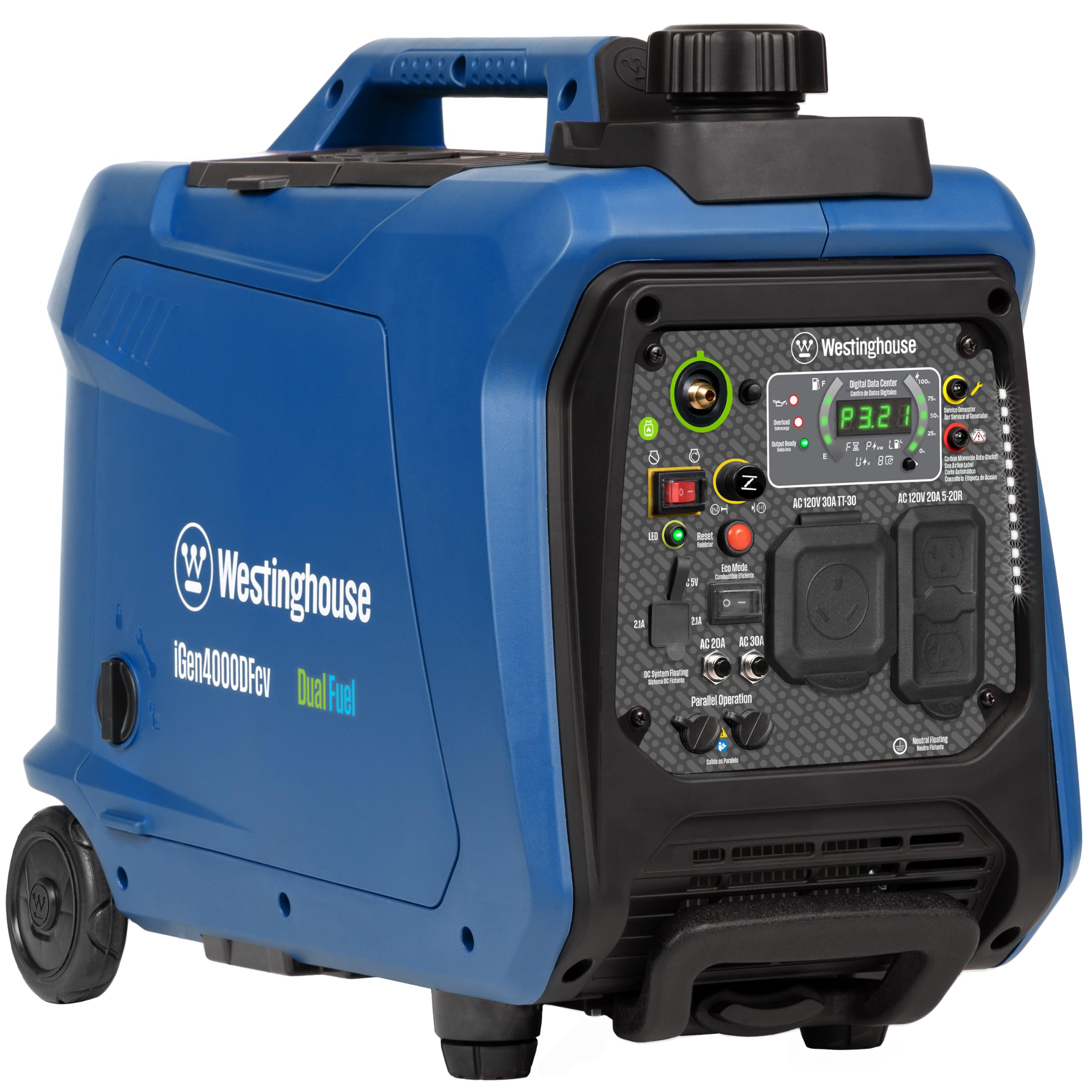
Westinghouse’s 52 dBA whisper that starts on the first pull and shows more info than generators twice its size.
Westinghouse packed its signature quality into a compact 59-pound frame with a defining spec: 52 dBA noise output — the quietest rating in the entire lineup, beating even the AIVOLT. Owners confirm it’s “much quieter than my Generac” and one described it as “most feature-rich of 20 gens owned.” That’s a strong statement.
The 4,000 peak watt / 3,300 rated watt output comes from a 4-stroke engine with recoil start. The 1.69-gallon tank delivers up to 7 hours of runtime with Economy Mode engaged. The LED data center rotates through fuel level, power output, remaining run time, voltage, and lifetime hours — genuinely useful info at a glance.
Owners love the thoughtful details: a threaded oil funnel, toe-push telescoping handle, rubberized top, and a spill-cup gas cap. One owner bought it to avoid gasoline entirely, running it on a grill tank that lasts about a day, which sidesteps carburetor degradation. It’s RV-ready with a TT-30R 30-amp outlet, two USB ports, and a duplex household outlet.
The Standouts
- 52 dBA — genuinely conversation-level quiet
- Starts first pull on propane, per owners
- Telescoping handle and wheels make 59 lbs easy
To Know
- Included regulator felt restrictive to one owner — warranty covered a swap
- 7-hour runtime is shorter than larger-tank rivals
Ideal for: RV travelers and homeowners who want the quietest possible 4,000-watt option with premium build quality.
Not for: long-duration outages where 7-hour maximum runtime means more refuels.
Understanding the Specs
Peak vs. Running Watts
Peak (or surge) watts is the brief burst of power needed to start a motor, like a refrigerator compressor or AC. Running (or rated) watts is what the generator sustains continuously. Shop with both numbers: your generator’s peak must cover your largest starting spike on top of everything else running.
THD and Inverter Generators
Total Harmonic Distortion (THD) measures how “dirty” the power is. Sensitive electronics like laptops and phones need clean power (under 3% THD), which is why inverter generators matter. Open-frame units often exceed 5% THD, which can slowly damage electronics over time.
FAQ
Can I run a dual fuel generator on gasoline and propane at the same time?
Which fuel gives me more power, gasoline or propane?
How long does a 20-pound propane tank last on a generator?
Is a dual fuel inverter generator safe for my laptop and TV?
What does the CO sensor on a generator actually do?
Can I connect a dual fuel generator to my house’s electrical panel?
How much does weight matter when choosing a portable generator?
What is the difference between a standard generator and an inverter generator?Inverter generators produce cleaner power with lower THD, run quieter by adjusting engine speed to load, and are typically lighter and more fuel-efficient than open-frame units. Standard open-frame generators are simpler and often cheaper, but they are louder and produce dirtier power that can damage sensitive electronics over time.?
What is a bonded neutral and why does it matter for home backup?
Final Thoughts: The Verdict
For most buyers, the best dual fuel generator is the Westinghouse 12000 because it delivers whole-home power with 12,000W peak, 19-hour runtime on a 7.9-gallon tank, and remarkably quiet 64 dBA operation, making it the most complete package for serious backup needs. If you want EV charging capability alongside RV power, grab the WEN DF680iX for its 240V output and Level 2 charging support. And for the best balance of portability and quiet in a compact frame, the Westinghouse 4000 at 59 pounds with 52 dBA noise is the one to reach for — especially if you plan to move it regularly or take it camping.
How We Picked
We do not accept paid placement. Every pick is matched to a real buyer and a real use-case; we do not hands-on test units.
Sources & Methodology
Specifications: manufacturer listings and product documentation. Review insights: verified customer reviews, as of August 2026. Pricing: not shown on this page (it changes often); check the current price via the retailer link.
As an Amazon Associate, WellFizz earns from qualifying purchases. This does not affect which products we feature.
Related Guides

Mo Maruf
I created WellFizz to bridge the gap between vague wellness advice and actionable solutions. My mission is simple: to decode the research and give you practical tools you can actually use.
Beyond the data, I am a passionate traveler. I believe that stepping away from the screen to explore new environments is essential for mental clarity and physical vitality.