Our readers keep the lights on and my smoothie glass nicely filled. As an Amazon Associate, I earn from qualifying purchases.
Specs are compiled from manufacturer listings and verified buyer reviews and can change over time — please confirm the key details on the product page before buying.
The real question about a dual dash cam is whether the footage will hold up when you need it most. A grainy plate at night or a dropped frame during a hit-and-run defeats the whole purpose. This guide compares resolution, low-light sensors, and parking mode reliability to find the best model for your windshield.
I’m Mohammad Maruf — the founder and writer behind WellFizz. This guide is built by comparing the manufacturers’ published specifications and the patterns across verified customer reviews, so you get each pick’s real strengths and trade-offs instead of marketing spin.
The list ahead sorts through the confusion to pinpoint the best dual dash cam for your car, from budget-friendly 2K options to premium Sony-sensor systems that capture crisp plates even in pitch-black conditions.
Our Picks at a Glance

How To Choose The Best Dual Dash Cam
Picking a dual dash cam means balancing front and rear resolution, night vision, storage safety, and app usability.
Front and Rear Resolution Balance
A front camera that shoots 4K is common now, but many cheap systems pair it with a fuzzy 1080p rear camera that can’t read a plate. Look for at least 2K on the rear channel if you want usable evidence from behind. The top-tier models push the rear to 4K or 2.5K, keeping both angles equally sharp for insurance-grade footage.
Sensor Quality for Night Driving
The lens aperture (F1.6 or F1.8) and sensor type determine night vision quality. Sony STARVIS sensors are the gold standard here — they dramatically boost light sensitivity without washing out detail. A dash cam with a STARVIS sensor can capture a license plate in near-total darkness, while a generic sensor often produces a blurry mess.
Storage Safety and Parking Mode
Loop recording is standard, but smart systems lock footage when a G-sensor detects a bump. Some models add a second layer of protection by storing critical clips on internal memory (eMMC) if the SD card fails. Parking mode requires a hardwire kit; look for time-lapse or impact-triggered options for surveillance when you’re away.
Quick Comparison
| Model | Best For | Front Resolution | Rear Resolution | Night Sensor | Amazon |
|---|---|---|---|---|---|
| FAIMEE F6★ Best Overall | Best Overall Value | 4K (3840x2160P) | 2K (2304x1296P) | WDR + Night Vision | Amazon |
| WANLIPO A13Budget Champion | Tight Budget Pick | 4K (3840x2160P) | 2.5K | WDR + Night Vision | Amazon |
| Coolcrazy N8Smooth Motion | High-Frame Rate Clarity | 4K UHD | 1080P | STARVIS + WDR | Amazon |
| IIWEY 4K+4K | True 4K Rear Coverage | 2560×1440 | 4K 2160P | STARVIS + HDR | Amazon |
| Pelsee P1 Pro | Smart Driving Assists | 4K HDR | 1080P WDR | STARVIS 2 + AI | Amazon |
| DDPAI Z60 | Dual Storage Safety | 4K | 1080P | AI ISP Night Vision 2.0 | Amazon |
| WOLFBOX G840S | Mirror Replacement | 4K UHD (2160P) | 1080P | WDR + HDR | Amazon |
| WOLFBOX G850 PRO | ADAS and Blind Spot | 4K 2160P | 1080P | WDR + HDR | Amazon |
| ROVE R2-4K Dual PRO | Peak Night Clarity | 4K (3840x2160P) | 2K (2560x1440P) | Dual STARVIS 2 IMX678 + IMX675 | Amazon |
In‑Depth Reviews
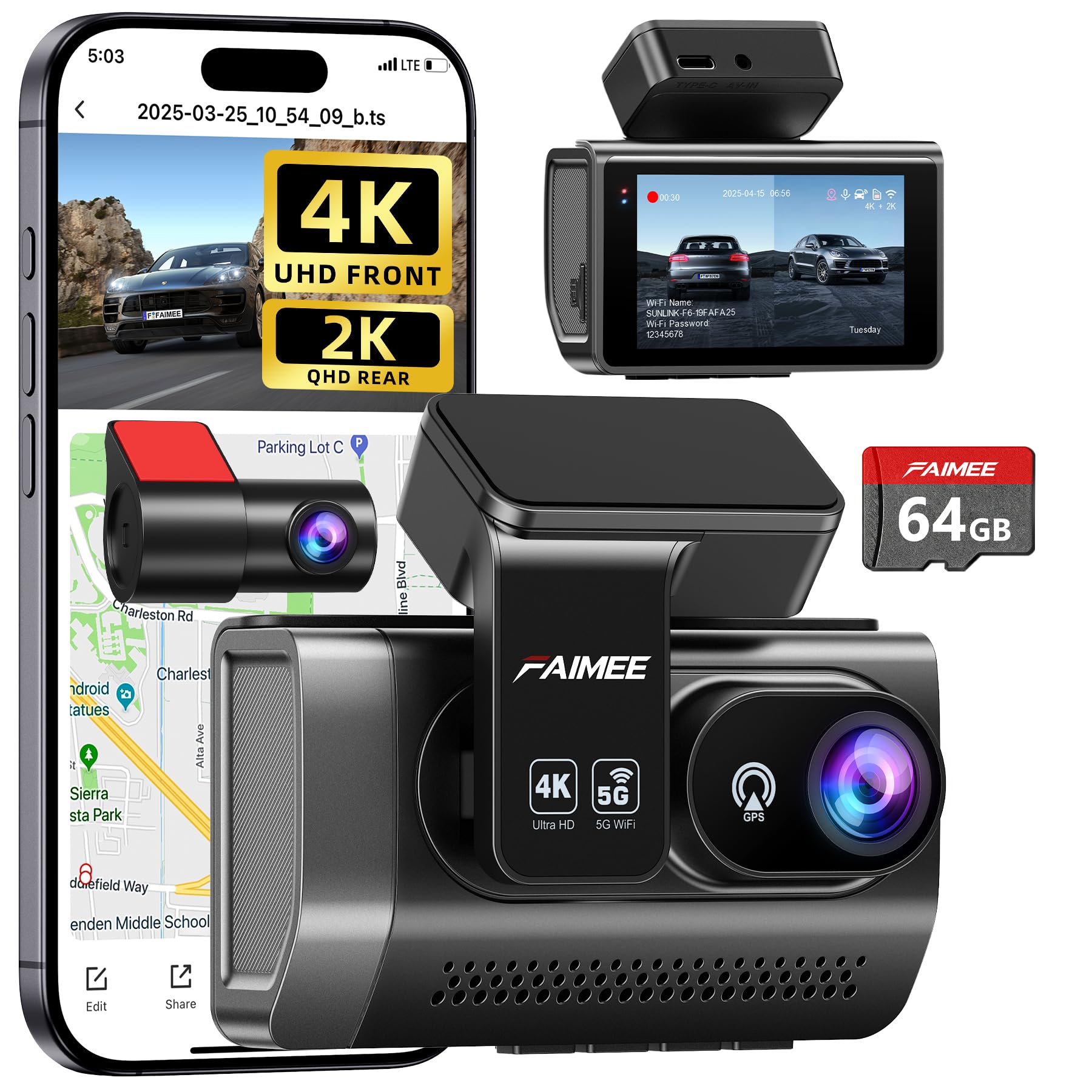
1. FAIMEE F6 4K Dash Cam Front and Rear
Our pick — 4.5★ from 850+ verified ratings; the strongest balance of quality and price.
The balanced performer delivers 4K front, sharp 2K rear, and a 64GB card in the box.
The first thing you notice is the 170-degree front lens that covers up to six lanes of traffic, so blind spots are genuinely minimized. The rear camera shoots at 2K (2304x1296P), which is a step up from the typical 1080P rear that leaves plates unreadable. This matters because the strongest evidence often comes from the rear channel in a rear-end collision. Buyers report that “the video quality is excellent, with clear and sharp footage both day and night,” and that installation is truly plug-and-play.
Unlike the WANLIPO A13 which has drawn complaints about a mandatory paid app membership, the FAIMEE app requires no subscription for standard recording, live view, or clip downloads. The built-in dual-band WiFi (5.8GHz/2.4GHz) keeps connection stable, and the GPS logs your speed and route in the footage. Owners also note “no battery issues in 3 days” — a quiet nod to the capacitor-based design that avoids the swollen-battery problems older dash cams suffered.
The trade-off surfaces in parking mode: you do need a hardwire kit (not included) to activate 24-hour time-lapse surveillance, and the 3-inch IPS screen is modest compared to the 12-inch mirror units. But for a system that asks almost nothing of you day one and delivers consistently sharp dual-channel footage, this is the one most drivers should start with.
Clear 4K footage
- True 4K front + 2K rear — the rear channel is noticeably sharper than most budget dual cams
- Comes with a 64GB high-endurance memory card, so no separate purchase needed
- Dual-band WiFi (5.8GHz/2.4GHz) for fast app connection and downloads
- 18-month warranty with responsive support, something cheaper brands often skip
Night mode glitch
- Hardwire kit for parking mode sold separately
- The 3-inch screen feels small compared to rearview-mirror dash cams
Your best bet if: you want a no-surprises dual cam that records crisp 4K front and 2K rear from the start with no app subscription trap.
Think twice if: you need a giant screen for real-time viewing, or you want parking mode without buying extra wiring.
2. WANLIPO A13 Dash Cam Front and Rear
Aggressive pricing with 4K front and 2.5K rear — but the app experience brings a big asterisk.
The headline spec is hard to argue with: a 4K front camera (3840x2160P) paired with a 2.5K rear, a 170-degree front lens that cuts blind spots, and a 120-degree rear view. The package includes a 64GB SD card and a 2.0-inch IPS screen. For the price, this is one of the highest-resolution rear channels you can get. What owners praise most is the camera quality — 39 reviewers call it out, and many describe setup as straightforward, with one noting it works great on a new Bronco Raptor.
The catch, and it is a real one, is the app. A frustrated buyer reports: “U need to buy a membership for a year to make it work on your phone.” The Viidure app does offer free video viewing and downloading, but certain features — video speed adjustment, cloud uploads, and timeline viewing — are locked behind that annual fee. The suction mount also draws mixed feedback, with some finding it less secure than adhesive mounts. On the positive side, the G-sensor triggers reliably on impact, locking footage automatically so critical clips survive loop recording. The parking mode works by detecting vibration when the car is off and saving a 15-second emergency clip.
If you are comfortable managing clips via the camera’s own screen and never touching the cloud features, the hardware itself is excellent for the money. Just know the full app convenience costs extra.
Wide angle view
- Very sharp 4K front + 2.5K rear — one of the best rear resolutions at this tier
- G-sensor locks footage on impact, preventing overwrites
- Parking mode activates on vibration without a hardwire kit (limited)
Battery drains fast
- App requires a ~ annual membership for full cloud and editing features
- Suction mount quality draws mixed feedback from owners
Reach for it if: you are on a tight budget and want top-tier resolution on both channels, and you are fine using the camera screen for daily tasks.
Pass if: you rely heavily on a phone app for reviewing and sharing clips without added subscription costs.
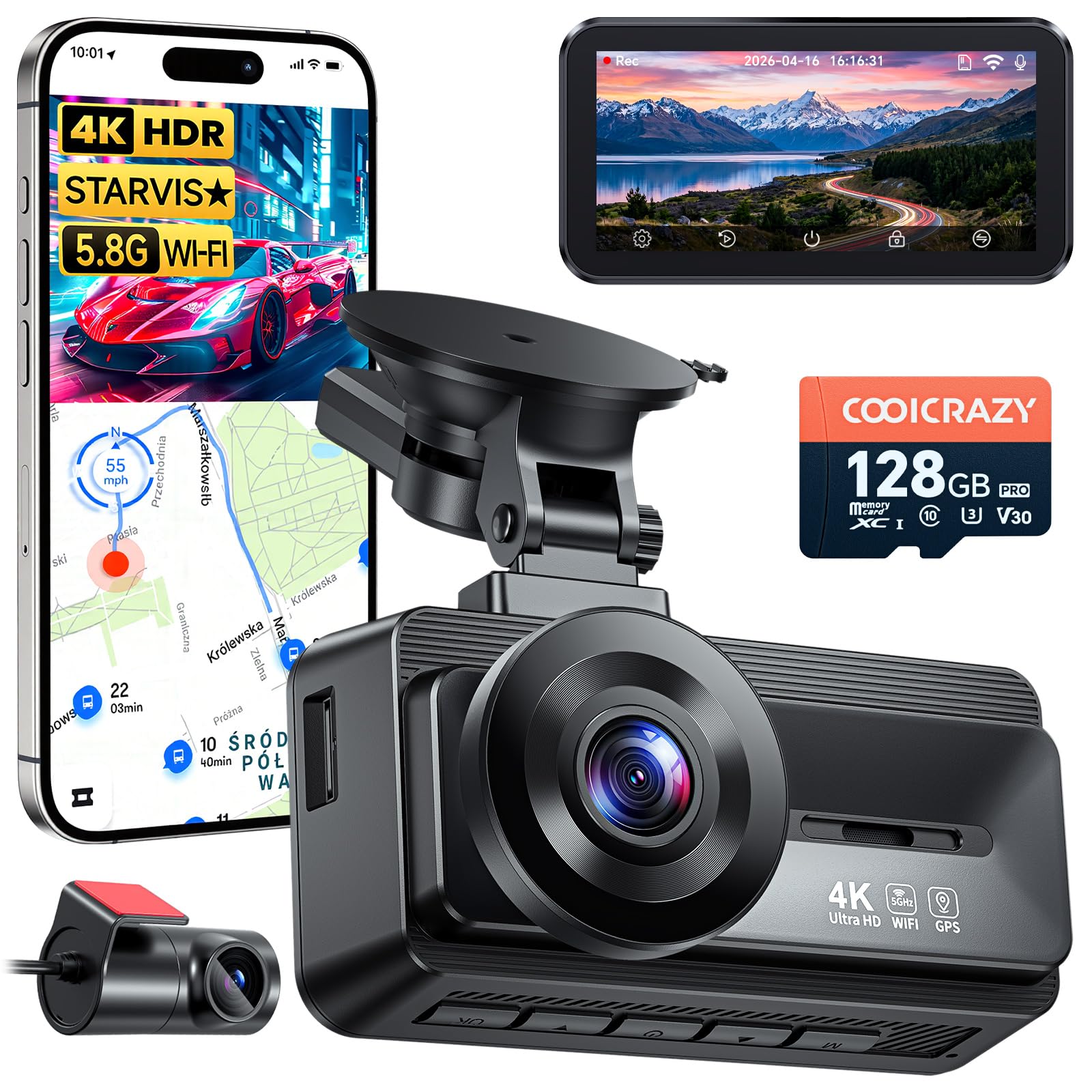
3. Coolcrazy N8 4K Dash Cam Front and Rear
The frame-rate king that shoots 4K at 60fps, catching sharp plates even at highway speed.
Most dual dash cams record at 30 frames per second, which is fine for city streets but can blur plates when you are going 65 mph. The Coolcrazy N8 shoots front footage at 60fps, giving you cleaner freeze-frames. Its rear camera uses a STARVIS sensor with a 150-degree wide angle, and the front lens covers 170 degrees — so both ends see around corners. Owners consistently call the 4K video clarity “excellent day and night,” and the preinstalled 128GB memory card is a generous step up from the 64GB cards most rivals bundle.
The 5GHz WiFi hotspot actually works well, according to buyers, making phone connection and clip downloads smooth. GPS tracking is embedded in the footage, logging speed and route. The 24-hour parking mode triggers on impact or motion, though it requires a hardwire kit (not included). A few owners mention the mobile app could be “more responsive” and that the printed setup instructions are unclear, but the overall value rating is very high. Unlike the WANLIPO A13, there is no paid membership trap here — the app is free for standard functions.
If capturing a clean plate at highway speeds is your priority, the extra frames per second on the N8 give you a distinct edge over the 30fps competition, including the FAIMEE F6. The 60fps front recording makes this the one to pick for frequent highway drivers.
Get this for: highway commuting where every frame counts — the 60fps front capture is class-leading at this price and keeps plates readable at speed.
Skip if: you prefer a polished app experience over raw frame-rate performance, or you want a rear camera above 1080P resolution.
4. IIWEY 4K+4K Dash Cam Front and Rear
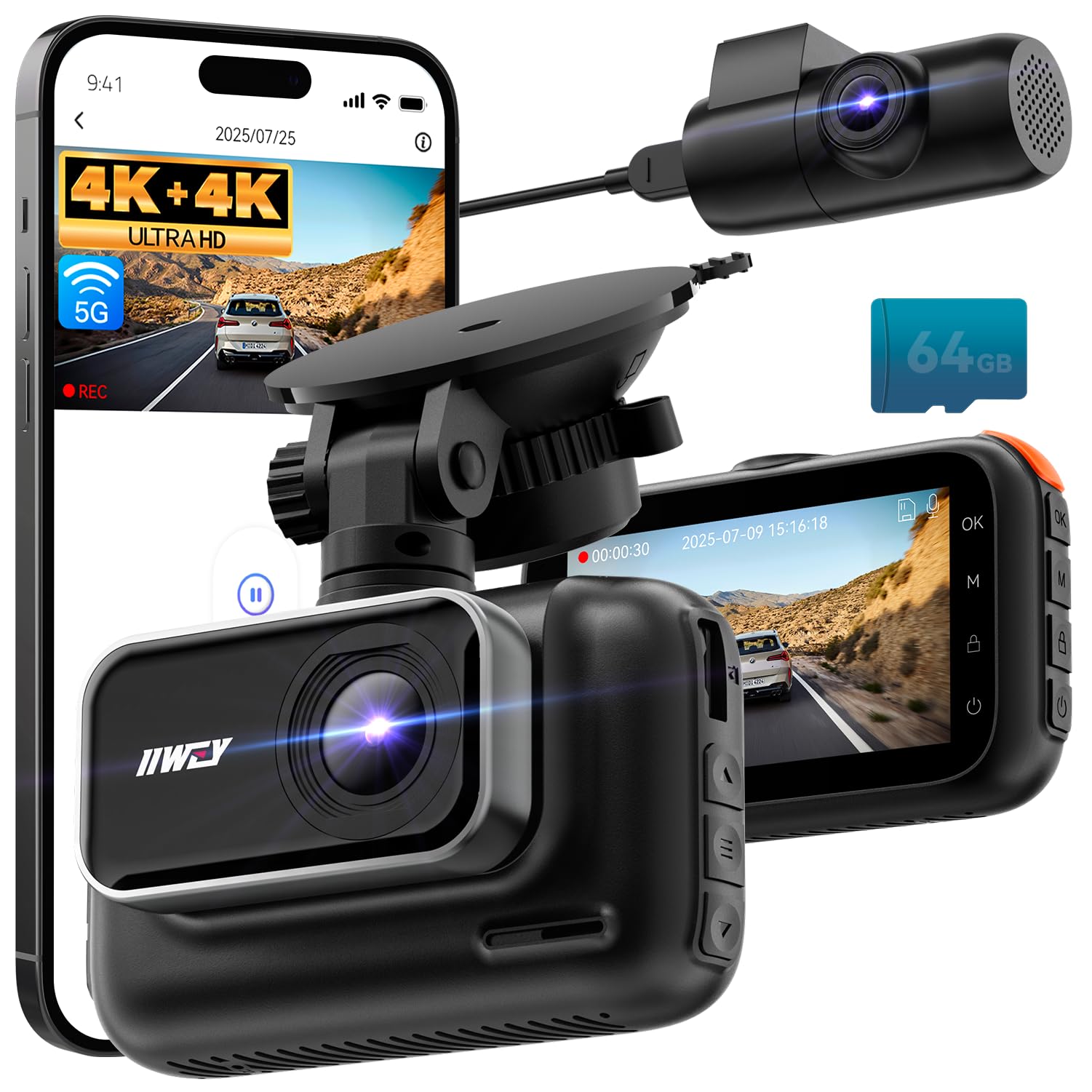
Both front and rear shoot true 4K — no resolution compromise on either channel.
Nearly every dual cam advertises “4K,” but the rear camera almost always drops to 1080P or 2K. The IIWEY bucks that trend by recording real 4K (2160P) on both lenses simultaneously, using STARVIS sensors with f/1.6 apertures for strong low-light performance. This means a car passing you on the right is captured in the same detail as one in front — crucial for side-swipe and merging incidents. Owners confirm the video quality is excellent, with one buyer noting the “wide-angle lens captures everything around them.”
The 5.8GHz WiFi delivers downloads up to 10 MB/s, so reviewing clips on the IIWEY app feels snappy. Dual-channel HDR balances highlights and shadows, making tunnels and direct sun more manageable. The 18-month warranty is competitive. The catch is reliability: the customers-say summary flags mixed feedback on reliability, with some units stopping work after a week or randomly turning off. Seven mentions of reliability appear in the feedback, and it is the only product in this list where reliability carries that warning. For daily drivers who need absolute dependability, the FAIMEE or ROVE options are safer bets.
If your insurance case hinges on rear detail — like a parking-lot backup collision — the IIWEY’s true 4K rear gives you the sharpest evidence available at this price level. Just check the unit promptly after delivery.
Perfect if: your top priority is equal 4K resolution on both front and rear channels for maximum rear detail.
Be cautious if: long-term reliability is non-negotiable — some owners have reported units failing early, so test yours right away.
5. Pelsee P1 Pro 4K Dash Cam Front and Rear
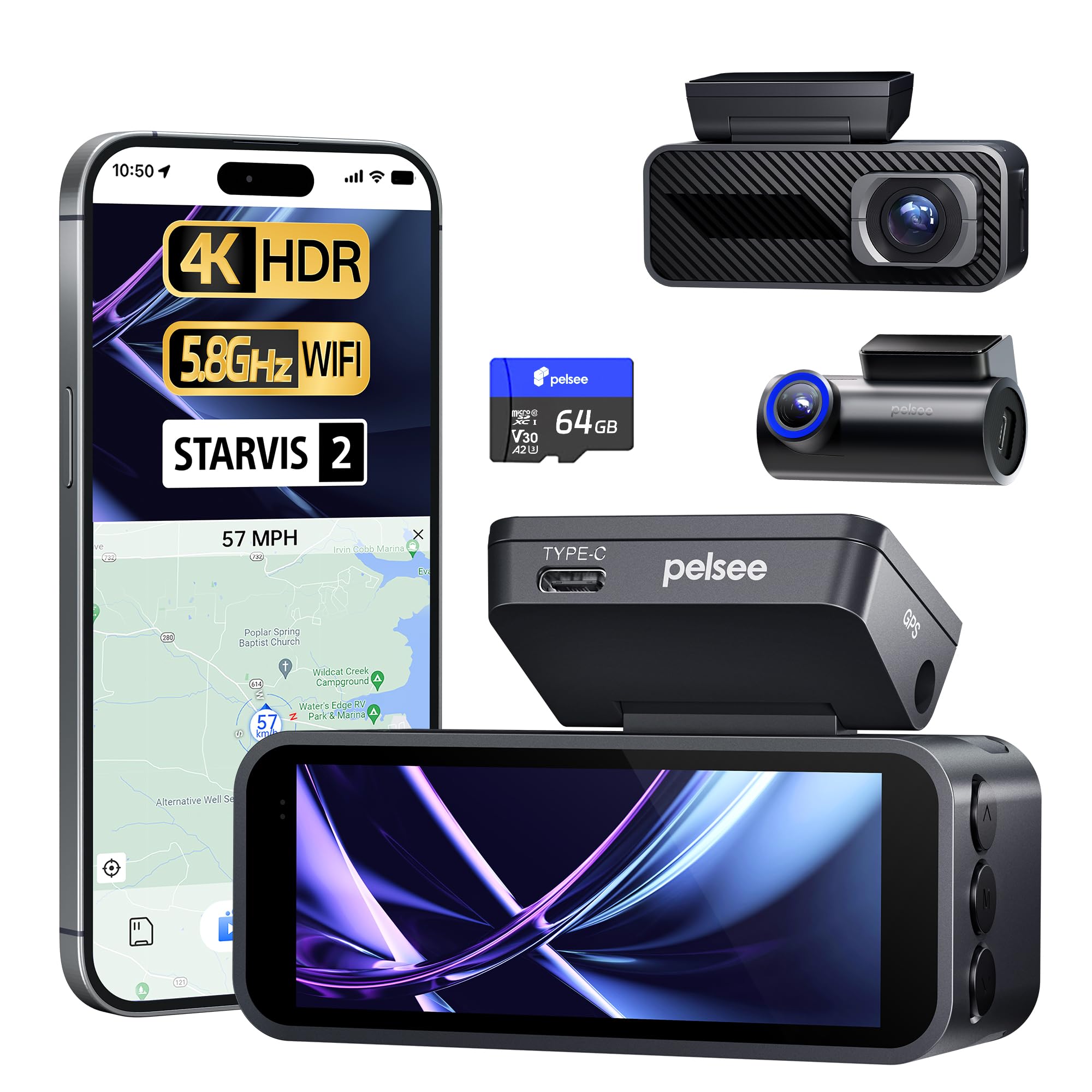
The co-pilot that talks back — voice commands and ADAS warnings keep your eyes on the road.
This is the only dual cam on the list that includes a full Advanced Driver Assistance System (ADAS) with audio alerts for forward collision, pedestrian collision, lane departure, and front vehicle start. Eight voice commands, including “Lock the video!” and “Take a photo,” let you control recording without touching the screen. The STARVIS 2 sensor from Sony delivers four times greater low-light sensitivity than conventional sensors, delivering “full color night vision in starlight,” as the marketing puts it — and owners agree the night clarity is excellent.
The front camera uses 4K HDR to slice through headlight glare and direct sun, while the rear 1080P WDR balances fog and tunnel exposures. The 3.39-inch HD IPS screen is the largest among the traditional windshield cams here, making menu navigation and live preview easier. The built-in 5.8GHz WiFi connects to the Pelsee Cam app for quick downloads, and GPS stamps speed and coordinates onto the footage. A 64GB card is included, expandable up to 512GB. One owner in Nicaragua reported it “works really well” with an intuitive app. The ADAS warnings are described as “helpful, not intrusive,” which is a fine line most driving-assist systems fail to walk.
The biggest limitation is the rear resolution: at 1080P, it is noticeably softer than the 2K rear on the FAIMEE or the ROVE R2-4K. Also, the power cable is very long for trucks, and some owners found the lighter adapter needed wiggling to restart. Still, for a driver who wants active safety nudges and hands-free control in a single unit, the P1 Pro is uniquely capable.
Choose this for: the voice commands and ADAS safety alerts — no other dual cam in this range offers proactive collision and lane-departure warnings.
Consider alternatives if: rear detail matters most to you, the 1080P rear is a clear step down from the 2K rear found on the FAIMEE or ROVE.
6. DDPAI Z60 4K Dash Cam Front and Rear
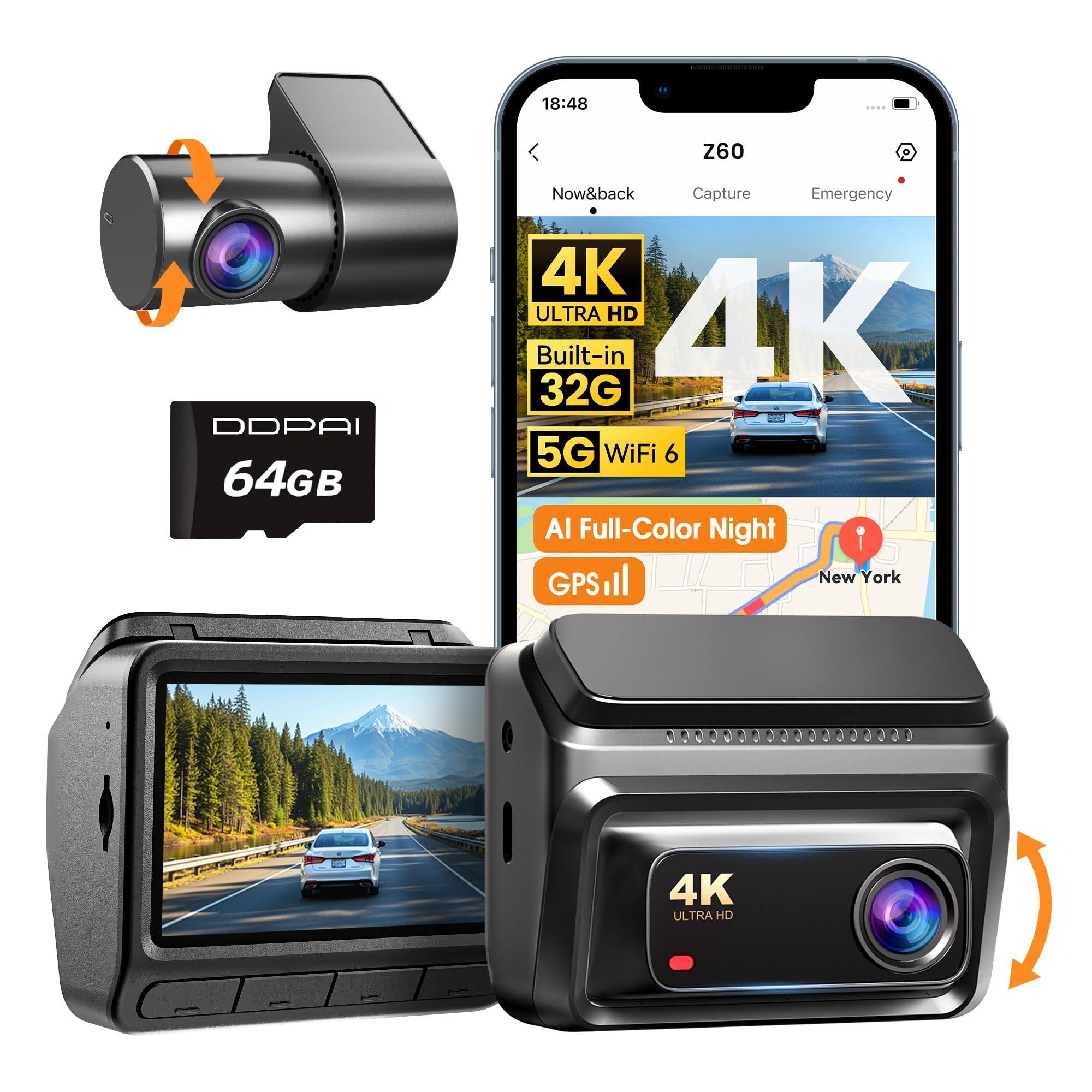
The only model that automatically backs up footage to internal memory if the SD card fails.
The DDPAI Z60 is built around a safety-first philosophy. It packs a built-in 32GB eMMC memory chip that works alongside the included 64GB microSD card. DDPAI’s exclusive D²Save 2.0 technology automatically transfers recordings to the internal storage if the memory card becomes damaged, corrupted, or full — a feature no other dash cam in this roundup offers. For anyone who has ever pulled an SD card only to find a corrupted file, this is a genuine peace-of-mind upgrade. The 4K front and 1080P rear video quality is described by owners as “crisp” with “excellent day and night clarity.”
The AI ISP Night Vision 2.0 uses real-time image processing to reduce glare, motion blur, and noise in low light — tunnels, rain, and nighttime streets all benefit. WiFi Turbo technology pushes transfer speeds to 18 MB/s. The 7-day AOV (Always-On Video) parking mode is the longest continuous surveillance offered here, using ultra-low power draw. The ADAS system provides voice alerts for front vehicle movement and fatigue driving. An automotive-grade super capacitor replaces the traditional battery, so there is no risk of swelling in hot cars.
The rear camera is 1080P, which is adequate but a step behind the 2K rears on the FAIMEE and ROVE. A few owners mention the rear cable is long enough to create a slack-management challenge in smaller cars. At 4.3 stars from over 500 ratings, reliability is strong, though 18 mixed responses on reliability suggest it is not bulletproof. If your main fear is losing a critical clip to card failure, the Z60’s dual-storage architecture is the solution.
Best fit for: drivers who worry about SD card failure — the built-in 32GB eMMC backup is a unique safety net.
Not ideal if: a sharp 2K+ rear camera is important to you, the 1080P rear is adequate but not class-leading.
7. WOLFBOX G840S 12″ 4K Mirror Dash Cam
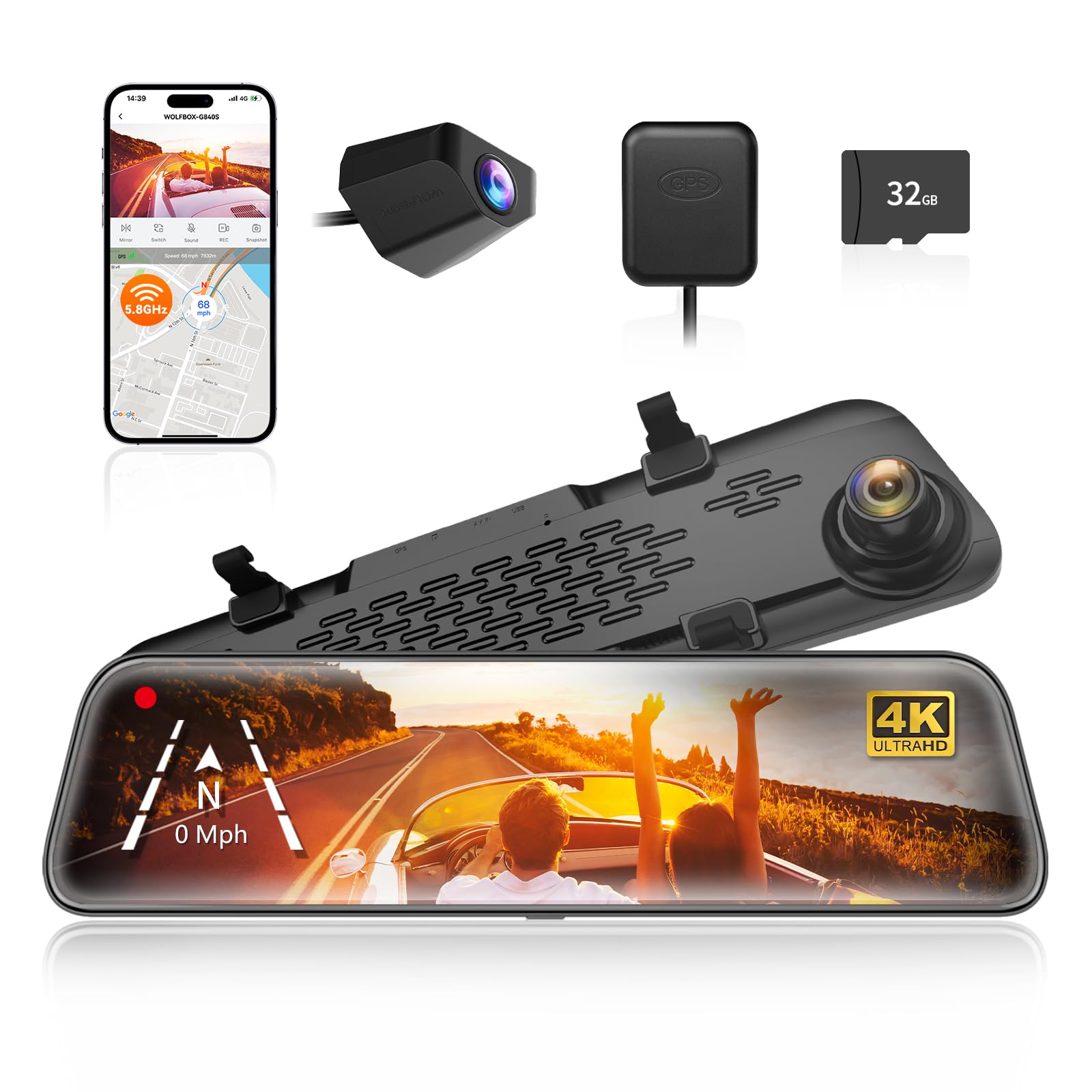
Replaces your rearview mirror with a huge 12-inch screen and a 4K forward-facing camera.
The WOLFBOX G840S takes a completely different approach from the windshield-mounted units above. It straps over your existing rearview mirror, turning it into a 12-inch display — about 1.5 times the viewing area of a standard mirror — while simultaneously recording 4K UHD (2160P) front footage and 1080P rear footage. The 170-degree front lens and 140-degree rear lens reduce blind spots significantly, and the smart split-screen lets you view both camera feeds at once. This is a massive hit with owners: it holds a 4.3-star rating from nearly 15,000 ratings, and quality is the most-praised aspect with over 1,000 mentions.
The camera ships with a 32GB card and includes an external GPS antenna for real-time speed and route logging. The “WOLFBOX” app (iOS/Android) lets you view live feeds and download clips. The screen brightness is excellent in daylight, though a few owners note the mirror surface can be shiny and recommend a matte screen protector. Night vision is enhanced by WDR and HDR technology, but the rear camera produces noticeable flare from trailing headlights — a trade-off of the mirror form factor. The 24-hour parking mode uses time-lapse recording at a low frame rate, requiring a separate hardwire kit.
The biggest drawback is the rear camera cable: at 11 feet, it is too short for minivans and larger SUVs, so those owners will need an extension. The mirror’s wide body can also obstruct the passenger-side sun visor in some vehicles. If you want to modernize your interior and gain a massive live view, the G840S is the most popular mirror cam available. But if you prioritize discreet installation and don’t need a giant display, the windshield-mounted FAIMEE or ROVE are more practical.
Great if: you want to replace your dull rearview mirror with a bright 12-inch screen that shows front and rear views live.
Better options if: you drive a large SUV or minivan — the rear cam cable may be too short, and the mirror can block the visor.
8. WOLFBOX G850 PRO 4K Mirror Dash Cam

Packs the same 12-inch mirror screen plus ADAS and blind-spot detection for a full safety layer.
The G850 PRO builds on the G840S foundation by adding a dedicated Advanced Driver Assistance System (ADAS) with alerts for forward collision, pedestrian collision, lane departure, and front vehicle start. It also features a Blind Spot Detection (BSD) algorithm that monitors adjacent lanes and issues a rear collision alert — a feature most useful for highway merging and tight parking lots. The front camera records 2560×1440 at 30fps, and the rear shoots 1080P at 25fps. Both channels use WDR and HDR to manage harsh shadows and bright sunlight.
Voice control is built in with 12 commands, including “turn on WiFi,” “take picture,” and “lock the video.” The 5.8GHz WiFi connects to the WOLFBOX App for downloading and sharing clips. A 64GB card is included. Owners praise the 4K clarity day and night, and note the display brightness is adjustable for nighttime driving. One owner who installed it on a 2020 Jeep Wrangler says it “solves rear visibility” with a soft top, and the collision warnings are “accurate.” The large 12-inch mirror can slightly obstruct the passenger visor, and the rear video can be affected by rain on the lens. The ADAS warnings are reported as sometimes distracting for drivers who don’t need them — but they can be turned off.
At 4.4 stars from nearly 1,000 ratings, this is a solid step up from the G840S for drivers who want active safety alerts. However, the 1080P rear is the same as the G840S — it does not match the 2K rear resolution of the FAIMEE or the ROVE. The price premium is really for the ADAS suite, not for better video.
Pick this if: blind-spot monitoring and forward-collision warnings are must-haves in your daily drive — the BSD and ADAS features are exclusive to this PRO model.
Choose the g840s if: you only need the mirror screen and recording, since the PRO’s extra safety alerts may feel like unnecessary noise.
9. ROVE R2-4K Dual PRO Dash Cam
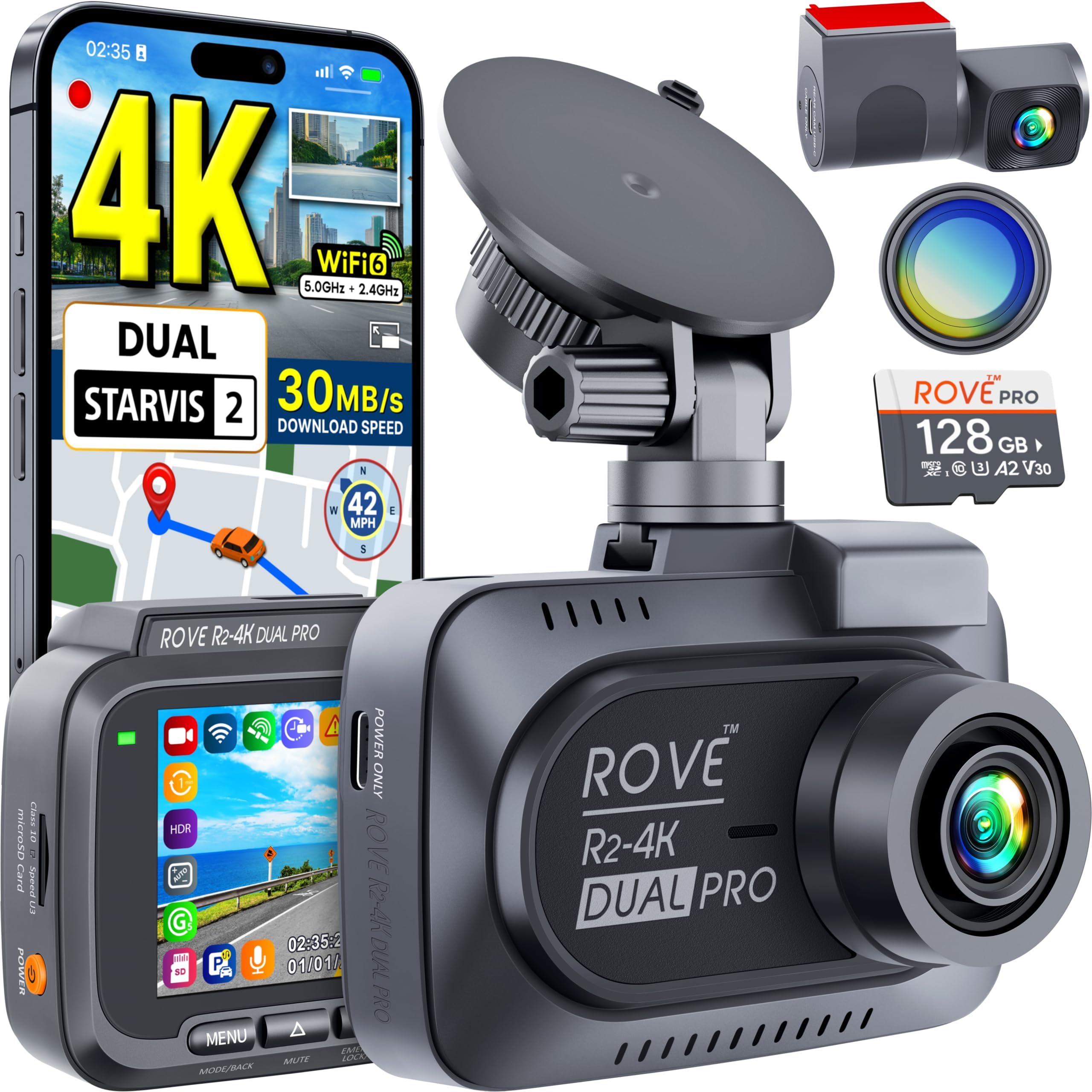
The night-shift specialist — Sony STARVIS 2 sensors on both channels with WiFi 6 transfer at 30MB/s.
The ROVE R2-4K Dual PRO is the only model here using Sony’s latest STARVIS 2 sensors on both the front (IMX678, 8MP) and rear (IMX675, 5MP). This combination delivers “higher light sensitivity, reduced noise, and minimized motion blur” according to the specs — and owners confirm it: the video quality aspect draws 69 positive mentions, the highest count of any aspect across all nine products. The front shoots true 4K (3840x2160P) at 30fps, and the rear shoots 2K (2560x1440P) — a genuine 2K rear, not 1080P. The large apertures (F1.7 front, F1.55 rear) pull in more light than the F1.8 lenses on most competitors, so the advantage in dim garages or unlit country roads is measurable.
WiFi 6 with dual-band 5GHz and 2.4GHz enables transfer speeds up to 30 MB/s; the DDPAI Z60 achieves 18 MB/s, and typical 2.4GHz cams are slower. A 128GB ROVE PRO microSD card and a CPL filter (to cut windshield glare) are both included in the box, saving you roughly in accessories compared to the FAIMEE or DDPAI. The Quad-Mode GPS locks onto GPS, BeiDou, Galileo, and GLONASS satellites for sturdy location tracking even in remote areas.
The 24-hour parking mode offers three options: time-lapse at 1FPS, motion detection, or collision detection, with a voice alert when you return to the car. The hardwire kit is sold separately. A few SUV owners note the rear camera cable could be longer for full-size vehicles (the cable is 6 meters). The Rove app takes a bit of learning, and the rear resolution, while 2K, still falls short of the IIWEY’s true rear 4K. But for overall low-light performance, transfer speed, and included accessories, the ROVE is the premium pick that justifies its top position.
Dual channel pro
- Dual Sony STARVIS 2 sensors (IMX678 + IMX675) for top-tier night recording
- WiFi 6 delivers 30 MB/s transfers — fastest in this comparison
- Includes 128GB card and CPL filter, a ~ value not found with competitors
- Quad-mode GPS (GPS, BeiDou, Galileo, GLONASS) locks in any environment
Complex setup
- Rear camera cable may be short for large SUVs — check your vehicle’s run length
- At this price point, some may not need the extreme nighttime performance
Go with this if: you frequently drive after dark and need the best possible low-light evidence — the dual STARVIS 2 sensors are class-leading here.
Save your money if: you mostly drive in daylight and don’t need WiFi 6 speeds the ROVE’s premium is wasted on simpler commutes.
Understanding the Specs
STARVIS Sensors vs Standard CMOS
STARVIS is Sony’s back-illuminated sensor technology that dramatically increases light sensitivity. A standard CMOS sensor captures about 0.1 lux in near-darkness, producing grainy footage. A STARVIS 2 sensor — found on the Pelsee P1 Pro and the ROVE R2-4K Dual PRO — can capture usable color images in starlight conditions (around 0.001 lux). This is the difference between seeing a license plate or seeing a blurry blob in your night recording.
G-Sensor and Parking Mode
The G-sensor is a small accelerometer inside the dash cam that detects sudden movement or impact. When it feels a bump — from a collision, a door ding, or a hit-and-run in a parking lot — it instantly locks the current video file so loop recording cannot overwrite it. Parking mode is an extension of this: with a hardwire kit, the camera stays powered even when the car is off, either recording a time-lapse or waiting for an impact to wake up and save a clip. Models like the DDPAI Z60 offer up to 7 days of parking monitoring on a single charge.
FAQ
Can I install a dual dash cam myself or do I need a professional?
What is the difference between loop recording and time-lapse parking mode?
Do all dual dash cams require a paid app membership?
Will a dash cam drain my car battery overnight?
How much storage do I need for a 4K dual dash cam?
Is a capacitor-based dash cam better than one with a battery?
Can I use the rear camera inside the car to record the cabin?
What does the G-sensor actually protect against?
Is a mirror dash cam better than a windshield-mounted one?
Will a rear camera cable fit in my SUV or truck?
Final Thoughts: The Verdict
For most drivers, the dual dash cam that ticks every box is the FAIMEE F6 because it delivers true 4K front and 2K rear recording with a free 64GB card and zero app subscription traps — all at a price that undercuts the competition. If you prioritize highway driving and need sharp plates at speed, the Coolcrazy N8 with its 60fps front capture is your best bet. And if you want the absolute best nighttime footage and lightning-fast WiFi transfers, the ROVE R2-4K Dual PRO with dual STARVIS 2 sensors is the one to reach for — just know it demands a bigger wallet. Honest nudge: the FAIMEE F6 has the highest rating and the most balanced feature set on this entire list, making it the most reliable bet for the widest range of drivers.
How We Picked
We do not accept paid placement. Every pick is matched to a real buyer and a real use-case; we do not hands-on test units.
Sources & Methodology
Specifications: manufacturer listings and product documentation. Review insights: verified customer reviews, as of July 2026. Pricing: not shown on this page (it changes often); check the current price via the retailer link.
As an Amazon Associate, WellFizz earns from qualifying purchases. This does not affect which products we feature.
Related Guides

Mo Maruf
I created WellFizz to bridge the gap between vague wellness advice and actionable solutions. My mission is simple: to decode the research and give you practical tools you can actually use.
Beyond the data, I am a passionate traveler. I believe that stepping away from the screen to explore new environments is essential for mental clarity and physical vitality.