Our readers keep the lights on and my smoothie glass nicely filled. As an Amazon Associate, I earn from qualifying purchases.
Specs are compiled from manufacturer listings and verified buyer reviews and can change over time — please confirm the key details on the product page before buying.
You are looking for a dual band mobile ham radio that can reliably get you on 2 meters and 70 centimeters without draining your wallet or requiring an engineering degree to set up. The real challenge isn’t finding a radio that transmits—it’s finding one with clear enough audio, easy programming, and a build that will still work years from now. This guide cuts through the confusion to help you pick the right radio for your vehicle, base station, or go-kit.
I’m Mohammad Maruf — the founder and writer behind WellFizz. This guide is built by comparing the manufacturers’ published specifications and the patterns across verified customer reviews, so you get each pick’s real strengths and trade-offs instead of marketing spin.
if you need something compact for a daily driver or a powerhouse base station, here are the best dual band mobile ham radio options ranked for real-world performance and value.
Our Picks at a Glance


How To Choose The Best Dual Band Mobile Ham Radio
Picking your first mobile ham radio can feel overwhelming with all the wattage figures and menu options. Focus on a few core specs that directly impact your daily use—installation space, audio clarity, and how easy it is to program without a computer science degree.
Power Output: 25W vs 50W
For most urban and suburban driving, a 25-watt radio is plenty to hit local repeaters and talk simplex over several miles. A 50-watt radio gives you that extra punch for reaching distant repeaters on the fringe of your coverage area, which is especially useful in rural or mountainous terrain. The trade-off is higher current draw and a larger heat sink to keep things cool.
Programming and CHIRP Support
Front-panel programming by poking buttons is time-consuming and error-prone. A radio that works with CHIRP, the free open-source programming tool, lets you manage hundreds of channels and repeater offsets from your computer quickly. This is the single feature that separates a radio you will use from one you will grow frustrated with.
Physical Size and Installation Flexibility
Mobile radios vary dramatically in size. A mini radio like the Radioddity DB25 Pro at 5 x 3.8 x 1.7 inches can fit in a glove box or under a seat, whereas a full-size unit like the Retevis RT95 is 6.42 x 4.88 x 1.54 inches and needs more real estate. If you need a detachable faceplate to mount the body remotely, that is a dealbreaker spec for certain vehicle interiors.
Quick Comparison
| Model | Best For | Power Output | Channel Capacity | Physical Size (W x D x H) | Amazon |
|---|---|---|---|---|---|
| Retevis RT95★ Best Overall | Overall Value & Base Station | 25W | 200 | 6.42″ x 4.88″ x 1.54″ | Amazon |
| AnyTone AT-778UVBest Value | Compact Budget Base | 25W | 200 | 5.8″ x 4.7″ x 1.5″ | Amazon |
| Radioddity DB25 ProCompact Pick | Ultra-Compact / Off-Road | 25W | 200 | 3.8″ x 1.7″ x 5″ | Amazon |
| BTECH UV-25X2 | Quad-Watch Monitoring | 25W | 200 | 9.8″ x 11.8″ x 3.5″ | Amazon |
| TYT TH-8600 | Weatherproof / ATV Use | 25W | 200 | 4.92″ x 1.77″ x 1.77″ | Amazon |
| Anytone AT-778UVII | Complete Starter Kit | 25W | 200 | — | Amazon |
| BTECH UV-50X2 | 50W Power & Audio Quality | 50W | 200 | 5.7″ x 7.5″ x 1.85″ | Amazon |
| Radioddity DB50 | 50W & Detachable Faceplate | 50W | 758 | — | Amazon |
| Icom IC-2730A | Premium Build & Bluetooth | 50W | 1052 | 5.9″ x 5.9″ x 1.6″ | Amazon |
In‑Depth Reviews
1. Retevis RT95 Mobile Ham Radio
Our pick — over 4.5★ from 400+ verified ratings; the strongest balance of quality and price.
The crowd favorite that nails great audio, easy CHIRP programming, and a rotatable screen in one tidy package.
Your audio is the first thing other hams judge you on, and the RT95 delivers clean transmit sound—buyers report getting positive signal reports right from the start. It transmits at 25 watts on both VHF (144-148MHz) and UHF (430-440MHz), which is plenty of power for hitting repeaters at moderate distances. The supplied data cable works with CHIRP on the first try with no errors, a huge relief compared to radios that require fiddling with drivers and port settings.
The 180-degree rotatable TFT LCD display means you can install the radio upside down and still read the screen right-side up, which gives you more mounting options in tight vehicle spaces. It includes a VOX function so you can transmit hands-free while driving, and a built-in heat dissipation fan lets it run continuously at high power without thermal worry. The radio measures 6.42 x 4.88 x 1.54 inches, so it is not the tiniest unit on this list—as owners put it: “It is bigger than I thought it would be.” But that extra size buys you dual speakers (one in the radio body and one in the microphone) and a rugged build with voltage protection.
The thing everyone raves about is how easily the programming cable works with CHIRP—reading and writing frequencies happens in seconds. For first-time mobile buyers, the combination of expandable frequency coverage, easy front-panel menu navigation, and responsive manufacturer support makes this the most forgiving entry point. The only recurring caveat is the physical footprint: if you are crammed for dashboard space, measure your installation area before buying.
What Owners Love
- CHIRP programming works flawlessly with the included data cable
- Clear transmit audio earns positive feedback from other operators
- Rotatable screen and dual speakers for flexible installation
Keep In Mind
- Larger than some competing mini mobiles—check your mounting space
- Factory band limits require a quick YouTube fix to open up full range
Reach for this if: you want a radio that just works from the start, programs without frustration, and sounds clean on the air.
The honest tradeoff: it physically takes up more room than the ultra-compact picks below, so measure your dash or center console first.
2. AnyTone AT-778UV Dual Band Transceiver
A rock-solid base station for three years running, with full quieting on repeaters up to 25 miles away.
If you want a proven workhorse that has been on the market long enough to have a mature support community, the AT-778UV is it. The all-alloy body acts as a hefty heat sink, so there is no noisy fan to worry about—conduction keeps it cool. It offers 25, 15, and 5 watts selectable power, so you can dial back to save your battery when operating from a portable setup. The 180-degree rotatable TFT LCD gives you the same upside-down mounting flexibility as the Retevis above, and the lighted keypad microphone makes night operation easy.
Programming via CHIRP is straightforward, though you will need to buy a separate programming cable. The receiver range covers 136-174MHz on VHF and 400-490MHz on UHF, with transmit locked to the amateur bands. The menu is deep but logical— owners mention it takes a little time to learn the shortcuts like “RDW” for dual watch. The compact size (5.8 x 4.7 x 1.5 inches) means it fits in places a larger radio simply will not.
The strong consensus is that the AT-778UV is reliable enough to serve as a base station for years. It hits the balance between price and build quality, with excellent signal reports and constant voltage delivery. The biggest missing feature for some is DTMF encoding, which may matter if you plan to use repeater autopatch functions. If that is not on your radar, this radio is a steal for the price.
Three-Year Test: customers note using this as a base station for three years without a hiccup, calling it the best budget VHF/UHF FM radio available. The audio is clean on both transmit and receive.
One Layout Quirk: the frequency up/down buttons sit on the side of the microphone, which makes one-handed mobile operation less natural than having them on top—something to try before you commit to in-car use.
Best fit: the budget-conscious ham who wants a fanless, durable base or mobile rig and does not need DTMF.
Who might look elsewhere: drivers who demand one-handed channel changing without taking their eyes off the road.
3. Radioddity DB25 Pro Dual Band Quad-Standby Mini Mobile
The tiniest radio on the list that still delivers 25 watts—perfect for a Jeep or ultra-tight install.
At just 3.8 x 1.7 x 5 inches, the DB25 Pro is a 2.9x size gap smaller than the Retevis RT95. That is the kind of shrink that fits under a truck seat, inside a center console cubby, or clipped to the side of a go-box. Despite the miniature form, it still pumps a full 25 watts on both VHF (144-148MHz) and UHF (420-450MHz), with a selectable 10-watt low-power mode. The quad-standby feature lets you monitor four frequencies at once—handy for keeping an ear on both 2 meters and 70 centimeters plus a local weather channel.
The four-color screen helps distinguish active channels at a glance. A built-in temperature-controlled cooling fan kicks in only when the unit reaches 45°C, which keeps the noise floor down during casual use. The kit includes a programming cable and a high-gain quad-band antenna, so you have a running start right from the start. Out-of-the-box transmit and receive is reported as 5×5 (full quieting) when paired with a decent mag-mount antenna.
The feedback from off-roaders is especially strong—Jeep owners love the range and clear reception in rugged terrain. However, the radio struggles with intermodulation interference if you operate near powerful VHF/UHF broadcast towers; full squelch may not be enough to filter it out. Some users also report compatibility quirks with CHIRP and Windows software. For an entry-level field radio or a secondary rig, it is tough to top this footprint.
Why It Shrinks
- Ultra-compact body fits where most mobile radios cannot
- Quad-standby monitors four frequencies simultaneously
- Includes programming cable and antenna for immediate setup
Where It Struggles
- Intermod rejection is weak near strong RF sources
- CHIRP and Windows software can be finicky to set up
When to grab this: your dash space is a premium and you need a 25W dual bander that hides away easily.
Think twice if: you operate in an urban core with high RF clutter—the lack of intermod filtering may frustrate you.
4. BTECH UV-25X2 (Second Gen.) Mini Mobile 25 Watt

Operates as multiple radios in one—monitor four frequencies while transmitting on a fifth.
The UV-25X2 lets you use 144 MHz or 430 MHz as the main transmit-and-receive band while simultaneously watching up to three other frequencies. You can even configure it for VHF-VHF or UHF-UHF operation, which is rare at this price point. The upgraded second generation adds audio input/output capabilities through the RJ45 microphone port and includes a K1 audio adapter that opens up a wide range of aftermarket accessories like external speakers and headsets. The kit includes the speaker mic, DC cable, and mounting hardware.
Reception on both 2 meters and 70 centimeters is strong, and the rear cooling fan helps maintain stability during longer transmissions. The radio is small enough to fit in a cup holder, which is a popular mounting tactic for go-boxes and temporary vehicle installs. At 0.15A standby current draw, it is gentle on your vehicle battery when the engine is off. Programming via CHIRP is easy and well-documented, though the soft rubber knobs have a reputation for slipping off if you twist them aggressively.
There is an occasional screen quirk—the display may appear upside-down or half-working on a rare unit, though the radio functionality remains unaffected. The power output measures around 20 watts on VHF and 16-17 watts on UHF (versus the labeled 25W), which is a real-world variance to factor in. For the operator who wants the most frequency-monitoring flexibility in a compact chassis, this is the one.
Monitoring Powerhouse: the ability to watch four frequencies at once while transmitting on a fifth is why so many base-station operators choose this BTECH over the 25W competition. The audio input/output support via the K1 jack is a meaningful upgrade for anyone using a digital mode interface.
The Softer Side: the rubber control knobs can loosen and fall off over time—a minor fix with a drop of super glue, but worth knowing before you buy.
Best for: the operator who needs maximum situational awareness with multi-frequency monitoring in a compact package.
Not ideal if: you want guaranteed 25W output on UHF—actual measured power is closer to 16-17W on the 70cm band.
5. TYT TH-8600 Mini 25 Watt Dual Band with IP67 Waterproof

The only IP67-rated mobile radio here—take it on an ATV or into the rain without worry.
Most mobile radios will die from a single splash of water, but the TYT TH-8600 is built to survive full immersion. The IP67 rating means it is dust-tight and can be submerged in up to a meter of water for 30 minutes. That makes it the only real choice for side-by-sides, boats, or any outdoor installation where weather exposure is a fact of life. It transmits at 25 watts on VHF (144-148MHz) and 20 watts on UHF (420-450MHz), with three power settings (high/mid/low) to conserve your battery when full power is not needed.
The display is large and easy to read, even in sunlight, and the unit is compact enough (4.92 x 1.77 x 1.77 inches) to fit into a standard battery box as part of a go-kit. The programming cable and software are included—just download the software from the TYT official site. The speaker is loud enough that most off-road users report they do not need an external speaker. The dual-watch function lets you monitor two frequencies at once, and the DTMF microphone adds selective calling capability.
Long-term reliability is the most-discussed aspect of this radio—a mixed picture, with some units working flawlessly for years while others develop issues after about two years. Programming is also a mixed bag: some find it very easy, while others find the manual cryptic and the software unforgiving. It does not support CHIRP, so you must use the manufacturer’s software. If you absolutely need a waterproof mobile radio for a harsh environment, the TH-8600 is your only real option in this price range.
what separates it
- IP67 waterproof rating—survives rain, splashes, and submersion
- Loud internal speaker eliminates the need for an external amp
- Compact size fits in battery boxes and ATV consoles
The Tradeoffs
- No CHIRP support—requires manufacturer software for programming
- Programming manual is sparse and can be difficult to follow
Reach for it when: your radio will live in an exposed environment—an open Jeep, a boat console, or a snowmobile glove box.
Pass if: you rely on CHIRP to manage your codeplugs, or if you prefer an intuitive front-panel programming experience.
6. Anytone AT-778UVII Amateur Mobile Radio with Car Antenna
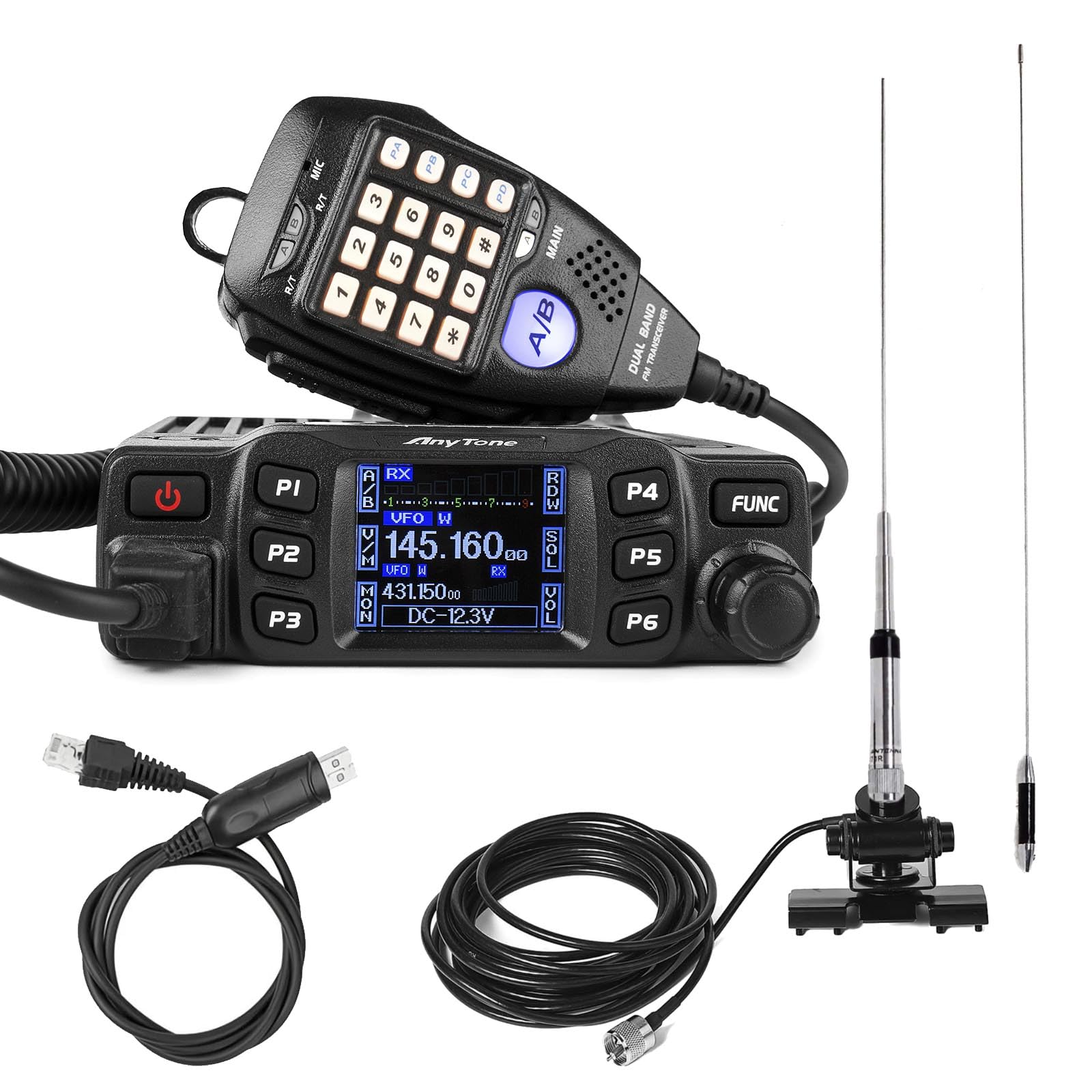
A complete set with a car antenna and power cable—you literally just need to mount it and key up.
The AT-778UVII is the updated version of the classic AT-778UV and comes bundled with a 770R car antenna, power cable with fuse holder, and a speaker microphone. That means you do not need to hunt down accessories separately—a real advantage for a first-time buyer. It offers three power levels (25W, 15W, and 5W) on both VHF (144-148MHz) and UHF (420-450MHz), and the 200-channel memory with CTCSS/DCS privacy codes keeps your conversations interference-free. The VOX function enables hands-free operation, which is a real asset when you are driving.
The display is bright and color-rich, and the six custom programmable buttons let you skip deep menu dives for the functions you use most. It works with both CHIRP and the factory programming software, and the included USB programming cable makes computer connection painless. The reported range is up to 30 kilometers (about 19 miles) in open areas with the included antenna, and many reviewers point out hitting repeaters 40 miles away with an indoor antenna. There is no cooling fan—the hefty heatsink does the job silently, and it does not overheat even during extended use.
Quality and functionality are the highest-cited aspects, with scores of owners saying the radio is well-built and reliable. The main downsides are a poorly written manual and a lack of dedicated volume and squelch knobs—you have to press a button before adjusting, which is slightly distracting while driving. For a complete entry-level package that minimizes accessory hunting, this is a compelling choice.
Ready to Roll: everything you need except a power supply for base use is in the box. The 770R antenna alone would cost you extra with most competitors. Owners consistently report it as the easiest path to getting on the air for the first time.
The Interface Quirk: no dedicated volume/squelch knobs means you must press a button to toggle the control—a minor hassle on the move.
Who it fits: new licensees and anyone who wants a single-box solution with no last-minute trips to the radio shop.
Who might prefer something else: experienced hams who want direct-access knobs and a more comprehensive manual.
7. BTECH UV-50X2 (Second Gen.) Mobile 50 Watt Dual Band

Fifty watts of transmit power that reaches repeaters 40 miles away, with sound quality that kills.
When you need the extra punch to punch through terrain and into a distant repeater, the UV-50X2 delivers the full 50 watts. It runs the same quad-watch architecture as the UV-25X2 above—monitor up to three other frequencies while actively transmitting on a fourth—but with double the output power. The sound quality is the most-praised feature by a wide margin, with owners consistently reporting clean, full-quieting audio on both transmit and receive. The deep finned heat sink paired with a quiet fan keeps the radio stable during long rag-chews.
The upgraded second generation adds the same RJ45-to-K1 audio adapter for aftermarket accessory support, and the kit includes mounting hardware, a speaker mic, and a DC cable. The display is tiny but colorful, offering seven color options plus black-and-white mode. Keep a printed channel list handy because the four-line screen makes scrolling through 200 channels slow while driving. It programs easily via CHIRP—you can plug the cable in with the radio on or off.
The most-discussed concern is reliability: there are reports of units failing in cold weather after the internal amplifier heats and cools rapidly during key-ups in freezing temperatures. If you live in a cold climate and the radio will sit in an unheated vehicle overnight, this is a risk worth noting. The microphone connector sits close to the volume knob, so a yanked cord can damage the jack. For a warm-climate base station or a vehicle that is garaged, the UV-50X2 is a phenomenal value for the power.
Why It Stands Out
- 50W output reaches distant repeaters with full quieting audio
- Quad-watch monitors multiple frequencies simultaneously
- Excellent sound quality is the top praise from owners
What To Watch
- Cold-weather reliability is inconsistent—some units fail after freezing nights
- Microphone connector is vulnerable to cord-tug damage
Best for: the operator who needs 50 watts of clean audio and multi-frequency monitoring, especially in a home base station or a garaged vehicle.
Think twice if: your radio will live in an unheated vehicle in freezing climates, or if you want the bulletproof cold-weather track record of a more expensive Icom.
8. Radioddity DB50 Dual Band Mobile Radio 50W

A detachable front panel gives you split-mount flexibility without sacrificing 50 watts of power.
The detachable faceplate is the headline feature here: you can mount the main radio body under a seat or in a trunk, run the cable to the control head on your dashboard, and keep all controls within easy sight. That solves the biggest installation headache for modern vehicles with tight dash clearance. The radio pumps 50 watts on both VHF and UHF, and the 758-channel capacity is the highest on this list—plenty of room for all your local repeaters, simplex frequencies, and a few GMRS or MURS channels if you have the license.
The dual-display, dual-watch system lets you monitor two channels at once, and the cross-band repeater function works effectively for linking UHF handhelds to VHF base stations. The included programming cable works with the Radioddity CSP software, but CHIRP support is limited—it reads and writes the first 35 channels only, so you will want to use Radioddity’s software for full 758-channel management. The audio reports are outstanding; owners consistently mention strong, clear signals. The 13.8V operating voltage is standard for the category.
Some users find the learning curve steep, and the microphone jack on the first batch had occasional quality issues that were resolved by customer support through Amazon replacement. The power cable comes bare-wire, so you will need to add a cigarette lighter plug or PowerPoles yourself. For the flexibility of a detachable faceplate at this power level, the DB50 represents strong value for the money.
Flexibility First: the detachable faceplate is a genuine space-saver in modern cars with no flat dash real estate. The cross-band repeater function makes this a practical bridge between your HT and your mobile.
Software Reality Check: CHIRP only reads the first 35 channels, so full programming means using the Radioddity CPS software, which lacks a manual. Plan for a bit of trial and error.
Who needs this: anyone whose vehicle interior demands a split-mount solution—the body in the trunk, the control head on the dash.
Skip if: you want smooth CHIRP support for all 758 channels, or if you want a plug-and-play power connection from the start.
9. Icom IC-2730A Dual Band VHF/UHF 50W Mobile Radio

Seventy years of ham radio experience refined into a 50W dual bander with Bluetooth and 1052 channels.
Icom is a name that commands respect in amateur radio, and the IC-2730A justifies its premium reputation with a receiver that one experienced operator called the best he has owned in 53 years on VHF. It transmits at a full 50 watts on both bands and offers simultaneous VHF/VHF or UHF/UHF receive—meaning you can monitor two channels on the same band at the same time, not just one per band like most dual-watch radios. The optional VS-3 Bluetooth headset eliminates the microphone cable for clutter-free mobile operation.
The large white backlit LCD is the most readable display in this roundup, and the well-designed microphone makes one-handed operation intuitive. The receiver is sensitive and accurate, with positive simplex audio that is punchy and clean. It hits a repeater at 42 miles using only 15 watts, which speaks to the quality of the front end and filtering. The 1052-channel memory is overkill for most operators, but it means you will never run out of space for channelized frequencies.
The biggest frustration is the lack of included mounting hardware—no bracket, no faceplate adapters—and the official Icom accessories are expensive. The cooling fan is also louder than the fanless competitors. For the price of the IC-2730A, you could buy two of the mid-range radios on this list. But if build quality, receiver sensitivity, and long-term reliability are your top priorities, the Icom is the radio you will pass down to the next generation of operators.
What Luxury Buys You
- Exceptional receiver sensitivity—top-tier for pulling weak signals
- Simultaneous same-band receive (VHF/VHF or UHF/UHF)
- Optional Bluetooth headset eliminates mic cable clutter
The Premium Tax
- No mounting bracket or faceplate hardware included—sold separately
- Icom accessories are expensive and proprietary
Buy this if: you value receiver performance above all else and plan to keep this radio for a decade or more.
Think twice if: your budget is tight and you are not willing to spend extra on mounting hardware and accessories—the total cost of entry is higher than the sticker suggests.
Understanding the Specs
Power Output (25W vs 50W)
This is the maximum transmit power your radio puts into the antenna. 25 watts is enough for most suburban and even some rural repeater coverage—you will reach repeaters 15-25 miles away depending on terrain and antenna height. 50 watts gives you that extra 3dB of signal, which can make the difference between a scratchy and a full-quieting signal on a marginal path. The trade-off is higher current draw from your vehicle’s electrical system: a 50W radio may pull 6-8 amps while transmitting, versus 3-4 amps for a 25W unit.
Dual Watch vs Quad Standby
Dual watch means your radio listens on two channels and switches between them. Quad standby means it scans between four channels (or more) and stops when it detects a signal. True dual-watch receivers can receive on two channels at the exact same time—this is only available on higher-end radios like the Icom IC-2730A. Most budget radios do time-slicing, which means they briefly peek at each channel in sequence. For casual monitoring, the difference is negligible; for critical communication like emergency services, true simultaneous receive matters.
FAQ
Can I use a dual band mobile radio as a base station at home?
What is CHIRP and why does it matter?
What does IP67 waterproof mean on the TYT TH-8600?
Can I monitor two channels at the same time on these radios?
How far can I transmit with a 25W mobile radio?
What is the difference between VHF and UHF bands for mobile use?
Does a detachable faceplate make installation easier or harder?
Do these radios support digital modes or are they analog only?
Final Thoughts: The Verdict
For most people, the dual band mobile ham radio winner is the Retevis RT95 because it combines easy CHIRP programming, excellent audio, and a rotatable display at a price that beats nearly everything with the same feature set. If you want maximum power and audio quality, grab the BTECH UV-50X2 for 50 watts and excellent sound. And for a weatherproof rig that survives rain and mud, the TYT TH-8600 is the one to reach for.
How We Picked
We do not accept paid placement. Every pick is matched to a real buyer and a real use-case; we do not hands-on test units.
Sources & Methodology
Specifications: manufacturer listings and product documentation. Review insights: verified customer reviews, as of July 2026. Pricing: not shown on this page (it changes often); check the current price via the retailer link.
As an Amazon Associate, WellFizz earns from qualifying purchases. This does not affect which products we feature.
Related Guides

Mo Maruf
I created WellFizz to bridge the gap between vague wellness advice and actionable solutions. My mission is simple: to decode the research and give you practical tools you can actually use.
Beyond the data, I am a passionate traveler. I believe that stepping away from the screen to explore new environments is essential for mental clarity and physical vitality.