Our readers keep the lights on and my smoothie glass nicely filled. As an Amazon Associate, I earn from qualifying purchases.
Specs are compiled from manufacturer listings and verified buyer reviews and can change over time — please confirm the key details on the product page before buying.
Getting a food photo that looks as good as the dish tastes depends on one thing: the lens. A standard kit zoom (the basic lens that comes with most cameras) flattens the texture of a seared steak or turns a bowl of ramen into a blurry mess. You need a lens that resolves every droplet of glaze, every crumb of a crusty loaf, and every leaf of microgreen with surgical clarity.
I’m Mohammad Maruf — the founder and writer behind WellFizz. This guide is built by comparing the manufacturers’ published specifications and the patterns across verified customer reviews, so you get each pick’s real strengths and trade-offs instead of marketing spin.
Whether you shoot plated desserts, flat-lay breakfasts, or steaming street food, the right dslr lenses for food photography will transform your images from muddy to magazine-worthy with true macro capability and beautiful background blur.
Our Picks at a Glance


How To Choose The Best DSLR Lenses For Food Photography
Finding the right lens for food shots means balancing how close you can get, how much blur you can create, and what angle of view matches your shooting style. Start with these four factors.
Magnification ratio — how big your subject fills the frame
A 1:1 magnification ratio lets you fill the frame with a single cherry tomato, capturing every shadow and highlight in the skin. Lenses with lower ratios (like 0.17x) are fine for a full plate shot but cannot isolate a tiny detail. For food, a lens that goes to 1:1 gives you the most creative flexibility.
Focal length — your distance from the dish
A short focal length like 30mm or 35mm works well for overhead flat-lays because you do not have to stand on a chair to fit the plate in the frame. Longer focal lengths like 85mm or 100mm give you a comfortable arm’s-length distance, which is ideal if you are shooting a steaming dish from the side without fogging up the front element. The trade-off is that long lenses need more table space behind the camera.
Aperture and background blur
A wide aperture (a low f-number like f/1.8 or f/2) lets you blur the background so the dish pops off the plate. For food photography, you often shoot at f/2.8 to f/5.6 anyway to keep the whole plate sharp, but having the option to open up creates that creamy blur around a single hero ingredient. A lens with an f/1.8 aperture gives you two full stops of low-light performance over an f/3.5 lens, which matters in a dim restaurant.
Image stabilization — your safety net for handheld shots
Unless you always shoot on a tripod, image stabilization (IS) lets you shoot at slower shutter speeds without blur from your own hand shake. A lens that offers 4 stops of IS means you can shoot handheld in the twilight of a cozy dining room and still get a crisp shot. Lenses without IS require a steady hand or a firm surface.
Quick Comparison
| Model | Best For | Max Magnification | Focal Length | Image Stabilization | Amazon |
|---|---|---|---|---|---|
| Canon EF 35mm f/2 IS USM★ Best Overall | Canon users wanting a sharp, versatile walk-around prime | 0.24m close focus | 35mm | 4 stops | Amazon |
| Canon EF 100mm f/2.8L IS USM Macro (Renewed)Budget Bokeh Champ | Canon users who want the gold standard of macro lenses | 1:1 | 100mm | Optical | Amazon |
| Meike 85mm f/1.8 SE Mark II | Canon shooters on a tight budget who want creamy bokeh | 0.17x | 85mm | — | Amazon |
| Sony SEL30M35 30mm f/3.5 Macro | Sony E-mount owners needing a budget true 1:1 macro | 1:1 | 30mm | — | Amazon |
| Laowa 100mm f/2.8 2X Ultra Macro | Manual-focus fans wanting extreme 2:1 macro detail | 2:1 | 100mm | No | Amazon |
| Nikon 24mm f/1.8G ED | Nikon shooters who need a wide-angle food and scene lens | Close focus supported | 24mm | — | Amazon |
In‑Depth Reviews
1. Canon EF 35mm f/2 IS USM
Our pick — over 4.5★ from 400+ verified ratings; the strongest balance of quality and price.
The 35mm prime that turns a casual dinner table into a studio set.
This lens is a workhorse for anyone shooting food regularly. The 35mm focal length on a full-frame body gives you a natural field of view — wide enough to capture a whole table spread, yet tight enough that a single plate fills the frame without distortion. The f/2 aperture is fast, letting you blur the background of a garnish shot, but what really sets this apart is the image stabilization. Buyers report that IS enables handheld shooting at 1/15th of a second, which is a lifesaver when you are balancing a camera overhead for a flat-lay with no tripod handy. The lens weighs just 11.82 ounces, so it never feels like a burden in a camera bag that already holds gear.
The thing everyone raves about is lens quality — well over 60 owners single it out for praise. Image quality and sharpness also get frequent nods, and owners note that on a Canon APS-C body the 35mm acts like a 56mm equivalent, which places it squarely in classic portrait-and-plate territory. The optical stabilization measures 4 stops, meaning you can slow the shutter by four increments without introducing shake, a massive advantage in a candle-lit dining room. The consensus is that this lens delivers L-glass sharpness at a non-L price.
The trade-off is that low-light performance earns mixed feedback. While many call it amazing for dim conditions, a few report some darkening around the edges of the frame wide open. The build is metal-solid but not L-grade rugged, and no hood or pouch is included. Still, the crowd favorite — 4.7 stars from 400+ owners — is clear: this is the lens that balances speed, stability, and sharpness for everyday food shooting.
What Owners Love
- Image stabilization lets you shoot handheld at shutter speeds as low as 1/15s
- Very sharp across the frame even at f/2 — rivals L-series zoom sharpness
- Lightweight 11.82-oz build makes it easy to carry and angle overhead for flat-lays
The Honest Caveats
- Some vignetting at f/2 in low-light edges
- Not weather-sealed like L-series lenses
- No lens hood or pouch included in the box
Best for: The Canon DSLR owner who shoots food in varied light — from bright brunch windows to dim dinner interiors — and wants one prime that does flat-lays, plated shots, and lifestyle scenes equally well.
Who should think twice: Anyone who needs true 1:1 macro to capture a single grain of salt; this lens focuses as close as 0.79 ft but does not magnify to actual size.
2. Canon EF 100mm f/2.8L IS USM Macro (Renewed)
The professional macro standard, now renewed and ready for plate-level detail.
If your food photography revolves around extreme close-ups — think the bubbles on a sourdough crust or the glisten of olive oil on a single basil leaf — this is the lens to reach for. It delivers a true 1:1 magnification ratio with a closest focusing distance of 0.99 ft, meaning you can fill the frame with a forkful of pasta. The 100mm focal length gives you comfortable working distance too; you are not looming over the dish, which means you can shoot a steaming plate without the lens fogging or casting a shadow. Crowned with Canon’s L-series build quality and a ring-type ultrasonic motor (USM) for fast, quiet focusing, this renewed version offers optical image stabilization to keep handheld macro shots steady.
Owners call it one of Canon’s best lenses. The consensus is that it performs exactly like a new unit, with many noting the lens appears brand new from the start. The 100mm f/2.8L IS USM gives you a 23.4-degree diagonal angle of view, which isolates the subject beautifully while the f/2.8 aperture blurs the background into a buttery gradient. Its optical IS is a major advantage over competing manual macro lenses — it lets you shoot at the edge of a dinner table without a tripod.
The catch is that this is a renewed product, so availability and cosmetic condition vary. The build uses 15 elements in 12 groups with a UD (Ultra-low Dispersion) element to suppress chromatic aberration, but the value depends on the specific unit you receive. A few owners mention occasional minor scratches despite the “excellent” condition rating. If you want a no-questions-asked factory warranty, the brand-new version costs considerably more. Nevertheless, the core optics and IS are identical to the original, making this the smart buy-for-life for serious macro shooters.
Why it wins: True 1:1 macro, optical image stabilization, and L-series optics — for less than the new price — is a combination no other lens at this level matches.
Who should skip: Anyone who cannot accept cosmetic blemishes or wants a full factory warranty; the renewed nature means some units show light wear despite excellent function.
Reach for this if: You shoot detail shots of food all day and need the gold-standard 100mm macro focal length with optical IS that catches camera shake in handheld macro work.
Look elsewhere if: You only shoot wide table scenes and do not need 1:1 magnification; you would pay for macro capability you rarely use.
3. Laowa 100mm f/2.8 2X Ultra Macro APO
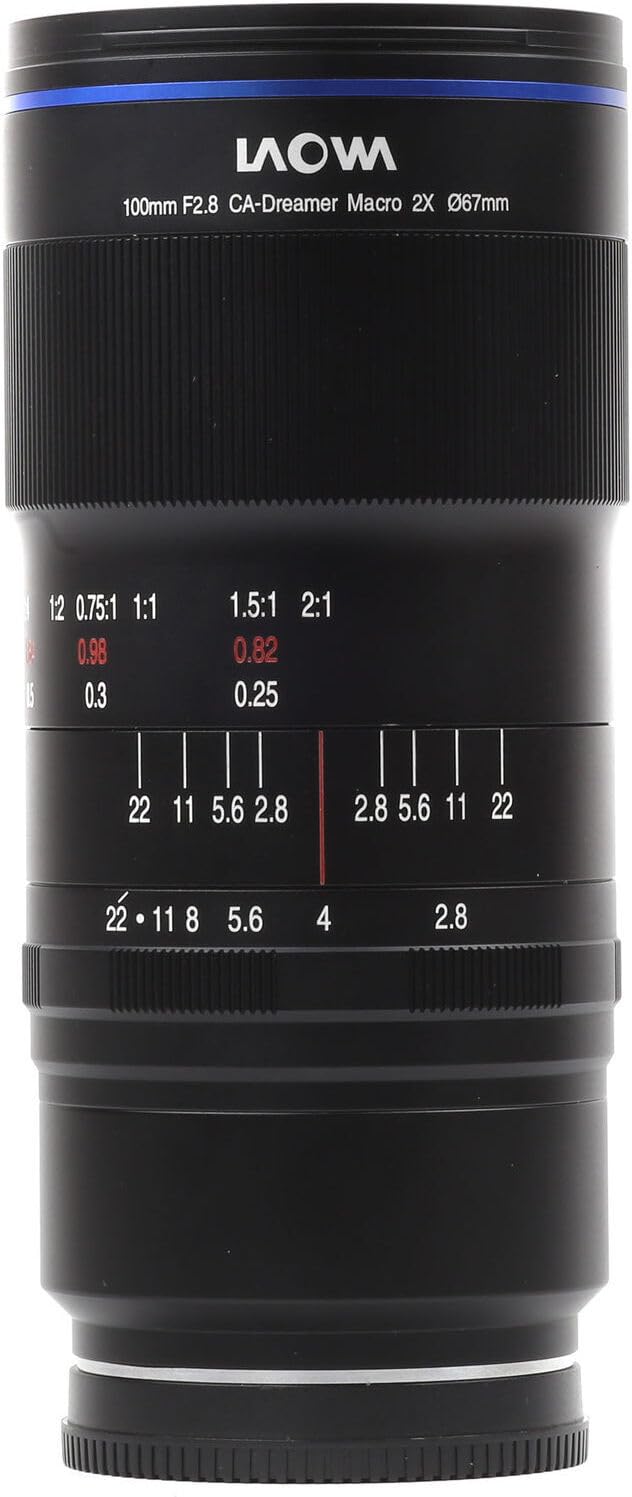
Double the magnification, double the detail — for the most obsessive food plates.
This Laowa lens goes beyond typical macro. Where most food lenses stop at 1:1 (life-size), the Laowa 100mm f/2.8 hits 2:1 magnification, meaning your subject appears twice as large on the sensor as it does in real life. That lets you capture the crystalline structure of sea salt or the tiny veins on a lettuce leaf with no cropping needed. The 100mm focal length keeps you far enough from the plate to avoid shadows, and the apochromatic (APO) optics eliminate the purple-green fringing that ruins extreme-macro shots. It weighs 638 g and uses a manual-only focus system built around 12 elements in 10 groups, with a 67mm filter thread.
Image quality is the headline: owners call it super sharp and note that it beats lenses costing twice as much, like the Sony 90mm and Sigma 105mm at half the price. The focusing ring turns smoothly, which matters for those minute focus adjustments you make when framing a single raspberry. Buyers also praise the zero distortion and chromatic aberration control, saying it creates tack-sharp photos even at the extreme 2:1 magnification. For locked-down food photography, the manual focus is a feature, not a flaw — you set your focus point and adjust the plate position.
The big trade-off is that there is no image stabilization and no autofocus. That means you need a solid tripod or a very steady hand, especially at 2:1 where any breath of movement creates visible blur. It also takes practice to learn manual focus quickly if you are shooting a fast-cooking dish that plates and melts within minutes. A few owners call the manual-only nature a learning curve but say the picture quality is rewarding enough to stick with it. If you shoot food on a tripod and want bragging-rights sharpness, this is your lens.
The standout spec: 2:1 magnification — the only lens in this roundup that lets you shoot a subject larger than life without extension tubes.
The honest limit: No autofocus or image stabilization means it is strictly for tripod work or very controlled setups; not a grab-and-go dinner party lens.
Best for: The photographer who shoots food on a tripod, wants to capture microscopic-level detail of ingredients, and values pure optical quality over convenience.
skip it if: You need to move fast between shots or shoot handheld in variable light; the manual-only operation will slow you down.
4. Sony SEL30M35 30mm f/3.5 Macro Lens

Tiny lens, tiny price, and a 1:1 macro that fits in a jacket pocket.
Sony E-mount shooters get a compact true macro lens here that weighs only 138 g. The 30mm focal length is perfect for overhead flat-lays — you can mount the camera on a tripod arm directly above a plate without needing a C-stand at ceiling height. The 1:1 magnification ratio means a single cherry fills the entire frame, and the minimum working distance is just 2.4 cm, allowing you to literally brush against the garnish. The lens uses a 6-group, 7-element design with an internal stepping motor for quiet video capture and rear focusing. Owners consistently call it very sharp up close, sharper than most kit zooms and some prime lenses.
Lens quality and autofocus are the two most-discussed strengths, each gathering dozens of positive mentions. The autofocus is fast and quiet thanks to the stepping motor, which also makes the lens well-suited to video b-roll of a chef assembling a dish. The f/3.5 maximum aperture is the main trade-off — it does not let in as much light as a fast f/1.8 lens, so you will rely on ambient light or a ring light for dim scenes. That said, many owners say the f/3.5 aperture is rarely a problem because they stop down anyway for full-plate sharpness. On a Sony ZV-E10 or similar APS-C body, this lens is a reliable daytime partner for plating shots and ingredient close-ups.
The build is entirely plastic, which keeps the weight low but means it does not feel as premium as the metal-barreled alternatives. A few owners describe it as bulky for its focal length, though most find it lightweight. The 49mm filter diameter is unusually small, so you may need step-up rings for common filters. But as the crowd says, it is the best bang-for-the-buck macro in the Sony E lineup — 4.5 stars from 300+ owners confirms that for a dedicated food and detail lens.
What You Get
- True 1:1 macro in a 138-gram body — fits any bag or pocket
- Sharp up close, out-resolving kit zooms and many primes
- Quiet internal stepping motor for video focus pulls
What to Consider
- f/3.5 aperture limits low-light performance and background blur
- Plastic build does not feel as durable as metal lenses
- 49mm filter size is non-standard for most photography kits
Best for: Sony E-mount owners who shoot overhead food flat-lays and ingredient macros on a budget; the light weight makes it a no-brainer for everyday carry.
Think twice if: You shoot in dimly lit restaurants or want dreamy background blur — the f/3.5 aperture limits both possibilities compared to the Canon or Meike primes.
5. Nikon AF-S 24mm f/1.8G ED
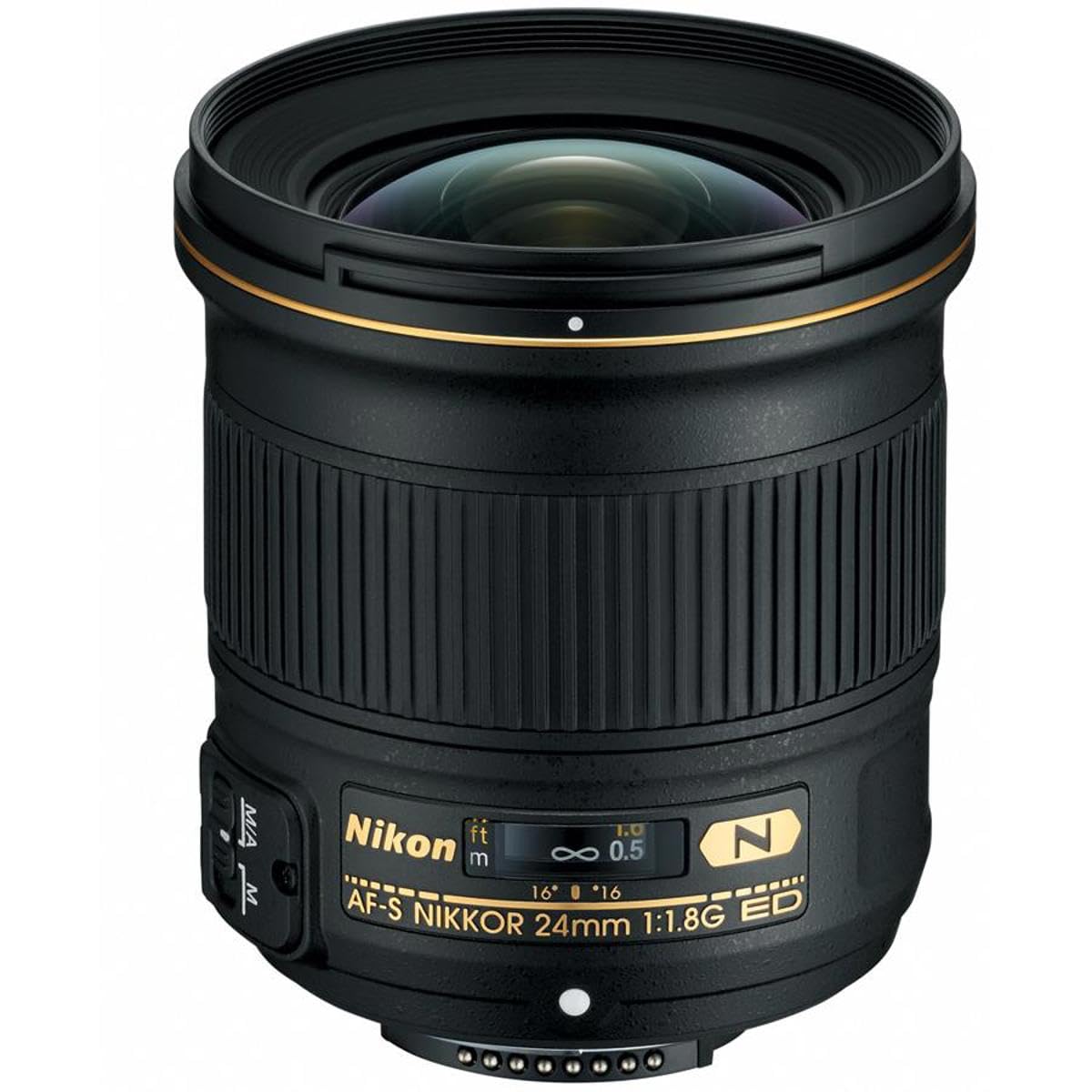
A wide-angle prime (a fixed-focal-length lens) with a wide f/1.8 aperture (lets in lots of light) built for rich table scenes.
This Nikon lens is built for a different kind of food shot — the scene that tells the story of the entire table, not just one plate. The 24mm focal length on full-frame gives you enough field of view to capture a sizzling skillet, a bubbling pot, and the steam rising from all of them in a single frame. The f/1.8 aperture is very fast, meaning you can shoot in near-darkness at a tapas bar without a flash. The lens uses an ED (Extra-low Dispersion) glass element to cut chromatic aberration, so you get clean edges even at the corners of the frame. Weighing 1.3 pounds, it is a moderate carry for a wide prime.
Owners call the glass incredible and praise its sharpness — lens quality and sharpness each receive roughly 20 positive mentions. The lens captures close-up objects with blurry backgrounds well, and the minimum focus distance lets you get reasonably close to a plate for a dramatic wide-angle portrait of the dish. The fast f/1.8 aperture also produces the very shallow depth of field that makes a single cocktail look gigantic against a blurred bar backdrop. Nikon’s official description specifically mentions food as a use-case alongside landscapes and action.
However, focus accuracy earns mixed feedback. While many find it fast and reliable, a notable complaint is that wide-open (f/1.8) the autofocus can miss, with one owner reporting they went through two copies and still could not tune the focus correctly. For food photography, where you often want pinpoint focus on a single element, this is a real concern. The lens also shows slight wide-angle distortion (straight lines curve outward) if your plate is too close to the edge of the frame. It is a specialized tool for rich, story-driven food photography rather than isolated macro detail work.
Why it stands out: The only wide-angle in the roundup — perfect for capturing an entire table scene or a chef’s hands plating a dish, all with f/1.8 low-light performance.
The real caveat: Autofocus at f/1.8 can be inconsistent on some bodies, and the 24mm focal length distorts close-up subjects at the frame edges.
Reach for this if: You are a Nikon shooter who wants an f/1.8 wide-angle for storytelling scenes — a full table of dim sum, a dramatically lit kitchen, a huge pot of chili.
pass on it if: You need true macro detail or distortion-free close-ups of a single plate; the 24mm wide angle is not designed for that job.
6. Meike 85mm f/1.8 SE Mark II STM
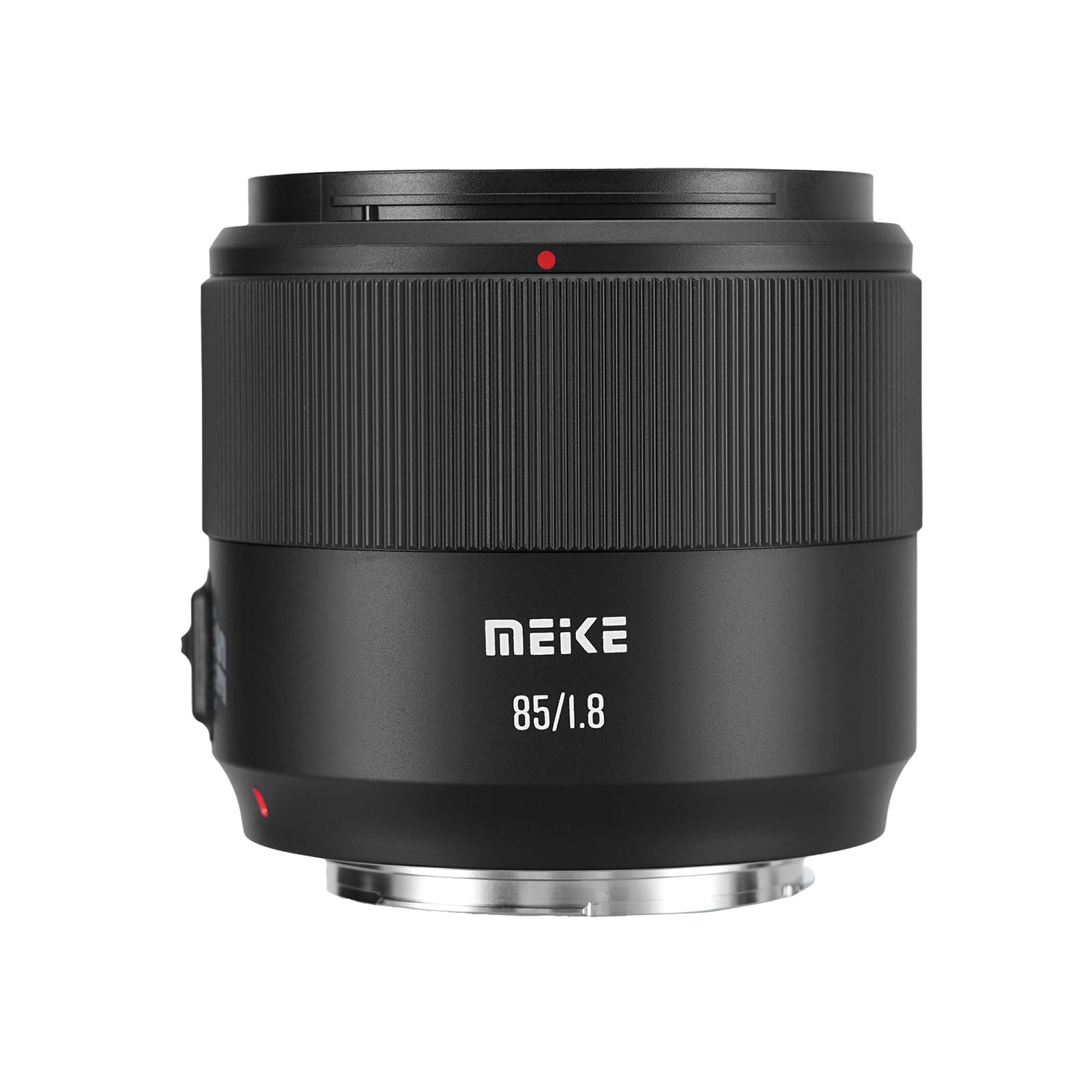
An 85mm portrait lens that doubles as a food bokeh machine for Canon shooters.
If your food photography style is all about isolating a single dish against a dreamy, blurred background, the 85mm f/1.8 focal length is a classic choice. The Meike delivers this at a dramatically lower cost than Canon’s own 85mm, but with modern features like an STM stepping motor for silent autofocus and a micro Type-C port for firmware updates. The aperture range goes from f/1.8 to f/16, and the 85mm focal length on a Canon APS-C body becomes roughly 136mm equivalent, which compresses the scene and makes any plate behind-the-main look beautifully soft. The lens uses 7 groups with 11 elements and claims 8K resolution sharpness.
Buyers praise the autofocus as fast and silent, with limited hunting except in very low light, where it struggled. Owners call it a high-quality Canon competitor with image quality on par with Canon’s own STM lenses. The f/1.8 aperture creates the classically flattering background blur that separates a bowl of ramen from its messy kitchen backdrop. The lens feels snug in the mount with no wiggle, which is reassuring at this price point. It also works on mirrorless bodies with an EF-to-RF adapter without losing autofocus speed or lens corrections.
The biggest gap here is that the Meike is not a macro lens — its maximum magnification is just 0.17x, and the minimum focus distance is 0.65m, so you cannot shoot an extreme close-up of a single berry. The lens also lacks weather sealing, which is not unique at this price but note if you shoot in steamy kitchens. A few owners noted that on older Canon bodies like the 40D, autofocus could fail entirely (maxing distance and stopping), leaving only manual focus available. For full-frame Canon bodies like the 5D Mark II, it works perfectly. It is a straightforward prime with one clear purpose: creamy bokeh at a bargain price.
What You Get at This Price
- Fast, silent autofocus with minimal hunting in good light
- Super smooth background blur at f/1.8 that isolates plates beautifully
- Firmware upgradeable via a micro Type-C port — unusual at this price
What It Lacks
- Not a macro lens — 0.17x magnification cannot capture small detail
- No weather sealing; keep it out of steamy commercial kitchens
- Compatibility issues reported on some older Canon APS-C bodies
Best for: Canon DSLR owners on a budget who want an 85mm f/1.8 for those beautiful, full-plate shots with deep background blur — think a single taco in sharp focus against a soft, warm background.
Not ideal for: Anyone who needs to get close to the plate; the 0.65m minimum focus distance means you stand back and shoot the whole dish, not the detail.
Understanding the Specs
Magnification Ratio
This number tells you how large your subject appears on the camera sensor compared to its real-life size. A 1:1 ratio means a one-inch tomato fills one inch on the sensor — full life-size. A 2:1 ratio (like the Laowa) means the tomato looks twice as large as real life, capturing microscopic detail. For food photography, 1:1 is the gold standard for close-up shots of ingredients and plating detail. Lenses below that (like 0.17x) still work for full-plate shots but cannot isolate a single grain or bubble.
Focal Length and Working Distance
Wider focal lengths (24mm to 35mm) let you shoot overhead flat-lays from a short, stable tripod arm. Longer focal lengths (85mm to 100mm) give you a comfortable arm’s-length distance from the plate, which is ideal for side-angle shots of a steaming dish without the lens fogging up. Shorter lengths require you to hover closer, which can cast shadows or risk steam damage. Longer lengths compress the perspective, making the background look closer and more blurred.
FAQ
Do I need a macro lens for food photography or can a standard prime work?
Is image stabilization important for food photography?
What is the best focal length for food photography?
Can I use a portrait lens for food photography?
Does a brand-new lens matter more than a renewed one for food shooting?
What does the f-stop number mean for food photos?
Will my Canon EF lens work on a mirrorless camera?
Why would I choose a manual focus lens for food?
Final Thoughts: The Verdict
For most buyers, the dslr lenses for food photography winner is the Canon EF 35mm f/2 IS USM because it combines fast aperture, 4-stop image stabilization (keeps shots sharp when you hand-hold in dim light), and outstanding sharpness in a lightweight body that handles everything from a window-lit flat-lay to a candlelit dinner plate without needing a tripod. If you want true 1:1 macro detail (life-size magnification) of ingredients and plating, grab the Canon EF 100mm f/2.8L IS USM (Renewed) for L-series optics at a fraction of the new price. And for Sony E-mount shooters who need a compact, affordable macro for overhead food work, the Sony SEL30M35 30mm f/3.5 is the one to reach for.
How We Picked
We do not accept paid placement. Every pick is matched to a real buyer and a real use-case; we do not hands-on test units.
Sources & Methodology
Specifications: manufacturer listings and product documentation. Review insights: verified customer reviews, as of July 2026. Pricing: not shown on this page (it changes often); check the current price via the retailer link.
As an Amazon Associate, WellFizz earns from qualifying purchases. This does not affect which products we feature.
Related Guides

Mo Maruf
I created WellFizz to bridge the gap between vague wellness advice and actionable solutions. My mission is simple: to decode the research and give you practical tools you can actually use.
Beyond the data, I am a passionate traveler. I believe that stepping away from the screen to explore new environments is essential for mental clarity and physical vitality.