Our readers keep the lights on and my smoothie glass nicely filled. As an Amazon Associate, I earn from qualifying purchases.
Specs are compiled from manufacturer listings and verified buyer reviews and can change over time — please confirm the key details on the product page before buying.
For self-portraits, the camera’s flip screen and remote-trigger options matter more than megapixels. You need to see yourself while framing, and fire the shutter without touching the camera — every pick here delivers on both. The real question is how sharp your autofocus is and how much control you want over the final image.
I’m Mohammad Maruf — the founder and writer behind WellFizz. This guide is built by comparing the manufacturers’ published specifications and the patterns across verified customer reviews, so you get each pick’s real strengths and trade-offs instead of marketing spin.
The best starting point for a sharp, flattering self-portrait setup is a dslr camera for self portraits with a vari-angle touchscreen and reliable eye-tracking autofocus, so you can frame, focus, and fire hands-free with confidence.
Our Picks at a Glance


How To Choose The Best DSLR Camera For Self Portraits
When you shoot self-portraits, you need a camera that frames you without a second person and locks focus on your face when you press the button from across the room. Most modern DSLRs handle both jobs well, so your choice depends on which bundle fits your budget and shooting style.
A vari-angle screen is the single biggest usability win
A flip-out screen that tilts and swivels means you can stand in front of the camera and see exactly what the sensor sees. A fixed screen forces you to frame blind or guess. For self-portraits, a touchscreen you can tap to focus makes the whole process faster and far less frustrating.
Autofocus points decide how sharp your eyes are
The more autofocus points a camera has, the more of the frame it can track. With fewer points, focus tends to lock on the center of the frame, which is fine if you are centered but awkward if you compose yourself off to one side. More points give you the freedom to pose anywhere in the shot and still keep your face crisp.
Remote triggering means hands-free shooting
To take a self-portrait without sprinting back and forth, you need a way to fire the shutter without touching the camera. A built-in self-timer works everywhere, but Wi-Fi or Bluetooth apps give you a live preview on your phone and let you tap to shoot from where you stand. That flexibility changes how natural your poses look.
Quick Comparison
| Model | Best For | Autofocus Points | Max Video | Screen Type | Amazon |
|---|---|---|---|---|---|
| Nikon D5600 (18-55mm)★ Best Overall | Overall self-portrait value | 39 | 1080p @ 60 fps | 3.2″ Vari-Angle Touch | Amazon |
| Canon EOS Rebel T7 + Deco GearBest Beginner Bundle | Photo quality on a budget | 9 | 1080p @ 30 fps | 3.0″ Fixed LCD | Amazon |
| Nikon D5600 (Renewed)Refurbished Value Pick | Refurbished value pick | 39 | 1080p @ 60 fps | 3.2″ Vari-Angle Touch | Amazon |
| Nikon D5200 | Sharp focus on a budget | 39 | 1080p @ 60 fps | 3.0″ Vari-Angle | Amazon |
| Canon Rebel T7 Triple-Lens | Versatile lens collection | 9 | 1080p @ 30 fps | 3.0″ Fixed LCD | Amazon |
| Canon EOS Rebel SL3 | Compact body with eye AF | 9 | 4K UHD | 3.0″ Vari-Angle Touch | Amazon |
| Nikon D850 | Professional full-frame | 153 | 4K UHD | Tilting Touch | Amazon |
In-Depth Reviews
1. Nikon D5600 with 18-55mm VR Kit Lens
Our pick — over 4.5★ from 650+ verified ratings; the strongest balance of quality and price.
The self-framing favorite that pairs a 3.2-inch vari-angle touchscreen with a class-leading 39-point autofocus system.
You compose your own portrait on a 3.2-inch vari-angle touchscreen that swings out and tilts, then tap the screen to lock focus exactly on your face. That 39-point autofocus system is the deepest here outside the pro-grade D850, so you can pose off-center and still get tack-sharp eyes. The kit lens is the AF-P DX NIKKOR 18-55mm f/3.5-5.6G VR, which adds vibration reduction (VR) to steady handheld shots in lower light.
Owners consistently describe it as a great starter model that is easy to use and lightweight, and they praise the crystal-sharp optics from that kit lens. The consensus also notes that the SnapBridge Bluetooth and Wi-Fi with NFC connectivity is handy but buggy, often requiring re-pairing with your phone. Battery life draws mixed feedback too, so a spare is a smart grab if you plan long shoots.
Buyers report “The battery was charged up and ready to go so I lost no time on my job and was able to start shooting pictures right away.” It shoots Full HD 1080p video at 60 fps, which is double the frame rate of the Canon Rebel T7, so your video self-portraits look smoother. The ISO range of 100 to 25600 keeps indoor shots clean, and the 5 fps continuous shooting speed catches a quick pose change without missing the moment.
Why Self-Portrait Users Love It
- 3.2-inch vari-angle touchscreen makes framing yourself easy from any angle
- 39 autofocus points track your face even when you compose off-center
- 5 fps burst speed captures natural in-between expressions
Fair Trade-Offs To Expect
- SnapBridge app can require re-pairing, so test the workflow before a big shoot
- Battery life is modest, so carry a spare for full-day sessions
Your best fit: The Nikon D5600 suits a beginner or intermediate who shoots most handheld self-portraits and videos at home, and wants a screen that swivels toward them.
Think twice if: You rely heavily on phone transfer, since the SnapBridge connectivity is the most-reported weak spot.
2. Canon EOS 2000D / Rebel T7 Essential Bundle (Renewed)
A 24.1MP Rebel T7 with a second battery and a vlogging tripod, built for quality self-portraits without the premium price.
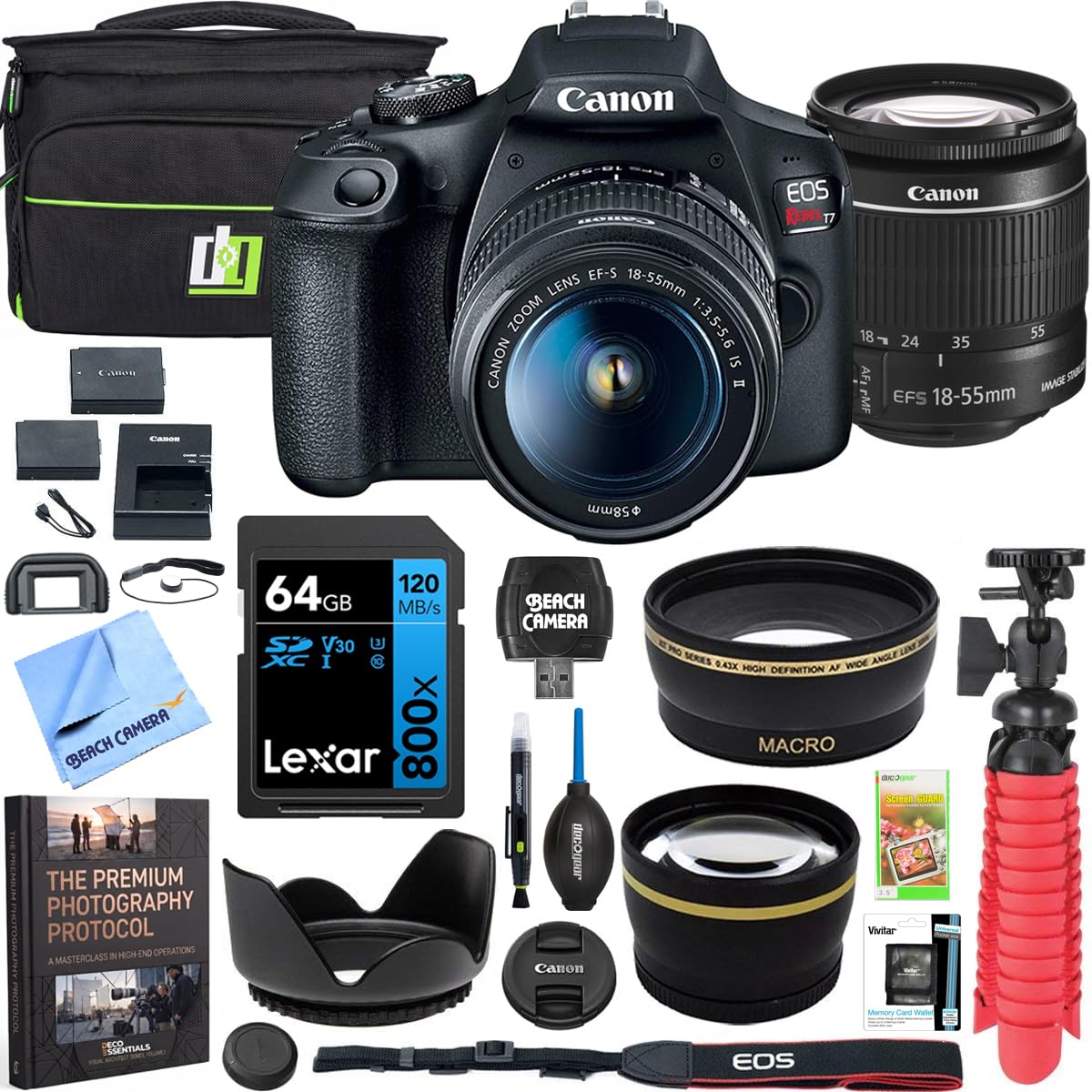
This bundle is built around the Canon EOS Rebel T7 with an EF-S 18-55mm f/3.5-5.6 IS II lens, and it ships with a Deco Gear camera bag, a replacement battery, a 12-inch tabletop vlogging tripod that doubles as a handheld grip, plus a 64GB Lexar SDXC card, cleaning tools, and a wide-angle-and-telephoto lens pair. The second battery is a genuine plus for long self-portrait sessions, and the 12-inch tripod is just the right height for a seated desk or vanity setup. Its 24.1MP APS-C CMOS sensor and 18-55mm lens are well-suited to portraits, landscapes, and everyday shots.
The customer consensus is strong here: this is a great starter option with lots of extras and excellent value, taking great pictures with good low-light performance. It is the most-reviewed Canon pick on this list, with hundreds of owners largely happy with what they got. The 9-point autofocus and 3 fps burst remain the same entry-level limits as the other Rebel T7 variants, and the fixed 3.0-inch screen means you frame yourself carefully rather than swiveling the display.
The honest trade-off is in the mixed functionality reports, where some buyers noted issues with the flash not working and one reported autofocus trouble after six months of use. Durability is the most-discussed negative aspect, so treat the moving parts gently. As buyers put it: “Great starter kit takes wonderful photos.”
Value angle: The bundle’s double-battery setup and versatile tripod make it the pick for a user who shoots long sessions on location without access to a wall outlet.
Durability note: The recurring gripe is long-term reliability, so a warranty check and gentle handling are worthwhile.
3. Nikon D5600 with 18-55mm VR Lens (Renewed)
A renewed D5600 that keeps the full 39-point autofocus and 3.2-inch vari-angle touchscreen at a friendlier budget.
If the full-price D5600 above is the pick but your budget is tighter, this renewed version delivers the same core self-portrait strengths: a 24.2MP DX-format CMOS sensor, the 3.2-inch 1.037m-dot vari-angle touchscreen, and a 39-point autofocus system. It also records Full HD 1080p video at 60 fps, for that smooth motion in your video self-portraits. SnapBridge Bluetooth and Wi-Fi with NFC round out the wireless control options.
Owners praise the photo quality, with several saying it takes excellent pictures “despite being refurbished,” and that it looks brand new. The battery is the EN-EL14 lithium-ion type, and battery life draws mixed reviews, so pack a spare for a long day. Customers note it arrives complete with strap, battery, and charger, ready to shoot.
The trade-off with any renewed camera is that you inherit someone else’s wear, and in rare cases a unit can have focus trouble. But the majority of reviewers point out a durable, fault-free body that still holds up well after a year of use. It is the sensible middle path between the full-price D5600 and the older D5200.
Smart spend: You get the same 39-point autofocus and 60 fps video as the new D5600, at a lower cost, if you are comfortable buying renewed.
Watch the battery: Battery life reviews are mixed, so a spare EN-EL14 is a smart addition.
4. Nikon D5200 with 18-55mm VR Kit Lens

An older Nikon that still packs 39 autofocus points and a vari-angle screen, making it the budget pick for sharp off-center self-portraits.
The D5200 is the smart budget pick for self-portraits because it carries the same 39-point autofocus system as the newer D5600, at a lower price. That means you get the same off-center posing freedom. It pairs a 24.1MP DX-format CMOS sensor with a 3.0-inch (921k-dot) vari-angle monitor, so you can flip the screen to face you and frame the shot. It shoots 5 fps continuous, keeping pace with the D5600, and offers 16 scene modes for quick auto results.
This camera earns the most positive reviews for image quality on this list — by a huge margin. Buyers praise sharp focus points and an easy-to-understand screen interface, calling it a bargain camera that’s easy to handle and use, with a lightweight body and highly convenient articulated screen. It suits both beginners progressing to advanced photography and experienced users.
The trade-offs: only AF-S lenses autofocus on this body, older screw-drive lenses won’t, and the built-in flash is weak, so an external flash helps for indoor portraits. Battery life of 300-500 photos per event day is workable, and the 18-55mm kit lens is fine for indoor use, though a 55-200mm is recommended for distance.
Budget brain: The 39-point autofocus is a rare find at this price, giving you sharp, off-center face focus without paying for a newer body.
Gear note: Pair this with a fast prime lens and an external flash to get the most out of low-light portraits.
5. Canon EOS Rebel T7 Triple-Lens Bundle (Renewed)

A Rebel T7 with three lenses, from 18-55mm to a 500mm preset, for self-portrait styles that range from wide to distant.
This bundle gives you the Canon EOS Rebel T7 body plus three lenses: the EF-S 18-55mm f/3.5-5.6 IS II for everyday shots, an EF 75-300mm f/4-5.6 III telephoto, and a 500mm f/8 preset lens for far-away subjects. For self-portraits, the 18-55mm is your workhorse, while the longer lenses open up creative compressed-background looks if you shoot with a tripod and remote. It includes SanDisk 32GB SDHC cards, a shoulder case, a slave flash, UV filters, a monopod, and a flexible spider tripod.
Buyers love the camera quality and lenses, with one noting it “comes with everything needed for professional-looking pictures.” The consensus is that it’s easy to manage and worth the money, with camera quality being the most-praised aspect. The two-lens-plus-telephoto setup is described as quality glass, though the long zoom is manual and needs a tripod at distance.
The catch is the same 9-point autofocus used across the Rebel T7 line, and the fixed 3.0-inch screen that doesn’t swivel. Reliability draws mixed feedback, with the rare report of a unit stopping after a few months. The slave flash is also weak, so a stronger external flash is worth budgeting for if you shoot much indoors.
The Lens Flexibility
- Three lenses cover 18-55mm everyday, 75-300mm telephoto, and 500mm preset looks
- Monopod and flexible tripod help you hold steady for hands-free shots
- High-quality UV filters included to protect your glass
The Practical Limits
- Autofocus is slow; manual focus is faster for most shooting
- Weak slave flash means you’ll want a stronger external unit for indoor portraits
Choose this if: You want to experiment with a wide range of focal lengths immediately, without buying lenses separately.
skip it if: You prioritize fast autofocus and a swivel screen, since the T7’s 9-point system and fixed display trail the D5600.
6. Canon EOS Rebel SL3 with Vari-Angle Touch

The lightest, smallest EOS DSLR with Dual Pixel autofocus and eye detection, plus 4K video, in a body made for self-portraits.
Canon calls this the lightest and smallest EOS DSLR, and that compact body is a real advantage when you are holding the camera at arm’s length or balancing it on a shelf. It packs a 24.1MP APS-C CMOS sensor with Dual Pixel CMOS AF and eye detection AF, which is a standout feature for self-portraits because the camera locks onto your eye, not just your face. The 3.0-inch vari-angle touchscreen swings out so you can see yourself, and you can tap the screen to focus and shoot.
It records 4K UHD 2160p video, a step above the 1080p found on every other budget DSLR in this guide, so your video self-portraits get four times the resolution. Owners praise its gorgeous photos and video, user-friendly interface, and a guided settings mode that teaches new photographers manual control. They also report a long battery life, with one noting about 1630 shots per charge in viewfinder use.
The mixed feedback is on its compact size, which some love and some find too small for larger hands, plus a clunky wireless transfer app and a 30-minute video limit. It uses the standard 9-point phase-detect autofocus system when you use the optical viewfinder, though the Dual Pixel system shines in live view on the screen. For a self-portrait shooter who wants 4K and eye AF in a travel-friendly body, this is the one.
Modern features: Eye detection AF and 4K video make this the most future-proofed self-portrait DSLR under the pro tier.
Size check: Its tiny body is a blessing for travel but can feel cramped if you have large hands.
7. Nikon D850 Full-Frame Bundle
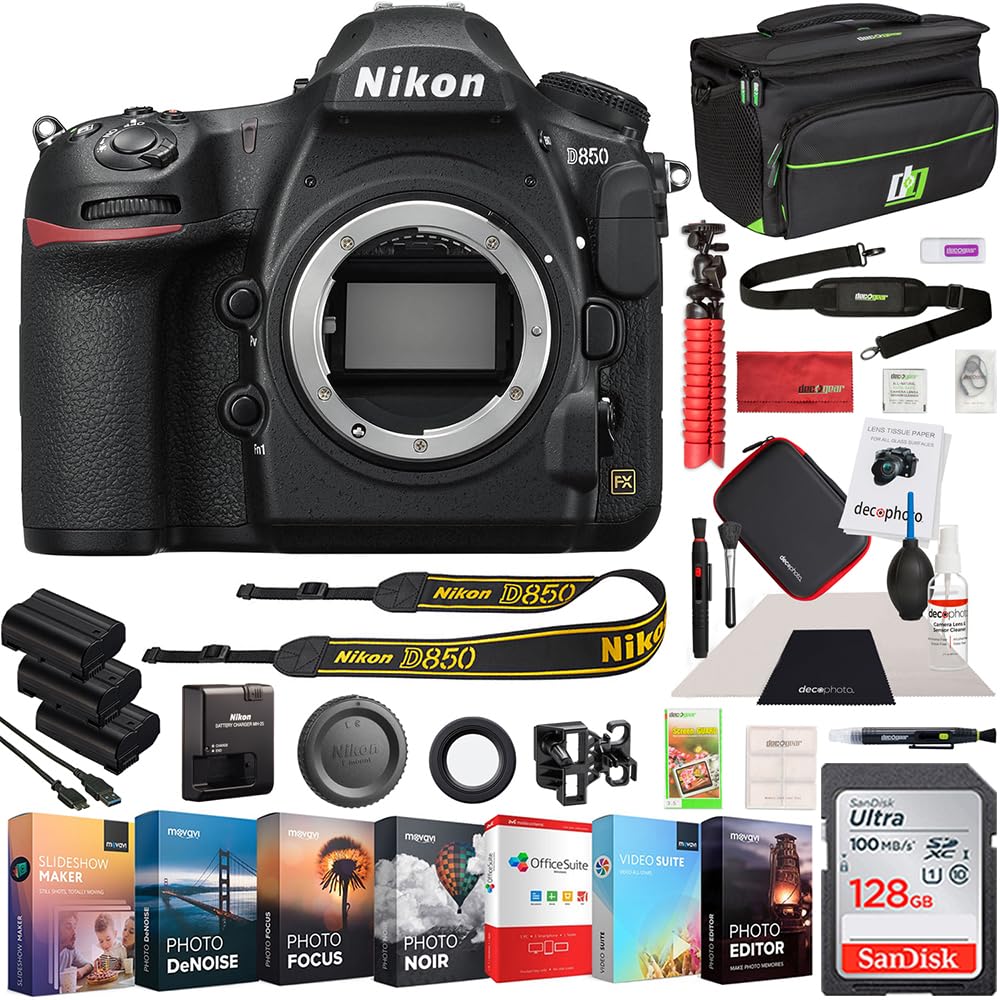
A 45.7MP full-frame powerhouse with 153 autofocus points and 4K video, when your self-portrait work demands professional detail.
If your self-portraits are commercial, high-end, or simply deserve the best, the D850 is the serious option. Its 45.7MP back-side illuminated (BSI) full-frame CMOS sensor, with no optical low-pass filter, captures extraordinary detail, and the EXPEED 5 processor keeps images clean from ISO 64 to ISO 25,600. It shoots up to 9 fps at full resolution with full autofocus performance, so you can fire off a burst and catch the perfect micro-expression.
The 153-point autofocus system is the most advanced on this list, easily tracking your face across the entire frame. It records 4K UHD (3840×2160) video in full frame, plus 4K and 8K time-lapse, making it a true hybrid for video self-portraits. It has a tilting touchscreen with touch AF and touch shutter control, which means you can tap the screen to focus and fire, and built-in Wi-Fi and Bluetooth for remote smartphone control.
This bundle adds two rechargeable EN-EL15a batteries, a 128GB SanDisk Ultra SDHC card, camera bag, 12-inch tripod, and a photo/video editing suite, so you are ready from unboxing to export. Buyers describe the camera quality as excellent, though reliability draws mixed feedback. It carries no built-in flash, so you will use an external unit for indoor portrait work.
What The Pro Tier Gets You
- 45.7MP full-frame sensor with no optical low-pass filter for maximum detail
- 153 autofocus points track your eye anywhere in the frame
- 9 fps continuous shooting captures fleeting expressions
What To Factor In
- No built-in flash, so budget for an external speedlight
- Reliability feedback is mixed, so consider the warranty coverage
For the working pro: Choose the D850 when you need the resolution, dynamic range, and autofocus breadth for large prints or commercial self-portrait work.
Value check: If your portraits live mostly on social media, the SL3’s 4K and eye AF deliver most of the benefit at a far lower budget.
Understanding the Specs
Vari-Angle vs Fixed Screens
A vari-angle screen flips out and rotates so it faces you while you stand in front of the camera. That is the single most important feature for self-portraits, because you can see your framing and your expression live. A fixed screen means you frame by guessing or using a phone app, which is slower and less reliable.
Autofocus Points and Eye Detection
Autofocus points are the spots in your frame where the camera can lock focus. More points mean you can place your face anywhere in the composition and still get it sharp. Even better is eye detection autofocus, which finds your actual eye and locks there, giving portraits that crisp, professional look.
Remote Triggering and Self-Timer
Self-portraits require firing the shutter without touching the camera. A built-in self-timer works everywhere and needs no extra gear. Wi-Fi or Bluetooth apps go further by showing a live preview on your phone and letting you tap to shoot from where you stand, which helps you adjust your pose before the shutter fires.
Video Resolution for Moving Self-Portraits
If you plan video self-portraits, resolution and frame rate matter. 1080p is standard and looks great on phone screens. 4K UHD delivers four times the detail, useful for cropping, but uses more storage and processing power. A higher frame rate like 60 fps gives smoother motion than 30 fps.
FAQ
What does a vari-angle screen do for self-portraits?
Do I need more autofocus points for self-portraits?
How do I take a self-portrait without touching the camera?
Is a more expensive full-frame camera better for self-portraits?
Does the kit lens work well for indoor self-portraits?
Why does 4K video matter for a self-portrait camera?
Does the flash matter for indoor self-portraits?
Is it better to get a bundle with more accessories?
Final Thoughts: The Verdict
The dslr camera for self portraits winner is the Nikon D5600 because its 3.2-inch vari-angle touchscreen and 39-point autofocus make framing and sharp focus easy, and it captures smooth 1080p video at 60 fps. If you want 4K resolution and eye-detection autofocus in a compact body, grab the Canon EOS Rebel SL3. And for the widest lens selection straight from the start, the Canon Rebel T7 Triple-Lens Bundle is the one to reach for.
How We Picked
We do not accept paid placement. Every pick is matched to a real buyer and a real use-case; we do not hands-on test units.
Sources & Methodology
Specifications: manufacturer listings and product documentation. Review insights: verified customer reviews, as of August 2026. Pricing: not shown on this page (it changes often); check the current price via the retailer link.
As an Amazon Associate, WellFizz earns from qualifying purchases. This does not affect which products we feature.
Related Guides

Mo Maruf
I created WellFizz to bridge the gap between vague wellness advice and actionable solutions. My mission is simple: to decode the research and give you practical tools you can actually use.
Beyond the data, I am a passionate traveler. I believe that stepping away from the screen to explore new environments is essential for mental clarity and physical vitality.