Our readers keep the lights on and my smoothie glass nicely filled. As an Amazon Associate, I earn from qualifying purchases.
Specs are compiled from manufacturer listings and verified buyer reviews and can change over time — please confirm the key details on the product page before buying.
A Toy Poodle puppy has a mouth the size of a walnut and a digestive system still figuring out how to work. The wrong kibble can be too big to chew, too rich to digest, or missing the precise nutrients a tiny breed needs in its first year. This guide cuts through the marketing noise to find the dry food that fits your puppy’s actual mouth, stomach, and growth curve — using real owner experiences and manufacturer specs, not shelf hype.
I’m Mohammad Maruf — the founder and writer behind WellFizz. This guide is built by comparing the manufacturers’ published specifications and the patterns across verified customer reviews, so you get each pick’s real strengths and trade-offs instead of marketing spin.
Whether you are transitioning from weaning, managing a sensitive stomach, or trying to prevent those stubborn tear stains on a light coat, here is what matters most when choosing the right dry food for toy poodle puppy growth and daily happiness.
Our Picks at a Glance


How To Choose The Best Dry Food For Toy Poodle Puppy
Feeding a Toy Poodle puppy is not the same as feeding a Labrador puppy. The difference is the size of the mouth, the speed of the metabolism, and the unique health quirks this breed carries. Here are the three things you actually need to check before you buy.
Kibble Size
The #1 practical problem owners of Toy Poodles face is kibble that is too large. A piece bigger than about 6–8 mm can be difficult for a tiny puppy to pick up, chew, or swallow safely. The risk of gulping and choking is real. Look for explicit “small breed” or “toy breed” kibble sizing on the bag, or check the kibble dimensions in the specs. If a review mentions the kibble being “small,” that is a strong positive signal.
Nutritional Profile for Tiny Bodies
Toy Poodle puppies have fast metabolisms and small stomachs. They need calorie-dense food so they get enough energy without eating huge volumes that cause bloating. High-quality protein (like chicken, turkey, or white fish) should be the first ingredient. DHA (docosahexaenoic acid, an omega-3 fat that builds brain tissue) is critical for brain development in the first year, and calcium/phosphorus levels need to be correct for proper bone growth without overloading a tiny frame. Avoid foods with excessive fillers like corn, wheat, or soy; they add bulk without nutrition and can upset a sensitive stomach.
Sensitive Digestion and Common Allergies
Toy Poodles are prone to sensitive stomachs and food allergies, often to chicken or grains. If your puppy has loose stools, itchy skin, or excessive gas, a limited-ingredient diet or a novel protein like salmon or white fish can resolve chronic digestive issues. Probiotics (live good bacteria) and prebiotics (fibers that feed those bacteria) in the formula help maintain healthy gut flora, which is especially important during the transition from mother’s milk or from a breeder’s food.
Quick Comparison
| Model | Best For | Kibble Size | Key Protein | Bag Size | Amazon |
|---|---|---|---|---|---|
| Royal Canin Small Puppy★ Best Overall | Trusted Breeder Formula | Small (puppy-tune) | Chicken | 4 lb | Amazon |
| NutriSource Small & Medium BreedSensitive Tummy Savior | Probiotic Digestion | Small (5×10 mm) | Chicken & Rice | 4 lb | Amazon |
| Canidae Pure Farm to Bowl | Sensitive Tummies | Small | Salmon & Oatmeal | 4 lb | Amazon |
| Nature’s Protection White Fish | Tear Stain Control | Small | White Fish | 3.3 lb | Amazon |
| Wellness CORE Small Breed | High-Protein Growth | Small | Turkey & Salmon | 4 lb | Amazon |
| Bil-Jac Small Breed | Easy-to-Chew Bites | Small (proprietary soft shape) | Fresh Chicken | 6 lb | Amazon |
| ORIJEN Small Breed Puppy | WholePrey Nutrition | Small (6–7 mm square) | Poultry & Fish | 4 lb | Amazon |
In‑Depth Reviews
1. Royal Canin Size Health Nutrition Small Puppy Dry Dog Food, 4 lb Bag
Our pick — over 4.5★ from 12,500+ verified ratings; the strongest balance of quality and price.
The breeder-recommended gold standard for a reason — tiny kibble, proven results, and a 4.8-star crowd stamp across over 12,000 ratings.
This is the food many Toy Poodle breeders send puppies home with, and the owner feedback explains why. The crunchy kibble is specifically formulated for puppies with an expected adult weight of 9 to 22 lbs, which covers the upper end of the Toy Poodle range. Buyers report immediate improvements in digestion and behavior: owners mention switching from grocery-store brands to Royal Canin for their 6.5 lb pups and seeing digestion normalize fast — specifically, pooping dropping from five times a day down to two, and the puppy stopping the constant food-begging behavior altogether.
What wins people over is the precision. The formula includes antioxidants (substances that help protect cells) for immune support and prebiotics plus proteins for gut health. It is not the flashiest ingredient list on the shelf (chicken is the protein, and it does contain wheat and gluten), but the consistency across more than 12,000 ratings is hard to argue with. An occasional owner notes the price is higher than basic kibble, but the portion size needed is smaller, so a 4 lb bag stretches further than expected. If you want the safest starting point — the one vets and breeders most often hand you — this is it.
What owners love most
- Kibble size is perfect for toy breed mouths — small and easy to crunch
- Digestion transforms: less poop volume, less odor, less begging
- Breeder and vet trust that is earned over years, not marketing
The one honest trade-off
- Contains gluten and wheat — not ideal if your puppy has known grain sensitivity
- Price per bag is higher than general puppy foods
Best suited for: First-time Toy Poodle owners who want the safest, most widely-tested formula and are fine paying a little extra for proven digestion results.
Think twice if: Your puppy has a confirmed wheat or gluten allergy — the formulation is not grain-free.
2. NutriSource Small & Medium Breed Puppy Dry Dog Food, 4 lb
The tiny-kibble champ that Toy Poodle owners specifically rave about — pieces are around 5 x 10 mm, small enough for a 5 lb puppy to manage easily.
If you have a Toy Poodle puppy under 6 lbs, the kibble size of this NutriSource formula is one of the smallest you will find. Owners of 5 lb “Teddybear” puppies confirm the pieces are roughly 5 mm x 10 mm — about the size of a large grain of rice — which makes it easy for tiny jaws to pick up and chew. One owner switched from Purina Puppy Chow specifically because the NutriSource kibble was smaller and easier for their 10-week-old Toy Poodle to manage; the puppy no longer needed the food wetted to soften it.
Beyond the size, the formula is built for sensitive digestion. Chicken meal is the #1 ingredient, providing high-quality amino acids (protein building blocks) for muscle growth, and it is supplemented with L-Carnitine and taurine for heart health — a big deal for the long-term cardiac health of Toy Poodles. The prebiotics and probiotics foster a healthy gut, and the inclusion of brown rice, oatmeal, and barley provides sustained energy without the spikes. The 4 lb bag may not last long for a growing puppy: the 4 lb bag is reasonably priced, but it goes quickly if you have a growing puppy, so subscribe-and-save is the smart play.
Why it stands out
- Kibble is genuinely tiny — owners measure it at 5-10 mm for easy eating
- Includes prebiotics, probiotics, and heart-healthy taurine/L-Carnitine
- Recommended by breeders for exclusive use, backed by strong nutrition scores
Worth noting
- Value is mixed — the smaller bag may not last long for a growing puppy
- Chicken-based, so not suitable if your pup has a chicken allergy
Reach for this if: You have a tiny puppy (5-6 lbs) that struggles with larger kibble, and you want a probiotic-rich, grain-inclusive formula that supports heart health.
Look elsewhere if: Your puppy needs a grain-free or chicken-free diet.
3. Wellness CORE Small Breed Puppy Dry Dog Food, Grain Free, 4 lb
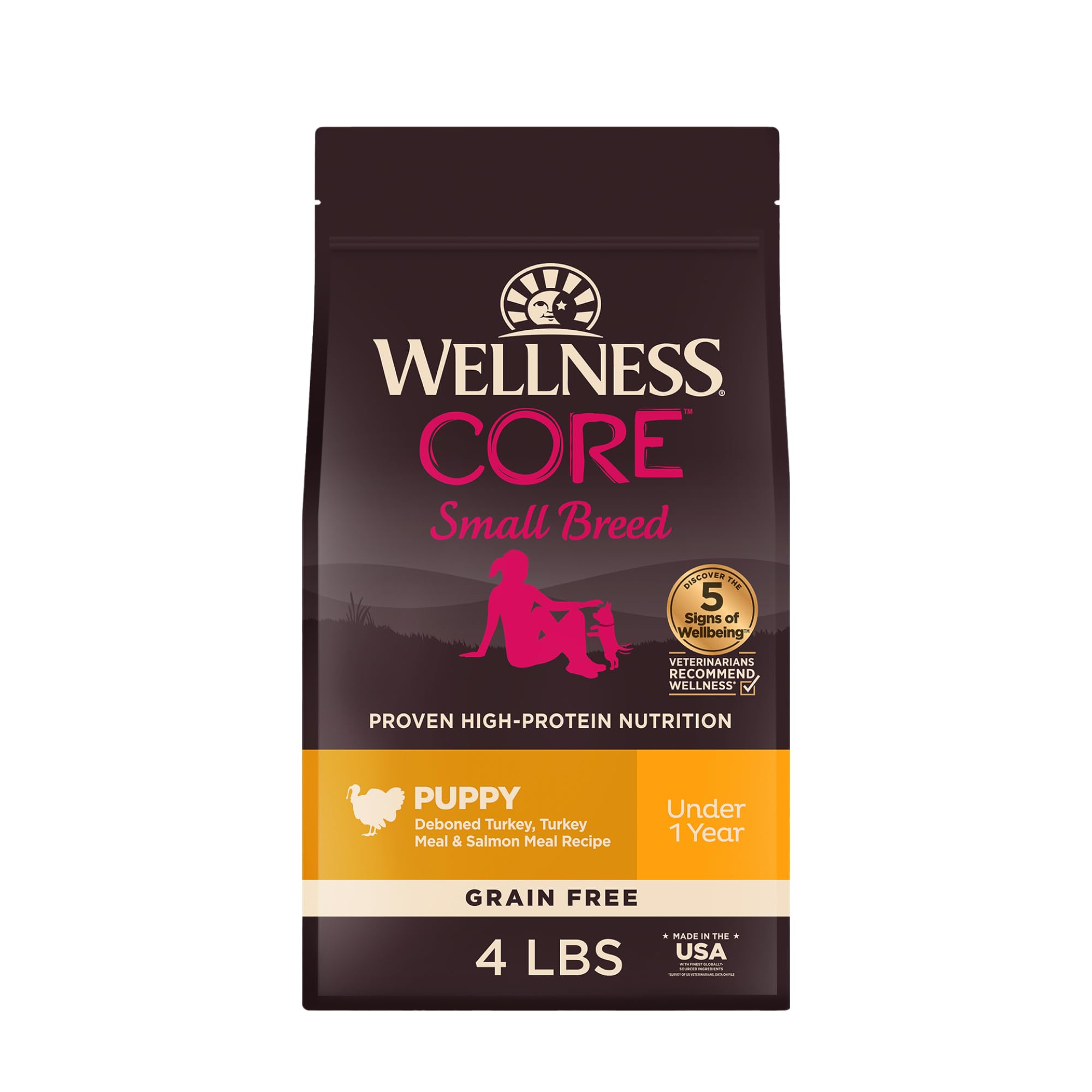
A protein-dense grain-free formula that fuels rapid growth — 53% of its ingredients are high-quality protein from turkey and salmon, with DHA for brain development.
For Toy Poodle owners who want a high-protein, low-filler diet, this Wellness CORE recipe is a strong candidate. The formula features responsibly sourced turkey and salmon, with guaranteed levels of DHA to support brain development and calcium/phosphorus for healthy bone and muscle growth. It also includes nutrient-rich superfoods like spinach and blueberries, which owners appreciate for their antioxidant content. The kibble is small-breed specific, and owners of teething puppies note the size is easy on sore gums.
Compared to the Royal Canin pick, the taste and digestive effects are more mixed here. While many puppies love it and thrive with well-formed stools and healthy coats, a smaller subset of customers note their dogs refused it or experienced digestive upset — including diarrhea — during the transition. The adjustment period can be a brief hurdle for some puppies, but for most, it resolves into excellent health. If your puppy has a chicken allergy, be aware that the turkey flavor may still contain chicken ingredients, so vet the label carefully before switching.
Strengths
- 53% high-quality protein for lean muscle and energy
- Contains DHA for brain development, plus spinach and blueberries for antioxidants
- Grain-free and made in the USA with non-GMO ingredients
Caveats
- Mixed digestive reactions — some puppies need a slow transition to avoid upset
- Not ideal for chicken-allergic dogs, as turkey formula may contain chicken
Best for: Owners who prioritize a high-protein, grain-free diet with superfood ingredients and are willing to manage a gradual food transition.
Who should pass: Puppies with known chicken sensitivities, or those with very sensitive stomachs that react poorly to rich protein.
4. ORIJEN Grain Free WHOLEPREY Dry Dog Food Small Breed Puppy Recipe, 4 lb
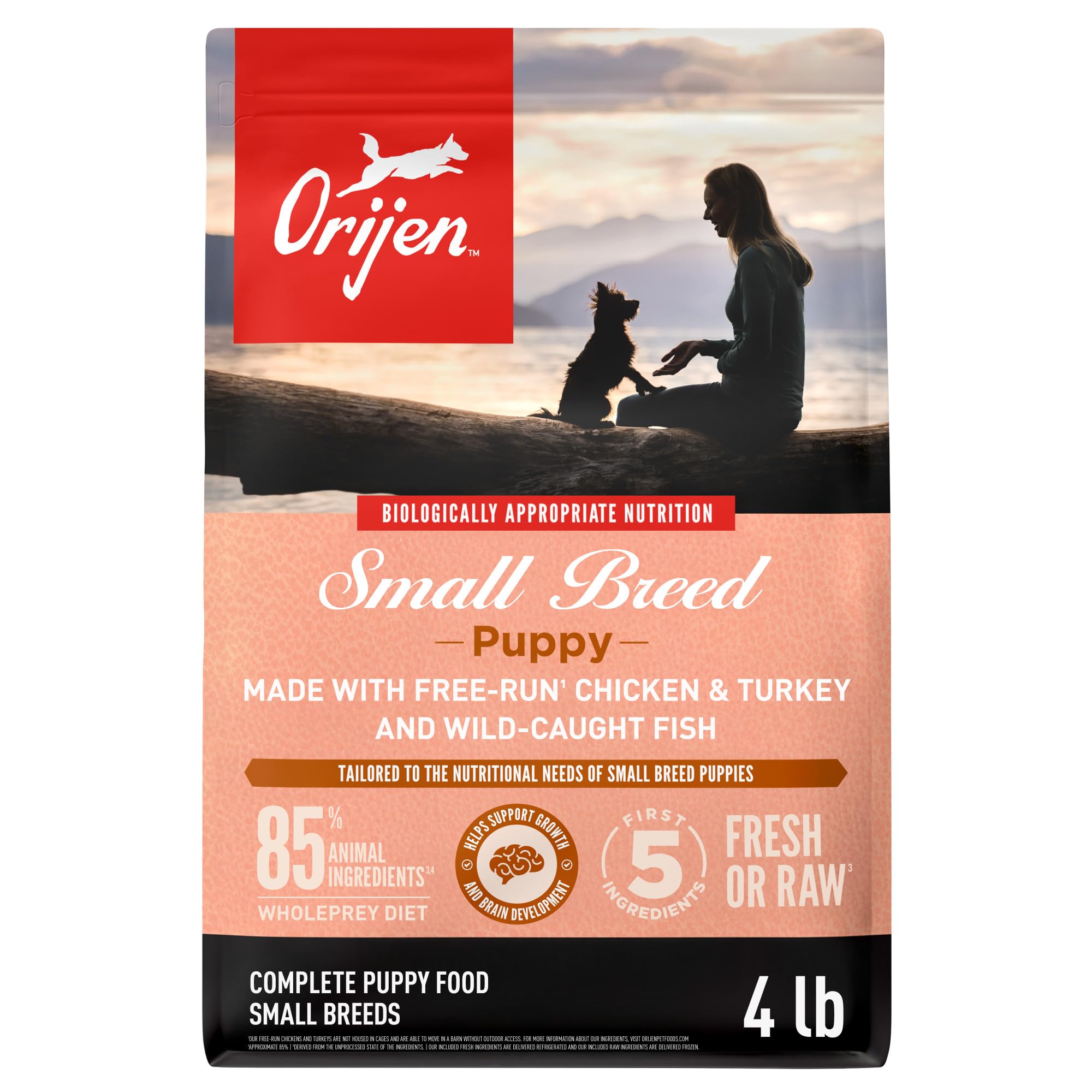
Biologically appropriate nutrition that mimics a wild diet — poultry, fish, and organs in small, chewable pebbles for tiny breeds.
ORIJEN takes a different philosophy: feed your puppy the way their ancestors ate in the wild. The WholePrey diet includes nourishing poultry, fish, and organs, all packed into a small square kibble that measures approximately 6-7 mm in diameter — perfectly sized for a Toy Poodle’s mouth. Owners of Yorkies and other toy breeds confirm the kibble is easy to pick up and chew, and they trust the ingredient list enough to feed it exclusively. The formula includes EPA (eicosapentaenoic acid, an omega-3) and DHA from salmon, whiting, haddock, and pollock oil to support the developing brain, plus fiber and a blend of pre- and probiotics for digestive health.
Puppies consistently prefer the taste over other brands: puppies love the taste, with owners reporting they “spit the other food on the floor” when ORIJEN is on the menu. The grain-free, high-protein formula supports excellent health — one owner noted their previous dog lived to 15.5 years on the original ORIJEN. It is the most expensive per-pound option in this guide, and availability can be spotty (it is “never in stock” according to one review). If your budget allows and you want the most biologically authentic kibble available, this is the pinnacle.
What makes it worth the price
- WholePrey philosophy: includes organs, fish, and poultry for natural nutrition
- Small 6-7 mm square kibble for tiny mouths
- High in EPA, DHA, and probiotics for brain and digestive health
The premium trade-offs
- Most expensive per-pound option in this guide
- Can be hard to find in stock on Amazon
Choose this if: You want the highest-quality, most ingredient-transparent kibble for your Toy Poodle and are willing to pay a premium for WholePrey nutrition.
skip it if: Budget is a primary concern, or you need consistent availability via subscription.
5. Canidae Pure Farm to Bowl Dry Puppy Dog Food, 4 lb — Salmon & Oatmeal
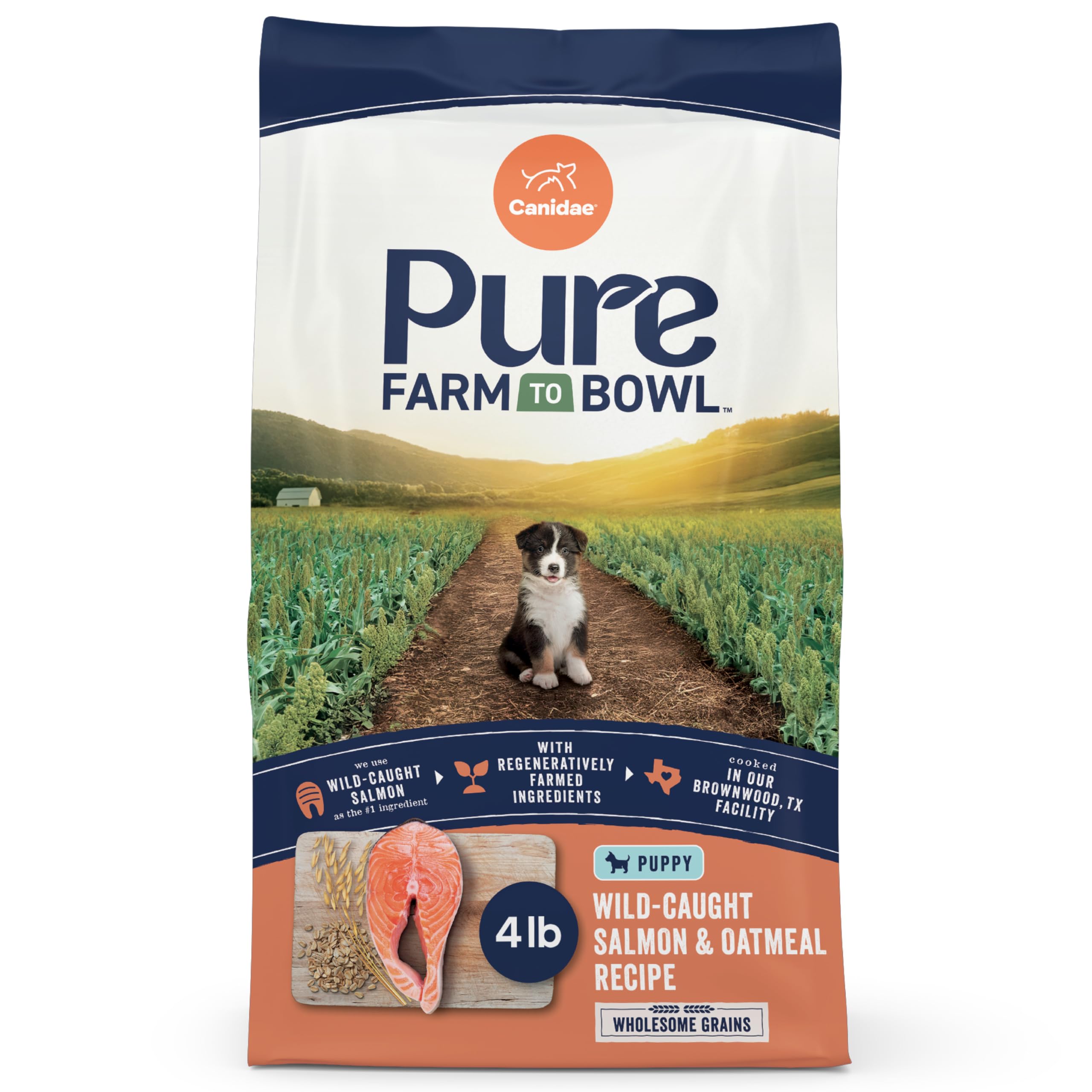
A simple 9-ingredient solution for chicken allergies — wild-caught salmon and oatmeal that solved one puppy’s lingering tummy trouble.
When a puppy has been through surgery and still cannot keep food down, a limited-ingredient diet is often the answer. That is the exact scenario where this Canidae formula shines: reviewers point out that the salmon-and-oatmeal recipe (just 9 ingredients) solved persistent diarrhea and chicken-allergy issues for a post-surgery pug puppy. The kibble is described as small, which fits well in slow-feeder bowls and tiny Toy Poodle mouths alike. The formula is grain-inclusive (not grain-free), using wholesome grains as a gentle fiber source, and is free of corn, wheat, and soy.
18 positive owner mentions confirm the formula’s quality — 18 positive mentions — and the digestive health benefits are the second-most praised feature. The salmon provides omega-3 fatty acids that support a healthy coat and skin, which is a perk for Toy Poodles with sensitive skin. Some owners found the kibble larger than expected, meaning some found it larger than expected. For most Toy Poodle puppies, it works fine, but if your pup is particularly tiny (under 4 lbs), you may want to check the kibble dimensions first.
Key advantages
- Limited 9-ingredient formula — ideal for chicken-allergic puppies
- Salmon provides omega-3s for coat and skin health
- Grain-inclusive, corn/soy/wheat-free, and cooked in small batches
Watch out for
- Kibble size is mixed — some owners found it less tiny than expected
- 4 lb bag is small; best for evaluating before committing to larger sizes
Reach for this if: Your puppy has a chicken sensitivity or skin issues, and you want a simple, traceable ingredient list with salmon as the sole protein.
Think twice if: Your puppy is under 4 lbs and needs the absolute smallest kibble on the market.
6. Nature’s Protection Superior Care Puppy Dry Food, White Fish, 3.3 lb
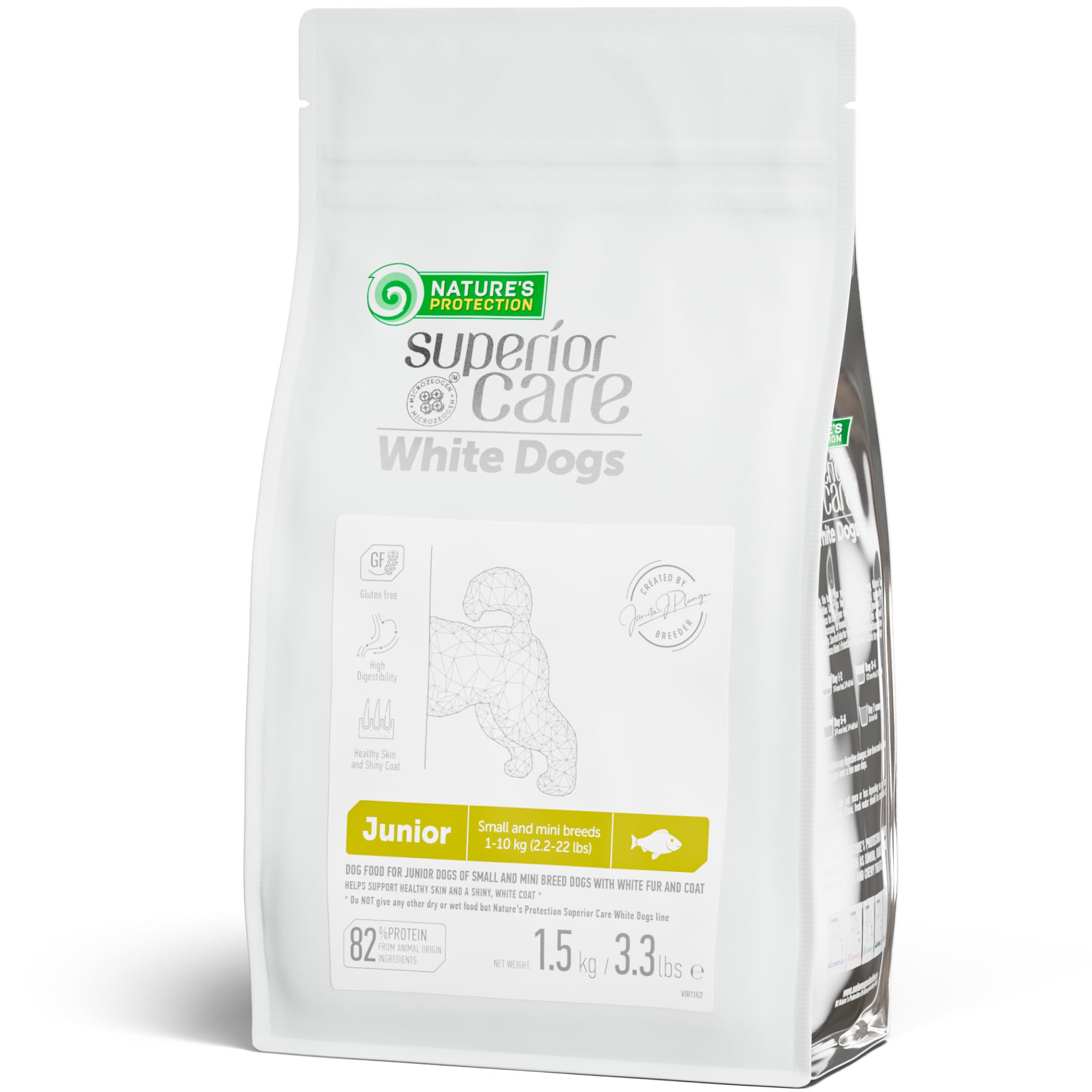
The white fish formula that tackles tear stains head-on — 10 owners specifically praise its stain-clearing ability for light-coated pups.
If you have a white or light-colored Toy Poodle, tear stains are a daily frustration. This Nature’s Protection formula is developed specifically to address that: it helps prevent unsightly tear stains and yellowing around eyes, mouth, and paws. The ingredient that stands out is Microzeogen, a unique additive that, according to the brand, binds to pigments in tears and saliva, reducing staining. Owners of Maltese and other white breeds report that the stains cleared up noticeably after switching to this food. At 11 months and 8 lbs, one finicky Maltese owner confirmed their puppy “seems to like this food” and that it “really helps to prevent those ugly tear stains.”
The formula is grain-free and made with white fish as the #1 ingredient, which is a lean, novel protein that is gentle on sensitive stomachs. It is also free of gluten, wheat, pork, and beef, making it a strong option for puppies with multiple food sensitivities. The 3.3 lb bag is smaller than most competitors, but portion-controlled for freshness. A few owners find the food’s smell off-putting: a few owners found the smell of the food off-putting, though their dogs did not seem to mind.
Why it is unique
- Formulated to reduce tear stains on light and white coats
- White fish is the #1 ingredient — a novel, gentle protein source
- Grain-free, gluten-free, and free of pork and beef
The honest downside
- Some owners find the odor unappealing
- 3.3 lb bag is smaller than standard, so it may need reordering more often
Best for: Owners of white or light-coated Toy Poodles who want to combat tear stains naturally through diet, and who prefer a grain-free, novel-protein formula.
Pass on this if: You are sensitive to dog food odor, or you want a larger bag for fewer repurchases.
7. Bil-Jac Small Breed Puppy Dry Dog Food with Chicken, Oatmeal & Yams, 6 lb
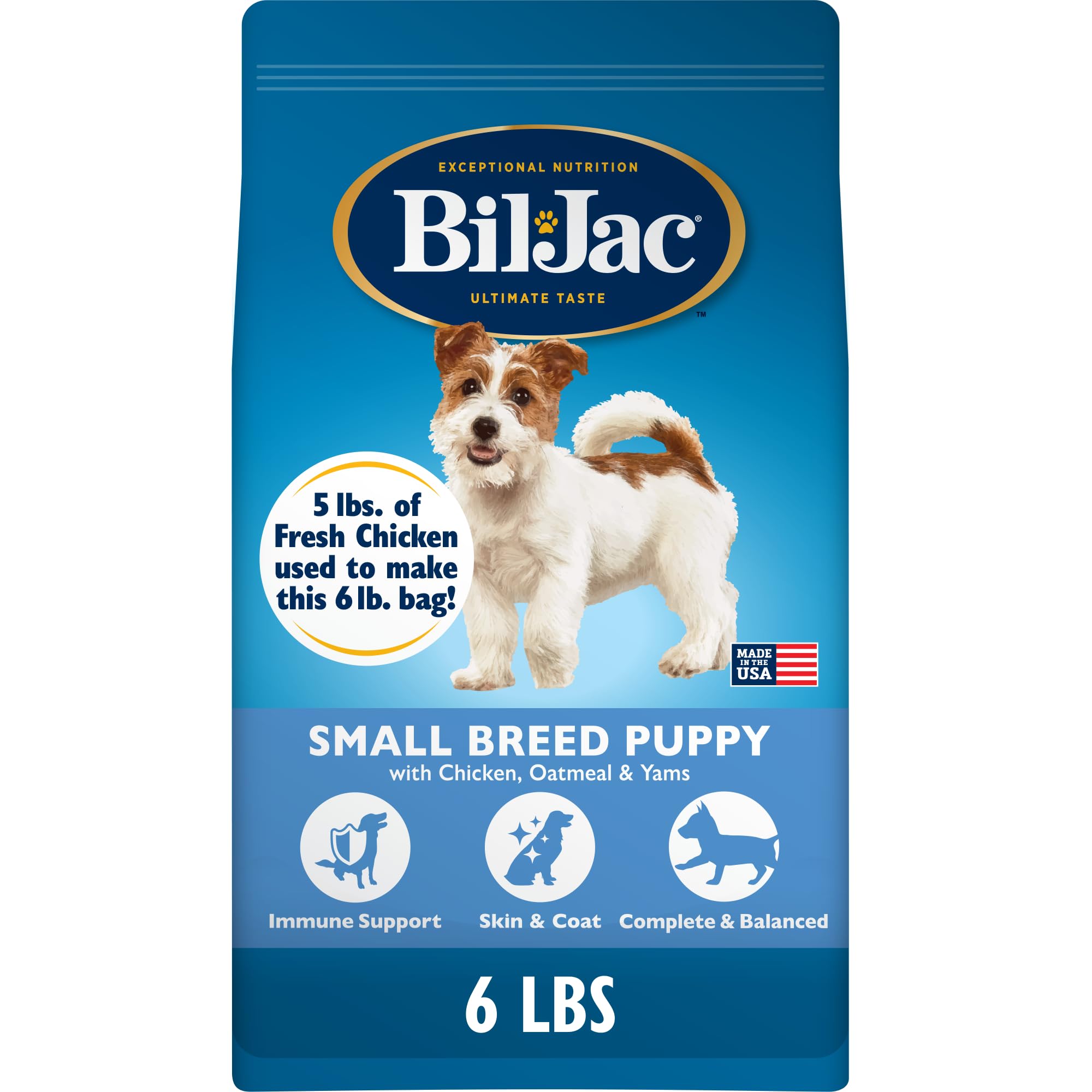
A uniquely soft, porous kibble shape that is easy for tiny teeth to pick up and chew — ideal for teething puppies.
The Bil-Jac formula takes a different approach to kibble design: instead of a dense, hard pellet, it creates a soft, porous bite that is easier for tiny puppy teeth to manage. This is a standout feature for Toy Poodle puppies transitioning from weaning, as the gentle texture helps smooth the move from milk to solid food without the resistance you often see with hard kibble. The formula uses 5 lbs of fresh, real chicken per every 6 lb bag (recipe ratio maintained for the 6 lb bag), providing the essential amino acids for lean muscle and organ development. The inclusion of oatmeal and yams adds gentle fiber that soothes sensitive stomachs.
Owner feedback is overwhelmingly positive on palatability — the top-mentioned aspect is “pet preference,” with 28 positive mentions. Puppies that were picky eaters or had chewing issues gobbled this food up immediately. The immune system is supported by Smart Defense (Vitamins C and E). However, the value-for-money rating is mixed; a few owners note that the food can cause more pungent stool gas or, at higher feeding rates, some digestive challenges. Stick to the recommended feeding amount and your puppy should do well.
What it does best
- Soft, porous kibble shape is gentler on teething gums than hard pellets
- 5 lbs of fresh chicken per 6 lb bag for high-quality protein
- Oatmeal and yams soothe sensitive stomachs and aid nutrient absorption
Consider this
- Value for money is mixed — some feel the price is justified, others do not
- Overfeeding can lead to foul-smelling stool or constipation per some owners
Reach for this if: Your Toy Poodle puppy struggles with hard kibble or is a picky eater, and you want a soft, palatable option for a smooth transition to solids.
Look elsewhere if: You need a grain-free formula, or your puppy is prone to digestive sensitivity at higher feeding volumes.
Understanding the Specs
DHA for Brain Development
DHA (docosahexaenoic acid, an omega-3 fat that builds brain tissue) is critical for a puppy’s brain and eye development during the first 12 months of life. It is naturally found in fish oils and some animal-based ingredients. When you see DHA listed on a puppy food label, it means the food is formulated to support cognitive function and learning capacity — essentially, it helps your puppy learn faster and develop better problem-solving skills during their most formative growth window.
Kibble Size and Shape
This is not a cosmetic detail for Toy Poodles. The kibble needs to be small enough for a dog that may never weigh more than 6 lbs to pick up, chew, and swallow without choking. Look for kibble diameters under 8 mm. Some brands like Bil-Jac use a porous, soft shape that is easier to break down, while others like ORIJEN and NutriSource provide explicit dimensions (5 x 10 mm or 6-7 mm squares). If a bag says “small breed” but does not give dimensions, read reviews to confirm the kibble is genuinely small.
Probiotics and Prebiotics
A Toy Poodle puppy has a tiny digestive tract that can be thrown off balance easily. Probiotics are live beneficial bacteria that help populate the gut with good microbes. Prebiotics are food fibers that feed those good bacteria. Together, they help prevent diarrhea, reduce gas, and improve nutrient absorption. If your puppy has a sensitive stomach or is coming off a round of antibiotics, a food with added probiotics (like NutriSource or ORIJEN) can make a big difference in daily comfort.
Limited Ingredient Diets (LID)
LID foods use a deliberately short list of ingredients — typically one protein source and one carbohydrate source — to minimize the risk of triggering food allergies or intolerances. For a Toy Poodle with itchy skin, chronic ear infections, or loose stools, a limited-ingredient diet like Canidae Pure (9 ingredients) can help isolate the problem ingredient. The trade-off is that LID foods may not have the full diversity of nutrients found in broader formulas, so they are best used under guidance if long-term.
FAQ
How much dry food should I feed my Toy Poodle puppy each day?
Can I feed an all-breed puppy food to my Toy Poodle?
What is the best protein source for a Toy Poodle puppy?
Should I choose grain-free or grain-inclusive dry food for my Toy Poodle puppy?
How do I transition my Toy Poodle puppy to a new dry food?
Is it safe to mix wet food with dry kibble for my Toy Poodle puppy?
How long should I feed puppy food before switching to adult food?
What causes tear stains in Toy Poodles and can dry food help?
Can I use dry food as training treats for my Toy Poodle puppy?
What is the difference between “small breed” and “toy breed” dry food?
Final Thoughts: The Verdict
For most owners, the dry food for toy poodle puppy choice depends on the Royal Canin Small Puppy because it is the most vetted, vet-recommended, and consistently well-digested formula available — and the 4.8-star rating across tens of thousands of owners backs that confidence up. If you want the absolute smallest kibble size and a probiotic-rich formula that supports heart health, grab the NutriSource Small & Medium Breed Puppy. And for a white-coated pup with tear stain troubles, the Nature’s Protection White Fish is the one to reach for. Whichever you choose, start with a small bag, transition slowly, and watch your puppy’s energy, coat, and digestion — they will tell you everything you need to know.
How We Picked
We do not accept paid placement. Every pick is matched to a real buyer and a real use-case; we do not hands-on test units.
Sources & Methodology
Specifications: manufacturer listings and product documentation. Review insights: verified customer reviews, as of July 2026. Pricing: not shown on this page (it changes often); check the current price via the retailer link.
As an Amazon Associate, WellFizz earns from qualifying purchases. This does not affect which products we feature.
Related Guides

Mo Maruf
I created WellFizz to bridge the gap between vague wellness advice and actionable solutions. My mission is simple: to decode the research and give you practical tools you can actually use.
Beyond the data, I am a passionate traveler. I believe that stepping away from the screen to explore new environments is essential for mental clarity and physical vitality.