Our readers keep the lights on and my smoothie glass nicely filled. As an Amazon Associate, I earn from qualifying purchases.
A swollen sleeping bag and a bag of soggy trail mix can derail an otherwise perfect overnighter. The physics of bikepacking punish bulky, heavy gear, yet the rain doesn’t care about your weight targets. The solution is a bag that resists abrasion from frame straps, packs into odd frame triangles, and seals out moisture even when the sky opens up for hours.
I’m Mohammad Maruf — the founder and writer behind WellFizz. I’ve spent hundreds of hours cross-referencing fabric denier, seam construction, roll-top closure hardware, and in-frame fit data to separate the gear that truly lasts from the stuff that leaks on the first real downpour.
After analyzing seven top contenders across spec sheets, real-world reviews, and material science, this guide delivers the definitive best dry bags for bikepacking based on real durability and packability.
How To Choose The Best Dry Bags For Bikepacking
Bikepacking dry storage isn’t the same as kayak dry gear. Your bags must conform to frame geometry, survive vibration against metal and carbon, and stay accessible without untying a whole harness. Three factors separate the winners from the also-rans.
Fabric Denier and Coating
Grab the fabric between your fingers. A 30D ripstop nylon bag, like the Sea to Summit Ultra-Sil, compresses into nothing but can abrade against a frame strap over 500 miles. A 420D TPU-coated nylon bag adds ounces but survives gravel grit and sharp tools inside your frame triangle. For bikepacking, 200D to 420D is the sweet spot — packable enough to stuff, tough enough to last a season of weekend trips.
Closure and Seal Design
A dry bag without a reliable roll-top seal is just a stuff sack. Look for a stiffener bar inside the roll that creates a clean crease line every time, plus a buckle that clicks without slipping. The number of rolls also matters: three full rolls is the industry standard for submersion proofing, but a bag that’s too long after rolling may not fit inside a frame pack. Measure the bag’s closed height, not just its advertised volume.
Attachment and Shape
Frame bags need a narrow profile that fits the triangle without bulging into your knees. Saddle bags need anti-sway stabilization and webbing loops for a rear light. An oval base resists rolling on the trail, and external lash points let you strap a sleeping pad or rain jacket externally without opening the main seal.
Quick Comparison
On smaller screens, swipe sideways to see the full table.
| Model | Category | Best For | Key Spec | Amazon |
|---|---|---|---|---|
| Pelican Exodry 20L | Dry Sack | Max waterproof assurance | Exodry welded seam | Amazon |
| Rhinowalk 13L Saddle Bag | Saddle Bag | Under-seat storage | 3000mm water pressure fabric | Amazon |
| Moosetreks Frame Bag 14L | Frame Bag | Stable load in frame triangle | YKK water-resistant zipper | Amazon |
| Sea to Summit Big River 5L | Dry Sack | Durable small-item storage | 420D TPU-coated nylon | Amazon |
| GVANCA 55L Backpack | Backpack | Multi-day haul on bars/rack | 500D PVC body | Amazon |
| Lamicall 30L with Phone Pouch | Dry Sack | Floatable gear protection | 500D PVC welded seams | Amazon |
| Sea to Summit Ultra-Sil 8L | Dry Sack | Ultralight packing | 30D Cordura, 69g weight | Amazon |
In‑Depth Reviews
1. Pelican Waterproof Dry Bag 20L

Pelican brings the same overbuilt philosophy they use in hard cases to a soft dry bag. The Exodry welded seam construction removes stitching as a failure point entirely — the fabric itself becomes the seal, which is why this bag passes the “sit on it filled with air” test without leaking a bubble. Real users confirmed it held a person’s weight while submerged, and that level of airtight integrity directly translates to bone-dry gear after a river crossing or a sudden thunderstorm.
The 20-liter version is the sweet spot for a bikepacking setup: large enough to swallow a puffy jacket, spare base layer, food pouch, and electronics pouch, yet compact enough to lash inside a frame harness or atop rear racks. The reflective print adds passive visibility on low-light roads, which matters when your ride starts before dawn or ends after dusk. The included shoulder strap works for hauling it camp-side, though for bikepacking use you’ll want to secure it with separate straps.
One tradeoff is the single-cavity design — there are no internal dividers, so smaller items can migrate to the bottom. Pair it with a few packing cubes or stuff sacks, and the Pelican becomes the most trustworthy waterproof layer in your system. It costs more than generic dry sacks, but the seal confidence is worth it when your phone and sleeping bag share the same ride.
Why it’s great
- Fully airtight seal when rolled — passes the weight test under submersion.
- Welded seam construction removes needle-hole leakage risk.
- Reflective detailing adds passive night visibility.
Good to know
- Single main chamber lacks internal organization.
- Premium price point compared to basic PVC sacks.
2. Rhinowalk Waterproof Bike Saddle Bag 13L

Rhinowalk packs a surprising amount of thought into a budget-friendly saddle bag. The 13-liter volume fits a weekend’s worth of clothing, food, a sleeping bag liner, and a small battery pack without suffocating the rear wheel clearance. The internal fabric carries a 3000mm water pressure rating with taped seams, which is higher than many mainstream bags at twice the price. Real users reported only minor moisture at the roll closure after hours of sustained heavy rain — gear remained dry, and the bag dried out overnight.
Installation uses four independent straps: thick Velcro loops around the seatpost and locking cam straps that grip the saddle rails. This four-point system reduces sway dramatically compared to two-strap designs, though some riders on very forward saddles still noticed slight wobble. Rhinowalk includes a reflective strap and a rear light webbing tab, which is a genuine safety feature you don’t always get at this price.
The bag sways more aggressively when riding out of the saddle, and the stitching on the saddle rail strap is a potential long-term weak point compared to riveted alternatives. For riders on a budget who want dependable waterproofing and legitimate capacity for overnight trips, the Rhinowalk 13L outperforms its price bracket.
Why it’s great
- 3000mm water pressure fabric with taped seams outperforms budget expectations.
- Four-point strap system reduces sway better than two-strap saddle bags.
- Reflective elements and tail light webbing improve night safety.
Good to know
- Sways when riding out of saddle; stabilizer bar may be needed.
- Stitching on saddle rail strap is a potential failure point over seasons.
3. Moosetreks Touring Road Bike Full Frame Bag 14L

Moosetreks solves the low-center-of-gravity problem better than any saddle or handlebar bag can. The frame bag integrates into your bike’s triangle, keeping 14 liters of gear mass exactly where it affects handling the least. The ripstop nylon with TPU lamination provides genuine water resistance — not just a DWR coating — and the YKK water-resistant zipper on the current production version eliminates the early-model zipper failures that earlier customers reported. The brand’s response to those issues by upgrading to YKK hardware shows they listen.
The bag comes in three sizes based on frame measurements, which is essential: a sloppy frame bag that sags into your crank or rubs your knees ruins the ride. The included Velcro straps are long enough to wrap teardrop-shaped downtubes and oversized top tubes, and the two-compartment design with a removable divider lets you separate tools from snacks or an e-bike battery from clothing. Real users reported that the bag handled 3+ years of regular commuting and touring without zipper failure after the upgrade.
The biggest limitation is the zipper closure itself — while YKK water-resistant zippers are excellent, they’re not fully submersible like a roll-top seal. If you anticipate river crossings where your bike goes completely underwater, pair this with internal dry bags. For all other rain scenarios — hours of PNW drizzle or a sudden squall — the Moosetreks frame bag keeps your gear dry and your bike stable.
Why it’s great
- Low-center-of-gravity placement improves handling on climbs and descents.
- YKK water-resistant zipper on current models is durable and reliable.
- Three sizes and long straps accommodate odd frame geometries.
Good to know
- Zipper closure not fully submersible — use internal dry sacks for deep crossings.
- Must measure frame carefully; large size runs big.
4. Sea to Summit Big River Dry Bag 5L
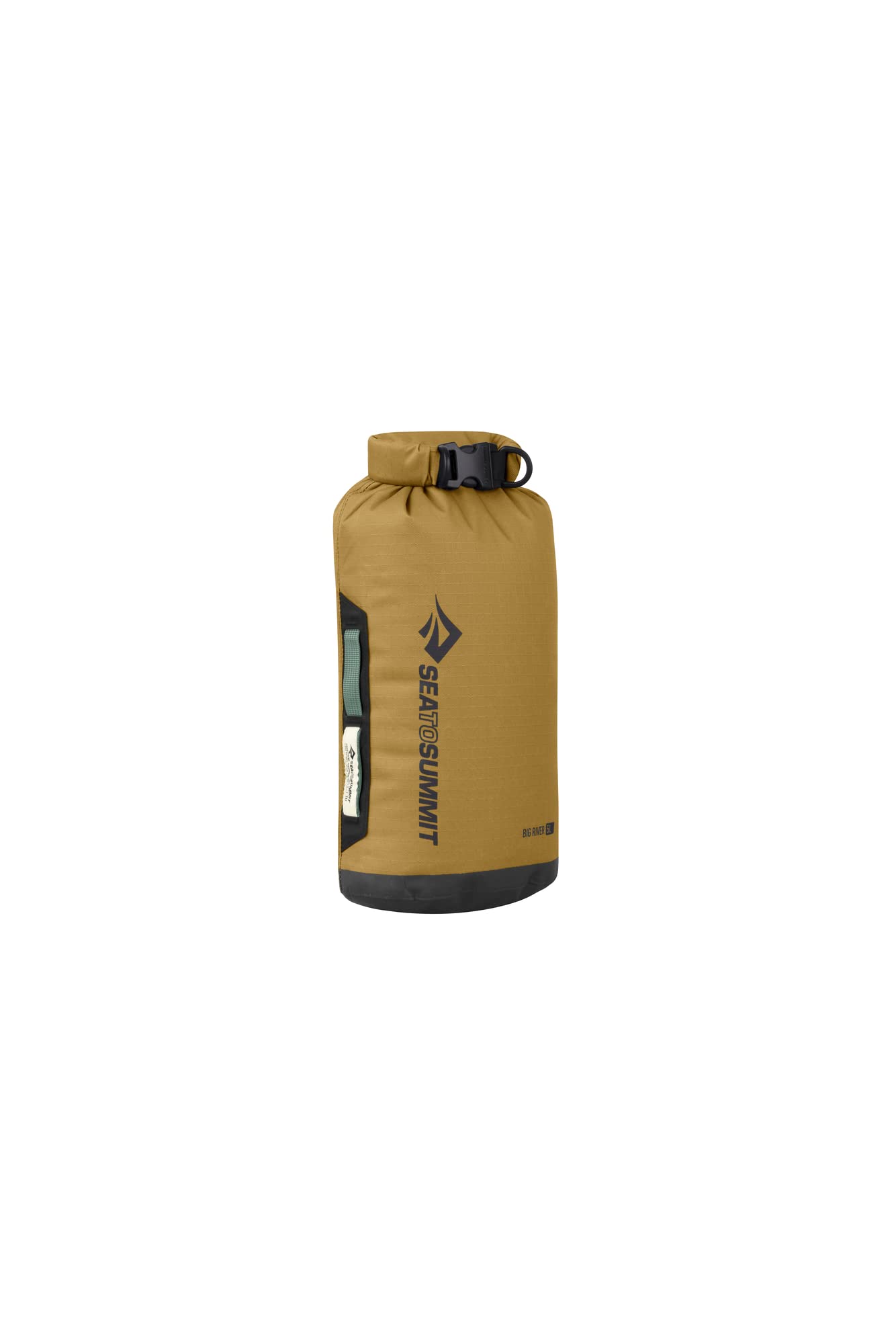
Sea to Summit’s Big River line targets the rider who needs a bombproof small bag for the items that absolutely cannot get wet. The 5-liter size fits perfectly in a frame bag’s spare corner, inside a handlebar roll, or strapped directly to a top tube. The 420D TPU-coated nylon is noticeably thicker and more abrasion-resistant than the Ultra-Sil line, and the triple-coated base adds extra protection where the bag contacts surfaces. Real users put it through a Grand Canyon rafting trip with zero leaks, which speaks to its seal integrity.
The white laminate interior is a thoughtful detail that other manufacturers miss — finding a small headlamp or battery pack inside a dark dry bag at night is much easier when the interior reflects light. Multiple sewn-in lash points allow you to clip the bag to a harness or daisy-chain it with other gear, and the Hypalon roll-top closure uses Sea to Summit’s field-repairable buckle that can be replaced without sewing. The oval base resists rolling, which keeps the bag stable when packed inside a larger duffel or frame pack.
The 5-liter volume is intentionally small — it fits a spare layer, electronics, and toiletries, but not a full sleeping system. At this capacity, the Big River is best used as a critical-items vault rather than your primary dry storage. It’s heavier and pricier than the Ultra-Sil, but the 420D fabric will outlast many seasons of gravel grinding.
Why it’s great
- 420D TPU nylon with triple-coated base is extremely abrasion-resistant.
- White laminate interior improves visibility of contents in low light.
- Field-repairable buckle can be replaced without sewing.
Good to know
- 5-liter capacity is limited — best for critical items only.
- Heavier than ultralight options due to thick fabric.
5. GVANCA Waterproof Dry Bag Backpack 55L

The GVANCA 55L is a different beast — it’s a full backpack-style dry bag designed for the bikepacker who needs to carry a week’s worth of gear on longer self-supported routes. The 500D PVC fabric is heavy-duty and completely waterproof when the roll-top is properly sealed; real users reported full submersion in rapids and a severe thunderstorm with zero water ingress. The backpack straps are wide and padded, which matters when you’re portaging a loaded bike across a stream or hiking your rig up a steep section.
The chest strap includes a whistle buckle for emergency signaling, and the three separate back air cushions promote airflow to reduce sweat during climbs. The roll-top closure requires three to four turns and clips securely with a reinforced strap. Multiple size options (35L, 55L, 85L) allow scaling for trip length. For bikepacking, the 55L is best mounted on a rear rack or lashed across a handlebar harness — it’s too large for a frame triangle but works well as a single-bag solution on a rack-supported tour.
The 55L size lacks internal organization beyond one small pocket, and the external pocket is not fully waterproof. The 500D PVC is undeniably tough, but the weight adds up: you’re carrying around 2 pounds before any gear is inside. For riders who want a single bag that does double duty as camp storage and a waterproof backpack, the GVANCA delivers total confidence in wet conditions.
Why it’s great
- 500D PVC construction is fully submersible and extremely durable.
- Backpack straps with whistle buckle and air cushions add comfort on long carries.
- Three size options accommodate trips from weekend to multi-week.
Good to know
- Heavy — 2+ pounds empty; not for weight-conscious riders.
- Single main compartment with limited organization; external pocket not waterproof.
6. Lamicall Waterproof Dry Bag 30L with Phone Pouch
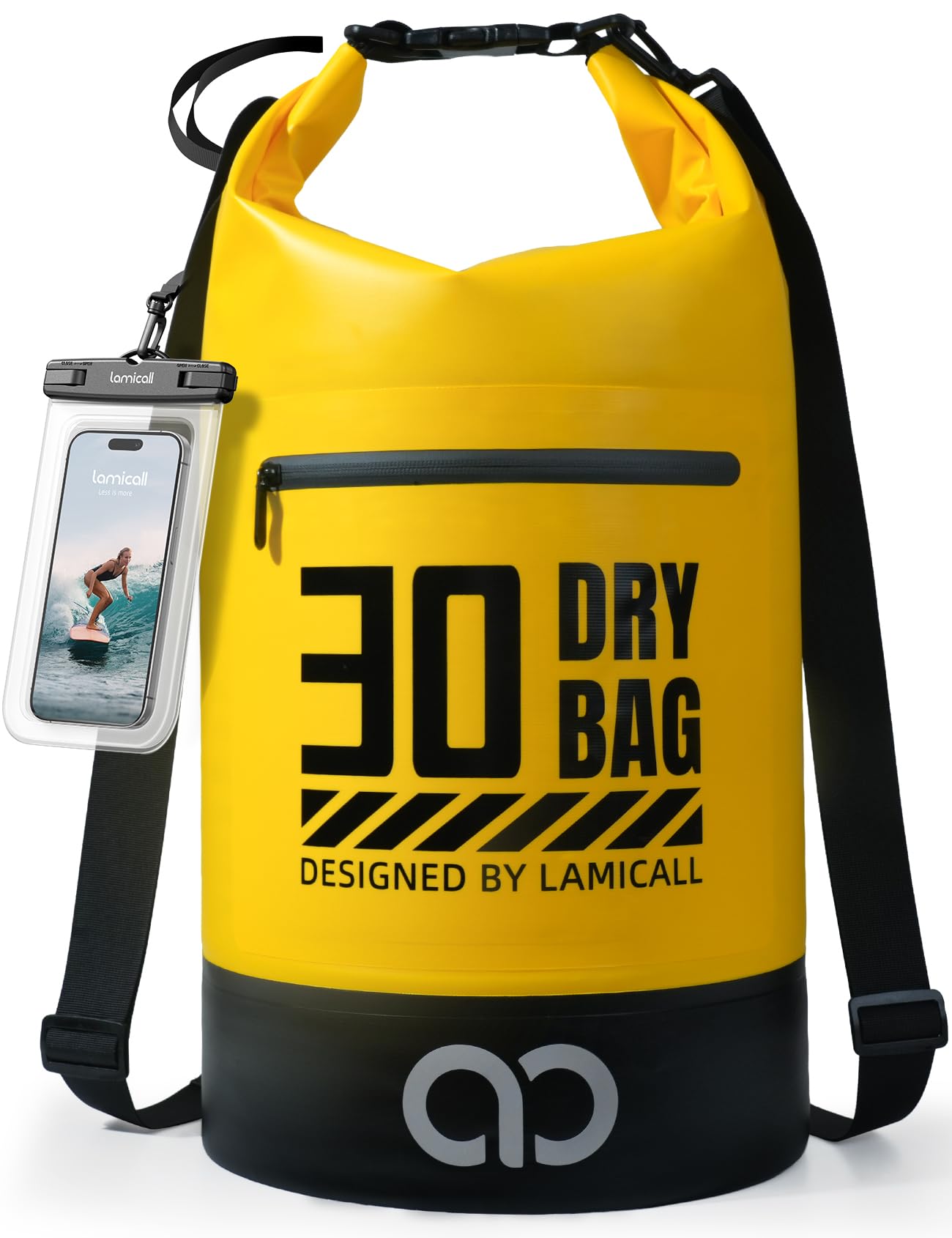
Lamicall takes a dual-defense approach that appeals to bikepackers who cross rivers or ride near coastlines. The main bag uses 500D PVC with airtight welded seams, and the trapped air inside makes the bag buoyant — useful if you drop it in the water while loading your bike on a ferry or crossing a shallow ford. The included IPX8-rated phone pouch adds a second layer of protection for your navigation device, which is a thoughtful inclusion at this price.
The 30-liter capacity sits in a useful middle ground: large enough to hold a sleeping bag, tent, and food for a weekend, yet compact enough to strap vertically on a front harness or sit on a rear rack. The backpack straps are adjustable and detachable, giving you the option to carry it as a backpack off the bike or strip the straps to save weight. Real users praised the rugged build and confirmed the bag kept contents dry after hours of wet conditions, including exposure in an open UTV.
The front splashproof zipper pocket is convenient for keys and sunscreen, but the specification is splash-resistant, not waterproof — electronics still belong inside the main roll-top chamber. Some users noted the bag appears larger before rolling, making it easy to overpack. For bikepackers who want peace of mind near water and a useful bonus phone pouch, the Lamicall 30L delivers strong protection without a premium price.
Why it’s great
- Buoyant when sealed — floats if dropped overboard.
- Includes IPX8-rated phone pouch for phone protection.
- 500D PVC with welded seams provides rugged waterproofing.
Good to know
- Front zipper pocket is splash-resistant only, not fully waterproof.
- Easy to overpack since bag is larger before rolling closed.
7. Sea to Summit Ultra-Sil Dry Bag 8L
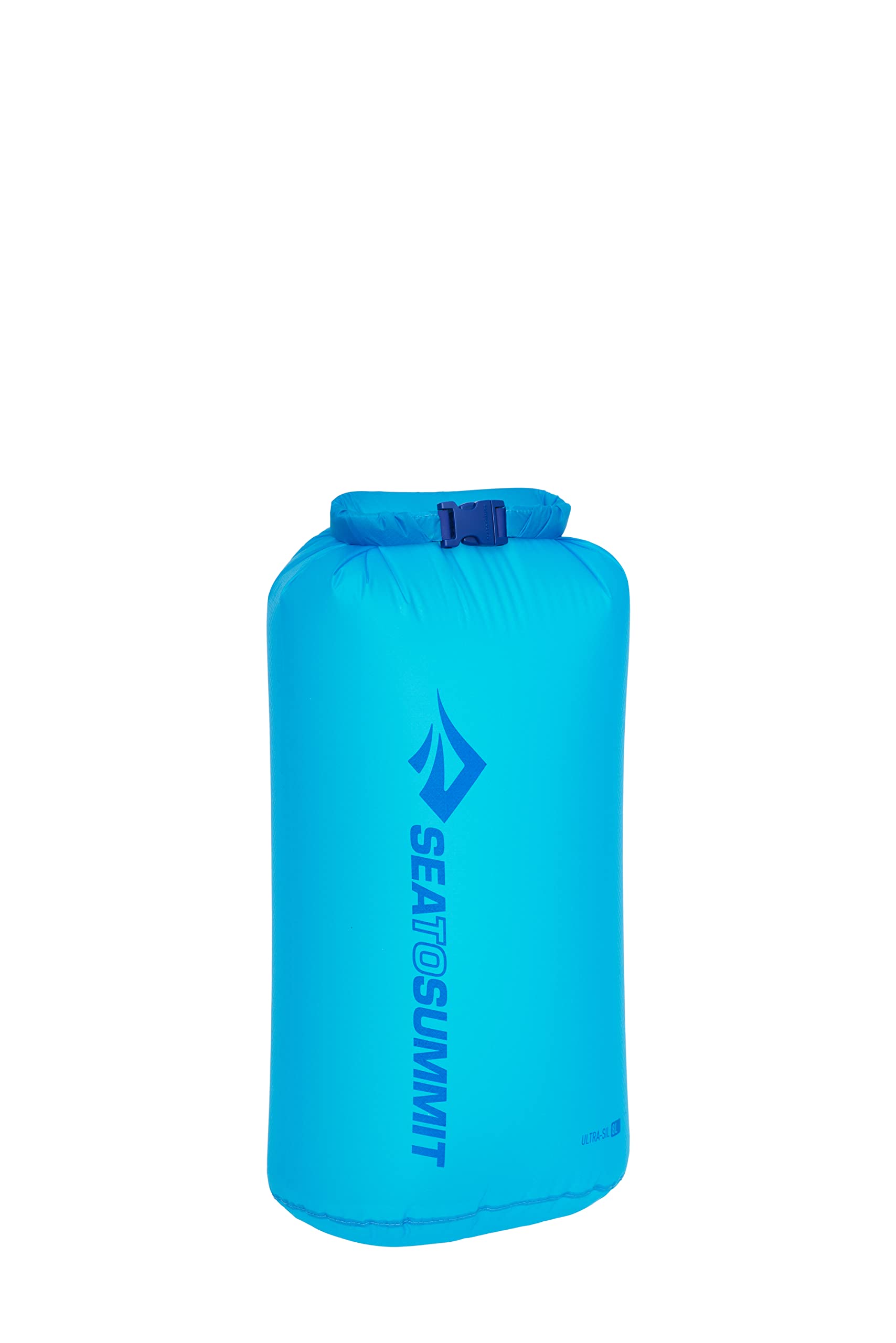
Weight weenies, this is your bag. The Sea to Summit Ultra-Sil weighs 69 grams — about the same as two Clif bars — and packs down to almost nothing when not in use. The 30D Cordura ripstop nylon is impressively thin yet holds a 2,000mm waterhead rating, which is sufficient for rain and splash exposure though not for full submersion. The translucent fabric lets you see roughly what’s inside without opening the seal, and the slippery finish makes it slide easily into tight frame bags or handlebar rolls.
Real users own multiples of these in different sizes and colors for color-coded organization — a system that works beautifully for bikepacking. The oval base resists rolling on a shelf or inside a larger pack. The Hypalon roll-top closure uses Sea to Summit’s field-repairable buckle, and the taped seams add reliability. Eight liters fits a puffy jacket, a spare base layer, and a small electronics pouch, making it ideal as a lightweight internal organizer inside a larger frame bag or harness.
The tradeoff for the feathery weight is durability. The 30D fabric will tear if stressed against sharp tools or abraded repeatedly against frame straps. The Ultra-Sil is not a bag for rough handling; it’s a bag for the gram-conscious rider who organizes gear carefully and doesn’t drag their bike through rock gardens. Pair it with a more robust outer bag for frame triangle storage, and use the Ultra-Sil for soft goods inside.
Why it’s great
- Incredibly light at 69 grams — barely adds weight to your kit.
- Translucent fabric allows quick visual identification of contents.
- Slippery finish slides easily into tight frame triangles.
Good to know
- 30D fabric is not abrasion-resistant — avoid contact with sharp tools.
- Not rated for full submersion; best for rain and splash protection.
FAQ
Can I use a standard dry bag inside a frame bag for extra protection?
How many rolls should I do on a roll-top dry bag for bikepacking?
How do I prevent my saddle dry bag from swaying on rough trails?
Final Thoughts: The Verdict
For most riders, the dry bags for bikepacking winner is the Pelican Exodry 20L because its welded seam construction and airtight seal deliver full submersion confidence without excessive weight. If you need stable frame-integrated storage, grab the Moosetreks Frame Bag 14L for low-center balance and YKK zipper reliability. And for ultralight gram-counting trips, nothing beats the Sea to Summit Ultra-Sil 8L for packability and weight.

Mo Maruf
I created WellFizz to bridge the gap between vague wellness advice and actionable solutions. My mission is simple: to decode the research and give you practical tools you can actually use.
Beyond the data, I am a passionate traveler. I believe that stepping away from the screen to explore new environments is essential for mental clarity and physical vitality.