Our readers keep the lights on and my smoothie glass nicely filled. As an Amazon Associate, I earn from qualifying purchases.
Specs are compiled from manufacturer listings and verified buyer reviews and can change over time — please confirm the key details on the product page before buying.
If you have ever fought to flatten a glued-up panel or remove planer marks without burning your fingertips, a drum sander is the machine that ends that battle. The right one turns rough, cupped boards into glass-smooth slabs in minutes instead of an evening, sparing your shoulders the worst of hand sanding. This guide breaks down the eight most capable drum sanders for woodworking, comparing drum width, motor draw, and feed speed so you can match a machine to your shop space and your projects.
I’m Mohammad Maruf — the founder and writer behind WellFizz. This guide is built by comparing the manufacturers’ published specifications and the patterns across verified customer reviews, so you get each pick’s real strengths and trade-offs instead of marketing spin.
Here is the short version: you want the widest drum your budget realistically allows, a motor strong enough to keep the conveyor feeding without stalling, and dust collection that actually captures the fine stuff. drum sander for woodworking picks are ranked below by how well they balance width, power, and everyday usability for a serious shop.
Our Picks at a Glance


How To Choose The Best Drum Sander For Woodworking
Buying a drum sander is a big decision because these machines are heavy, powerful, and meant to last for years. Before you commit, focus on three things: the width of the drum, the power behind the conveyor, and how the machine handles dust and heat. Get those right and the sander becomes the most-used tool in your shop.
Drum Width Sets Your Panel Limit
The drum width is the maximum board you can sand in one clean pass. A 16-inch drum handles most cabinet parts and cutting boards, while 22-inch and 25-inch models cover wider tabletops and panels. Many machines also have an open-ended design, so you can flip a longer piece and run a second pass to sand up to 20 inches on a 10-inch drum. Match the width to the biggest workpiece you build regularly, not the one you dream about.
Motor Power and Feed Speed Work as a Team
A drum sander has two motors: one spins the abrasive drum, the other drives the conveyor that pulls your board through. If the conveyor moves too fast for the cut depth, the drum stalls or burns the wood. Look for variable feed speed, usually measured in feet per minute (fpm), so you can slow down for heavy stock and speed up for finish passes. Systems like Sandsmart automatically adjust the conveyor speed when the drum strains, which removes the guesswork.
Quick Comparison
| Model | Best For | Drum Width | Amperage | Drum Speed | Amazon |
|---|---|---|---|---|---|
| JET 16-Inch (JWDS-1632)★ Best Overall | Balanced shop workhorse | 16 in | 20 A | 1725 rpm | Amazon |
| Shop Fox 12-Inch (W1740)Compact Workhorse | Cabinet doors and solid wood | 12 in | — | — | Amazon |
| JET 10-Inch (JWDS-1020)Small Shop Pick | Small shop benchtop | 10 in | 8 A | 1720 rpm | Amazon |
In‑Depth Reviews
1. JET 16-Inch Drum Sander, Open Stand, 1-1/2 HP (JWDS-1632)
Our pick — over 4★ from 200+ verified ratings; the strongest balance of quality and price.
The 16-inch workhorse that flattens end-grain cutting boards without burning them.
The headline here is Sandsmart, a control system that watches the load on the drum motor and automatically slows the conveyor to keep the feed rate safe. You get a 20 A motor spinning the drum at 1725 rpm, and you can dial the conveyor anywhere up to 10 feet per minute. That combination means you can push stock through aggressively and trust the machine to back off before it scorches the wood.
Owners who flatten rough sawn wood and end-grain boards with CNC inlays say the learning curve is real — the reports note that a too-deep, too-fast pass can destroy your first sandpaper strip in about 15 minutes. The fix is patience: multiple passes with small increments, and most users settle on 120 grit as the most versatile. Once you get the depth dialed in, the results come out level and consistent, which is why many call it better than orbital or belt sanders for this job.
The dust hood uses a patented integrated channel that mirrors the drum shape and funnels everything to a 4-inch port, so a shop vac or dust collector keeps the air clear. The open stand has a 20″ x 37″ footprint, a storage shelf, and predrilled holes for casters, and the handwheel carries a relative depth scale so you can reset cuts between projects. The whole package comes with a 5-year warranty, which drops to 2 years for commercial use.
Why owners stay loyal
- Saves hours versus hand or belt sanding on panels
- Open-end design handles boards wider than the 16-inch drum
- Zero dust reaching the air when paired with a collector
Where you must be careful
- Steep learning curve on depth settings; burns wood if set too deep
- Sandpaper changes need practice with the spring clamps
- Heavy machine that arrives damaged if carriers mishandle it
Reach for it if: you want the best-balanced mix of width, feed automation, and dust control for a serious hobby shop.
Think twice if: you refuse to learn the depth-setting rhythm and want instant results on your first board.
2. Shop Fox 12 in. 1-1/2 HP Benchtop Drum Sander (W1740)
The benchtop 12-inch that chews through solid wood cabinet doors without complaint.
This machine ships with a coarse 36-grit strip already installed, so it is ready to attack rough stock from the first power-on. It runs on corded electric 115V power, and the buyers who use it for sanding solid wood cabinet doors report it works great straight from the start. The 24″ x 24″ x 25.94″ footprint keeps it compact enough for a smaller shop bench.
One owner hit an ON/OFF switch problem on arrival, phoned customer service, and got guided through a few tests before the switch was replaced at no charge. That kind of support matters on a machine this size. A separate report notes the conveyor crank gears slipped on day one, but the fix in the manual — while convoluted — does work. The sander is solid and heavy, and sandpaper changes are easy.
Dust collection is average rather than stellar, which owners flag as the main trade-off on an otherwise capable machine. It also draws a serious 16 amps, so check that your circuit can handle it before you wire it up. For a shop that mostly builds doors, drawers, and smaller solid-wood pieces, this benchtop handles the job with room to spare.
Solid where it counts: heavy build, simple paper changes, and real customer support when a switch fails on delivery.
Best for: cabinetmakers and hobbyists who work solid wood under 12 inches wide and want a bench-mounted sander.
Not ideal if: you sand wide panels daily, because the 12-inch drum forces two passes on anything bigger.
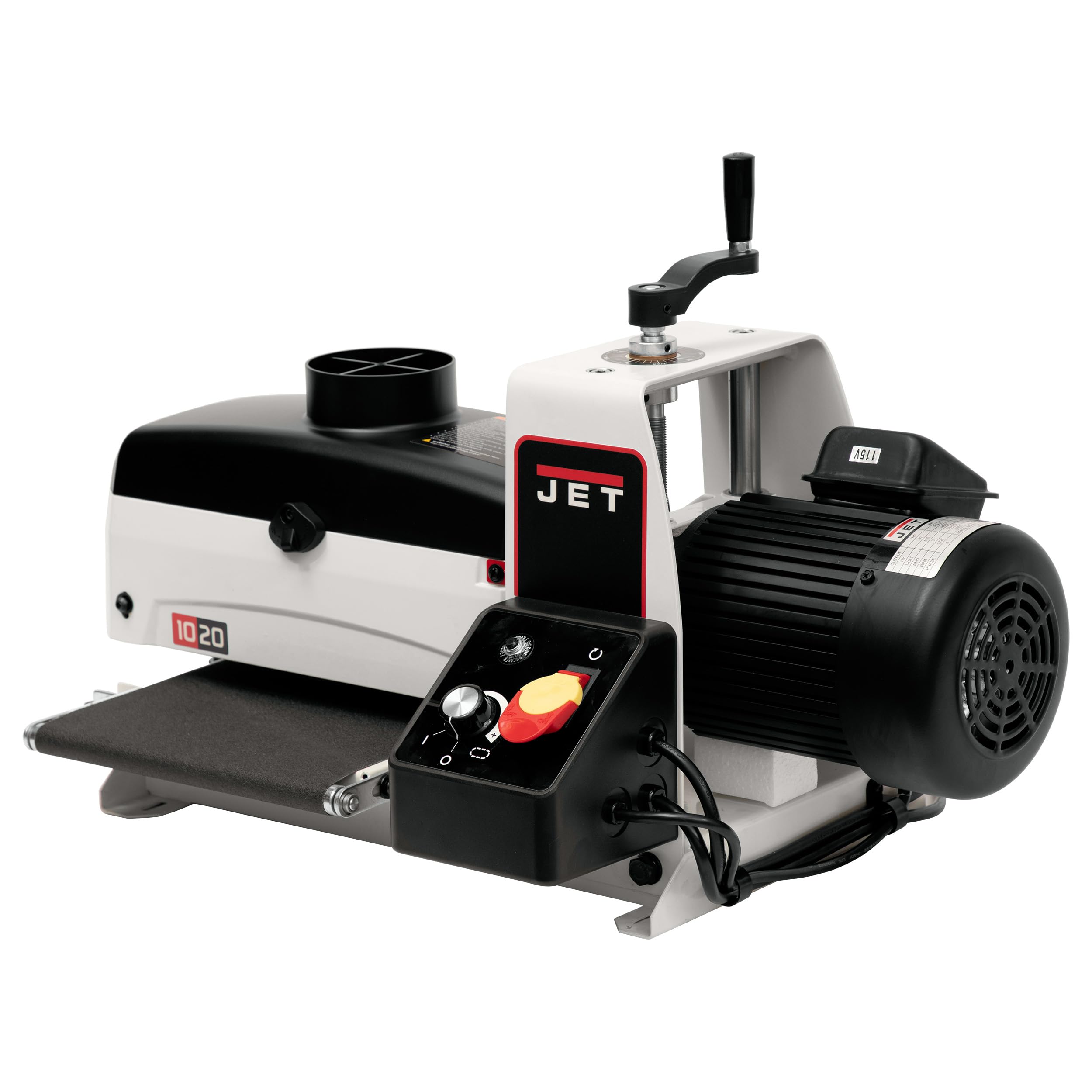
3. JET 10-Inch Benchtop Drum Sander, 1 HP (JWDS-1020)
The 73-pound benchtop that delivers planer-quality finishes in a compact footprint.
This is the drum sander for the shop without floor space, and the 8 A motor makes it friendly to more circuits than its bigger siblings. The drum spins at 1720 rpm, and the infeed is infinitely variable so you choose the feed rate yourself. The open-ended design is the clever part: flip a board and you can sand up to 20 inches of capacity in two passes.
Owners describe it as perfect for small shops and say it produces an excellent finish with no planer snipe or tear-out, and it runs quieter than a planer to boot. The trade-off is that it demands patience — slow passes with small height adjustments are the recipe for the best results. The heavy-duty die-cast aluminum and steel body gives the rigidity that keeps those finishes consistent, and the toolless abrasive take-up fasteners make strip changes quick.
The recurring theme in the review pages is shipping damage, with several buyers receiving bent fans or dented covers and needing to fix them manually. Once repaired, the machine earns upgraded ratings because it works well for small, light wood. The extruded aluminum drum is designed to dissipate heat so it protects your workpiece from heat damage, and the integrated circuit breaker guards the motor against overheating. At 73 pounds, it fits on a rolling cabinet and disappears into a corner when you are done.
The winning traits
- Compact footprint fits on a rolling cabinet
- Quieter and cleaner finish than a planer
- Two-pass 20-inch capacity on a 10-inch drum
Watch for
- Shipping damage is common; inspect the fan and cover on arrival
- Slow feed is required — this is not a production machine
- Belt alignment and circuit protection draw occasional complaints
Choose this if: your shop is tight and you want a quality finish on small projects without dedicating floor space.
Look elsewhere if: you routinely sand wide panels, because 10 inches means constant flipping.
4. JET 18-Inch Drum Sander with Open Stand, 1-3/4 HP (JWDS-1836)

The 18-inch drum that owners say is worth the extra money over smaller machines.
Stepping up to an 18-inch drum means you can run a full cabinet-width panel thro stability and power. The included infeed and outfeed tables provide 37-1/2 inches of workpiece support, which makes feeding long boards dramatically easier than on machines without them. The feed logic system monitors the drum motor and regulates the conveyor speed automatically, while belt tracking is designed to reduce manual adjustment.
Owners mention 0.001-inch alignment accuracy over five passes on an 18-inch door and flatten a cupped hard maple slab in four passes per side with a 60-grit strip. The integrated casters make the 328-pound unit surprisingly easy to move around the shop, and the closed stand includes storage for keeping abrasives organized. An emergency stop gives you a fast shutoff when you need it.
The review pages tell a mixed delivery story. One buyer received a bent base and demanded a replacement; a second got a dented motor shroud and stripped screws, which Powermatic resolved by sending parts; a third hit a cracked casting with a blame-shifting carrier dispute. The machine itself, when intact, earns praise as super solid with plenty of power. The one performance complaint involves large pieces — a 25″ x 72″ walnut top — stalling the conveyor and leaving burn marks, which suggests this sander prefers the steady, moderate feed it was designed for. At 14 A, it is also one of the more circuit-friendly large machines here.
The production edge
- 37.5-inch infeed/outfeed tables support long stock
- 0.001-inch alignment accuracy on demanding work
- Integrated casters make the 328-lb unit mobile
Demand care
- Large, long pieces can stall the conveyor and burn
- Delivery damage reports are more frequent than average
- Carrier dispute resolution can drag when damage occurs
Choose this for: a production-minded shop that wants integrated tables and casters in one package.
Insist on: a full inspection at delivery, since shipping damage is the most common complaint here.
Understanding the Specs
Amperage and Drum Speed
Amperage tells you how much electrical current the motor pulls, which decides what circuit the machine needs. The JET 16-inch draws a hefty 20 A while the 10-inch benchtop pulls just 8 A — a 2.5x gap that makes the smaller unit far friendlier to standard home circuits. Drum speed, measured in rpm, stays near 1720-1725 rpm across JET models, so you are not trading surface quality for either choice.
Grit Number and Feed Rate
Grit number measures abrasive coarseness, with lower numbers cutting faster but leaving rougher surfaces. The Shop Fox 12-inch ships with a 36-grit coarse strip for aggressive stock removal, while the JET machines come with 80-grit medium — a 2.2x difference in abrasive size that sets the starting point for your finishing progression. Feed rate, measured in feet per minute, controls how fast the board passes under the drum; slowing down for heavy cuts prevents burns.
FAQ
Can a drum sander replace a thickness planer?
What does the open-ended design on a drum sander do?
What amp circuit do these drum sanders require?
How does Sandsmart feed control actually help?
What is drum oscillation and why does it matter?
How do I choose the right grit for my drum sander?
Will a drum sander fit in a small home shop?
How important is dust collection on a drum sander?
Why do some owners change the stock sandpaper?
Can a drum sander burn the wood if set incorrectly?
Final Thoughts: The Verdict
If you want one dependable pick, the drum sander for woodworking winner is the JET 16-Inch (JWDS-1632) because it pairs the crowd-favorite 20 A motor with Sandsmart feed automation and proven dust control in a floor-standing package. If you want a compact machine that lives on a bench, grab the JET 10-Inch (JWDS-1020). And for the flattest possible surface on cabinet panels, the JET 16-Inch Oscillating is the one to reach for.
How We Picked
We do not accept paid placement. Every pick is matched to a real buyer and a real use-case; we do not hands-on test units.
Sources & Methodology
Specifications: manufacturer listings and product documentation. Review insights: verified customer reviews, as of August 2026. Pricing: not shown on this page (it changes often); check the current price via the retailer link.
As an Amazon Associate, WellFizz earns from qualifying purchases. This does not affect which products we feature.
Related Guides

Mo Maruf
I created WellFizz to bridge the gap between vague wellness advice and actionable solutions. My mission is simple: to decode the research and give you practical tools you can actually use.
Beyond the data, I am a passionate traveler. I believe that stepping away from the screen to explore new environments is essential for mental clarity and physical vitality.