Our readers keep the lights on and my smoothie glass nicely filled. As an Amazon Associate, I earn from qualifying purchases.
A dropper post lever sits under your thumb for hours, yet most stock levers have vague pivot feel and plasticky paddles that flex when you need a clean drop or return. The wrong lever introduces lag in your reaction time, forcing you to look down or shift grip at the worst moment on the trail. Getting the paddle shape, cable pull ratio, and clamp design right transforms a dropper from awkward gadget to instinctive extension of your riding.
I’m Mohammad Maruf — the founder and writer behind WellFizz. I’ve spent hundreds of hours comparing cartridge actuation feel, clamp compatibility with handlebar diameters, lever blade lengths, and return-speed adjustability across the levers that serve externally and internally routed dropper posts.
This guide distills those comparisons into the best dropper post lever options for trail, enduro, and commuter setups, whether you want a thumb-friendly paddle or a trigger-style actuator.
How To Choose The Best Dropper Post Lever
An aftermarket dropper lever changes how quickly and instinctively you can drop your saddle mid-trail. The OEM levers bundled with budget posts often use a simple plastic blade, a single bushing pivot, and no reach adjustment — they work but never feel precise. Picking a replacement lever means weighing handlebar real estate, cable pull length, and whether your post uses a standard 1:1 or proprietary cable ratio.
Paddle Shape and Blade Length
Short thumb paddles (under 25mm) give a crisp positive click but require a deliberate press from your thumb, which can shift grip when you’re in a downhill attack position. Longer blades (30mm+) arc further into your thumb path, letting you activate the post with a light sweep without moving your hand. Curved paddles, like the 3D-forged designs from Wolftooth or PNW, cradle the thumb tip and reduce pressure points on long descents.
Clamp Format and Cockpit Integration
Standalone clamps attach directly to the handlebar, taking up about 22mm of bar space. MatchMaker-style mounts integrate the lever clamp into the brake master cylinder shifter mount, freeing up grip real estate — critical for riders running a shifter, brake, and dropper lever on the same side. Some lever bodies accept both clamp types via interchangeable hardware, letting you switch without buying a new lever.
Cable Pull and Compatibility
Most modern dropper posts (BikeYoke, Fox, PNW, OneUp) use a standard 12mm cable pull at the lever end, but some budget and older models require a longer or shorter pull. Actuating a post with a lever that pulls too little cable results in a half-drop or a sluggish return; too much pull can over-stress the cartridge seal. Before buying, confirm that your post’s cable stroke matches the lever’s cam profile.
Quick Comparison
On smaller screens, swipe sideways to see the full table.
| Model | Category | Best For | Key Spec | Amazon |
|---|---|---|---|---|
| PNW Components Cascade | Post (lever not included) | Trail and enduro riders with external routing frames | Adjustable air cartridge system | Amazon |
| Bibike Dropper Post | Complete post with lever | Heavy riders and tall frames needing 125mm travel | 200 kg max rider weight capacity | Amazon |
| EXA Form Speed Up | Post with under-saddle lever | Gravel and commuter builds without cable routing | 7075 alloy internal hydraulic cartridge | Amazon |
| JFOYH EXA Form Speed Up | Post with under-saddle lever | Fat bikes and e-cargo bikes with no internal routing | 7 diameter shims included (27.2 to 33.9mm) | Amazon |
| KONG MING CAR Dropper Post | Post with under-saddle lever | Casual riders and kids’ bike setups on a budget | Clamp angle adjustable alloy post | Amazon |
In‑Depth Reviews
1. PNW Components Cascade Dropper Post

The PNW Cascade is built for bikes without internal cable routing — its sealed cartridge system keeps mud and trail grit out of the lower bushing, and the 30.9mm diameter fits the majority of modern hardtails and older full-suspension frames. Riders report a 15-minute installation and a return speed that feels quicker than the KS Lev but more controlled than a Command Post, with a smooth actuation that requires only a pinky push once the lever is adjusted.
The post itself is the star here — a lifetime warranty backs the cartridge, and the three travel options (125mm, 150mm, 170mm) let you match stroke to your frame’s insertion depth. The lever is not included, which is a deliberate choice: PNW expects you to pair the Cascade with their Loam lever, a 3D-forged paddle with a sealed cartridge pivot and tool-free reach adjust. That separate purchase pushes the total cost higher, but the lever’s short-throw cam and bearing pivot deliver a tactile click that standard plastic levers cannot match.
The dedicated Loam lever uses a standard 12mm cable pull, making it compatible with most other dropper posts if you ever swap frames. The paddle arc is shaped to sit directly under your thumb when gripping in a neutral trail position, so you do not have to shift your hand during a technical descent. For riders who want a crisp, consistent drop-and-return feel and are willing to buy the lever separately, this is the most reliable long-term setup.
Why it’s great
- Sealed cartridge system stays smooth in mud and wet conditions
- Tool-free reach adjust on the Loam lever changes the paddle position without cutting cable
- Lifetime warranty on the post cartridge covers air spring failures
Good to know
- Lever, cable, and housing are sold separately — adds to the overall investment
- Return speed is fixed and non-adjustable, which may feel slow for racing applications
2. Bibike Dropper Post with Remote Lever

The Bibike dropper post includes a handlebar-mounted remote lever with a metal clamp and a 1.5-meter cable pre-routed for upper entry (cable exits at the top of the post body). The 7075 alloy construction handles a 200kg max rider weight, which makes it one of the few dropper posts that accommodate heavier riders without developing bushing play. The lever itself uses a short-throw cam that translates into a positive, audible click when the paddle is pressed.
The post travel is 125mm on a 440mm total length — a good fit for medium to large frames where you want the collar to stay visible without showing too much stanchion. A hexagonal nut near the lever allows you to adjust the return speed by tightening or loosening the cable tension, giving you some control over the rise rate. Riders report that the post returns quicker than the standard EXA Form units, with less side-to-side wobble in the extended position.
The included lever has a flat plastic paddle that works adequately but lacks the sculpted curve of premium aftermarket levers. If you have large hands or ride with thick gloves, the paddle may feel too short to reach without shifting your thumb off the grip. Replacing just the lever with a Wolftooth or PNW Loam lever (using the existing cable) solves this while keeping the robust post body intact.
Why it’s great
- 200kg max rider weight rating is significantly higher than most droppers in its segment
- Cable tension adjustment at the lever lets you fine-tune return speed
- Includes shim adapter rings for 27.2mm to 30.9mm seat tube compatibility
Good to know
- Factory cable is 4.5mm diameter and too short for left-side routing on larger frames
- Plastic lever paddle flexes under heavy thumb pressure and lacks reach adjustment
3. EXA Form Speed Up Dropper Post

The EXA Form Speed Up is a cable-less hydraulic dropper post that uses an under-saddle lever instead of a handlebar remote — you reach behind you, pull the paddle, and sit to drop the saddle. This design eliminates the cable altogether, making installation a simple slide-in process that takes less than 60 seconds. The 7075 alloy tube houses a sealed hydraulic cartridge that provides stepless height adjustment anywhere in the 100mm or 120mm stroke range.
The under-saddle lever works well for commuters, gravel riders, and e-bike users who need a dropper but do not want to run a cable along the outside of their frame. The lever is a small metal paddle that sits directly below the saddle tip, and pulling it releases the hydraulic lock. Lowering requires you to apply body weight to the saddle — the post does not drop under its own spring tension — so riders under 140 pounds may need to push down actively to get the saddle to move.
The main compromise is the hand position: you must take one hand off the bars to pull the lever, making it impractical for aggressive trail riding or tight switchbacks where you need both hands on the grips. Riders who installed this on a town bike or a fat bike for stoplight-to-stoplight use report excellent reliability, with no cable to fray or adjust. The hydraulic cartridge has no user-serviceable parts, but replacement units are affordable when the seal eventually wears.
Why it’s great
- Tool-free installation with zero cables or housing to route or cut
- Stepless adjustment lets you stop the saddle at any height within the stroke
- 7075 alloy tube and anodized finish resist corrosion on daily commuter bikes
Good to know
- Requires one hand off the handlebar to operate the under-saddle lever
- Hydraulic cartridge is non-serviceable; when it fails you replace the whole post
4. JFOYH EXA Form Speed Up Dropper Post

The JFOYH EXA Form is essentially the same hydraulic cable-less post as the standard EXA Form Speed Up but sold with a kit that includes shims for seven different seat tube diameters (27.2mm through 33.9mm). If you have a non-standard frame or a fat bike with a 33.9mm seat tube, this kit saves you from having to buy a separate post and shim. The post itself uses a 27.2mm main body and then slides into the appropriate shim for your frame.
The under-saddle lever works identically to the standard EXA Form — a pull-and-sit motion that releases the hydraulic lock. However, the multi-diameter shim system introduces an extra interface between the post and the frame. When the shim is not a perfect concentric fit (as reported by some fat bike owners), the post can develop a slight wobble under hard pedaling. Applying carbon assembly paste between the shim and the frame reduces this play significantly.
For e-cargo bikes and hybrid commuters where the rider swaps between multiple users (each with different inseam lengths), the cable-less design is ideal — no cables to snag on cargo straps, no adjuster barrels to corrode. The post has been reported to work on city bikes that get ridden four to five days a week in stop-and-go traffic, where the rider lowers the saddle at every red light for a flat-footed stance.
Why it’s great
- Single post fits a huge range of frame diameters with included shim set
- Cable-free design removes the most common failure point of dropper posts
- Light at 677g with the shim installed
Good to know
- Shim-to-frame fit may wobble without carbon paste — not a true press-fit solution
- Under-seat lever position makes it impractical for MTB descending and technical terrain
5. KONG MING CAR Dropper Post
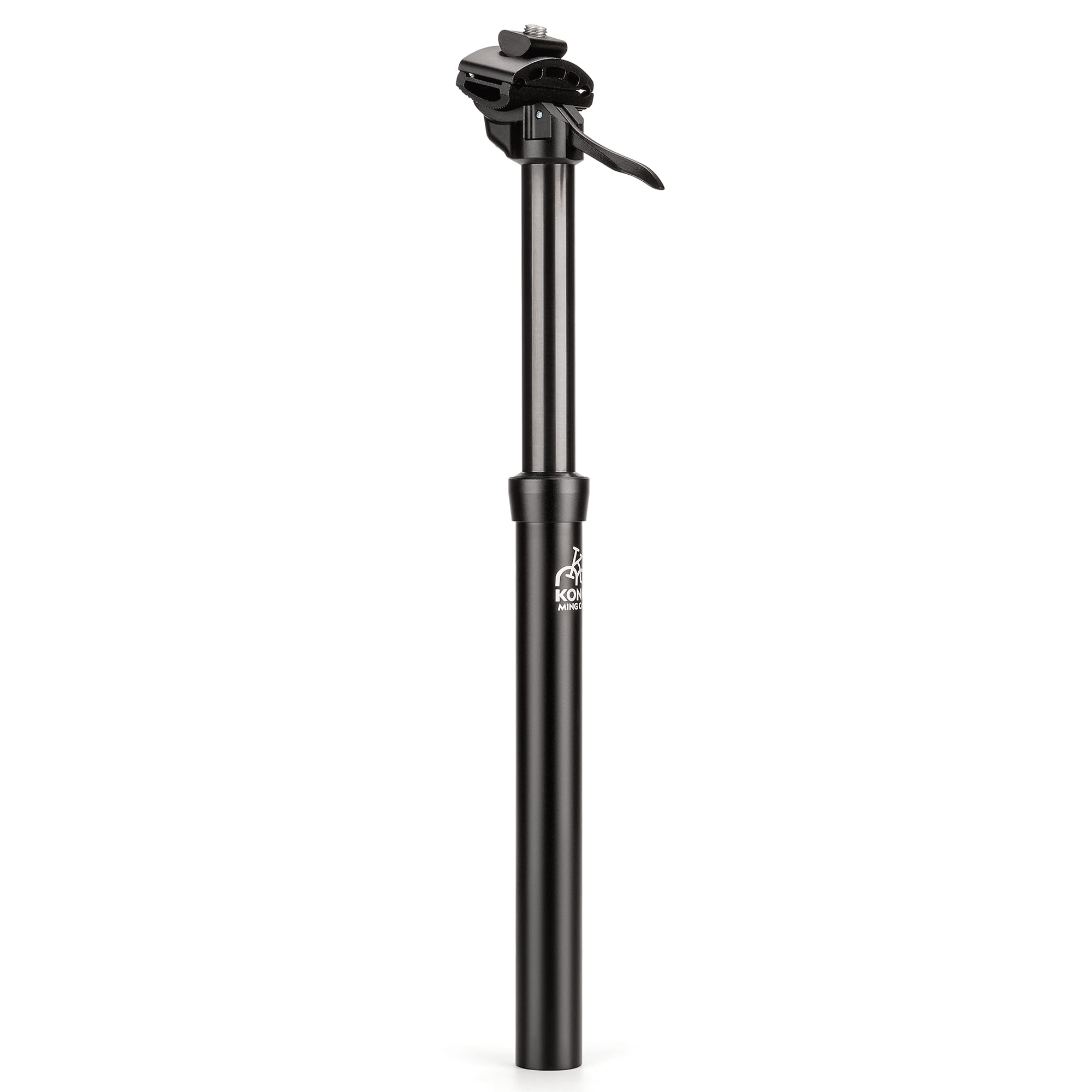
The KONG MING CAR Dropper Post represents the bottom of the price spectrum and uses the same cable-less under-saddle lever concept as the EXA Form, but with a simpler mechanical actuator rather than a full hydraulic cartridge. The lever is a small metal tab that sits directly under the saddle nose — you pull it to release the post, then sit to compress. The construction is 6061 aluminum alloy rather than 7075, which means the post is slightly heavier and more prone to scratching from saddle clamp adjustments.
The post offers 125mm of travel with three available diameters (27.2mm, 30.9mm, 31.6mm), though you must buy the correct diameter — no shim kit is included. The clamp angle is adjustable via loosening the saddle clamp bolts, allowing you to tilt the saddle nose up or down independently of the post angle. Riders report a 15-minute installation and note that the actuator mechanism feels firm when new, requiring a deliberate pull rather than a light squeeze.
The main durability concern is the actuator seal: several reviews report the post failing to return to full height after fewer than ten rides when used in wet or muddy conditions. The under-saddle lever is not compatible with handlebar remote conversion, so this post is best suited for dry-weather commuter bikes or kids’ bikes where the saddle height change is occasional rather than per-ride. Replacement is cheaper than repair since the cartridge is not user-serviceable.
Why it’s great
- Very low entry point makes dropper post access possible for kids’ bikes and budget builds
- Adjustable saddle clamp angle allows fine-tuning fore/aft and tilt position
- Simple tool-free installation with no cables to route or cut
Good to know
- Several reports of the post failing to return to full height after fewer than ten rides
- Small under-seat lever screws are hard to tighten without stripping the bolt head
FAQ
Do all dropper post levers fit all handlebar diameters?
Can I use a handlebar remote lever with a cable-less dropper post?
What does “MatchMaker compatible” mean for a dropper lever?
Final Thoughts: The Verdict
For most users, the best dropper post lever winner is the Bibike Dropper Post with Remote Lever because it pairs a robust 7075 post that supports 200kg riders with a functional handlebar lever and cable in one package. If you want a sealed cartridge system with lifetime warranty and are willing to buy the lever separately, grab the PNW Components Cascade. And for a no-cable commuter build or a fat bike where you never need to drop the saddle in motion, the EXA Form Speed Up stays simple and reliable.

Mo Maruf
I created WellFizz to bridge the gap between vague wellness advice and actionable solutions. My mission is simple: to decode the research and give you practical tools you can actually use.
Beyond the data, I am a passionate traveler. I believe that stepping away from the screen to explore new environments is essential for mental clarity and physical vitality.