Our readers keep the lights on and my smoothie glass nicely filled. As an Amazon Associate, I earn from qualifying purchases.
A drop spreader applies material exactly where you place it—no drift, no waste, and no toxic spray landing on your flower beds. Unlike broadcast models that fling seed into wind or onto pavement, a drop spreader releases granules straight down between the wheels, giving you clean edges and measured coverage you can trust.
I’m Mohammad Maruf — the founder and writer behind WellFizz. I’ve spent countless hours cross-referencing manufacturer specs, real owner experiences, and build tolerances to find the drop spreader that delivers straight, even passes without the guesswork.
Whether you’re fighting crabgrass on a half-acre or topdressing a putting green, the best drop spreader keeps fertilizer, seed, or ice melt exactly where you aim it—every pass.
How To Choose The Best Drop Spreader
Choosing a drop spreader starts with knowing your lawn size, material types, and how much control you need at the edge of a sidewalk or garden bed. Two major factors separate a precision tool from a frustrating one: gate design and agitator style.
Gate Design and Flow Adjustment
A drop spreader’s gate controls how much material falls through the openings. Look for a multi-position lever or slide that clicks into repeatable settings so you can dial in the exact rate for grass seed versus ice melt. Some mid-range models use a binary open-close system that makes fine-tuning difficult—avoid those if you apply lightweight materials like fescue seed or pelletized lime.
Agitator Material
Most fertilizer granules contain moisture-absorbing salts that can cause caking inside the hopper. A galvanized steel or stainless-steel agitator breaks up clumps before they reach the drop openings. Plastic agitators flex under heavy loads and tend to jam when damp material sticks to the hopper walls. Steel agitators also resist corrosion from ammonium-based fertilizers, which is critical for a multi‑season tool.
Hopper Capacity and Tire Size
A 50‑ to 75‑pound hopper holds a full bag of premium fertilizer, saving you refill trips on a 10,000‑square‑foot lawn. Pair that with 10‑inch never‑flat tires: foam‑filled tires keep the drop height consistent because they don’t lose air pressure mid‑spread. Larger 12‑ or 13‑inch pneumatic tires can smooth out bumpy terrain, but require occasional inflation and are prone to sidewall punctures.
Quick Comparison
On smaller screens, swipe sideways to see the full table.
| Model | Category | Best For | Key Spec | Amazon |
|---|---|---|---|---|
| EarthWay 2150 | Premium Broadcast/Drop Hybrid | Precise edge work on uneven lawns | 13″ pneumatic stud tires | Amazon |
| At Home 75 lb Drop Spreader | Drop Spreader | Large, flat lawns needing even coverage | Galvanized steel agitators | Amazon |
| Scotts Turf Builder Bundle | Mini Broadcast Bundle | Small northern lawns up to 5,000 sq ft | EdgeGuard side shield | Amazon |
| Agri-Fab Tow Behind | Tow-Behind Broadcast | Riding mower attachment for ¼‑acre+ | 10″ pneumatic tires | Amazon |
| Yard Commander 60 lb | Walk-Behind Drop | Medium lawns needing precise flow | 12″ never-flat tires | Amazon |
| Uniqwamo Handheld Power | Handheld Broadcast | Tight beds, patios, and small patches | 3L hopper, 6 speeds | Amazon |
| Compost Peat Moss Spreader | Roller Spreader | Topdressing with peat moss or compost | Diamond‑shaped metal mesh roller | Amazon |
In‑Depth Reviews
1. EarthWay 2150 Commercial 50 LB Broadcast Fertilizer Spreader

The EarthWay 2150 uses a three-hole drop system with side‑spread control, giving you feathered edging that reduces waste along driveways and flower beds. Its 13-inch pneumatic stud tires glide over rough terrain without bogging down, and the enclosed gearbox keeps debris out during damp applications.
Owners consistently note the clog‑free grate that slides in and out to break apart clumpy material before it reaches the drop openings. The adjustable drop rate is controlled directly on the hopper, letting you switch setting between heavy ice melt and fine grass seed without guesswork.
Assembly can take over two hours, and the printed instructions are sparse—many owners rely on video guides. A five‑year limited warranty backs the unit, which suggests confidence in the steel frame and gearbox durability.
Why it’s great
- Large pneumatic tires provide traction on wet or uneven grass
- Clog‑free grate handles clumpy material without jamming
- Side‑spread control protects planting beds and hardscapes
Good to know
- Extended assembly; needs a video for clarity
- Adjuster tends to over‑apply at factory setting—start at minimum
- Engaged gearbox is not spring‑loaded to shut off automatically
2. At Home 75 lb Drop Spreader

The At Home 75‑pound drop spreader pairs a large composite hopper with maintenance‑free steel flow control and 10‑inch never‑flat tires, delivering repeatable precision pass after pass. The galvanized steel agitators break lumps before they reach the drop gates, which is critical when applying damp‑textured materials like humic acid or organic fertilizers.
Owners praise the clear instructions and well‑labeled hardware—assembly runs about 90 minutes with no missing parts. The foam‑padded handles reduce vibration during long sessions, and the 10,000‑square‑foot coverage rating means one full hopper handles a typical suburban lawn without mid‑project refills.
Flow adjustment is not infinitely variable; some users report that the control feels binary, transitioning from closed to a heavy spill with minimal fine‑tuning in between. Check calibration with a small batch before applying to the full lawn.
Why it’s great
- Steel agitators prevent clogging from caked material
- Never‑flat tires keep drop height consistent
- Easy assembly with labeled hardware
Good to know
- Flow adjustment lacks granular control between closed and open
- Wheels may jam on the lowest settings
- Quality control can produce bent spindles on initial units
3. Scotts Turf Builder Bundle for Small, Northern Lawns
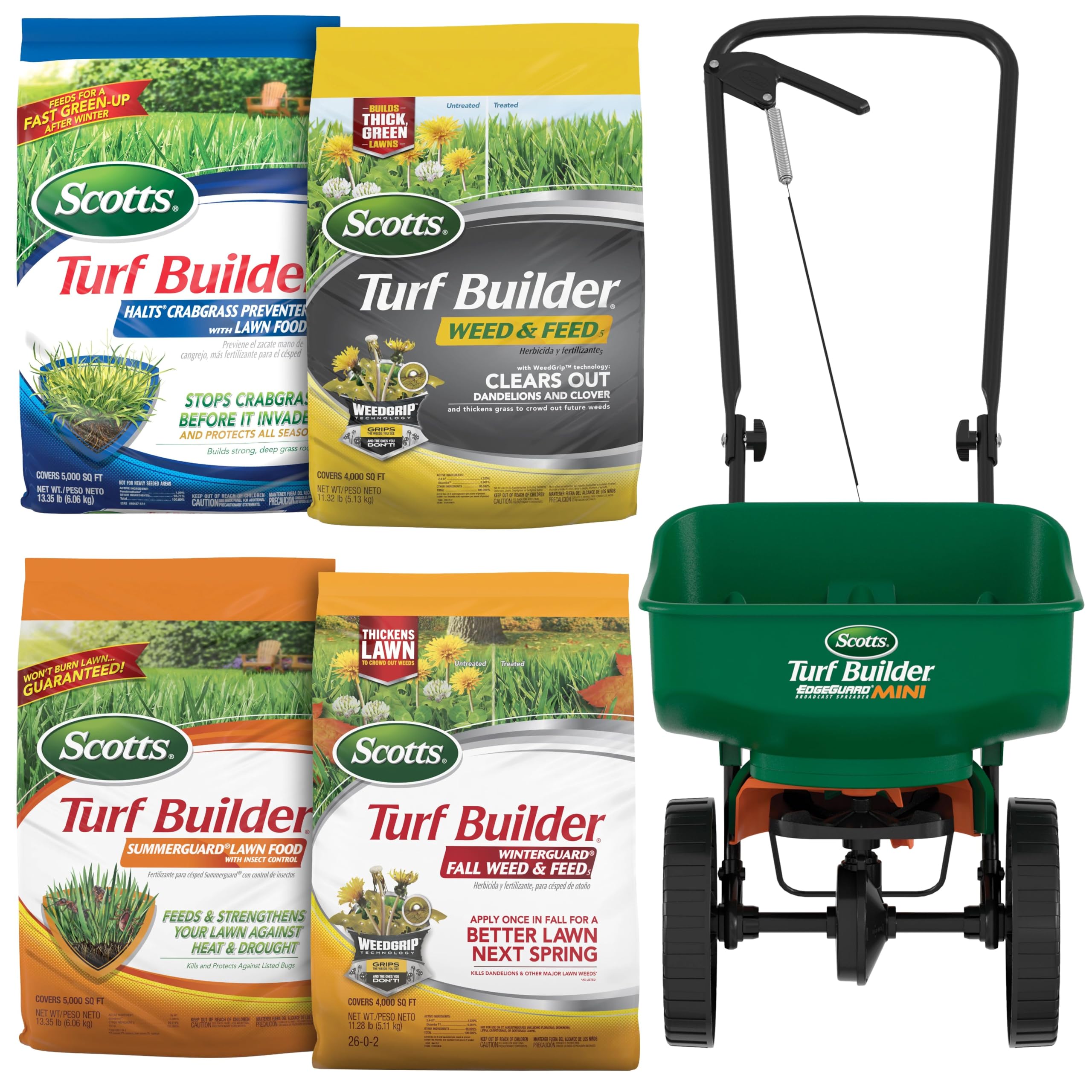
This bundle combines four Scotts Turf Builder products with a mini broadcast spreader that includes EdgeGuard, a side shield that shuts off material on one side to keep walkways and garden borders clean. It’s formulated for northern grass types like Kentucky Bluegrass and Perennial Ryegrass and covers up to 5,000 square feet per season.
Owners appreciate the convenience of a single purchase that covers spring, summer, fall, and winter applications. The mini spreader is lightweight and easy to store, though the broadcast action means material can drift in light wind—not a true drop spreader for those who need zero lateral movement.
The bags have been downsized compared to previous seasons while the price holds steady, which frustrates owners who remember the larger volumes. The spreader itself feels durable for small‑yard duty, and the EdgeGuard works well when you keep the shield pressed against a straight border.
Why it’s great
- All‑in‑one seasonal lawn care with matching spreader
- EdgeGuard shields hardscapes from chemical drift
- Compact size fits small sheds and garages
Good to know
- Broadcast action still drifts in moderate wind
- Product bags are smaller than previous versions
- Bundle is specific to northern grass types
4. Agri-Fab Tow Behind Broadcast Spreader
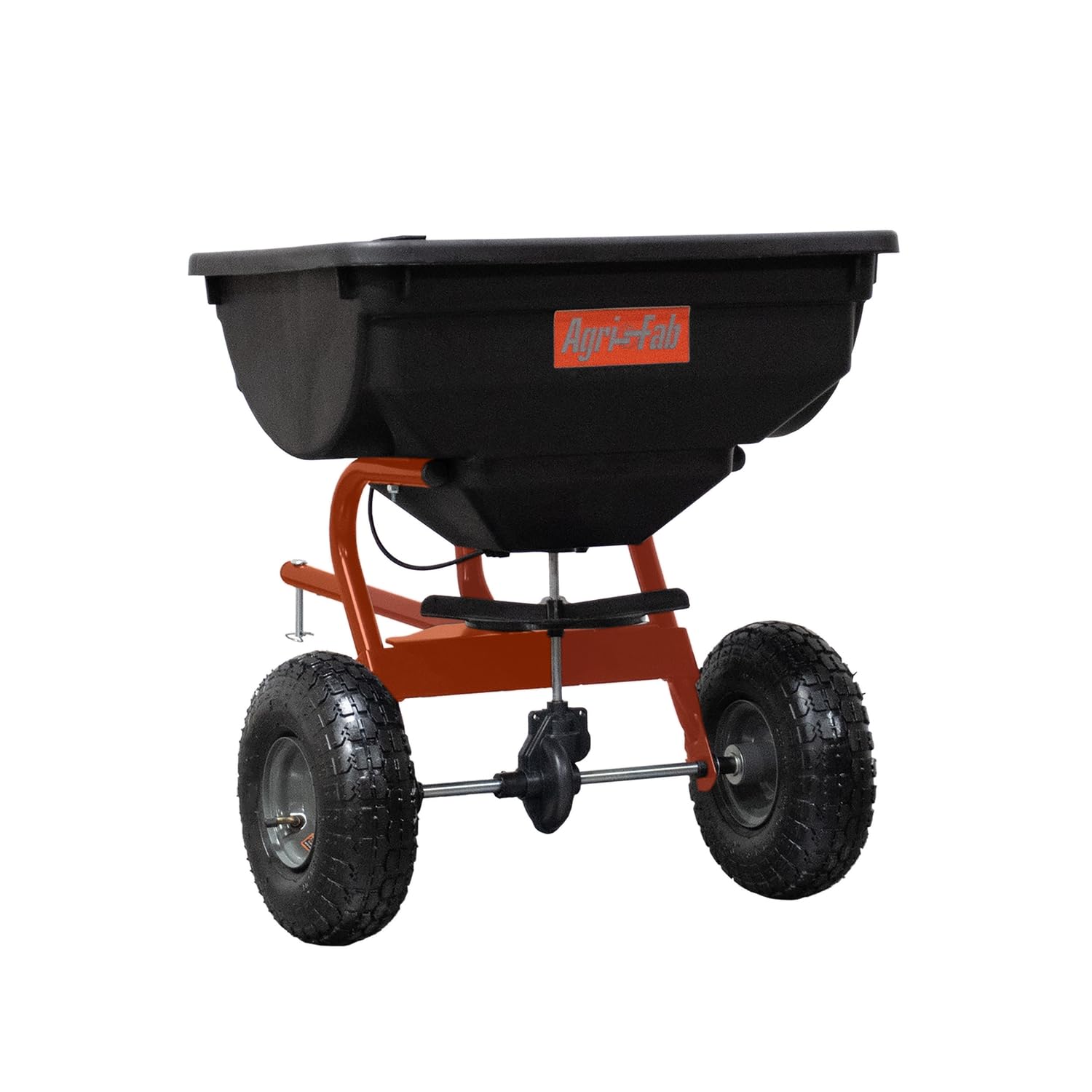
The Agri-Fab broadcast spreader attaches to a riding tractor or zero‑turn mower and covers up to 14,000 square feet without stopping. Its 85‑pound poly hopper resists corrosion from fertilizer salts, and the cable flow control lets you open or close the material gate without dismounting.
Spread width reaches 10 feet depending on ground speed and material type, making it efficient for properties over half an acre. The 10‑inch pneumatic tires roll smoothly over lumpy grass, and the enclosed gearbox reduces maintenance compared to exposed chain‑drive designs.
Assembly is tedious and packaging is loose—parts often arrive shifted and can be damaged in transit. The hopper cover, deflector, and grate accessories are sold separately, which adds cost. The controller cable may be hard to reach from a zero‑turn mower seat, so measure your reach before committing.
Why it’s great
- Cable control allows adjustment from the tractor seat
- 85‑lb hopper reduces refill trips on large lawns
- 10‑foot spread width covers ground quickly
Good to know
- Packaging offers poor protection during shipping
- Essential accessories (cover, grate) sold separately
- Controller position may be awkward on zero‑turn seats
5. Yard Commander 60 LB Walk-Behind Push Drop Spreader
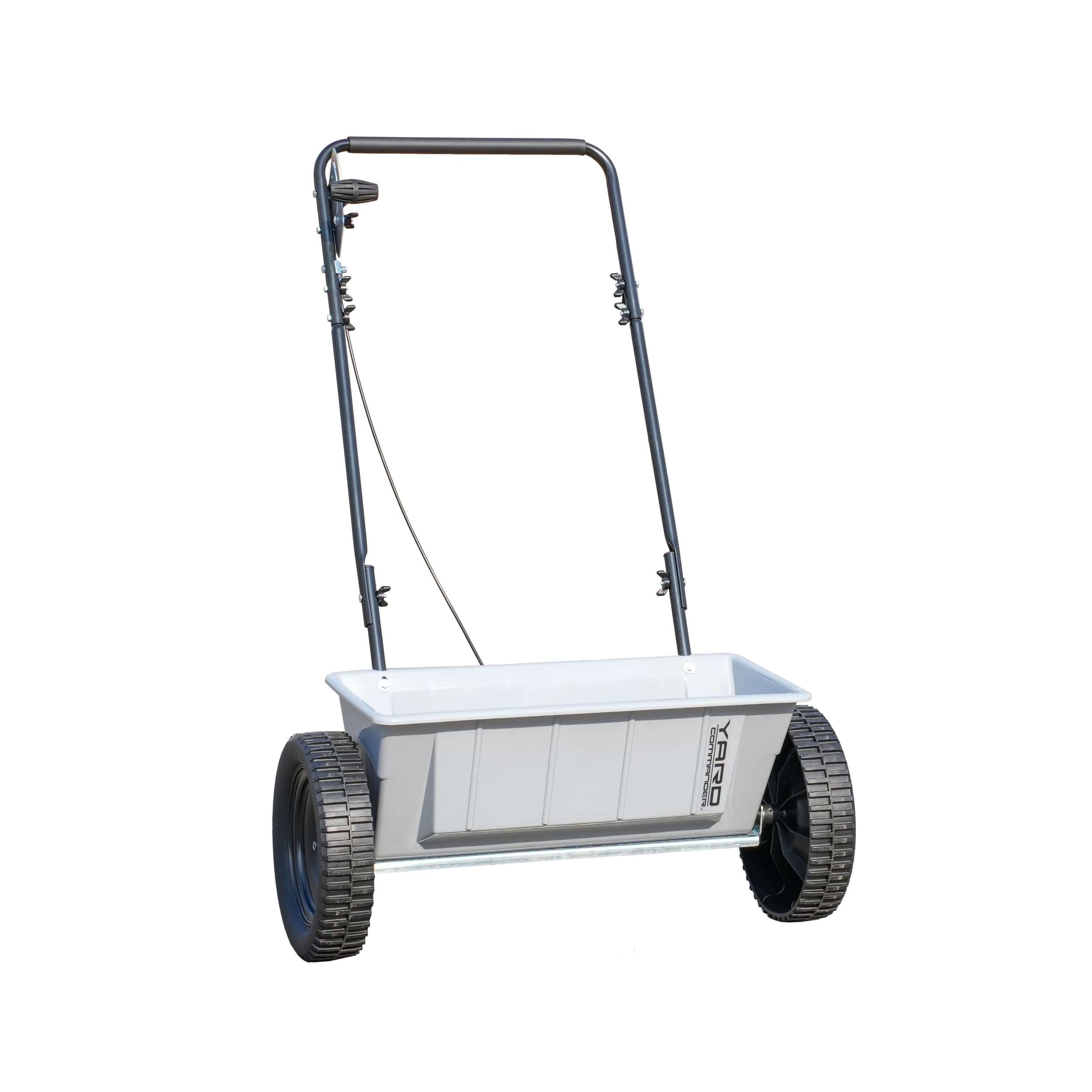
The Yard Commander holds 60 pounds of material, covers up to 15,000 square feet, and uses a 22‑inch spread pattern that keeps fertilizer in a tight band between the wheels. The powder‑coated steel frame resists rust, and the composite hopper cleans out quickly after each use.
Owners report that the drop rate adjustment is effective for grass seed and fine fertilizers, but the gate does not close completely—fine granular material leaks out even when the lever is in the closed position. This makes it unsuitable for applications where zero product should exit between passes.
Assembly requires significant effort and the instructions are minimal. Several units arrive with a bent wheel or cracked component, though the seller typically replaces parts quickly. The never‑flat tires keep the ground clearance consistent, which helps maintain pattern uniformity.
Why it’s great
- 22‑inch drop pattern suits suburban lawns
- Never‑flat tires eliminate air pressure worries
- Composite hopper resists chemical corrosion
Good to know
- Gate does not seal completely—fine material leaks
- Assembly is difficult with unclear instructions
- Unit may arrive with minor damage or bent parts
6. Uniqwamo Handheld Power Spreader

The Uniqwamo handheld spreader runs on Dewalt 20V or 60V lithium batteries (not included) and weighs only 2.8 pounds, making it ideal for small patches, raised beds, and rock salt on icy walkways. The 3‑liter hopper covers up to 700 square meters, and the six‑speed motor plus eight‑stage sowing volume control let you dial in a light dusting of clover seed or a heavier layer of ice melt.
Owners who use it for fine seed like white clover appreciate the adjustable drop chute and motor speed, which prevent waste. The ergonomic center‑of‑gravity design reduces wrist fatigue during extended use, and the broad compatibility with tool batteries means no extra charger clutter.
Build quality concerns surface in some units—one owner reported failure just after the one‑year warranty expired. The rotating impeller can cake when high‑moisture material sits in the hopper, and the unit requires occasional shaking to keep granular flow consistent.
Why it’s great
- Uses existing Dewalt batteries—no new charger needed
- Precise control for tiny seeds like clover
- Compact design reaches tight garden beds
Good to know
- Build may not survive heavy daily use
- Seed can cake and needs shaking mid‑job
- Battery and charger not included
7. Compost Peat Moss Spreader for Lawn
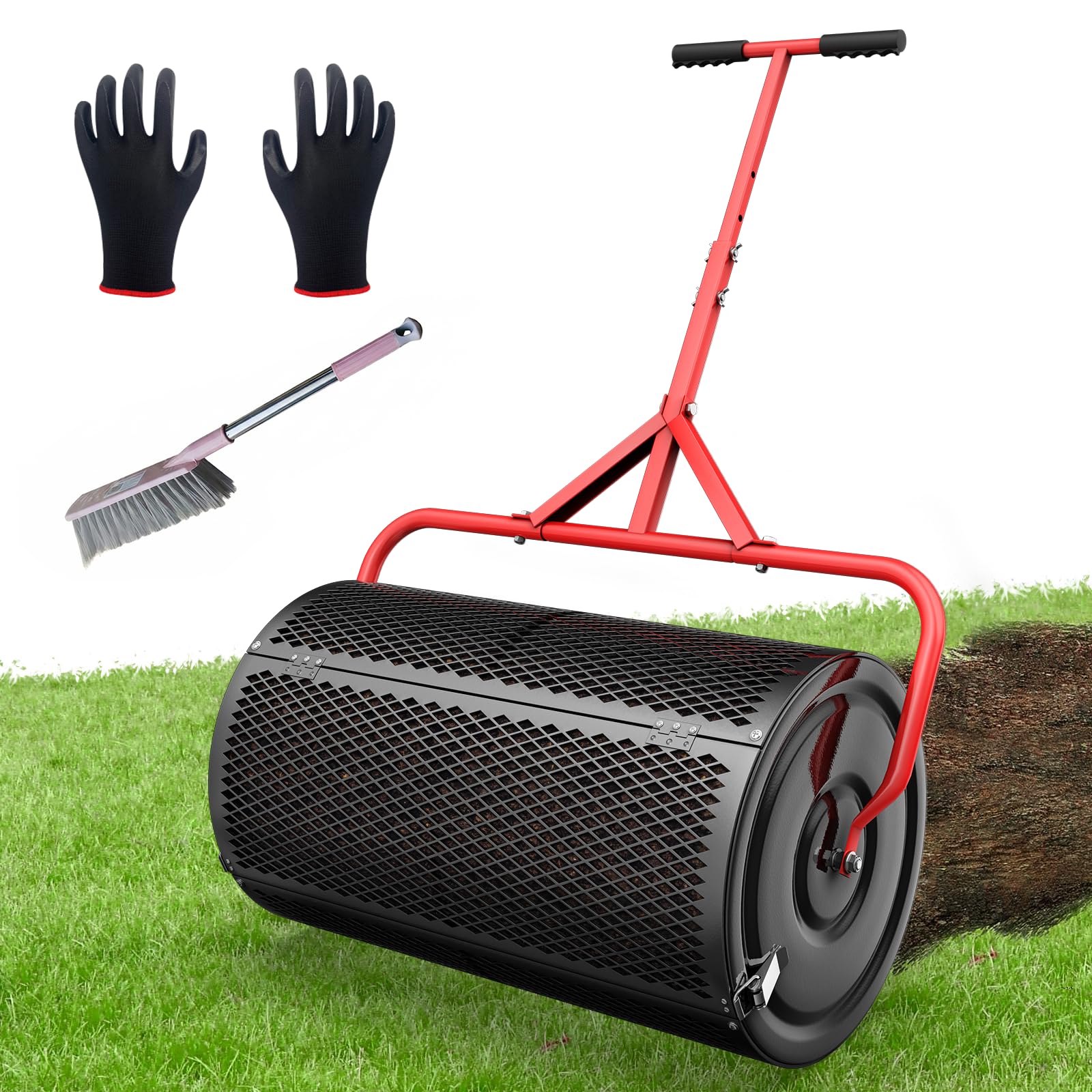
This 24‑inch roller spreader uses a thickened diamond‑shaped metal mesh to sift peat moss, compost, or topsoil evenly onto the lawn surface. The adjustable T‑shaped handle reduces fatigue when rolling multiple passes, and the upgraded side clasps protect hardware from being crushed during rolling movement.
Owners report even coats of peat moss that improve soil texture without leaving clumps or bare spots. The included gloves and cleaning brush help maintain the mesh, which can clog with wet compost if left uncleaned. Assembly is straightforward at about 15 minutes, though the instructions are limited to simple diagrams.
The unit is not designed for granular fertilizer or seed—the mesh openings are too large for fine granules, which would fall straight through. It excels specifically with fibrous, loose materials like peat moss or aged compost for topdressing established lawns.
Why it’s great
- Even distribution of organic matter like peat moss
- Metal mesh roller outlasts plastic drum designs
- Easy 15‑minute assembly with included tools
Good to know
- Not suitable for granular fertilizer or grass seed
- Mesh clogs with wet compost if not cleaned promptly
- Limited instructions; some trial and error required
FAQ
Can I use a drop spreader for ice melt in winter?
Why does my drop spreader leave stripes even when I overlap passes?
What size drop spreader do I need for a 10,000 square foot lawn?
Final Thoughts: The Verdict
For most users, the best drop spreader winner is the At Home 75 lb Drop Spreader because its galvanized steel agitators, never‑flat tires, and large composite hopper deliver consistent, stripe‑free passes on a typical suburban lawn. If you need precise edge control on uneven ground, grab the EarthWay 2150 for its pneumatic stud tires and three‑hole drop system. And for topping off small beds or icy walkways, nothing beats the Uniqwamo Handheld Power Spreader for portability and battery‑powered convenience.

Mo Maruf
I created WellFizz to bridge the gap between vague wellness advice and actionable solutions. My mission is simple: to decode the research and give you practical tools you can actually use.
Beyond the data, I am a passionate traveler. I believe that stepping away from the screen to explore new environments is essential for mental clarity and physical vitality.