Our readers keep the lights on and my smoothie glass nicely filled. As an Amazon Associate, I earn from qualifying purchases.
Buying a drone under $50 often feels like a gamble — you’re hoping for stable flight but bracing for a plastic brick that drifts into a tree. The market is flooded with cheap quadcopters that promise HD footage but deliver grainy, shaky video and flight times measured in seconds. Finding a model that actually hovers steadily, responds to controls, and survives a crash requires filtering through the noise to the few designs that prioritize durability and functional features like altitude hold and headless mode.
I’m Mohammad Maruf — the founder and writer behind WellFizz. My approach to this guide involved analyzing hours of flight test footage and cross-referencing technical specifications like battery chemistry, camera resolution, and motor response across dozens of budget-tier models to identify the few that outperform their price point.
This guide cuts through the confusion to deliver a clear verdict on the best drone under $50 for beginners, kids, and casual flyers seeking a reliable introduction to the hobby without breaking the bank.
How To Choose The Best Drone Under $50
Every drone in this price bracket is a toy-grade quadcopter, but the gap between a frustrating, short-lived experience and a genuinely fun flying toy comes down to a few key specifications. Prioritize these features to avoid common disappointment.
Altitude Hold and Optical Flow Positioning
The biggest pain point for new pilots is fighting the throttle to keep the drone at a steady height. Altitude hold uses a barometric sensor to lock the drone’s altitude, freeing your thumb to focus on direction and camera work. Optical flow positioning goes a step further — it uses a downward-facing camera to track ground movement, keeping the drone stable laterally. This is the difference between a drone that hovers in place indoors and one that drifts into a wall the second you take your hand off the stick.
Battery Chemistry and Flight Time
Look for modular lithium-ion or lithium-polymer batteries. The mAh rating (typically 600 to 1800 mAh) dictates single-battery flight time, which averages 8 to 13 minutes per pack in this class. A kit with two batteries effectively doubles your flying session. Avoid drones with permanently wired batteries — when they eventually fail, the entire drone becomes e-waste. Li-Po batteries generally deliver punchier power for stunts, while Li-Ion batteries prioritize longevity and safety with built-in overcharge protection.
Camera Resolution and FPV Lag
A 720P camera is the realistic baseline for a drone under $50. True 1080P sensors exist in a few models, but you should temper expectations — the compression and small sensor size mean footage will look decent on a phone screen but will not match a GoPro. More important than raw resolution is the FPV transmission lag. A responsive connection lets you frame shots in real-time; a laggy one introduces nausea and missed captures. Check reviews for specific complaints about Wi-Fi interference or video delay.
Quick Comparison
On smaller screens, swipe sideways to see the full table.
| Model | Category | Best For | Key Spec | Amazon |
|---|---|---|---|---|
| MOCVOO Drone | Camera Drone | Best Overall Value | 1080P camera, 1800mAh battery | Amazon |
| Pallton Mini Drone | Beginner Drone | Indoor Stability | Optical flow positioning, 24 min total flight | Amazon |
| Oviliee S17 | Camera Drone | Gesture & Voice Control | 1080P adjustable 90° lens, 2 batteries | Amazon |
| Holy Stone HS210T | Toy Drone | Indoor Fun & Stunts | Land & Fly 2-in-1 mode, 3D flips | Amazon |
| SIMREX X300C | Budget Pick | Kids & Beginners | Optical flow, 720P FPV, foldable | Amazon |
In‑Depth Reviews
1. MOCVOO Drone With 1080P Camera
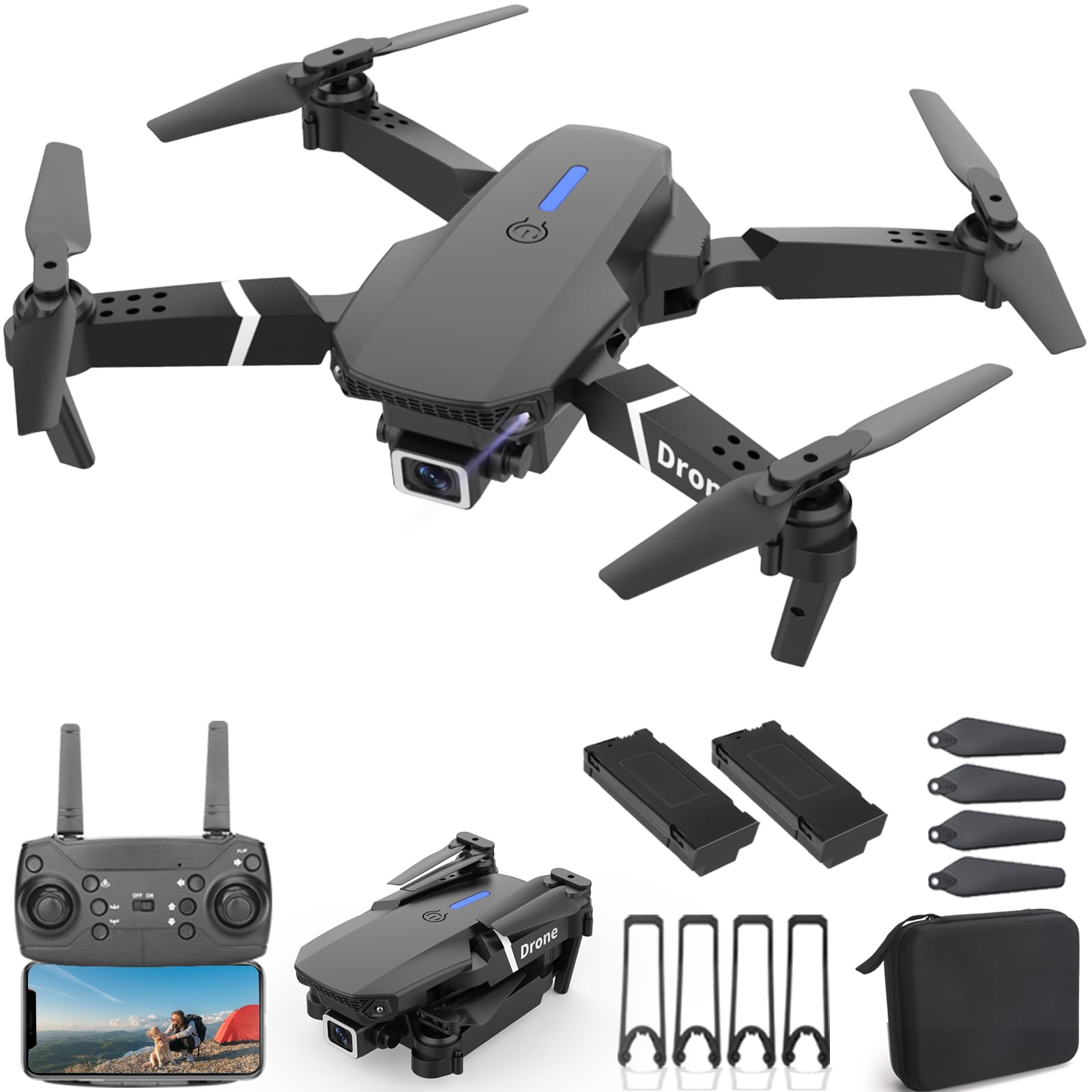
The MOCVOO drone stands out in this price tier for one clear reason: its 1800mAh lithium-ion battery is the largest capacity we found, delivering up to 26 minutes of combined flight across two packs. This directly addresses the primary complaint in the budget drone world — ending a session in what feels like five minutes. The 1080P camera with a 120-degree adjustable angle provides noticeably clearer footage than the 720P sensors common at this price, and the included carrying case makes it a complete package for beginners.
Flight stability is supported by three adjustable speed levels and a reliable one-key takeoff/landing system. The headless mode eliminates orientation confusion, which is a genuine help for first-time pilots who lose track of which direction the drone is facing. Reviewers consistently report the drone surviving multiple crashes on concrete, including one documented 30-foot fall, with only minor scuffs — a testament to the propeller guards and durable plastic frame.
The potential trade-off is that the camera, while crisp for the class, still exhibits compression artifacts in low light, and the Wi-Fi FPV range drops noticeably past about 50 meters. Some users reported erratic behavior after several days of use, suggesting build quality inconsistency across units. However, for most families looking for a first drone that works reliably out of the box, this is the value leader.
Why it’s great
- Highest battery capacity (1800mAh) in the class for extended flight sessions
- 1080P camera with 120-degree adjustable angle outperforms typical 720P budget sensors
- Included carrying case and extra propellers make it a ready-to-go gift
Good to know
- FPV video lag increases beyond 50 meters of range
- Camera quality degrades noticeably in low-light conditions
- A small number of units have reported erratic control behavior after a few days
2. Pallton Mini Drone with 1080P Camera

The Pallton drone earns its spot near the top for its optical flow positioning technology, which provides a noticeably steadier hover than basic altitude hold alone. This is the feature that distinguishes it from many competitors — it locks the drone in place laterally, making indoor flying in small rooms actually manageable. The 1080P camera with FPV live view streams smoothly to your phone, and the gesture selfie function works reliably enough for posing group shots at the park.
The kit includes two modular batteries for a total flight time of about 24 minutes, and the foldable design with a premium carrying case makes it a genuinely portable companion for camping trips or beach days. Three speed modes allow progression from a gentle drift to a more aggressive flying style, and the 360-degree 3D flips are responsive enough to impress onlookers. Customer feedback consistently praises its surprising durability, with multiple reviewers noting it survived crashes and falls that would have grounded lesser toy drones.
The primary limitation is that the camera, while 1080P rated, uses a small sensor that produces soft images in anything less than bright sunlight. The remote controller lacks a screen and relies entirely on your phone for FPV, which can be a minor inconvenience in direct sunlight. But for new pilots prioritizing a stable, frustration-free first flight experience indoors, this model performs above its weight class.
Why it’s great
- Optical flow positioning provides exceptional lateral stability for indoor flying
- Durable construction with propeller guards survives repeated crashes
- Gesture selfie and trajectory flight modes add creative fun
Good to know
- Camera sensor struggles with soft images in cloudy or dim conditions
- Remote control relies entirely on phone screen for FPV viewing
3. Oviliee S17 Mini Drone with 1080P Camera

The Oviliee S17 packs a surprising number of features for its price, starting with a physically adjustable 90-degree lens that lets you tilt the camera without relying on digital zoom. This is a meaningful distinction — you can frame shots more precisely than with fixed-lens competitors. The 1080P camera delivers crisp stills and smooth video in good light, and the included two 800mAh batteries provide a practical total flight time that keeps the fun going while the first pack recharges.
Voice control is the standout novelty here. You can command the drone to “Fly,” “Land,” “Forward,” or “Photo” without touching the remote. It works well enough to be genuinely useful for capturing a quick selfie without fumbling for buttons. Gesture recognition for photo and video, combined with the trajectory flight mode, makes this drone feel more advanced than its price suggests. The altitude hold is responsive, and multiple reviewers note that an 8-year-old can fly it confidently on the first attempt.
The compromise is that the battery capacity per pack (800mAh) is lower than the MOCVOO’s 1800mAh cells, so you’ll swap batteries more frequently. The Wi-Fi FPV connection can be finicky around interference sources like power lines or dense tree cover. One reviewer noted difficulty getting the camera feed to work initially, suggesting that the initial setup process is not as frictionless as some competitors. For families seeking a feature-rich gadget with camera flexibility, though, the S17 delivers excellent depth.
Why it’s great
- 90-degree adjustable lens provides better framing than fixed-camera rivals
- Voice control and gesture recognition add unique, engaging functionality
- Beginner-friendly flight profile with altitude hold and one-key start
Good to know
- Each 800mAh battery offers shorter single-session flight time than top competitors
- Camera setup can be finicky for some users on first connection
- FPV signal drops in areas with heavy Wi-Fi interference
4. Holy Stone HS210T 2-in-1 Drone

The Holy Stone HS210T is less a camera drone and more a creative toy, and it earns its place here for sheer uniqueness. Its 2-in-1 Land & Fly mode transforms it from a flying quadcopter into a ground-based RC car that can drift and spin. This dual-function design extends its play value far beyond what a standard drone offers, especially for younger children who may find pure flying repetitive. The four posture deformations change the drone’s shape mid-flight, adding a visual twist that keeps kids engaged.
Flight safety is prioritized with full nylon ABS propeller guards, an emergency stop button, and a low-battery alarm. The two included lithium-polymer batteries deliver about 16 minutes of total flight time, and the 2.4GHz remote allows multiple HS210T units to race simultaneously without interference. Customer feedback emphasizes its surprising durability — multiple reviewers note it has survived crashes that destroyed previous drones from other brands, making it a resilient choice for rough-handed kids.
The trade-off for this creativity focus is that there is no camera, so this drone is unsuitable for anyone wanting to capture aerial footage. The battery charging time (reportedly over an hour for a 7-8 minute flight per pack) is slower than some competitors. And while it works best indoors, the propellers tend to collect dust and hair from carpets, requiring occasional cleaning. This is a specialist toy for indoor stunt play, not a general-purpose flyer.
Why it’s great
- 2-in-1 Land & Fly mode with RC car functionality is uniquely engaging for kids
- Durable nylon ABS frame and propeller guards survive hard crashes
- Multiple HS210T units can race together without frequency interference
Good to know
- No camera — purely a stunt toy, not for aerial photography
- Long charging time relative to flight duration per battery
- Propellers collect dust and hair from indoor surfaces quickly
5. SIMREX X300C Mini Drone with 720P Camera

The SIMREX X300C occupies the entry-level position for good reason — its price is the lowest of the group, yet it still manages to include optical flow positioning, a feature typically found on more expensive models. This technology allows the drone to hold its position laterally indoors, which dramatically reduces the frustration of fighting drift in small rooms. The 720P camera is grainier than the 1080P sensors on higher-ranked drones, but for a first flyer on a tight budget, it’s serviceable for social media sharing.
The foldable design packs down to roughly the size of a smartphone, making it genuinely pocketable, and the included carrying case keeps everything organized. The SIMREX Zoomy app offers gravity sensor control — tilting your phone steers the drone — which younger kids find intuitive and fun. Two modular batteries deliver about 20 minutes of total flight time, which is competitive with mid-range options. The altitude hold is responsive, and the one-key takeoff/landing removes the hardest part of learning to fly.
The camera is the clear weak point. At 0.92 effective megapixels, images look soft and compressed, especially on phone screens. The app’s interface has translation quirks that some users found mildly confusing. Build quality reports are mixed — a few reviewers documented propeller failures after about 10 minutes of total use, suggesting some quality control variance. This drone is best understood as a low-risk, low-investment entry point for a child or absolute beginner to learn the basics before upgrading.
Why it’s great
- Optical flow positioning at an entry-level price point for steady indoor hovering
- Folds to a very compact size for pocketable portability
- Gravity sensor control in the app is intuitive for young kids to grasp
Good to know
- 720P camera produces soft, grainy images — the weakest camera in this list
- App interface has rough translation and can be confusing during setup
- Some units have reported propeller breakage after minimal use
FAQ
How long does a drone battery under $50 actually last per charge?
Is a 1080P camera under $50 actually good or just a marketing label?
Why does my cheap drone drift to one side and how do I fix it?
Final Thoughts: The Verdict
For most families and beginners, the best drone under $50 winner is the MOCVOO Drone with 1080P Camera because it combines the highest battery capacity in the class with a genuinely usable camera and a durable frame that reviewers say survives serious crashes. If you want superior indoor stability and optical flow positioning, grab the Pallton Mini Drone. And for a kid whose primary interest is stunts and racing rather than photography, nothing beats the unique 2-in-1 Land & Fly fun of the Holy Stone HS210T.

Mo Maruf
I created WellFizz to bridge the gap between vague wellness advice and actionable solutions. My mission is simple: to decode the research and give you practical tools you can actually use.
Beyond the data, I am a passionate traveler. I believe that stepping away from the screen to explore new environments is essential for mental clarity and physical vitality.