Our readers keep the lights on and my smoothie glass nicely filled. As an Amazon Associate, I earn from qualifying purchases.
The biggest fear of any new drone pilot is watching a hundred-dollar investment vanish over a treeline or plummet into a pond. Budget drones have historically earned a reputation for flimsy builds and frustratingly short flight windows, but the latest generation of entry-level quadcopters has closed that gap with features once reserved for premium models. GPS satellite locks, brushless motors, and 4K cameras now appear in sub- packages that fold small enough to fit in a jacket pocket.
I’m Mohammad Maruf — the founder and writer behind WellFizz. I’ve spent hundreds of hours cross-referencing flight specs, reading real owner reviews, and comparing image-stabilization systems to separate the true value picks from the disposable toys.
Whether you want to capture aerial vacation clips, inspect your roof gutters safely, or just buzz around the park, this guide to the best drone on a budget breaks down the seven models that deliver the most reliable performance without demanding a second mortgage.
How To Choose The Best Drone On A Budget
Spending less than two hundred dollars on a drone forces you to make intentional trade-offs. Three specs separate a fun, reliable flier from a frustrating one that drifts in the breeze and loses signal inside a football field’s distance.
GPS or Optical Flow — Your Safety Net
A drone without GPS cannot hold a fixed position against wind, nor can it fly itself home when the controller loses connection. Budget models under typically rely on an optical flow camera mounted on the belly — good for indoor hover, unreliable outdoors over water or grass. Models with a GPS module (starting around ) add automatic return-to-home, geofencing, and the ability to set a failsafe landing point. For your first drone, the peace of mind GPS provides is worth the extra cost.
Brushless Motors vs. Brushed Motors
Brushed motors are cheap to produce and common in toy-grade drones, but their internal brushes wear down after roughly 10 to 15 hours of runtime. Brushless motors — found on most mid-range and premium budget drones — run cooler, produce less noise, and deliver higher torque against wind gusts. If you plan to fly more than a few times a month, the longer service life of brushless motors justifies a slightly higher upfront price.
Camera Quality and Gimbal Stabilization
A drone can claim 4K resolution on the box while delivering footage that looks like a watercolor painting in motion. Real 4K requires a decent sensor (12MP or higher), a wide aperture lens (around f/2.15), and some form of mechanical or electronic stabilization. Below , most cameras are 1080p with digital stabilization that crops the image. At the – mark, models add a 90-degree adjustable lens and electronic vibration reduction that produces share-worthy footage. Look for reviews that mention actual video quality, not just the resolution sticker.
Quick Comparison
On smaller screens, swipe sideways to see the full table.
| Model | Category | Best For | Key Spec | Amazon |
|---|---|---|---|---|
| REDRIE HK33 | Premium Budget | Long flights & GPS safety | 45 min total / 2 x 1800 mAh batts | Amazon |
| Oddire HK11 | Premium Budget | 48-min flight time & brushless | 249g / 7.7V batts / 5G WiFi | Amazon |
| SIMREX G29 | Mid-Range | Intelligent flight modes | 4K / 40 min / brushless motors | Amazon |
| REDRIE HK33 (Gimbal) | Mid-Range | Stable 4K with 2-axis gimbal | 2-axis gimbal / Level 5 wind | Amazon |
| Mcokoe Camo Drone | Mid-Range | Built-in screen controller | 5.9-inch monitor / 60 min fly | Amazon |
| Hocany HK99 | Budget | GPS features at lowest price | 985-ft FPV / brushless / GPS RTH | Amazon |
| BeiyoQSZ Mini | Budget | Kids & absolute beginners | 25 min / 1080P / optical flow | Amazon |
In‑Depth Reviews
1. REDRIE HK33 — Premium GPS Drone
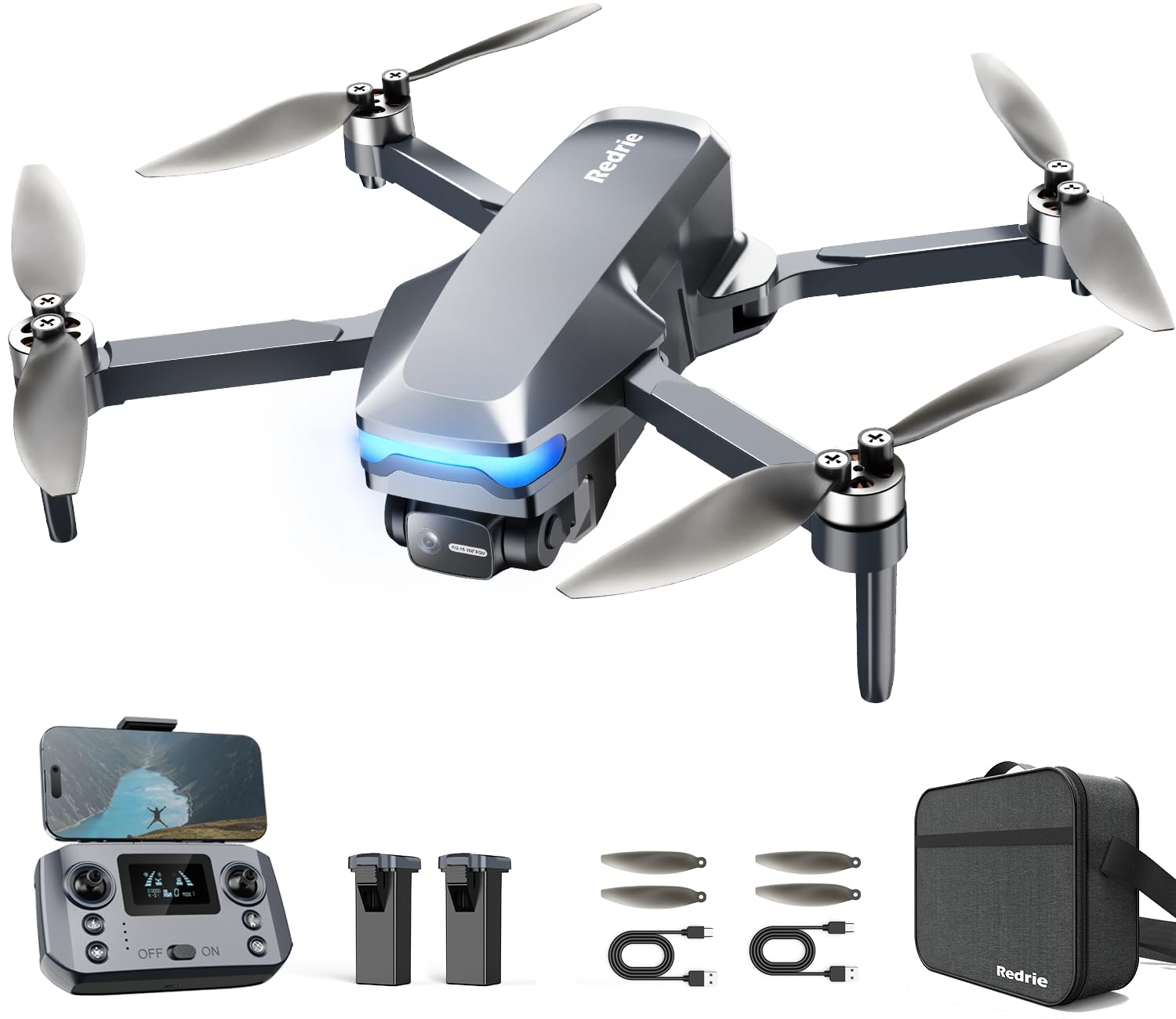
The REDRIE HK33 earns the top spot because it bundles nearly every feature a cautious beginner wants — GPS auto return, 5G FPV transmission, brushless motors, and a total flight time of 45 minutes from two 1800 mAh batteries — without exceeding the sub-250g weight limit that triggers FAA registration. The 110-degree wide-angle lens with a 90-degree remote-controlled adjuster lets you frame landscape shots from straight above to level horizon without landing to tweak the camera angle manually.
Real owners consistently praise the responsive GPS tracking and the waypoint flight mode, which lets you draw a path on your phone and let the drone fly it autonomously. The included carrying case and spare blades show the manufacturer invested in the unboxing experience. Several reviews mention that the camera produces “decent” results for the price tier, with the physical vibration reduction smoothing out minor shakes that cheaper digital stabilization systems would amplify.
Battery life matches the claimed 45 minutes closely in moderate conditions, and the built-in battery indicator on the remote controller helps you plan landings before the low-voltage failsafe kicks in. The only real trade-off is the lack of a mechanical gimbal — the stabilization is electronic, so fast lateral movement will produce some wobble in the footage.
Why it’s great
- Sub-250g no FAA registration needed
- Long 45-minute total flight with 2 batteries
- Reliable GPS auto-return and waypoint mode
Good to know
- Electronic stabilization only, no 3-axis gimbal
- Maximum 300m FPV range is adequate but not class-leading
2. Oddire HK11 — 48-Minute Premium Drone

The Oddire HK11 justifies a slight premium over other entry-level drones by being the only model in this comparison that ships with 7.7V batteries instead of the standard 7.4V or 3.7V packs. The higher voltage translates directly into longer hover and flight times — real owners report total flight windows that hover right around the advertised 48 minutes when you rotate between the two included batteries. That extra flying time makes a real difference when you are trying to cover a large park or capture a full sunset sequence without rushing back to swap packs.
Like the REDRIE HK33, the Oddire HK11 features a 249g frame that keeps it outside FAA registration requirements, plus a 4K camera with a 110-degree field of view and 90-degree adjustable angle. The 5G WiFi transmission uses a signal repeater in the remote controller to maintain a stable video feed at distances up to 500 meters. Owners particularly enjoy the gesture control feature — raising a V-signal triggers a photo, while a palm gesture starts recording — which makes group selfies much easier than fumbling with the app.
The compass recalibration process is a minor friction point. A few first-time users were confused by the drone’s beeping patterns during calibration. The included manual does not explain the sequences clearly, but a quick online search resolves it. The brushless motors handle level 4 wind with no drift, and the VR headset compatibility adds a nice immersive option for FPV enthusiasts.
Why it’s great
- 48 minutes total flight time — class leading
- 7.7V batteries offer stronger sustained power
- 249g frame avoids FAA registration
Good to know
- Compass calibration required before each flight session
- No SD card included in the package
3. SIMREX G29 — Intelligent Flight Modes

The SIMREX G29 targets the user who wants the most automated photography modes without moving into the four-hundred-dollar range. It ships with GPS auto-return, optical flow positioning for stable indoor hover, and a set of intelligent flight modes — Follow Me, Waypoint Flight, and Circle Fly — that let you focus on the composition while the drone handles the piloting. The 90-degree electrically adjustable 4K camera pairs with 5G WiFi FPV to stream smooth live video to your phone screen at distances up to 700 meters outdoors.
Owners report that the Follow Me tracking works reliably on foot and at slow bike speeds, making it a solid pick for action-sports hobbyists who want overhead shots without a second person operating the controls. The brushless motors produce noticeably less whine than the brushed alternatives on toy-grade drones, and the optical flow sensor keeps the hover rock-solid even inside gymnasiums where GPS signals are weak. The foldable arms collapse into a compact shape that fits into the included storage case with room for both batteries and the remote control.
The battery door on the controller feels slightly flimsy, and a few users noted that the phone holder struggles with larger phones when thick cases are installed. On the bright side, the batteries charge via USB-C, which is a welcome departure from the barrel-plug chargers that still plague most budget drones. The total flight time sits around 40 minutes, which is competitive but a few ticks behind the Oddire and REDRIE options.
Why it’s great
- Follow Me and Circle Fly modes work well at moderate speeds
- USB-C battery charging — no barrel plug needed
- Stable optical-flow hover indoors or under tree cover
Good to know
- Phone holder may not fit large phones with thick cases
- Controller build quality feels less premium than the drone itself
4. REDRIE HK33 with 2-Axis Gimbal
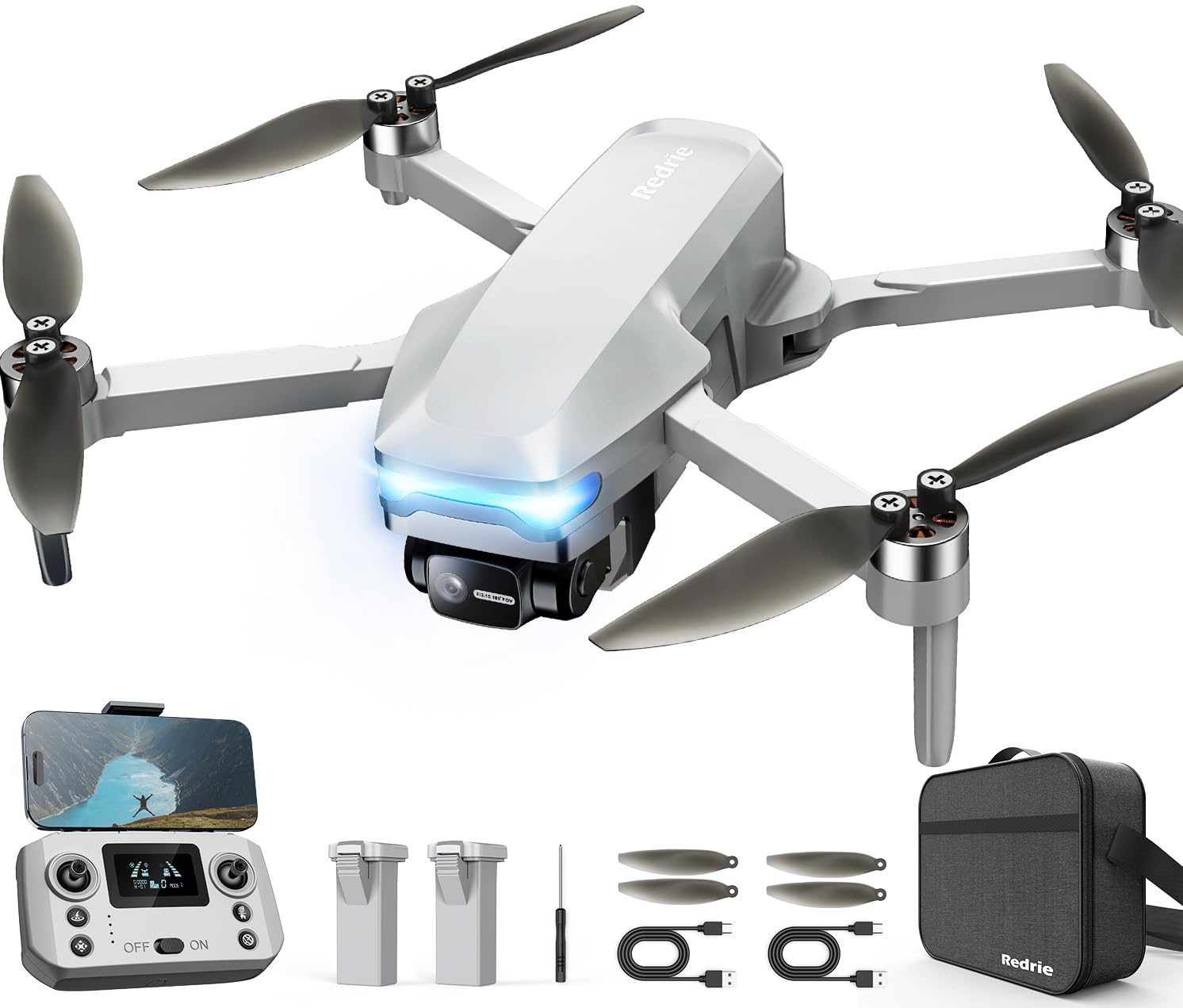
This variant of the REDRIE HK33 stands apart from its sibling (product #1 in this guide) by adding a true 2-axis mechanical gimbal that physically stabilizes the camera pitch and roll. That hardware makes a visible difference in the final footage — fast forward flight, banking turns, and moderate wind gusts no longer produce the jello-effect wobble that plagues electronically stabilized cameras in this price bracket. The F2.15 aperture with 110-degree wide-angle lens captures more light than typical f/2.8 budget cameras, producing cleaner low-light shots at dusk.
Weighing under 250g, the drone maintains the FAA-free advantage while delivering footage that looks closer to what you would expect from a + platform. The GPS module includes all the expected safety features — automatic return-to-home on signal loss or low battery, waypoint route planning, and orbit mode for circling a fixed point. Real owners particularly appreciate the included carrying case, extra propellers, and the QR code-based setup guide that reduces the learning curve for first-time pilots.
The main drawback is that the 2-axis gimbal only stabilizes pitch and roll — yaw movements (spinning the drone left or right) will still show in the footage. For most users capturing landscape pans and hover shots, the gimbal is a massive upgrade over purely digital stabilization. Battery life totals 40-45 minutes across two 1800 mAh packs, and the remote controller’s phone holder works well with most modern smartphones.
Why it’s great
- True 2-axis mechanical gimbal eliminates jello wobble
- F2.15 aperture captures clearer low-light footage
- Level 5 wind resistance with stable brushless motors
Good to know
- Gimbal does not stabilize yaw (rotational) movement
- The phone holder can be a bit too tight for some cases
5. Mcokoe Camo Drone — Built-in 5.9-Inch Screen
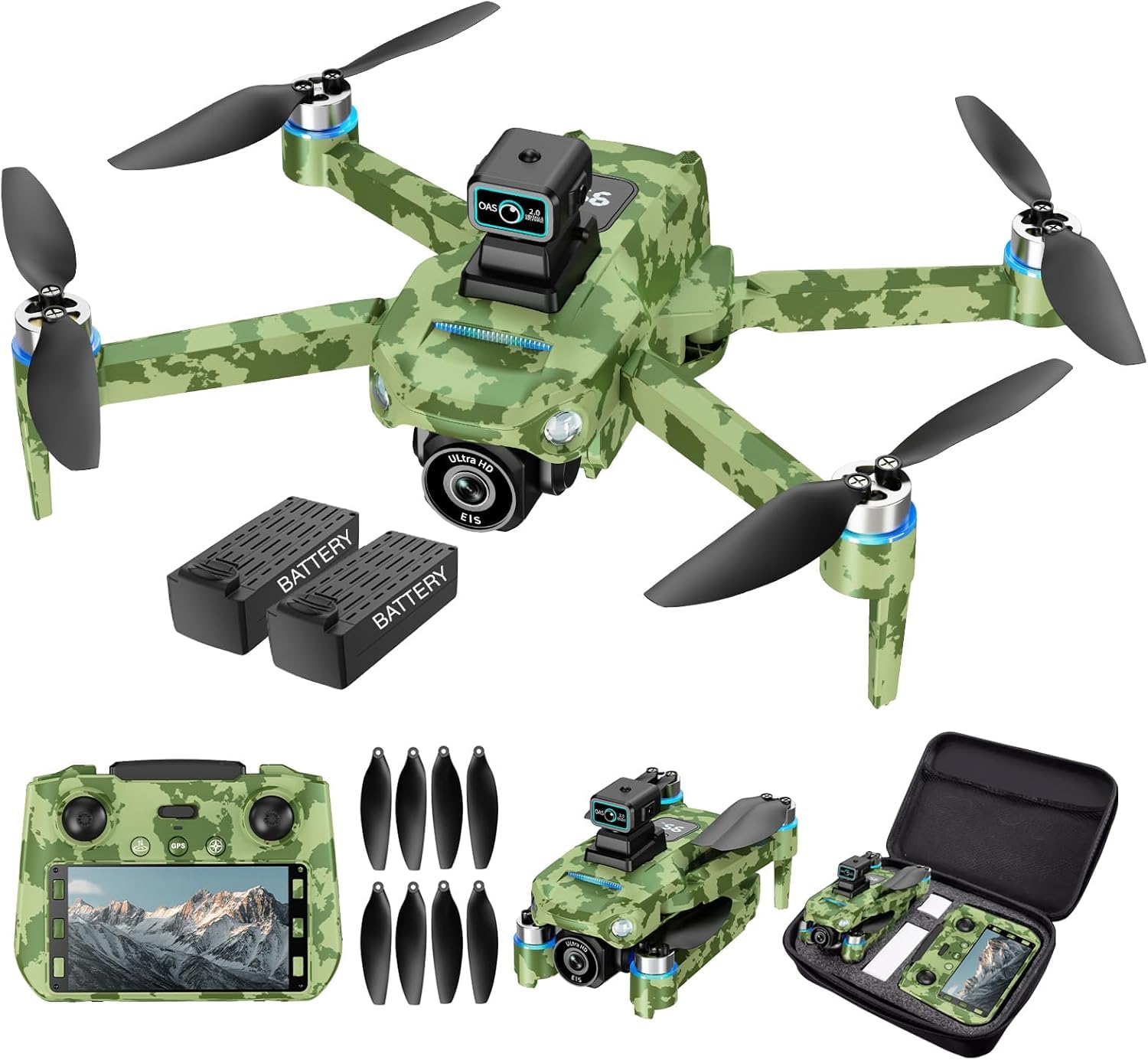
The Mcokoe drone takes a different approach from every other model in this guide by integrating a 5.9-inch color screen directly into the remote controller. That design choice eliminates the common friction point of budget drones — needing to clamp your phone into a flimsy holder and keep the app running in the foreground. The screen is bright enough for outdoor use in overcast and partially sunny conditions, though direct sunlight will still create glare. The 720P camera is the weakest sensor in this comparison, but the convenience of the all-in-one controller may outweigh the resolution downgrade for casual users.
Flight performance is stable thanks to the brushless motors and GPS-assisted hover. The drone includes beginner mode, which limits altitude and distance while you build confidence, and automatically returns home when signal drops or battery hits the threshold. Two 2200 mAh batteries deliver a combined 40 minutes of flight — slightly below the claims but still competitive. The camouflage finish is a fun aesthetic touch that makes the drone easier to spot against a blue sky than the standard white or gray shells.
Many owners in the reviews highlight the gesture control system, which reliably triggers photos and videos with hand signals. The 120-degree wide-angle lens captures a broad field of view, and the 90-degree adjustable angle lets you tilt the camera downward for inspection-style shots without landing. The controller’s joysticks feel responsive with no dead zone, and the one-button takeoff feature works reliably every time.
Why it’s great
- Built-in 5.9-inch screen eliminates phone-holder hassle
- Beginner mode restricts altitude and range for new pilots
- 2200 mAh batteries — largest capacity in this comparison
Good to know
- 720P camera resolution is lower than 4K competitors
- Screen glare can be problematic in direct strong sunlight
6. Hocany HK99 — Lowest-Price GPS Drone
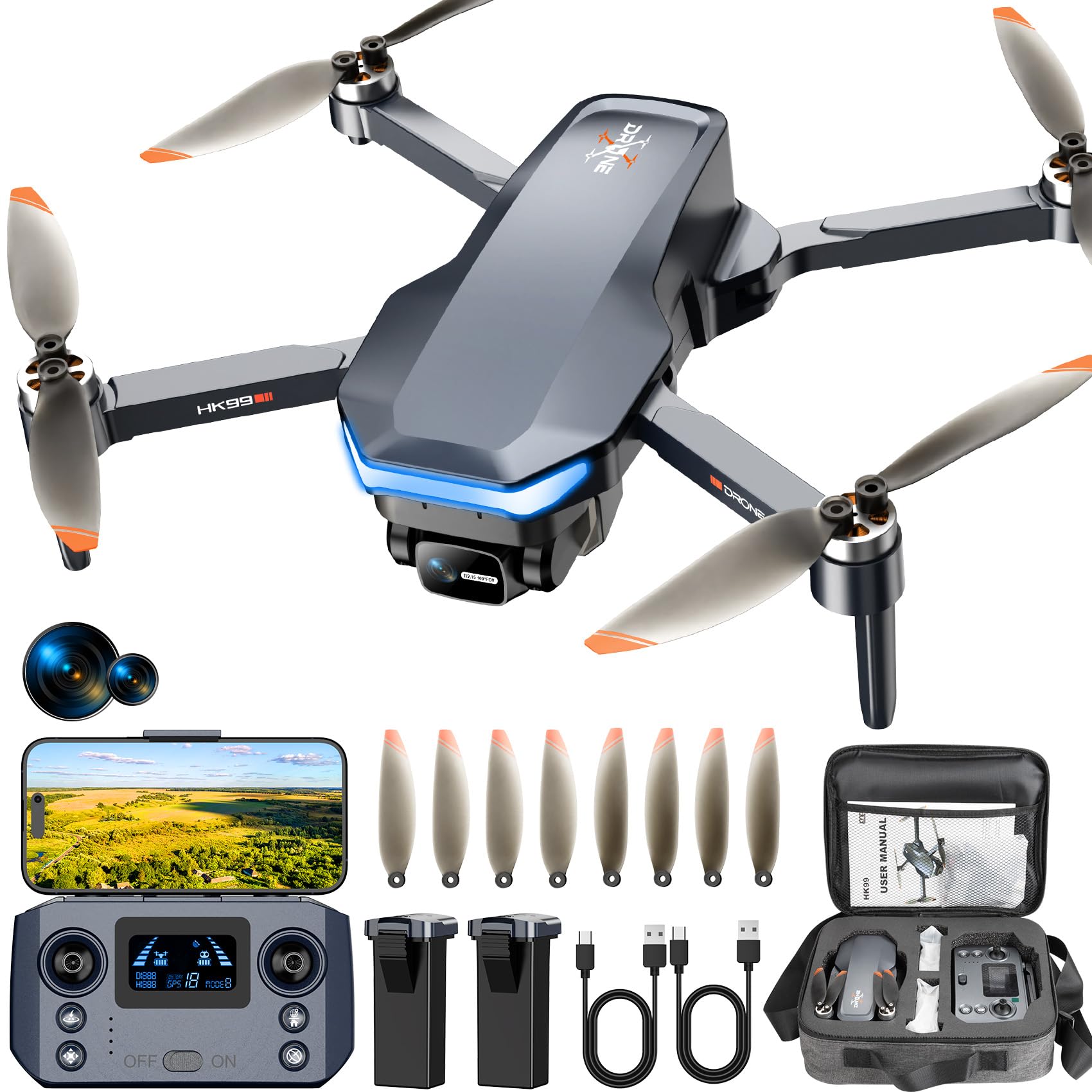
The Hocany HK99 is the cheapest drone in this roundup that includes true GPS functionality — return-to-home, follow-me, circle fly, and waypoint navigation — in a sub- package. That alone makes it a compelling entry point for anyone who wants to learn on a platform that will not fly away when the battery hits 20 percent. The 4K camera produces passable stills in good light, and the 110-degree wide-angle lens with 90-degree electronic tilt lets you frame shots without landing. The brushless motors are a rarity at this price point and give the HK99 better wind resistance than any toy-grade competitor.
Real-world flight tests reveal that the GPS lock takes about 30 to 40 seconds outdoors, and the drone holds position well in zero-wind conditions. In light breezes below 5 mph, some users noticed a gentle drift that the optical flow sensor could not fully counteract. The controller includes a phone holder for FPV viewing, and the 5G WiFi transmission maintains a stable feed up to about 300 feet — shorter than the marketing claims but still usable for line-of-sight flying.
The plastic build is lighter than the more expensive options, which contributes to the drift in wind but also makes it virtually indestructible. One owner reported surviving seven crashes with zero frame damage. The two batteries in the box provide around 40 minutes of total flight time, and the carrying case fits everything neatly. Experienced pilots may find the controls slightly less precise than the + models, but as a training platform, the HK99 is unmatched at this price.
Why it’s great
- GPS and RTH at the lowest price point of any reviewed drone
- Brushless motors at an affordable price
- Extremely durable plastic frame survives crashes well
Good to know
- Drifts noticeably in winds over 5 mph
- FPV range shorter than advertised in real-world use
7. BeiyoQSZ Mini — Best for Kids & First Flights
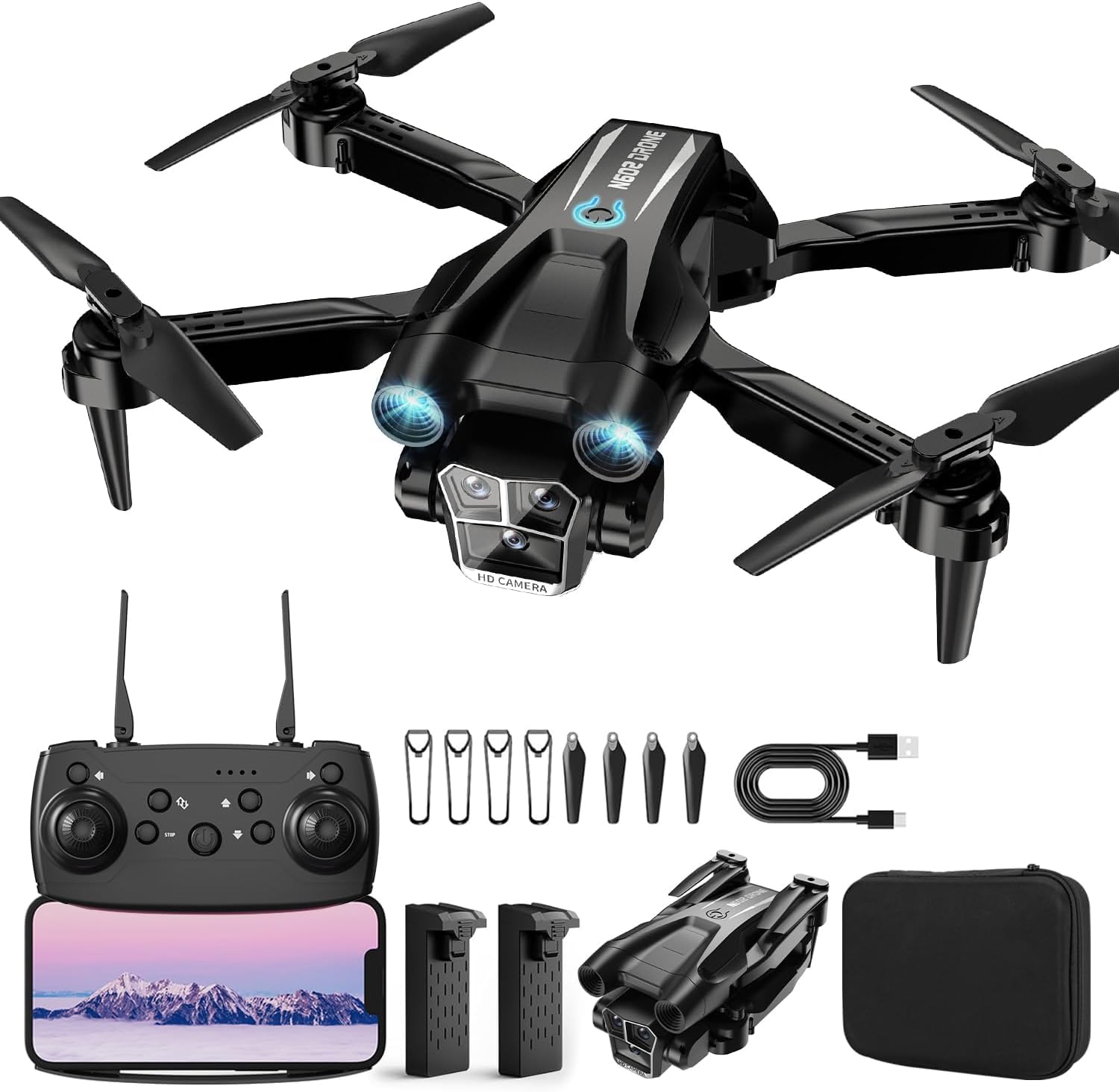
If your goal is to put a drone in the hands of a child or someone who has never touched a quadcopter remote before, the BeiyoQSZ Mini is the safest bet. It uses optical flow positioning instead of GPS, which means the drone can hold a steady hover indoors — carpet, hardwood, or tile — without drifting into walls. The 1080P camera is lower resolution than the 4K models higher on this list, but for casual yard flying and family photo albums, the clarity is more than sufficient. The real win here is the set of beginner-friendly features: one-key takeoff/landing, emergency stop, headless mode (where the drone orientation relative to the controller does not matter), and three adjustable speed modes.
Two batteries in the box deliver a combined 25 minutes of flight time, which is modest compared to the competition but adequate for short attention spans. The included carrying case, propeller guards, spare blades, and screwdriver mean you do not need to buy anything extra to fly safely right out of the box. Owners consistently mention how intuitive the controls feel — even reviewers who had never flown a drone before were able to lift off, hover, and land on the first attempt.
The foldable frame collapses to a size that fits in a coat pocket, and the weight is low enough that a crash onto grass typically causes no damage. The Wi-Fi range is limited — about 80 to 100 feet before the video feed starts stuttering — but at this price point and target audience, keeping the drone close to the pilot is actually a safety feature. The trajectory flight mode, where you draw a path on your phone and the drone follows it, is a hit with kids and adds replay value long after the novelty of basic hovering wears off.
Why it’s great
- Optical flow hover works well indoors and outdoors on flat surfaces
- Headless mode eliminates orientation confusion for true beginners
- Includes propeller guards, spare blades, and carrying case
Good to know
- Wi-Fi range limited to roughly 80-100 feet
- 1080P camera — no 4K option available
FAQ
Do I need FAA registration for a drone under 250 grams?
Why does my budget drone lose FPV signal after only a few hundred feet?
Can I use a budget drone for real-estate or roof inspection work?
How long do budget drone batteries last before they need replacing?
Final Thoughts: The Verdict
For most users, the best drone on a budget winner is the REDRIE HK33 Premium GPS Drone because it combines GPS safety, a 45-minute total flight time, brushless motors, and a sub-250g frame that avoids FAA registration — all at a price that undercuts anything with comparable specs. If you want the longest flight windows for exploring large areas, grab the Oddire HK11. And for gimbal-stabilized footage that approaches DJI Mini territory without the price tag, nothing beats the REDRIE HK33 with 2-Axis Gimbal.

Mo Maruf
I created WellFizz to bridge the gap between vague wellness advice and actionable solutions. My mission is simple: to decode the research and give you practical tools you can actually use.
Beyond the data, I am a passionate traveler. I believe that stepping away from the screen to explore new environments is essential for mental clarity and physical vitality.