Our readers keep the lights on and my smoothie glass nicely filled. As an Amazon Associate, I earn from qualifying purchases.
The drone aisle is crowded with promises of 4K clarity and auto-follow features, but the real difference between a memorable flight and a frustrating crash comes down to three things: gimbal stabilization, GPS reliability, and flight time per battery. A drone helicopter with camera is only as good as its ability to hold a steady hover and return home when the signal dips.
I’m Mohammad Maruf — the founder and writer behind WellFizz. I’ve spent hundreds of hours combing through technical specs, real-world user flight logs, and side-by-side comparisons to separate marketing claims from real performance in this guide.
This review focuses on nine rigorously selected models to help you find the best drone helicopter with camera for your skill level and budget without wasting money on gimmicks.
How To Choose The Best Drone Helicopter With Camera
The sweet spot for a camera drone is balancing wind resistance, video stabilization, and smart GPS features without exceeding the 249-gram FAA threshold. Understanding the interplay between these specs prevents overpaying for features you won’t use or buying a drone that drifts uncontrollably in a light breeze.
Gimbal Type: 2-Axis vs 3-Axis vs EIS
The single most important component for video quality is the stabilization system. A 3-axis brushless gimbal physically counteracts pitch, roll, and yaw, producing cinematic footage even in moderate wind. Electronic Image Stabilization (EIS) crops the sensor to remove shake and works best in good light but introduces a slight jelly effect during fast yaw movements. Budget drones rely on 2-axis gimbals that leave roll compensation to EIS — functional for still shots but noticeable in sweeping video.
Flight Time and Battery Chemistry
Advertised flight times assume perfect conditions with minimal wind and steady hovering. Real-world numbers are usually 60-70% of the claim. Battery voltage matters: 7.4V packs are common in entry-level drones, while 7.7V and 11.1V batteries deliver higher sustained power for brushless motors. A drone with three batteries at 2200mAh each often gives more total airtime than a single 5000mAh pack, because swapping a battery is faster than waiting for a recharge.
GPS Intelligence and Auto Return
Not all GPS modules are equal. A drone that supports multiple satellite constellations (GPS + GLONASS + Galileo + BeiDou) acquires a lock faster and holds position more accurately. The auto-return feature should have three independent triggers: one-key return, low-battery auto-return, and signal-loss auto-return. Models that also include a dynamic home point — where the return location updates as the controller moves — are safer for hiking and moving shoots.
Transmission Technology: Wi-Fi vs Digital
Standard 5G Wi-Fi transmission works well up to about 500 meters in open areas but suffers from interference in urban environments. Proprietary digital transmission systems (like DJI’s O4 or Ruko’s R2) push range past 4 kilometers with lower latency and resistance to signal dropouts. For casual backyard flying, Wi-Fi is sufficient. For exploration or long-range photography, a digital link is worth the premium.
Quick Comparison
On smaller screens, swipe sideways to see the full table.
| Model | Category | Best For | Key Spec | Amazon |
|---|---|---|---|---|
| Ruko F13 Pro | Premium | All-around 4K with 3-axis gimbal | 3-axis gimbal + EIS, 96 min flight (3x 2200mAh) | Amazon |
| Bwine F7MINI 4K RC3 | Premium | Built-in 5.5″ 1080p controller screen | 3-axis gimbal, 64 min flight, 5.5″ 500nit screen | Amazon |
| DJI Flip (RC-N3) | Premium | Best camera sensor reliability | 1/1.3″ CMOS, 4K/60fps HDR, 31 min per battery | Amazon |
| Bwine F7GB2 Pro | Premium | High altitude (2000m) and wind resistance | 3-axis gimbal, 75 min flight, 2000m altitude rating | Amazon |
| Potensic ATOM LT | Mid-Range | Long flight time under 250g | EIS 2.5K, 80 min flight (2x 3000mAh), 4KM PixSync | Amazon |
| Karuisrc GPS Screen Drone | Mid-Range | Built-in 4.5″ screen with GPS tracking | EIS camera, 4.5″ HD display, GPS auto return | Amazon |
| SIMREX G29 GPS | Mid-Range | Teen-friendly with gesture control | 90° adjustable 4K, optical flow, brushless motors | Amazon |
| REDRIE HK33 | Budget | Best value beginner drone | 2-axis gimbal, 4K UHD, 45 min flight (2x 1800mAh) | Amazon |
| Oddire HK11 GPS | Budget | Durable crash-resistant build | 7.7V 1800mAh battery, 48 min flight, 5G WiFi | Amazon |
In‑Depth Reviews
1. Ruko 4K UHD Camera Drone with 3-Axis Gimbal

The Ruko F13 Pro sets the benchmark for sub-250-gram drones by combining a genuine 3-axis brushless gimbal with a 48MP 1/2-inch CMOS sensor that captures 8K stills and smooth 4K/30fps video. The electronic image stabilization (EIS) works as a secondary layer, providing extra jitter reduction during fast yaw maneuvers that pure gimbal drones sometimes miss. Flight time reaches 96 minutes across three intelligent 2200mAh batteries, and the proprietary R2 digital transmission system pushes a steady 20,000-foot range without the dropout issues common to 5G Wi-Fi drones.
The GPS module uses quadruple positioning — GPS, barometer, TOF, and optical flow — which means it holds altitude precisely even when flying near structures or in partial shade. Auto-return triggers from three independent events (one-key, low battery, signal loss), and the built-in 120dB beeper helps locate the drone if it lands in tall grass. Beginner flyers appreciate the AI-assisted takeoff and landing that handles the last three feet of descent without user input.
The joystick sensitivity is tuned for smooth cinematic moves out of the box, though experienced pilots may find the yaw rate a touch slow in sport mode. A few users reported battery recognition issues early in the production run, but Ruko’s support team responded quickly with replacements. For anyone wanting premium video stabilization without stepping above the FAA exemption weight, this is the most complete package available today.
Why it’s great
- True 3-axis brushless gimbal delivers buttery smooth 4K footage even in 15mph wind.
- R2 digital video transmission reaches 20,000 feet with no Wi-Fi interference.
- Three batteries provide 96 minutes of total airtime, ideal for long shoots.
Good to know
- Joystick sensitivity may feel slightly slow for experienced pilots in sport mode.
- Early units had rare battery recognition issues though support resolves them quickly.
2. Bwine F7MINI 4K RC3 with 5.5″ 1080P Screen
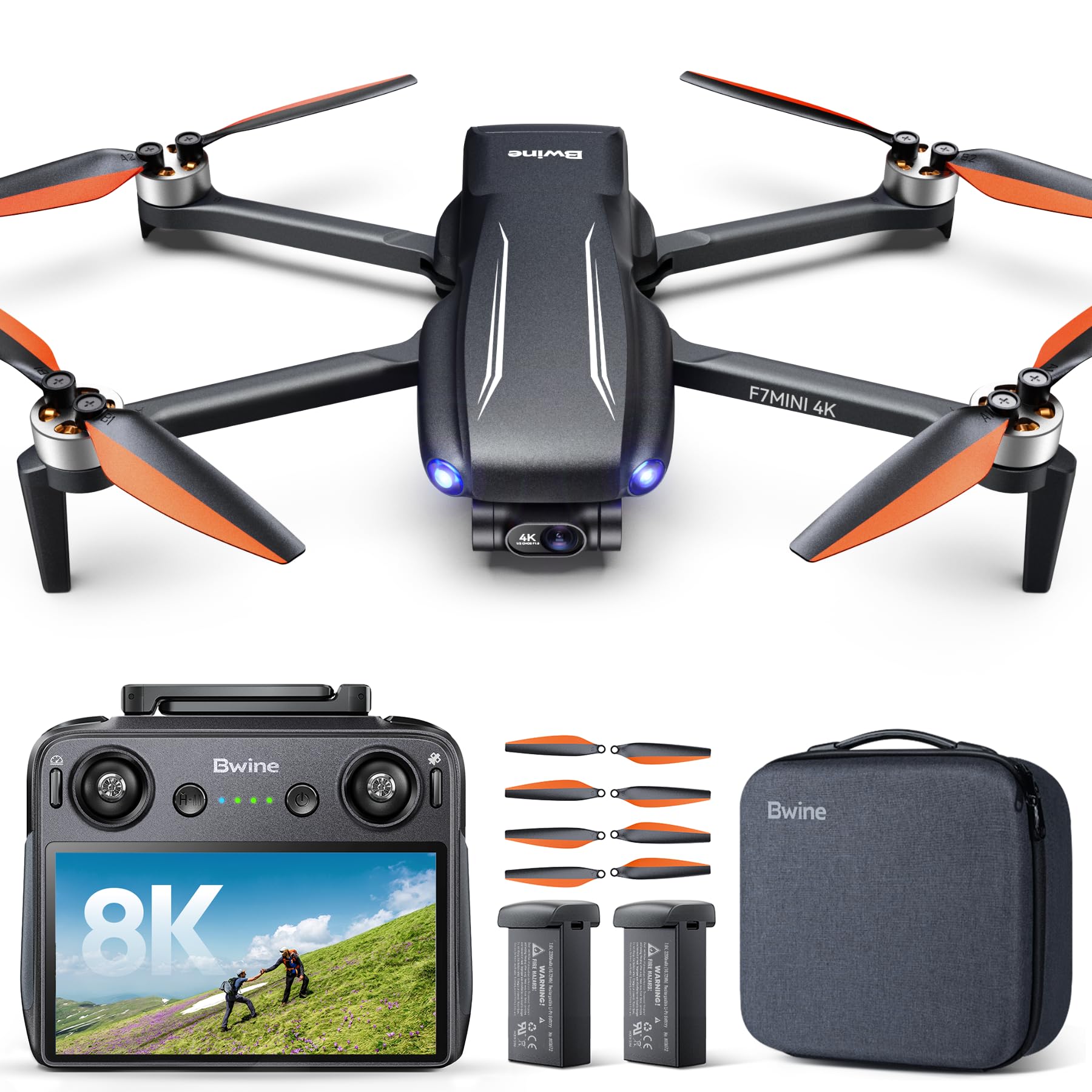
The Bwine F7MINI 4K RC3 eliminates the need for a smartphone entirely by integrating a 5.5-inch 1080p touchscreen with 500 nits of brightness into the remote controller. The screen stores 32GB of internal memory, so you can capture 8K photos and 4K UHD video directly to the controller and review footage without transferring files. The 3-axis brushless gimbal paired with F1.8 aperture and 48MP sensor keeps footage smooth through turns, and the 5x digital zoom allows tighter framing of distant subjects without introducing significant grain at moderate zoom levels.
The 20,000-foot digital transmission system maintains a 0.1s latency in open areas, and the range holds surprisingly well in suburban neighborhoods where Wi-Fi drones typically glitch. Two 2200mAh batteries deliver a combined 64 minutes of flight time, and PD 3.0 fast charging support cuts recharge downtime to roughly an hour per pack. The dynamic home point feature updates the return location as the controller moves, making it safer for hiking trails where the pilot keeps walking after launch.
The 120dB buzzer accessible via the app is loud enough to locate the drone in a dense forest, but the controller’s plastic build feels slightly less premium than the Ruko’s. Some users noted that downloading full-resolution files from the controller to a phone is slow — using a USB-C cable to a computer is faster. For pilots who dislike fumbling with phone mounts and want a self-contained flight deck, this is the most polished option under 250 grams.
Why it’s great
- 5.5-inch 1080p 500nit screen eliminates phone dependency and cable clutter.
- 32GB internal storage lets you save and review footage instantly on the controller.
- Dynamic home point automatically updates return location as the pilot moves.
Good to know
- Controller build feels slightly plastic compared to Ruko and DJI alternatives.
- Downloading full files from controller to phone is slow; best to use a computer.
3. DJI Flip (RC-N3) 4K UHD Drone

The DJI Flip takes the sub-250-gram category to a different level of image quality with its 1/1.3-inch CMOS sensor that captures 4K/60fps HDR video with 48MP stills. The larger sensor pulls in significantly more light than the 1/2-inch sensors found on most competitors, translating to cleaner shadows and better highlight detail during sunrise and sunset shoots. The 3-axis mechanical gimbal provides the same stabilization found on DJI’s larger Air series, and the full-coverage carbon fiber propeller guards offer physical protection without adding noticeable weight.
The O4 digital video transmission system delivers a 44,000-foot (13km) range with 1080p/60fps live feed — the longest range on this list by a wide margin. Subject tracking locks onto a moving target with impressive accuracy, making it ideal for action sports or hiking companions. Palm takeoff and landing are genuinely one-handed, and the 31-minute per-battery flight time is competitive given the sensor size and transmission power.
The main trade-off is the single battery included in the base kit — additional Intelligent Flight Batteries cost a significant premium. The Flip also only has forward obstacle avoidance, not omnidirectional, so side and backward collisions are possible during complex maneuvers. For photographers who prioritize image sensor quality and video codec options over raw flight time, the DJI Flip justifies its higher entry price by delivering professional-grade footage consistently.
Why it’s great
- 1/1.3-inch CMOS sensor captures superior dynamic range and low-light detail.
- O4 digital transmission maintains steady 1080p feed up to 44,000 feet.
- Full-coverage carbon fiber propeller guards provide crash protection.
Good to know
- Only includes one battery; extra packs are expensive.
- Forward-only obstacle avoidance leaves sides and rear vulnerable to collisions.
4. Bwine F7GB2 Pro 4K UHD 3-Axis Gimbal

The Bwine F7GB2 Pro is engineered specifically for high-altitude flying, with a certified 2000-meter altitude ceiling and Level 6 wind resistance that keeps the drone stable in 25mph gusts. The 1806 brushless motors generate enough thrust to climb quickly even in thin air, and the 3-axis gimbal with a 120-degree FOV lens captures 4K video at 2160p without the jitter that plagues optical-flow-only drones at elevation. The 11.1V 2600mAh batteries (three included) provide 75 minutes of total flight time, and each pack carries UL 2054 safety certification, a rarity at this price point.
GPS acquisition uses a multi-constellation receiver that locks onto satellites in under 60 seconds even in mountainous terrain. The auto-return triggers reliably at 25% battery, and the 10,000-foot (3km) control range is conservative but honest — most users report solid signal up to 3,000 feet before any hesitation. The detachable camera module is a thoughtful design choice: if the camera is damaged, you replace just the camera, not the whole drone.
The remote controller overlay provides vital telemetry (altitude, distance, satellite count, battery voltage) directly on the phone screen, but the display becomes difficult to read in direct sunlight. The carrying shell case is robust and fits all three batteries plus spares. Some pilots found the sport mode speed exhilarating — upwards of 40mph — but the battery drain at that speed cuts individual flight time to around 12 minutes. For mountain photographers and rural property inspectors, this is the most capable high-elevation drone under .
Why it’s great
- 2000-meter altitude certification with L6 wind resistance for mountain flying.
- Detachable 4K camera module allows easy replacement without discarding the drone.
- Three UL 2054 certified 11.1V batteries for safe high-voltage operation.
Good to know
- Phone screen with controller overlay is hard to see in bright sunlight.
- Sport mode drains each battery to roughly 12 minutes at top speed.
5. Potensic ATOM LT EIS 2.5K GPS Drone

The Potensic ATOM LT prioritizes endurance over raw resolution, packing two 3000mAh intelligent batteries that yield a genuine 80 minutes of total flight time — 40 minutes per pack in real-world conditions. The 2.5K (2560×1440) camera uses a Sony sensor with ShakeVanish 2.0 EIS stabilization that smooths footage well in calm conditions, though it struggles with the jelly effect during aggressive turns. The PixSync 2.0 transmission system delivers a 4-kilometer range with reliable 1080p live view that stays crisp up to 2 miles in open fields.
The quad-GNSS receiver supports GPS, GLONASS, Galileo, and BeiDou, giving it fast satellite lock even in urban canyons or near tree lines. Auto-return works reliably across all three triggers, and the SurgeFly 2.0 control system includes three flight modes: normal, sport, and a beginner-limited mode that caps altitude and distance. The foldable design collapses to 3.5×5.6×2.3 inches — small enough to slide into a jacket pocket.
The main limitation is the EIS-only stabilization: without a physical gimbal, footage in winds above 10mph shows noticeable roll wobble. Satellite acquisition can take up to 90 seconds on first power-on, and the app requires the XDRONE GO application (not the generic Potensic app) for full feature access. For budget-conscious buyers who prioritize flight time and reliable GPS over gimbal-stabilized video, the ATOM LT offers the highest airtime-per-dollar ratio in this lineup.
Why it’s great
- Two 3000mAh batteries deliver 80 minutes of real-world flight time.
- Quad-GNSS support locks GPS quickly even in challenging signal environments.
- PixSync 2.0 transmission keeps 1080p feed steady up to 4 kilometers.
Good to know
- EIS stabilization cannot compensate for roll wobble in winds above 10mph.
- First GPS lock can take up to 90 seconds; requires open sky for best results.
6. Karuisrc GPS Drone with 4.5″ LCD Controller Screen
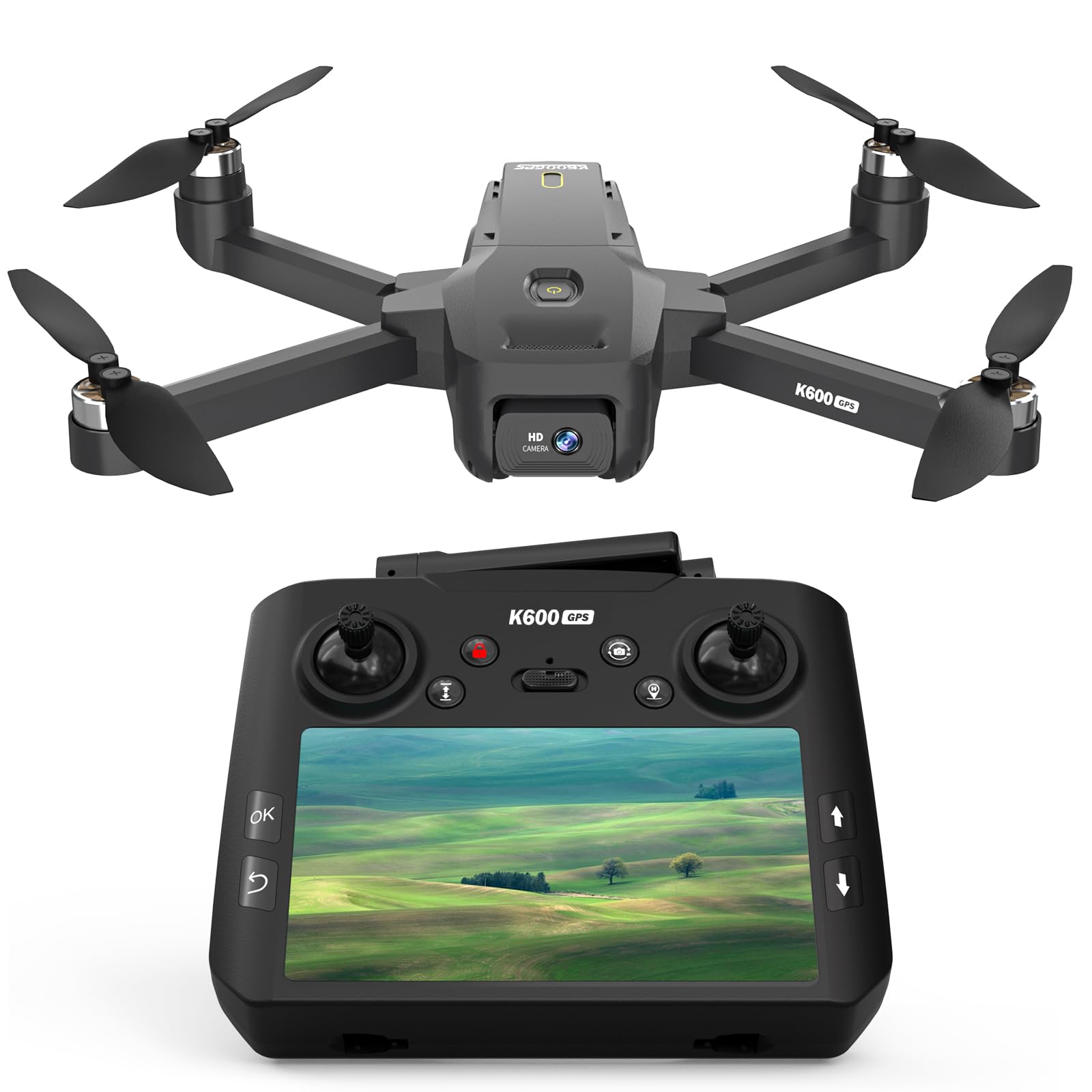
The Karuisrc integrates a 4.5-inch HD display directly into the remote controller, giving real-time FPV footage without needing a phone mount or cable. The EIS camera captures stable 4K photos and 1080p video, and the AI Track and Orbit modes lock onto moving subjects with reasonable accuracy for this price tier. The 2200mAh battery provides approximately 22 minutes of flight per charge, and the brushless motor setup handles Level 4 wind well enough for suburban flying.
GPS positioning uses automatic return-to-home triggered by low battery, signal loss, or manual command, and the 400-meter control range is conservative but reliable. The foldable arms reduce the drone to a compact 7 inches long, and the included carrying case fits everything including the screen controller and spare props. The altitude hold feature combined with optical flow allows stable indoor hovering, which is rare for a GPS-centric drone.
The screen brightness tops out at around 400 nits, making it usable in overcast conditions but difficult to read in direct sunlight. The EIS system introduces slight cropping and a narrow field of view compared to gimbal-equipped drones. For beginners who want the simplicity of an all-in-one controller without pairing a phone, the Karuisrc delivers a clean flying experience at a mid-range price.
Why it’s great
- 4.5-inch built-in screen eliminates phone pairing steps completely.
- AI Track and Orbit modes work reliably for following moving subjects.
- Optical flow plus altitude hold allows stable indoor hovering.
Good to know
- Screen brightness maxes at 400 nits and washes out in direct sunlight.
- EIS introduces crop and narrower field of view than gimbal-equipped alternatives.
7. SIMREX G29 GPS 4K Foldable Drone

The SIMREX G29 is designed with teens and young hobbyists in mind, featuring a 90-degree electrically adjustable 4K camera that tilts from straight ahead to straight down for overhead shots. The optical flow sensor paired with barometric altitude hold keeps the drone locked in place for stable photos, and the brushless motors deliver enough torque for quick altitude changes and spirited maneuvers. The GPS auto-return includes a Find My Drone feature that shows the last known location on a map if the drone lands out of sight.
The 2296-foot (700m) video transmission range is adequate for recreational flying, and the gesture control mode lets you wave to trigger a photo or start recording without touching the app. The two included batteries deliver roughly 40 minutes of combined flight time, and USB-C charging on the batteries simplifies cable management. The foldable arm design compresses to a compact package that fits easily in a backpack.
The 4K sensor is more of an interpolated 4K than true optical 4K — the actual capture resolution is closer to 2.7K. The optical flow sensor requires good ground texture and fails over uniform surfaces like water or dark carpet. For families looking for an engaging entry point into aerial photography with smart GPS safety nets, the G29 provides a fun and forgiving learning platform.
Why it’s great
- 90° electric camera tilt enables overhead and vertical shots.
- Gesture control allows hands-free selfies and video starts.
- Find My Drone feature locates the drone on a map if lost.
Good to know
- 4K sensor is interpolated; actual resolution is closer to 2.7K.
- Optical flow sensor struggles over uniform surfaces like water or dark floors.
8. REDRIE HK33 4K UHD GPS Drone
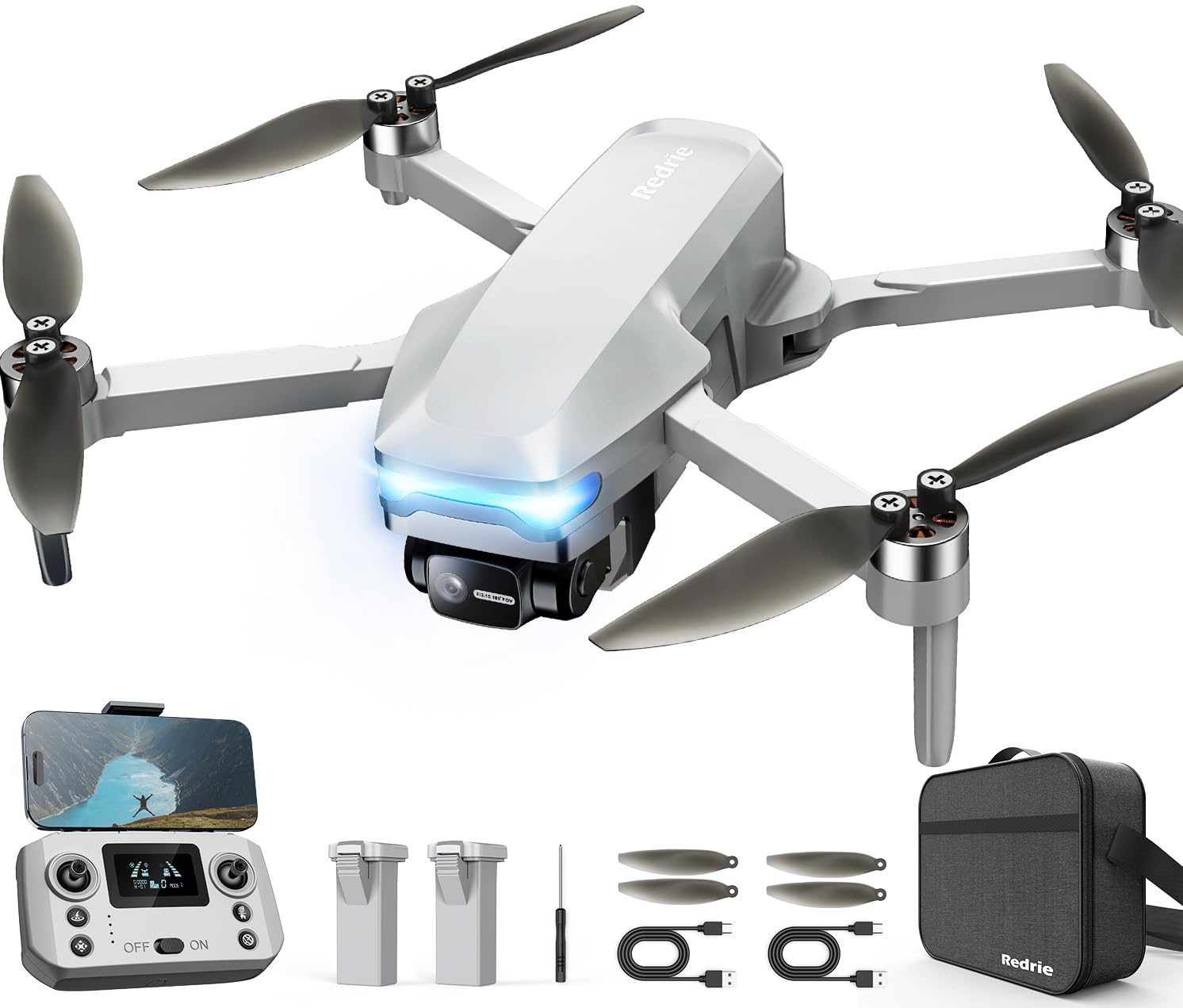
The REDRIE HK33 proves that a budget-priced drone can still deliver solid features with its 2-axis gimbal for tilt and roll stabilization, combined with an F2.15 110-degree wide-angle lens that captures true 4K photos (4096x3072P) and 2K video. The 2-axis gimbal eliminates vertical shake well, leaving only yaw-induced roll to be handled by EIS, which is acceptable for straight-line landscape shots. The two 1800mAh batteries provide a combined 45 minutes of flight time, and the brushless motors offer Level 5 wind resistance that keeps the drone stable in breezy conditions.
The GPS module supports automatic return-to-home triggered by low battery, signal loss, or one-key command, and the 500-meter control range is respectable for this price tier. The 5G WiFi FPV transmission delivers a real-time feed at 300 meters with low latency. The included carrying case, extra propellers, and screwdriver kit make this a true ready-to-fly bundle.
The gimbal’s plastic construction feels less robust than metal-gimbal drones, and the 2-axis design means rapid pans introduce visible wobble. The phone holder on the remote is flimsy and may not securely hold larger phablet-style phones. For first-time buyers who want to learn GPS-assisted flying with decent video quality and don’t need professional-grade gimbal performance, the HK33 offers the best value proposition in the budget tier.
Why it’s great
- 2-axis gimbal provides vertical stabilization uncommon at this price point.
- True 4K photo resolution (4096×3072) captures sharp stills.
- Two batteries with carrying case make it ready-to-fly out of the box.
Good to know
- 2-axis gimbal cannot compensate for roll wobble during fast pans.
- Remote phone holder feels cheap and may not fit large phones securely.
9. Oddire HK11 GPS 4K Foldable Drone

The Oddire HK11 uses a higher-voltage 7.7V battery chemistry (compared to the typical 7.4V) that delivers more consistent power to the brushless motors, resulting in snappier throttle response and better wind handling. The 4K camera is adjustable within 90 degrees via the remote or app, and the F2.15 110-degree wide-angle lens captures 4096x3072P photos and 2048x1088P video. The GPS module supports auto return, Follow Me, waypoint flight, and orbit mode, with the auto-return activating at 25% battery or upon signal loss.
Customer feedback consistently highlights the drone’s durability — it has survived multiple crashes onto concrete with only cosmetic damage, thanks to the reinforced plastic frame and flexible propeller guards. The 5G WiFi FPV transmission reaches a stated 500 meters, though real-world range is closer to 300 meters in suburban environments. The included hard-shell carrying case keeps everything organized, and the spare propeller set with screws ensures quick field repairs.
The 7.7V battery requires a specific charger (included), and the app must be switched from the generic listing to “XDRONE GO” for full feature access — a common point of confusion noted in reviews. The controller beep sounds lack documentation, and new users may find the compass calibration process unclear without watching YouTube setup videos. For beginners who prioritize durability and crash survival over gimbal stabilization, the HK11 is a tough, affordable entry point into the hobby.
Why it’s great
- 7.7V battery chemistry provides snappier throttle than standard 7.4V packs.
- Reinforced frame and flexible guards survive repeated crashes.
- Full GPS suite with Follow Me, waypoint, and orbit modes at an entry-level price.
Good to know
- Requires XDRONE GO app instead of the app listed in generic materials.
- Controller beeps lack documentation; compass calibration requires external tutorials.
FAQ
Do I need FAA registration for a drone under 249g?
Can a 2-axis gimbal produce smooth footage for YouTube videos?
How important is a built-in controller screen versus using my phone?
What does Level 5 wind resistance actually mean for flying?
Why does my drone show a 4K label but the video looks only 2.7K?
Final Thoughts: The Verdict
For most users, the drone helicopter with camera winner is the Ruko F13 Pro because it combines a true 3-axis brushless gimbal, 48MP sensor, and 96 minutes of flight time at the 249-gram threshold for a price that undercuts premium competitors by a significant margin. If you want a built-in controller screen so you never have to fumble with a phone mount, grab the Bwine F7MINI 4K RC3. And for the absolute best image sensor quality and professional-grade video codecs in a sub-250g body, nothing beats the DJI Flip.

Mo Maruf
I created WellFizz to bridge the gap between vague wellness advice and actionable solutions. My mission is simple: to decode the research and give you practical tools you can actually use.
Beyond the data, I am a passionate traveler. I believe that stepping away from the screen to explore new environments is essential for mental clarity and physical vitality.