Our readers keep the lights on and my smoothie glass nicely filled. As an Amazon Associate, I earn from qualifying purchases.
Aerial photos are the new curb appeal. Listing after listing proves it: the house that looks small and flat from the ground becomes a story when you see its roofline, its lot lines, and the way the light hits the backyard all at once. But the wrong drone makes that story blurry, jerky, or simply illegal to fly over a client’s property. The gimbal has to be real, the sensor has to handle shadows and bright windows equally, and the weight has to stay where the rules let you launch without paperwork.
I’m Mohammad Maruf — the founder and writer behind WellFizz. I’ve spent hundreds of hours analyzing flight logs, camera specs, gimbal stabilization data, and transmission range figures across dozens of models to find the drones that actually deliver publish-ready footage for real estate work.
This guide cuts through the noise to help you pick the best drone for real estate photography based on what actually matters on a shoot: sensor size, wind resistance, flight time per battery, and obstacle avoidance that keeps your investment safe.
How To Choose The Best Drone For Real Estate Photography
A real estate shoot is a specific mission: you need to capture the exterior lot, the roofline, the pool or backyard, and sometimes a dramatic “reveal” shot that flies over the house into the front door. That mission demands a specific set of drone specs that a travel or action-sports drone might not have. Here is what to look for.
Gimbal Type and Stabilization
A 3-axis mechanical gimbal is the only way to keep listing video smooth when the drone banks around a corner or fights a gust of wind over an open lot. Electronic image stabilization (EIS) alone can cause a “jello” effect when the drone yaws, which ruins the straight lines of a roof or driveway. Every drone in this guide that carries a “professional” tag uses a 3-axis brushless gimbal. Do not compromise on this spec.
Sensor Size and Low-Light Performance
Real estate shoots happen at golden hour and sometimes under heavy cloud cover. A 1/2-inch CMOS sensor with an f/1.8 aperture (found on most mid-range drones) does a solid job in good light. But if you shoot high-end properties where you need shadow detail under eaves or bright window exposure without blowing out the sky, a 1-inch CMOS sensor (like the DJI Mini 5 Pro or Autel EVO 2 Pro V3) offers dramatically better dynamic range and less noise.
Weight and FAA Registration
Drones under 250 grams — like the Ruko, Potensic ATOM 2, and DJI Mini 5 Pro — are exempt from FAA registration and Remote ID. That makes them the easiest choice for quick shoots without bureaucracy. Heavier models (Holy Stone HS600D at 603g, Autel EVO 2 Pro at 1191g) require full registration but often carry larger sensors and longer flight times that justify the paperwork.
Obstacle Avoidance and Safety
Flying close to a house, near trees, or around power lines is the real estate photographer’s daily reality. Omnidirectional obstacle avoidance (found on the DJI Mini 5 Pro and Autel EVO 2 Pro) gives you the most safety margin. Forward-only or downward-only sensing (common on budget models) still helps, but you must be more cautious when backing up or moving sideways around a structure.
Quick Comparison
On smaller screens, swipe sideways to see the full table.
| Model | Category | Best For | Key Spec | Amazon |
|---|---|---|---|---|
| DJI Mini 5 Pro Fly More | Premium | Pro-grade HDR & omnidirectional safety | 1-inch CMOS, 4K/60fps HDR | Amazon |
| Autel EVO 2 Pro V3 | Professional | 6K color grading & no geofencing | 1″ Sony CMOS, 6K HDR | Amazon |
| Potensic ATOM 2 | Mid-Range | Long flight time & included ND/CPL filters | 1/2″ Sony CMOS, 4K HDR | Amazon |
| Holy Stone HS600D | Mid-Range | Wired digital transmission for stable feed | 1/2″ Sony CMOS, 8K photo | Amazon |
| Holy Stone HS790 | Entry-Level Plus | Long 9KM range & night mode | 3-axis gimbal, 6K photo | Amazon |
| Bwine F7MINI | Mid-Range | Built-in screen controller & no FAA reg | 3-axis gimbal, 4K/30fps | Amazon |
| Bwine F7GIM | Mid-Range | Industrial build & TOF safety sensors | 3-axis gimbal, 6K photo | Amazon |
| DJI Flip (RC-N3) | Entry-Level Plus | DJI ecosystem & comprehensive prop guards | 1/1.3-inch CMOS, 4K/60fps HDR | Amazon |
| Ruko Drone 4K UHD | Budget-Friendly | 96-minute total flight & beginner ease | 3-axis gimbal, 8K photo | Amazon |
| HOVERAir X1 PRO | Specialty | Hands-free action & follow shots | 2-axis gimbal + EIS, 4K/60fps | Amazon |
| Antigravity A1-360 | Specialty | Immersive 360 capture & reframing later | 360-degree 8K video | Amazon |
In‑Depth Reviews
1. DJI Mini 5 Pro Fly More Combo Plus
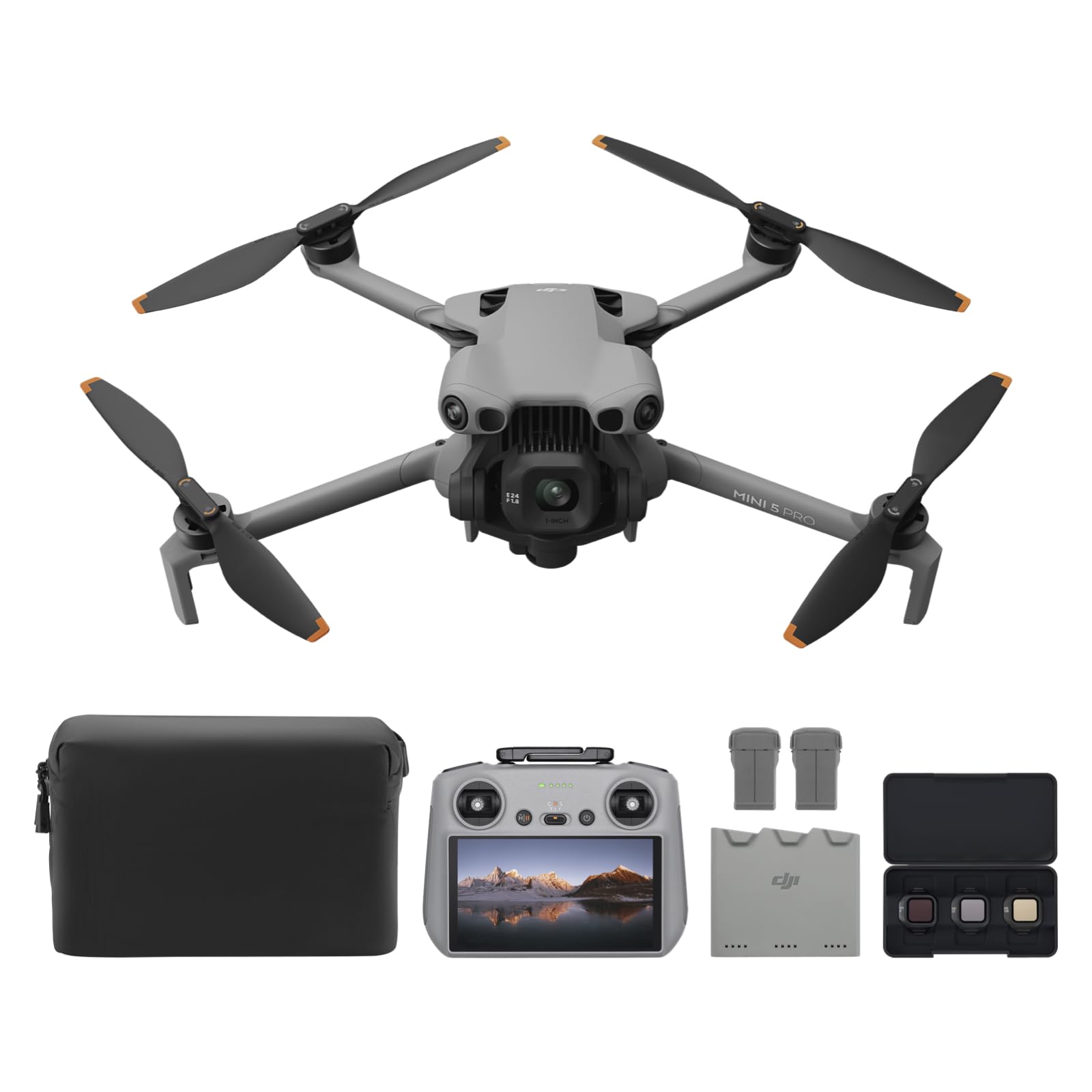
This is the drone that closes the gap between “good enough for social media” and “publish-ready for a real estate listing.” The 1-inch CMOS sensor captures 4K/60fps HDR video with enough dynamic range to hold detail in a bright sky while the shadow side of a house stays visible. The 225-degree gimbal rotation allows vertical filming without cropping, which is critical for social media listings that favor portrait framing.
The omnidirectional obstacle sensing — forward LiDAR plus vision sensors — lets you fly confidently around eaves, trees, and power lines. The three extended-capacity batteries deliver roughly 45 to 50 minutes of flight time each, enough for multiple property inspections without landing to swap packs constantly. The DJI RC 2 controller has a bright built-in screen, so you don’t need to cable your phone or worry about screen brightness in direct sunlight.
ActiveTrack 360 keeps a walking subject framed automatically, useful for “walk the driveway to the front door” reveal shots. The Fly More Combo includes ND filters and a charging hub that powers three batteries in about 193 minutes. Weight sits at 249g with the standard battery, but the Plus batteries push it over 250g, meaning you will need FAA registration and Remote ID for those longer flights. For high-end real estate work, this is the benchmark.
Why it’s great
- 1-inch sensor delivers professional dynamic range for golden-hour and mixed-light shoots
- Omnidirectional obstacle avoidance reduces risk when flying near structures
- Vertical gimbal rotation for native portrait video without cropping
Good to know
- Plus batteries push weight over 250g, requiring FAA registration
- DJI Care Refresh not currently available for US customers
- High initial investment, especially in the Fly More Combo configuration
2. Autel EVO 2 Pro V3

If you shoot luxury properties and need maximum flexibility in post-production, the Autel EVO 2 Pro V3 justifies its premium status. The 1-inch Sony CMOS sensor captures 6K HDR video at up to 44000 ISO, and the adjustable aperture (f/2.8 to f/11) lets you control depth of field and exposure without ND filters. The 12-bit A-Log color profile records 68.6 billion colors, which gives you 64 times the color data of a standard 10-bit log for grading skies, grass, and architectural finishes.
All 12 computer vision sensors plus 2 sonar sensors create 360-degree obstacle avoidance that works in all directions, not just forward. The SkyLink 2.0 transmission reaches 15 kilometers with tri-band frequency hopping, so you can move around the property without losing the feed. The Smart Controller SE has a 6.4-inch OLED screen that stays readable in bright light, and the Android OS allows third-party mapping apps for mission planning.
The built-in no-geofencing policy — you are responsible for where you fly — is a double-edged sword. It gives you freedom but demands discipline. The 7100mAh battery provides about 40 minutes of forward flight, and the rugged combo includes a hard case, extra propellers, and a 32GB SD card. Note that the drone weighs 1191 grams, so FAA registration and Remote ID are mandatory.
Why it’s great
- 6K capture and 12-bit A-Log for professional color grading workflows
- Adjustable aperture f/2.8-f/11 gives exposure control without ND filters
- No geofencing restrictions for experienced pilots flying legally
Good to know
- Weight requires full FAA registration and Remote ID
- More sensitive controls than DJI systems — requires pilot finesse
- Third-party accessories and spare parts less available than DJI ecosystem
3. Potensic ATOM 2 Fly More Combo
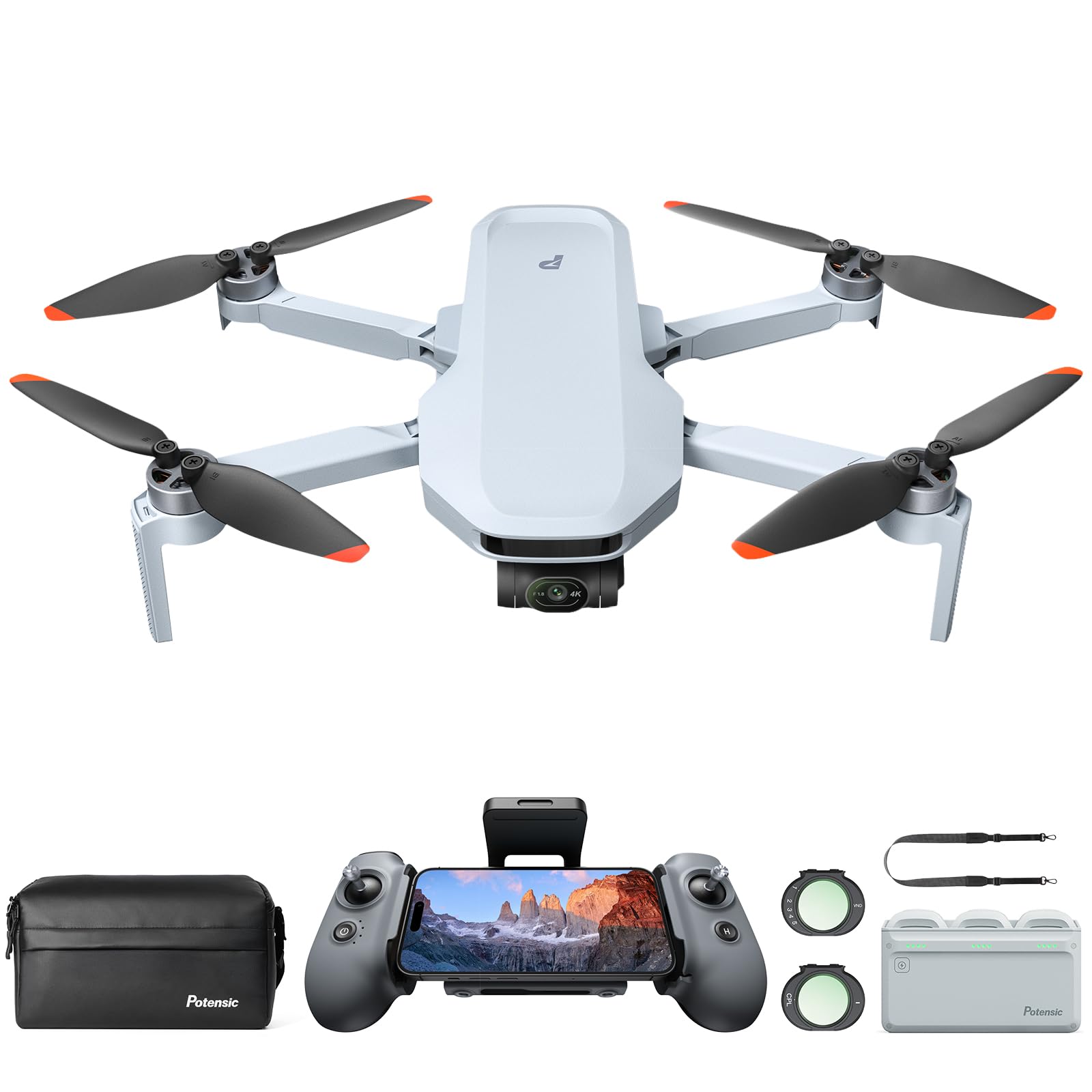
The Potensic ATOM 2 is the strongest challenge to DJI’s sub-250g dominance. The 1/2-inch Sony CMOS sensor captures 48MP photos and 4K/30fps HDR video stabilized by a genuine 3-axis gimbal. The f/1.8 aperture and 4-in-1 pixel technology improve low-light performance enough for golden-hour exteriors without excessive noise. The inclusion of both ND and CPL filters in the Fly More Combo is a real value — you can control reflections from windows and water while managing exposure in bright conditions.
Flight time hits 96 minutes total across three batteries, thanks to a rapid charging hub that powers all three simultaneously in 1.3 hours. The PixSync 4.0 transmission system reaches 10 kilometers with 1080p/30fps live view, enough range for large estate properties. AI Track (Spotlight, Follow, Parallel) keeps a subject framed, and the AI Night Shot mode reduces noise for twilight listings. Weight is 245g, so no FAA registration is needed for standard operation.
SmartTransfer at up to 25 MB/s speeds file transfer to your phone for quick edits. The vertical 2.7K shooting mode outputs native portrait video without cropping, ideal for Instagram and TikTok real estate ads. The shoulder bag holds everything, including the remote strap and spare propellers. The only missing feature is waypoint mission planning, which some real estate agents use for repeatable “driveway reveal” shots.
Why it’s great
- ND + CPL filters included for controlling light and reflections on glass
- 45-minute flight per battery with fast simultaneous charging hub
- Sub-250g weight avoids FAA registration hassle
Good to know
- No waypoint mission planning for repeatable automated routes
- Lacks obstacle avoidance sensors — pilot must fly manually near structures
- Single gimbal camera orientation limits creative angles compared to 360-degree gimbals
4. Holy Stone Sentinel HS600D

Holy Stone tackled the biggest weakness of sub- drones — video feed interference — by using a wired relay transmission system on the HS600D. Instead of a Wi-Fi link that drops when you fly behind a house, the drone tethers to a relay device via cable, delivering a low-latency, interference-resistant HD feed up to 20,000 feet away. For real estate shoots where you are moving around the property and the drone is behind the house, this makes a real difference.
The 1/2-inch Sony CMOS sensor with f/1.8 aperture captures 8K photos (48MP) and 4K HDR video. The 3-axis gimbal plus EIS keeps footage stable even in Level-6 wind, which is common on open lots and coastal properties. The 603g reinforced frame and 3500mAh batteries (two included) deliver about 34 minutes of flight time each, totaling 68 minutes in the air. GNSS positioning plus TOF and optical flow sensors provide stable hover and accurate return-to-home.
Smart modes include Follow Me, Smart Tracking, Time-Lapse, and Panorama — all useful for different listing angles. The remote controller has a built-in screen, so you can fly without connecting a phone. The included carrying case fits the drone, two batteries, and the relay kit. At 603g, FAA registration and Remote ID are required.
Why it’s great
- Wired digital relay eliminates Wi-Fi dropouts behind structures
- Level-6 wind resistance keeps shoots on schedule in breezy conditions
- Remote controller with built-in screen avoids phone cable clutter
Good to know
- No manual ISO or exposure time controls in camera settings
- Weight requires FAA registration and Remote ID
- Camera may overexpose in high-contrast scenes without manual compensation
5. Holy Stone HS790
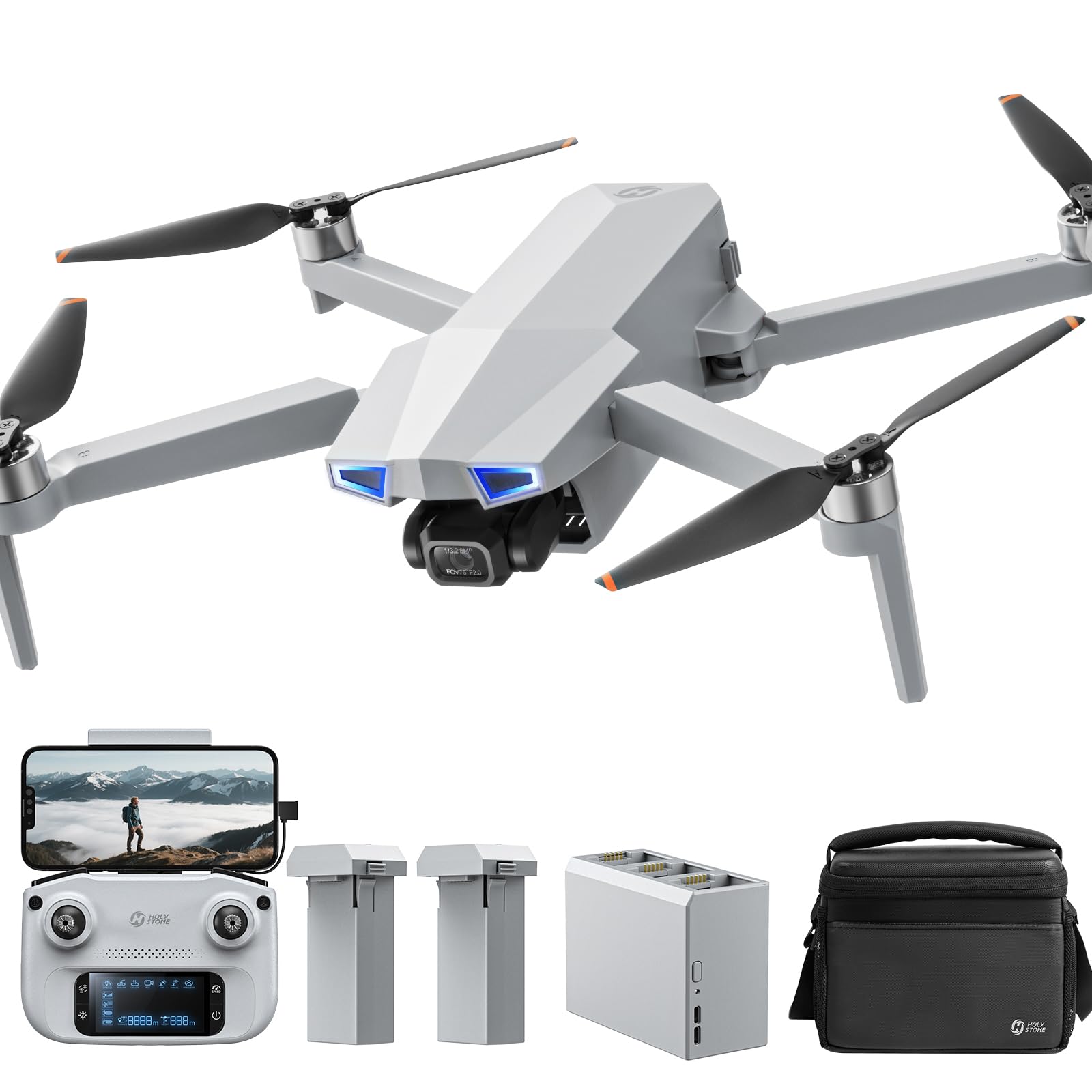
The HS790 brings a surprisingly long 9-kilometer (30,000-foot) HD transmission range to a mid-range price point. The Wi-Fi repeater technology delivers a smooth FPV feed with minimal lag, which lets you position the drone far from the controller while you move around the property to frame the shot. The 3-axis brushless gimbal ensures that 4K/30fps video stays stable even in windy conditions.
The 6K photo resolution (38MP effective still resolution) provides enough cropping room to reframe listing photos in post. Two intelligent batteries with the Smart PD Charging Hub deliver about 60 minutes of total flight time — roughly 30 minutes each. The hub also doubles as a power bank, useful for charging a phone or tablet on location between shoots. The Night Mode improves visibility during twilight drone flights, a common time for real estate shoots.
GPS smart modes include Follow Me, Waypoint Flight, and Auto Return to Home. The built-in Remote ID (RID) keeps you FAA-compliant without needing an external module. At 375.5 grams, FAA registration is required. The foldable design fits into the included carrying case. Some users report that the app can be buggy and that manual camera controls are limited.
Why it’s great
- 9KM HD transmission for long-range control and live view
- Built-in Remote ID for FAA compliance without external module
- Charging hub doubles as power bank for on-site device charging
Good to know
- App can be buggy — alternate third-party app may be needed
- Limited manual camera controls for ISO and shutter speed
- FAA registration required due to weight over 250g
6. Bwine F7MINI 4K
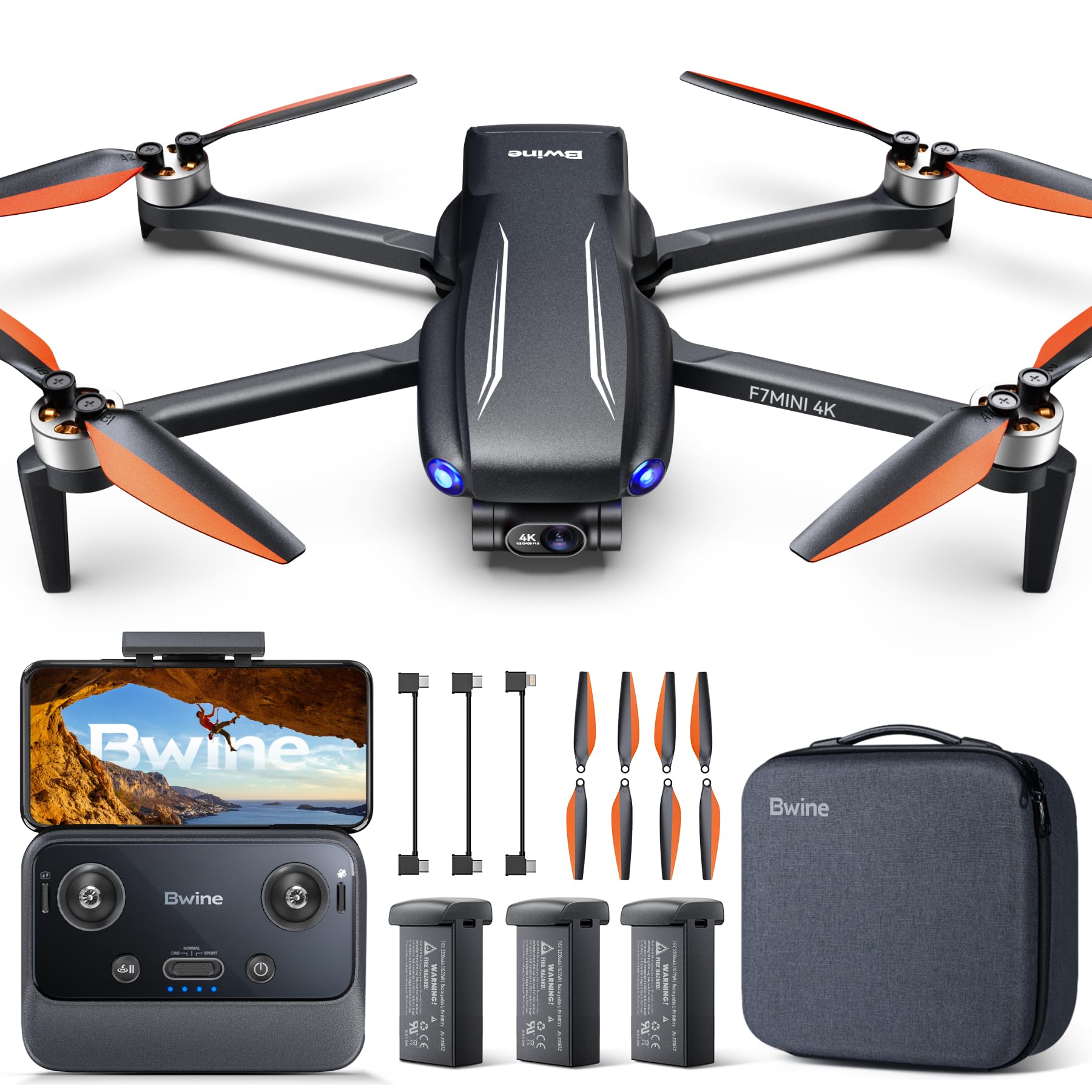
The Bwine F7MINI stands out because the remote controller has a built-in 5.5-inch screen. That means you do not need to cable your phone to the controller, freeing up your phone for client communication or looking at the property layout while you fly. The 3-axis mechanical gimbal keeps the 4K/30fps video and 8K photos steady even in L5 wind resistance conditions, which is roughly 19-24 mph gusts.
The 48MP 1/2-inch CMOS sensor with f/1.8 aperture captures plenty of detail for standard listing photos. Three batteries provide a total of 96 minutes of flight time — 32 minutes each — with PD 3.0 fast charging support. The 20,000-foot (6-kilometer) wired digital transmission eliminates the signal dropout issues common with Wi-Fi-based drones, which is crucial when flying around obstructed views near larger homes.
GPS smart modes include Follow, Orbit, Waypoint, and Auto Cruise for repeatable flight paths. The 120dB locator buzzer helps you find the drone if it lands in tall grass or bushes. At 249g, it is FAA registration exempt. The optical flow positioning allows stable indoor flight for atrium or warehouse shots when GPS is unavailable. The controller screen is bright, but some users find file transfer from controller to phone slower than expected.
Why it’s great
- Remote controller with built-in 5.5-inch screen — no phone needed
- Under 249g, no FAA registration required
- Wired digital transmission avoids Wi-Fi interference
Good to know
- File transfer from controller to phone can be slow
- Limited advanced camera controls compared to DJI models
- App compatibility requires specific SD card formatting for Mac users
7. Bwine F7GIM
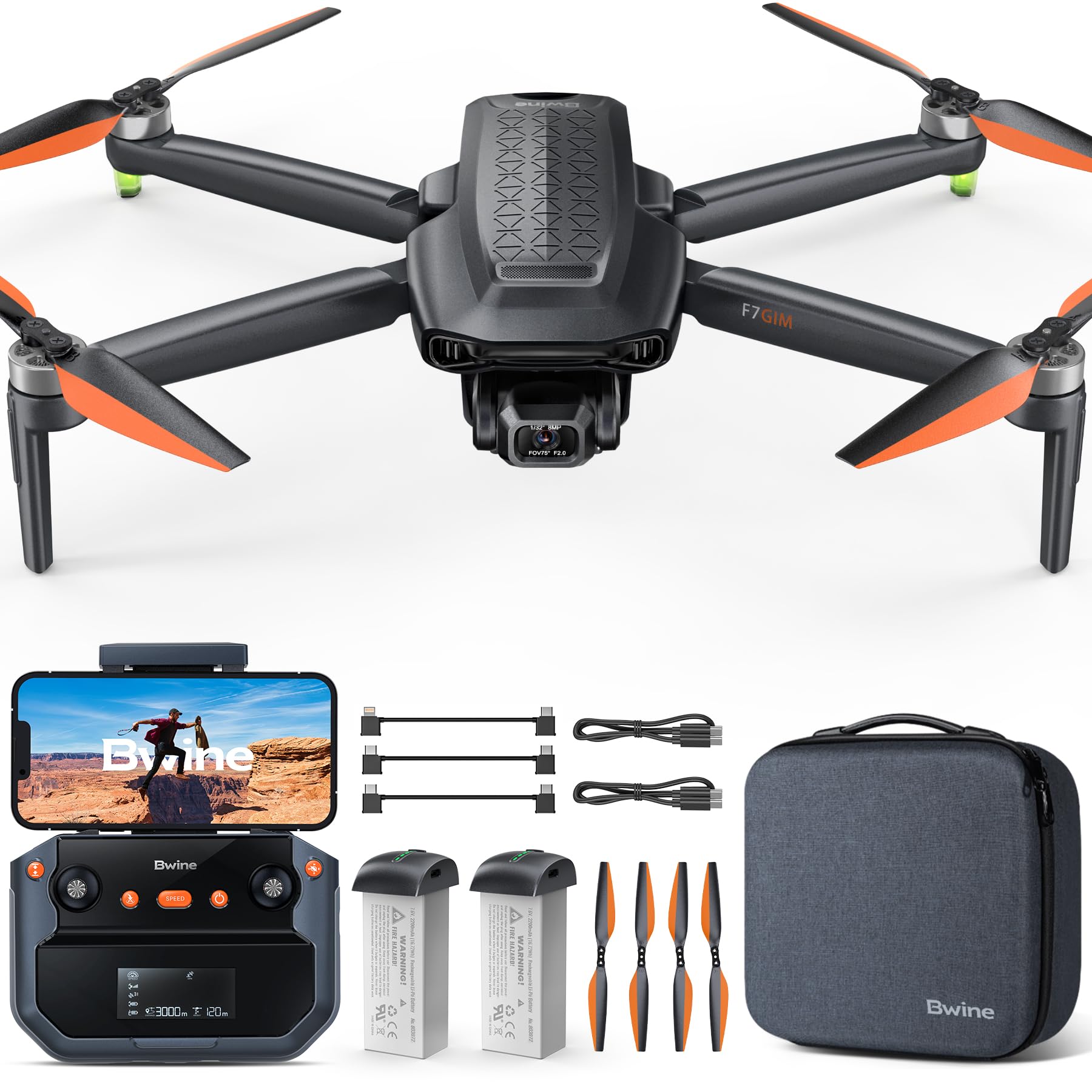
The F7GIM is built for the real estate photographer who needs a drone that can handle farm, ranch, dock, or construction site inspections alongside standard home shoots. The industrial aesthetic with textured body and orange propellers is not just for looks — the 3D laser-engraved frame and streamlined structure provide aerodynamic stability in windy conditions. The 3-axis brushless gimbal improves stability accuracy by 300 percent over standard gimbals, keeping 6K photos and 4K/30fps video steady in high-speed flight.
TOF (Time of Flight) sensors combine with the GPS system to improve low-altitude stability by 200 percent, which is critical when flying a drone close to a roofline for detail shots. Two batteries provide about 70 minutes of total flight time (35 minutes per flight), with a 10,000-foot digital transmission range that does not rely on Wi-Fi — it uses a wired data cable from the controller to your phone. Night Mode 2.0 reduces image noise by 90 percent for crisp dusk and dawn footage.
Smart GPS modes include Follow, Orbit, Cruise Control, and Waypoint Planning. The auto return-to-home system reduces flyaway risk. The USB-C cable for the phone is stored in the phone holder on the remote, a thoughtful detail. The imported military-grade shockproof carrying case is water-resistant and dust-resistant. The F7GIM has a built-in FAA-compliant Remote ID module on the drone arm. At 357g, FAA registration is required. The camera can distort on fast turns, so smooth, slow yaw is recommended for listing video.
Why it’s great
- TOF sensors improve low-altitude stability for close-to-roof detail shots
- Industrial build with shockproof carrying case for job site durability
- Wired digital transmission avoids Wi-Fi interference
Good to know
- Camera can distort on fast turns — requires gentle yaw inputs
- Weight requires FAA registration and Remote ID
- Remote screen can be hard to read in direct sunlight
8. DJI Flip (RC-N3)

The DJI Flip is a unique entry — it is a compact folding drone with full-coverage propeller guards made from lightweight carbon fiber. Those guards make it safer to fly in tight spaces near windows, railings, and trees, which is a common situation on real estate shoots where you need to get close to the structure. The 1/1.3-inch CMOS sensor (larger than the 1/2-inch sensors on most budget drones) captures 4K/60fps HDR video with vivid detail and good low-light performance.
Subject tracking keeps a walking agent or homeowner framed as they walk the driveway or stand on the deck. The 31-minute max flight time per battery is standard for this weight class, and the under-249g design means no FAA registration is needed. The palm takeoff and landing make launching from a client’s driveway or backyard simple and professional-looking.
The RC-N3 remote controller requires you to mount your phone for the live view, which some photographers prefer for screen brightness control. The downside is that the Flip lacks omnidirectional obstacle avoidance — only front-facing sensors are present — so you must be careful when flying backward or sideways around a house. The video quality is excellent for the price point, but the single battery in the standard package means you will want to purchase extras for a full day of shooting.
Why it’s great
- Full-coverage carbon fiber prop guards for safe flying near structures
- Large 1/1.3-inch sensor captures detailed 4K/60fps HDR video
- Sub-250g design with no FAA registration required
Good to know
- Only forward obstacle avoidance — no side or rear sensors
- Standard package includes only one battery
- Requires phone for live view, unlike controllers with built-in screens
9. Ruko Drone with 4K UHD Camera

The Ruko drone is the most budget-friendly entry on this list, but it does include a genuine 3-axis brushless gimbal, which is the minimum requirement for usable real estate video. The 1/2-inch CMOS 48MP sensor captures 8K photos and 4K/30fps video that, while not matching the dynamic range of larger sensors, produces clean images in good daylight conditions. The 20,000-foot digital transmission range uses the R2 system instead of Wi-Fi, which reduces signal interference.
Three intelligent batteries provide a total of 96 minutes of flight time — about 32 minutes each — which is generous for the price tier. The drone weighs under 249g, so it is FAA registration exempt. Beginner-friendly features like one-button takeoff and auto return make it easy to hand to a team member for quick aerial shots. The AI Takeoff/Landing system and quadruple positioning (GPS, barometric altitude, TOF, optical flow) keep the drone stable even without strong GPS.
The carrying case includes the drone, three batteries, and a full accessory kit. Customer service is responsive, with several reviews noting that defective batteries or propeller failures were handled quickly with replacements. The sensitive joysticks take some getting used to, and the lack of manual camera controls means you are relying on the auto-exposure for each shot. For entry-level real estate photography and tight budgets, this is a capable starter.
Why it’s great
- 96 minutes total flight time with three included batteries
- 3-axis mechanical gimbal provides smooth video at a low price
- Under 249g with no FAA registration needed
Good to know
- No manual camera controls — auto-exposure only
- Sensitive joysticks require careful handling for smooth shots
- Limited low-light performance compared to larger sensor drones
10. HOVERAir X1 PRO

The HOVERAir X1 PRO is not a traditional drone — it is an action-flying camera that launches from your hand and follows you autonomously. For real estate, that means you can set it to Follow or Dolly Track mode and walk the property line, and the drone keeps you centered in the frame at up to 26 mph. The 2-axis gimbal with electronic image stabilization and horizon leveling produces smooth 4K/60fps footage, though it lacks the yaw stability of a 3-axis mechanical gimbal for orbiting shots.
The OmniTerrain system allows operation over snow, water, and cliffs, which is useful if the property backs onto a lake or has a pool. The 192g weight makes it FAA-exempt, and the foldable, fully enclosed design with aerospace-grade HEM prop guards makes it safe to hand to clients for their own aerial shots. The 32GB internal storage can be expanded via SD card up to 1TB. Rear ToF obstacle detection provides braking when obstacles are detected at speeds up to 1.5 m/s.
The lack of a traditional controller — it operates via app control or voice commands — limits precise positioning. This is not the drone for precise, repeatable real estate framing; it is better suited for dynamic walkthrough shots and lifestyle footage of the surrounding neighborhood. The battery life is limited to about 20 minutes per flight, so you will need to budget for multiple charges during a shoot day.
Why it’s great
- Hands-free operation with voice commands and palm launch
- Ultra-light 192g design with no FAA registration
- Rear ToF obstacle detection for safer autonomous tracking
Good to know
- Only 2-axis gimbal — less stable for orbiting and yaw shots
- Limited flight time (~20 minutes per battery) requires multiple charges
- No traditional remote controller, limiting manual control precision
11. Antigravity A1-360
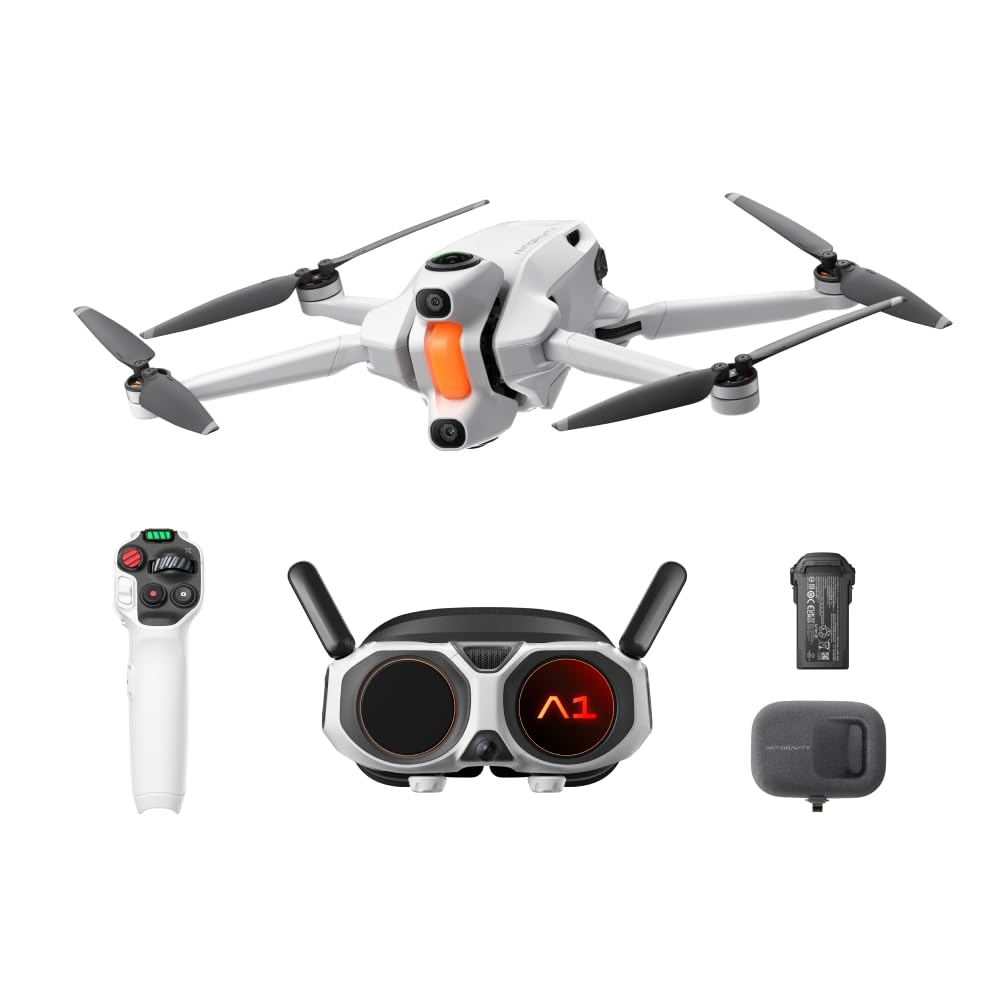
The Antigravity A1-360 is a radical departure from every other drone on this list. It captures 360-degree 8K video using Insta360 technology, meaning you can fly the property once and later reframe the footage to any angle in post-production. This “fly first, frame later” approach is incredibly efficient for real estate — you never miss a shot because you can rotate the view after the flight. The invisible stitching creates seamless spherical footage that works with VR headsets and interactive virtual tours.
The immersive Vision Goggles with dual 1-inch Micro-OLEDs and a 90-degree FOV provide a 66 percent wider field of view than standard goggles. The FreeMotion Mode uses point-to-fly motion controls, so a client or agent can simply point where they want the drone to go without needing piloting skills. The standard battery keeps the weight at 249g for FAA-exempt flights, while the high-capacity battery extends flight time to 39 minutes at the cost of adding weight.
Omnidirectional obstacle avoidance (360 sensing plus forward/downward binocular vision) keeps the drone safe during autonomous flight. Sky Path lets you create automatic flight paths, and Deep Track keeps subjects centered. The Auto Editing 2.0 software automatically reframes 360 footage into cinematic clips, which saves hours of post-production work. The starting price is high, and the 360 workflow requires a different editing approach than traditional drones, but for high-end listings that need interactive tours, it is unmatched.
Why it’s great
- 360-degree capture allows reframing any angle in post-production
- Immersive goggles provide true FPV experience for client demos
- Omnidirectional obstacle avoidance for autonomous flight safety
Good to know
- Requires different editing workflow for 360 footage conversion
- High price point compared to standard 4K camera drones
- Does not include traditional remote controller — goggles and motion control only
FAQ
Can I fly a sub-250g drone commercially for real estate photography?
What is the minimum gimbal type needed for usable real estate listing video?
Why is transmission range important for real estate when I am standing right there?
Final Thoughts: The Verdict
For most real estate photographers, the best drone for real estate photography is the DJI Mini 5 Pro Fly More Combo because it combines a professional-grade 1-inch sensor, omnidirectional obstacle avoidance, and sub-250g portability into one package that delivers publish-ready video straight out of the box. If you need maximum color grading flexibility and 6K resolution for luxury listings, grab the Autel EVO 2 Pro V3. And for the budget-minded agent who still needs a 3-axis gimbal and long flight time, the Potensic ATOM 2 Fly More Combo offers exceptional value with included ND filters and no FAA registration.

Mo Maruf
I created WellFizz to bridge the gap between vague wellness advice and actionable solutions. My mission is simple: to decode the research and give you practical tools you can actually use.
Beyond the data, I am a passionate traveler. I believe that stepping away from the screen to explore new environments is essential for mental clarity and physical vitality.