Our readers keep the lights on and my smoothie glass nicely filled. As an Amazon Associate, I earn from qualifying purchases.
A blind spot the size of a sedan, a crosswind that jerks your steering, or a sudden brake light in heavy traffic — these aren’t just annoyances. They are moments where a fraction of a second and a clear view make the difference between a smooth arrival and a claim. Modern driver assistance systems have evolved from luxury-car exclusives into accessible hardware that adds 360-degree awareness, collision alerts, and continuous recording to any vehicle.
I’m Mohammad Maruf — the founder and writer behind WellFizz. I’ve spent countless hours studying the specifications, customer feedback, and real-world performance of dozens of driver assistance setups, focusing on the sensors, display resolutions, and alert algorithms that define this category.
Whether you haul an RV, commute in a sedan, or manage a fleet, this guide breaks down the 2024 market to reveal the best driver assistance systems for every vehicle type and budget.
How To Choose The Best Driver Assistance Systems
Choosing the right system starts with matching the hardware to your vehicle’s size and your daily driving challenges. A compact car driver needs a different setup than someone towing a fifth-wheel trailer. Here are the core factors that separate a well-integrated system from a frustrating one.
Camera Resolution and Sensor Quality
The image sensor defines what you see in low light and at speed. Entry-level systems use 1080p CMOS sensors that work well in daylight but struggle with plate readability at dusk. Premium setups now feature Sony STARVIS 2 sensors (IMX678 and IMX675) capable of true 4K capture with wide dynamic range, preserving details in shadows and direct headlight glare. For night-time parking lots or rural roads with no streetlights, look for systems advertising full-color night vision rather than grayscale IR-only modes.
Display Type and Field of View
Larger monitors (10 to 12 inches) reduce eye strain and let you glance at all camera feeds simultaneously. A dedicated touchscreen monitor with a quad-split view is essential for RVs and trucks, while a mirror-replacement dash cam keeps your windshield clean and your cabin layout stock. Field of view should be at least 150 degrees for the front camera and 170 degrees for side and rear units to minimize blind spots. Beware of overly wide lenses that distort roadside objects into tiny specks.
ADAS and Alert Reliability
Advanced Driver Assistance Systems (ADAS) add forward collision warnings, lane departure alerts, and blind spot monitoring. Algorithm quality varies significantly — some systems trigger false alerts from guardrails and parked cars, while others miss actual threats. The best ADAS implementations use dedicated radar (as in the Brandmotion system) or a combination of GPS data and sensor fusion. Mirror dash cams that rely solely on optical flow for lane detection are less reliable in rain or on winding roads.
Recording, Storage, and Parking Mode
Continuous loop recording with G-sensor collision locking is standard, but the included SD card size and maximum supported capacity vary from 64 GB to 1 TB. For parking surveillance, a hardwire kit connected to the vehicle’s OBD-II port or fuse box provides 24/7 time-lapse or impact-triggered recording. Make sure the system includes low-voltage protection to prevent draining your starter battery overnight.
Quick Comparison
On smaller screens, swipe sideways to see the full table.
| Model | Category | Best For | Key Spec | Amazon |
|---|---|---|---|---|
| Pelsee S3 Ultra | Dash Cam | Best Overall | True 4K + 2.5K, Sony IMX678/675 | Amazon |
| WOLFBOX G850 PRO | Mirror Dash Cam | Smart Mirror Upgrade | 12″ Mirror, 4K Front, ADAS+BSD | Amazon |
| Roadwitness Dual IMX678 | Mirror Dash Cam | Dual 4K Clarity | 12″ Mirror, 4K+4K, Dual Sony IMX678 | Amazon |
| VOONOA 4K RV System | 4-Channel System | RV / Trailer 360° View | 10.36″ Touch, 4x1080P, IP69K | Amazon |
| Pelsee P12 Pro Max | Mirror Dash Cam | Value + Features | 12″ Mirror, 4K+2.5K, OBD Hardwire | Amazon |
| Seventour 4-Channel System | 4-Channel System | Budget 360° Coverage | 10.2″ Touch, 4x1080P, IP69 | Amazon |
| Garmin DriveCam 76 | GPS + Dash Cam | Navigation with Recording | 7″ GPS, Built-in Dash Cam, ADAS | Amazon |
| Brandmotion RDBS-1600 | Radar System | True Blind Spot Radar | 40ft Range, Cross-Traffic Alert | Amazon |
| Escort Redline 360c + M2 | Radar Detector + Cam | Long-Range Warning Combo | 360° Radar, 1080P Cam, CarPlay | Amazon |
In‑Depth Reviews
1. Pelsee S3 Ultra Dash Cam
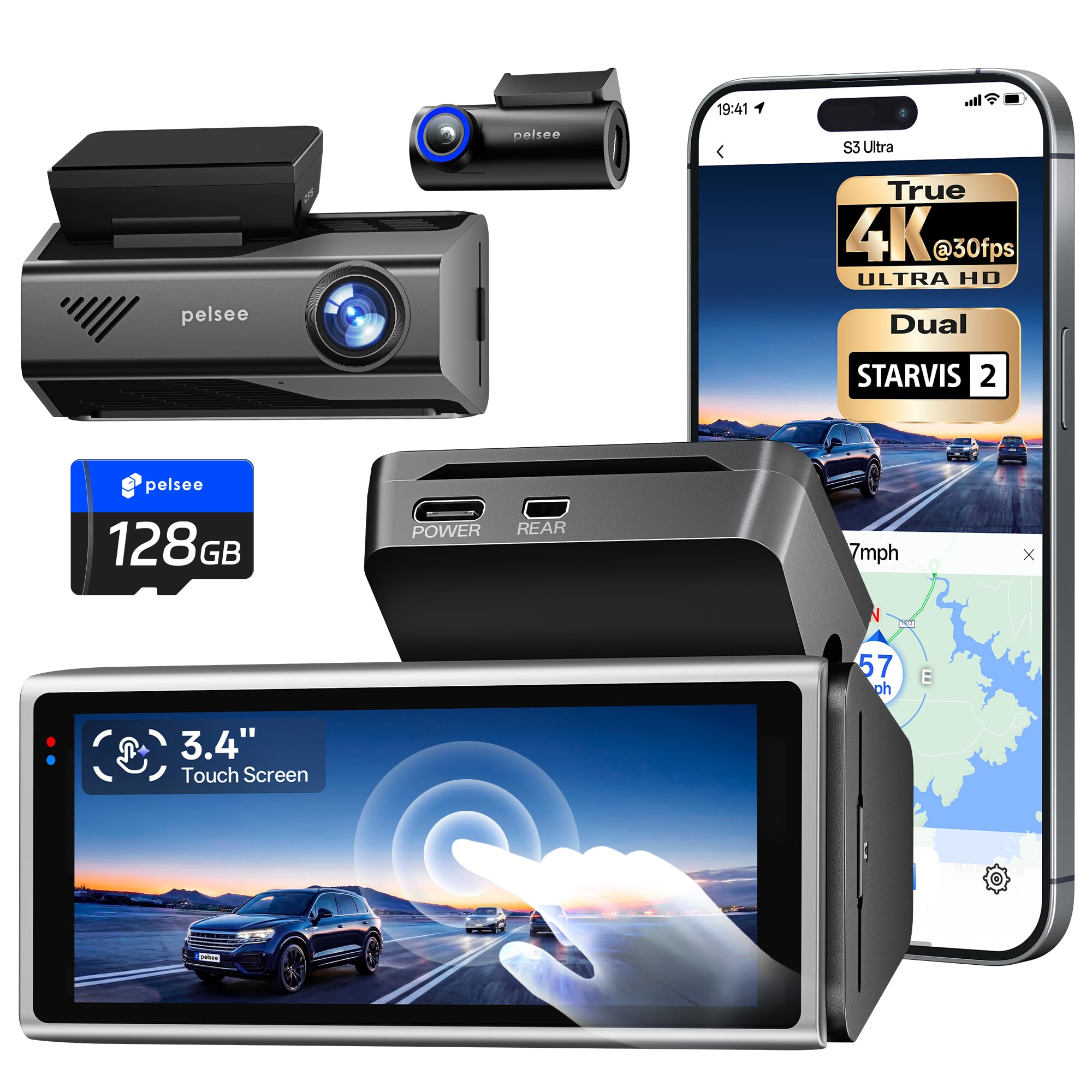
The Pelsee S3 Ultra sets a new benchmark for dash-cam-based driver assistance by pairing a native 4K front sensor (IMX678) with a 2.5K rear sensor (IMX675), both from Sony’s STARVIS 2 line. This sensor combination captures 50 percent wider dynamic range than conventional CMOS, meaning license plates remain readable even when transitioning from a dark tunnel into direct sunlight. The F1.5 aperture and True HDR processing further reduce motion blur at highway speeds, making this unit a legitimate tool for evidential recording.
ADAS functionality includes forward collision, lane departure, and pedestrian alerts delivered through voice commands and the 3.4-inch IPS touchscreen. The built-in 5.8GHz Wi-Fi 6 radio downloads clips to the Pelsee Cam app at up to 30 MB/s, which is roughly 15 times faster than older 2.4GHz systems. The package also includes a 128GB high-endurance card and an OBD hardwire kit, so parking mode with time-lapse recording activates immediately without extra purchases.
Where it falls short is channel count — it covers front and rear only, with no option for side cameras or cabin recording. The adhesive mount is single-use, and there is no video-out port for an external monitor. For drivers who want the sharpest dual-channel footage with reliable ADAS voice alerts, this unit delivers the best balance of sensor hardware and included accessories at its tier.
Why it’s great
- True 4K front + 2.5K rear with Sony STARVIS 2 sensors
- Full-color night vision instead of grayscale IR
- OBD hardwire kit and 128GB card included
Good to know
- No side or cabin camera channels
- Adhesive mount is not reusable after removal
- Touchscreen is 3.4 inches, smaller than mirror-based displays
2. WOLFBOX G850 PRO Mirror Dash Cam

The WOLFBOX G850 PRO replaces your factory rearview mirror with a 12-inch IPS touch display while keeping the form factor low-profile. The front camera records at 4K (2560×1440) at 30 fps using the 170-degree wide-angle lens, while the rear camera captures 1080p at 25 fps. The mirror display switches between a full rear-camera view and a standard reflective mode, and the touch interface lets you split the screen to monitor both feeds simultaneously without lag.
This unit integrates both ADAS and BSD (Blind Spot Detection) algorithms that produce voice alerts for forward collisions, lane departure, pedestrian hazards, and vehicles approaching from the rear corners. The BSD function uses optical detection rather than radar, so it works best when the rear camera has a clear view of adjacent lanes. The 5.8GHz Wi-Fi connects to the WOLFBOX app for quick clip downloads, and voice commands handle screen toggles and video locking hands-free.
The 12-inch mirror body may obstruct the driver-side visor in some vehicles, and the ADAS alerts can feel overly sensitive on curvy two-lane roads, generating beeps for guardrails and parked cars. The included 64GB card is adequate for daily commutes, but the maximum supported size of 256 GB limits heavy users. For drivers who want a clean OEM-style mirror replacement with useful ADAS and BSD warnings, this is a solid mid-range pick.
Why it’s great
- 12-inch IPS touch mirror display with split-view
- ADAS + Blind Spot Detection with voice alerts
- 5.8GHz Wi-Fi for fast app transfers
Good to know
- Large mirror may block passenger visor
- BSD is optical, not radar — less reliable in rain
- Max microSD support is 256 GB
3. Roadwitness Dual Sony STARVIS 2 4K+4K Mirror Dash Cam
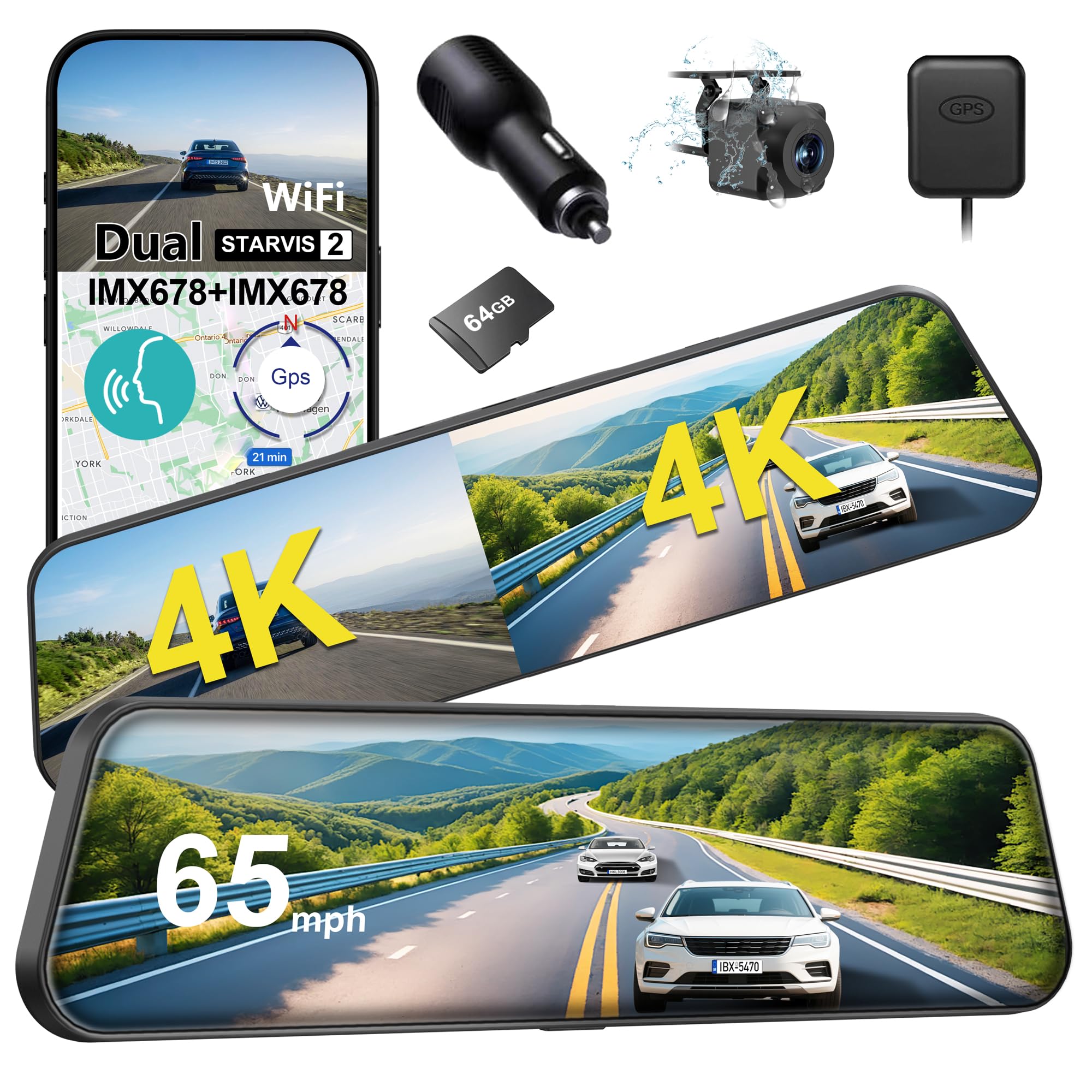
Roadwitness pushes the mirror dash cam category into premium territory by equipping both the front and rear cameras with the same Sony STARVIS 2 IMX678 sensor, each capturing true 3840x2160p at 30 fps. This dual-4K architecture means the rear feed has the same resolving power as the front — critical for reading plates of following vehicles or capturing details during reversing maneuvers. The 170-degree seven-glass lenses minimize barrel distortion while covering six lanes of traffic.
The STARVIS 2 HDR engine handles extreme backlighting and tunnel transitions by simultaneously capturing short and long exposures and merging them into a single balanced frame. Full-color night vision remains active in parking mode when connected to the optional hardwire kit. The ADAS suite includes forward collision, lane departure, and pedestrian detection alerts, plus a digital BSD system that overlays visual warnings on the 12-inch anti-glare touchscreen. The screen’s anti-glare coating reduces reflections during daytime driving, improving usability as a rearview mirror.
The 64GB included card is underwhelming for a dual-4K system that fills storage quickly, and the default voice announcements and beeps cannot be fully silenced — a common complaint among users who want a quieter cabin. The display’s ultra-wide FOV makes cars behind appear smaller than expected, which some find disorienting when checking the mirror. For technologists and safety-focused drivers who demand equal 4K resolution from both channels, this is the top dual-sensor mirror unit available.
Why it’s great
- True 4K front AND rear with identical Sony IMX678 sensors
- Anti-glare 12-inch touchscreen reduces daytime reflections
- HDR merges exposures for balanced low-light footage
Good to know
- Only 64GB card included; dual 4K fills it fast
- Unavoidable beeps and voice prompts
- Extreme wide-angle makes trailing cars appear tiny
4. VOONOA 4K RV Backup Camera System
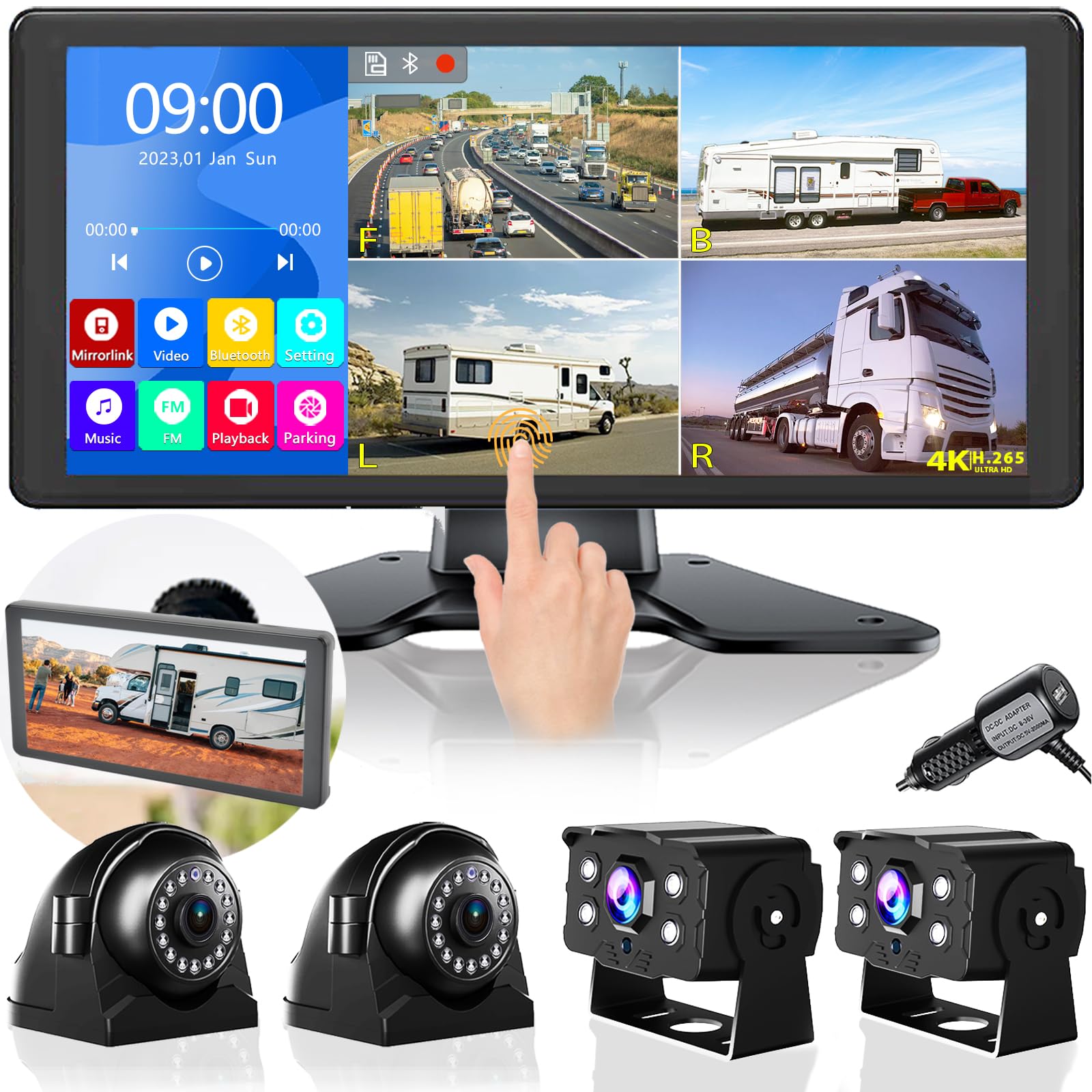
The VOONOA 4K RV system delivers a full 360-degree view through four 1080P cameras feeding into a 10.36-inch 4K ultra-HD touchscreen monitor. The quad-split display shows all four camera feeds simultaneously, with the ability to tap any feed for full-screen enlargement. This layout is invaluable for maneuvering a long RV or trailer, as the driver can watch the front approach, rear clearance, and both sides at a single glance without toggling views.
Each camera uses full-glue sealing technology and IP69K waterproofing, meaning it withstands high-pressure car washes and extreme temperatures from minus-68°F to 167°F. Infrared LEDs and a light sensor provide at least 50 feet of night vision in complete darkness, and the built-in DVR records all four channels with loop recording. The monitor also includes Bluetooth for hands-free calls and music streaming, plus a USB port for media playback from a flash drive — a welcome comfort feature for long trips.
Wired installation requires running individual camera cables to the monitor, and the system does not include extension cables for longer trucks or trailers beyond 30 feet. The 64GB SD card is included, but the system lacks a dedicated parking mode with motion detection unless paired with aftermarket accessories. For motorhome, fifth-wheel, and box-truck owners who need constant all-angle visibility, this is the most complete wired 4-channel setup at its tier.
Why it’s great
- Quad-split view covers four sides simultaneously
- IP69K waterproofing and metal camera housings
- Bluetooth for music and calls while driving
Good to know
- Wired installation requires running cables for each camera
- No dedicated parking mode without add-ons
- Short extension cables may not fit extra-long trailers
5. Pelsee P12 Pro Max Mirror Dash Cam
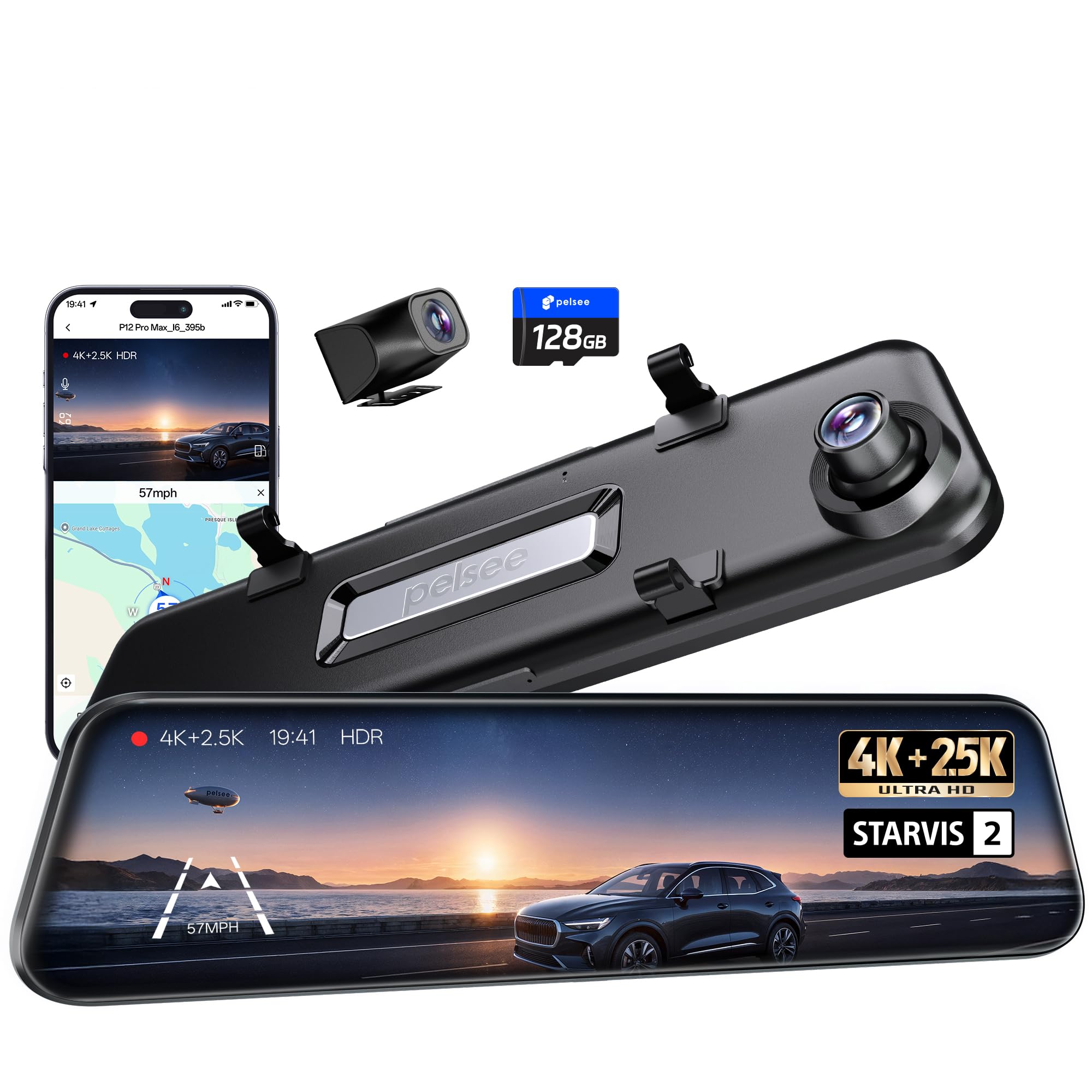
The Pelsee P12 Pro Max sits at the intersection of features and price, offering a 12-inch mirror dash cam with a Sony STARVIS 2 IMX678 front sensor recording true 4K at 30 fps and a STARVIS IMX335 rear sensor capturing 2.5K. The 160-degree field of view is slightly narrower than the 170-degree competitors, but the trade-off is reduced barrel distortion and more natural depth perception from the mirror display. The unit includes an OBD hardwire kit and a 128GB card out of the box, saving you about in add-ons compared to similarly spec’d mirrors.
ADAS and BSD are handled through the same optical-feed algorithms found in the WOLFBOX, but Pelsee supplements them with dual-band 5.8GHz Wi-Fi for 20 MB/s downloads and voice commands that let you toggle the display, lock videos, and switch camera views without reaching for the screen. The parking mode uses time-lapse recording with full-color night vision, drawing power from the OBD port while maintaining low-voltage protection to prevent battery drain.
The rear camera cable is 33 feet long, which fits larger SUVs and trucks without needing an extension. However, the rear view mirror setting resets after time-lapse mode or a shutdown cycle, requiring a manual re-toggle each time the vehicle restarts — a firmware bug that Pelsee has yet to patch. ADAS users also report inconsistent lane-departure warnings that sometimes trigger after the vehicle has already drifted. For budget-conscious drivers who want premium sensor hardware and included accessories, this is the strongest value proposition in the mirror category.
Why it’s great
- 4K STARVIS 2 front sensor at a strong price point
- OBD hardwire kit and 128GB card included
- 33-foot rear cable fits trucks without extension
Good to know
- Rear mirror setting resets after time-lapse parking mode
- Lane-departure ADAS can be inconsistent
- 160-degree FOV is slightly narrower than competitors
6. Seventour 4-Channel 1080p Backup Camera System
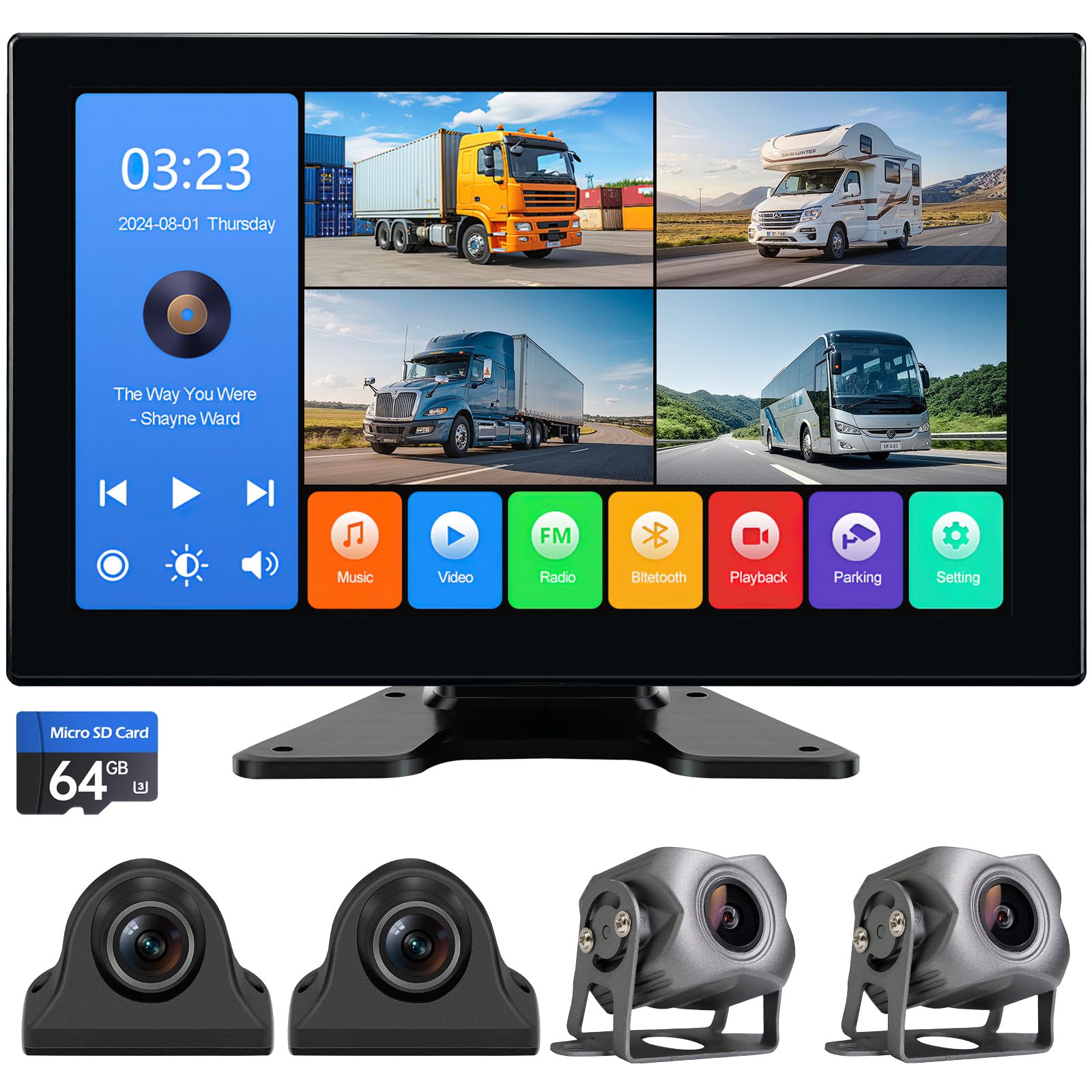
Seventour’s 4-channel system brings quad-view monitoring to a wider audience with four 1080p cameras, a 10.2-inch HD touchscreen, and a built-in DVR that records all feeds simultaneously. The aluminum-alloy camera housings carry an IP69 waterproof rating, meaning they survive pressure washing and salt spray — important for truck and van owners who operate in harsh environments. The touchscreen interface supports quad-split, dual-view, and single-camera full-screen modes, and the monitor includes Bluetooth 5.0 for phone calls and music streaming.
The system includes a 64GB SD card and supports loop recording, local playback, and reverse-trigger activation that automatically switches to the rear camera when the transmission shifts into reverse. The cameras use RCA connectors and a simple plug-and-play harness, making installation feasible for a DIY owner with basic wiring knowledge. The resistive touchscreen is less responsive than the capacitive screens found on higher-priced models, but it remains functional with gloves — a useful feature for cold-weather work.
The 120-degree real angle of view per camera is noticeably narrower than the 150- to 170-degree lenses on competitors, leaving larger blind spots at the extreme edges. The monitor’s brightness is adequate for daytime use but washes out under direct sunlight on the dashboard. For operators of work vans, trailers, and small RVs who want a functional 360-degree wired system without spending three figures more, this unit provides reliable coverage at an accessible entry point.
Why it’s great
- Four 1080p cameras with IP69 metal housings
- Bluetooth 5.0 for calls and music
- 64GB SD card included, supports loop recording
Good to know
- Only 120-degree viewing angle per camera
- Resistive touchscreen is less responsive than capacitive
- Monitor washes out in direct overhead sunlight
7. Garmin DriveCam 76 GPS Navigator

The Garmin DriveCam 76 combines a dedicated 7-inch GPS navigator with a built-in dash cam and forward-facing ADAS warnings, creating an all-in-one device that reduces windshield clutter. The high-resolution LCD displays clear turn-by-turn directions with Birdseye satellite imagery, while the integrated camera continuously records 1080p video with automatic incident detection. When a collision is detected via the G-sensor, the clip is auto-uploaded to the secure Garmin Drive Vault, accessible through the smartphone app for insurance and legal purposes.
The ADAS suite includes forward collision and lane departure warnings, plus alerts for school zones, sharp curves, and speed changes based on GPS data and map content. The Garmin Drive app adds live traffic, fuel prices, and weather overlays when paired with a smartphone over Bluetooth. Voice assist handles destination entry and POI searches hands-free, and built-in Wi-Fi updates maps and software without connecting to a computer. The 16GB internal memory stores several hours of footage before loop recording overwrites older clips.
This unit is not a full driver assistance system — it lacks blind spot monitoring, side cameras, and a rear camera. The dash cam is single-channel front only, so it cannot cover rear-end events or parking surveillance without additional Garmin accessories. The suction cup mount can detach in extreme heat, and the battery lasts roughly one hour when unplugged. For drivers who prioritize GPS navigation and want an integrated dash cam with cloud backup, this is a unique and polished solution.
Why it’s great
- 7-inch GPS with pre-loaded North America maps
- Automatic incident detection with cloud upload
- Wi-Fi map updates and live traffic via app
Good to know
- Single-channel front camera only
- No blind spot or rear-view coverage
- Suction mount can fail under prolonged sun exposure
8. Brandmotion Radar Blind Spot System RDBS-1600

The Brandmotion RDBS-1600 represents a different philosophy in driver assistance: instead of cameras, it uses millimeter-wave radar sensors operating at 76-77 GHz to detect vehicles in adjacent lanes up to 40 feet away. Two radar modules mount behind the rear quarter-panels and communicate with a CAN-bus integration module that reads turn signal and speed data from the vehicle’s OBD-II port. When a vehicle is detected in the blind spot and the turn signal is activated, an audible tone sounds and a bright LED indicator illuminates on the windshield-pillar trim.
Cross-traffic alert is built into the same radar hardware, sensing vehicles approaching from the sides when reversing out of a parking spot. The system is designed to ignore vehicles two lanes over, reducing false alarms on multi-lane roads. The RDBS-1600 is the upgraded version of the RDBS-1500, extending detection range by 15 feet compared to the earlier model. The integration module taps into the vehicle’s CAN-bus for speed sensing, so the system disables warnings below 15 mph to avoid nuisance alerts in stop-and-go traffic.
Installation is complex and requires cutting into rear fasings, running wires through the cabin, and splicing into turn signal circuits — not a DIY project for most owners. The radar modules are designed for plastic rear fascias only; vehicles with metal pickup truck bumpers are incompatible without custom bracketry. Brandmotion’s technical support receives mixed reviews, and local installers may not have experience with aftermarket radar. For drivers who want true radar-based blind spot detection that works in fog, rain, and darkness where camera-based ADAS fails, this is the only serious option at its price point.
Why it’s great
- 74-77 GHz radar detects vehicles in any weather
- 40-foot range covers adjacent lane fully
- Cross-traffic alert included for reversing safety
Good to know
- Professional installation required; not DIY-friendly
- Incompatible with metal truck bumpers
- System does not function below 15 mph
9. Escort Redline 360c + M2 Smart Dash Cam Bundle

The Escort Redline 360c paired with the M2 Smart Dash Cam forms a premium bundle that addresses driver awareness from a different angle: radar and laser detection. The Redline 360c uses a digital signal processor with AI-assisted filtering (IVT Filter, GPS AutoLearn) to eliminate false alerts from automatic doors and adaptive cruise control sensors while maintaining extreme detection range — users report K-band and Ka-band pickups from 1.5 to over 2 miles away. The 360-degree directional awareness displays the approximate heading of the radar source, and the TELIT GPS module pinpoints the location within 2.5 meters for marking known enforcement zones.
The M2 dash cam records in full 1080P with a wide dynamic range lens optimized for both daytime and nighttime clarity. It pairs with the Drive Smarter app to sync with the radar detector’s alerts, overlaying speed and location data onto recorded video. The bundle supports Apple CarPlay and Android Auto, so alerts and route information display on the vehicle’s factory screen. Escort’s Live community shares real-time alerts from other drivers across the country, adding a crowdsourced layer that no camera-based ADAS can match.
This bundle is not a substitute for 360-degree camera coverage or blind spot radar — it only warns about radar and laser enforcement. The M2 camera is front-facing only and lacks rear or side channels. Some units have experienced early hardware failures requiring replacement, and the suction cup mount can lose grip in hot climates. For drivers whose primary concern is speed enforcement awareness with integrated video documentation, this combo delivers the longest detection range and most refined false-alert filtering available.
Why it’s great
- Industry-leading radar detection range up to 2+ miles
- AI-powered filtering nearly eliminates false alerts
- Apple CarPlay / Android Auto integration for in-dash display
Good to know
- Camera is front-only, no rear or side coverage
- Not a blind spot or collision avoidance system
- Suction mount can fail in high heat; Blendmount recommended
FAQ
Can a mirror dash cam replace my factory rearview mirror entirely?
Do ADAS warnings work in heavy rain or fog?
How much storage do I need for a multi-camera system?
Can I install a four-camera system myself?
Are radar detectors like the Escort Redline 360c legal?
Final Thoughts: The Verdict
For most users, the best driver assistance systems winner is the Pelsee S3 Ultra because it combines the sharpest Sony STARVIS 2 sensors with a 128GB card and OBD hardwire kit at a mid-range price, delivering true 4K footage and reliable ADAS alerts without needing costly extras. If you want a 12-inch mirror display with full 360-degree 4-channel coverage for an RV or truck, grab the VOONOA 4K RV System. And for genuine radar-based blind spot detection that works in any weather, nothing beats the Brandmotion RDBS-1600.

Mo Maruf
I created WellFizz to bridge the gap between vague wellness advice and actionable solutions. My mission is simple: to decode the research and give you practical tools you can actually use.
Beyond the data, I am a passionate traveler. I believe that stepping away from the screen to explore new environments is essential for mental clarity and physical vitality.