Our readers keep the lights on and my smoothie glass nicely filled. As an Amazon Associate, I earn from qualifying purchases.
A garden irrigation system is only as reliable as its smallest part — the emitter. A poorly designed dripper wastes water, clogs mid-season, or fails to reach the root zone, leaving plants parched while the water bill climbs. The right emitter delivers a controlled, steady flow directly where it’s needed, transforming a chaotic spray pattern into a precise hydration plan.
I’m Mohammad Maruf — the founder and writer behind WellFizz. I’ve analyzed hundreds of hours of real-world feedback and cross-referenced hydraulic specs to separate the products that perform season after season from those that pop off or clog when it matters most.
Whether you are setting up raised beds, flower borders, or a full greenhouse, choosing the right hardware makes the difference between a system that thrives and one that frustrates. This guide breaks down the best drip irrigation emitters by real-world performance, install simplicity, and long-term reliability.
How To Choose The Best Drip Irrigation Emitters
Every component in a drip system matters, but the emitter is the final link between your supply line and your plant’s roots. A poor emitter causes unpredictable water distribution, wasted runoff, and irrigation headaches. Understanding three core specs ensures you invest in a system that waters evenly all season long.
Flow Rate and Pressure Compensation
Flow rate is measured in gallons per hour (GPH) and determines how much water each plant receives. Low-flow emitters (0.5 GPH) work well for small perennials, while higher rates (2 GPH or more) suit trees and large shrubs. Non-pressure compensating emitters (like the Rain Bird button dripper) maintain a consistent output regardless of pressure fluctuations across long tubing runs — an essential feature if your garden has elevation changes or extensive 1/2-inch mainlines.
Installation Style and Ease
Emitters fall into two broad groups: barbed push-in types and pre-installed dripline. Barbed emitters (such as the Raindrip bubbler or Carpathen drippers) attach directly to punched holes in 1/4-inch distribution tubing and can be repositioned as plants grow. Pre-installed dripline (like the MIXC roll) features emitters factory-embedded every 6 inches — ideal for straight-row plantings where you want to cut, place, and forget. Your choice depends on whether you need flexibility for odd-shaped beds or the speed of a continuous grid.
Durability and Clog Resistance
Exposure to sunlight, soil, and mineral-heavy water can degrade cheap plastic emitters within a single growing season. Look for UV-stabilized polyethylene or chemical-resistant materials that resist cracking. Emitters with large internal water passages or self-flushing action — such as the Rain Bird button dripper — naturally shed sediment rather than packing it inside the orifice, drastically reducing clogs in hard-water regions.
Quick Comparison
On smaller screens, swipe sideways to see the full table.
| Model | Category | Best For | Key Spec | Amazon |
|---|---|---|---|---|
| Rain Bird BUE05-25S | Button Dripper | Consistent low-flow on sloped beds | 0.5 GPH, non-pressure compensating | Amazon |
| MIXC 100ft Dripline | Pre-Installed Line | Row crops and raised beds | 0.5 GPH every 6 inches | Amazon |
| Raindrip 157050B | Adjustable Bubbler | Trees, shrubs, groundcover | 0 to 11.7 GHP, 8-stream pattern | Amazon |
| Carpathen 30pk Vortex | Push-to-Connect | Quick-install container gardens | 360° adjustable, 6″ stake | Amazon |
| HIRALIY 15pc | 8-Hole Dripper | Custom micro-spray layouts | Push-fit, detachable head | Amazon |
In‑Depth Reviews
1. Rain Bird BUE05-25S Button Dripper/Emitter

Rain Bird’s button dripper is the gold standard for consistent low-flow delivery. Each emitter is rated at 0.5 gallon per hour, and the non-pressure compensating design means you get that same 0.5 GPH whether you run 5 feet of distribution line or 50 feet — a critical advantage for gardens with change in elevation. The self-piercing barb punches directly into 1/4-inch tubing without a separate punch tool, saving one step during installation.
Large internal water channels and a self-flushing action clear debris every time the system cycles on, reducing clogs that plague cheaper emitters in hard-water zones. The UV-resistant plastic holds up season after season without becoming brittle. Gardeners with long tubing runs or sloped beds consistently report even watering across every plant, something adjustable bubblers often fail to match.
The 25-pack provides a modest number of emitters for targeted shrubbery lines rather than broad-area coverage. Each unit measures less than one inch long, so it disappears into foliage. If you prioritize uniform per-plant hydration over spray coverage, this compact button is the most reliable choice in the lineup.
Why it’s great
- Extremely consistent 0.5 GPH output across long distances
- Self-piercing barb simplifies installation with no extra tool needed
- Self-flushing action resists clogging from hard water
Good to know
- Rigid barb requires a firm push; may crack tubing if forced at an angle
- Non-adjustable — fixed 0.5 GPH, not suited for plants needing higher flow
2. MIXC 100ft Dripline with Built-In Emitters
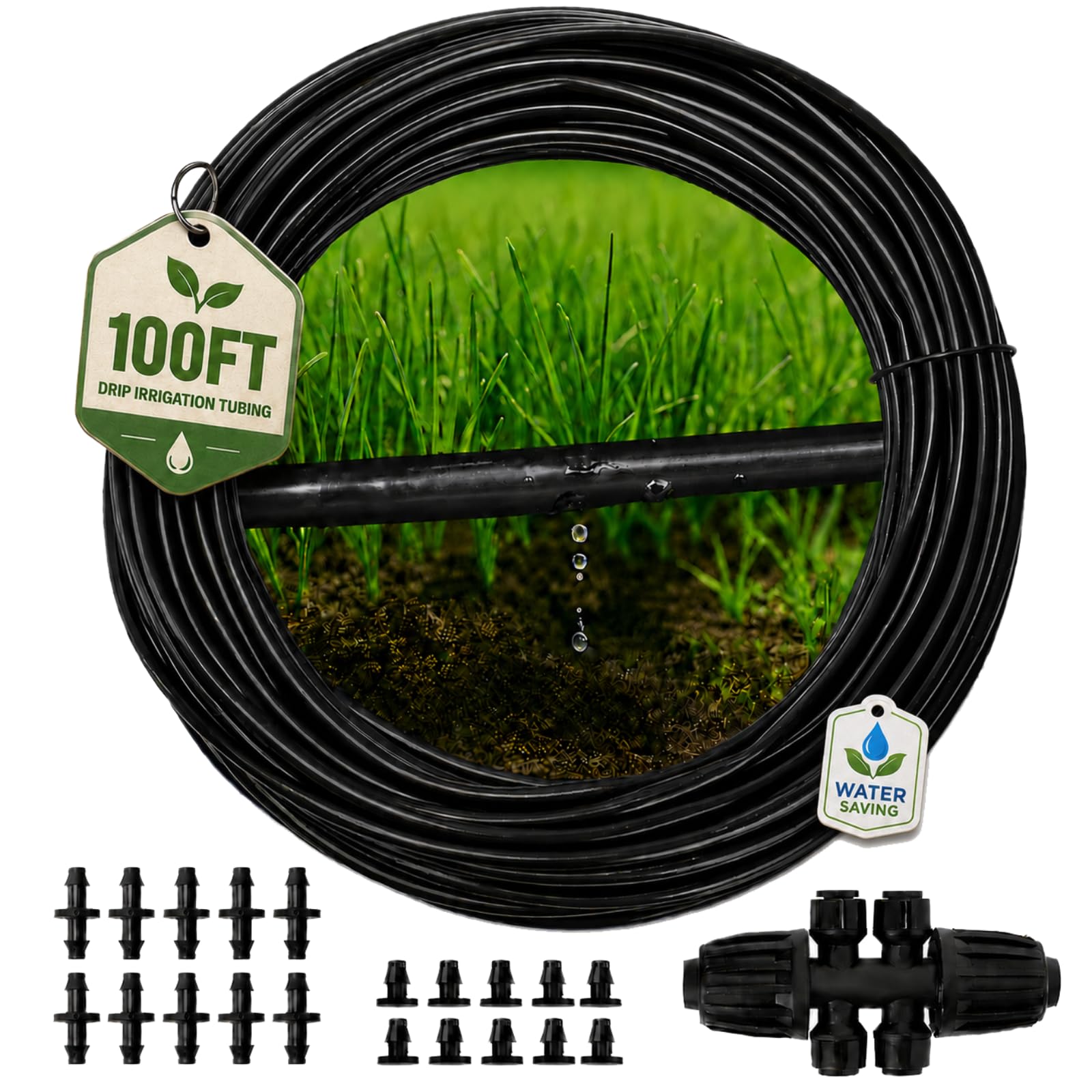
The MIXC dripline eliminates the need to punch and insert individual emitters. Pre-installed 0.5 GPH emitters are spaced every 6 inches along 100 feet of 1/4-inch tubing — simply cut, connect, and snake the line through raised beds or along vegetable rows. The 6-way quick connector and ten 1/4-inch barbed couplings included in the box let you branch the line to multiple zones immediately without separate purchases.
Because water is delivered directly to the root zone through low-pressure seepage, evaporation and runoff drop dramatically compared to overhead spray heads — users report up to 80% reduction in water usage. The polyethylene material withstands UV exposure and can be buried for subsurface irrigation to further reduce moisture loss. Each individual dripline segment runs up to 19 feet with even distribution, making it perfect for rectangular raised beds.
The tradeoff is flexibility — once the line is laid, you cannot reposition emitters to adapt to changing plant layouts. Some users noted that the included goof plugs seal poorly if the tubing shifts. For gardeners planting in straight rows who want a fast, consistent soak without fiddling with individual drippers, this is the most time-efficient option.
Why it’s great
- Factory-embedded emitters save hours of installation labor
- Included connectors allow immediate expansion into multiple zones
- Can be buried for subsurface irrigation to minimize evaporation
Good to know
- Emitters are fixed in place — not adjustable for spacing or flow rate
- Some users report minor leaks at connector joints when pressure fluctuates
3. Raindrip 157050B Adjustable Flow Bubbler

Raindrip’s 8-stream bubbler offers the widest adjustability in this lineup. A simple twist of the dial varies output from a trickle up to 11.7 GPH at 30 PSI, and the spray radius reaches 16 inches — wide enough to cover a mature shrub base without multiple emitters. The full-circle pattern distributes water evenly around the stem, making it a strong choice for groundcover, decorative grasses, and medium-sized trees.
The non-pressure compensating design means flow shifts with line length and elevation changes — closer to the water source you’ll see higher output, further down the line it drops. In practice, this works fine for simple, flat runs under 40 feet but requires attention on sloped property. Users running very low pressure from rain barrels (around 2 PSI) report the bubbler still drips slowly rather than spraying, adding low-flow versatility.
Some installers found the barbed stem lacks a hard insertion ridge, causing the unit to pop out of the tubing if not fully seated. The polyethylene material holds up well to sun exposure, and the 50-pack provides excellent coverage for large garden areas. At this price per unit, it offers the most flexible spray coverage of any option reviewed here.
Why it’s great
- Adjustable from 0 to 11.7 GPH with a simple dial turn
- 16-inch spray radius covers large ground area per emitter
- 50-pack delivers very low cost per unit for broad coverage
Good to know
- Non-pressure compensating — output varies with line length and slope
- Barb can pop loose if not fully seated in the tubing
4. Carpathen 30pk Vortex Drip Emitters
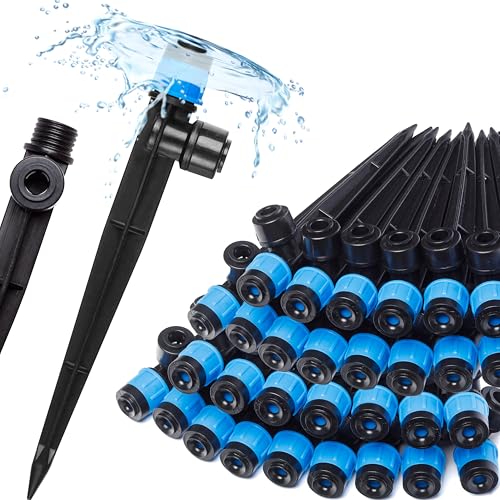
Carpathen’s push-to-connect emitters are built for gardeners who want a micro-spray system up and running in minutes. The barbless connection clips into 1/4-inch tubing without hot water softening or wrestling with rigid barbs — just push in and twist. Each unit sits on a 6-inch plastic stake that drives into loose or compacted soil, holding the spray head steady at the correct height above the root zone.
The spray head rotates 360 degrees and adjusts from a narrow drip to a full cone spray pattern, giving you fine control over coverage width. The vortex design spins the water stream slightly, producing a gentle shower rather than a straight jet that erodes soil. Users with small potted gardens or raised containers find the adjustable reach covers multiple pots from one emitter — a big space saver compared to fixed-flow bubblers.
The detachable head unscrews for cleaning, which prevents long-term clogging from sediment buildup. The 30-pack includes a printed instruction guide, and the brand’s customer service is responsive if parts arrive damaged. The maximum pressure rating of 45 PSI means you should add a pressure regulator if your home line exceeds that limit. For container gardeners and DIY enthusiasts, this is the most flexible, tool-free install option.
Why it’s great
- Push-to-connect design eliminates need for hot water or tools
- 6-inch stake secures emitter height in loose or sloped soil
- Detachable vortex head cleans easily to prevent long-term clogs
Good to know
- Adjustment knob offers limited fine-tuning between drip and spray
- Maximum operating pressure of 45 PSI requires a regulator on most home lines
5. HIRALIY 15pc 8-Hole Dripper Set
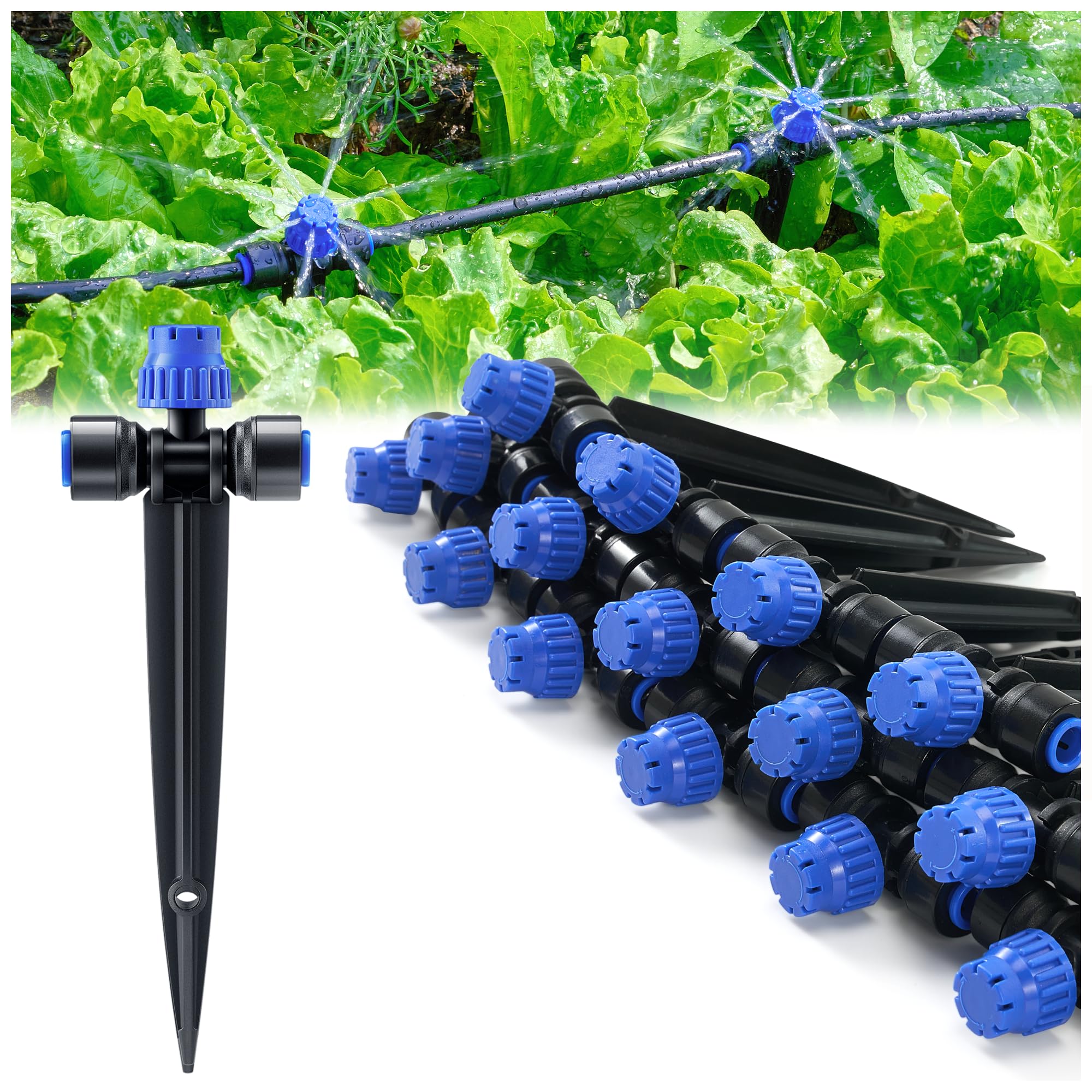
HIRALIY’s 8-hole dripper set bridges the gap between a targeted emitter and a micro-sprinkler. The push-fit connection clicks onto 1/4-inch tubing instantly, and a blue claw button releases the hose for reconfiguration without damage. Each nozzle adjusts independently from fully off to a micro drip stream to a fine spray, enabling mixed-use zones where one plant needs a trickle and a neighbor needs a soak.
The 15-piece count is lower than the 30-pack competitors, but the detachable design makes up for it. Pop the sprinkler head off to rinse out debris under running water — a simple cleaning process that extends usable life through hard-water seasons. The included soil stake holds the dripper in place at the base of medium-sized plants, and the spray pattern covers a circular area rather than a single point, making it effective when placed in the center of a cluster of pots.
Because the head works as a spinner, water dispersion can shift slightly with pressure changes throughout the day. Users recommend checking alignment periodically if your municipal water pressure fluctuates. For small to medium gardens where you want the flexibility to adjust each plant’s feed individually without buying separate flow-control valves, this set offers the most granular micro-level adjustment.
Why it’s great
- Each nozzle adjusts independently from off to spray for mixed plant needs
- Blue claw release allows quick reconfiguration of hose layout
- Detachable sprinkler head rinses clean to prevent mineral buildup
Good to know
- Only 15 emitters per pack — may need multiple sets for larger gardens
- Spray coverage shifts with water pressure changes; heads may need periodic realignment
FAQ
How many drip emitters should I place per plant?
Why do my drip emitters keep clogging?
Can I bury drip irrigation emitters underground?
Final Thoughts: The Verdict
For most users, the best drip irrigation emitters winner is the Rain Bird BUE05-25S because its non-pressure compensating design delivers consistent 0.5 GPH output across long, sloped tubing runs without guesswork. If you want fast, flexible, tool-free install for container gardens, grab the Carpathen 30pk Vortex. And for straight-row raised beds where you want to cut and forget, nothing beats the MIXC 100ft Dripline with embedded emitters every six inches.

Mo Maruf
I created WellFizz to bridge the gap between vague wellness advice and actionable solutions. My mission is simple: to decode the research and give you practical tools you can actually use.
Beyond the data, I am a passionate traveler. I believe that stepping away from the screen to explore new environments is essential for mental clarity and physical vitality.