Our readers keep the lights on and my smoothie glass nicely filled. As an Amazon Associate, I earn from qualifying purchases.
A drip hose that waters your garden’s root zone instead of the driveway saves hundreds of gallons per season. The difference between a soaker that clogs or cracks after one summer and one that delivers consistent moisture year after year comes down to emitter design, material construction, and pressure tolerance. Get the wrong type and you will battle kinked tubing, uneven water distribution, and leaky brass fittings before July arrives.
I’m Mohammad Maruf — the founder and writer behind WellFizz. I spend hundreds of hours each season analyzing drip irrigation hardware, reading pressure-compensation data sheets, and comparing wall thickness specs across the leading hose manufacturers so you can skip the trial-and-error phase.
This guide ranks the most reliable drip hoses by their ability to deliver slow, deep watering at the root line without wasting a drop. Whether you need a pressure-compensating emitter line for raised beds or a flat soaker for dense shrubbery, the best drip hose for your setup depends on wall thickness, emitter spacing, and maximum operating pressure.
How To Choose The Best Drip Hose
Drip hoses look simple, but material composition, emitter type, and pressure rating separate units that deliver even moisture from those that leave dry patches. A hose with 0.04-inch wall thickness and pressure-compensating emitters handles long runs without pressure drop, while recycled rubber hoses with 0.2-inch wall thickness resist cracking but may kink in cold weather. Evaluate your garden bed shape, water pressure, and seasonal storage habits before picking a style.
Emitter Type — Pressure-Compensating vs Non-Compensating
Pressure-compensating emitters maintain a consistent flow rate across the entire hose length regardless of elevation change. Non-compensating soaker hoses rely on porous material and lose pressure at the far end, making them suitable only for short, flat runs. For beds longer than 30 feet or terraced gardens, a pressure-compensating line with built-in 0.8 GPH emitters spaced 6 inches apart delivers uniform saturation from the first plant to the last.
Material and Wall Thickness
Hose durability correlates directly with wall thickness. Thin-walled tubing (0.04 inch) remains flexible for tight bends but punctures easier under heavy mulch or foot traffic. Thicker walls (0.2 inch) resist oxidation and cracking but feel stiffer. PVC flat hoses with three-tube construction avoid kinking entirely, while round rubber soakers require anchoring with stakes to stay flat. Brass and solid copper fittings outlast plastic connectors by multiple seasons because they resist UV embrittlement and thread stripping.
Maximum Operating Pressure
Most drip hoses operate between 8.5 and 60 psi. Soaker hoses relying on micro-pores to weep water perform best under 50 psi — higher pressure forces water through the sidewall too fast, creating puddles instead of slow absorption. Pressure-compensating emitter lines handle up to 60 psi without blowing out seals, but every system benefits from a pressure regulator and inline filter to prevent clogging from sediment.
Quick Comparison
On smaller screens, swipe sideways to see the full table.
| Model | Category | Best For | Key Spec | Amazon |
|---|---|---|---|---|
| Rain Bird ET256-50S | Pressure-Compensating | Long raised beds & slopes | 0.8 GPH emitters every 6 in | Amazon |
| Thiswing 360° Adjustable Kit | Adjustable Mister Kit | Multi-zone garden coverage | 5/16″ tubing, 16 brass nozzles | Amazon |
| KOBAZ Sprinkler Soaker Hose | Flat Soaker Sprinkler | Shrubs & dense flower beds | Three-tube PVC, kink-resistant | Amazon |
| Cokacot 49.21Ft Drip Kit | Bendable Mister Kit | Pots & greenhouse benches | 3-mode adjustable brass nozzles | Amazon |
| MAMIZO Soaker Hose 50 ft | Rubber Soaker Hose | Large lawn border strips | 0.7″ OD recycled rubber | Amazon |
In‑Depth Reviews
1. Rain Bird ET256-50S Drip Irrigation Pressure Compensating Tubing

Rain Bird’s ET256-50S uses pressure-compensating emitters built directly into the 1/4-inch tubing at 6-inch intervals, so every plant along a 50-foot run gets the same 0.8 GPH delivery regardless of elevation changes. The brown polyethylene construction blends into soil and mulch, while the 0.04-inch wall thickness keeps the line flexible enough to snake around individual plants without kinking. Operating pressure spans 8.5 to 60 psi, making it compatible with both low-pressure gravity barrels and standard hose-bib systems.
The micro-porous connection design creates an ultra-tight seal when attached to 1/2-inch mainline drip tubing using 1/4-inch barbed fittings. Two outlet holes on each emitter — positioned 180 degrees apart — water both sides of the bed simultaneously, reducing the number of lines needed for wide raised beds. Users report that laying the tubing in direct sun for a few minutes reduces stiffness, and elevating it above soil with stakes provides even moisture distribution across the entire bed.
Long-term reliability stands out because the pressure-compensating diaphragm resists clogging better than porous soaker fabrics that trap sediment. A filter and pressure regulator on the mainline are still recommended, but the emitter design extends maintenance intervals significantly compared to standard drip tape. For gardeners managing slopes, long rows, or mixed-height beds, this hose delivers the most consistent saturation per gallon.
Why it’s great
- Pressure-compensating emitters maintain even flow on inclines and long runs
- 180-degree dual outlet holes water both sides of a bed from one line
- Wide 8.5 to 60 psi range works with low-pressure and standard systems
Good to know
- Stiff tubing when cold; laying in sun improves flexibility before installation
- Requires 1/4-inch barbed fittings or quick-connects to attach to mainline
2. Thiswing 360° Adjustable Drip Irrigation System

Thiswing’s kit upgrades the typical 1/4-inch drip line to 5/16-inch tubing, which increases internal water flow and eliminates the pressure drop that plagues longer runs. The 16 solid copper misting nozzles each rotate 360 degrees and adjust from a fine mist to a concentrated stream, so you can dial in the exact wetting pattern for each plant zone. The quick-connect pneumatic push fittings replace traditional barbed sockets — they snap together without tools and resist leaking even after multiple disconnections.
Installation takes under 20 minutes for a 50-foot bed because the kit includes a pipe cutter, fixing nails, cable ties, and a replacement core. Each copper nozzle contains a metal tube that holds its bent position, unlike plastic stems that spring back. Users report consistent water distribution across 50-foot by 3-foot beds with 2-foot nozzle spacing, and the mist setting covers roughly 2 feet wide from a 6-inch height. The closed position stops flow completely, letting you skip watering specific sections without capping.
The copper construction resists rust and UV degradation far better than brass or plastic alternatives. If a connection goes in crooked, the pneumatic tee disassembles and reconnects without damaging the tubing. For gardeners who want a modular system that grows with their layout — adding nozzles, extending lines, or repositioning emitters — this kit delivers the most flexibility per dollar in the mid-range bracket.
Why it’s great
- 5/16-inch tubing provides higher flow than standard 1/4-inch lines
- Solid copper nozzles resist corrosion and hold 360-degree positioning
- Quick-connect pneumatic fittings install and reinstall without tools
Good to know
- No printed instruction manual; setup relies on included diagram pictures
- Terminal plug may need heat-sealing for leak-free closure on long runs
3. KOBAZ Sprinkler Soaker Hose 50FT
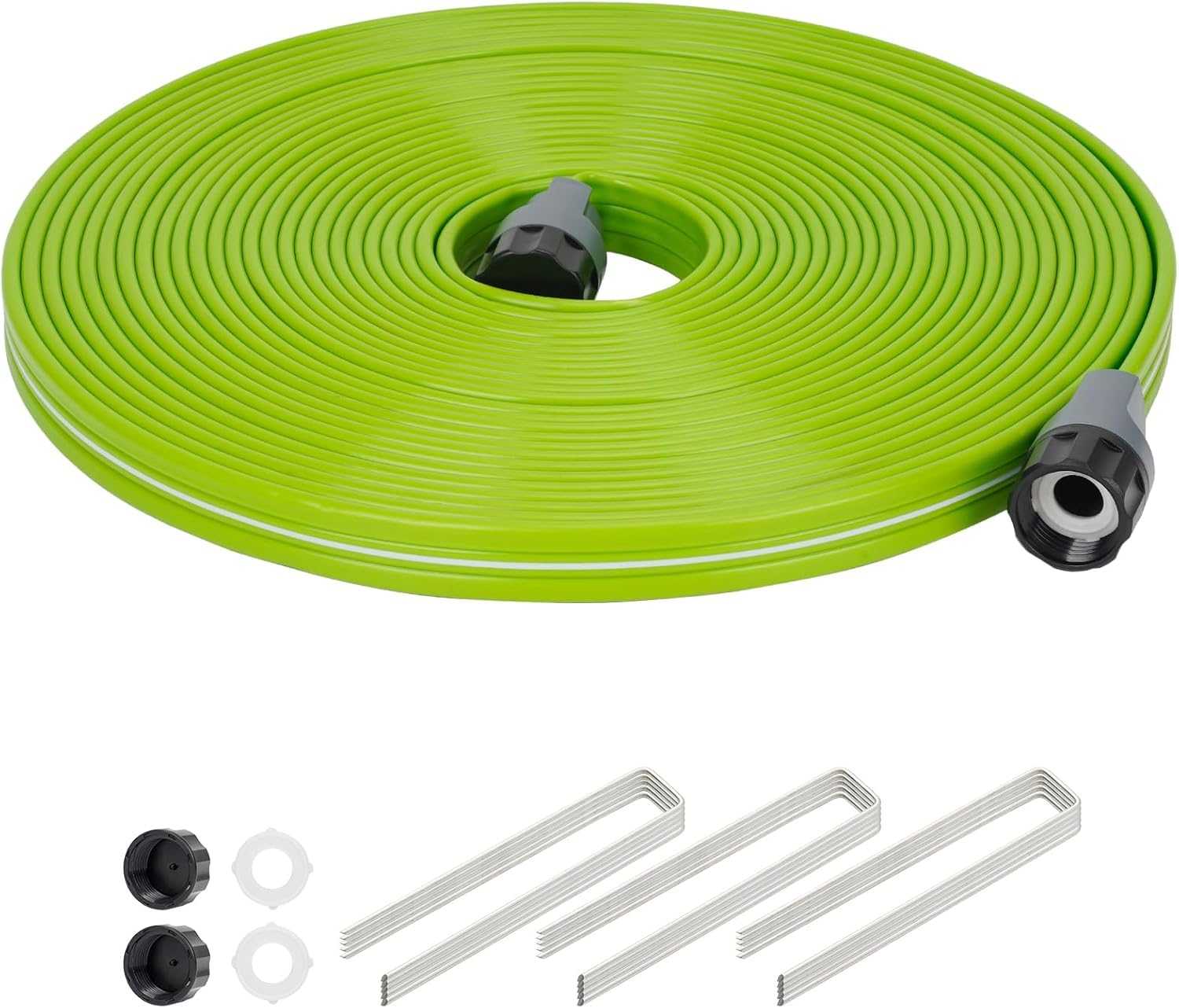
KOBAZ designed this hose as a flat soaker that doubles as a sprinkler, using three parallel PVC tubes instead of a single round channel. The flat profile eliminates the kinking that round rubber soakers suffer when bent around corners, and the hole-side-down orientation directs water into the soil rather than spraying upward into the air. The detachable end caps let you flush debris from the interior or connect multiple hoses in series for wider coverage.
At pressures under 60 psi, the hose creates a low mist that rises 3 to 6 feet, making it suitable for both ground-level soaking and overhead canopy watering. The green color blends into garden beds, and the included metal stakes keep the hose flat along straight runs. Users report that the three-tube design maintains consistent water distribution across the full 50-foot length without the dry tail common in single-tube soakers. The leak-proof gaskets at each connection point prevent the drips that attract ants and wasps.
Heavy-duty PVC construction makes this hose lightweight for storage but tough enough to withstand accidental trowel strikes and foot traffic. Unlike recycled rubber soakers that crack after one winter, the PVC resists oxidation and remains pliable in cooler temperatures. For gardeners who need a versatile hose that transitions between a soaker for dense shrub beds and a mister for seed flats, the KOBAZ design covers both roles without compromise.
Why it’s great
- Flat three-tube design avoids kinking completely around obstacles
- Dual-function soaker and sprinkler with 3-6 foot mist height
- Detachable end caps allow debris flushing and series connection
Good to know
- Requires straight runs; tight turns cause the flat profile to twist and spray sideways
- One hose per package; some units may arrive with packaging damage
4. Cokacot 49.21Ft Drip Irrigation System

Cokacot’s kit brings 49.21 feet of 5/16-inch tubing with three adjustable misting modes — small, medium, and large — controlled by turning each brass nozzle. The 360-degree bendable stems let you direct water exactly where each plant needs it, and the 10 included fixing stakes hold the line above ground for even moisture distribution without soil splash. The faucet adapter includes a built-in filter net to block sediment before it reaches the nozzles.
The 5/16-inch inner diameter represents a meaningful upgrade over standard 1/4-inch drip lines, increasing flow enough to maintain pressure at the far end of the system. Brass T-joints and nozzles seal tightly without thread tape, and the kit comes with enough adapters to connect to both 1/2-inch and 3/4-inch faucets. Users praise the ease of cutting the tubing with the included cutter and repositioning nozzles without creating leaks — a common pain point with cheaper plastic systems.
No printed instructions are included, but the system is intuitive enough that most users assemble it by referencing the box diagram. The zip ties provided are short and thin, so investing in longer garden ties improves the final installation. For greenhouse benches, patio pot arrays, or small raised beds where each plant needs individual flow control, this kit offers the most precise per-nozzle adjustment in the entry-to-mid-tier price bracket.
Why it’s great
- Three adjustable misting modes per nozzle for plant-specific flow control
- 5/16-inch tubing delivers better end-of-line pressure than 1/4-inch systems
- Brass nozzles and T-joints resist UV damage and seal without tape
Good to know
- No printed instruction manual; assembly relies on box diagram or online videos
- Included zip ties are short; longer garden ties improve stability
5. MAMIZO Soaker Hose 50 ft 1/2″
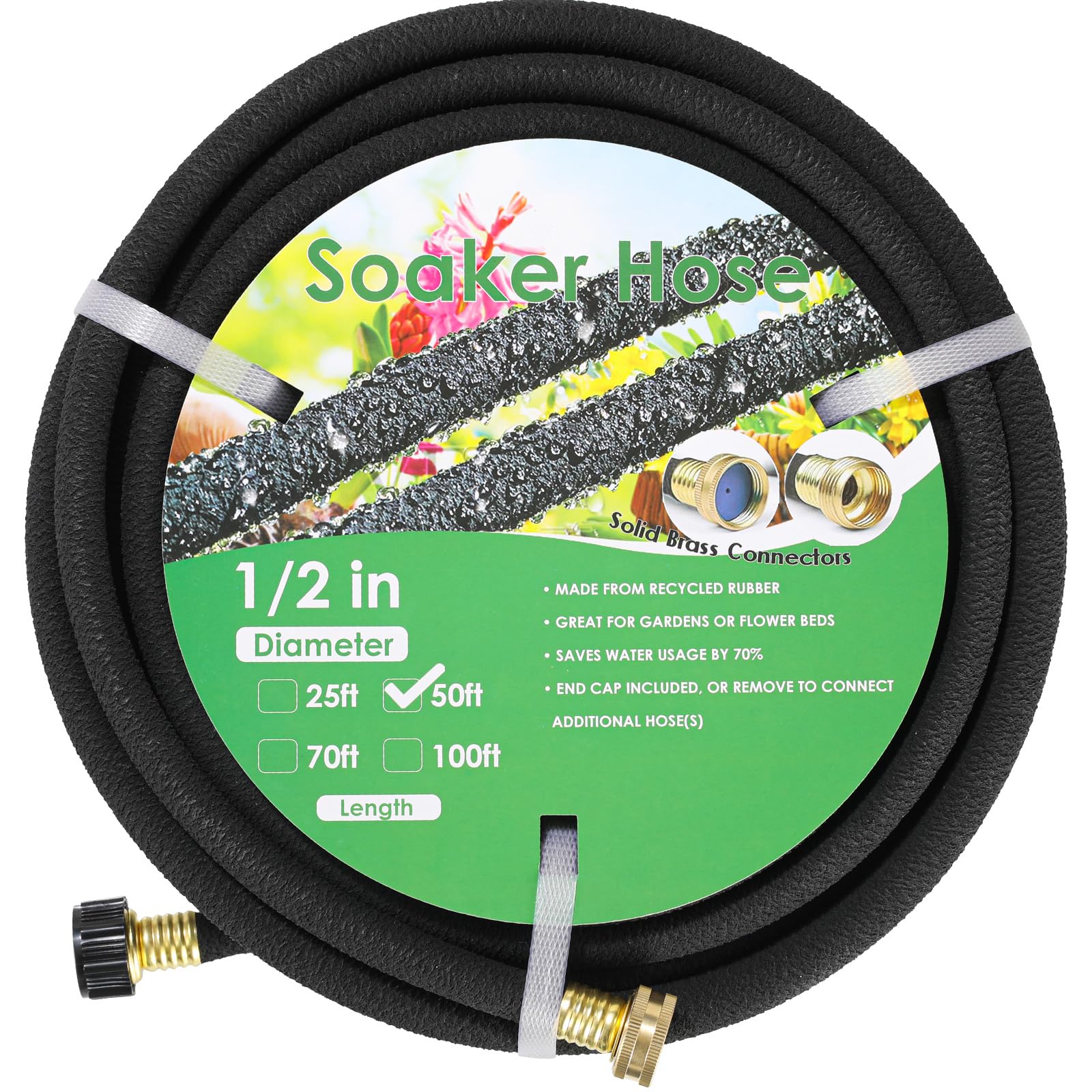
MAMIZO’s 50-foot soaker hose uses recycled rubber with a 0.2-inch nominal wall thickness and a 0.7-inch outside diameter, giving it substantial material density that resists cracking from sun exposure. The 3/4-inch solid brass connectors thread onto standard garden hose fittings without adapters, and the included rust-resistant end cap lets you connect multiple hoses for larger areas. The micro-hole design releases water across the entire surface at roughly 2 to 2.65 gallons per minute at 50 psi.
Users report that the rubber does not create negative pressure when the water shuts off, so sediment stays suspended rather than settling into the pores and clogging the hose. The recycled rubber construction feels heavier than PVC alternatives, which helps it stay in place without frequent staking. For large lawn border strips or rows of shrubs where exact emitter placement is less critical, this hose covers ground quickly with minimal setup — just roll it out, connect, and turn on the water.
A few units have arrived with damaged seals at the connector, and the rubber kinks more readily than flat PVC designs when bent around tight corners. Laying the hose flat and straightening it in the sun before first use reduces kinking. The manufacturer offers responsive customer support for seal issues. For budget-conscious gardeners covering wide, straight areas who want a simple plug-and-water solution, this hose delivers reliable performance without complex fittings or pressure regulators.
Why it’s great
- Thick recycled rubber wall (0.2 inch) resists cracking and UV damage
- Solid brass 3/4-inch connectors are compatible with standard garden hoses
- No negative pressure on shutoff prevents sediment clogging in micro-pores
Good to know
- Rubber kinks more than flat PVC when bent around tight corners
- Some units arrive with damaged connector seals; inspect before installation
FAQ
Can I bury a drip hose under mulch or soil?
How do I prevent water from leaking at the hose connector?
Why does the far end of my soaker hose not weep water?
Final Thoughts: The Verdict
For most users, the best drip hose winner is the Rain Bird ET256-50S because its pressure-compensating emitters deliver consistent 0.8 GPH flow across slopes and long beds without manual adjustment. If you want a modular system with adjustable copper nozzles for zone-specific watering, grab the Thiswing 360° Kit. And for straightforward border-strip watering where kink resistance matters most, nothing beats the KOBAZ Sprinkler Soaker Hose.

Mo Maruf
I created WellFizz to bridge the gap between vague wellness advice and actionable solutions. My mission is simple: to decode the research and give you practical tools you can actually use.
Beyond the data, I am a passionate traveler. I believe that stepping away from the screen to explore new environments is essential for mental clarity and physical vitality.