Our readers keep the lights on and my smoothie glass nicely filled. As an Amazon Associate, I earn from qualifying purchases.
The taste of chlorine in your morning coffee, the metallic edge in your tap water, and the nagging cost of plastic bottles are problems with a single fix. A dedicated drinking water filtration system tackles these issues at the source, delivering clean, great-tasting water directly from your faucet without the waste or recurring expense of bottled alternatives.
I’m Mohammad Maruf — the founder and writer behind WellFizz. This guide is based on hundreds of hours analyzing filter media, flow rates, certification data, and real-world performance metrics to help you find the perfect match for your home.
Whether you rent an apartment or own a house, finding the best drinking water filtration system means balancing filter life, contaminant reduction, installation ease, and long-term cost to match your specific water quality needs.
How To Choose The Best Drinking Water Filtration System
Choosing the right drinking water filter comes down to three factors: the contaminants in your tap water, the space you have available, and how much water your household uses daily. Each system type targets different problems, and understanding these trade-offs prevents costly mistakes.
Filter Type and Contaminant Reduction
The media inside the filter determines what gets removed. Basic carbon block systems reduce chlorine, taste, and odor but leave heavy metals and dissolved solids untouched. Ultrafiltration membranes catch particles down to 0.01 microns, removing bacteria and most cysts while retaining beneficial minerals. Reverse osmosis systems go further by reducing TDS, fluoride, arsenic, and nitrates, making them ideal for problem water. Check your municipal water report or use a home test kit before deciding — the results tell you which system you actually need rather than guessing based on marketing claims.
Flow Rate and Filter Life
A filter that starves your faucet with slow flow creates daily frustration. Carbon-based under-sink units often deliver 1.5 to 2 GPM, fine for filling glasses and cooking pots. Reverse osmosis systems with storage tanks produce water slowly but store it for on-demand use. Filter life matters more for recurring cost than initial price — a cartridge lasting 12 months at 20,000 gallons costs less per year than replacing a small countertop filter every three months. Calculate your household’s weekly water consumption and look for systems where replacement schedules align with your actual usage.
Installation and Space Requirements
Countertop filters require zero plumbing changes, making them perfect for renters. Under-sink systems need cold-water line access and cabinet space — measure the area under your sink before buying any unit taller than 12 inches. Whole-house systems mount at the main water line and handle all taps but demand significant space and professional installation in most cases. Reverse osmosis units need a dedicated faucet hole on your countertop or sink deck; some kitchens have a spare hole from a soap dispenser that works perfectly.
Quick Comparison
On smaller screens, swipe sideways to see the full table.
| Model | Category | Best For | Key Spec | Amazon |
|---|---|---|---|---|
| iSpring RCC7P | Under-Sink RO | Maximum contaminant removal | 75 GPD with booster pump | Amazon |
| Waterdrop T3-T | Under-Sink RO | Fast flow with remineralization | 220 GPD, 7-stage filtration | Amazon |
| iSpring WGB32B | Whole House | Whole-home chlorine reduction | 15 GPM, 100,000 gallon capacity | Amazon |
| Waterdrop TST-UF | Under-Sink UF | Retaining minerals while filtering | 0.01 micron ultrafiltration | Amazon |
| Frizzlife DS99 | Countertop | Renters and no-drill setups | 2 GPM, 0.5 micron dual stage | Amazon |
| SimPure V7 | Under-Sink | Compact under-sink carbon filtration | 1.6 GPM, 20,000 gallon capacity | Amazon |
| Pentair OMNIFilter U25 | Whole House | Entry-level whole-house filtration | 5 GPM, 10″ standard cartridge | Amazon |
In‑Depth Reviews
1. iSpring RCC7P

The iSpring RCC7P tackles problem water with a 5-stage reverse osmosis process backed by an electric booster pump. The pump compensates for low incoming water pressure — a common issue in homes with well water or older plumbing — ensuring consistent 75 gallons per day output. The clear first-stage housing lets you inspect the sediment filter without disassembling anything, a small detail that makes maintenance far less annoying.
Users report TDS reductions from over 350 ppm down to single digits, with output TDS often settling between 2 and 8 ppm. The included brushed nickel faucet mounts on the countertop, and the storage tank holds enough purified water for kitchen use. Installation takes roughly two hours for a first-timer, and the system connects to refrigerator ice makers. Replacement filters cost under a hundred dollars annually — reasonable for the contaminant reduction you get.
Customer service response times stand out here. Multiple users describe iSpring support sending free replacement parts for issues caused by user error, including cross-threaded fittings and faulty membranes. The system is bulky under the sink, and some users relocate the tank to a basement to reclaim cabinet space. The booster pump runs quietly and contributes to a better pure-to-drain ratio than passive RO systems.
Why it’s great
- Booster pump handles low water pressure situations effectively
- Exceptional customer support with fast replacement parts
- TDS reduction to single digits for ultra-pure water
Good to know
- Storage tank takes up significant under-sink space
- Filling large containers is slower than non-RO filters
- Initial membrane may need replacement to hit target TDS levels
2. Waterdrop T3-T
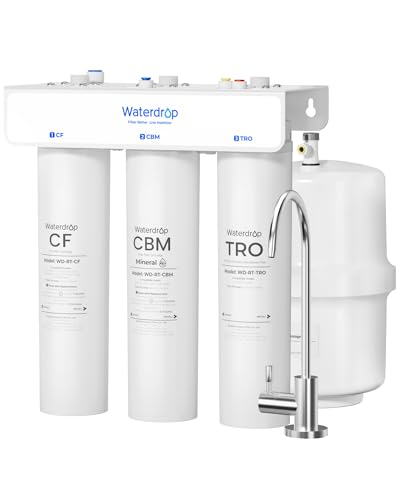
The Waterdrop T3-T redefines what a countertop RO system can do. Its 220 GPD production rate cracks the bottleneck that plagues traditional RO units — you can fill a 16.9-ounce bottle in roughly 12 seconds, five times faster than older 75 GPD designs. The 7-stage filtration includes a remineralization stage that adds potassium, calcium, sodium, and magnesium back into the purified water, correcting the flat taste that some reverse osmosis users dislike.
The compact housing measures 12.6 by 6.1 by 14.69 inches, fitting under most sinks without hogging space. An NFC chip inside the filters sends replacement reminders to your phone, automating a task people forget regularly. The 2:1 pure-to-drain ratio cuts wastewater drastically compared to conventional RO units. Installation is cleaner than multi-line systems — fewer tubes mean fewer potential leak points.
Users consistently praise the water taste improvement and the easy filter swaps. The all-in-one cartridge twists out in three seconds with no housing removal. One drawback: the system requires an electrical outlet under the sink for its pump, which may conflict with garbage disposal wiring. Also, countertop faucet installation requires drilling a hole — not an issue if you have a spare, but something to plan for.
Why it’s great
- Fast 220 GPD production fills bottles quickly
- Remineralization stage improves RO water taste
- Compact footprint saves under-sink storage space
Good to know
- Requires dedicated faucet hole in countertop
- Needs electrical outlet under sink for pump operation
- NFC filter reminder paper slip can be easy to lose
3. iSpring WGB32B

The iSpring WGB32B is a 3-stage whole-house system using 20 by 4.5-inch industrial-standard filters that handle a 15 GPM flow rate — enough to run multiple showers and appliances simultaneously. The first stage catches sediment down to 5 microns, while the second and third stages use coconut shell carbon block to remove up to 99 percent of chlorine, taste, and odor. The system preserves beneficial minerals since it is not a reverse osmosis setup.
Each set of three filters lasts roughly a year with the 100,000-gallon capacity, translating to annual filter costs around a hundred dollars — far cheaper than point-of-use cartridges for each tap. The 1-inch NPT inlet and outlet maintain pressure across the house. The clear housing design lets you visually monitor sediment buildup in the first stage, and the included wrench makes cartridge swaps manageable without tools.
Multiple reviews highlight iSpring’s customer service replacing parts free of charge years after purchase, including cracked caps and manifolds. The heavy blue housings can be difficult to unscrew during replacement, and the O-ring needs careful placement to avoid leaks. Most users pair this with a sediment spin-down pre-filter for well water applications.
Why it’s great
- Handles full home water demand without pressure drop
- Annual filter replacement at reasonable cost
- Lifelong customer support and replacement policy
Good to know
- Large housings require ample installation space
- Filter changes can involve water spillage
- Professional installation recommended for most homes
4. Waterdrop TST-UF

The Waterdrop TST-UF uses a 0.01-micron ultrafiltration membrane to remove bacteria, chlorine, heavy metals, and odors while retaining potassium, calcium, sodium, and magnesium. This makes it a strong pick if your water quality is decent but you want to remove particles and improve taste without stripping out minerals. The stainless steel housing is lead-free 304-grade, holding up better than plastic alternatives that crack over time.
Flow rate hits 2.5 GPM, filling an 8-ounce cup in about 2.3 seconds. The 3-stage design — PP sediment, UF membrane, and CT carbon block — spaces replacements across 6 to 24 months depending on the stage, reducing how often you need to open the cabinet. The system installs directly to 3/8 or 1/2 NPT cold water lines with included hoses and a black steel wrench.
Users report night-and-day improvement in taste and odor, particularly for water with heavy chlorine smells. The quick-connect hoses let you disconnect the system for countertop filter changes, a flexible setup. A few users note the push-connector fittings create leak anxiety, and the blue locking clips are fiddly to seat correctly. Also, the system does not reduce TDS, so if dissolved solids are your concern, this is not the right fit.
Why it’s great
- Retains beneficial minerals while filtering contaminants
- High 2.5 GPM flow rate for quick filling
- Long filter intervals reduce maintenance frequency
Good to know
- Does not reduce TDS or dissolved solids
- Push-connect fittings require careful installation
- Not compatible with well water or hot water lines
5. Frizzlife DS99
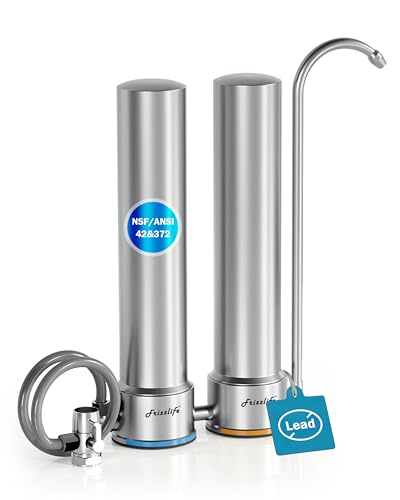
The Frizzlife DS99 sits on the countertop and connects directly to your existing sink faucet via a diverter valve — no drilling, no permanent installation. This makes it ideal for apartment dwellers who cannot modify plumbing. The 8-stage filtration combines a PP membrane and activated coconut shell carbon block with KDF media, reducing lead, chlorine, fluoride, and heavy metals down to 0.5 microns while preserving natural minerals.
Flow rate reaches 2 GPM at 60 psi, which means a glass fills in 2 to 3 seconds. The stainless steel housings are 1mm thick, passed 100,000-cycle water hammer tests, and resist corrosion. The first stage filter lasts up to 8 months, the second up to 12 months or 8,000 gallons. The diverter valve switches between unfiltered and filtered water using a simple snap toggle.
Users report immediate taste improvement and easy installation averaging 15 minutes. The included adapters cover six different thread sizes, though some faucets need a custom adapter from the manufacturer. A small drip after shutoff is common but not a functional issue. The system produces zero wastewater and requires no electricity, so it works in RVs and offices just as well as in apartments.
Why it’s great
- Zero plumbing changes for quick installation
- Stainless steel housings withstand pressure and corrosion
- Switch between filtered and unfiltered water instantly
Good to know
- Countertop footprint takes up sink space
- Some faucets need special adapter from manufacturer
- Minor drip after shutoff on some installations
6. SimPure V7

The SimPure V7 focuses on fitting into tight under-sink spaces. The housing measures just 3.6 inches in diameter and 12 inches tall, small enough to share a cabinet with a garbage disposal or dishwasher connections. The 5-stage filtration uses double sediment membranes, KDF-55, and double-activated coconut shell carbon blocks to reduce lead, chlorine, and bad taste while keeping healthy minerals intact at 0.5 microns.
Flow rate hits 1.6 GPM, filling an 8-ounce cup in about 3 seconds. The single cartridge lasts up to 12 months or 20,000 gallons, making ongoing costs minimal. The 304 food-grade stainless steel housing is BPA-free and avoids the cracking issues common with plastic filters. Installation requires no drilling — the system connects directly to 3/8 or 1/2 cold water lines with included converter fittings.
Customers highlight the solid metal build and easy installation that takes under 10 minutes. The water taste improvement is immediate, and some users report pets preferring the filtered water. One review noted that the filter may be closer to 5 microns despite the 0.5 micron claim, and chlorine taste returned after about 4 months in that case. The manufacturer’s customer service replaced the unit. The system does not reduce TDS, so it is not a replacement for RO.
Why it’s great
- Ultra-slim design fits tight cabinets easily
- All-metal stainless build avoids plastic failures
- 20,000-gallon filter life minimizes replacements
Good to know
- Some reports of actual micron rating being larger than claimed
- Does not reduce TDS or dissolved solids
- Filter housing may need replacement if chlorine taste returns early
7. Pentair OMNIFilter U25

The Pentair OMNIFilter U25 is an entry-level whole-house system that reduces sediment and chlorine taste from every tap. It uses standard 10 by 2.5-inch cartridges, compatible with TO1, RS1, CB3, and GAC1 filters, so you can tailor filtration to your water quality over time. The built-in valve-in-head shuts off water to the housing without turning off the main line, simplifying cartridge swaps.
Flow rate sits at 5 GPM — enough for a single bathroom or a small household. The clear sump housing gives a visible indicator of filter condition, so you know when the cartridge needs changing without guessing. The included TO1 cartridge handles 15,000 gallons, roughly three months for an average family. The system mounts on 3/4 NPT connections and includes a wrench and bracket.
Users value the reliability and straightforward installation, with many using it as a pre-filter for a dedicated under-sink RO system. The 3-month filter cycle keeps replacement costs predictable. Some users report needing extra Teflon tape wraps on connections to prevent small leaks. The housing can be difficult to unscrew if over-tightened, and water spills during changes — using a bucket and a second person helps. The system is not designed for high-flow or large households.
Why it’s great
- Valve-in-head allows easy cartridge replacement without shutting off main water
- Standard cartridge size offers flexible filter options
- Clear housing lets you see when filter needs changing
Good to know
- 5 GPM limit not suitable for larger households
- Cartridge changes every 3 months increase maintenance frequency
- Connections may need careful seating to prevent leaks
FAQ
How do I know if I need reverse osmosis or carbon filtration?
Will an under-sink filtration system fit my kitchen cabinet?
Final Thoughts: The Verdict
For most users, the best drinking water filtration system winner is the iSpring RCC7P because its booster pump and proven 5-stage RO design deliver the highest contaminant reduction for homes with any water pressure. If you want faster flow and remineralized water without the bottled-water taste, grab the Waterdrop T3-T. And for whole-home chlorine and sediment reduction with minimal maintenance, nothing beats the iSpring WGB32B.

Mo Maruf
I created WellFizz to bridge the gap between vague wellness advice and actionable solutions. My mission is simple: to decode the research and give you practical tools you can actually use.
Beyond the data, I am a passionate traveler. I believe that stepping away from the screen to explore new environments is essential for mental clarity and physical vitality.