Our readers keep the lights on and my smoothie glass nicely filled. As an Amazon Associate, I earn from qualifying purchases.
Your tap water hides more than chlorine and sediment. From pharmaceutical residues to PFAS “forever chemicals,” the contaminants that slip through municipal treatment demand a filtration strategy that matches the specific threat profile of your home’s supply. Choosing the wrong system wastes money and leaves your family exposed.
I’m Mohammad Maruf — the founder and writer behind WellFizz. I’ve spent hundreds of hours reading independent lab reports, NSF certification documents, and user longevity data to understand exactly which filtration technologies actually perform under real household conditions.
Whether you need point-of-use precision or whole-house protection, this guide to finding the absolute best drinking water filtration system for home breaks down the contaminants each technology targets and the measurable specs that separate real protection from marketing claims.
How To Choose The Best Drinking Water Filtration System For Home
The right system depends entirely on what is actually in your water. A municipal tap supply with residual chlorine requires a different approach than a private well carrying sediment and heavy metals. Before comparing brands, identify your primary concern: taste and odor improvement, specific contaminant removal, or whole-house protection for appliances and bathing.
Filtration Technology Depth
Basic activated carbon traps chlorine and improves taste but leaves dissolved solids, fluoride, and nitrates untouched. Multi-stage systems add sediment filters (5 to 20 microns), catalytic carbon for chloramine, or ultrafiltration membranes (0.01 microns) that catch bacteria and cysts. Reverse osmosis pushes water through a semipermeable membrane to remove TDS, fluoride, and heavy metals. The more aggressive the technology, the slower the flow rate and the higher the water waste — RO systems typically produce 1:1 to 2:1 pure-to-drain ratios.
Flow Rate and Pressure Compatibility
Whole-house systems must handle your home’s peak simultaneous demand — usually 8 to 15 gallons per minute. Under-sink units operate on a single tap, so flow rates of 1.5 GPM or higher are comfortable. Check your incoming water pressure: most filter housings are rated for up to 80 PSI. If you have a private well, consider a sediment pre-filter upstream to prevent premature clogging of finer media.
Filter Life and Replacement Cost
A filter that lasts 100 gallons is fine for a countertop pitcher but impractical for a whole-house 30,000-gallon system. Calculate the annual cost of replacement cartridges — some premium systems offset their higher upfront price with longer service intervals (12 to 24 months) and lower per-gallon operating expense. Always verify that replacement filters remain readily available for the model you choose.
Quick Comparison
On smaller screens, swipe sideways to see the full table.
| Model | Category | Best For | Key Spec | Amazon |
|---|---|---|---|---|
| iSpring WGB32B | Whole House | Complete home protection | 100,000 gal, 15 GPM, 1″ ports | Amazon |
| Waterdrop KJ600 | Under Sink RO | Pure water + instant hot | 600 GPD, 0.01 micron RO | Amazon |
| iSpring WCB32C-KS | Whole House | Heavy metal & PFAS removal | 30,000 gal, 12 GPM, 5 micron | Amazon |
| Waterdrop TST-UF | Under Sink UF | Mineral retention, low maintenance | 8,000 gal, 0.01 micron UF | Amazon |
| Clearly Filtered Pitcher | Pitcher | Portable, fluoride removal | 100 gal, 365+ contaminants | Amazon |
| SimPure V7 | Under Sink | Budget entry-level, no drilling | 20,000 gal, 1.6 GPM, 304 steel | Amazon |
| Aquaboon 20″ Whole House | Whole House | Well water sediment control | 100 gal, 1″ ports, 5 micron | Amazon |
In‑Depth Reviews
1. iSpring WGB32B

The iSpring WGB32B is the benchmark for whole-house filtration. With 20-inch by 4.5-inch industrial-standard filters and 1-inch NPT ports, it delivers up to 15 GPM — enough to run multiple showers and taps simultaneously without pressure drop. The three-stage sequence starts with a 5-micron sediment filter, followed by two coconut-shell carbon block cartridges that reduce up to 99% of chlorine, along with tastes, odors, herbicides, and other volatile organic compounds.
What sets this system apart is its 100,000-gallon capacity per set of filters, translating to roughly a full year of service for a family of four. Users report the system runs reliably for a decade or more, with several verified reviews documenting leak-free performance after five to ten years. The transparent first-stage housing on the WCB32C-KS sibling is absent here, but the WGB32B compensates with thicker, more robust blue housings that stand up to well water sediment loads.
iSpring’s customer support receives consistent praise — replacement manifolds and housings have been shipped free of charge even years after purchase. The unit requires basic plumbing skills for installation, and you’ll want to use thread sealant rather than Teflon tape on the NPT connections to avoid the minor leaks some users encountered during initial setup. For whole-house chlorine reduction and sediment control, this is the proven standard.
Why it’s great
- 100,000-gallon capacity cuts annual replacement cost dramatically
- 15 GPM flow supports simultaneous household water use
- Decade-long reliability with documented owner longevity
Good to know
- Heavy unit at 45 pounds; requires sturdy mounting
- Installation is not tool-free — needs basic plumbing work
2. Waterdrop KJ600
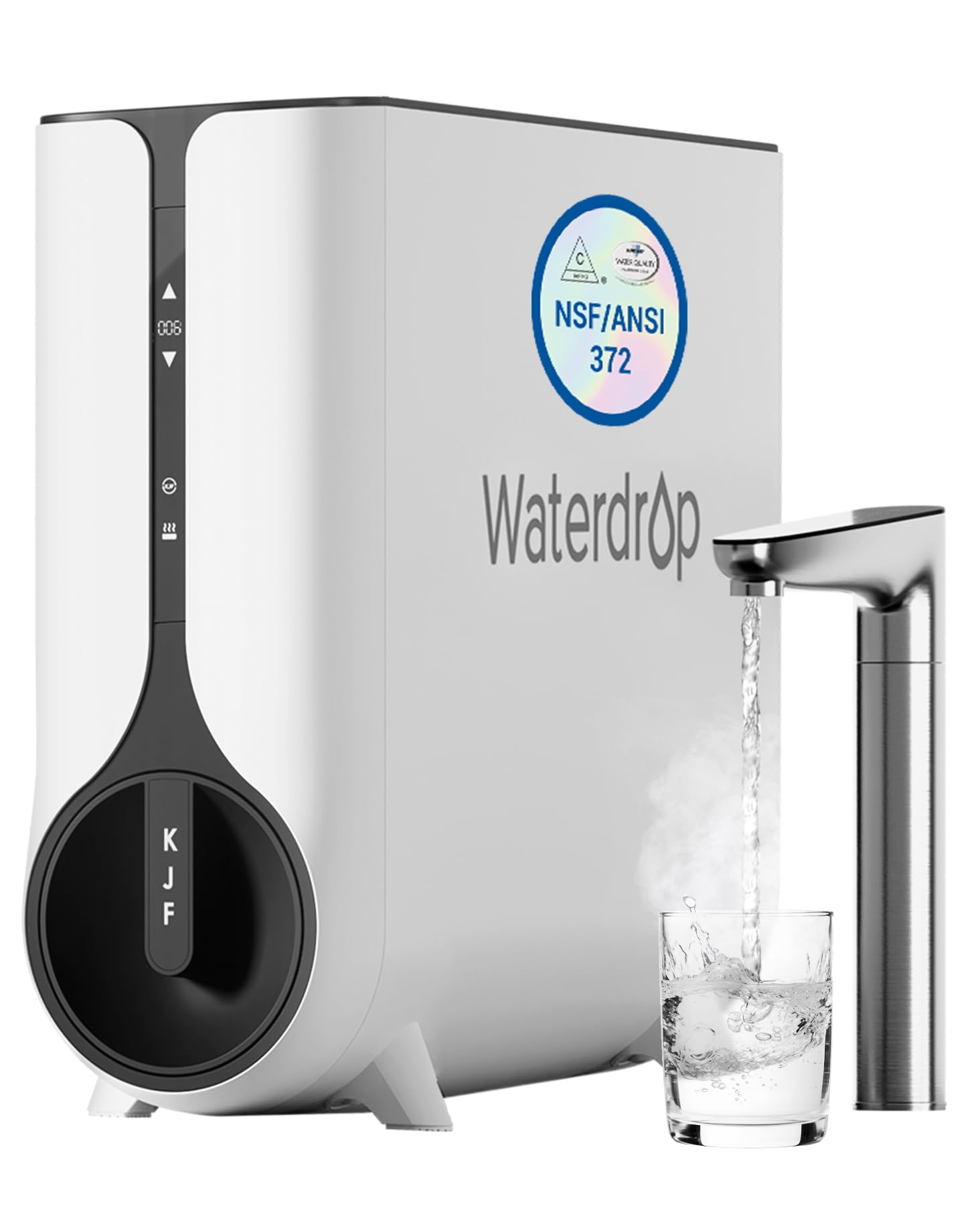
This is the only system in this guide that combines reverse osmosis with an integrated instant hot water dispenser. The 600 GPD tankless RO membrane reduces TDS, PFOA, PFOS, fluoride, arsenic, nitrate, lead, and mercury through five stages, while the heating element delivers water from 104°F to 203°F on demand — no kettle, no waiting. The 2:1 pure-to-drain ratio is efficient for a high-output RO system, wasting significantly less water than older designs.
Users confirm that feed water measuring 200 ppm TDS drops to 5 ppm after filtration, and even after two years of use the output stays around 30 ppm, indicating durable membrane performance. The smart display faucet shows real-time TDS and filter life; the child lock prevents accidental hot water dispensing. The unit does require a 110V outlet under the sink and enough cabinet space — the base measures 17.5 by 6.7 inches and sits about 16.6 inches tall.
Installation is moderately complex: you will need to drill a drain hole and potentially purchase an air gap faucet if local code requires one. The touch sensor on the dispenser can be finicky with wet hands, and the initial system flush takes 15 minutes before use. For households that want both purified drinking water and instant hot water for tea, coffee, oatmeal, or cooking, the KJ600 eliminates the need for a separate kettle and countertop water heater.
Why it’s great
- Integrated heating up to 203°F eliminates countertop appliances
- 600 GPD tankless RO with 2:1 efficient drain ratio
- Smart faucet shows TDS and filter status
Good to know
- Takes significant under-sink space and requires power outlet
- Touch sensor sometimes unresponsive with wet fingers
3. iSpring WCB32C-KS

Where the WGB32B focuses on chlorine and sediment, the WCB32C-KS is engineered specifically for heavy metals, PFAS, chloramine, and hydrogen sulfide. Its three stages use a 5-micron PP sediment pre-filter, a GAC and KDF-55 composite cartridge in the second stage, and a CTO carbon block final stage. KDF-55 is a redox media that binds lead, mercury, and other heavy metals while also controlling bacterial growth inside the filter — a smart feature for homes with variable water quality.
The transparent first-stage housing is a practical addition: you can visually inspect the sediment cartridge and replace it on schedule without guessing. At 30,000 gallons of capacity and a 12 GPM flow rate, this system covers a family of four for roughly six months per set of filters. The wall-mount design keeps the unit off the floor, and the included wrench and detailed manual make installation straightforward for anyone comfortable with basic plumbing.
Owners consistently highlight how much cleaner their water tastes and smells after installation, and several note that the system protects their water heater and washing machine from sediment buildup. The only recurring minor issue is O-ring care — a nicked or pinched O-ring during installation can cause a small leak, but iSpring’s support team responds quickly with replacements. For municipal water customers worried about emerging contaminants like PFAS, this is the most targeted whole-house option in the lineup.
Why it’s great
- KDF-55 media targets heavy metals and PFAS specifically
- Transparent housing lets you see filter condition
- 30,000-gallon capacity serves family of four affordably
Good to know
- O-rings require careful seating to prevent leaks on first install
- Rated for 40°F minimum inlet water temperature
4. Waterdrop TST-UF

The Waterdrop TST-UF is the best choice if you want thorough filtration without stripping out the naturally occurring calcium, magnesium, and potassium your body needs. Its ultrafiltration membrane blocks particles down to 0.01 microns — small enough to catch bacteria, cysts, and most sediment — while letting dissolved minerals pass through. The three-stage process also includes a PP sediment filter and a catalytic carbon cartridge that handles chlorine, bad tastes, and odors.
Flow rate is a practical 1.59 GPM, filling an 8-ounce glass in about 2.3 seconds. The 304 stainless steel housing is far more durable than the plastic canisters found on budget under-sink systems, and users report no leaks or cracking over years of service. The filter replacement schedule is generous: the PP filter lasts 6-8 months, the UF membrane lasts 12 months, and the CT carbon filter runs 12-24 months depending on usage. Total capacity is 8,000 gallons.
Installation is DIY-friendly with included 3/8-inch to 1/2-inch converter fittings, and the unit can sit on the cabinet floor or be wall-mounted. One caveat: this system is designed for municipal tap water only — it does not work with well water or hot water lines. The push-connect fittings create some anxiety for first-time users, but as long as you fully insert the tubing and lock the blue clips, the seal holds reliably. If retaining healthy minerals is your priority, this is the strongest contender.
Why it’s great
- 0.01 micron UF removes bacteria while keeping minerals
- 304 stainless steel housing outlasts plastic alternatives
- Long filter life reduces per-gallon operating cost
Good to know
- Not compatible with well water or hot water lines
- Push-connect fittings need care to seat tubing fully
5. Clearly Filtered Pitcher
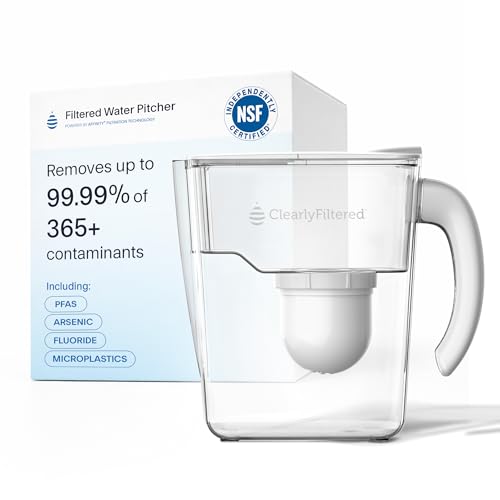
No other pitcher on the market targets 365+ contaminants with third-party NSF certification. The Clearly Filtered pitcher uses proprietary Affinity Filtration Technology — an ionic-binding media that captures fluoride, lead, PFAS, microplastics, chlorine, arsenic, and perchlorate while leaving beneficial minerals intact. Independent lab results confirm removal rates up to 99.99% for most listed contaminants, which is exceptional for a countertop pitcher.
The 80-fluid-ounce capacity (10 cups) is family-sized without being too bulky for refrigerator shelves. Medical-grade Tritan plastic is BPA-free and BPS-free, and the ergonomic handle and spill-resistant dam make daily use comfortable. Each filter handles 100 gallons — roughly four months for a typical household — and replacement is straightforward. The pitcher is NSF certified to NSF/ANSI Standards 42 and 372 for chlorine reduction and lead-free materials.
A small minority of users reported black growth in the pitcher bottom after several months, but most cleaned the unit regularly without issue. The flow rate slows noticeably as the filter nears its 100-gallon limit, signaling it is time for a swap. For renters, dorm dwellers, or anyone who wants NSF-verified filtration without permanent plumbing changes, this pitcher delivers laboratory-grade results from a simple pour.
Why it’s great
- NSF certified for 365+ contaminants including fluoride and PFAS
- Medical-grade Tritan construction is BPA/BPS-free
- 100-gallon filter life reduces per-pitcher operating cost
Good to know
- Flow slows noticeably near the end of filter life
- Regular cleaning recommended to prevent any buildup
6. SimPure V7

The SimPure V7 proves that premium construction — full 304 stainless steel housing — does not require a premium budget. This 5-stage under-sink filter uses double sediment membranes, KDF-55 media, and double coconut-shell activated carbon blocks to achieve 0.5-micron filtration accuracy. It reduces 99% of lead, chlorine, bad tastes, and odors while preserving natural minerals. The 20,000-gallon capacity means a single cartridge lasts up to 12 months under normal use.
Installation is genuinely tool-free for most setups. The system connects directly to the cold water line under your sink with a 3/8-inch to 1/2-inch converter fitting included in the box — no drilling, no plumber. At just 3.6 inches in diameter, the slim profile leaves room for other cabinet items. The flow rate is a quick 1.6 GPM, filling a glass in about three seconds.
Users appreciate the solid all-metal build compared to the plastic housings common at this price tier. The main trade-off is that the filter likely achieves closer to 5 microns in real-world conditions rather than the advertised 0.5, and some owners reported chlorine taste returning after four months rather than the full year. Still, considering the stainless steel construction and straightforward installation, this is a strong entry-level under-sink option for renters and first-time buyers.
Why it’s great
- Full 304 stainless steel housing at a very accessible price
- Tool-free 3-minute installation fits standard cold water lines
- 20,000-gallon capacity per cartridge reduces waste
Good to know
- Real-world filtration accuracy may be closer to 5 microns
- Filter life shorter than advertised for some municipal water sources
7. Aquaboon 20″ x 4.5″ Whole House
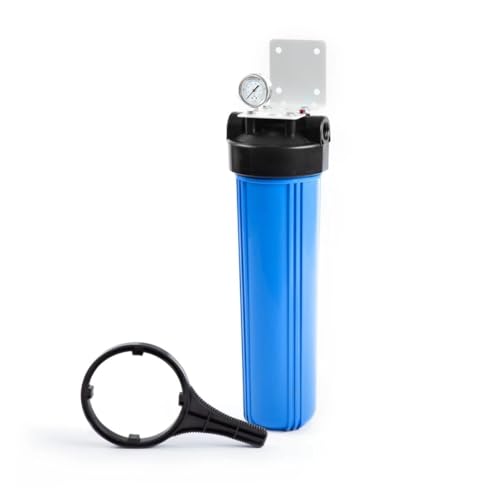
If you draw from a private well and your primary concern is sediment — sand, rust, silt — this single-stage whole-house system is built for the job. The 20-inch by 4.5-inch reinforced polypropylene housing with 1-inch inlet and outlet ports maintains full flow while trapping particles down to 5 microns. It is compatible with standard Pentek 150233 and 150235 cartridges as well as Geekpure BB-20B, giving you broad filter selection flexibility.
Users on well water report that the Aquaboon housing catches heavy sediment loads effectively, with filters lasting 4-6 months before needing replacement. The system includes an oil-filled pressure gauge that lets you monitor differential pressure and know when the cartridge is clogged. Setup requires heavy Teflon tape or pipe dope on the plastic female threads — several reviewers noted that over-tightening can crack the threads, so a careful hand with sealant is essential.
The single-stage design means this system does not address chemical contaminants, taste, or odor on its own. It functions best as a first-stage sediment pre-filter placed before a carbon or RO system. For its targeted purpose of protecting downstream appliances and improving clarity of well water, the Aquaboon housing is durable, leak-free when installed correctly, and one of the most affordable whole-house entry points available.
Why it’s great
- 1-inch ports handle high-flow well water without pressure drop
- Reinforced polypropylene housing resists cracking under pressure
- Compatible with widely available standard 20-inch cartridges
Good to know
- Plastic female threads require careful sealing to avoid leaks
- Single-stage design addresses sediment only — pair with carbon for full filtration
FAQ
Should I install a whole-house system before or after my water softener?
Do I need a system that removes fluoride if I use fluoridated toothpaste?
How often should I sanitize my under-sink filter housing?
Final Thoughts: The Verdict
For most users, the best drinking water filtration system for home winner is the iSpring WGB32B because it delivers whole-house protection with 100,000-gallon capacity, 15 GPM flow, and decade-long reliability. If you want instant hot water plus RO-pure drinking from a single faucet, grab the Waterdrop KJ600. And for targeted PFAS and heavy metal removal without stripping minerals, nothing beats the iSpring WCB32C-KS.

Mo Maruf
I created WellFizz to bridge the gap between vague wellness advice and actionable solutions. My mission is simple: to decode the research and give you practical tools you can actually use.
Beyond the data, I am a passionate traveler. I believe that stepping away from the screen to explore new environments is essential for mental clarity and physical vitality.