Our readers keep the lights on and my smoothie glass nicely filled. As an Amazon Associate, I earn from qualifying purchases.
Well water comes straight from the ground, meaning it carries a unique load of sediment, heavy metals, and organic compounds that city water simply doesn’t have. A standard fridge filter won’t touch iron bacteria or hydrogen sulfide, which is why a dedicated system designed for this specific source is non-negotiable.
I’m Mohammad Maruf — the founder and writer behind WellFizz. My research focuses on breaking down the filtration stages, flow rates, and contaminant reduction specs that actually matter for protecting a well water home.
This guide compares the top whole-house and point-of-entry systems to find the best drinking water filter for well water that handles sediment, sulfur odors, and heavy metals without choking your water pressure.
How To Choose The Best Drinking Water Filter For Well Water
Well water contaminants vary by region — iron, manganese, silt, clay, sulfur bacteria, and even trace arsenic can show up in your tap. The right filter must tackle your specific water profile without reducing your home’s flow to a trickle. Here are the critical factors to evaluate.
Filtration Stages and Media Types
A single carbon cartridge can’t handle the sediment load from a well. Look for a minimum of three stages: a high-capacity sediment filter (5 to 20 micron) for sand and rust, a catalytic carbon or GAC filter for chlorine and VOCs, and a KDF media filter that targets heavy metals like lead, iron, and hydrogen sulfide (the source of that rotten egg smell). Some systems also include a dedicated iron-reduction or scale-inhibition stage for hard water.
Flow Rate and Pressure Drop
Every filter cartridge creates resistance. A well-water system should maintain at least 10 to 15 gallons per minute (GPM) so you can run a shower and a washing machine simultaneously without a pressure crash. Oversized housings (such as 20-inch by 4.5-inch Big Blue filters) provide more surface area and less restriction than smaller 10-inch cartridges.
Filter Life and Replacement Cost
Sediment from a well can clog a standard 5-micron filter in two to three months. Budget-friendly systems with proprietary cartridges may cost less upfront but sting you with frequent replacements. Look for systems that use standard-sized cartridges (10-inch or 20-inch) available from multiple brands, and check whether the system includes a spin-down pre-filter to catch larger debris before it reaches the main stages.
Quick Comparison
On smaller screens, swipe sideways to see the full table.
| Model | Category | Best For | Key Spec | Amazon |
|---|---|---|---|---|
| iSpring WGB32B | Premium | Proven reliability up to 10 years | 100,000-gallon capacity, 20″x4.5″ filters | Amazon |
| Waterdrop WHF3T-PG | Mid-Range | 97.72% chlorine reduction with 7-stage media | 15 GPM, 12-month filter life | Amazon |
| iSpring WCB32C-KS | Mid-Range | PFAS and heavy metal reduction | 30,000-gallon capacity, transparent first-stage | Amazon |
| HQUA WF3-01 | Premium | Professional monitoring with gauges/timers | 15 GPM, 20″x5.5″ Big Blue filters | Amazon |
| Waterdrop Mega Spin Down | Mid-Range | Pre-filter for extremely muddy well water | 25 GPM, reusable 500+200 micron mesh | Amazon |
| Express Water WH300SCKP | Premium | Heavy metal + scale protection + monitoring | 17 GPM, stainless steel frame, 3 gauges | Amazon |
| PRO+AQUA PRO-WELL-1E | Premium | Automatic backwashing for high iron/manganese | 10 GPM, programmable digital timer | Amazon |
| Reverse Osmosis Revolution WHF-34F5 | Budget-Friendly | Sulfur odor reduction on a budget | 10,000-gallon capacity, 3/4″ ports | Amazon |
| Express Water FLTWH2045CKS1 | Budget-Friendly | Iron and heavy metal reduction, value set | 100,000-gallon capacity, 4.5″x20″ cartridges | Amazon |
In‑Depth Reviews
1. iSpring WGB32B

The iSpring WGB32B has been a consistent top performer for well water owners for years. Its three-stage setup uses a 5-micron sediment filter followed by two 20-inch CTO carbon block filters — the same industrial-sized cartridges that commercial plumbers install for high-sediment wells. The 1-inch inlet and outlet maintain a steady 15 GPM, which means you can fill a bathtub and run a washing machine simultaneously without noticeable pressure loss.
Customer feedback across a decade of use confirms the system handles everything from heavy sediment to hydrogen sulfide odors. The individually wrapped cartridges stay fresh on the shelf, so buying a backup set is practical. The polypropylene housings are durable, and the wrench that ships with the unit makes filter swaps straightforward — no special tools required.
The only real trade-off is the weight and footprint. The system tips the scales at 45 pounds and stands nearly 28 inches tall, so you need sturdy wall space or a freestanding bracket. But for the combination of build quality, cartridge availability, and consistent contaminant removal, this remains the benchmark for a mid-range well water system that delivers serious performance.
Why it’s great
- Proven 10+ year track record with well water
- Standard 20-inch cartridges are easy to find
- Lifetime technical support from a responsive US-based team
Good to know
- Heavy unit at 45 pounds; requires secure mounting
- O-rings can be tricky to seat during reinstallation
- No pressure gauge included for monitoring
2. Waterdrop WHF3T-PG
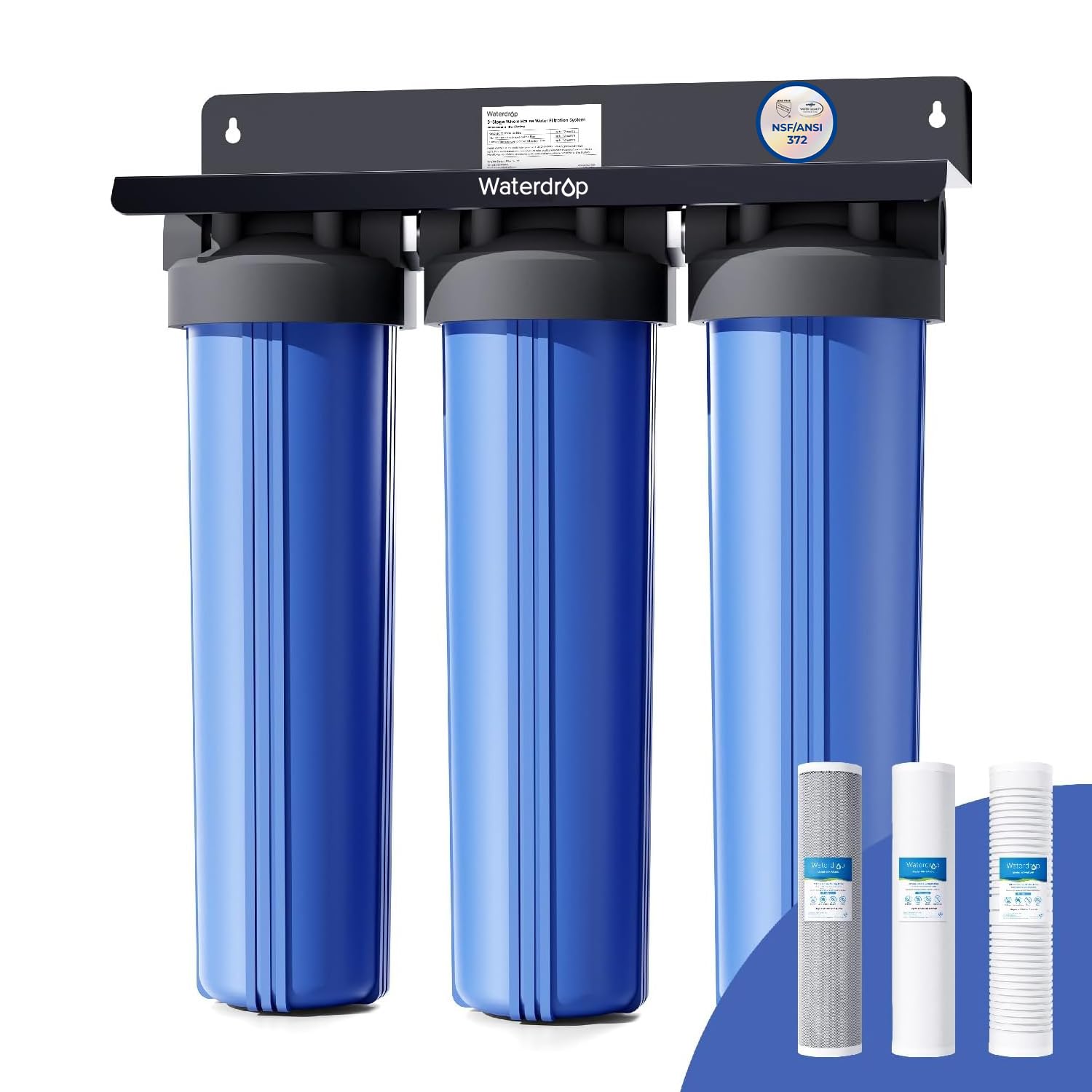
Waterdrop engineered the WHF3T-PG with a 7-stage filtration media inside a compact three-cartridge layout. The KDF composite filter combined with a GAC carbon fiber layer achieves a 97.72% chlorine reduction rate, and the 5-micron sediment stage catches the sand, rust, and silt that plague well water. At 15 GPM, the system won’t starve a four-bathroom home during peak usage.
Buyers consistently report immediate improvements in taste and odor, with several reviews noting the water from their well actually tasted better than bottled after installation. The system is NSF/ANSI 372 certified for lead-free materials, and the brass-lined housing adds corrosion resistance. Many users mention that their skin feels softer and their laundry appears brighter after a few weeks.
The biggest concern is potential leaks from the filter housing O-rings if not lubricated during installation. Waterdrop’s customer service has a strong reputation for overnighting replacement parts when issues arise. The system is also on the heavier side at around 42 pounds, so you’ll want to mount it on a solid wall or frame.
Why it’s great
- High-efficiency chlorine and sediment reduction
- NSF/ANSI 372 lead-free certification
- Customer service resolves shipping damage quickly
Good to know
- O-rings need lubrication to prevent leaks
- Filter housings are not transparent
- Pex-A fittings can be hard to source locally
3. iSpring WCB32C-KS

The WCB32C-KS brings iSpring’s reliability into a more affordable tier without cutting corners on filtration media. Its first-stage PP sediment filter captures particles down to 5 microns, and the transparent housing lets you see exactly when it’s time to swap. The second stage combines GAC and KDF media to tackle chlorine, lead, PFAS, and hydrogen sulfide — common well water culprits that cause bad taste and odor.
The third-stage CTO block polishes the water, removing residual chlorine and fine particulates for crystal-clear output. With a 30,000-gallon capacity designed for a family of four, the system delivers about six months between filter changes. The modular design includes a wall-mount bracket that simplifies installation, and the included wrench fits both the housing and the connections.
Some users experienced minor leaks due to overtightening or pinched O-rings, but customer support (often mentioned by name) resolves these quickly. The flow rate tops out at 12 GPM, which is slightly lower than larger-diameter systems. That’s still enough for a three-bath home running two fixtures at once, but heavy simultaneous use might cause a small drop.
Why it’s great
- Transparent first stage for easy monitoring
- GAC+KDF filter reduces PFAS and heavy metals
- Excellent warranty and US-based support
Good to know
- 12 GPM flow is lower than some competitors
- Thread sealant recommended instead of Teflon tape
- Wall-mount bracket can be tight on PVC fittings
4. HQUA WF3-01

The HQUA WF3-01 is built for well owners who want to track their system’s performance without guesswork. Each of the three 20-inch by 5.5-inch Big Blue housings has its own pressure gauge, relief valve, and drain valve, so you can monitor clogging and purge air during cartridge changes. A built-in 180-day countdown timer on each filter reminds you when the cartridge is due — no more relying on memory or calendar alerts.
The compound GAC+KDF filter in the second stage reduces heavy metals including lead, mercury, arsenic, and chromium, as well as chlorine and VOCs. A cleaning brush ships with the kit, letting you scrub the inside of the housings during maintenance. The bracket-mount design offers flexible placement, and the included adapters convert the inlet/outlet to either 3/4-inch NPT or 1-inch NPT depending on your plumbing.
The 15 GPM flow rate is ample for a typical household, and the large filter surface area minimizes pressure drop. However, the system is heavy at 44 pounds and tall at 28 inches, so you need to plan the installation space carefully. Some customers noted that the included thread tape was insufficient; a high-quality PTFE tape or joint compound is recommended to avoid initial leaks on the brass fittings.
Why it’s great
- Individual pressure gauges and drain valves per stage
- 180-day timer prevents missed filter changes
- Includes cleaning brush and multiple fitting sizes
Good to know
- Large footprint; needs ample wall space
- Included Teflon tape may not seal well
- Heavy unit requires solid mounting
5. Waterdrop Mega Spin Down
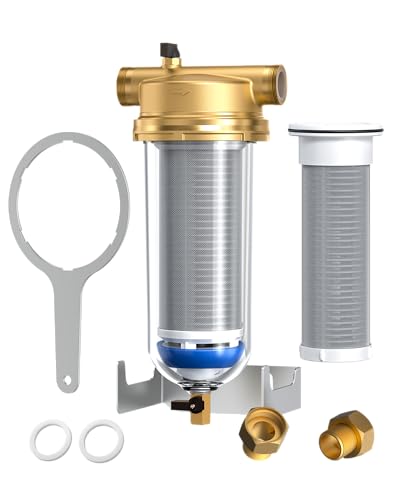
When your well water looks more like muddy tea than clear drinking water, a standard cartridge filter will clog in days. The Waterdrop Mega Spin Down solves that with a dual-mesh system — a 500-micron outer layer catches pebbles and coarse sand, while the 200-micron inner layer traps fine silt and algae fragments. The 20-times-larger chamber compared to standard spin-down filters means less frequent cleaning.
The forged brass head weighs 3.2 pounds and includes a nano-coating that resists corrosion. Waterdrop tested the unit to 200,000 water hammer cycles, double the NSF standard. The 360-degree power flush uses forward and reverse water jets to scour the mesh screens, pushing debris out through the drain port. The manual bypass valve lets you isolate the filter for cleaning without shutting off water to the house.
Flow is a massive 25 GPM, so this unit won’t cause any pressure drop even on large properties. The magnetic scale prevention technology reduces mineral buildup on the filter surfaces. On the downside, the two-week cleaning schedule can be tedious if your water is exceptionally dirty, and the mounting bracket design makes it difficult to remove the filter bowl without detaching the whole unit from the wall.
Why it’s great
- Reusable stainless steel mesh — no cartridges to replace
- 25 GPM flow rate for large households
- Built to withstand freezing and high-pressure conditions
Good to know
- Requires cleaning every two weeks with dirty well water
- Mounting bracket hinders filter bowl removal
- Only removes sediment; needs additional stages for chemical reduction
6. Express Water WH300SCKP

Express Water’s WH300SCKP is a complete heavy-metal defense system wrapped in a stainless steel frame that includes three pressure gauges for real-time monitoring. The first stage catches sediment down to 5 microns, the second stage uses KDF and catalytic carbon to reduce lead, arsenic, chromium, and chlorine, and the third stage deploys polyphosphate media to stop scale buildup in pipes and appliances. At 17 GPM, it’s one of the highest-flow systems in this tier.
The freestanding design eliminates the need for wall mounting — you can place it on a concrete floor or a sturdy shelf. Each filter housing has a pressure release button that simplifies cartridge changes by venting residual pressure. The 100,000-gallon capacity means filter replacements roughly every 6 to 12 months, depending on your water quality and usage.
Buyers consistently report immediate improvements — chlorine and sulfur odors vanish, and showers feel noticeably different. The unit weighs 63 pounds and takes up substantial floor space (29 inches wide by 30 inches tall), so it’s not a hidden installation. A few users mentioned that the pressure gauges were tight from the factory and needed a slight loosening to read accurately.
Why it’s great
- Freestanding stainless steel frame — no wall mount needed
- Three pressure gauges for stage-by-stage monitoring
- Anti-scale polyphosphate protects pipes and water heater
Good to know
- Large and heavy; requires dedicated floor space
- Does not reduce TDS
- Gauges may need adjustment after installation
7. PRO+AQUA PRO-WELL-1E
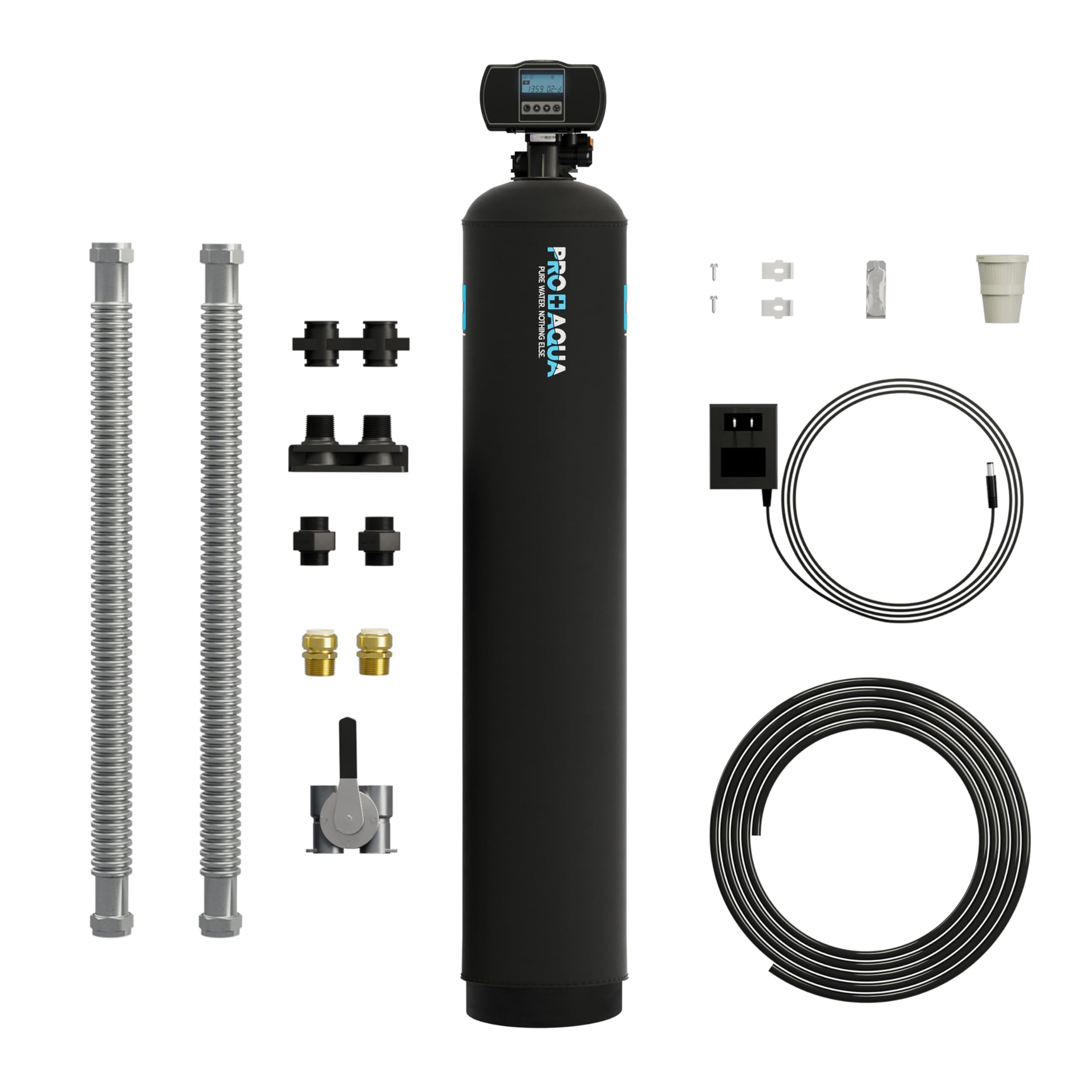
The PRO+AQUA PRO-WELL-1E is a completely different approach — instead of disposable cartridges, it’s a standalone backwashing tank that uses a fiberglass-lined polyethylene vessel filled with premium-grade resin. The system’s programmable backlit display lets you set automatic flush intervals based on your water quality and usage, which means the filter media self-cleans without you touching a wrench.
This unit is specifically designed for high iron, manganese, and hydrogen sulfide — the contaminants that cause orange staining, tea-colored water, and rotten egg smell. Customer reports from users with severe Florida well water show that the system eliminated iron staining and sulfur odor completely within days. The 10 GPM flow rate is lower than the cartridge-based systems, but the backwashing design ensures consistent performance without clogging.
At 91 pounds and 57 inches tall, the tank is massive and requires a dedicated floor space with a drain connection for the backwash cycle. The 5-year warranty and US-based support provide peace of mind, though the initial cost is significantly higher than cartridge systems. A few users experienced media loss during shipping due to inadequate packaging, so inspect the unit thoroughly upon arrival.
Why it’s great
- Self-cleaning backwashing design for hands-off maintenance
- Effectively removes iron, manganese, and sulfur from severe wells
- Programmable timer with digital display for custom cycles
Good to know
- Very heavy and tall; needs drain and floor space
- Lower 10 GPM flow rate
- Requires additional filtration for taste and chlorine reduction
8. Reverse Osmosis Revolution WHF-34F5
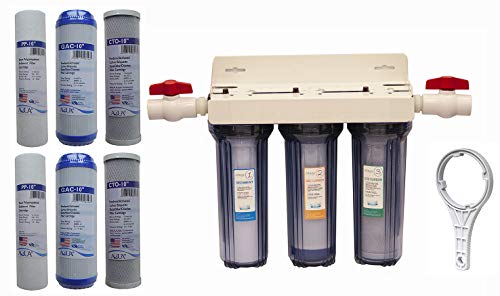
The WHF-34F5 from Reverse Osmosis Revolution is an accessible three-stage system that targets the most common well water complaints: sediment and sulfur taste. The first 5-micron sediment filter traps dust, dirt, and silt. The second stage uses a GAC granular activated carbon filter to reduce chlorine, radon, and VOCs, and the third stage finishes with a CTO carbon block that polishes the taste and removes remaining odors. The kit includes two extra sets of filters, giving you roughly a year of supply out of the box.
Customers with well water that smells like sulfur report a noticeable improvement in both taste and odor after installation. The 3/4-inch threaded connections are standard for most home plumbing, and the included brass valves make the install straightforward. The system is fairly compact at 20 inches tall and 16 inches wide, fitting into tight spaces under a sink or beside a water heater.
The trade-off is capacity. The flow rate is not officially listed by the manufacturer, but users note it supports a typical household without major pressure complaints. The build quality is average — the housings are functional but not as thick as premium brands.
Why it’s great
- Includes two extra filter sets in the box
- Compact design fits tight installation spaces
- Effective at reducing sulfur taste and odor
Good to know
- 10,000-gallon capacity requires frequent filter changes
- No pressure gauge for monitoring
- Warranty registration process can be frustrating
9. Express Water FLTWH2045CKS1
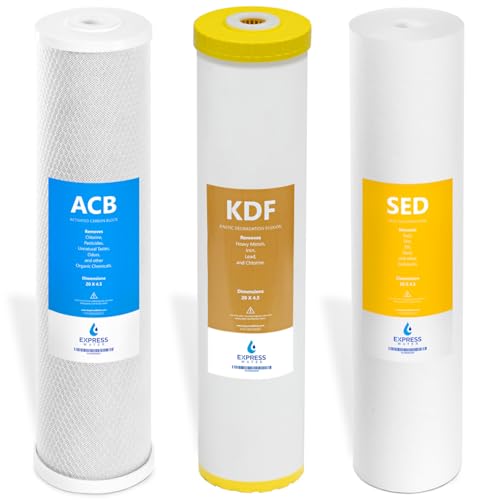
Express Water’s FLTWH2045CKS1 replacement filter set is designed for their whole-house systems but works as a stand-alone heavy-metal reduction kit for well water. The three-cartridge set includes a 4-layer polypropylene sediment filter that traps large particles, a carbon block for chlorine and VOC reduction, and a KDF filter that uses ionically charged copper and zinc granules to bind heavy metals like lead, iron, nickel, and chromium.
Each cartridge is 4.5 inches in diameter and 20 inches tall, giving you a large surface area for high flow without significant pressure drop. The total system capacity is 100,000 gallons, which means these filters can last up to 12 months depending on your water quality. The universal 20-inch sizing means they fit most standard 3-stage whole-house filter housings from Express Water and other compatible brands.
Well owners with iron and odor problems report that these filters clear up cloudiness and remove that chemical taste effectively. The main limitation is that you need the corresponding filter housings and bracket — this is a replacement cartridge set, not a complete system. If you’re building a DIY filtration setup, check that your housings accept 4.5-inch by 20-inch cartridges before purchasing.
Why it’s great
- KDF media reduces iron, lead, and chromium
- 100,000-gallon capacity for long filter life
- Standard 20-inch sizing fits many housings
Good to know
- Cartridge set only — requires filter housings and bracket
- Does not reduce TDS
- Best for 4+ person households; may clog faster with very dirty well water
FAQ
Will a whole-house filter remove the rotten egg smell from my well water?
How often do I need to change the filters on a well water system?
Do I need a water softener in addition to a whole-house filter?
Can I install a whole-house well water filter myself?
Why does my water test say TDS is high after installing a whole-house filter?
What size sediment filter should I use for muddy well water?
Final Thoughts: The Verdict
For most users, the best drinking water filter for well water winner is the iSpring WGB32B because it combines proven long-term reliability, easy-to-source 20-inch cartridges, and a flow rate that handles a busy household without pressure complaints. If you want professional-level monitoring with pressure gauges and filter life timers, grab the HQUA WF3-01. And for severe iron, manganese, and sulfur problems that require automatic backwashing, nothing beats the PRO+AQUA PRO-WELL-1E.

Mo Maruf
I created WellFizz to bridge the gap between vague wellness advice and actionable solutions. My mission is simple: to decode the research and give you practical tools you can actually use.
Beyond the data, I am a passionate traveler. I believe that stepping away from the screen to explore new environments is essential for mental clarity and physical vitality.