Our readers keep the lights on and my smoothie glass nicely filled. As an Amazon Associate, I earn from qualifying purchases.
The tap water coming into your kitchen carries a story — one that often includes chlorine, heavy metals, sediment, and sometimes even PFAS. A good drinking water filter removes that narrative, leaving you with clean, great-tasting water straight from the faucet. But with options ranging from countertop pitchers to under-sink systems and full reverse osmosis units, choosing the right one means understanding what’s actually in your water and which filtration method handles it best.
I’m Mohammad Maruf — the founder and writer behind WellFizz. I’ve spent hundreds of hours analyzing filtration certifications, flow rates, filter lifespans, and real-user experiences across dozens of home water treatment systems to cut through the marketing noise and deliver clear, category-specific recommendations.
This guide walks you through the five best models available right now, from a budget-friendly pitcher to a premium mineral-remineralizing RO system. Whether you rent an apartment or own your home, you’ll find the right water filter for home that matches your space and water quality needs.
How To Choose The Best Drinking Water Filter For Home
Selecting a water filter isn’t about picking the most expensive model. It’s about matching the filtration type to your specific water chemistry, your kitchen layout, and how much filtered water you actually use each day. Here are the three most important factors to weigh.
Filtration Method: Carbon Block vs. Ion Exchange vs. Reverse Osmosis
Carbon block filters (0.5 micron) are excellent at removing chlorine, sediment, and bad taste while retaining beneficial minerals. They do not lower TDS. Ion exchange filters, like ZeroWater’s five-stage design, remove virtually all dissolved solids, producing 0 TDS water — but they strip minerals and replace them with nothing. Reverse osmosis systems offer the broadest contaminant removal, including heavy metals, fluoride, and PFAS, but they also remove minerals unless a remineralization stage is added. If you want mineral-rich water, choose a carbon block or a remineralizing RO system.
Installation Type: Countertop vs. Under Sink
Countertop pitchers and dispensers require no installation — just fill and wait. They work for renters or anyone who doesn’t want to modify plumbing. Under-sink systems need to be connected to the cold water line, but they free up counter space and provide filtered water on demand with higher flow rates. Under-sink RO systems require a dedicated faucet hole — drilling may be needed. Evaluate whether you own your home and whether you can access your sink cabinet before deciding.
Filter Life and Replacement Cost
A filter that lasts 200 gallons (3 months) will need replacing four times per year. A system rated for 20,000 gallons (12 months) only needs one annual change. The difference in annual consumable cost can be huge — some premium cartridges cost under per year, while others can exceed annually. Always check the replacement filter price and how many gallons it’s rated for before buying the initial unit.
Quick Comparison
On smaller screens, swipe sideways to see the full table.
| Model | Category | Best For | Key Spec | Amazon |
|---|---|---|---|---|
| Waterdrop T3-T RO | Reverse Osmosis | Mineral-added pure water | 220 GPD, 7-stage RO | Amazon |
| SimPure V7 | Under Sink | Space-saving stainless build | 20,000 gal, 1.6 GPM | Amazon |
| Waterdrop ED01W | Electric Pitcher | Instant filtered water | 200 gal, 0.5 µm carbon | Amazon |
| WINGSOL Under Sink | Under Sink | Long-lasting 11,000 gal | 2.5 GPM, anti-clog | Amazon |
| ZeroWater 32-Cup | Countertop Dispenser | Zero TDS water | 32-cup, 5-stage ion | Amazon |
In‑Depth Reviews
1. Waterdrop T3-T 7-Stage RO System
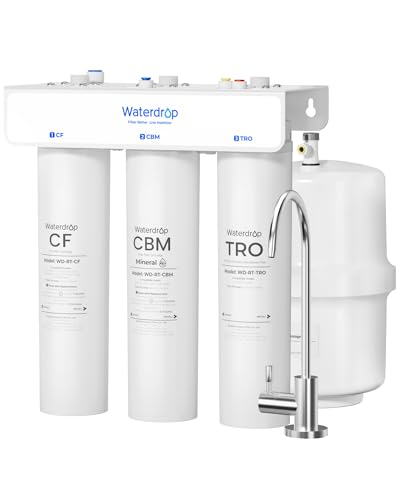
The Waterdrop T3-T is a full reverse osmosis system that goes beyond simple filtration by adding a remineralization stage. It uses seven stages to reduce TDS, chlorine, fluoride, and heavy metals, then reintroduces potassium, calcium, sodium, and magnesium for improved taste and hydration. The system produces 220 gallons per day — more than triple the output of older 75-GPD units — and fills five 16.9-ounce bottles in about one minute.
Installation takes roughly 30 minutes with simplified water lines, though you’ll need to drill a hole in the counter for the dedicated faucet. The 2:1 pure-to-drain ratio wastes less water than conventional RO systems, saving a family of three up to 225 gallons per month. The all-in-one filter design swaps in three seconds without mess — twist, replace, discard.
NFC technology sends filter replacement reminders to your phone, taking the guesswork out of maintenance. The CF filter lasts up to 6 months, the CBM filter up to 12 months, and the TRO filter up to 24 months. Real users consistently praise the water taste and the responsive customer support team.
Why it’s great
- Remineralized RO water tastes better than stripped options
- 220 GPD output means minimal wait time
- 2:1 pure-to-drain ratio saves water
- NFC reminders for filter changes
Good to know
- Requires countertop hole for faucet
- Needs an outlet under the sink
2. SimPure V7 Under Sink Water Filter

The SimPure V7 uses a 5-stage filtration system built into a 304 food-grade stainless steel housing — a significant upgrade over plastic under-sink filters that can crack or degrade over time. It filters down to 0.5 microns, reducing lead, chlorine, bad taste, and odors while retaining beneficial natural minerals. The system connects directly to the cold water line with 3/8″ and 1/2″ adapters, requiring no drilling and taking about three minutes to install.
With a flow rate of 1.6 GPM, you can fill an 8-ounce glass in about three seconds. The single cartridge lasts up to 20,000 gallons or 12 months, making it one of the most cost-effective options in this guide. The slim profile — 3.6 inches wide by 12 inches tall — leaves plenty of cabinet space for other kitchen essentials.
Real-world buyers consistently note the solid all-metal build, the ease of installation, and the noticeable improvement in water taste. Several users reported that their pets also preferred the filtered water. Note that this system does not lower TDS; if you want stripped water, look at the ZeroWater or the Waterdrop RO.
Why it’s great
- All-metal 304 stainless housing is durable and BPA-free
- 20,000-gallon filter life — only one change per year
- Tool-free installation in 3 minutes
- Retains healthy minerals
Good to know
- Does not reduce TDS
- Some users report filter accuracy may be closer to 5 micron vs 0.5
3. Waterdrop ED01W Electric Pitcher
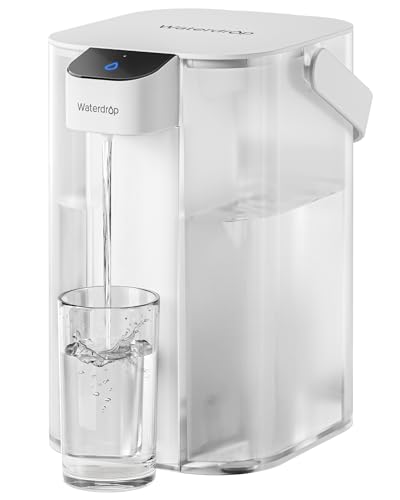
The Waterdrop ED01W is an electric countertop pitcher that delivers filtered water on demand with a one-touch button — no waiting for water to drip through a gravity filter. It uses a 0.5-micron premium carbon block filter certified by IAPMO against NSF/ANSI 42, 53, 401, and 372 to reduce over 45 contaminants including lead, chlorine, microplastics, and mercury. Importantly, this system does not lower TDS, so it preserves beneficial minerals present in your source water.
Each filter lasts up to 200 gallons or 3 months. The built-in rechargeable battery holds a charge for up to 30 days and recharges via USB Type-C. The 15-cup capacity is compact enough for apartment countertops but still large enough to serve a small family. The unit is freestanding and requires no plumbing modification — just fill the reservoir, charge the battery, and dispense.
User reviews highlight the great taste improvement and how easy the system is for all ages. A few users experienced pump failures after extended use, but Waterdrop’s customer support was quick to replace the units. The 30-day standby battery is ideal if you don’t have an outlet near your drinking station.
Why it’s great
- Instant electric dispensing — no gravity wait
- 30-day rechargeable battery with USB-C charging
- NSF/ANSI 42, 53, 401, 372 certified
- Compact and portable for apartments or RVs
Good to know
- Does not lower TDS
- Filter needs replacing every 3 months (200 gallons)
4. WINGSOL Under Sink Water Filter System
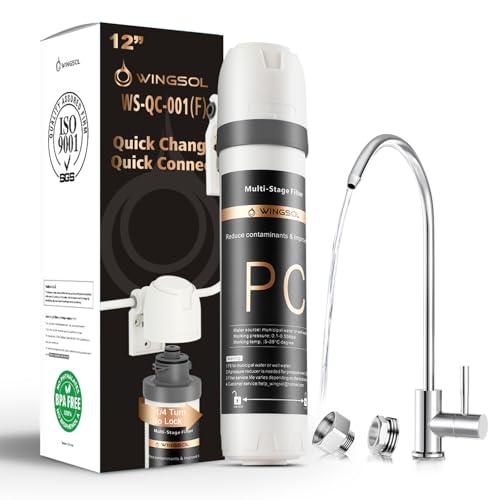
The WINGSOL under-sink filter features a unique anti-clog pleated design that delivers a high flow rate of 2.5 GPM at 60 psi — one of the fastest in this comparison. The multi-stage filtration reduces PFAS, PFOA/PFOS, chlorine, heavy metals, and sediment while keeping beneficial minerals. It’s NSF/ANSI 42 and 53 certified, and all materials are food-grade and BPA/lead-free.
The filter is rated for 11,000 gallons or up to 12 months, significantly outlasting many competitors that need replacement every 3 to 6 months. The compact housing measures just 2.76 by 3.54 by 12.2 inches, fitting easily under most sinks. A dedicated chrome faucet with a 360-degree swivel spout is included, and installation takes about five minutes with quick-connect fittings and included adapters.
Buyers report great results with city water containing PFAS and appreciate the tankless design that provides a steady supply. Some users noted the included plastic valve adapters had subpar O-rings that could cause minor leaks — upgrading to metal fittings solves this. The system works with both municipal and well water, though the manufacturer suggests replacing the filter every 4 to 6 months for best taste.
Why it’s great
- 2.5 GPM flow rate — fastest in this guide
- 11,000-gallon filter life
- NSF/ANSI 42 & 53 certified
- Compact tankless design
Good to know
- Plastic valve adapters may need upgrading
- Does not reduce TDS
5. ZeroWater 32-Cup 5-Stage Dispenser

The ZeroWater 32-Cup dispenser uses a five-stage ion exchange filtration process that removes virtually all total dissolved solids, bringing water to 0 TDS. The integrated TDS meter lets you instantly check water purity — change the filter when the reading reaches 006. This is the only system in this guide that strips everything from the water, including fluoride and all minerals, resulting in a taste that some describe as ultra-pure and almost sweet.
The 32-cup (7.5-liter) capacity is the largest among the countertop options here, reducing the frequency of refills for households that drink a lot of water. The filter is IAPMO certified to reduce lead, chromium, PFOA/PFOS, and mercury. The housing is BPA-free plastic, and the dispenser includes a sliding hatch for convenient refilling without removing the lid.
Real-world feedback is split: many users love the pure taste and the savings on bottled water, especially in areas with hard water (500 ppm TDS reduced to 3 ppm). Others warn that replacement filters can cost around each and may last only three weeks if your source water has very high TDS, leading to annual consumable costs north of . Consider your local water hardness before committing to this system — it’s excellent for taste but expensive to run on high-TDS supply.
Why it’s great
- Achieves 0 TDS — removes virtually all dissolved solids
- Built-in TDS meter shows when to change filter
- 32-cup capacity — fewer refills
- Reduces plastic bottle waste
Good to know
- Replacement filters can cost over /year with high TDS water
- Strips beneficial minerals — water may taste flat
- Slow filtration rate
FAQ
Should I choose a filter that lowers TDS or one that keeps minerals?
How do I know if my water needs a reverse osmosis system?
What’s the real annual cost of running these filters?
Final Thoughts: The Verdict
For most users, the water filter for home winner is the SimPure V7 because it combines a durable all-metal build, a 20,000-gallon filter life, and mineral-preserving 5-stage filtration at a mid-range price that keeps annual costs low. If you want the purest water possible with added minerals, grab the Waterdrop T3-T RO system. And for a no-install, instant-dispense option, the Waterdrop ED01W electric pitcher is the most convenient apartment-friendly solution.

Mo Maruf
I created WellFizz to bridge the gap between vague wellness advice and actionable solutions. My mission is simple: to decode the research and give you practical tools you can actually use.
Beyond the data, I am a passionate traveler. I believe that stepping away from the screen to explore new environments is essential for mental clarity and physical vitality.