Our readers keep the lights on and my smoothie glass nicely filled. As an Amazon Associate, I earn from qualifying purchases.
The difference between a quick duct install and a frustrating afternoon often comes down to the drill in your hand. For HVAC professionals, the right tool needs to drive self-tappers through thick gauge sheet metal, fit between studs in a cramped attic, and still have enough finesse not to snap a screw head off in a delicate air handler cabinet.
I’m Mohammad Maruf — the founder and writer behind WellFizz. I’ve spent hundreds of hours analyzing motor specs, chuck quality, and battery platform compatibility to separate the tools that truly belong in an HVAC service van from the ones that just look the part on a shelf.
Whether you’re running linesets, securing duct straps, or drilling through pantry walls for a mini-split install, choosing from the best drill for hvac requires balancing torque delivery, compact head length, and brushless efficiency to match the unique demands of the trade.
How To Choose The Best Drill For HVAC
Selecting a drill for HVAC work is different than picking one for general construction. The specific demands of the trade — thin sheet metal, tight crawl spaces, and repetitive screw driving — mean that a tool with the wrong torque curve or an overly long head will slow you down every single day.
Torque and Speed Profile
Look for a drill that offers a wide range of clutch settings and a variable speed trigger. HVAC fasteners like #8 and #10 self-tapping screws require enough initial torque to punch through metal without stripping the head. A hammer drill function is generally unnecessary for ductwork but can be useful if you occasionally drill into masonry for mounting brackets.
Head Length and Weight
An HVAC technician spends a significant portion of the day working above the ceiling or inside a mechanical closet. The shorter the tool head, the easier it is to maneuver between joists and studs. A compact brushless motor design can shave off nearly an inch of length compared to older brushed models, which makes a tangible difference in tight spaces.
Battery Platform and Runtime
The battery system you choose will define your entire cordless tool lineup. Opt for a manufacturer that offers a range of battery capacities (2.0Ah for lightweight use, 5.0Ah for all-day drilling) and a reliable charger. Brushless motors extract more runtime from each charge, which is critical when you’re on a job site without easy access to a power outlet.
Quick Comparison
On smaller screens, swipe sideways to see the full table.
| Model | Category | Best For | Key Spec | Amazon |
|---|---|---|---|---|
| DEWALT DCD799B | Hammer Drill | Compact power for tight spaces | 6.49″ head length, 552 UWO | Amazon |
| RYOBI Right Angle Drill | Right Angle Drill | 90° access in joists and cabinets | 350 in-lbs torque, 0-1700 RPM | Amazon |
| Bosch GSR18V-400B12 | Drill/Driver | Lightweight all-day driving | 6.3″ head, 400 in-lbs torque | Amazon |
| Metabo HPT DS18DEX | Driver Drill | Best value with two batteries | 620 in-lbs, 2000 RPM | Amazon |
| Milwaukee M12 Fuel Impact | Impact Driver | High torque in a stubby body | 1500 in-lbs, 5″ length | Amazon |
| Milwaukee M18 Hole Hawg | Right Angle Drill | Bore large holes through studs | 15.6″ length, 7.7 lbs | Amazon |
| Makita XPH07Z | Hammer Driver-Drill | Heavy-duty drilling and mixing | 1090 in-lbs, 2100 RPM | Amazon |
In‑Depth Reviews
1. DEWALT DCD799B Atomic Compact Hammer Drill

The DEWALT Atomic Compact is a masterclass in balancing power and portability for HVAC work. Its hammer drill function, delivering up to 28,050 BPM, handles masonry anchors for condenser pad brackets while the 1,650 RPM top speed drives self-tappers through ductwork without bogging down.
At just 6.49 inches in head length, this drill slips between wall studs and into ceiling cavities where full-size models get stuck. The half-inch ratcheting chuck provides excellent bit retention, which matters when you’re reaching blindly into an attic to drive a screw. Users consistently note the metal chuck construction — a welcome upgrade against the plastic collars found on some competitors.
The on-tool LED light illuminates dark crawl spaces, and at 2.5 pounds it reduces forearm fatigue during long installs. The tool-only format lets you choose your preferred DEWALT 20V battery capacity, from a lightweight 2Ah for quick service calls up to a 5Ah for extended use.
Why it’s great
- Exceptionally short head fits tight spaces easily
- Metal chuck provides secure bit grip without slipping
- Hammer function available for light masonry work
Good to know
- Tool only — requires separate battery purchase
- Hammer drill adds slight weight for those who never need it
2. Bosch GSR18V-400B12 Compact Drill/Driver

The Bosch GSR18V-400B12 focuses on refined control and lightweight handling for HVAC techs who drive screws all day. With 400 inch-pounds of torque and 20 clutch settings, it offers precise fastener control that reduces the risk of over-driving and stripping screws in thin sheet metal panels.
Its 6.3-inch head length rivals the DEWALT for compactness, while the all-metal chuck ensures durability through repetitive bit changes. At under 2 pounds for the tool itself, this is one of the lightest brushless drill/drivers in its class — a clear advantage when working overhead on duct runs or air handler installs.
The included 2.0Ah battery provides adequate runtime for a day of light to medium drilling, and the charger can top up a partially depleted battery in about 10 minutes. The ergonomic grip zone with a small diameter makes one-handed operation comfortable, and the belt clip keeps it accessible on a ladder.
Why it’s great
- Ultra-lightweight design reduces fatigue on long jobs
- 20 clutch settings offer precise torque control for delicate materials
- All-metal chuck improves bit retention over plastic options
Good to know
- Torque output is lower than many premium competitors
- Kit includes only one battery
3. Metabo HPT DS18DEX Driver Drill Kit

The Metabo HPT DS18DEX delivers the highest max torque in its class at 620 inch-pounds, combined with a compact 6.1-inch body that makes it ideal for HVAC installs. The brushless motor spins up to 2,000 RPM, providing enough speed and power to drill through steel studs and drive large self-tapping fasteners without slowing down.
Included in the kit are two 2.0Ah lithium-ion batteries, a charger, a carrying bag, and a metal belt hook — giving you everything you need out of the box. The Reactive Force Control (RFC) safety feature stops the tool if it detects a bind-up, protecting your wrist during sudden stall events in tight spaces.
Users highlight its lightweight feel at 2.6 pounds and the excellent battery life, with some noting that batteries from older Hitachi tools are also compatible. The keyless metal chuck grips bits firmly, though a few users mention needing to ensure the chuck is fully tightened to avoid slippage during heavy use.
Why it’s great
- Highest torque output in the mid-range class
- Comes with two batteries and a bag for immediate use
- Reactive Force Control adds safety in bind-up situations
Good to know
- Chuck can loosen under heavy load if not tightened fully
- Some users find the tool louder than comparable models
4. Milwaukee M12 Fuel 1/4 Hex Impact Driver Kit
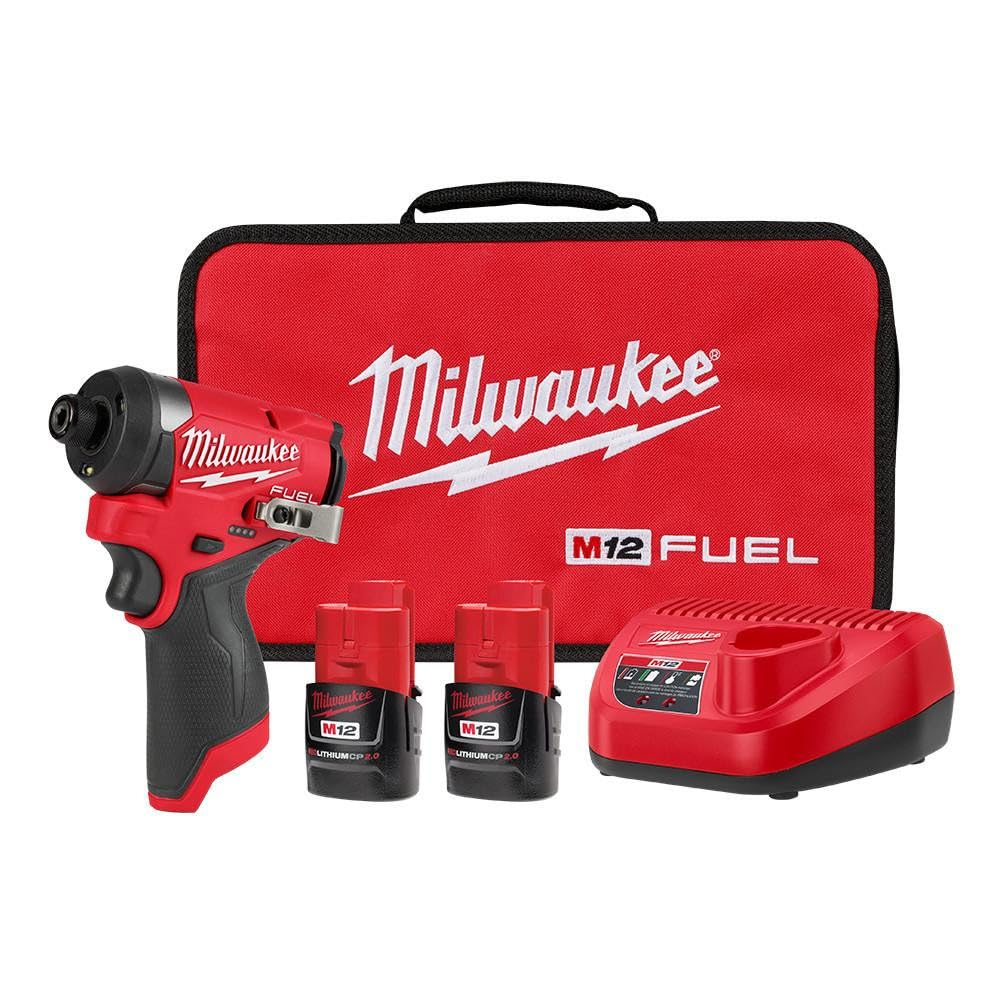
The Milwaukee M12 Fuel impact driver brings heavy-hitting torque in a stubby 5-inch package that fits into spaces where traditional drills cannot reach. With 1,500 inch-pounds of torque and up to 3,600 RPM in Mode 3, it powers through self-tapping screws in thick gauge steel without hesitation.
Its 4-Mode Drive Control includes a dedicated self-tapping screw mode that prevents over-driving, which is critical when fastening duct straps or access panels where stripping the head means lost time. The Tri-LED system lights up the workspace without casting shadows, a useful feature inside dark equipment closets.
Despite being an impact driver rather than a standard drill, it handles a wide range of HVAC fasteners with authority. The M12 platform keeps the tool and battery lightweight — a huge advantage for carrying up ladders or reaching into overhead plenums. Users frequently mention that they reach for this tool more often than their full-size drills due to its compact balance.
Why it’s great
- Incredibly short 5-inch length for tight access
- High torque output handles heavy-gauge fasteners
- Self-tapping screw mode prevents stripping
Good to know
- 1/4 hex chuck limits bit compatibility to hex-shank bits
- Not suitable for drilling holes — impact driver only
5. Makita XPH07Z Hammer Driver-Drill

The Makita XPH07Z is a high-torque workhorse designed for the most demanding HVAC applications, including mixing mud for duct sealant and boring large holes through LVL beams for lineset routing. Its brushless motor delivers 1,090 inch-pounds of max torque and up to 31,500 BPM for hammer drilling into masonry for equipment mounts.
The electronically-controlled motor optimizes battery energy use for up to 50% longer runtime per charge compared to brushed alternatives. While the tool is on the heavier side due to its all-metal construction, the long auxiliary handle provides the control needed to manage the torque during heavy drilling without wrist strain.
This drill excels when you need muscle — drilling 4-inch hole saws through pantry walls or mixing thin-set for floor-mounted units. Users caution that it may be overkill for light screw driving and that the weight can cause fatigue during extended use. It is a tool-only purchase, so you will need to invest in Makita 18V LXT batteries separately.
Why it’s great
- Extremely high torque for heavy drilling and mixing
- Long auxiliary handle provides excellent control
- Brushless motor extends runtime significantly
Good to know
- Heavy and bulky for all-day screw driving
- Tool only — requires separate battery purchase
6. RYOBI ONE+ HP Right Angle Drill

The RYOBI ONE+ HP Right Angle Drill is purpose-built for those hard-to-reach spots that make standard drills useless. Its 90-degree head design allows you to drive screws tight against floor joists, behind ductwork, and inside cramped mechanical chases where a straight drill simply cannot fit.
With 350 inch-pounds of torque and a two-speed motor (0-450 / 0-1,700 RPM), it provides sufficient power for driving self-tapping screws and drilling smaller holes in wood and metal. The brushless motor delivers longer runtime and more torque than previous RYOBI models, making it a solid choice for the HVAC tech already invested in the ONE+ platform.
The compact head length is the defining advantage here — users specifically mention its value under decks, inside engine compartments, and in tight attic spaces. However, it is not designed for heavy-duty drilling or high-torque applications, and the short head can make bit changes slightly more awkward than a standard drill.
Why it’s great
- 90-degree head accesses tight spaces impossible for straight drills
- Brushless motor provides good runtime for a dedicated tool
- Excellent value for RYOBI ONE+ system users
Good to know
- Lower torque output limits use to lighter tasks
- Short head design makes bit changes less convenient
7. Milwaukee M18 FUEL Hole Hawg Right Angle Drill

The Milwaukee M18 FUEL Hole Hawg is the undisputed king of boring large holes through studs and joists for lineset and refrigerant piping. With a drilling capacity of 2.63 inches in both wood and metal, it powers through dense framing material that would stall a standard drill.
At 7.7 pounds, this tool is heavy and not intended for every task. It is a specialized right-angle drill built for one job — making big holes fast and reliably. The rock-solid build and powerful motor inspire confidence when boring through multiple studs in a row, and users report that it handles residential wiring holes and DWV water lines without complaint.
The right-angle geometry keeps the tool body parallel to the work surface, making it easier to control in confined spaces. While some users wish for longer battery life during extended boring sessions, the raw power and durability make this a staple for any HVAC crew doing new construction or major retrofits.
Why it’s great
- Unmatched hole-boring power through thick framing
- Right-angle design fits between studs and joists
- Extremely durable construction for job site abuse
Good to know
- Very heavy and not suitable for general driving tasks
- Battery life can be short under heavy continuous drilling
FAQ
Is a hammer drill necessary for HVAC work?
Should I get a right-angle drill or a compact straight drill?
Final Thoughts: The Verdict
For most users, the best drill for hvac winner is the DEWALT DCD799B Atomic Compact because it packs hammer-drill capability into a 6.49-inch head that fits nearly any space an HVAC tech encounters. If you want maximum torque in a compact impact driver, grab the Milwaukee M12 Fuel Impact. And for boring large holes through studs for lineset routing, nothing beats the Milwaukee M18 FUEL Hole Hawg.

Mo Maruf
I created WellFizz to bridge the gap between vague wellness advice and actionable solutions. My mission is simple: to decode the research and give you practical tools you can actually use.
Beyond the data, I am a passionate traveler. I believe that stepping away from the screen to explore new environments is essential for mental clarity and physical vitality.