Our readers keep the lights on and my smoothie glass nicely filled. As an Amazon Associate, I earn from qualifying purchases.
A wobbly straightedge and an uneven surface can turn a precise architectural sketch or a careful technical drawing into a frustrating mess of skewed lines and misaligned angles. Finding a drafting board that stays flat, locks your paper, and glides its parallel bar without play is the single most important upgrade a manual drafter can make — whether you’re a student learning hand drafting or a professional laying out construction plans.
I’m Mohammad Maruf — the founder and writer behind WellFizz. I’ve spent hundreds of hours cross-referencing foam core density, straightedge tolerance, and cable-tension mechanisms to separate the boards that deliver studio-grade accuracy from the ones that introduce more wobble than they fix.
This guide walks you through the seven top-rated rigid drafting surfaces currently available, from compact A3 portables to full 30×42-inch studio workstations — all chosen for their build quality, adjustable angles, and parallel-motion reliability. It is a complete list of the finest options for your next purchase — the definitive resource for anyone searching for the best drafting board.
How To Choose The Best Drafting Board
A drafting board isn’t simply a table substitute. The right one must maintain a dead-flat surface, keep its parallel bar precisely aligned even after repeated adjustments, and support the angles that reduce shoulder and neck strain during long sessions. Here are the three critical factors to weigh before you buy.
Board Size and Working Area
The sheet size the board can handle — A3 (roughly 12×16 inches), 18×24 inches, or full 24×36 inches — dictates what projects you can tackle. Architects and engineers laying out floor plans need larger formats, while illustrators and students may find mid-size boards more desk-friendly. Measure your actual desk depth first: many larger boards measure over 30 inches deep when the stand is fully extended, which overhangs a typical 24-inch desk.
Parallel Straightedge Quality and Adjustment
A cable-driven parallel bar must return to true horizontal after every lift and slide. Boards with one-sided adjustment knobs often require fine-tuning out of the box. Look for anti-warp aluminum bodies in the straightedge itself — plastic bars can bow over time, introducing a consistent error on every horizontal line. Clear acrylic blade extensions (inking edges) allow you to see your line as it’s drawn, which matters for inking and cutting work.
Stand Design and Angle Range
Folding metal legs with multiple lockable positions — typically 10 to 45 degrees — let you transition from a flat surface for inking to a steep incline for sketching without sagging. Check whether the board’s braking mechanism uses friction clamps or a ratcheting system; ratcheting types tend to hold more securely at high angles but add weight. Rubber grip feet prevent the board from sliding on a polished desk surface.
Quick Comparison
On smaller screens, swipe sideways to see the full table.
| Model | Category | Best For | Key Spec | Amazon |
|---|---|---|---|---|
| Martin Pro-Draft 23×31 | Premium | Architectural plans & heavy studio use | Anti-warp aluminum straightedge | Amazon |
| Martin Pro-Draft 24×36 | Premium | Full-size drawings on a compact footprint | 5-position stand, 16 lb weight | Amazon |
| ALVIN PXB42 (30×42) | Premium | Large-format professional drafting | 30″ x 42″ melamine surface | Amazon |
| ALVIN PXB24 (18×24) | Mid-Range | Students & portable home studios | Acrylic blade with inking edges | Amazon |
| Acurit PXB 20×26 | Mid-Range | Versatile tabletop sketching & drafting | 7 drawing angles up to 45° | Amazon |
| rOtring Profil A3 | Mid-Range | Precision A3 drafting on the move | Stop-and-Go parallel straightedge | Amazon |
| Staedtler Mars 661 A3 | Mid-Range | Lightweight school & home A3 use | Double locking mechanism, 2.2 lb | Amazon |
In‑Depth Reviews
1. Martin Universal Design Pro-Draft Deluxe 23×31 (U-PEB2331K)

The Martin Pro-Draft 23×31 is built around a high-resin particle board core that resists warping even under the pressure of repeated solvent cleaning and tool scraping. Its straightedge is the only one in this roundup with an anti-warp aluminum body — a feature that keeps the working edge true regardless of humidity changes in the studio. The five-position stand ramps from near-flat for inking up to a steep 45 degrees for sketching, and the large locking knobs on each side make re-alignment straightforward.
At 16 pounds, this board is heavy enough to stay planted during aggressive drafting but still carries a molded handle for moving between workspaces. The melamine surface is smooth and non-porous, though some users report compass points leave tiny burrs that can interfere with circle work — slipping a sheet of craft paper over the surface solves that cleanly. The parallel bar glides via a cable system that requires initial tension calibration, but once set, it returns to horizontal reliably.
Architects and serious illustrators will appreciate the forgiving work area — it accepts 18×24 and 24×36 sheets without overhang — and the grippy rubber feet that hold fast on polished desk surfaces. The board arrives double-boxed, but a quick check of the straightedge alignment on arrival is wise before locking the knobs for the first time.
Why it’s great
- Aluminum straightedge resists warping better than plastic or laminate bars
- Five-position stand provides a wide range of comfortable working angles
- High-resin particle board core is extremely durable and solvent-resistant
Good to know
- Melamine surface can develop burrs from compass needles; use a cutting mat or craft paper overlay
- Initial cable tension adjustment may require careful fine-tuning for perfect parallelism
2. Martin Universal Design Pro-Draft 24×36 (U-PEB2436K)
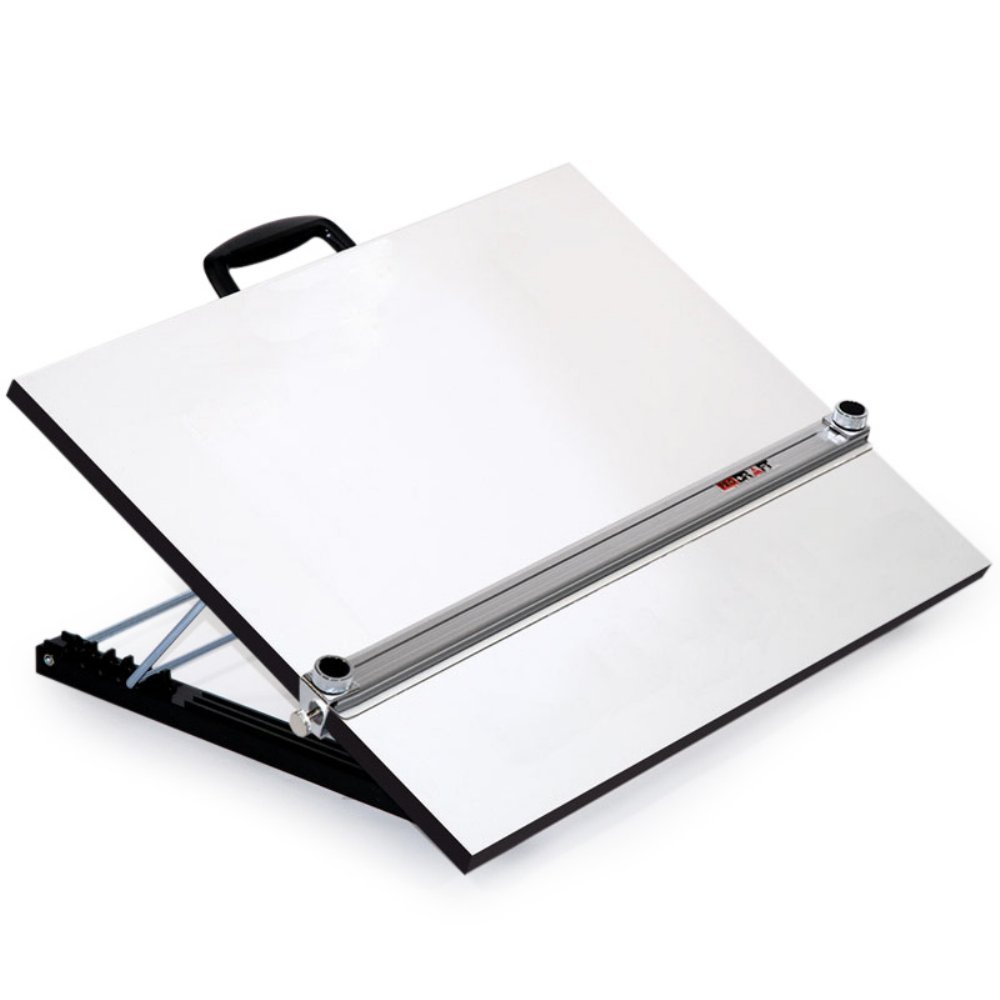
This larger sibling of the 23×31 Pro-Draft offers the same anti-warp aluminum straightedge and high-resin particle board core but expands the drawing surface to a true 24×36 inches — enough to accommodate full architectural sets and large-format renderings without folding or shifting the paper. The five-position metal stand provides the same 10-to-45-degree range, making it a genuine drafting table alternative for studios where a dedicated table isn’t an option.
The board’s weight of roughly 16 pounds keeps it stable during extended use, but the footprint is substantial: measure your desk carefully, because the depth with the stand extended approaches 30 inches. The handle is useful for repositioning across a room, but daily relocation between desks is not practical. As with the smaller model, the cable-driven parallel bar can need an initial adjustment, so follow the manual’s alignment instructions step-by-step.
A meaningful consideration is packaging quality: several units have arrived with cracked melamine corners or bent hardware due to insufficient protection in the box. Inspect the board and straightedge as soon as it arrives, and be prepared to request a replacement if the melamine finish is compromised — a hairline crack will propagate under the tension of the parallel bar cables.
Why it’s great
- True 24×36-inch surface fits standard architectural and engineering sheets without overhang
- Anti-warp aluminum straightedge maintains alignment in humid or variable studio conditions
- Five-position folding stand allows comfortable tilt from flat to 45 degrees
Good to know
- Packaging can be inconsistent; inspect the melamine surface and corners immediately on arrival
- At 30+ inches deep with the stand, it overhangs many standard 24-inch-deep desks
3. ALVIN PXB42 (30×42)

The ALVIN PXB42 is the biggest board in this lineup, offering a 30×42-inch melamine working surface that can swallow full-size blueprints and large presentation drawings without any sheet overhang. The parallel straightedge uses an aluminum bar with a crystal-clear acrylic blade that features dedicated inking edges — the clearance beneath the blade (0.19 inches) allows foam board, cutting mats, and multiple paper layers to slide beneath without lifting the straightedge off the surface.
Folding metal legs with top-mounted adjustment knobs let you set the angle from flat to a steep incline, and the brake mechanism combined with rubber grips keeps the board steady even at the highest tilt. The blade’s acrylic construction provides excellent visibility for checking line placement, but the gap between the slide bar and the board can be large enough that thinner triangles and templates slide under it, potentially throwing off vertical lines. Fine-tuning instructions are included, and on well-assembled units the adjustment resolves the problem.
At this size the board is heavy — moving it from desk to storage is a two-person job. It ships fully assembled, so unpack it carefully to avoid damaging the melamine edges. For professionals who need a true large-format manual drafting surface and have a dedicated desk space, the PXB42 delivers the most working area in this selection.
Why it’s great
- 30×42-inch surface accommodates oversized blueprints and presentation boards without folding
- Crystal-clear acrylic blade with 0.19-inch clearance allows cutting mats and multiple paper layers
- Folding metal legs with brake mechanism lock securely at aggressive tilt angles
Good to know
- Gap between the slide bar and board can let thin triangles slip underneath; adjust the cable tension
- Extremely heavy — plan for a permanent or semi-permanent placement on a sturdy desk
4. ALVIN PXB24 (18×24)

The ALVIN PXB24 compresses the professional features of the larger PXB models into a more desk-friendly 18×24-inch format that still accepts standard 18×24-inch drafting paper without trimming. The white melamine top is paired with an aluminum straightedge and a 0.12-inch acrylic blade that includes inking edges on both sides — a detail students and hobbyists often overlook but that makes a real difference when rendering ink lines that must not bleed.
The stand uses folding metal legs with top-mounted knobs for angle adjustment, and the brake mechanism locks securely across its full range. Users consistently praise the build quality relative to the investment, though a recurring note is that the parallel bar often arrives requiring a tension adjustment to eliminate a gap between the bar and the board. When that gap is present, triangles can slide under the bar and ruin vertical line precision. The adjustment process is straightforward with the included instructions, but it’s worth checking immediately after unboxing.
This board is significantly heavier than its compact size suggests, which is good for stability but means it’s not something you’ll want to shift between rooms daily. It comes fully assembled. For architecture students and calligraphers who need a reliable angled surface that fits on a standard desk, the PXB24 is a proven choice that has been in production for years without major complaints about surface delamination or warping.
Why it’s great
- 18×24-inch size fits standard paper sizes while occupying minimal desk space
- Aluminum straightedge with dual inking edges provides clean, bleed-free ink lines
- Proven long-term durability with no reported surface delamination or warping
Good to know
- Parallel bar may need immediate fine-tuning to close the gap beneath the straightedge
- Heavier than its size suggests — better as a semi-permanent desk setup than a daily carry
5. Acurit PXB 20×26

The Acurit PXB 20×26 enters the market as one of the newest boards in this lineup, and it differentiates itself with seven discrete drawing angles — the most of any board here — ranging from near-flat to 45 degrees. The 17mm laminated, nonporous melamine surface is thicker than many budget boards, resisting dents and scratches during daily use. The transparent ruler with inch markings and an inking edge runs along the top of the parallel bar, making measurements visible without lifting the bar.
The parallel motion bar uses a dial-adjustable cable-and-pulley system. The dials on each side let you tighten or loosen the cable tension for smooth, wobble-free travel, and the underlying wire network keeps the bar parallel across its full travel. Users praise the balance of this board for mixed media work — it holds a phone or a small ring light for recording time-lapses without slipping, and it folds completely flat for storage. At 15.4 pounds it is not ultralight, but the 20×26 size is just compact enough to fit on a lap with a lap tray underneath for casual sketching away from a desk.
The single complaint worth noting is that some units arrive with a strong chemical odor from the packaging that dissipates after a few days of airing out. The Acurit lacks a dedicated pencil tray, so keep a separate tool holder on hand. For artists and designers who switch between drawing, inking, and painting on the same surface, the seven-position adjustability here adds real versatility.
Why it’s great
- Seven discrete tilt positions provide more angle options than any other board in this review
- 17mm thick melamine surface is dense and resistant to scratches and impact
- Dial-adjustable cable system makes tension fine-tuning tool-free
Good to know
- No integrated pencil tray — you’ll need a separate holder for tools
- New units may emit a strong chemical smell that requires a few days to air out
6. rOtring Profil Drawing Board A3

rOtring’s Profil A3 board is built around an “L-system” straightedge design that lets the bar travel all the way to the bottom of the sheet without obstruction — a small ergonomic win that speeds up work when you need to draw continuous lines near the paper edge. The Stop-and-Go mechanism adds friction where you need it, preventing the bar from sliding when you lift your hand. A magnetic clamp strip with automatic hold-open grips the paper firmly at the top edge, while an additional corner clamp secures the bottom corner against curling.
The guide rails are cut for featherlight movement, so the bar glides with minimal effort. Media-size markings and viewing holes along the rail let you confirm paper placement without measuring. Made from non-warping, unbreakable plastic, the board is light enough (just 3.5 ounces, essentially negligible carriage weight) to be genuinely portable — a stark contrast to the heavier melamine boards in this list. Its A3 format (roughly 12×16 inches) is ideal for technical drawing on smaller sheets but too small for full architectural plans.
The board has no separate stand; it sits flat on a desk, which is fine for drafting but means you lose the ergonomic tilt that most of the other boards here offer. The rOtring is metric-only, which can be inconvenient for North American users accustomed to imperial measurements. For designers and illustrators who work primarily at a desk and need a reliable, ultra-portable A3 surface with a smooth parallel rail, this board has earned years of praise for its build consistency.
Why it’s great
- Stop-and-Go mechanism prevents the parallel bar from sliding unexpectedly during use
- Magnetic clamp strip with corner clamp secures paper without shifting
- Extremely lightweight and genuinely portable for moving between studio and classroom
Good to know
- Designed for flat desktop use only — no integrated tilt stand for ergonomic angle adjustment
- Metric-only scale markings may be inconvenient for users working in imperial units
7. Staedtler Mars 661 A3 Drawing Board

The Staedtler Mars 661 is an A3-sized drafting board made from impact- and shatter-resistant plastic — a lightweight alternative to the melamine and particle-board boards that dominate the larger end of the spectrum. Its defining feature is the single-hand double locking mechanism on the parallel rail: one squeeze locks the T-square-style slide at any vertical position, and a color indicator on the knob shows whether the lock is engaged or released. That visual feedback is simple but genuinely useful when you’re focusing on linework rather than the lock mechanism.
Sheet clamping strips run along both sides of the board, holding paper flat without the need for tape or magnets. A built-in scale with a needle hole allows precise compass radius settings directly on the board surface. The whole unit weighs just 2.2 pounds, making it the lightest board in this selection and genuinely travel-friendly for classroom or coffee-shop use. It has no integrated tilt stand — it sits flat on a desk by design — but the low weight means you can prop it on a book or a separate laptop stand if you need an angle.
The board uses metric scales exclusively (scaled 3 cm to 1 foot in some versions), which can throw off North American woodworkers and architects who work in imperial units. The paper clip that holds the bottom of the sheet sometimes misaligns with the bottom groove, requiring a small repositioning. For students, sketchers, and hobbyists who need a portable, durable A3 board with a smooth T-square slide and don’t require an integrated stand, the Staedtler Mars 661 is a proven, “Made in Germany” workhorse.
Why it’s great
- Double-locking mechanism with color indicator provides quick, visual lock-status confirmation
- Weighs only 2.2 pounds — the most portable board in this review for frequent transport
- Shatter-resistant plastic construction handles being tossed in a bag without damage
Good to know
- Metric-only scaling is inconvenient for users who need imperial measurements
- No tilt stand or storage; requires a separate surface or book to create a comfortable working angle
FAQ
Can I use a drafting board for cutting with a rotary cutter or hobby knife?
How many degrees of tilt should a drafting board have for comfortable long-session work?
What is the difference between a parallel straightedge and a T-square on a drafting board?
Final Thoughts: The Verdict
For most users, the best drafting board winner is the Martin Universal Design Pro-Draft 23×31 because it combines an anti-warp aluminum straightedge with a sturdy five-position stand and a durable high-resin particle board core at a mid-range price point that doesn’t compromise on professional accuracy. If you need a full 24×36-inch working area for architectural plans, the Martin Pro-Draft 24×36 gives you the same build quality in a larger format. And for artists and designers who value versatility across multiple media, the Acurit PXB 20×26 with its seven discrete tilt angles offers the most adjustable drawing experience in this selection.

Mo Maruf
I created WellFizz to bridge the gap between vague wellness advice and actionable solutions. My mission is simple: to decode the research and give you practical tools you can actually use.
Beyond the data, I am a passionate traveler. I believe that stepping away from the screen to explore new environments is essential for mental clarity and physical vitality.