Our readers keep the lights on and my smoothie glass nicely filled. As an Amazon Associate, I earn from qualifying purchases.
Factory door speakers are the single weakest link in your car’s audio chain, often built with paper cones and tiny magnets that distort at moderate volume and roll off bass entirely. Upgrading to a dedicated set of aftermarket door speakers transforms every drive, revealing layers of detail in vocals and bringing thump to kick drums that your stock system simply cannot produce.
I’m Mohammad Maruf — the founder and writer behind WellFizz. I’ve spent hundreds of hours analyzing car audio specifications, comparing power handling, cone materials, and sensitivity ratings to identify which door speakers actually deliver measurable improvements for real-world installs.
Whether you drive a sedan, truck, or SUV, choosing the right door speakers means matching your vehicle’s mounting depth, power source, and listening preferences to a speaker that fits physically and performs acoustically. This guide breaks down the top contenders across every meaningful metric.
How To Choose The Best Door Speakers
Selecting the right door speakers is a mix of mechanical fit, electrical matching, and sonic preference. The most expensive speaker is useless if its magnet hits your window track or if your head unit lacks the power to drive it. Prioritize your vehicle’s mounting depth limit, then match RMS handling to your amplifier or stereo output, and let cone material guide your tonal choice.
Measure Your Mounting Depth First
The single most common installation mistake is buying speakers that are too deep for the door cavity. Measure from the mounting surface to the window track at its closest point. If you have less than 2.5 inches of depth, stick with shallow-mount designs. For full-size trucks and SUVs, 3-inch depths are common and open up more options with larger magnets and better thermal management.
Match Power Ratings To Your Source
RMS power is the continuous wattage a speaker can handle, not peak marketing numbers. A door speaker rated around 80-100 watts RMS pairs well with a small external amplifier. If you are running directly off a factory head unit that outputs 15-25 watts RMS per channel, look for speakers with a high sensitivity rating (92 dB or above) so they produce adequate volume without an amp.
Choose The Right Speaker Type
Coaxial speakers combine a woofer and a tweeter in a single frame, making them the simplest upgrade for factory locations. Component systems separate the tweeter for better soundstage but require more installation work. Midrange speakers like the ORION Cobalt or DS18 PRO-X are designed for dedicated mid-bass reproduction and typically need an amplifier and a separate tweeter to cover highs. Choose coaxial for all-in-one simplicity, midranges for brute-force mid-bass output in an amplified system.
Quick Comparison
On smaller screens, swipe sideways to see the full table.
| Model | Category | Best For | Key Spec | Amazon |
|---|---|---|---|---|
| CT Sounds Meso 6×9 | Coaxial | Premium full-range upgrade | 200W RMS per pair / Fiberglass cone | Amazon |
| Kenwood KFC-6996PS | 5-Way Coaxial | Wide soundstage with clarity | 300W Peak / Diamond array woofer | Amazon |
| DS18 PRO-X698 BM | Midrange | Extreme mid-bass output | 200W RMS / 1.5″ CCAW voice coil | Amazon |
| Pioneer A-Series TS-A6971F | 4-Way Coaxial | Balanced sound with installation adapters | 100W RMS / 29 Hz low extension | Amazon |
| ORION Cobalt CM654 | Midrange | High-efficiency amplified systems | 250W RMS / 96.67 dB sensitivity | Amazon |
| Kenwood KFC-6966S | 3-Way Coaxial | Direct factory replacement | 90W RMS per pair / 3″ top-mount depth | Amazon |
| NVX ESP69 | 2-Way Coaxial | Budget-friendly clarity | 160W RMS per pair / PEI dome tweeter | Amazon |
In‑Depth Reviews
1. CT Sounds Meso 6×9” 2-Way Coaxial Speakers

The CT Sounds Meso 6×9 coaxial set sits at the top of this list because it delivers genuine audiophile-grade bass extension down to 35 Hz from a fiberglass cone and nitrile butadiene rubber surround. The 1.5-inch CCAW voice coil and neo-magnet silk-dome tweeter produce articulate highs without harshness, while the 200W RMS total power handling means these speakers thrive on moderate amplifier power without complaining.
Owners running them in Ram 1500 trucks report excellent bass response that rivals premium brands costing significantly more, with zero distortion even at 80% head unit volume. The included grilles and hardware make installation straightforward, though the large magnet assembly requires a half-inch spacer in some front door applications to clear the window track.
Sensitivity sits around 91 dB, which is reasonable for a fiberglass cone design, but these speakers perform best with a clean amplifier signal rather than a low-power head unit alone. The silk tweeters handle vocals with smoothness that avoids the brittle treble common in cheaper metal-dome designs.
Why it’s great
- Deep bass extension to 35 Hz without a subwoofer
- Premium fiberglass cone and NBR surround for durability
- Silk-dome tweeters deliver smooth, non-fatiguing highs
Good to know
- Large magnet may require spacers in shallow doors
- Lower sensitivity (91 dB) works best with an external amp
2. Kenwood KFC-6996PS 5-Way Speakers

Kenwood’s KFC-6996PS uses a five-way coaxial design with dedicated drivers for ultra-wide frequency separation, minimizing intermodulation distortion between the woofer, midrange, and tweeter sections. The diamond array pattern on the woofer cone stiffens the surface without adding mass, reducing breakup modes that cause muddy mid-bass at higher volumes.
The Sound Field Enhancer circuitry widens the perceived soundstage, which makes these speakers ideal for vehicles where the driver sits off-center. Owners report crystal-clear cymbal hits and vocal articulation that exceeds typical three-way designs, though the 300W peak rating and polypropylene cone limit deep bass output compared to dedicated subwoofer systems.
Installation is straightforward with a standard 6×9 cutout and 3-inch top-mount depth, fitting most trucks and sedans without spacers. Some users note that the grilles can pop loose over time, but the acoustic performance justifies a small dab of adhesive during install.
Why it’s great
- Five-way design delivers exceptional treble separation
- Diamond array cone reduces distortion at high output
- Sound Field Enhancer creates a wider listening stage
Good to know
- Limited bass extension without a subwoofer
- Grilles may require adhesive to stay seated
3. DS18 PRO-X698 BM Midrange Speaker
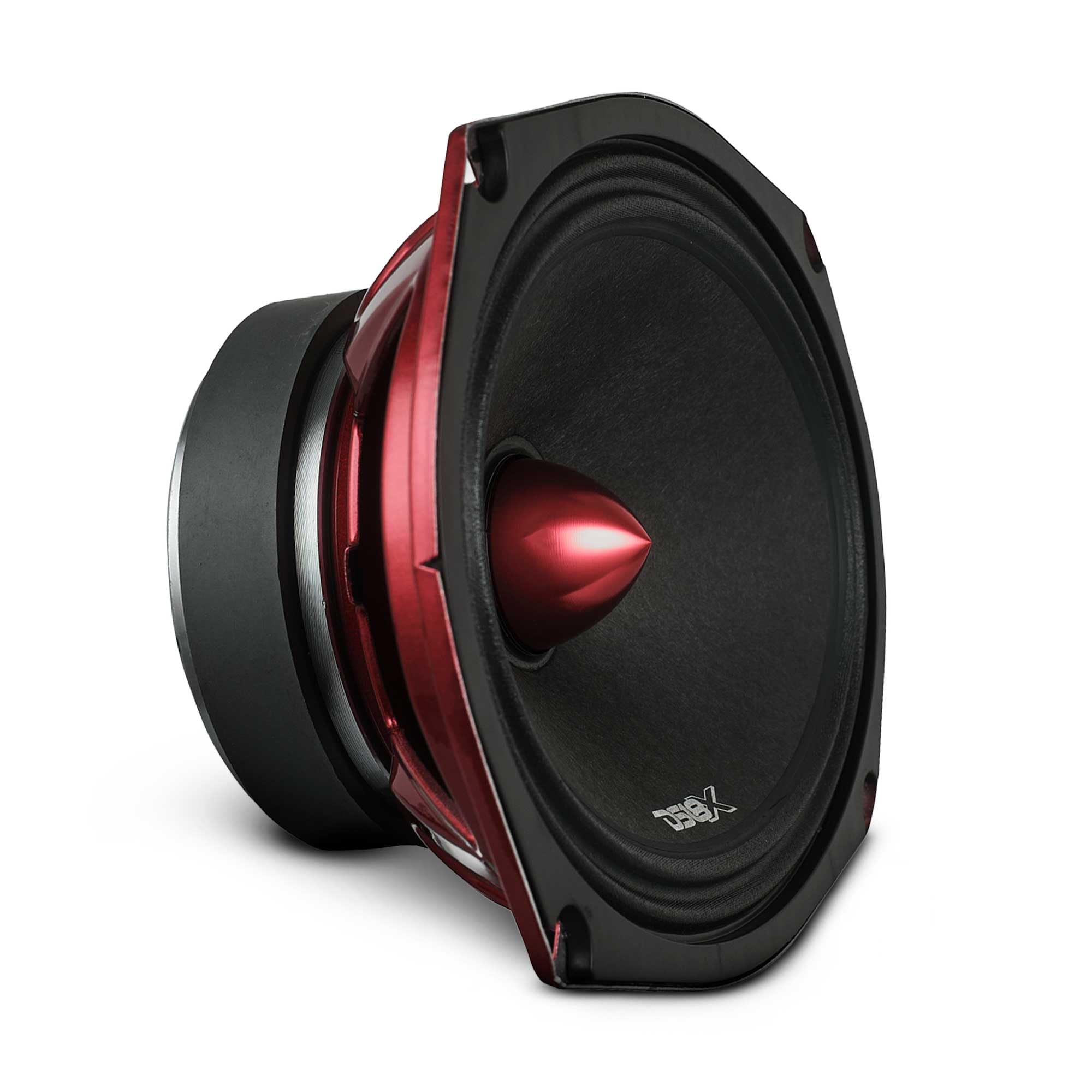
The DS18 PRO-X698 BM is a pure midrange driver built for systems that already have a separate tweeter and subwoofer. Its 8-ohm impedance and 200W RMS rating allow it to handle serious amplifier power, while the 1.5-inch high-temperature CCAW voice coil withstands extended abuse without thermal degradation.
The aluminum bullet phase plug extends high-frequency response beyond what a standard midrange cone can reach, blending smoothly into a dedicated tweeter’s range. Owners running these in high-SPL systems report they handle 1200-watt amplifier setups without failure, outperforming cheaper speakers that blew under the same load.
Ferrite magnet construction delivers impressive motor force for the price point, producing punchy mid-bass that cuts through engine noise. This is a single-speaker unit, not a pair, so factor that into your budget. Installation requires a 6×9 cutout and adequate mounting depth for the large magnet structure.
Why it’s great
- Extreme 200W RMS handling per speaker
- Aluminum bullet extends usable frequency range
- High-temp CCAW voice coil prevents burnout
Good to know
- Sold individually, not as a pair
- Requires separate tweeter and sub for full-range sound
4. Pioneer A-Series Plus TS-A6971F 4-Way Speakers

Pioneer’s TS-A6971F 4-way coaxial speakers strike a rare balance between deep frequency extension down to 29 Hz and high sensitivity at 92 dB, making them one of the most versatile choices for both amplified and head-unit-only systems. The multi-fit installation adapters included in the box simplify the swap from factory speakers, especially for owners who want a no-modification upgrade in trucks and full-size sedans.
The 600W peak power handling looks flashy on paper, but the real story is the 100W continuous RMS rating and the 4-way driver layout that keeps bass, midrange, and treble channels physically separated for cleaner output. Owners report significant improvement over factory speakers in clarity and loudness, particularly in the mid-bass region where paper-cone stock speakers typically fall apart.
The bronze-colored cone adds a subtle visual upgrade behind grilles, and the flush-mount design keeps installation clean. Some users note that the speakers benefit from a small amplifier to reach their full potential, but they remain listenable at moderate volumes even on factory power.
Why it’s great
- Excellent 29 Hz low-frequency extension for 6×9 size
- High 92 dB sensitivity works well without an amp
- Includes multi-fit adapters for easy installation
Good to know
- Full output requires an external amplifier
- Flush mount design may not fit all door profiles
5. ORION Cobalt CM654 Midrange Speakers

The ORION Cobalt CM654 is a 6.5-inch midrange bullet speaker built for efficiency-first systems. With a staggering 96.67 dB sensitivity, these speakers convert nearly every watt into acoustic output, making them ideal for setups where amplifier headroom is limited but raw volume is required.
The 1.5-inch high-temperature voice coil and 250W RMS rating provide a wide safety margin when paired with moderate amplifiers. The bullet phase plug extends high-frequency response up to 10 kHz, allowing the midrange to play higher than typical mid-bass drivers, which simplifies crossover design when paired with a separate tweeter.
Owners report that these speakers are exceptionally loud on a 100W RMS per channel amplifier, easily overpowering less efficient speakers in the same system. The paper cone construction is lightweight for high efficiency but requires careful handling during installation to avoid damage. Mounting depth is a shallow 2.63 inches, which helps fitment in tighter door cavities.
Why it’s great
- Extremely high 96.67 dB sensitivity for massive output on low power
- 250W RMS rating provides generous power headroom
- Shallow 2.63-inch mounting depth fits tight doors
Good to know
- Paper cone is less durable than polypropylene in moisture
- Requires separate tweeter for full high-frequency range
6. Kenwood KFC-6966S 3-Way Coaxial Speakers

The Kenwood KFC-6966S is a straightforward 3-way coaxial set that prioritizes ease of installation and reliable performance over exotic materials. The polypropylene mid-woofer cone with a foam-rubber surround provides consistent sound reproduction across a 35 Hz to 20 kHz frequency range, and the 3-inch top-mount depth fits the vast majority of factory 6×9 locations without modification.
With 90W RMS total and 800W peak marketing numbers, these speakers are designed to work with factory head units or small amplifiers. Owners swapping blown factory speakers in older vehicles like the 1978 Dodge Little Red Express report that the KFC-6966S fits behind factory grilles without clearance issues, which is a crucial consideration for classic car builders.
The treated cloth surround on some variants adds weather resistance, though these are not waterproof and should not be exposed to direct moisture. Sound quality is described as a clear improvement over stock paper-cone speakers, with better mid-bass presence and smoother high-frequency extension.
Why it’s great
- Shallow 3-inch top-mount depth fits almost any factory location
- Polypropylene cone resists moisture better than paper
- Reliable performance at a sensible power level
Good to know
- Not designed for high-power amplified systems
- Foam surround may degrade faster than rubber over decades
7. NVX ESP69 2-Way Coaxial Speakers

The NVX ESP69 coaxial speakers deliver impressive power handling for their tier, with 160W RMS total and 480W peak ratings backed by CEA-2031 compliance for honest specification. The 1-inch PEI dome tweeters produce clear, refined treble that avoids the harshness of cheaper metal tweeters, while the polypropylene cone and rubber surround combination provides controlled bass response down to 47 Hz.
Owner feedback highlights these speakers as a significant upgrade over factory Ford and Kia units, with cleaner mids and highs and better bass retention at high volume. The 3-inch top-mount depth is standard for 6×9 speakers, though some Ram 1500 owners had to trim plastic trim slightly to achieve a perfect fit.
These speakers are best suited for buyers who want genuine CEA-2031 rated power without paying a premium. The rubber surround will outlast foam alternatives in temperature-cycling car door environments, and the 47 Hz to 20 kHz frequency response covers the full musical spectrum for most genres.
Why it’s great
- CEA-2031 certified power ratings for honest spec comparison
- PEI dome tweeters deliver smooth, non-sibilant highs
- Rubber surround provides long-term durability
Good to know
- May require minor trimming in some truck door panels
- Frequency response starts at 47 Hz, not subwoofer-deep
FAQ
Can I install 6×9 door speakers in any car?
Do I need an amplifier for new door speakers?
Why do my door speakers sound distorted at high volume?
What is the difference between 2-way and 4-way coaxial speakers?
Final Thoughts: The Verdict
For most users, the best door speakers winner is the CT Sounds Meso 6×9 because it combines exceptional 35 Hz bass extension with a premium fiberglass cone and silk-dome tweeters that rival speakers costing significantly more. If you want the highest sensitivity for maximum volume on limited power, grab the ORION Cobalt CM654. And for a balanced, easy-install upgrade that works with factory head units, nothing beats the Pioneer A-Series TS-A6971F with its included installation adapters and 92 dB sensitivity.

Mo Maruf
I created WellFizz to bridge the gap between vague wellness advice and actionable solutions. My mission is simple: to decode the research and give you practical tools you can actually use.
Beyond the data, I am a passionate traveler. I believe that stepping away from the screen to explore new environments is essential for mental clarity and physical vitality.