Our readers keep the lights on and my smoothie glass nicely filled. As an Amazon Associate, I earn from qualifying purchases.
Getting your door speakers to play genuinely loud without distorting requires more than just a powerful amplifier. You need speakers engineered specifically for high sensitivity and high power handling, components that can turn your car into a mobile concert hall without blowing out at the first crescendo. This guide cuts through the spec-sheet noise to find the drivers that truly deliver raw output.
I’m Mohammad Maruf — the founder and writer behind WellFizz. I’ve spent hundreds of hours analyzing sensitivity ratings, RMS power curves, and voice coil construction data to identify which door speakers can produce true stage-filling volume while maintaining clarity.
After deep-diving into the specs and real-world reviews, I’ve assembled the definitive guide to the best door speakers for loudness, focusing on the ones that actually deliver the SPL they promise.
How To Choose The Best Door Speakers For Loudness
Selecting a speaker that screams without shattering requires focusing on a few key engineering metrics that directly translate to output. Ignore marketing fluff about peak power and zero in on these three pillars.
Sensitivity: The Loudness Number
Measured in decibels (dB) at 1W/1m, this is the single most important spec for volume. A speaker with 90 dB sensitivity will play roughly twice as loud as an 87 dB speaker on the same amplifier wattage. For high-output builds, look for 90 dB or above — the PRV and ORION options in this guide sit well past that threshold.
RMS Power Handling: The Sustained Output Cap
Peak wattage is a meaningless number for real-world listening. RMS (continuous) power handling tells you how much clean power a speaker can absorb long-term. Match your amplifier’s RMS output per channel to the speaker’s RMS rating. A 250W RMS speaker paired to a 100W RMS amp will play loud and clean — the opposite mismatch risks immediate failure.
Driver Type: Bullet vs. Component
Bullet midranges (like the ORION and DS18 in this list) use a phase plug that acts as a radiator, allowing them to play higher frequencies without a separate tweeter, making them extremely efficient for midbass and midrange punch. Component systems (like the Memphis and KICKER) split the load across a woofer and a dedicated tweeter for better top-end extension, but they often require more careful crossover tuning to avoid harshness at extreme volume.
Quick Comparison
On smaller screens, swipe sideways to see the full table.
| Model | Category | Best For | Key Spec | Amazon |
|---|---|---|---|---|
| Rockville X6.5C | Component | High-SPL competition front stage | 250W RMS / 90 dB sensitivity | Amazon |
| PRV AUDIO 6MR400-4 | Bullet Midrange | Clean midbass punch in custom doors | 400W program power / 4 Ohm | Amazon |
| KICKER 46CSS654 | Component | Clear highs & deep bass without distortion | 200W RMS / EVC motor structure | Amazon |
| Memphis PRX60C | Component | OEM upgrade with aftermarket amp | 100W RMS / 20 kHz response | Amazon |
| PIONEER TS-6900PRO | Coaxial | High-SPL builds without separate components | 100W RMS / 88 dB sensitivity | Amazon |
| ORION Cobalt CM654 | Bullet Midrange | Budget high-output midbass | 250W RMS / 96.67 dB sensitivity | Amazon |
| DS18 PRO-X698 BM | Bullet Midrange | Motorcycle and marine-like builds | 200W RMS / 8 Ohm impedance | Amazon |
In‑Depth Reviews
1. Rockville X6.5C

The Rockville X6.5C is a purpose-built component system for listeners who demand extreme output. Each pair handles 250W RMS and features a 2″ titanium compression tweeter with ferro fluid cooling — that tweeter alone hits 96 dB sensitivity, ensuring the high frequencies keep up with a pounding midbass section. The 6.5″ woofers use a reinforced pulp cone and an aluminum bullet phase plug, a detail that helps dissipate heat and extend the midrange bandwidth without a separate driver.
The included 2-way crossovers offer selectable tweeter attenuation (0 dB, -3 dB, -6 dB), which is essential for dialing in the tonal balance when you’re pushing serious power. Owners report these speakers “scream” when paired with a strong amplifier, easily out-performing more expensive competition sets. The mounting depth is shallow enough at 2.09″ to fit many factory door locations, but the large tweeter housing may require some pod modification.
For a true high-SPL front stage that can handle heavy daily abuse, the Rockville X6.5C delivers a level of build quality and power handling that justifies its premium position. It rewards careful tuning with sound that rivals sets costing considerably more.
Why it’s great
- Titanium tweeters with ferro fluid cooling for clear highs at extreme volume
- Selectable crossover attenuation for system tuning flexibility
- Shallow mount depth fits most factory doors
Good to know
- Tweeter housings are large and may need custom pods for A-pillar install
- Requires a strong amplifier to reach full potential
2. PRV AUDIO 6MR400-4
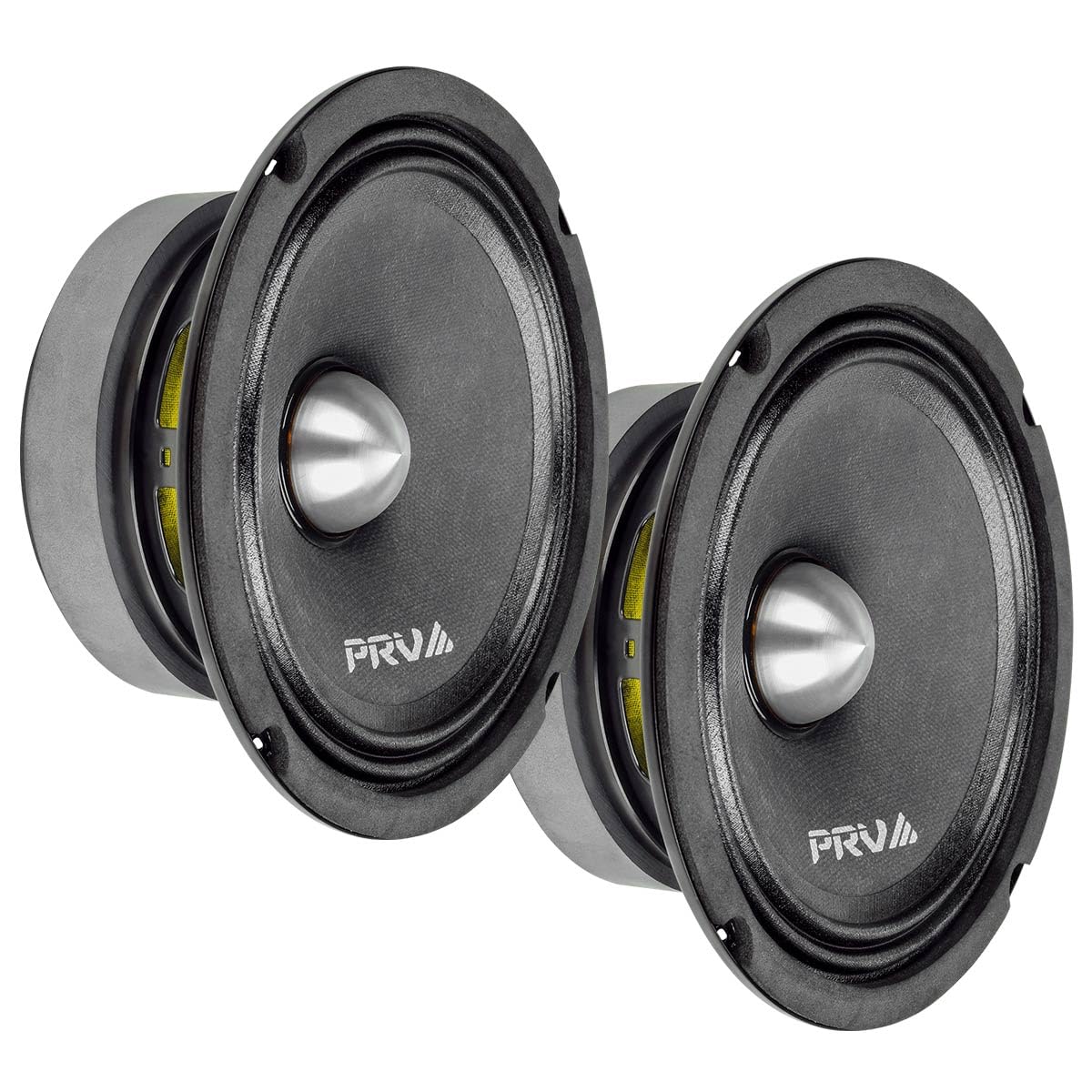
The PRV 6MR400-4 is a pure pro-audio midrange bullet speaker designed for custom 3-way door systems. Its stamped steel basket houses a 400-watt continuous program power rating, and the pure aluminum bullet phase plug doubles as a heat sink to keep the voice coil cool under sustained high-output use. With a 4-ohm impedance, these speakers are straightforward to pair with most aftermarket amplifiers.
PRV designed these specifically for high efficiency — they are meant to be played loud, and they do so with remarkable clarity in the midband. Users report a heavy magnet assembly weighing around 2–3 pounds, a strong indicator of motor strength and long-term reliability. The tradeoff is physical size: the magnet is large enough that installation in tight factory locations may require modification to the door pod or bracket.
If you are building a dedicated front stage with a separate subwoofer and tweeter, the PRV 6MR400-4 is a top-tier choice for midbass and midrange that will not compress at high volume. These are not simple drop-in replacements — they reward the effort of a custom install with sound quality that feels live.
Why it’s great
- Heavy-duty stamped steel frame and large ferrite magnet for low distortion
- Aluminum bullet phase plug acts as a heat sink for sustained output
- 400W program power rating handles aggressive amplifier tuning
Good to know
- Large magnet depth requires custom pods or modified adapters
- Designed for 3-way systems; needs a separate tweeter for top end
3. KICKER 46CSS654 CS-Series

KICKER’s CS-Series component system brings a heavy-duty motor and magnet structure with Extended Voice Coil (EVC) technology, engineered to produce deeper, cleaner lows than typical component sets. The woofer features phase plugs to push distortion down, and the UV-treated poly-foam surround resists sun and heat damage — a smart choice for door installations that face direct sunlight.
The 0.75″ neodymium tweeters come with flush, angled, and surface-mount pods, giving you the installation flexibility required to aim the high frequencies directly at your ears. Paired with a proper amplifier, these speakers deliver a remarkably balanced soundstage that stays composed at high volume levels. Users note they are a massive upgrade over factory speakers, with clean mids and highs that do not break up when the volume climbs.
Where the KICKER truly shines is in vocal range and instrument separation. It is not the absolute loudest option here in terms of raw SPL, but it delivers a more refined loudness — one where every note stays distinct rather than merging into a wall of noise.
Why it’s great
- EVC motor design for extended low-frequency output without distortion
- Multiple tweeter mounting options for optimal sound staging
- UV-treated poly-foam surround for long-term durability in doors
Good to know
- Best results require an aftermarket amplifier with proper crossover tuning
- Bass output may still need a dedicated subwoofer to fill the bottom octave
4. Memphis PRX60C Power Reference

The Memphis Power Reference series is built around a polypropylene cone with a butyl rubber surround, a combination that resists environmental wear and keeps the cone moving freely for years. It is a component system with separate poly dome tweeters and outboard crossovers, allowing you to position the tweeter for ideal imaging while the woofer stays in the factory door cutout.
With 100W RMS per side, this is not the highest power handling on the list, but the speaker’s efficiency and build quality mean it plays loud and clear when fed a clean 100W per channel. Owners report it being “super loud and punchy” even with the top down at highway speeds, and the separate crossover network lets you dial in exactly how much top end you want.
The PRX60C is an excellent upgrade for anyone who has a quality 4-channel amplifier and wants to retain factory fitment without cutting metal. It may lack the sheer brute-force ceiling of the Rockville or PRV options, but it delivers a pleasing, loud, and fatigue-free sound that works for daily driving.
Why it’s great
- Butyl rubber surround for long-term durability in moist environments
- Outboard crossovers with tweeter attenuation for fine-tuning
- Plays loud and clear with 100W RMS per channel
Good to know
- Not suitable for high-power systems above 100W RMS per channel
- Bass response is limited compared to dedicated midbass drivers
5. PIONEER P.R.O. Series TS-6900PRO

The Pioneer P.R.O. Series 6×9 is designed for high-SPL builds where you want the convenience of a coaxial driver without sacrificing output. With 100W RMS and 600W peak handling, it is fully capable of handling serious amplifier power. The 88 dB sensitivity is modest compared to dedicated midranges, but the large 6×9 cone area moves more air than a 6.5″ driver, giving it a natural advantage in bass output.
The frequency response spans from 31 Hz to 16 kHz, covering a wide range without needing a separate subwoofer for basic listening. Users repeatedly praise these for playing “loud with no distortion” and note they can be run off a strong head unit, though they really shine with an external amp. Build quality is typical of Pioneer’s pro-audio line — solid baskets, grilles included, and standard wiring harness adapters.
One limitation is the 2.5″ mounting depth, which may not fit all factory door locations. The TS-6900PRO is a smart pick if you want to keep a simple 2-way system that still delivers chest-thumping volume.
Why it’s great
- Large 6×9 cone area produces deep, punchy bass without a sub
- High sensitivity allows strong performance with moderate amplifier power
- Decades of Pioneer pro-audio reliability
Good to know
- Mounting depth of 2.5″ may require adapters or mods in some vehicles
- 88 dB sensitivity is lower than bullet-style midranges
6. ORION Cobalt CM654

At a sensitivity rating of 96.67 dB, the ORION Cobalt CM654 is among the most efficient speakers in this entire guide. That means it produces high volume with minimal amplifier power — a massive advantage for anyone running a factory head unit or a lower-wattage amp. The 1.5″ high-temperature voice coil and 250W RMS rating give it the thermal capacity to handle sustained high-output sessions.
The bullet phase plug design allows this 6.5″ midrange to extend into higher frequencies without a dedicated tweeter, covering the vocal range with clarity. Users confirm it is “super loud on an amp” and that a pair of these can replace both a midrange and a tweeter in a simplified 2-way setup. The mounting depth is just 2.75″, making it compatible with many factory door locations.
The ORION is a fantastic entry point for high-SPL builds on a tight budget. It lacks the top extension of a full component system, but its sheer sensitivity and low price make it a tempting choice for anyone wanting maximum decibels per dollar.
Why it’s great
- Extremely high 96.67 dB sensitivity for loud output on low power
- 1.5″ high-temp voice coil for sustained power handling
- Very affordable entry into high-SPL door speakers
Good to know
- Midrange-focused; lacks extended treble response
- Paper cone is not as weather-resistant as polypropylene
7. DS18 PRO-X698 BM Loudspeaker
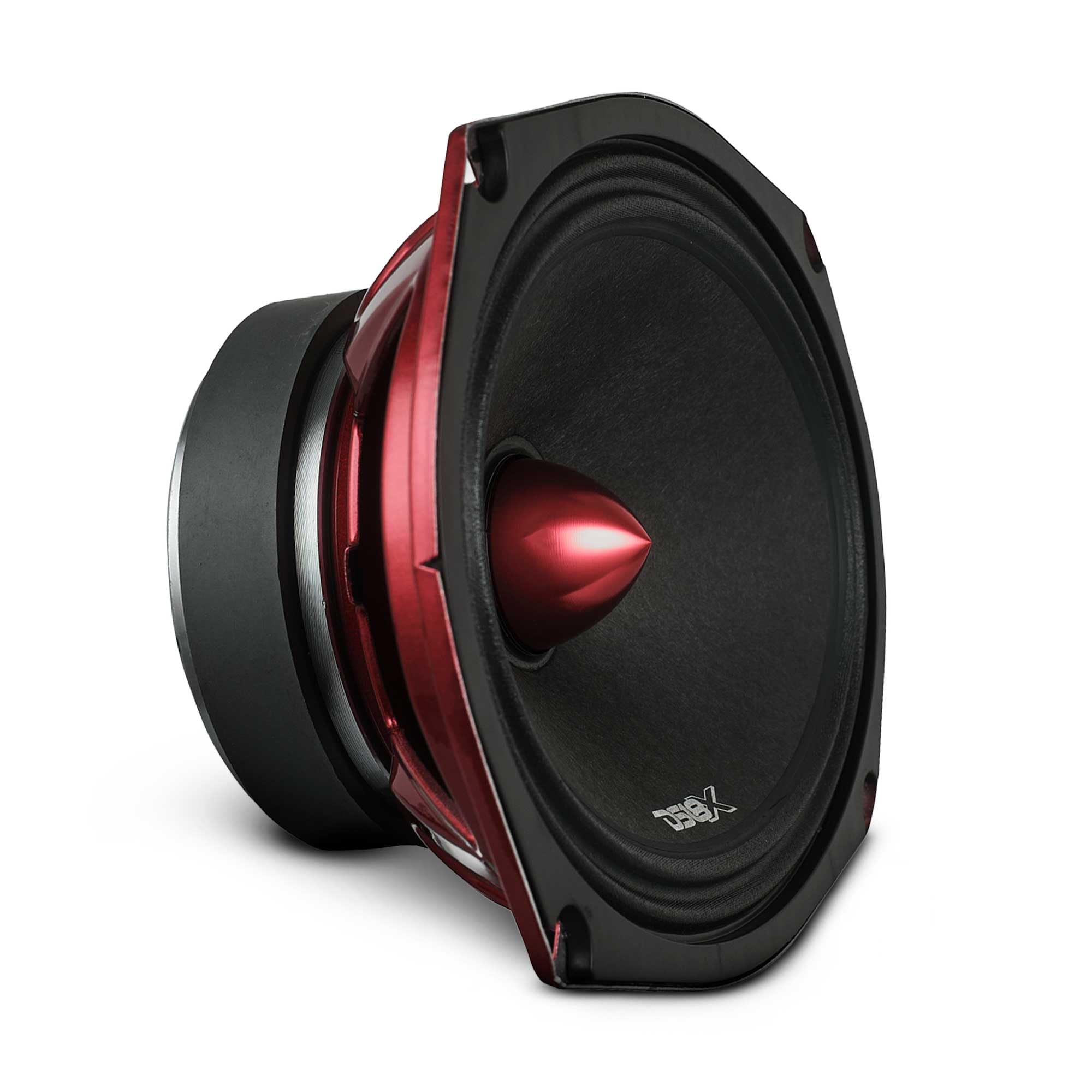
DS18’s PRO-X698 BM is a 6×9 midrange bullet driver built for motorcycles, boats, and custom car builds where maximum midrange output is the goal. Its 8-ohm impedance is ideal for series/parallel wiring configurations or for pairing with high-impedance amplifiers. The 1.5″ CCAW voice coil and high-strength ferrite magnet provide the muscle behind its 200W RMS rating.
The aluminum bullet phase plug doubles as a cooling radiator, while the red anodized finish gives it a distinct visual identity — though the performance is what matters. Users who have blown through multiple sets of standard speakers note that the DS18 handles the heat and power without failure. Because it is an 8-ohm driver, it will draw less current from an amplifier compared to a 4-ohm model, which can be an advantage in systems with limited electrical capacity.
The DS18 is not a full-range speaker — it covers the midband and extends into treble thanks to the bullet design, but it performs best as part of a multi-driver system. It is a durable, loud option for those who need a bullet midrange that can take a beating.
Why it’s great
- 8-ohm impedance for easy pairing with high-impedance amp setups
- Aluminum bullet phase plug for heat dissipation and extended response
- Durable build quality survives high-output use in bikes and boats
Good to know
- 8-ohm impedance produces lower volume per watt compared to 4-ohm options
- Requires a 3-way system with separate tweeter and sub for full range
FAQ
Can I run bullet midranges without a tweeter?
What sensitivity number should I look for in a loud door speaker?
Will higher RMS power handling automatically make my speakers louder?
Final Thoughts: The Verdict
For most users, the best door speakers for loudness winner is the Rockville X6.5C because it combines competition-grade 250W RMS handling, a titanium compression tweeter, and flexible crossovers in a package that rewards tuning with world-class output. If you want bullet-style midbass punch in a custom 3-way build, grab the PRV AUDIO 6MR400-4. And for a budget-friendly entry that still delivers exceptional efficiency, nothing beats the sheer sensitivity of the ORION Cobalt CM654.

Mo Maruf
I created WellFizz to bridge the gap between vague wellness advice and actionable solutions. My mission is simple: to decode the research and give you practical tools you can actually use.
Beyond the data, I am a passionate traveler. I believe that stepping away from the screen to explore new environments is essential for mental clarity and physical vitality.