Our readers keep the lights on and my smoothie glass nicely filled. As an Amazon Associate, I earn from qualifying purchases.
Thin, hollow, rattling door speakers are the single weakest link in any car audio system that claims to deliver real bass. You can add a subwoofer, you can tune your head unit, but if the speakers bolted into your door panels can’t move enough air at low frequencies, the punch you crave will never arrive. The path to tight, chest-thumping low end starts with selecting drivers engineered specifically for deep extension and high power handling—components that turn your car door into a proper enclosure rather than a resonant headache.
I’m Mohammad Maruf — the founder and writer behind WellFizz. I’ve spent countless hours analyzing frequency response curves, comparing motor structures, and dissecting power handling specs to separate door speakers that merely play loud from those that deliver genuine, authoritative bass.
This guide evaluates seven contenders across power class, sensitivity, cone material, and real-world performance to identify the best door speakers for bass that actually transform your daily commute into a controlled low-frequency experience.
How To Choose The Best Door Speakers For Bass
The door of your vehicle is a challenging acoustic space—thin metal panels, irregular cavities, and limited mounting depth conspire against clean low-frequency output. A speaker that delivers strong bass in a proper box may sound thin or distorted in a door. The following factors separate door speakers that genuinely produce bass from those that just promise it.
Power Handling (RMS vs. Peak)
RMS (Root Mean Square) is the continuous power a speaker can handle without damage. Peak power is a short burst rating that marketing departments love. For bass production, you need speakers with a robust RMS rating—at least 75-100 watts per channel—because sustained low frequencies demand significantly more energy than mids or highs. A speaker rated at 250W RMS will reproduce a kick drum hit with far more authority than one rated at 50W RMS, all else being equal.
Component vs. Coaxial
Component systems separate the woofer and tweeter, often including an external crossover, which allows each driver to operate in its optimal frequency range. This separation enables the woofer to focus entirely on mid-bass and low frequencies without interference. Coaxial systems mount the tweeter on a pole in the center of the woofer, which saves installation effort but can compromise bass response due to mechanical interference and limited cone excursion. For serious door bass, a component system is the superior architecture.
Cone Material and Surround Construction
Polypropylene and paper cones treated with special coatings are the primary materials used in bass-oriented door speakers. Polypropylene offers better dampening and resistance to moisture—critical inside a door cavity. The surround material matters just as much. Butyl rubber surrounds provide the flexibility and durability needed for the long excursions that produce deep bass, while foam surrounds deteriorate faster in temperature extremes. A speaker with a stiff cone and compliant butyl surround is the mechanical foundation of strong door bass.
Sensitivity
Sensitivity, measured in decibels (dB), indicates how loud a speaker plays with one watt of power at one meter of distance. Higher sensitivity (88 dB and above) means more output from less power, which is helpful if you are running speakers off a head unit alone. But high sensitivity often comes at the cost of bass extension—the speaker may be efficient but roll off early in the low frequencies. Lower sensitivity (85-87 dB) usually indicates a heavier cone and motor structure designed for deeper bass, but it demands more amplifier power to achieve comparable volume levels.
Mounting Depth and Fitment
Door cavities vary wildly between vehicle makes and models. A speaker with a mounting depth of 2.75 inches may fit a Ford F-150 door but not a Honda Civic door. Before purchasing, measure the available depth behind your factory speaker grille. Some speakers require spacer rings or adapter brackets. Also consider the speaker’s overall diameter and cutout dimensions—most vehicles accept either 6.5-inch or 6×9-inch drivers, but confirm your specific fitment to avoid returns and frustration.
Quick Comparison
On smaller screens, swipe sideways to see the full table.
| Model | Category | Best For | Key Spec | Amazon |
|---|---|---|---|---|
| CT Sounds Meso 6.5″ 3-Way Component | Component | Maximum front-stage bass impact | 250W RMS / 500W Peak, 4 Ohm | Amazon |
| ORION XTR65.SC Component | Component | Detailed low-end with amp integration | 85W RMS, 340W Max, Butyl Rubber Surround | Amazon |
| KICKER 46CSS654 CS-Series Component | Component | Ultra-clean bass with EVC technology | 200W Max, 21 kHz Freq Response, 6.5″ Woofer | Amazon |
| KICKER DSC650 6.5″ Coaxial | Coaxial | Budget-friendly door bass upgrade | 4-Ohm, Polyethylene-Naphthalate Tweeter | Amazon |
| NVX NSP65KIT Component | Component | Clean mid-bass on a moderate budget | 200W RMS, 600W Peak, 2.28″ Mount Depth | Amazon |
| ORION Cobalt CM654 Bullet Midrange | Midrange | High-efficiency mid-bass with wide range | 250W RMS, 96.67 dB Sensitivity, 4 Ohm | Amazon |
| KICKER DSC680 4-Pack for Ford F-150 | Coaxial | Plug-and-play Ford F-150 bass upgrade | 200W Max per Pair, 6×8″ Size, Harness Included | Amazon |
In‑Depth Reviews
1. CT Sounds Meso 6.5″ 500 Watt 3-Way Premium Component Car Speaker Set

The CT Sounds Meso is a three-way component system that separates the woofer, a dedicated 3.5-inch midrange driver, and a 25mm silk-dome tweeter. This architecture allows the 6.5-inch woofer to focus exclusively on the low-end, and it handles 250 watts RMS per set—the highest continuous power rating in this roundup. The woofer’s large motor structure and coated basket are designed to resist resonance, which means the bass it produces stays tight even when you push the volume to levels that shake the side-view mirrors.
Real-world reports confirm that these speakers can play rap, rock, and electronic music without a dedicated subwoofer, producing authoritative kick drum impact. The 3.5-inch midrange driver, powered by a neodymium motor, fills the critical upper-bass and lower-midrange region that creates the sensation of chest-thumping bass. The included passive crossovers manage the frequency split, ensuring each driver operates within its optimal band. The system demands substantial amplifier power—it is not suited for stock head unit power—but with a proper amp, the Meso set delivers controlled, room-filling bass from the front doors alone.
Installation requires more effort than a simple drop-in. Owners report needing to fabricate custom brackets or modify door panels to accommodate the separate 3.5-inch midrange driver, and the tweeter mounting requires cutting or modification. The result, however, is a front-stage system that produces bass depth and impact that rivals many subwoofer setups. For anyone building a serious SPL or SQ front stage and willing to invest in amplification and installation labor, the CT Sounds Meso is the premium choice for door bass.
Why it’s great
- Highest RMS power handling (250W per set) for sustained low-end output
- Dedicated 3.5″ midrange driver bridges the critical gap between woofer and tweeter
- Coated woofer basket and butyl rubber surround minimize door-panel resonance
- Exceptional clarity and impact at high volumes with proper amplification
Good to know
- Requires substantial amplifier power—not suitable for head unit only
- Three-way component design demands significant installation effort and fabrication
- Larger footprint may require door panel modification in many vehicles
2. ORION XTR Series XTR65.SC 2-Way Component System
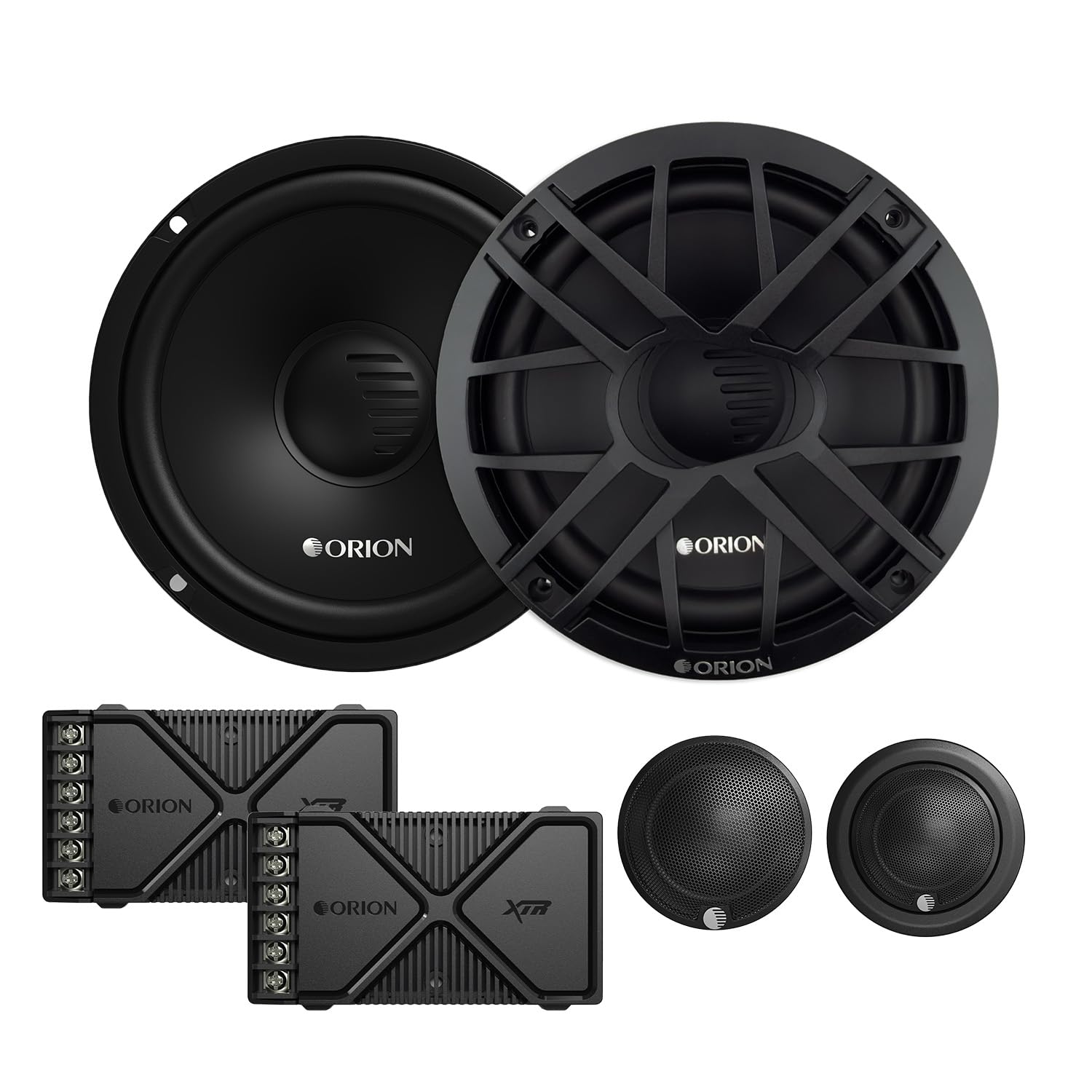
The ORION XTR65.SC is a two-way component system that pairs a 6.5-inch woofer with a 1-inch silk dome tweeter and an external passive crossover. The woofer features a polypropylene cone for controlled damping and a butyl rubber surround that maintains compliance across temperature extremes, critical for consistent bass performance inside a door cavity that can reach well over 140°F in summer. The butyl surround resists drying and cracking, extending the speaker’s lifespan far beyond foam-surround alternatives.
With an RMS rating of 85 watts per side and a maximum power handling of 340 watts, this system occupies the mid-power sweet spot—strong enough to produce punchy bass when paired with a 100-watt-per-channel amplifier, but not so power-hungry that it demands a competition-grade electrical system. The sensitivity is rated at 87 dB, which is typical for a bass-oriented component speaker, meaning it will need amplifier power to reach its full potential. The external crossover provides adjustable slope options that let you tailor the bass roll-off to match your vehicle’s acoustic characteristics.
Owner feedback consistently highlights the speaker’s clean, accurate sound and impressive bass output relative to its price point. The system works well as a front-stage complement to a subwoofer, with the crossover set around 70-80 Hz to keep the door speakers focused on mid-bass while the sub handles the lowest octaves. The mounting depth is manageable for most vehicles, and the included hardware makes installation straightforward for DIY enthusiasts. For a component system that balances bass authority with refined midrange clarity, the ORION XTR65.SC is a strong mid-range contender.
Why it’s great
- Butyl rubber surround provides long-term durability inside door cavities
- External crossover with adjustable tuning for system integration
- Balanced bass response that works well with or without a subwoofer
- Efficient power handling suitable for moderate amplifiers (75-125W RMS per channel)
Good to know
- Mid-bass is strong, but the woofer is not designed for deep sub-bass extension
- 85W RMS rating means it will be outpowered by high-wattage amplifiers
- Requires adapter plates for non-standard door openings
3. KICKER 46CSS654 CS-Series Component System

KICKER’s CS-Series component system is engineered around Extended Voice Coil (EVC) technology, which increases the voice coil’s linear travel distance relative to the magnetic gap. The practical result is that the woofer can move further without distortion, producing deeper, cleaner low frequencies from the same enclosure volume—a critical advantage in shallow door cavities. The woofer also incorporates phase plugs that break up standing waves on the cone surface, reducing distortion in the critical upper-bass and lower-midrange region.
The system includes a 0.75-inch neodymium tweeter with three mounting options: flush, angled, and surface pods. This flexibility allows you to aim the tweeter toward the listening position, improving stage width without compromising the woofer’s low-frequency output. The woofer itself uses a UV-treated poly-foam surround that resists heat and direct sunlight better than standard foam, though butyl rubber would offer longer-term reliability. The 200-watt maximum power rating works well with head unit power or a moderate amplifier, making this system accessible to a broader range of installations.
Users report that these speakers produce ultra-clean bass that is articulate rather than boomy, with a notable improvement in low-end clarity over factory systems. The system integrates well with a powered subwoofer, handling the mid-bass crossover duties seamlessly. The plastic enclosure material for the crossover is functional but less robust than the metal housings found on pricier systems. For drivers prioritizing bass accuracy over maximum SPL and seeking a well-rounded component system that works with stock or upgraded amplifiers, the KICKER CS-Series delivers consistent low-end performance.
Why it’s great
- EVC (Extended Voice Coil) technology improves low-frequency extension in shallow doors
- Phase plugs reduce cone distortion for cleaner upper-bass reproduction
- Multiple tweeter mounting positions for optimal soundstage tuning
- UV-treated foam surround handles heat better than standard foam
Good to know
- Poly-foam surround is less durable long-term than butyl rubber options
- Woofer’s bass output benefits significantly from amplifier power
- Plastic crossover housing feels less premium than metal alternatives
4. NVX NSP65KIT 6.5″ 2-Way Component System

The NVX NSP65KIT offers a 200-watt RMS system with a polypropylene woofer cone and Nitrile Butadiene Rubber (NBR) surrounds, entering the component speaker market at a price point that undercuts most competitors. The NBR surround is a synthetic rubber compound that provides excellent dampening and resistance to the temperature and humidity extremes found inside door panels, performing similarly to butyl rubber at a lower manufacturing cost. The woofer’s 2.28-inch top-mount depth makes it one of the shallowest component woofers in this review, fitting vehicles where mounting depth is a constraint.
Frequency response is rated from 68 Hz to 20 kHz, with a sensitivity of 88 dB. The 88 dB sensitivity is higher than the ORION XTR65.SC’s 87 dB, meaning the NVX system produces slightly more output per watt, which can be beneficial if you are running speakers off a head unit or a lower-power amplifier. The silk dome tweeters aim for smooth high-frequency extension without the harshness that can accompany metal dome designs. The passive crossovers are basic but functional, providing a fixed crossover point that works well for most installations.
Real-world performance shows that the NVX system produces clean, crisp sound at moderate volumes, with bass that is present but not overwhelming. Some users report that the woofers distort when pushed hard at high volumes, particularly above 65% of the amplifier’s output, which aligns with the 200W RMS rating being somewhat optimistic relative to real-world thermal capacity. The system shines in budget-conscious builds where the priority is upgrading from factory speakers with clear, balanced sound rather than achieving maximum bass output. For a component system that respects a tight budget while still delivering a noticeable bass improvement, the NVX NSP65KIT is a compelling choice.
Why it’s great
- Shallow 2.28-inch top-mount depth fits many vehicles with limited door clearance
- NBR rubber surround resists heat and moisture better than foam
- Higher sensitivity (88 dB) works reasonably well with head unit power
- Component architecture improves mid-bass clarity over coaxials at similar price
Good to know
- Woofer distortion becomes noticeable at high volume levels
- 200W RMS rating may not be sustainable under prolonged high-power use
- Passive crossovers lack adjustability for fine-tuning bass roll-off
5. ORION Cobalt CM654 6.5″ Mid-Range Bullet Loudspeaker

The ORION Cobalt CM654 is not a typical door speaker—it is a high-efficiency mid-range driver with a bullet phase plug designed to extend its frequency response upward while maintaining low-end authority. With a sensitivity of 96.67 dB, it is the most efficient speaker in this group, producing massive output from minimal amplifier power. The 1.5-inch high-temperature voice coil handles 250W RMS, making it capable of extreme volume levels without thermal failure. The paper cone material, while traditional, offers a natural sound signature that many enthusiasts prefer for mid-bass reproduction.
The bullet phase plug is the defining feature of this speaker. It allows the CM654 to play high-range frequencies that would normally be handled by a tweeter, while the woofer cone handles the low-to-mid frequencies. This design means the CM654 can serve as both a mid-bass driver and a high-frequency driver in a two-way system, eliminating the need for a separate tweeter in some configurations. The mounting depth of just 2.75 inches makes it reasonably door-friendly, though the overall diameter of 6.54 inches means it fits standard 6.5-inch openings.
Owners consistently report that these speakers are “super loud” and handle amplifier power far beyond their RMS rating without distortion. The high efficiency means they produce thunderous mid-bass that punches hard, particularly in the 60-150 Hz range that gives kick drums their impact. The tradeoff is that the paper cone is not moisture-resistant, and the speaker is not designed for full-range reproduction—it will not produce the lowest sub-bass frequencies a dedicated subwoofer covers. For a dedicated loud mid-bass driver that excels on an amplifier, the ORION Cobalt CM654 delivers startling output levels at an accessible price.
Why it’s great
- Extremely high sensitivity (96.67 dB) produces massive output from modest amplifier power
- 250W RMS handling with a 1.5″ voice coil withstands aggressive amplifier tuning
- Bullet phase plug extends frequency range, reducing the need for a separate tweeter
- Compact mounting depth (2.75″) fits most standard door openings
Good to know
- Paper cone is vulnerable to moisture damage inside door cavities over time
- Designed as a mid-range driver, not a full-range speaker—sub-bass requires a subwoofer
- Not waterproof; exposure to door leaks can cause cone deterioration
6. KICKER DSC650 6.5-Inch Coaxial Speakers
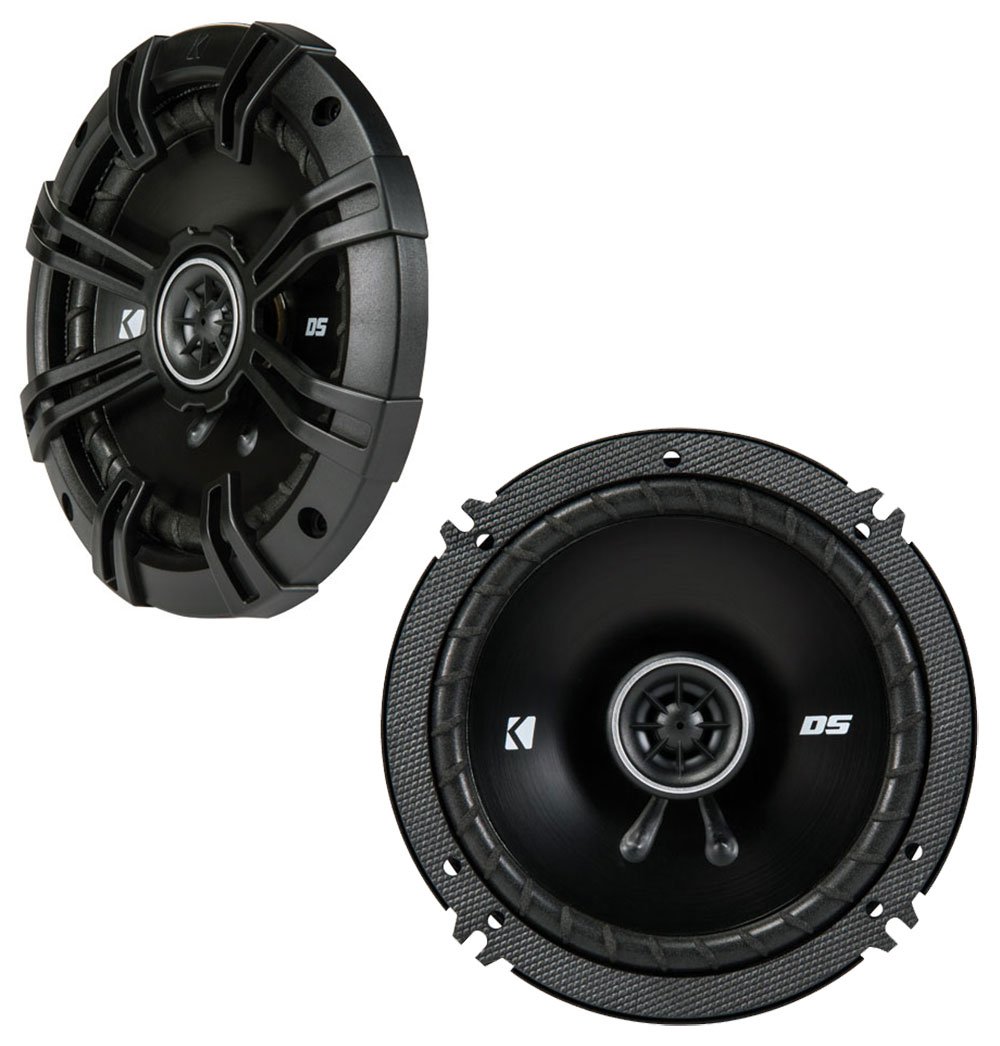
The KICKER DSC650 is a 6.5-inch coaxial speaker that represents the entry point for achieving improved door bass without the complexity and cost of a component system. The coaxial design integrates a 0.75-inch polyethylene-naphthalate dome tweeter into the center of the woofer’s pole piece, which simplifies installation to a drop-in replacement. Despite its coaxial nature, the DSC650 features a woofer cone and motor structure that punch above its price class, producing notably more low-end output than the factory speakers it replaces.
The polyethylene-naphthalate (PEN) tweeter is more rigid than standard polyester domes, allowing it to play louder without breakup at the crossover point. The woofer uses a coated paper cone that provides decent stiffness for mid-bass reproduction. With a 4-ohm impedance, these speakers are compatible with virtually all aftermarket head units and most factory systems. User reports confirm that they deliver significantly louder and clearer sound than stock speakers, with a measurable increase in bass presence that makes subs sound more integrated rather than disconnected.
The DSC650’s performance is heavily dependent on the source power. Running from a stock head unit, bass is present but not overwhelming. Pairing these speakers with an aftermarket head unit (especially one with built-in high-pass filtering) transforms their low-end behavior, producing punchy bass that can vibrate the doors. The speakers work well with a small amplifier in the 50-watt-per-channel range. For anyone on a tight budget who wants a straightforward, no-fabrication upgrade that adds real low-end weight to their system, the KICKER DSC650 is the benchmark budget coaxial.
Why it’s great
- Simplest installation path—direct fit in most 6.5″ openings with no custom brackets
- PEN dome tweeter offers better high-frequency clarity than standard polyester domes
- Produces punchy mid-bass when paired with an aftermarket head unit or amplifier
- Strong value at the entry-level for a known brand with reliable build quality
Good to know
- Bass output is underwhelming when powered solely by a factory radio
- Coaxial design inherently limits maximum bass extension compared to components
- Foam surround is less durable long-term than butyl rubber alternatives
7. KICKER Speakers 6×8 inch for Ford F-150 1999-2014 Upgrade Kit (4 Pack)

This KICKER bundle is specifically designed for 1999-2014 Ford F-150s, combining two pairs of DSC680 6×8-inch coaxial speakers with plug-and-play harnesses that eliminate the need for cutting or splicing factory wiring. The 6×8-inch oval shape is the factory fitment for Ford F-150 doors, and the included harness adapters match the factory connector pinout, making installation a literal plug-and-play operation. The speakers themselves are DS Series 2-way coaxials rated at 200 watts maximum power per pair, with a high sensitivity that works well with the factory head unit’s limited power output.
The oval woofer design provides greater cone area than a 6.5-inch round driver within the same mounting footprint, which translates to more air movement and consequently more bass output from the same amplifier power. The 1/2-inch PEI dome tweeter is integrated into the woofer frame, maintaining the factory speaker’s footprint while adding a dedicated high-frequency driver. The polypropylene cone with acoustic-foam surround offers a good balance of stiffness and compliance for mid-bass reproduction. Users report immediate, dramatic improvements over the stock Ford speakers, with significantly more bass presence and clearer vocals.
The most common feedback from F-150 owners is that these speakers sound “100 times better than stock” and fit perfectly without any modification. The included harnesses are credited as a time-saving feature that makes the whole upgrade a 30-minute job. Some users note that the speakers need more power to reach their full bass potential—setting the head unit to maximum bass and minimum treble helps, but a small amplifier would unlock significantly more low-end authority. One isolated report mentioned a speaker failing within a month, which appears to be an outlier. For Ford F-150 owners seeking a direct, hassle-free door speaker upgrade that adds real bass weight, this kit delivers exactly what it promises.
Why it’s great
- Perfect factory fit for 1999-2014 Ford F-150 with included plug-and-play harnesses
- Oval 6×8″ design provides larger cone area for greater bass output than round 6.5″ speakers
- Eliminates the need for cutting, splicing, or adapter fabrication
- Four-speaker kit upgrades all doors in one purchase for consistent sound front to rear
Good to know
- Limited to Ford F-150 fitment—not suitable for other vehicle makes or models
- Performance ceiling is capped by the factory radio’s power output
- Some users report a single speaker failure, though isolated
FAQ
Do component speakers produce more bass than coaxial speakers in a door?
Can I get door speakers that produce subwoofer-level bass without a subwoofer?
Will replacing my door speakers alone improve bass without adding an amplifier?
What does the butyl rubber surround do for door speaker bass?
Do 6×9-inch door speakers produce more bass than 6.5-inch door speakers?
Final Thoughts: The Verdict
For most users, the best door speakers for bass winner is the CT Sounds Meso 3-Way Component Set because it delivers the highest RMS power handling, dedicated midrange driver for seamless bass integration, and the ability to produce authoritative, room-filling low-end from the front doors alone when properly amplified. If you want a refined, accurate bass response with easy tuning flexibility, grab the ORION XTR65.SC Component Set. And for a budget-conscious upgrade that delivers meaningful bass improvement through simple drop-in installation, nothing beats the KICKER DSC650 Coaxial Set—it transforms factory speakers into a punchy, engaging listening experience.

Mo Maruf
I created WellFizz to bridge the gap between vague wellness advice and actionable solutions. My mission is simple: to decode the research and give you practical tools you can actually use.
Beyond the data, I am a passionate traveler. I believe that stepping away from the screen to explore new environments is essential for mental clarity and physical vitality.