Our readers keep the lights on and my smoothie glass nicely filled. As an Amazon Associate, I earn from qualifying purchases.
Adding a dedicated door speaker amp is the single most effective upgrade you can make to a factory or aftermarket car audio system. Without sufficient clean power, your door speakers distort at moderate volume, fail to reproduce low-end punch, and leave your music sounding flat and lifeless. A proper amplifier delivers the headroom needed to make every note clear, even at highway speeds.
I’m Mohammad Maruf — the founder and writer behind WellFizz. I’ve spent countless hours poring over amplifier specifications, analyzing RMS power ratings, crossover topologies, signal-to-noise ratios, and real-world installation constraints to help you make a smart, informed purchase.
Whether you want crisp highs from your tweeters or full-bodied midrange from your woofers, finding the right best door speaker amp starts with understanding the specs that actually matter for your specific setup.
How To Choose The Best Door Speaker Amp
Choosing the right amp for your door speakers goes beyond just looking at the highest wattage number. You need to match the amplifier’s RMS output to your speakers’ handling, ensure your electrical system can support the draw, and pick a chassis that fits your mounting location.
Match RMS Power to Your Speakers
Your door speakers have a continuous RMS power rating and a peak rating. Always prioritize matching the amplifier’s RMS output per channel to the speaker’s RMS handling. Running an amp that delivers 100W RMS to a speaker rated for 50W RMS risks damage. Conversely, underpowering can cause clipping as you turn up the volume, which also damages speakers. Look for an amp that delivers 75% to 100% of your speaker’s RMS rating at your target impedance.
Crossover Flexibility Is Key
Door speakers reproduce midrange and high frequencies, but they can’t handle deep bass without distorting. A built-in high-pass filter (HPF) blocks low frequencies from reaching your door speakers, letting them play cleaner and louder. Most quality amps include variable HPF and LPF controls. Fixed crossovers (like 90Hz on some models) work fine if they align with your subwoofer’s crossover point, but variable crossovers give you more control to tune your system.
Physical Size and Installation Constraints
Space inside a door panel, under a seat, or in a trunk is often limited. Compact Class D amplifiers are popular because they generate less heat and fit in tight spaces. Measure your intended mounting location before buying. Some amps include vertical or horizontal mounting brackets for flexible installs. A physically large amp may offer more power, but if it doesn’t fit, it won’t do you any good.
Quick Comparison
On smaller screens, swipe sideways to see the full table.
| Model | Category | Best For | Key Spec | Amazon |
|---|---|---|---|---|
| Taramps TS 400×4 | Full-Range Class D | Compact builds & 2-ohm systems | 100W RMS x 4 @ 2 ohms | Amazon |
| Recoil DI550.4 | Full-Range Class D | Value-oriented clean power | 130W RMS x 4 @ 2 ohms | Amazon |
| Taramps TS 800×4 | Full-Range Class D | Mid-range power upgrade | 200W RMS x 4 @ 2 ohms | Amazon |
| DS18 SXE-1200.4 | Full-Range Class A/B | Budget-friendly A/B sound quality | 100W RMS x 4 @ 2 ohms | Amazon |
| PRV Audio MDX1200.4 | Mini Class D | Powersports & marine builds | 300W RMS x 4 @ 2 ohms | Amazon |
| AudioControl EPICFOUR | Digital Class D | High-end SQ builds | 200W RMS x 4 @ 2 ohms | Amazon |
| Kicker 46CXA3604 | Full-Range Class A/B | Reliable traditional A/B power | 90W RMS x 4 @ 2 ohms | Amazon |
In‑Depth Reviews
1. Taramps TS 400×4
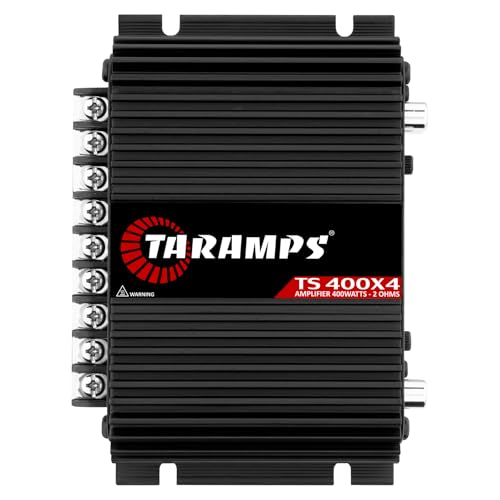
The Taramps TS 400×4 packs a genuine 400W RMS into a chassis that weighs under one pound. That’s 100W per channel at 2 ohms in a package small enough to fit behind a glovebox or under a motorcycle seat. The built-in crossover offers fixed high-pass and low-pass filters at 90Hz, plus a full-range mode for flexible tuning. Both RCA and high-level inputs are included, with automatic turn-on when using speaker-level signals — no remote wire adapter needed.
<
Real-world user reports confirm it drives 5.25-inch and 6×9-inch speakers with clean headroom and no distortion. One owner installed it in a vintage Porsche 911 with Kicker and Boston Acoustics drivers, praising the increased clarity and the low-pass crossover that kept the smaller woofers from over-excursion. Another paired it with a Taramps 2000.1 sub amp for a full-system build, calling the combo “stupid powerful and clear.”
The amp runs cool thanks to efficient Class D topology. Installation requires a 20A fuse and 11 AWG power wire — modest electrical demands that work with most stock alternators. If you need a ultra-compact amp that delivers real power without the bulk, this is one of the most versatile options on the market.
Why it’s great
- Extremely small and light at 0.99 pounds
- Includes high-level input with auto-turn-on
- Runs cool with low electrical draw
Good to know
- Fixed 90Hz crossover may not suit all systems
- 11 AWG power wire requirement is non-standard
2. Recoil DI550.4

The Recoil DI550.4 delivers 130W RMS per channel at 2 ohms from a compact chassis measuring just 7.48 x 5.90 inches. It uses a high-speed MOSFET power supply and 4-way protection circuitry to keep the amp stable during extended listening sessions. User-adjustable gain, LPF, HPF, and bass EQ controls give you full tuning authority over your door speakers.
Reviews consistently highlight its clean sound and low heat output. One user running four Skar 6.5-inch speakers and tweeters reported the amp barely gets warm even at high volume. Another replaced a 12-year-old Crunch amp and called the DI550.4 “outstanding sound quality” with a “small footprint and 95% SNR.” The bridged mode pushes 260W RMS x 2 at 4 ohms, enough to drive a pair of midbass woofers if desired.
The amplifier meets CE, FCC, and RoHS standards for electrical safety. Some users noted a faint hiss at idle — typical for budget Class D designs — but the overall value proposition is hard to beat. If you want maximum power per dollar without sacrificing build quality, the DI550.4 is a strong contender.
Why it’s great
- Excellent value with strong RMS ratings
- Compact footprint fits tight spaces
- Runs cool even under load
Good to know
- Some audible hiss at idle in quiet vehicles
- Hi-level input design can be fiddly
3. Taramps TS 800×4

The Taramps TS 800×4 cranks out 800W RMS total — 200W per channel at 2 ohms — making it a serious step up for drivers who want authority behind their door speakers. The amplifier uses Class D efficiency to keep heat in check while delivering clean power across the frequency range. It includes fixed crossover settings with high-pass and low-pass options, plus precise level control knobs that users describe as “actual knobs” rather than fragile trim pots.
Customer feedback shows this amp reliably replaces larger units. One user swapped out a Sony amp and found the TS 800×4 delivered the same clean power in a smaller package. Another powers four DS18 6.5-inch speakers and says they “sound great.” The amp includes short-circuit and overheat protection, shutting down automatically if it detects unsafe impedance or temperature levels.
Physical dimensions are 6.89 x 5.43 x 1.89 inches — still compact enough for under-seat mounting. The required 7 AWG power wire and 40A fuse indicate moderate electrical demands. If your door speakers need more than 100W per channel to truly come alive, the TS 800×4 delivers the headroom you need without jumping to a much larger chassis.
Why it’s great
- High RMS output in a compact size
- Sturdy gain knobs for easy tuning
- Built-in protection against shorts and overheating
Good to know
- Requires 7 AWG power wire (larger than typical)
- Fixed crossover may not suit all systems
4. DS18 SXE-1200.4

The DS18 SXE-1200.4 is a Class A/B amplifier that prioritizes sound quality and thermal stability. Delivering 100W RMS x 4 at 2 ohms and 60W RMS x 4 at 4 ohms, it uses larger power transformers than Class D designs for a warmer, more natural audio signature. The fully variable crossover lets you dial in the exact high-pass or low-pass frequency for your door speakers and tweeters.
Users report this amp runs cool even after extended use. One installer mounted it on 1/2-inch standoffs for airflow and noted no clipping after two weeks of daily driving with four DS18 6.5-inch coaxials. Another added it to a 2023 Jeep Gladiator to power bed speakers, reporting great results with no issues. The bridged mode delivers 200W x 2 at 4 ohms for more demanding midbass drivers.
At 10 x 12 x 9 inches, the chassis is larger than compact Class D amps, so measure your space before ordering. DS18 meets Audio Precision and CE certification standards. If you prefer the classic sound of a Class A/B amplifier and have room to mount it, the SXE-1200.4 delivers reliable performance at a fair price point.
Why it’s great
- Class A/B topology for natural sound reproduction
- Fully variable crossover for precise tuning
- Stays cool during extended use
Good to know
- Larger chassis requires more mounting space
- Lower efficiency than Class D designs
5. PRV Audio MDX1200.4
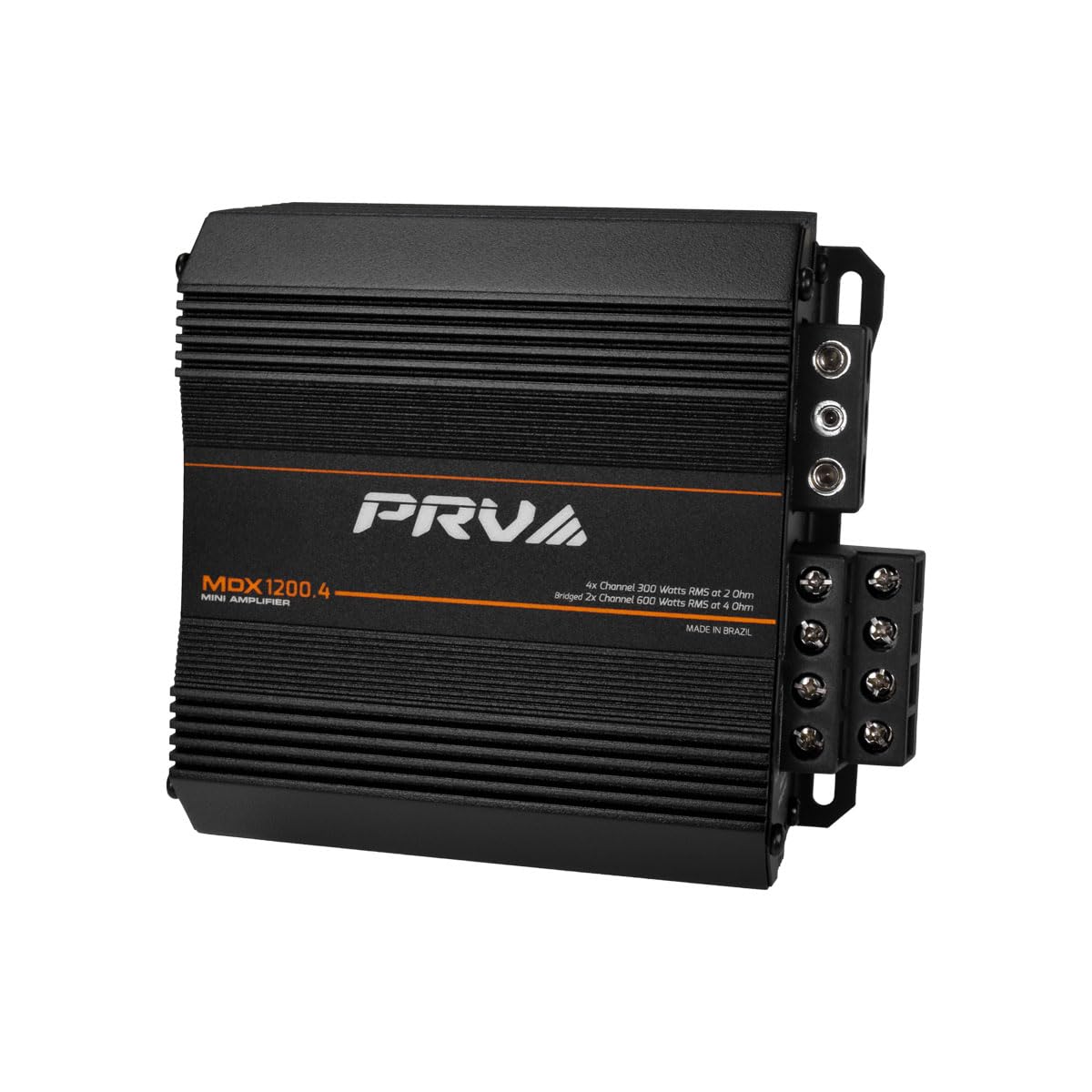
The PRV Audio MDX1200.4 is a mini 4-channel amplifier that delivers a staggering 300W RMS per channel at 2 ohms — 1200W total from a chassis only 6.75 x 5.90 x 2.60 inches. Brazilian Class D technology powers this compact beast, making it ideal for motorcycles, ATVs, boats, and Slingshots where space is at an absolute premium. It’s 2-ohm stable per channel, and bridging two channels yields 600W RMS at 4 ohms.
Real-world installations confirm its power. One user runs it inside a motorcycle fairing, pushing door speakers with authority and praising both the build quality and sound. Another powers eight 4-ohm speakers in a boat — two per channel — and reports the amp easily keeps up with a separate 12-inch subwoofer amplifier. The high-mass heatsink dissipates heat effectively even in enclosed spaces.
The amp is designed for 12V electrical systems common in powersports vehicles. All connections are surface-mount style for secure wiring. If you need enormous power in a tiny footprint for a non-traditional vehicle build, the MDX1200.4 is in a class of its own.
Why it’s great
- Incredible 300W RMS per channel in a mini chassis
- Ideal for motorcycles, ATVs, and boats
- High-mass heatsink for thermal management
Good to know
- Designed for 12V systems only
- Premium pricing for the high output
6. AudioControl EPICFOUR

The AudioControl EPICFOUR is a digital Class D amplifier built for sound quality enthusiasts. It delivers 200W RMS x 4 at 2 ohms or 400W RMS x 2 bridged at 4 ohms from a low-profile chassis (6.1 x 9.41 x 2.01 inches). The 12dB/octave Linkwitz-Riley crossovers ensure only the correct frequencies reach your door speakers, minimizing phase distortion for accurate imaging and staging.
Users report exceptional clarity. One owner runs Alpine Type R 6×8 coaxial speakers in an F150 with a Tesla-style radio, calling the sound “great for the price.” Another powers four DS18 speakers and says the amp makes them “loud and clear.” The EPICENTER Link port lets you add AudioControl’s bass restoration processor for even deeper low-end control. Multiple protection modes guard against voltage fluctuations and short circuits.
The amp uses 4 GA power wire and 8 GA speaker terminals with hex screws for solid connections. A faint hiss has been noted by some users at idle, but overall build quality and signal integrity are top-tier. If you care deeply about sound stage and want a compact SQ-focused amp with room to grow, the EPICFOUR is the pick.
Why it’s great
- Linkwitz-Riley crossovers for accurate frequency separation
- Ultra-efficient idle draw prevents battery drain
- EPICENTER Link port for system expansion
Good to know
- Faint hiss reported by some users at idle
- Recommended 80A fuse not included
7. Kicker 46CXA3604

Kicker’s CXA360.4 is a Class A/B amplifier that delivers 90W RMS x 4 at 2 ohms with the brand’s signature reliability. A variable 12dB crossover gives you control over frequency distribution, and the KickEQ bass boost adds up to 6dB of extra thump when needed. The amplifier works with input signals as low as 9 volts, making it compatible with both factory and aftermarket head units.
Customer reviews span over a year of daily use. One owner bench-tested the amp and found it delivered about 100W RMS per channel — above the advertised spec. Another powers four Kicker 6×9-inch speakers with “crisp clear” results. The single-connector harness simplifies installation and removal, a thoughtful touch for those who swap vehicles or troubleshoot. The amp has survived minor water exposure without issues.
The chassis measures 16 x 9 x 4 inches, so it’s larger than compact Class D options. Vertical and horizontal mounting hardware is included for flexible installations. If you value bulletproof build quality, traditional A/B sound, and a brand with decades of car audio reputation, the Kicker CXA360.4 is a safe long-term investment.
Why it’s great
- Rated power exceeds advertised spec in bench tests
- Single-connector harness for easy install/removal
- Proven long-term reliability
Good to know
- Larger chassis may not fit under seats
- Manual lacks detailed tuning instructions
FAQ
Can I use a door speaker amp with factory speakers?
Should I choose Class A/B or Class D for door speakers?
What size amplifier do I need for four door speakers?
Final Thoughts: The Verdict
For most users, the best door speaker amp winner is the Taramps TS 400×4 because it delivers 100W RMS per channel, weighs less than a pound, includes high-level input with auto-turn-on, and works across cars, motorcycles, and marine applications. If you want maximum power for a powersports build, grab the PRV Audio MDX1200.4. And for uncompromising sound quality with Linkwitz-Riley crossovers, nothing beats the AudioControl EPICFOUR.

Mo Maruf
I created WellFizz to bridge the gap between vague wellness advice and actionable solutions. My mission is simple: to decode the research and give you practical tools you can actually use.
Beyond the data, I am a passionate traveler. I believe that stepping away from the screen to explore new environments is essential for mental clarity and physical vitality.