Our readers keep the lights on and my smoothie glass nicely filled. As an Amazon Associate, I earn from qualifying purchases.
A door that creaks open in the middle of the night or a child wandering into an off-limit zone is a stress you shouldn’t have to live with. A quality door sensor solves that by instantly alerting you the moment a gap appears—no monthly fees, no complex wiring, just pure peace of mind.
I’m Mohammad Maruf — the founder and writer behind WellFizz. For this guide, I spent hours digging through spec sheets, studying real user reports about false alarm triggers and adhesive failures, and analyzing the decibel outputs and trigger ranges that actually matter for home security.
After filtering for build quality, alert volume, battery life, and installation simplicity, I landed on a shortlist of the best options. Here is the best door sensor for a calm, protected home.
How To Choose The Best Door Sensor
Not all door sensors are built the same. The wrong choice can mean annoying false chimes from a passing pet or a sensor that fails to trigger at all. Focus on these three elements to get a system that works reliably for years.
Trigger Type: Magnetic Contact vs. Motion Detection
Magnetic contact sensors consist of two halves—a magnet and a reed switch. When the gap between them exceeds the specified distance (usually under 1 inch), the alarm sounds. These are ideal for doors and windows because they only trigger on actual opening. Motion detectors use passive infrared (PIR) to sense heat and movement across a wide angle. They cover a broader area but may trigger on pets or passing cars. For a specific door, a contact sensor is more precise; for a room or hallway entrance, a PIR unit is better.
Alert Volume and Sound Options
Decibel ratings matter. A 65 dB alarm is loud enough to hear in the next room, while a 120 dB model can be heard across a two-story house. Look for adjustable volume settings, especially if you need a quiet chime during the day and a full alarm at night. Bonus features include multiple chime tones, silent mode, and visual LED indicators for hearing-impaired users.
Installation and Power
Most door sensors mount with strong 3M double-sided tape—no drilling required. Ensure the adhesive can handle your door or window frame material. Battery life is critical: models with LR44 button cells may last six to twelve months, while those running on AAA batteries often exceed a year. A low-battery indicator LED prevents unexpected silence.
Quick Comparison
On smaller screens, swipe sideways to see the full table.
| Model | Category | Best For | Key Spec | Amazon |
|---|---|---|---|---|
| Philips LRM3320W/27 | Magnetic Contact | Trusted brand, reliable 120dB alarm | Trigger gap of 0.5 inches | Amazon |
| METAK PIR Chime Kit | PIR Motion | Wide area coverage with 32 chimes | 110° detection, 500 ft range | Amazon |
| AMHEY Motion Chime | PIR Motion | Business entrance alerts with plug-in receiver | 110 dB max volume, 26 ft sensor | Amazon |
| METAK 2-Pack Contact Alarm | Magnetic Contact | Remote disarm with 600 ft range | 120 dB alarm, 2-pack | Amazon |
| TECKNET 3-Pack | Magnetic Contact | Budget-friendly multi-pack with low volume option | 65 dB alarm, 0.78 in trigger | Amazon |
In‑Depth Reviews
1. Philips LRM3320W/27 Window and Door Alarm (4 Pack)
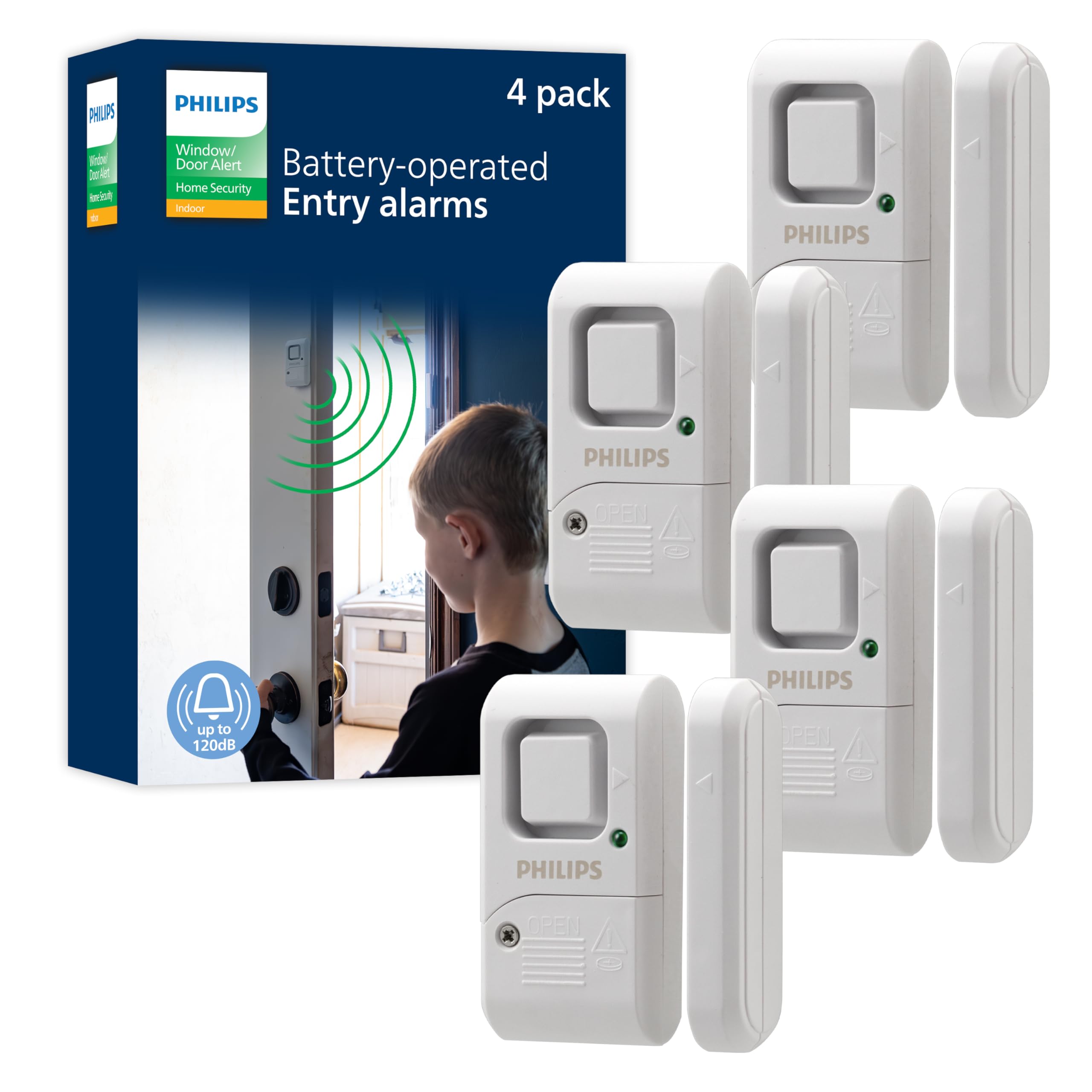
This is the goldilocks option for anyone who wants a trusted brand name, high-decibel performance, and enough units to cover every vulnerable entry. The 120 dB alarm is genuinely jarring—testers reported hearing it clearly across a full two-story home. Each unit is a self-contained magnetic contact sensor with a simple three-way switch: off, chime, or alarm. The chime mode produces a gentle ding-dong for everyday comings and goings, while the alarm mode unleashes that full 120 dB blast if an intruder forces entry. The switch mechanism is tactile and easy to operate even with less steady hands.
Installation is truly adhesive-only. The included double-sided tape holds well on clean, smooth surfaces, but experienced users recommend upgrading to a heavy-duty mounting putty for textured or painted frames. The trigger gap is a tight 0.5 inches, which means the magnet and sensor body must be practically touching when the door is closed. This eliminates false alarms from wind or vibration while keeping sensitivity high. The set of four alarms provides excellent value for the price tier.
Battery life is respectable given the 120 dB sounder. Each alarm runs on four included LR44 button cells. A low-battery indicator LED glows red when replacement is due, preventing the silent failure that plagues many cheaper sensors. The only tradeoff is the lack of adjustable volume—this thing is either off, chiming softly, or roaring like a fire alarm. For users who need a discreet office alert, this may be too aggressive.
Why it’s great
- Trusted Philips brand with 120 dB ear-catching alarm
- 4-pack covers multiple entry points at once
- Simple switch for off/chime/alarm modes
- Low-battery LED indicator prevents surprises
Good to know
- No adjustable volume on alarm mode — always full blast
- Adhesive may struggle on rough or textured surfaces
- LR44 batteries are small and may need replacing sooner than AAAs
2. METAK Motion Sensor Door Chime Kit

If you need to know when someone enters a room rather than just opens a door, this PIR motion-based system is the right tool. The infrared detector sweeps a 110-degree arc up to 26 feet away, sensing body heat and movement. When triggered, it wirelessly sends a signal to the receiver chime up to 500 feet away. This makes it ideal for monitoring a hallway, a store entrance, or a dementia patient who might wander out of their room. The included receiver features 32 different chime tones and 5 volume levels from zero to 110 dB, including a silent mode that flashes the LED only.
The real standout feature is expandability. The METAK system allows you to pair up to 20 motion sensors with one receiver. This means you can cover multiple doors, a garage entrance, and a back gate with a single chime unit. The detector offers dual power: 3 AAA batteries (included) or USB charging, which is rare at this price tier. The 360-degree adjustable mount lets you point the sensor exactly where you need it—straight down a hallway, across a doorway, or angled to avoid triggering on a nearby walking pet.
One common observation from users is that the sensor is sensitive enough to catch small pets. If you have a dog or cat that walks through the detection zone, you will get alerts. For some, that’s a feature (knowing when the dog comes in), but for others it’s a source of nuisance. The lowest volume setting is still fairly loud at around 60 dB, so there’s no truly whisper-quiet option. Overall, the flexibility and range make this the best choice for monitoring movement through a space rather than a specific door crack.
Why it’s great
- 110-degree PIR sensor covers a wide area, not just a door gap
- 32 chime options and 5 volume levels
- Expandable to 20 sensors on one receiver
- Dual power with USB option for continuous use
Good to know
- Can trigger on small pets walking through the zone
- Lowest volume setting may still be too loud for some
- Requires AAA batteries or USB for the receiver (receiver uses power cord)
3. AMHEY Motion Sensor Door Chime

Business owners and retail managers will appreciate the AMHEY system’s plug-in receiver that stays powered without battery swaps. The receiver unit draws power from a standard wall outlet, while the motion sensor runs on 2 included AAA batteries. This setup is ideal for a store counter or office desk where you want a permanent alert station that never goes silent. The sensor detects motion within 16–26 feet at a 110-degree angle, and the 500-foot wireless range means you can place the receiver in a back office while the sensor watches a front door.
The 32-chime library includes distinct tones like doorbell rings, long alarm sounds, and short alert beeps. With 5 volume levels going up to 110 dB, you can set a gentle doorbell chime during business hours and crank up the alarm volume after closing. An LED light indicator flashes with each trigger, providing a visual cue for the hearing impaired or for noisy environments. The system also supports expansion to up to 20 sensors, making it easy to scale across a warehouse or retail floor.
One design nuance worth noting: the receiver has no physical on/off switch, so silencing it requires unplugging or removing batteries from the sensor. Several users found the instructions poorly translated and unclear about battery orientation. The sensor itself is indoor-rated only, so you cannot mount it under an eave exposed to rain. For a dedicated indoor doorway, however, the AMHEY delivers reliable performance and deep customization in a compact form factor.
Why it’s great
- Plug-in receiver eliminates battery anxiety at the alert point
- 32 ringtones with 5 volume levels up to 110 dB
- Visual LED indicator for hearing-impaired users
- Expandable to 20 sensors for large coverage
Good to know
- No on/off switch on the receiver
- Instructions are sparse and poorly written
- Not weather-rated for outdoor sensor placement
4. METAK 2-Pack Contact Alarm with Remote

For users who want a standard magnetic contact sensor but with the convenience of a wireless remote disarm, this METAK two-pack is a thoughtful solution. Each sensor set includes a keychain-style remote that can arm or disarm the paired alarm from up to 600 feet away. This is immensely practical for a sliding glass door or a front door—you can silence the alarm as you walk up the driveway without fumbling for buttons on the unit itself. The alarm offers two selectable volume levels: 90 dB for a more discreet alert and 120 dB for a full-throated intrusion deterrent.
Installation is the same peel-and-stick process as other contact sensors, with durable 3M adhesive on both the magnet and the alarm body. The remote pairing process is straightforward and requires no app or hub—just holding the remote near the alarm while pressing a button. The alarms can also be used in chime-only mode, producing a pleasant ding-dong when the door opens without setting off the full alarm.
The one real limitation is battery consumption. Each alarm runs on 2 AAA batteries (not included), and the continuous listening for the remote signal draws slightly more power than a basic contact alarm. Users report around 6 to 8 months of typical use before needing replacements. The remote itself is small and could be lost easily—tucking it into a keychain is the safest bet. Overall, this is the strongest mid-range choice for anyone who wants remote control without moving to a smart home platform.
Why it’s great
- Remote control disarms from up to 600 feet away
- Two volume settings: 90 dB chime or 120 dB alarm
- Good 3M adhesive for quick mounting
- Chime mode available, not just a screaming alarm
Good to know
- Batteries not included, and drain faster with remote pairing
- Remote is small and easy to misplace
- May trigger on wind if sensor halves are misaligned
5. TECKNET 3-Pack Door and Window Alarm

The TECKNET set is the entry-level workhorse for people who need basic awareness without a window-rattling siren. At 65 dB maximum volume, it is loud enough to hear in the next room but not so piercing that it shocks a sleeping child or disturbs neighbors. The three-pack provides excellent value for the price tier—enough to cover a front door, a back door, and a window in one purchase. One user with an autistic child specifically chose this model because the lower volume helped prevent overstimulation while still providing a reliable alert.
Each alarm unit has three modes: off, a single doorbell-style chime, and a continuous alarm. The 3-level volume control lets you fine-tune between a barely-audible murmur and the full 65 dB. Installation uses standard adhesive tape; the manufacturer recommends cleaning the surface and placing the sensor within 0.5 inches of the arrow side of the alarm for reliable triggering. The trigger gap is 0.78 inches—slightly more forgiving than the Philips model, which reduces false alarms from minor misalignment over time.
The biggest tradeoff is the trigger reliability over long distances. Users have noted that the two halves must be very close together, and the adhesive on the sensor half may fail on grooved or textured molding. A simple workaround is mounting the alarm upside down with the ringer on the door and the sensor at an angle on the frame. The 36-month warranty (with registration) adds genuine peace of mind. If you need a simple, gentle alert for a few doors and want to keep the budget tight, this is the smartest buy.
Why it’s great
- Lower 65 dB max volume is ideal for kids, pets, and sensitive households
- 3-pack covers multiple entry points for a low investment
- 3-level volume control for fine-tuning
- 36-month registered warranty from TECKNET
Good to know
- Trigger halves must be very close (within 0.5 inches) for reliable operation
- Adhesive may not stick well to textured or grooved molding
- Not as loud as other options — 65 dB vs 120 dB competitors
FAQ
What is the difference between a magnetic door sensor and a PIR motion sensor?
Can I use a door sensor outdoors?
How do I stop a door sensor from triggering on pets?
Final Thoughts: The Verdict
For most users, the best door sensor winner is the Philips LRM3320W/27 because it combines a trusted brand, a genuinely loud 120 dB alarm, and a four-pack that covers every essential entryway. If you need motion-based room monitoring with maximum customization, grab the METAK Motion Sensor Chime Kit. And for a budget-friendly multi-pack that keeps the peace with lower volumes, nothing beats the TECKNET 3-Pack.

Mo Maruf
I created WellFizz to bridge the gap between vague wellness advice and actionable solutions. My mission is simple: to decode the research and give you practical tools you can actually use.
Beyond the data, I am a passionate traveler. I believe that stepping away from the screen to explore new environments is essential for mental clarity and physical vitality.