Our readers keep the lights on and my smoothie glass nicely filled. As an Amazon Associate, I earn from qualifying purchases.
The scariest moment for any caregiver is the sound of a door clicking shut at 2 a.m. Standard privacy locks with thumb turns are dangerously easy for a confused loved one to manipulate, turning the home into a hazard zone. The right security hardware doesn’t just lock a door—it buys you sleep, focus, and the knowledge that your family member is safe inside.
I’m Mohammad Maruf — the founder and writer behind WellFizz. For this guide, I spent hours comparing latch mechanisms, code entry systems, and child-proof hardware specs to identify which solutions actually work for dementia-related wandering without turning your home into a fortress.
After researching over a dozen models across multiple security categories, I’ve compiled the most effective hardware options that balance caregiver access, patient safety, and everyday convenience in this roundup of the best door locks for dementia patients.
How To Choose The Best Door Locks For Dementia Patients
Selecting the right security hardware for a loved one with dementia requires a completely different set of priorities than a standard home lock purchase. You are not trying to repel burglars—you are trying to keep a confused person safe inside while maintaining quick access for yourself and emergency responders. The wrong choice traps the caregiver or frustrates the patient. The right choice disappears into the background of daily life.
Keyless Entry vs. Keyed Locks
Keyless code entry systems are almost always the better choice for dementia care. A patient who cannot remember a four-digit code will not be able to exit. A caregiver with the code enters silently and quickly without fumbling for keys. Keyed locks create a dangerous bottleneck when you need to rush inside or when emergency services need access. If you choose a keyed solution, ensure keys are stored in a break-glass box near the door.
Mounting Height and Accessibility
The most effective dementia locks live at the top of the door—well above the patient’s natural reach. Toddler-focused hardware like top-mounted latches serves double duty here because adults can operate them from either side. Standard deadbolts at waist height are too easy for a determined individual to manipulate, especially if the thumb turn is within sight. A lock mounted at 60 inches or higher creates a physical barrier that most patients never attempt to defeat.
Auto-Locking and Battery Backup
Automatic locking features are a massive advantage for dementia care because they eliminate the “did I lock it?” anxiety. An electronic deadbolt that re-engages after 10 seconds ensures the door is always secure even if you are distracted. Battery backup is non-negotiable—when the batteries die, you must have a physical key or external power port. Look for models with low-battery indicators and backup charging ports to avoid middle-of-the-night lockouts.
Quick Comparison
On smaller screens, swipe sideways to see the full table.
| Model | Category | Best For | Key Spec | Amazon |
|---|---|---|---|---|
| GlideLok 3‑Pack | Top Mount Latch | High‑reach wandering prevention | Painted metal, fits doors up to 1‑3/8″ thick | Amazon |
| TEEHO TE001 | Keypad Deadbolt | Front door code security | 20 user codes, auto‑lock 10‑99 seconds | Amazon |
| AST Knob Lockout | Knob Cover | Retrofitting round knobs | Diecast metal shell, 4‑digit combo padlock | Amazon |
| Buoan Keypad Knob | Keypad Knob | Interior door code entry | Auto‑lock 3 seconds, backlit keypad | Amazon |
| Amazon Basics Deadbolt | Keypad Deadbolt | Budget‑friendly code access | 6 user codes, auto‑lock 10‑99 seconds | Amazon |
| BaoWei Door Latch 2‑Pack | Frame Latch | Inward‑swing door reinforcement | Zinc alloy, 3″ stainless steel screws | Amazon |
| SUMMIT Sliding Door Lock | Sliding Door Key Lock | Patio door elopement prevention | Alloy steel peg with 2 keys | Amazon |
In‑Depth Reviews
1. GlideLok 3‑Pack

The GlideLok is the single most effective non-electronic solution for dementia wandering prevention currently available. Its metal saddle design sits at the very top of the door, placing the locking mechanism completely out of the patient’s reach while remaining fully operable by an adult from either side. The construction is painted metal rather than flimsy plastic, meaning it withstands the repetitive stress of daily use without cracking or flexing.
Installation is straightforward: one screw into the door frame on the hinge side. The latch engages smoothly with a simple slide, and the included spacer bar accommodates doors up to 1-3/8 inches thick or up to 1-13/16 inches when removed. Caregivers report that adding thin adhesive-backed felt to the inner sliding surfaces prevents scratching of the door finish. The three-pack covers interior doors, front doors, and even pantry doors for the price of a single electronic lock.
This lock excels in the dementia context because it cannot be defeated by fumbling with thumb turns, codes, or keys. The patient simply cannot reach it. Meanwhile, the caregiver can lock or unlock it from either side without trapping themselves. For families with a history of elopement, this is the gold standard.
Why it’s great
- Mounts high out of patient reach
- Operable from both sides of door
- Sturdy metal build outlasts plastic alternatives
Good to know
- Requires drilling one screw into door frame
- Not compatible with sliding, bifold, or pocket doors
2. TEEHO TE001 Keyless Entry Deadbolt

The TEEHO TE001 offers the most robust code management system in its price tier, accepting up to 20 individual user codes plus temporary single-use codes. For dementia care, this means you can assign a dedicated caregiver code and delete it if staffing changes, while the patient never learns a code. The automatic locking function adjusts from 10 to 99 seconds, ensuring the door re-secures itself after every entry without caregiver intervention.
The matte black deadbolt features IP54 weather resistance, making it suitable for exterior front doors. The backlit keypad includes anti-peeping protection—enter random digits before or after your code to mask the actual entry sequence from onlookers. Battery life is rated up to 365 days on four AA batteries, with a red LED indicator that fires when capacity drops below 15 percent. A physical key backup is included for emergency access.
Installation is a 10-minute job with a single screwdriver, fitting standard 2-1/8-inch door bores. The motorized deadbolt cycles smoothly, though a few reviewers noted occasional multi-cycle locking that may require future adjustment. For a front door solution that automates security without smart-home complexity, this is an excellent mid-range choice.
Why it’s great
- Twenty individual codes for diverse caregivers
- Adjustable auto-lock prevents forgetting
- IP54 weather resistant for exterior use
Good to know
- Requires 2-1/8″ door bore, not compatible with 38mm
- No smart home or app connectivity
3. AST Door Knob Lockout Device
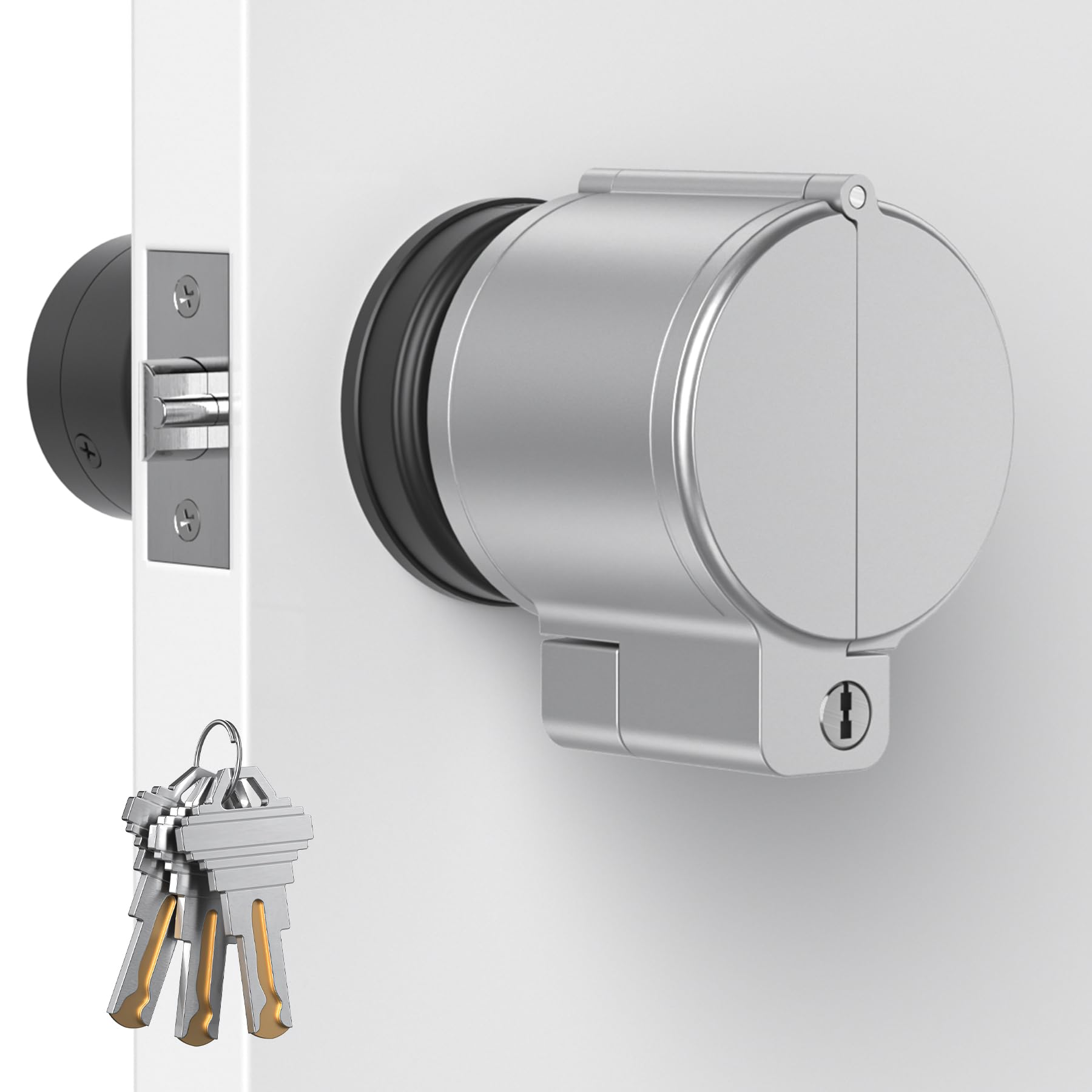
The AST Knob Lockout Device is a purpose-built metal shell that fits over a standard round doorknob and completely prevents rotation when locked. Unlike adhesive strap locks that patients can tear off, this diecast aluminum alloy cover encloses the entire knob with a wall thickness that resists prying. The adjustable locking bolt tightens around the neck of the knob, leaving only about 10mm of rotational play—not enough to actuate the latch.
This kit includes both a keyed lockout cover and a 4-digit resettable combination padlock, giving you two locking options in one package. The combination padlock is waterproof, making this suitable for exterior spigots or gates as well. Reviewers with dementia patients report that the device completely prevents nighttime wandering, and the product description specifically mentions use as “dementia door locks for elderly.” One caregiver called it the best money they ever spent for peace of mind.
The critical limitation is compatibility: this only works on round doorknobs, not lever handles. If your interior doors have levers, you will need to swap the hardware before installing this cover. Installation involves removing the existing knob screws, placing the cover, and tightening the bolt. It is not a permanent modification—the cover can be removed later.
Why it’s great
- Rugged metal build resists prying
- Includes both keyed and combination lock options
- Temporary installation, no permanent door damage
Good to know
- Only fits round doorknobs, not lever handles
- Not rated for high-security or determined intrusion
4. Buoan Keyless Entry Door Knob

The Buoan keypad door knob is designed specifically for interior doors—bedrooms, studies, basements—and brings keyless convenience to rooms where a deadbolt would be overkill. The backlit keypad is a standout feature for low-light conditions: the numbers illuminate when touched, making code entry visible in the dark without a flashlight. This is particularly useful for caregivers checking on a patient at night without turning on overhead lights.
The automatic locking retractor engages three seconds after the door closes, which cannot be turned off. This is a deliberate safety feature for dementia care—the door re-secures itself if the patient enters a room and closes the door behind them. The lock supports up to eight changeable codes with anti-spy encryption, and the exterior handle includes a backup battery port with an emergency power charger in the package. A physical key is also included for override.
Installation is simple with just a screwdriver, and it fits standard door prep. Note that the auto-lock function is fixed at three seconds—if you need a longer delay or want to disable auto-lock entirely, this is not the lock for you. Some users reported the internal motor failing after about a month, so consider this a secondary solution rather than a primary security door lock.
Why it’s great
- Backlit keypad perfect for nighttime use
- Fixed 3-second auto-lock for instant security
- Includes emergency battery backup port
Good to know
- Auto-lock cannot be disabled
- Motor reliability concerns reported in some units
5. Amazon Basics Electronic Keypad Deadbolt

The Amazon Basics keypad deadbolt delivers core electronic lock functionality at a price that beats nearly every competitor. It supports six user codes plus temporary single-use codes for visitors or therapists, and the automatic locking timer adjusts from 10 to 99 seconds—the same feature set found on deadbolts costing three times as much. The touch-control keypad is responsive, and the satin nickel finish blends with standard hardware.
For dementia care, the key advantage here is the price-to-feature ratio. You can outfit multiple doors—bedroom, basement, garage entry—for the cost of one premium lock. The auto-lock function eliminates the “did I lock it?” worry. The lock operates via keypad on the exterior and a thumb turn on the interior, so it is not fully keyless on the inside. A traditional key is also included for backup.
However, there are trade-offs. The interior housing is larger than name-brand alternatives, measuring roughly eight inches in length. Some users reported quality-control issues such as unthreaded screw holes or binding deadbolts. This lock works best as a secondary or budget solution rather than your sole security layer. If you need absolute reliability for a primary exit door, consider stepping up to the TEEHO.
Why it’s great
- Excellent value for multi-door installations
- Adjustable auto-lock timer
- Includes temporary guest codes
Good to know
- Quality control can be inconsistent
- Large interior housing may not suit all doors
6. BaoWei Privacy Door Lock 2‑Pack

The BaoWei Privacy Door Lock is a simple but effective frame-mounted latch that works exclusively on inward-swinging doors. The mechanism installs on the door frame rather than the door itself, leaving the door slab untouched. The design is similar to hotel privacy locks but built with thicker zinc alloy and longer screws for residential use.
For dementia care, this lock shines in scenarios where you need to prevent a patient from opening a specific door—such as a pantry, basement, or linen closet—without altering the main door hardware. The latch mounts high on the frame, out of the patient’s natural reach, and can be engaged or disengaged in seconds. The two-pack lets you secure two doors simultaneously, and the satin nickel finish matches standard door hardware.
The important limitation is that this only works on inward-swinging doors with a frame width greater than 1.5 inches and a flush surface. It is not suitable for outward-swinging doors, sliding doors, or metal frames. Installation requires drilling into the frame, but the included 3-inch stainless steel screws provide excellent holding power. Reviewers noted that upgrading to 4-inch screws adds even more security.
Why it’s great
- Does not alter the door slab
- Installs high out of patient reach
- Includes upgraded stainless steel screws
Good to know
- Only compatible with inward-swinging doors
- Requires minimum 1.5″ door frame width
7. SUMMIT DOORWARE Sliding Patio Door Lock

Sliding patio doors are a notorious elopement risk because standard sliding door latches are trivially easy to lift off the track. The SUMMIT DOORWARE lock solves this with a simple but robust design: a thick alloy steel peg that slides into a pre-drilled hole in the door frame, secured by a key-operated lock. When engaged, the pin physically prevents the door from sliding open, regardless of how much force is applied to the handle.
This lock has proven especially effective for families with dementia patients or children on the autism spectrum who exhibit wandering behavior. Reviewers consistently report that their loved ones could not defeat the lock despite significant effort. The white finish blends with most sliding door frames, and the key operation means only the caregiver can disengage it. The lock installs with basic drilling—a 5/16-inch bit for the pilot hole—and the peg mechanism is durable enough for daily use.
The key limitation is that this is a keyed lock, not a keyless system. If you lose the key or need emergency responders to open the door, the key must be accessible. Consider mounting a lockbox with a spare key near the door or keeping a key on your person at all times. This lock is not compatible with sliding glass doors that have existing integrated locks, so measure before purchasing.
Why it’s great
- Thick steel peg resists forced sliding
- Proven effective for elopement prevention
- Simple installation with basic tools
Good to know
- Requires key access for emergency entry
- Not for integrated-lock sliding doors
FAQ
Are keypad door locks safe for dementia patients or will they cause more confusion?
Can I install these locks on interior bedroom doors without damaging the door?
What should I do if emergency responders need to access a locked room?
How do I stop a dementia patient from unlocking a door with a thumb turn?
Will these locks work on French doors or double doors?
Final Thoughts: The Verdict
For most users, the door locks for dementia patients winner is the GlideLok 3‑Pack because its top-mounted metal design places the lock completely out of the patient’s reach while remaining fully accessible to caregivers from either side of the door. If you want keyless code convenience for your front door, grab the TEEHO TE001 for its 20-code capacity and adjustable auto-lock. And for a sliding patio door that is a known elopement risk, nothing beats the SUMMIT DOORWARE Sliding Door Lock with its thick steel peg that no confused patient can dislodge.

Mo Maruf
I created WellFizz to bridge the gap between vague wellness advice and actionable solutions. My mission is simple: to decode the research and give you practical tools you can actually use.
Beyond the data, I am a passionate traveler. I believe that stepping away from the screen to explore new environments is essential for mental clarity and physical vitality.