Our readers keep the lights on and my smoothie glass nicely filled. As an Amazon Associate, I earn from qualifying purchases.
Few caregiving moments are as jarring as realizing the front door has been silently opened by a loved one who shouldn’t be walking outside alone. The anxiety of nighttime wandering or unexpected exits can strip away the peace you need to rest, work, or simply breathe. A dedicated door alarm turns that silence into a clear, actionable alert—giving you back the time to respond before a situation escalates.
I’m Mohammad Maruf — the founder and writer behind WellFizz. I’ve spent hundreds of hours cross-referencing technical specs, caregiver feedback, and real-world performance data to identify which alert systems truly stand up to the unique demands of dementia care.
Navigating the options can feel overwhelming, but this guide cuts through the noise to help you find the right door alarms for dementia patients. I focus on the features that reduce false triggers, keep installation simple, and deliver alerts you can actually trust.
How To Choose The Best Door Alarms For Dementia Patients
The right alarm balances three things: reliable detection, an alert you can’t miss, and an experience that doesn’t startle the person you care for. Dementia-related wandering demands a system that triggers the instant a door is opened, not when movement is guessed. Below are the key decisions that separate effective systems from frustrating ones.
Sensor Type: Contact vs. Motion vs. Vibration
Contact sensors (magnetic) are the gold standard for door-specific detection because they only trigger when the door physically opens—no false alarms from passing traffic or pets. Motion sensors placed under a bed work well for detecting leg movement before a person stands, helping prevent falls during exit attempts. Vibration sensors attach directly to the door handle and react to the slightest touch or twist, making them useful for doorknobs that aren’t square with a standard magnetic sensor.
Alert Method and Volume Control
A chime that’s too soft gets ignored; an alarm that’s too loud can disorient the person with dementia and frustrate neighbors. Look for systems with adjustable volume (ideally from a low chime up to 120 dB or higher) and the option to pair a loud receiver with a silent vibrating pager. Some caregivers prefer a remote pager that vibrates in another room so the patient remains calm while the caregiver is instantly notified.
Range, Expandability, and Power Backup
If the receiver must sit in a distant bedroom or basement, verify the listed open-air range (260–918 feet is common) and consider obstructions like walls. Systems that accept multiple sensors (up to 20 per receiver) let you protect every external door plus windows with one receiver. Battery backup or a USB power option ensures the alarm still works during a power outage—a critical point when caring for someone who may wander at any hour.
Quick Comparison
On smaller screens, swipe sideways to see the full table.
| Model | Category | Best For | Key Spec | Amazon |
|---|---|---|---|---|
| Smart Caregiver Bed Exit Alarm | Premier | Bed exit + door monitoring | 300 ft pager range; 10×30 in pressure pad | Amazon |
| YisTech WiFi Door Alarm | Mid-Range | Remote app alerts across cities | 110 dB max; 2 sensor + gateway kit | Amazon |
| YisTech Caregiver Pager (3 Sensor 2 Receiver) | Mid-Range | Multi-door coverage with two receivers | 110 dB; 260 ft range; 58 ringtones | Amazon |
| Securityman Vibration Alarm | Premium | Doorknob-specific vibration detection | 130 dB max; sensitivity adjustable | Amazon |
| METAK Window and Door Alarm (5 Pack) | Value | Budget multi-point coverage | 120 dB; 5 pack; 90/120 dB switch | Amazon |
| Philips Personal Security Alarm (4 Pack) | Value | Simple chime/alarm for multiple doors | 120 dB; 4 pack; chime or alarm mode | Amazon |
| Nesthao Bed Sensor Alarm & Pager | Value | Bed exit detection + door monitoring | 918 ft range; motion + door sensor | Amazon |
In‑Depth Reviews
1. Smart Caregiver Bed Exit Alarm with Wireless Pager
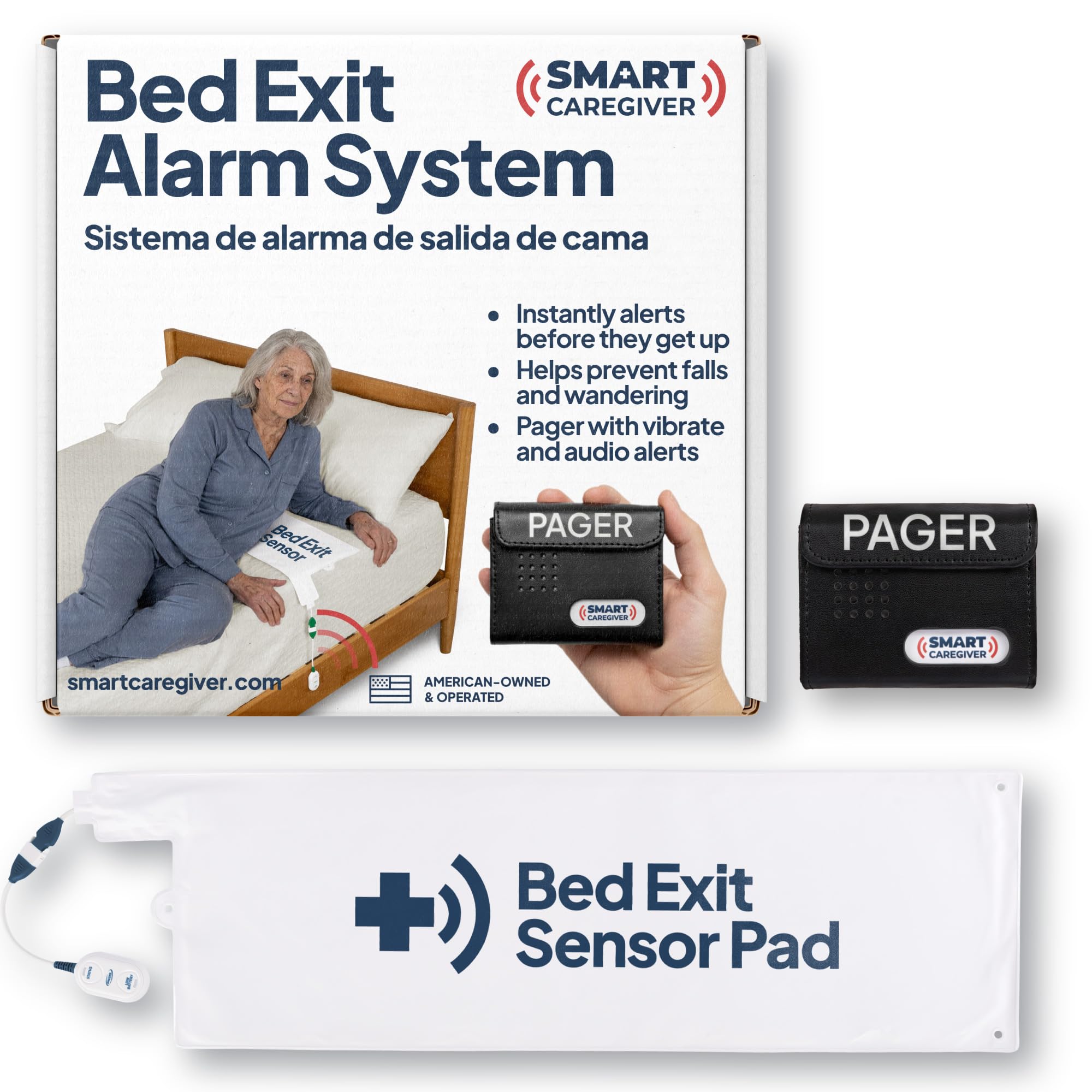
This system from a U.S.-based company with three decades of fall prevention experience stands apart because it doesn’t rely on motion or contact sensors at the door alone. The large 10×30-inch weight-sensing pad sits under the patient’s shoulders and detects when they begin to sit up or leave the bed, giving you an alert before they ever reach the door. The pager offers both audible and vibrate modes, so you can choose a silent vibration during nighttime hours to avoid disorienting the sleeper.
The pager pairs with up to six Smart Caregiver sensors, meaning you can build a network that includes chair pads, floor mats, and additional door exit sensors under one receiver. The range is a solid 300 feet through typical home conditions, and the pad’s full-coverage design significantly reduces false alarms that plague smaller pressure points. The pad’s durability wipes clean easily and stays functional through regular use.
The main trade-off is the price—this is a premium investment. Also, the pad can shift under sheets if not checked daily; caregivers recommend using double-sided tape on the mattress to keep it centered. The tone is limited to a single doorbell-like chime, but the vibrate option effectively compensates for hearing sensitivity needs.
Why it’s great
- Proactive bed exit detection catches wandering before the door opens
- Expandable to six sensors for full-room coverage
- Vibrate pager mode preserves patient sleep and avoids startling
- Trusted U.S. company with responsive customer support
Good to know
- Premium price point reflects the specialized pressure-pad design
- Pad must be repositioned daily to avoid shifting and false triggers
- Only one alert melody available on the pager
2. YisTech WiFi Smart Door Sensor Alarm

When you need to know remotely that a door has been opened—whether you’re in the next room or in another city—this WiFi-enabled system delivers. The gateway plugs into an outlet and pairs with two included door sensors. When the door opens, the gateway sounds up to 110 dB while simultaneously pushing a notification to your smartphone via the free app. This dual alert path is invaluable for caregivers who work outside the home or sleep in a distant part of the house.
The app also handles sharing with other family members, so everyone on the care team gets the same instant alert. You can choose from 32 ringtone options and five volume levels, including silent mode for when you want only the phone alert. Multiple caregivers report that it works reliably across states, providing peace of mind during work hours or overnight trips. The adhesive holds well on clean surfaces, though some users opt to nail the sensor frame in humid garages.
Beware that the sticky tape can fail in damp environments, and the sensor’s battery type (12V) is less common than standard AA or AAA cells. The WiFi connection depends on your home network stability, and the initial pairing process requires following the manual step by step. A few users note that the app notifications can be slightly delayed during moments of poor WiFi signal.
Why it’s great
- Remote push notifications reach you anywhere with cellular data
- 32 ringtones plus five adjustable volume levels
- Expandable with additional sensors and receivers
- Share alerts with multiple family members through the app
Good to know
- Requires stable WiFi; sensor may not pair in dead zones
- Adhesive tape can fail in humid or outdoor locations
- Less common 12V batteries may be harder to find locally
3. YisTech Caregiver Pager (Three Sensor Two Receiver)

This bundle is designed for caregivers who need to monitor multiple doors without opening a phone app or relying on WiFi. The package includes three door sensors and two plug-in receivers, letting you cover the front door, back door, and a bedroom exit with two independent alert stations. Each receiver supports up to 20 sensors, so you can add more doors, windows, or even a garage door as needs grow.
The highlight is the massive selection of 58 ringtones, which allows you to assign a unique chime to each sensor. You’ll instantly know which door opened without looking at a receiver. Volume adjusts from 0 dB (silent) to 110 dB, and the receiver’s built-in LED indicator flashes to assist hearing-impaired caregivers. The 260-foot range covers most single-family homes, and the plug-in design means you never worry about receiver battery life.
Some users report that the chime selection defaults back to a main tone after a period of inactivity, requiring a re-selection. The sensor batteries (12V) are not as common as standard cells, so keeping a spare set on hand is wise. The adhesive is functional but may need reinforcement with a small screw or tape on rough surfaces.
Why it’s great
- Three sensors cover multiple doors right out of the box
- 58 distinct ringtones let you identify each door by sound
- Two receivers provide alerts in separate rooms
- Expandable to 20 sensors per receiver
Good to know
- Custom ringtone selection may reset after power interruptions
- Uses less common 12V batteries in the sensors
- Adhesive may not hold on rough or textured door frames
4. Securityman Door Handle Vibration Alarm (2 Pack)

This alarm uses a different philosophy: it attaches directly to the doorknob and triggers on vibration rather than magnetic separation. For doors where a standard contact sensor can’t fit—oversized handles, sliding doors, or unusual frames—this is the solution. The 130 dB alert is ear-splittingly loud, designed to both alert you and potentially deter the person from continuing to manipulate the door.
You get two alarms in the pack, each with adjustable sensitivity and two alarm modes (30-second or continuous). The sensitivity tuning is crucial for dementia settings: set it too high, and footsteps or passing trucks may trigger a false alarm; set it just right, and only a deliberate handle twist sets it off. The package includes 9V batteries, wall-mounting screws, and a simple hang-on-the-knob design that requires zero installation.
The main drawback is that some units arrive overly sensitive out of the box, causing false alarms. The sensitivity dial requires patient trial-and-error to nail the sweet spot. Also, the continuous alarm mode can be startling for the person with dementia, so the 30-second timed mode is often the safer choice. For travel or temporary use on a secondary door, the ease of setup is hard to beat.
Why it’s great
- Works on any doorknob type including sliding and French doors
- 130 dB alarm is among the loudest in this category
- Two alarm modes and adjustable sensitivity for fine-tuning
- No installation needed—hangs on the handle instantly
Good to know
- Sensitivity dial requires careful adjustment to avoid false triggers
- Continuous alarm can startle the patient if not set to timed mode
- Some units may ship with overly sensitive sensors
5. METAK Window and Door Alarm (5 Pack)
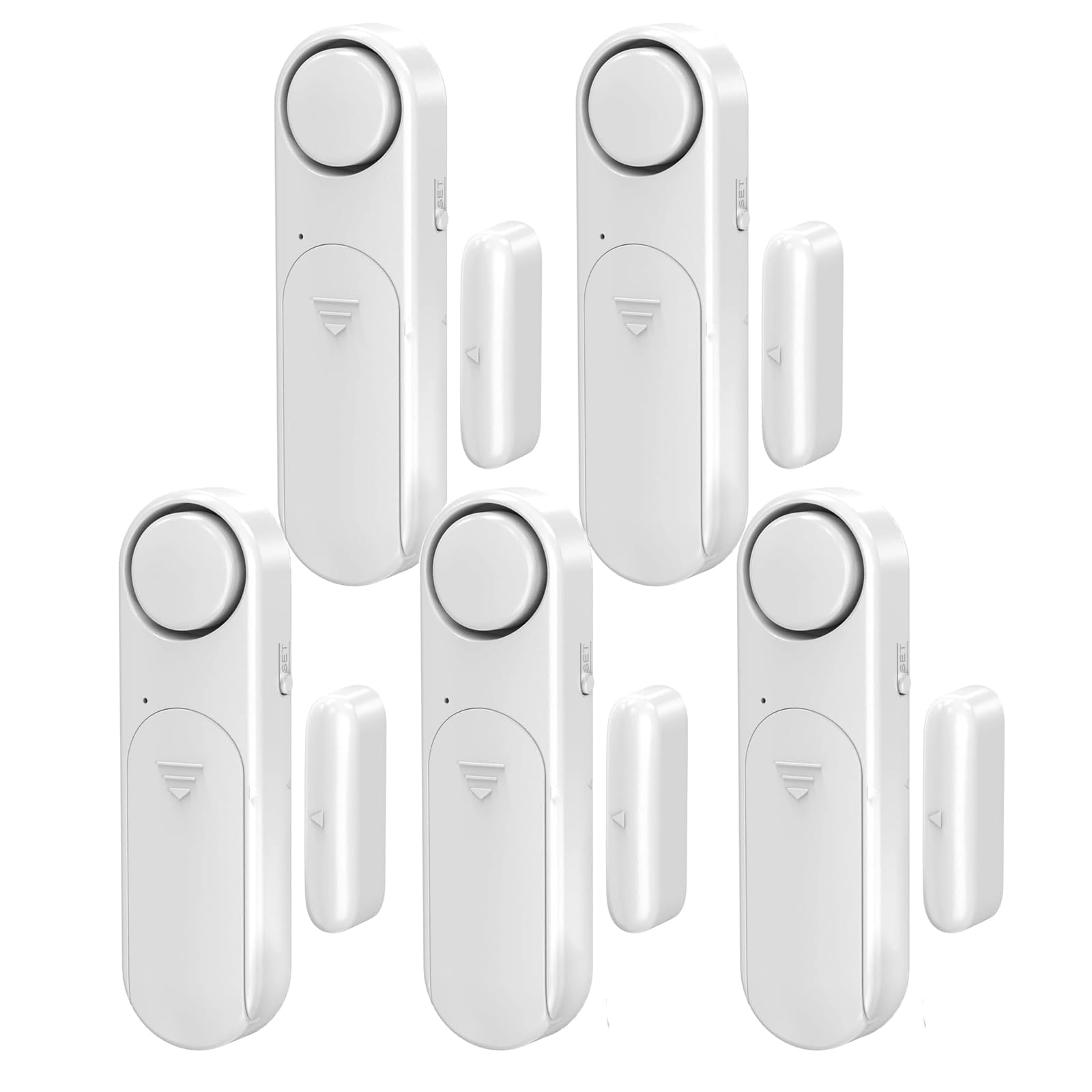
If you need to secure multiple doors on a tight budget, this five-pack delivers simple contact-sensor logic without any wireless pairing or app setup. Each unit is self-contained: the magnetic sensor and alarm are integrated into one small white unit. When the door opens, the magnet separates, and the internal speaker blasts a 120 dB tone. You can switch between 90 dB and 120 dB on each unit individually.
Installation is peel-and-stick adhesive—place the main unit on the door frame and the smaller magnet on the door itself. The adhesive holds well on clean, flat surfaces, and the low-profile design fits on narrow window sashes and cabinet doors, not just main entry points. The battery compartment takes two AAA batteries per unit (not included), and a red LED flashes both when the alarm triggers and when batteries run low.
The trade-off is that each alarm operates independently—there is no central receiver or remote pager. You must be within earshot of the specific door to hear the alert. Also, the alarm mode is fixed: there’s no chime-only option, so every activation produces the full 120 dB or 90 dB siren. For caregivers who sleep deeply or have a large home, this limitation may be a real concern.
Why it’s great
- Five units cover multiple doors at a very low cost per sensor
- Switchable 90 dB and 120 dB volume levels
- Easy peel-and-stick installation with no wires
- Low battery LED indicator on each unit
Good to know
- No remote pager or central receiver—must be in earshot
- Only siren mode; no chime or gentle alert option
- Requires AAA batteries per unit (not included)
6. Philips Personal Security Window and Door Alarm (4 Pack)
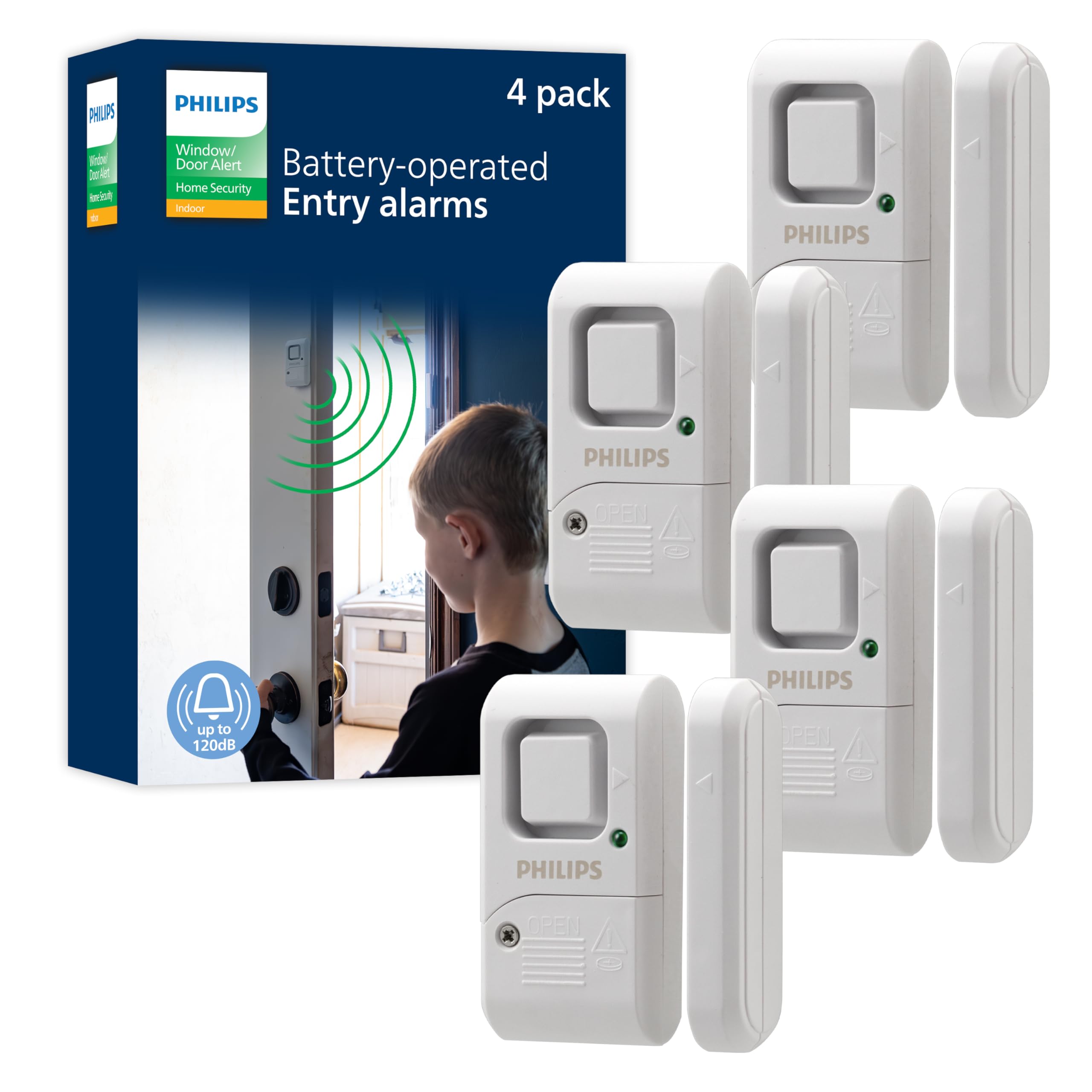
Philips brings its brand reliability to this four-pack of self-contained contact alarms. The distinguishing feature here is the three-position switch on the side of each unit: Off, Chime, and Alarm. The chime mode sounds a pleasant doorbell-like ding-dong when the door opens—perfect for daytime when you just want to know someone entered or exited without the shock of a full siren. Flick to alarm mode, and the unit jumps to 120 dB.
Caregivers of deaf parents with dementia have reported installing these on the main entry door and switching to the high-volume alarm, which they can hear from across the house. The chime mode is also excellent for monitoring general traffic flow without alarming the person with dementia. Each unit comes with four LR44 button batteries installed, a battery test button, and a low-battery indicator LED. The adhesive mounting is wire-free and takes about two minutes per door.
The button cell batteries are a double-edged sword: they are included and last a reasonable time, but they cannot be replaced by common household batteries. When they die, you’ll need to source LR44 or equivalent coin cells. The alarm volume is fixed at 120 dB when in alarm mode—no volume dial. A few users wish the chime mode were a bit louder for larger homes.
Why it’s great
- Chime mode offers a gentle, non-startling alert for daytime use
- Simple three-position switch for Off/Chime/Alarm on each unit
- Batteries included, test button, and low-battery indicator
- Trusted Philips brand with solid build quality
Good to know
- Uses hard-to-find LR44 button cells; not replaceable with standard types
- Alarm volume is fixed at 120 dB with no adjustment
- Chime volume may be too soft for very large or noisy homes
7. Nesthao Bed Sensor Alarm and Caregiver Pager

This system bridges the gap between a bed exit alarm and a door alarm in one affordable package. The motion sensor can sit on the floor under the bed, pointing upward to detect leg movement as the patient’s foot lowers toward the ground. When it registers motion, it transmits wirelessly to the included caregiver pager, which can sit in another room. The same sensor can be repositioned to a door frame to monitor for door openings, making it a versatile two-in-one.
The open-air range is impressive at 918 feet, easily covering large homes, multi-story layouts, and even short distances between a detached garage and the main house. The pager offers five volume levels plus both LED and sound alerts, which helps hearing-impaired caregivers. Power options are flexible: the sensor runs on three AAA batteries, and the pager runs on three AA batteries, with a micro USB backup port on the sensor for continuous power.
Some users note that the motion sensor’s detection beam is wide and cannot be narrowed, which can lead to false alerts if positioned near a door or a high-traffic hallway. Several reviewers also report that the lowest volume setting is still quite loud compared to other systems, and the bright LED strobe effect on the pager can be overstimulating for some caregivers. A few units have shown button durability issues after extended use.
Why it’s great
- One sensor works as both a bed exit monitor and a door alarm
- Excellent 918-foot range covers large homes and multi-story layouts
- Dual power: battery plus micro USB backup
- Five volume levels with LED and sound alerts for hearing-impaired
Good to know
- Wide detection beam can cause false alarms near hallways or doorways
- Lowest volume may still be too loud for some caregivers
- Build quality concerns reported on the physical power button
FAQ
Should I choose a contact sensor or a motion sensor for dementia wandering prevention?
Will a loud 120 dB alarm frighten my loved one with dementia?
Do I need a WiFi-enabled alarm if I’m home most of the day?
Final Thoughts: The Verdict
For most users, the door alarms for dementia patients winner is the Smart Caregiver Bed Exit Alarm because it catches wandering at the earliest possible moment—when the person begins to leave the bed—using a pressure pad that feels natural under the sheets. If you want remote alerts to your phone while you’re away from home, grab the YisTech WiFi Door Sensor Alarm. And for affordable multi-door coverage without complexity, nothing beats the METAK five-pack for covering every exit on a budget.

Mo Maruf
I created WellFizz to bridge the gap between vague wellness advice and actionable solutions. My mission is simple: to decode the research and give you practical tools you can actually use.
Beyond the data, I am a passionate traveler. I believe that stepping away from the screen to explore new environments is essential for mental clarity and physical vitality.