Our readers keep the lights on and my smoothie glass nicely filled. As an Amazon Associate, I earn from qualifying purchases.
That moment in a film when a helicopter passes directly overhead — not just from left to right, but from front to back and over your head — is the promise of a true Dolby Atmos surround sound system. It demands a specific array of upward-firing or ceiling-mounted speakers working in concert to place audio objects in a three-dimensional space, creating a dome of sound that traditional 5.1 setups simply cannot achieve.
I’m Mohammad Maruf — the founder and writer behind WellFizz. I focus on deep market analysis and hardware specification breakdowns to help buyers navigate the complex world of multi-channel home theater audio.
After hours of researching speaker configurations, amplifier wattages, subwoofer sizes, and real-world performance across dozens of systems, this guide cuts through the noise to help you find the ideal dolby atmos surround sound system for your room and your budget.
How To Choose The Best Dolby Atmos Surround Sound System
Selecting a Dolby Atmos system means evaluating not just overall sound quality but specifically how the system handles height channels. The physical design of the up-firing drivers, the number of dedicated amplification channels, and the subwoofer’s low-frequency extension all determine whether the system creates a convincing three-dimensional soundstage or simply adds a hint of ambience overhead. Room size, furniture layout, and the decision between a soundbar or a traditional passive-speaker setup further narrow the field.
Channel Configuration: The Language of Atmos
The first number in a channel configuration (like 5.1.4 or 7.1.2) represents the traditional surround channels at ear level. The second number is the subwoofer channel. The third — and most critical for Atmos — is the number of height or overhead channels. A 5.1.4 system has four dedicated drivers for height effects, offering significantly better overhead imaging than a 5.1.2 system, which has only two. For a genuinely immersive bubble of sound, prioritize at least two height channels; four is ideal for large or open-plan rooms.
Up-Firing vs. Down-Firing: The Speaker Driver Dilemma
Up-firing speakers bounce sound off the ceiling to create the illusion of height. This works best in rooms with flat, acoustically reflective ceilings between 7.5 and 9 feet high. Down-firing or in-ceiling speakers, which are used in dedicated home theater builds, produce a taller, more precise height layer but require in-wall wiring and installation labor. Soundbar-based Atmos systems overwhelmingly use up-firing drivers; traditional receiver-and-speaker packages offer both options. If your ceiling is vaulted, textured, or higher than 10 feet, up-firing drivers lose effectiveness, and a system with dedicated height channels becomes essential.
Subwoofer Size and Room Dynamics
A good Atmos system delivers bass you feel as much as hear. Subwoofer driver diameter — 8 inches, 10 inches, or 12 inches — correlates with the ability to move air and reproduce the lowest frequencies (below 40 Hz). An 8-inch sub is sufficient for small to medium-sized rooms (up to 300 square feet), while a 10-inch or 12-inch sub is necessary for larger spaces. Systems with dual subwoofers offer smoother bass distribution across multiple seating positions without the “one-note” boom that a single subwoofer can produce in an untreated room.
Connectivity and Passthrough Capabilities
HDMI eARC (enhanced Audio Return Channel) is the gold standard for connecting a soundbar or AV receiver to a modern television, as it supports lossless Dolby Atmos and DTS:X bitstreams. For gaming, look for HDMI 2.1 ports that support 4K 120Hz passthrough and VRR (Variable Refresh Rate). Optical and 3.5mm aux connections are fallback options and cannot carry object-based Dolby Atmos metadata. If your TV lacks eARC, verify that the sound system can decode Atmos via HDMI input directly from your source devices.
Quick Comparison
On smaller screens, swipe sideways to see the full table.
| Model | Category | Best For | Key Spec | Amazon |
|---|---|---|---|---|
| Samsung Q990D | Soundbar System | Complete all-in-one Atmos | 11.1.4 ch with rear speakers | Amazon |
| Sonos Arc Ultra | Soundbar System | Ecosystem expandability | 9.1.4 ch with Sound Motion tech | Amazon |
| Nakamichi Shockwafe Ultra 9.2.4 | Soundbar System | Bass enthusiasts | Dual 10″ subs, four surrounds | Amazon |
| JBL Bar 1300XMK2 | Soundbar System | Flexible detachable surrounds | 11.1.4 ch, 12″ sub, 1570W | Amazon |
| LG S95TR | Soundbar System | LG TV integration | 9.1.5 ch with center up-firing | Amazon |
| Bose Home Theater System | Component System | Premium brand bundle | Soundbar + Bass 700 + surrounds | Amazon |
| JBL Bar 700MK2 | Soundbar System | Mid-range with detachable rears | 7.1 ch, 10″ sub, 780W | Amazon |
| Sony BRAVIA Theater System 6 | Soundbar System | Clear dialogue priority | 5.1 ch with dedicated center | Amazon |
| TCL Q85H | Soundbar System | Value-packed performance | 7.1.4 ch, 860W, AI Sonic | Amazon |
| ULTIMEA Skywave X50 | Soundbar System | Wireless and compact | 5.1.4 ch, 760W, GaN amp | Amazon |
| Klipsch Reference Cinema Dolby Atmos 5.1.4 | Passive Speaker System | Traditional receiver upgraders | Four Atmos satellite speakers | Amazon |
In‑Depth Reviews
1. Samsung Q990D 11.1.4ch Soundbar

The Samsung Q990D represents the current benchmark for a complete, all-in-one Dolby Atmos soundbar system. Its 11.1.4 channel configuration — featuring 11 forward-firing drivers, a single wireless subwoofer, and four up-firing channels — delivers a dome of sound that rivals many passive-speaker setups. The included rear speaker kit has three drivers per satellite: a forward-firing, a side-firing, and an upward-firing driver, which creates dense surround layers and convincing overhead effects.
Wireless Dolby Atmos functionality allows the system to receive a lossless 3D audio signal from a compatible Samsung TV without an HDMI cable, reducing clutter while maintaining sound quality. SpaceFit Sound Pro automatically calibrates the audio to the room’s acoustics using built-in microphones. Adaptive Sound and AVA (Active Voice Analyzer) ensure dialogue remains crisp even during action-heavy scenes, which is a common pain point in lower-tier systems.
Game Mode Pro syncs with compatible Samsung TVs to enable automatic low-latency mode and optimizes the driver array for 3D gaming audio. The subwoofer, while not the largest at approximately 8 inches, produces tight, controlled bass that integrates well without overwhelming the mids. Occasional audio dropouts over eARC have been reported by some users, but firmware updates and switching to standard ARC (with a minor quality trade-off) typically resolve the issue.
Why it’s great
- Full 11.1.4 channel Atmos with included rear speakers — no add-ons needed out of the box
- Q-Symphony allows the soundbar to work in harmony with compatible Samsung TV speakers for a wider soundstage
- SpaceFit Sound Pro adapts the sound field to your specific room geometry automatically
Good to know
- Some users report random audio dropouts over eARC; using standard ARC can serve as a workaround
- Firmware updates via USB are recommended over automatic network updates to avoid stability hiccups
- Best performance is achieved when paired with a Samsung TV for Q-Symphony and wireless Atmos
2. Sonos Arc Ultra Soundbar

The Sonos Arc Ultra utilizes a completely new acoustic architecture called Sound Motion technology, which uses dual force-cancelling woofers to deliver deeper bass than a typical soundbar without adding bulk. This 9.1.4 channel soundbar creates a wide, immersive soundstage that precisely places audio objects in three-dimensional space. The system uses spatial mapping algorithms to process Dolby Atmos metadata and direct sound beams for overhead effects even in rooms with non-ideal ceiling angles.
AI-powered Speech Enhancement detects human voices within the mix and clarifies dialogue independently from the rest of the soundtrack, which is a distinct advantage over systems that simply boost the center channel. The Arc Ultra supports Trueplay tuning, which uses the built-in microphones to measure room acoustics and adjust frequency response accordingly. Control is handled through the Sonos app, touch controls, TV remote (via HDMI CEC), Sonos Voice Control, or Amazon Alexa.
The Arc Ultra is the centerpiece of a modular ecosystem. Adding a Sonos Sub (third-generation or newer) and a pair of Era 300 speakers as rear surrounds transforms the system into a true 9.1.4 setup with dedicated side and upward-firing drivers in the rears. This expandability is unmatched in the soundbar category, though the total cost scales quickly. For streaming, the Arc Ultra supports WiFi, Bluetooth, Apple AirPlay 2, and Spotify Connect, making it ideal for multi-room audio setups.
Why it’s great
- Sound Motion technology provides deep, room-filling bass from the soundbar alone
- Modular design allows adding genuine rear surround speakers (Era 300) for a true 9.1.4 experience
- AI Speech Enhancement ensures clear dialogue without affecting the rest of the soundstage
Good to know
- Optimal Dolby Atmos performance requires the addition of a Sub and Era 300 speakers, which increases total investment
- No HDMI input for source devices; relies solely on HDMI eARC connection to the TV
- Trueplay calibration requires an iOS device for initial setup; the app can be used for fine-tuning on Android
3. Nakamichi Shockwafe Ultra 9.2.4

The Nakamichi Shockwafe Ultra 9.2.4 is an anomaly in the soundbar category: it ships with dual 10-inch wireless subwoofers and four modular surround speakers, a configuration that is typically the domain of passive-speaker home theater systems. The dual-subwoofer design minimizes bass localization, meaning no single seating position gets a “boomy” corner bass peak while another gets a thin, hollow low end. Total peak power is rated at 1300 watts, which is substantial enough to fill a large media room without strain.
The system uses SSE MAX processing to decode Dolby Atmos and DTS:X audio tracks and map them to the driver array. The four surround speakers are modular: they can be used individually as four separate satellites or attached to dipole mounts for a more diffuse, enveloping surround effect. Each surround speaker connects to its respective subwoofer via an RCA cable, which offers superior signal integrity compared to a fully wireless connection but does require running cables. The soundbar includes three HDMI inputs and one HDMI eARC output with Dolby Vision and 4K HDR pass-through.
Dialogue clarity is notably strong, with the center channel handling vocal frequencies with minimal bleed into the left and right channels. The subwoofers integrate well with the soundbar, producing bass that is felt physically — during explosion-heavy scenes, the low-end pressure is palpable — without muddying the mid-range. The included remote has a backlit keypad, which is a thoughtful detail for darkened home theater rooms. Some users report minor static from the surround speakers when no audio is playing, and the power cable for the subwoofer uses a non-angled connector that may protrude from a wall socket.
Why it’s great
- Dual 10-inch subwoofers deliver exceptionally even, distortion-free bass across a wide seating area
- Four modular surround speakers allow a true 360-degree sound field with precise object placement
- Includes all necessary cables, wall mounts, and a comprehensive setup guide out of the box
Good to know
- Surround speakers connect to their respective subs via RCA cable, not fully wireless
- Soundbar dimensions (45.5 inches wide) require a large TV stand or furniture piece
- Some users report a hiss or static from the surround speakers during quiet passages
4. JBL Bar 1300XMK2 11.1.4 Channel
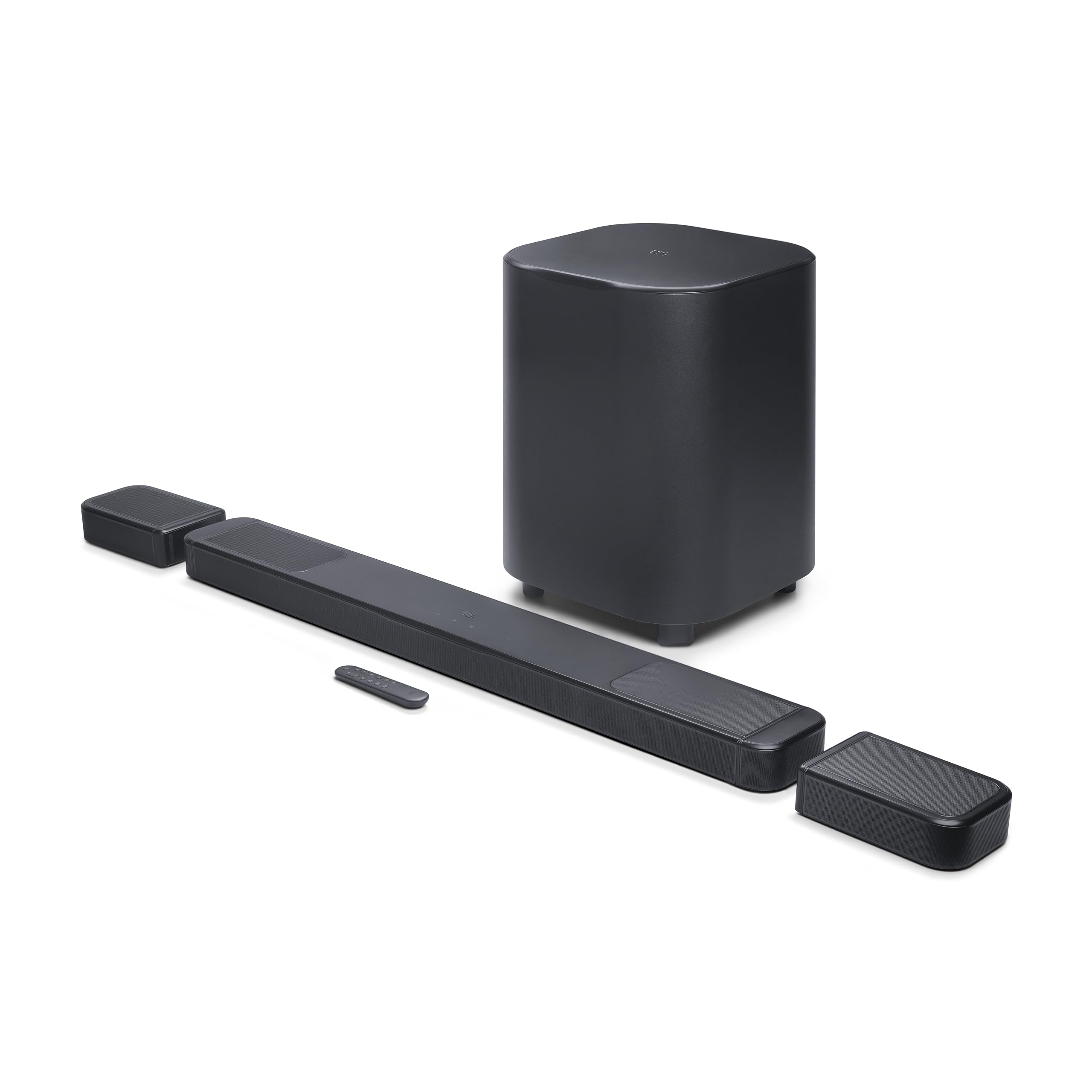
The JBL Bar 1300XMK2 takes the detachable wireless surround speaker concept and scales it up dramatically. The system features a main soundbar with six up-firing drivers — three in the bar itself and three across the two detachable rear modules — for a total of 11.1.4 channels. The detachable speakers have rechargeable batteries that last approximately four to five hours per charge, and they dock magnetically back onto the soundbar for recharging, eliminating the need for wall outlets near the rear seating positions.
The included 12-inch wireless subwoofer is the largest driver in any soundbar system at this tier, capable of producing low-frequency extension down to about 30 Hz. Total peak output is rated at 1570 watts, the highest among the systems tested here. MultiBeam 3.0 technology uses beamforming to create a wide soundstage that compensates for less-than-ideal speaker placement, and PureVoice 2.0 enhances dialogue intelligently based on both the ambient sound level in the scene and the overall system volume. The system also supports DTS:X for object-based audio from that competing format.
A unique Broadcasting feature allows you to bring one or both of the detachable speakers with you to another room — while in the kitchen or on a patio, for instance — and hear the same audio that is playing in the main room. The JBL ONE app provides a precise equalizer for fine-tuning and access to streaming services. The system’s overall sound signature is forward and impactful, favoring an exciting presentation for movies and games. At this tier, the soundbar alone is the brain of the system, so all audio sources still connect through the main bar via HDMI eARC or optical.
Why it’s great
- 12-inch subwoofer delivers truly physical low-frequency output that fills a large room
- Detachable rechargeable rear speakers offer true wireless convenience without any cable management
- Broadcasting feature allows portable audio away from the main listening area
Good to know
- Rear speaker battery life is limited to 4-5 hours; requires overnight charging after each use
- At this price point, the lack of a dedicated center-channel dialogue driver inside the soundbar is noticeable at low volumes
- System is best suited for medium to large rooms; in smaller spaces, the subwoofer may overwhelm
5. LG S95TR 9.1.5-Channel Soundbar

The LG S95TR is engineered specifically for integration with LG OLED and QNED televisions, using WOW Orchestra to synchronize the TV’s built-in speakers with the soundbar for an expanded soundstage. Its channel configuration is 9.1.5, with the “.5” representing an industry-exclusive center up-firing driver that focuses specifically on dialogue clarity from above the screen. This driver does not create a separate overhead channel for effects; instead, it anchors vocal frequencies in the center of the sound field, reducing the sensation of dialogue coming from below the TV.
The rear speakers feature both forward-firing and up-firing drivers, and they pair with the subwoofer wirelessly using a dedicated 5 GHz connection. WOWCAST allows wireless transmission of Dolby Atmos audio from a compatible LG TV to the soundbar, eliminating the need for an HDMI cable between the TV and the bar. Advanced Room Calibration uses the built-in microphone to measure distances and adjust timing and frequency response for the specific seating positions. The system supports VRR and ALLM with 4K 120Hz passthrough, making it an excellent choice for gamers with LG TVs and next-gen consoles.
The subwoofer is discrete and compact for an 8-inch driver, producing clean, articulate bass rather than overwhelming low-end. Sound quality out of the box may require some adjustment through the LG ThinQ app, particularly raising the center channel input level for dialogue. The system is not as physically imposing as the JBL 1300 or Nakamichi Ultra setups, but for users committed to the LG ecosystem, the integration advantages are real: one remote controls both TV and soundbar settings, and the WOW Interface displays soundbar controls directly on the TV screen.
Why it’s great
- WOW Orchestra combines TV and soundbar speakers for a wider, more seamless soundstage
- Center up-firing driver improves dialogue intelligibility by anchoring voices to the screen
- WOWCAST enables wireless Dolby Atmos from compatible LG TVs without an HDMI cable
Good to know
- Best value is typically realized when purchased on sale; full retail pricing can feel high relative to competing systems
- Dialogue clarity may require manual adjustment of the center channel volume in the ThinQ app
- Wireless rear speakers are larger than expected and require a stable, flat surface near an outlet
6. Bose Home Theater System (Ultra + Bass 700 + Surrounds)
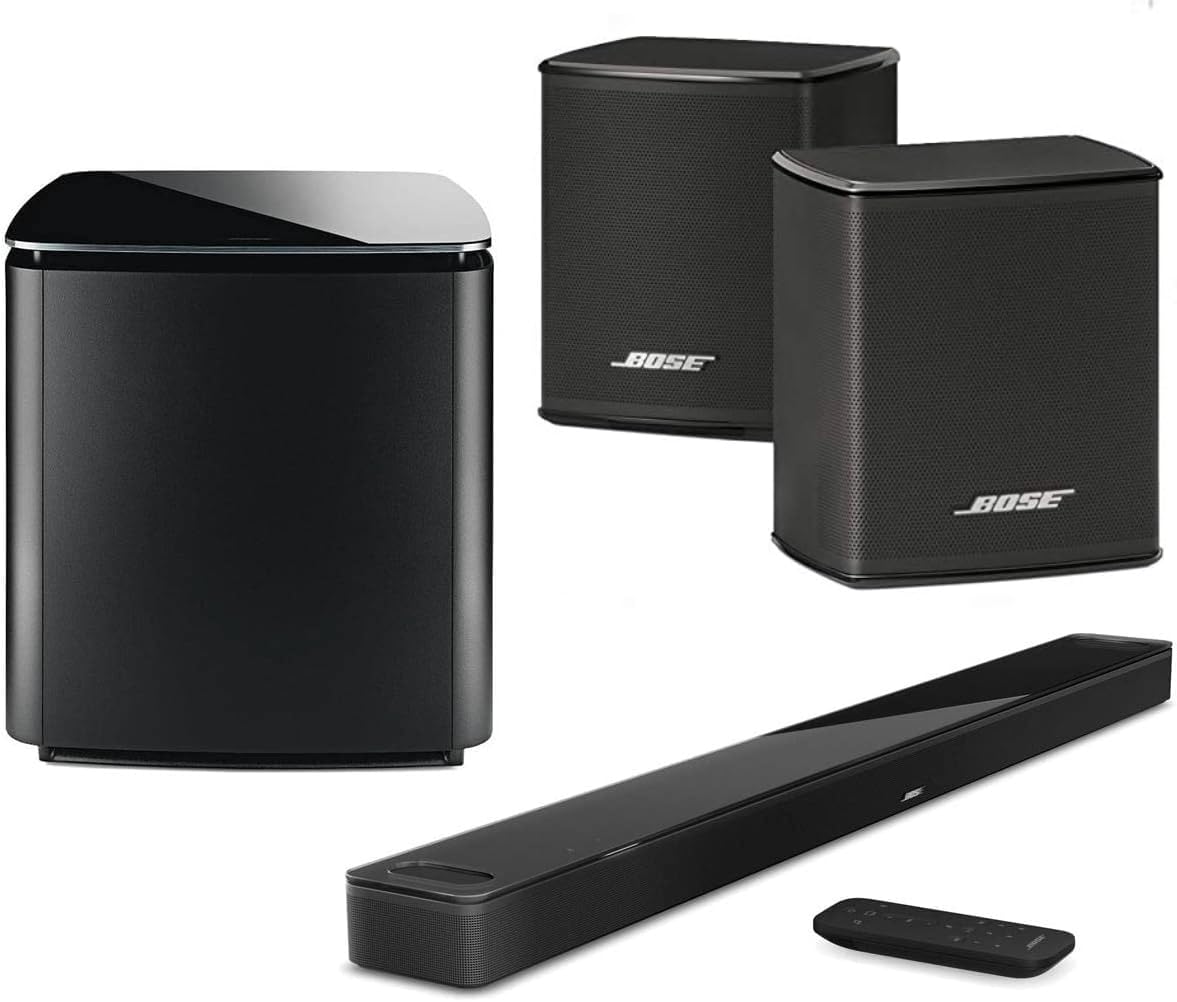
This Bose Home Theater System bundles the Smart Ultra Dolby Atmos Soundbar, the Bass Module 700, and two wireless surround speakers into a single complete package. The soundbar itself is a 5.0 design that uses PhaseGuide and spatial mapping to simulate height channels rather than relying on physical up-firing drivers. The result is a very wide soundstage with surprisingly good overhead imaging for a system that does not fire drivers at the ceiling. Dialogue is separated clearly from effects, and the system handles complex Dolby Atmos mixes without sounding congested.
The Bass Module 700 uses a dual-opposed driver configuration — two 5.2-inch woofers positioned to cancel cabinet vibration — which produces deep, distortion-free bass that integrates seamlessly with the soundbar. The wireless surround speakers are small and unobtrusive, connecting directly to the soundbar over a proprietary wireless protocol. They do not need a wired connection to a subwoofer or an external receiver. Setup through the Bose Music app takes approximately five minutes, and ADAPTiQ room calibration uses the included headset to measure the room’s acoustic characteristics.
Voice control options include both Amazon Alexa and Google Assistant built into the soundbar, and Voice4Video technology lets you control TV power, input switching, and volume through voice commands. The HT-S700 subwoofer can occasionally sound “woofy” when the bass level is set above 50 percent during bass-heavy content, but this is a minor quibble in an otherwise polished system. The main drawback is the reliance on firmware updates via Wi-Fi, which can sometimes fail and temporarily disable the system. A wired Ethernet connection during setup can mitigate this risk.
Why it’s great
- True plug-and-play wireless surround speakers with no subwoofer cable required
- Bass Module 700 uses dual-opposed drivers for clean, low-distortion bass with minimal cabinet vibration
- ADAPTiQ room calibration tailors the sound field to your specific room geometry
Good to know
- Firmware update failures can render the system temporarily unusable; hardwiring Ethernet during setup is recommended
- The Bass Module 700 can sound “woofy” on high-bass content if the level is set too aggressively
- Simulated height channels may not match the specificity of physical up-firing drivers in dedicated Atmos content
7. JBL Bar 700MK2 7.1-Channel System

The JBL Bar 700MK2 is a 7.1-channel system that uses the same core detachable wireless surround speaker concept as its bigger sibling, the Bar 1300XMK2. The main soundbar houses drivers for the left, center, and right channels, along with virtual height processing to deliver Dolby Atmos effects. Two detachable speakers pop off from the sides of the bar and can be placed behind the listening position to create true rear surround sound. The system uses a 10-inch wireless subwoofer rated at 780 watts peak, providing strong, punchy bass for medium-sized rooms.
MultiBeam 3.0 calibration measures how sound reflects off the walls and furniture to optimize the beamforming pattern for the specific room layout. PureVoice 2.0 is the standout feature here: it analyzes the scene’s audio mix and the current volume level to boost dialogue frequencies without making them sound artificial or tinny. The Night Listening mode mutes the soundbar and subwoofer and routes audio only to the detachable speakers placed in front of you for quiet, personalized listening. Detachable speaker battery life is long enough to last through a full movie marathon, and the speakers recharge automatically when docked.
The system supports AirPlay 2, Google Cast, Spotify Connect, and Tidal Connect, making it platform-agnostic for music streaming. Voice assistant support includes Amazon Alexa, Google Assistant, and Apple Siri through the connected smart device. Compared to the Bar 1300XMK2, the 700MK2 trades some channel count — it lacks the dedicated up-firing drivers in the rear speakers — but retains the same user-friendly design philosophy. This system is ideal for users who want Dolby Atmos functionality with the convenience of detachable surrounds but do not need the absolute highest channel count or subwoofer size.
Why it’s great
- Detachable wireless surround speakers offer true rear channel audio without any cables or wall outlets
- PureVoice 2.0 automatically enhances dialogue based on ambient scene level and system volume
- Night Listening mode allows personalized quiet viewing through the detachable speakers alone
Good to know
- Rear speakers lack physical up-firing drivers, limiting overhead effects to beamforming and virtual processing
- Surround sound from the rear speakers can feel slightly low in volume even at maximum setting
- No dedicated center channel driver in the soundbar, so dialogue clarity relies on digital processing rather than hardware separation
8. Sony BRAVIA Theater System 6 (HT-S60)

The Sony BRAVIA Theater System 6, model HT-S60, is a 5.1-channel package that emphasizes dialogue clarity above all else. The soundbar incorporates a dedicated center-channel speaker, which is a rarity in soundbars at this price tier, allowing the system to physically separate vocal frequencies from the left and right channels. This hardware design choice significantly reduces the “muffled dialogue” complaint that plagues many entry-level Atmos systems. The two rear speakers and included subwoofer complete the 5.1-channel array, and the system supports Dolby Atmos and DTS:X processing to up-mix traditional surround soundtracks with height metadata.
Voice Zoom 3, when paired with a compatible BRAVIA TV, allows the user to adjust dialogue prominence on a slider, independent of the overall volume level. The Multi Stereo mode plays the same audio from all speakers simultaneously, which fills the room with sound for music and social gatherings but is not intended for accurate directional audio. The BRAVIA Connect app provides system control on a smartphone, including sound field adjustments and volume management. The subwoofer delivers powerful, clean bass that can resonate through walls, which is excellent for immersion but worth noting for apartment dwellers.
Setup is straightforward, with HDMI eARC being the recommended connection method. Some users have reported occasional HDMI handshake issues that cause brief audio dropouts, particularly with streaming services like YouTube. Switching to the included optical cable sidesteps this issue entirely, though optical cannot carry lossless Atmos. The system’s 5.1-channel architecture means it lacks the dedicated height drivers that higher-channel-count systems use for overhead effects; Atmos presentation here relies on virtualization rather than physical driver placement.
Why it’s great
- Dedicated center-channel speaker provides consistently clear dialogue even during action-heavy scenes
- Voice Zoom 3 (with compatible BRAVIA TV) offers granular dialogue enhancement independent of main volume
- Includes wireless rear speakers and a subwoofer for a true 5.1 setup out of the box
Good to know
- HDMI eARC connection may cause intermittent audio dropouts; an optical cable can provide a stable alternative
- Subwoofer requires a wired power connection to the TV for signal, limiting placement flexibility
- Atmos effects are virtualized rather than produced by dedicated physical up-firing drivers
9. TCL Q85H 7.1.4 Surround Sound Bar

The TCL Q85H delivers a full 7.1.4 channel configuration at a price point that undercuts most competitors by a wide margin. The system uses upgraded rear speakers that include both front-firing and up-firing drivers, creating genuine overhead effects from the rear of the room rather than relying solely on virtual processing. The soundbar itself produces 860 watts of peak power, which is sufficient to fill a large living room without the audio breaking up or compressing at higher volumes. AI Sonic optimization calibrates the sound based on your room’s dimensions and seating position through a one-time setup in the TCL app.
Dolby Atmos and DTS:X decoding are both supported, and the system handles object-based audio tracks with clear separation between dialogue, effects, and background ambience. The 6.5-inch wireless subwoofer is less physically imposing than the 10-inch or 12-inch drivers found in premium systems, but it is tuned to prioritize texture and speed over sheer volume, which works well for the system’s price tier. The soundbar features a metal enclosure, giving it a more premium feel than its budget-friendly price would suggest.
Setup is truly plug-and-play: the soundbar, subwoofer, and rear speakers auto-pair via a dedicated wireless protocol. The system supports HDMI eARC, optical, Bluetooth, and USB connections. A key limitation to note is that it does not support 4K 120Hz passthrough — only 4K 60Hz — which might be a consideration for gamers with the latest consoles. Non-Atmos content can sound slightly unbalanced, with dialogue occasionally quieter than effects, but the app-based EQ adjustments can compensate to some degree. The TCL Q85H is a strong choice for buyers who prioritize channel count and Dolby Atmos support without breaking their budget.
Why it’s great
- True 7.1.4 channel configuration with up-firing drivers in both the soundbar and rear speakers
- AI Sonic optimization tailors the sound field to your specific room and seating position
- Easy setup with auto-pairing between all components; no manual syncing required
Good to know
- HDMI passthrough is limited to 4K 60Hz, without support for VRR or ALLM for high-refresh-rate gaming
- Non-Atmos content can have quiet dialogue relative to effects; app EQ adjustment is recommended
- The 6.5-inch subwoofer may lack the low-frequency extension needed for very large rooms or bass-heavy content
10. ULTIMEA Skywave X50 5.1.4ch System
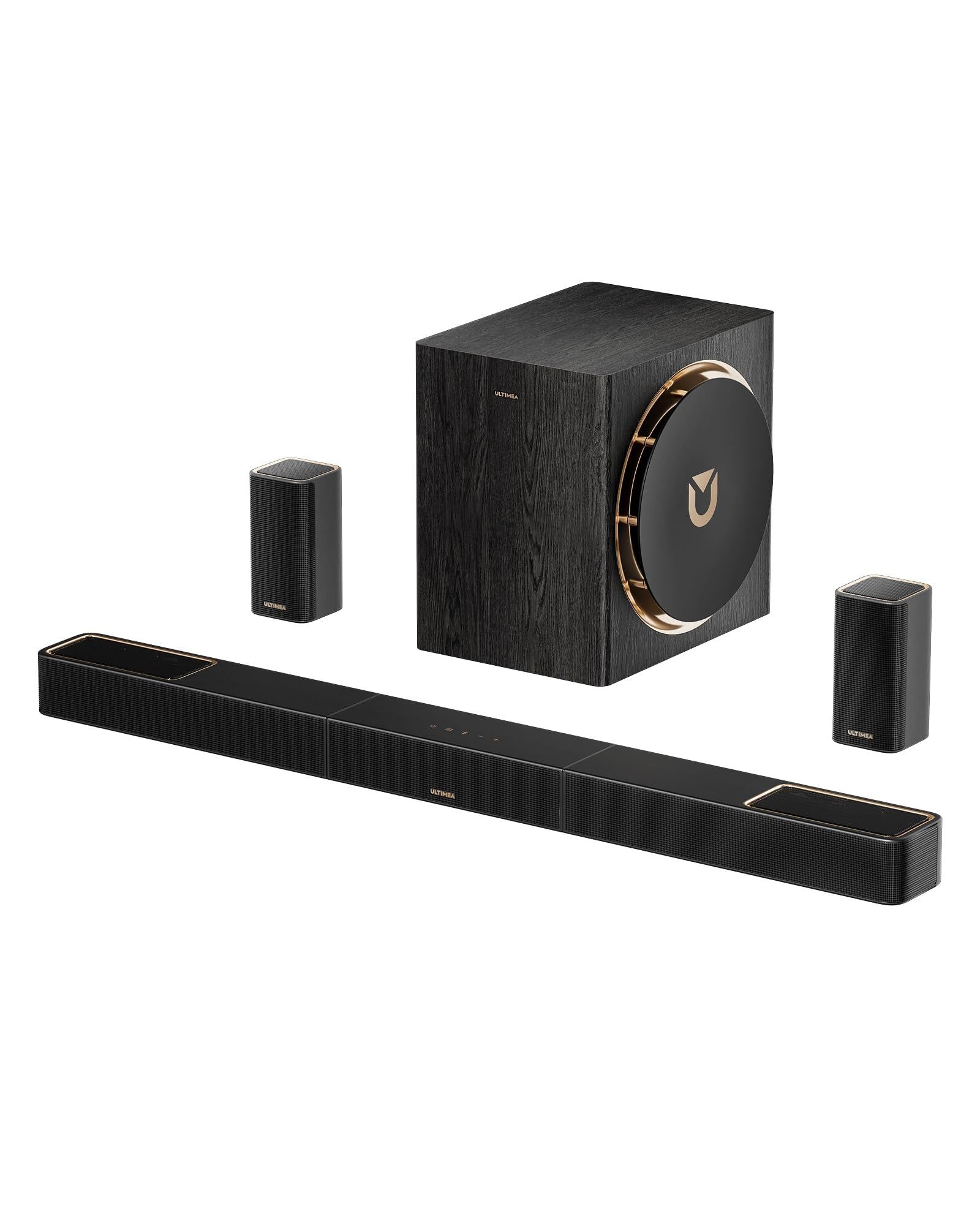
The ULTIMEA Skywave X50 is a 5.1.4-channel system that employs a gallium nitride (GaN) amplifier, a technology typically found in high-end audio gear. GaN amplifiers offer up to 98 percent efficiency and an 8x faster switching speed than traditional silicon-based amplifiers, which translates to lower heat output, higher power density, and cleaner signal processing. The system delivers 760 watts of peak power through its array, which includes a soundbar with up-firing drivers, two wireless rear speakers, and an 8-inch wood-crafted subwoofer with Gravus Ultra-Linear Bass Technology capable of reaching 28 Hz.
The wireless rear speakers connect via dual 5 GHz transmission bands, ensuring stable connectivity with minimal interference from household Wi-Fi networks. The NEURACORE multi-channel audio engine, powered by a triple-core DSP and dual-core MCU, processes up to 17 channels at 24-bit/192kHz resolution with less than 0.5 percent total harmonic distortion. This level of processing headroom allows the system to render height effects with precision uncommon at this tier. The subwoofer uses a tuned waveguide and precision-engineered acoustic chamber to maintain full-bodied low frequencies even at high volume levels without the typical “port noise” or chuffing sounds.
Visual design is a clear priority: the soundbar features a metal grille with rose gold accents, and the subwoofer uses wood paneling, making the system a furniture-grade addition to a living room. The 4K HDR pass-through supports Dolby Vision and HDR10+ without signal loss. Setup is genuinely plug-and-play, with auto-pairing between the soundbar, subwoofer, and rear satellites. The system is compact enough for smaller rooms but the subwoofer’s output is powerful enough to shake a medium-sized room. Dialogue can sometimes compete with the subwoofer, particularly on bass-heavy tracks, but the app provides customizable sound profiles to rebalance the mix.
Why it’s great
- GaN amplifier provides high efficiency and ultra-clean audio with less than 0.5% distortion
- Wood-crafted subwoofer with Gravus technology delivers clean 28 Hz extension without port noise
- Fully wireless rear speakers on a dedicated 5 GHz band eliminate connection dropouts
Good to know
- Subwoofer output can dominate the mix; app-based EQ adjustment is often needed for balance
- 5.1.4 channel count limits the width of the front soundstage compared to wider 7.1.4 or 9.1.4 systems
- No passthrough HDMI 2.1 support; limited to 4K 60Hz for video sources
11. Klipsch Reference Cinema Dolby Atmos 5.1.4 System

The Klipsch Reference Cinema Dolby Atmos 5.1.4 system is fundamentally different from every other entry in this guide. It is a passive speaker system, meaning it requires an external AV receiver (sold separately) to power the drivers and decode the audio. The set includes four satellite speakers, each equipped with a dedicated upward-firing driver for Dolby Atmos, along with a center channel speaker and a powered subwoofer. The satellites use Klipsch’s proprietary Tractrix 90×90 horn technology and aluminum tweeters, which are known for their high sensitivity (typically 90 dB+), making them easier to drive with mid-range receivers.
The four up-firing speakers — two for the front and two for the rear — create a true 5.1.4 height layer that is physically generated rather than virtually processed. This approach produces a more convincing overhead bubble than any soundbar, regardless of channel count, because the height information is anchored to specific physical drivers placed around the room. The subwoofer is powered by a built-in amplifier, so it appears as a standard .1 channel to the AV receiver. The satellites and center channel are magnetically shielded and feature a contemporary black finish with copper-colored driver cones.
This system is not a plug-and-play solution. You will need to connect each satellite speaker to the AV receiver using speaker wire (14 or 16 gauge is recommended, and wire is not included). The binding posts on the satellites are push-locking connectors that work best with smaller banana plugs. Crossover settings should be set to approximately 90 Hz for the center channel, 100 Hz for the satellites, and 120 Hz for the upward-firing speakers to match the design of the drivers. The result, however, is a system with upgrade potential: you can swap out the subwoofer, add more speakers, or upgrade the receiver over time without replacing the entire setup.
Why it’s great
- Physical up-firing drivers in all four satellites produce genuine overhead Atmos effects that outperform virtual processing
- Klipsch Tractrix horn technology delivers high sensitivity and clean high-frequency response
- Component-based design allows future upgrades to subwoofer, receiver, or individual speakers
Good to know
- Requires a separate AV receiver with at least 7 channels (preferably 9 for a 5.1.4 setup) to power and decode
- Speaker wire and banana plugs are not included; 16-gauge wire and small banana plugs are recommended
- The included subwoofer lacks the deep extension of the 10-inch or larger subs found in soundbar systems in this guide
FAQ
Do I need up-firing speakers for Dolby Atmos or can virtual processing work?
What ceiling height works best for up-firing Atmos speakers?
Can I use a soundbar-based Atmos system with an older TV that lacks HDMI eARC?
What is the practical difference between 5.1.4 and 7.1.4 channel counts?
Does a higher peak wattage rating mean a soundbar sounds better?
Final Thoughts: The Verdict
For most users, the dolby atmos surround sound system winner is the Samsung Q990D because it delivers a complete 11.1.4-channel package with rear speakers included, Wireless Dolby Atmos capability, and excellent room calibration — no add-ons or separate receiver required. If you want deep, physical bass that you can feel during action scenes, grab the Nakamichi Shockwafe Ultra 9.2.4 with its dual 10-inch subwoofers. And for a modular, expandable ecosystem that can grow into a multi-room audio setup, nothing beats the Sonos Arc Ultra with its Sound Motion technology and AI-powered dialogue enhancement.

Mo Maruf
I created WellFizz to bridge the gap between vague wellness advice and actionable solutions. My mission is simple: to decode the research and give you practical tools you can actually use.
Beyond the data, I am a passionate traveler. I believe that stepping away from the screen to explore new environments is essential for mental clarity and physical vitality.