Our readers keep the lights on and my smoothie glass nicely filled. As an Amazon Associate, I earn from qualifying purchases.
A dog that suddenly lunges after a squirrel while you’re pedaling at 12 mph is a recipe for a dislocated shoulder, a bent wheel, or a panicked pet under traffic. The right bike leash solves this by keeping your dog at a fixed safe distance from the spinning spokes while absorbing the shock of those sudden pulls. It transforms a risky experiment into a genuine shared workout.
I’m Mohammad Maruf — the founder and writer behind WellFizz. I’ve spent hundreds of hours evaluating hands-free dog leashes, analyzing frame-mount engineering, bungee fatigue cycles, and buckle tensile ratings so you don’t have to guess which one survives real-world use.
This guide cuts through the noise to help you find the safest, most durable best dog bike leash for your riding style, dog size, and budget.
How To Choose The Best Dog Bike Leash
Not all bike leashes are built the same. The cheapest options use thin hardware that strips after a few rides, while premium models include redundant connections and shock-absorbing bungees. Here are the three deciding factors.
Mounting System and Frame Protection
The mounting point determines how the leash behaves when your dog changes direction. Seat-post clamps keep the leash low and centered, reducing bike wobble. Look for a clamp that includes a rubber or silicone liner — without it, metal-on-metal contact will scratch your frame and loosen over time. Quick-release mechanisms matter if you switch the leash between bikes or remove it for storage.
Bungee Length and Tensile Strength
A bungee section between 12 and 30 inches provides enough stretch to absorb sudden lunges without letting your dog reach the rear wheel. Tensile strength ratings above 300 pounds give you a real safety margin for medium to large dogs. Shorter bungees offer more control but less forgiveness; longer bungees allow more freedom but can create a whipping effect if the dog bolts sideways.
Harness Integration and Side-Switching Prevention
A leash alone won’t stop a dog from crossing behind your bike. Systems that include a harness with side rings keep the leash path predictable and prevent tangles in the spokes. If you use a standard collar, a guide pole (14–17 inches) is critical to maintain distance. For dogs that pull hard, a waist-belt system shifts the force to your core instead of your arms, reducing strain on long rides.
Quick Comparison
On smaller screens, swipe sideways to see the full table.
| Model | Category | Best For | Key Spec | Amazon |
|---|---|---|---|---|
| BIKE AND DOG | Harness System | Reactive dogs & side-switchers | 3-ring harness + 10-sec install | Amazon |
| Unicam Retractable | Guide Pole | Small to medium dogs on pavement | 16.5″ stainless steel guide pole | Amazon |
| NEWURBAN Hands Free | Guide Pole | Budget-conscious small dog owners | 15″ shock-absorbing guide pole | Amazon |
| Tuff Pupper Heavy Duty | Waist Belt | Large strong pullers up to 125 lbs | 500 lb tensile bungee + lumbar belt | Amazon |
In‑Depth Reviews
1. BIKE AND DOG Leash & Harness System
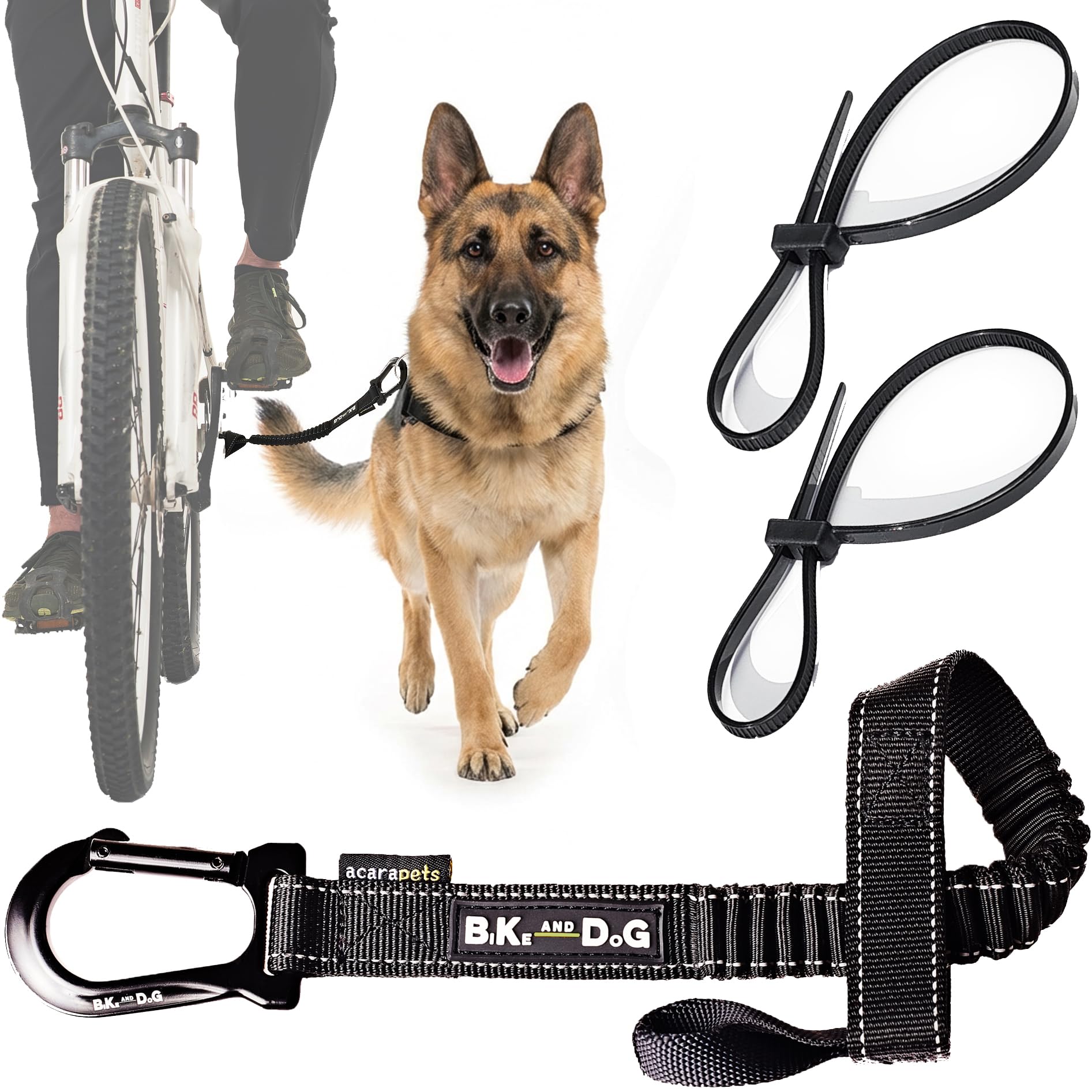
The BIKE AND DOG system is the only product here that includes a purpose-built harness with three metal D-rings — two on the sides and one on the back. This design prevents your dog from switching sides mid-ride, which is the most common cause of leash tangles in the rear wheel. The nylon webbing is thick enough to resist fraying, and the quick-release buckle makes harness removal fast even with an excited dog.
Installation takes about ten seconds with the two included cable ties — no tools, no threading. The leash attaches low on the bike frame, keeping the center of gravity stable. Multiple reviews confirm that this system works well even for dogs that previously panicked near a moving bike, though prior leash training is recommended. The 59-inch total length provides enough freedom for a comfortable stride without letting the dog wander too far.
The main trade-off is that the leash alone (without the harness) is not sold separately, so if your dog chews through the harness you’ll need to buy the full kit again. Some users with extra-large breeds wish the leash was two inches longer for more clearance from the wheel. For most riders, however, this integrated package removes the guesswork entirely.
Why it’s great
- Side rings prevent dangerous side-switching behavior
- Tool-free install in under ten seconds
- Included harness distributes pull force across chest, not neck
Good to know
- Leash length feels short for very large dogs
- Full kit required — no standalone leash replacement
2. Unicam Retractable Bicycle Dog Leash

The Unicam uses a 16.5-inch stainless steel guide pole to keep your dog safely away from the rear wheel, paired with a retractable elastic rope that extends up to 30 inches. The 360-degree swivel mount lets the leash follow your dog’s natural movement without twisting against the seat-post clamp. This is the best mid-range option for small to medium dogs that don’t test the hardware limits with hard lateral pulls.
The clamp mechanism attaches to the seat post via a threaded screw that tightens directly against the frame. Several users note that the included rubber insert helps protect the paint, but it can be difficult to get the clamp tight enough on thinner seat posts. Once secured, the system stays put through bumpy pavement and mild trail riding. The elastic section provides enough give to prevent abrupt yanks while maintaining a constant tension that reminds your dog to stay in position.
Durability is the main concern here. Multiple long-term reviews mention that the elastic rope eventually wears out after several months of heavy use with strong dogs, and the smaller threaded components can strip if over-tightened. For a well-trained, medium-energy dog on regular neighborhood rides, this leash offers an excellent balance of function and affordability.
Why it’s great
- Swivel mount prevents leash twisting and leg contact
- 30-inch elastic reach gives dog comfortable running stride
- Stainless steel pole resists bending under normal use
Good to know
- Threaded clamp can strip on frequent install/removal cycles
- Elastic rope degrades faster with strong, reactive dogs
3. NEWURBAN Hands Free Dog Bike Leash

The NEWURBAN leash is an entry-level guide-pole system built around a 15-inch industrial stainless steel pipe and a folding bungee rope. The patented shock-absorbing design uses a sliding buffer rope that dampens sudden jerks before they reach your handlebars. It’s compatible with any bike frame and screws on or off in seconds, making it a decent choice if you want to test bike-leash running without a large investment.
The seat-post clamp uses a rubber insert to protect your frame, but several users report that the bracket doesn’t fit well on thicker 35mm tubes — the silicone liner slides rather than grips, causing the whole assembly to wobble. The bungee section is thin compared to premium models, and a handful of customers experienced the elastic breaking when their dog ran behind the bike and pulled at an angle. For small, calm dogs on short rides this is rarely an issue.
The biggest safety complaint involves the exposed open end of the guide rod, which can scrape a rider’s leg during sharp turns. The D-ring connector has also been flagged as weak under hard lateral load. If you have a 15-pound terrier that loves a slow cruise, this leash works fine. For any dog over 40 pounds, consider moving up to a more robust system.
Why it’s great
- Quick screw-on installation with no tools needed
- Lightweight design ideal for small dogs under 30 lbs
- Detaches easily to convert into a walking leash
Good to know
- Open rod end can scrape rider’s leg during turns
- Clamp fits poorly on oversized seat posts
4. Tuff Pupper Heavy Duty Hands Free Dog Leash

The Tuff Pupper is not a bike-mount leash — it’s a waist-belt system, and it earns its spot on this list because it solves a different problem. For dogs that pull hard enough to yank a bike sideways, strapping the leash to your waist transfers that force to your core instead of the frame. The belt uses thick foam lumbar padding and a dual stainless steel attachment point rated for 500 pounds of tensile strength, which is overkill for most dogs but provides genuine peace of mind for owners of 100-pound pullers.
The dual bungee sections absorb sudden movements in two stages: the first inch or two gives gently, then the second bungee engages to provide a firmer stop. This prevents the slingshot effect that single-bungee leashes create when a dog bolts. The leash also includes two padded handles — one near the dog for close control in traffic and one mid-leash for general handling. The 3M reflective stitching across the full width of the webbing makes this the most visible option for low-light rides.
The trade-off is that this is a hands-free waist leash, not a bike-specific attachment. You can’t clip it to your seat post, so your dog runs beside you rather than alongside the bike. This works well on straight paths but can become awkward when maneuvering through tight turns. For runners and joggers who occasionally bike, this dual-purpose versatility is a strength. For dedicated cyclists who want a fixed guide pole, a seat-post mount is the better fit.
Why it’s great
- 500 lb tensile rating handles the strongest pullers
- Padded lumbar belt eliminates shoulder and arm strain
- Full 3M reflective stitching for high nighttime visibility
Good to know
- Not a bike-mount system — waist only
- Leash extension can be too long for tight trail riding
FAQ
Can I use a regular leash attached to my bike?
How do I stop my dog from switching sides behind the bike?
What size bike leash do I need for a 60-pound dog?
Final Thoughts: The Verdict
For most users, the best dog bike leash winner is the BIKE AND DOG Leash & Harness System because it eliminates the single biggest danger — side-switching — through its three-ring harness design. If you want hands-free running versatility for a large puller, grab the Tuff Pupper Heavy Duty. And for a budget-friendly entry point with small, calm dogs, the NEWURBAN Hands Free gets the job done without breaking your wallet.

Mo Maruf
I created WellFizz to bridge the gap between vague wellness advice and actionable solutions. My mission is simple: to decode the research and give you practical tools you can actually use.
Beyond the data, I am a passionate traveler. I believe that stepping away from the screen to explore new environments is essential for mental clarity and physical vitality.