Our readers keep the lights on and my smoothie glass nicely filled. As an Amazon Associate, I earn from qualifying purchases.
A document feeder scanner changes the pace of paper handling by automatically pulling stacks of pages through a sensor array, capturing both sides in a single pass. For anyone drowning in receipts, contracts, or archived paperwork, the difference between feeding pages one by one and dropping a stack into a tray is measured in hours saved per week.
I’m Mohammad Maruf — the founder and writer behind WellFizz. I spend weeks analyzing automatic document feeder throughput, duplex scanning reliability, paper path designs, and the real-world durability of feeder rollers to separate products that deliver consistent batch performance from those that frustrate.
The right document feeder scanner eliminates the bottleneck of manual page-by-page scanning by combining duplex capture, rated speed, and a paper path that resists jams under sustained use.
How To Choose The Best Document Feeder Scanner
Three specifications separate a scanner that fits your workflow from one that becomes a shelf ornament: feeder capacity, duplex speed, and the software environment that processes your scans. Ignoring any of these turns a fast piece of hardware into a slow workflow.
Feeder capacity and paper path design
The sheet capacity of the automatic document feeder determines how many pages you can load before walking back to the machine. A 50-sheet feeder handles most tax returns and client files in one drop, while a 100-sheet tray suits high-volume offices that process full folders without interruption. The geometry of the paper path — straight-through versus U-turn — affects whether wrinkled or creased pages jam or glide through. Straight paper paths reduce jams with mixed media but take up more desk depth.
Duplex speed in images per minute
Manufacturers advertise simplex pages per minute, but anyone scanning double-sided documents needs images per minute (ipm), which doubles the effective throughput. A 30-ppm scanner that scans both sides produces 60 ipm. Entry-level models often throttle duplex speed, while premium units maintain high speed in both directions. For batch processing of double-sided contracts, look for machines that keep rated speed in duplex mode rather than halving it.
Software integration and OCR engine
The bundled software determines whether your scan becomes a searchable PDF you can find in seconds or a static image you have to re-scan. Good OCR engines preserve text formatting and recognize table structures. Proprietary software like ScanSnap Home gives you a unified dashboard for organizing receipts, documents, and photos, while TWAIN-compliant scanners let you integrate with third-party document management systems. If you route scans directly to cloud storage, check whether the scanner supports destination profiles that bypass the computer entirely.
Quick Comparison
On smaller screens, swipe sideways to see the full table.
| Model | Category | Best For | Key Spec | Amazon |
|---|---|---|---|---|
| ScanSnap iX2400 | Premium | High‑volume office paperless transition | 100‑sheet ADF / 45 ppm simplex | Amazon |
| Fujitsu fi‑7160 | Business | Enterprise reliability with Kofax VRS | 80‑sheet ADF / 60 ppm duplex | Amazon |
| Canon RS40 | Photo + Doc | Mixed photo and document archiving | 40 ipm duplex / Polaroid feeder | Amazon |
| ScanSnap iX1300 | Compact | Small desk with mixed media needs | 30 ppm duplex / Wi‑Fi + USB | Amazon |
| Ambir ImageScan Pro 820ix | Budget TWAIN | Software integration via TWAIN | 20 ppm duplex / 50‑sheet ADF / 9 watts | Amazon |
| Fujitsu iX500 (Renewed) | Proven Workhorse | Wireless cloud scanning on a budget | 25 ppm duplex / CCD sensor | Amazon |
| Plustek PS188 | File Search | Document management with full‑text search | 30 ppm duplex / 50‑sheet ADF | Amazon |
| Koncept iX500 (Renewed) | Refurb Stable | High‑speed batch scanning at lower entry cost | 1200 dpi / 50‑sheet ADF / CCD | Amazon |
| Doxie Pro | Portable | Lightweight travel and small batches | 20‑sheet ADF / 3 lbs / 11×17 max | Amazon |
In‑Depth Reviews
1. ScanSnap iX2400
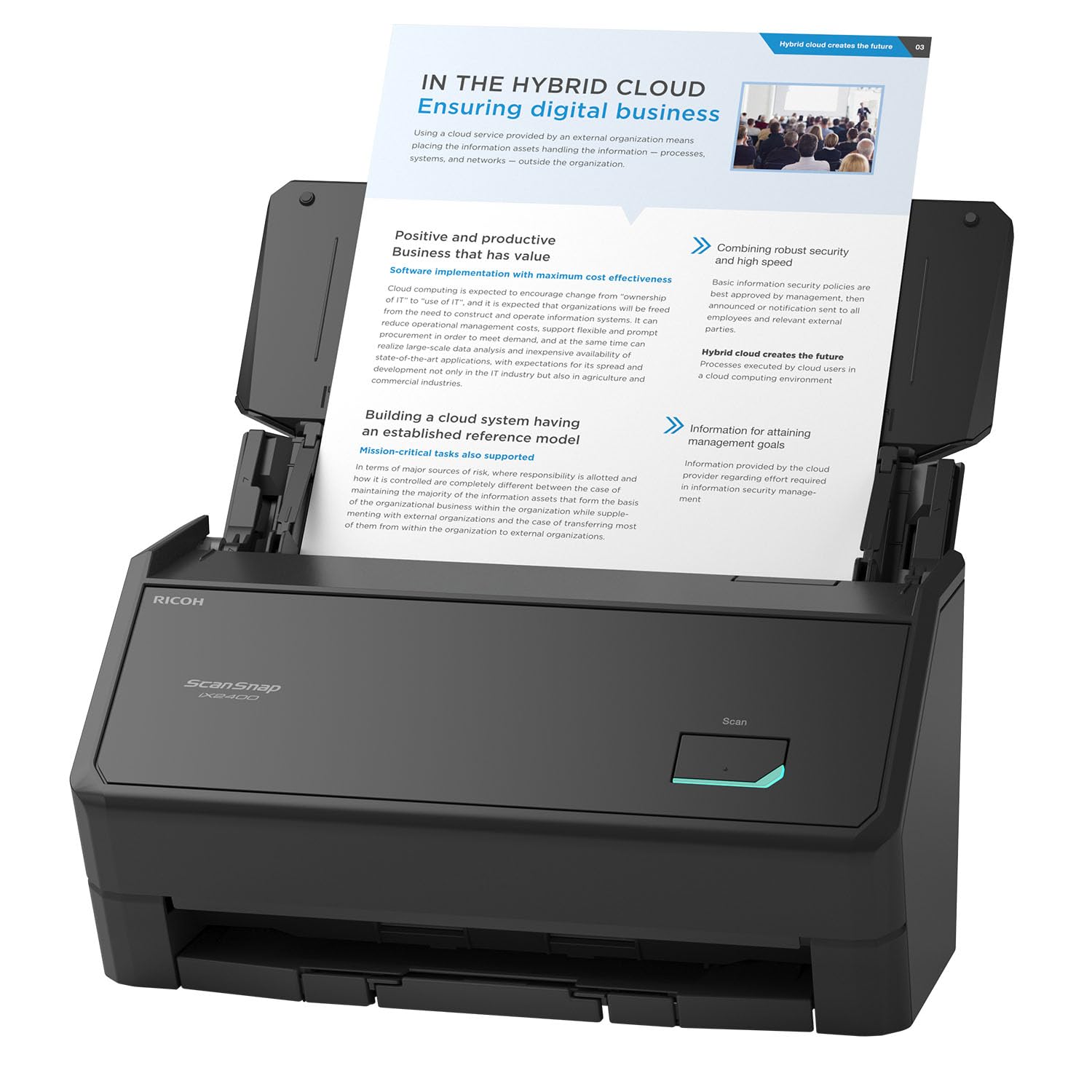
The ScanSnap iX2400 leads this lineup with a 100-sheet automatic document feeder and a rated simplex speed of 45 pages per minute — the highest feeder capacity in this review. Its one-touch button workflow bypasses driver configuration entirely: press the button and the scanner processes color depth, deskews, and removes blank pages before saving a searchable PDF. Previous ScanSnap owners report getting seven years of daily use from older models, suggesting the roller assembly and paper path are built for sustained batch runs.
Duplex scanning at 90 images per minute means a 50-page double-sided client file finishes in just over 30 seconds. The iX2400 does not include Wi-Fi — it relies on a stable wired USB connection, which eliminates wireless dropouts during large batches. Users describe installation taking under ten minutes, with the software automatically detecting the device and guiding profile creation. The ScanSnap Home software provides a single dashboard for receipts, photos, and documents, though some reviewers note the interface requires extra clicks compared to third-party tools.
The scanner handles business cards, receipts, envelopes, and ID cards without manual feeder adjustments. At 7.1 pounds and a footprint slightly larger than a loaf of bread, it occupies modest desk space while delivering workflow speed that suits solo professionals and small offices processing several thousand pages per month. The absence of TWAIN support means it works best with ScanSnap Home rather than third-party document management suites.
Why it’s great
- 100-sheet ADF reduces trips to the scanner during big batches
- 90 ipm duplex speed eliminates waiting during double-sided jobs
- Proven durability from previous-generation ScanSnap owners
Good to know
- No Wi-Fi — only USB connectivity
- ScanSnap Home software has a learning curve for custom profiles
- Price sits at the premium end of the home-office segment
2. Fujitsu fi-7160

The Fujitsu fi-7160 represents the professional threshold where reliability and image quality meet enterprise workflow integration. It delivers 60 ppm duplex scanning through an 80-sheet automatic document feeder, with a straight paper path that reduces jams on stapled or misfed pages. Users report two misfeeds in 5,000 pages, a reliability figure that justifies its position as the most popular business scanner on the market. The included PaperStream ClickScan software allows push-button scanning to email, print, or folder destinations without opening a control panel.
Kofax VRS compatibility gives the fi-7160 an edge in environments that require consistent image quality across varied document conditions — faded receipts, thermal papers, and highlighter markings. The TWAIN and ISIS driver support means it integrates with any ECM or document management system without proprietary lock-in. PaperStream IP software provides advanced image processing like blank page removal, auto-crop, and color detection, though the software interface is complex enough that several users recommend spending time with the manual before batch scanning.
The physical footprint is substantial at 17.7 inches wide and 11.2 inches deep, so it demands dedicated desk real estate. At 9.3 pounds and 38 watts, it is the heaviest and most power-hungry unit in this review, built for continuous daily use rather than occasional scanning. Users note that TWAIN integration with Adobe Acrobat can be slow — around 30 seconds per page — so direct PaperStream workflows produce better throughput for high-volume jobs.
Why it’s great
- Kofax VRS and TWAIN/ISIS support for enterprise integration
- 60 ppm duplex with under 0.1% misfeed rate over thousands of pages
- PaperStream ClickScan for one-button folder delivery
Good to know
- Large footprint — requires dedicated desk space
- PaperStream IP software has a steep learning curve
- TWAIN scanning in Acrobat can be slow without direct workflow
3. Canon imageFORMULA RS40

The Canon RS40 carves a unique niche as a hybrid scanner that handles both photos and documents through the same automatic document feeder. Its rated speed of 40 images per minute applies to double-sided documents, but the real value lies in the photo feeder tray that accommodates Polaroid prints, 4×6 snapshots, and cardstock without manual feeding. The bundled software includes red-eye correction, digital face smoothing, and color enhancement — features absent from standard document scanners that treat images as flat data.
The feeder handles stacks of 20 to 30 photos, though users report that dust tends to accumulate on the CIS sensor after about ten photo scans, requiring a soft cloth cleaning to remove vertical streaks. For document batches, the RS40 handles receipts, driver licenses, and tax documents of varying sizes with a dual-side pass that captures both sides at once. Output formats include JPG, TIF, PNG, PDF, and even PPTX, giving flexibility for presentation workflows. Default scan settings tend to crush shadow detail in dark photos, so adjusting contrast and brightness in the software before batch scanning preserves tonal range.
One notable software limitation involves temporary file management: the application does not automatically delete temp files after scans, which can fill the system drive after roughly 800 photo scans. Users recommend monitoring disk space during large archiving projects. The 6.6-pound chassis and 11.4-inch width make it suitable for a home office desk, though the software interface requires more clicks to set custom jobs compared to ScanSnap’s streamlined approach.
Why it’s great
- Photo feeder handles Polaroid and cardstock without adapter
- 40 ipm duplex for document batch scanning
- Face smoothing and red-eye correction built into software
Good to know
- CIS sensor picks up dust during photo runs — clean regularly
- Software does not delete temp files, risking drive fill
- Default photo settings lose shadow detail
4. ScanSnap iX1300

The ScanSnap iX1300 packs duplex scanning, wireless connectivity, and a manual front feeder into a chassis that measures just 11.7 by 4.5 inches — smaller than most keyboard trays. Its 30 ppm duplex speed handles moderate batch volumes, while the Wi-Fi support lets it operate without a wired connection to a Mac, PC, or Chromebook via the mobile app. The Quick Menu software allows scan-drag-drop into applications like Dropbox, OneNote, or iCloud, and the auto-naming feature intelligently reads document content to generate filenames — a time saver for receipt-heavy workflows.
The 20-sheet standard feeder capacity is the lowest in this review, making the iX1300 better suited for daily document processing rather than bulk archiving sessions. The manual front feeder compensates by accommodating thick items like plastic ID cards, insurance cards, and folded envelopes that would jam in a standard ADF. Users report that the feeder handles mixed sizes — receipts alongside legal sheets — without misalignment, and auto-crop and blank page removal produce clean output without driver configuration.
Some users experienced a four-day setup process due to driver compatibility issues, though once running the scanner proved fast and quiet. The sensor required cleaning after the first week for one reviewer, suggesting that glossy or dusty originals leave residue on the glass. Wireless scanning works reliably for single-user setups, but only one device can send scan jobs at a time. At 4.4 pounds, it is light enough to relocate between desks but stable enough that it does not slide during paper pulls.
Why it’s great
- Wi-Fi scanning works with Mac, PC, Chromebook, and mobile apps
- Manual front feeder handles thick media like plastic cards
- Compact footprint frees desk space in home offices
Good to know
- 20-sheet feeder limits batch scanning without reloading
- Setup can require multiple driver install attempts
- CIS sensor may need weekly cleaning with glossy media
5. Ambir ImageScan Pro 820ix

Its compact footprint roughly matches a toaster, making it one of the most space-efficient ADF scanners for a small desk. The included enhanced TWAIN driver ensures compatibility with thousands of software applications, from practice management systems to enterprise document capture suites, without proprietary software lock-in.
The 20 ppm duplex speed places it in the entry-level tier for batch throughput, but users emphasize that the speed is consistent and the build quality supports repeated daily use. The auto-sleep power-saving mode engages after a period of inactivity, but the scanner requires a manual button press to wake it, which can interrupt workflow if the unit is placed out of arm’s reach.
Mac users face a notable challenge: the Mac software lacks several features available in the Windows version, and drivers are harder to locate on Ambir’s support page. One reviewer spent over eight hours configuring the scanner on a Mac before achieving stable operation. Once running, the scanner feeds well and produces clean scans, but the limited Mac software and the absence of bundled applications like OCR or document management tools mean users must supply their own workflow software. The retail price reflects a hardware-focused approach — you pay for the feeder mechanism and TWAIN compatibility rather than a polished software suite.
Why it’s great
- Full TWAIN compatibility integrates with thousands of applications
- Ultra-low 9-watt power consumption for always-on workflows
- Toaster-sized footprint fits tight desk spaces
Good to know
- Mac software is limited and hard to configure
- Jams with thick stacks — best fed in small batches
- No bundled OCR or document management software
6. Fujitsu iX500 (Renewed)

The Fujitsu iX500 remains a benchmark even as a renewed product, thanks to its CCD optical sensor technology that produces sharper text and richer color than the CIS sensors found in most budget and mid-range scanners. Its 50-page automatic document feeder feeds up to 25 double-sided pages per minute, and the one-button scanning workflow creates searchable PDFs without requiring a connected computer. Wireless scanning to iOS, Android, Mac, and PC gives it flexibility that many current models still lack.
The renewed units have received mixed feedback: most users report receiving scanners that function like new, with clean rollers and no jams after months of daily use. The bundled software package includes Nuance Power PDF, ABBYY FineReader, and ScanSnap Organizer — a comprehensive suite that covers OCR, PDF editing, and receipt management. Users who owned the iX500 new and repurchased it renewed note that the software CD is often missing, requiring online downloads that may no longer be available from Fujitsu’s support page for older operating systems.
Paper handling is reliable for standard office paper and receipts, though glossy or very thin paper can trigger separation roller slippage. The CCD sensor produces consistent image quality at 600 dpi, with color fidelity that preserves receipt thermal ink before it fades. The renewed price point makes this an attractive entry into the ScanSnap ecosystem, though buyers should verify that the specific renewal vendor offers a return policy for DOA units. The unit weighs 5.6 pounds and occupies a modest 8.7 by 10.5 inch desk footprint.
Why it’s great
- CCD sensor produces sharper text than CIS-based alternatives
- Wireless scanning to mobile devices and cloud without a PC
- Comprehensive software bundle includes OCR and PDF editing
Good to know
- Renewed units may lack software CDs — check with vendor
- Glossy paper can cause separation roller issues
- Older model — driver support may be limited for newer OS versions
7. Plustek PS188

The Plustek PS188 targets users who need more than just captured images — its embedded full-text search engine indexes every word within scanned documents, allowing retrieval by any keyword without pre-tagging. The 50-sheet automatic document feeder delivers 30 ppm duplex scanning, and the barcode recognition feature reads barcode numbers and automatically saves them as filenames, eliminating manual renaming for inventory logs or invoice batches. DocAction II software supports up to 255 customizable scan profiles, each storing specific resolution, file format, and destination folder settings.
The scanner handles paper from business cards to 200-inch-long documents, making it useful for continuous forms or architectural prints. The ultra-short paper path reduces the chance of jams on creased or curled pages, and the 600 dpi CIS sensor captures sufficient detail for text documents and receipts. Users report that the included paper feed guide is not rigid enough to support legal paper, recommending a nearby wall or a pencil cup as a backstop to prevent multi-page pulls. Calibration is recommended before each batch to maintain consistent image quality.
Some units have exhibited persistent USB disconnection errors, requiring power cycling to re-establish communication. Customer service experiences vary: one user reported a rushed call that ended without resolution, while another praised the support team for helping with calibration issues. The 5-inch depth makes it one of the narrowest ADF scanners available, though the 11-inch width still requires moderate desk space. The price sits in the mid-range tier, offering software features — full-text search and barcode naming — that are absent from comparably priced competitors.
Why it’s great
- Embedded full-text search engine retrieves any word in scanned docs
- Barcode recognition auto-names files for inventory workflows
- 255 customizable scan profiles for different document types
Good to know
- USB connection errors may require power cycling
- Paper feed guide is not sturdy enough for legal sheets
- Calibration needed before each batch for consistent quality
8. Koncept iX500 (Renewed)

The Koncept-branded renewed iX500 brings the same CCD sensor and 50-sheet feeder design as the Fujitsu original, with an interpolated resolution of 1200 dpi that exceeds the standard 600 dpi found on most modern scanners. This optical resolution advantage matters for scanning fine print, engineering diagrams, or detailed graphics where every pixel captures subtle line work. The 25 ppm duplex speed matches the original iX500, and the one-button PDF creation workflow preserves the ScanSnap hallmark of minimal driver interaction.
Renewed units from Koncept have drawn mixed durability reports: several users describe months of flawless batch scanning for tax season paperwork, while one unit ceased powering on after two to three months. The renewed process replaces worn rollers and cleans the optics, but the internal power supply or main board carries the risk of latent failure from the original device lifecycle. Users recommend testing the scanner extensively within the return window, running at least 500 pages through the feeder to confirm roller grip and sensor alignment.
Mac compatibility works via USB but requires a USB-C adapter for newer MacBooks that lack Type-A ports. The included software package mirrors the Fujitsu suite with ABBYY FineReader and ScanSnap Organizer, though Mac users report remote connection issues when scanning over a network. The 8.2-pound weight is heavier than the Fujitsu original, suggesting the Koncept unit may include a different power adapter or chassis reinforcement. At the refurbished price, this represents the lowest-cost entry to the iX500 ecosystem, but buyers should weigh the savings against potential reliability variance between individual units.
Why it’s great
- 1200 dpi interpolated resolution captures fine detail
- CCD sensor produces sharp OCR-ready images
- Lowest-cost entry to the ScanSnap ecosystem
Good to know
- Durability varies between individual renewed units
- Test thoroughly within return window — some units fail after 2-3 months
- Requires USB-C adapter for newer MacBooks
9. Doxie Pro

The Doxie Pro prioritizes portability and ease of use over raw capacity, weighing just 3 pounds and folding its document feeder for storage in a drawer or laptop bag. Its 20-sheet automatic document feeder captures both sides in a single pass, and the maximum media size of 11×17 inches lets it scan larger documents than most compact scanners. The included Doxie software sends scans to Dropbox, Evernote, OneNote, and iCloud without complicated driver installation — the scanner appears as a standard USB device on both Mac and Windows.
The software provides real-time contrast and gamma adjustments, which become necessary when scanning glossy receipts or maps where automatic exposure tends to wash out mid-tones. Users report handling folded and wrinkled pages without jams, though the single-item feed mode is recommended for damaged paper to prevent multi-page pulls. The duplex speed is competitive for this form factor, completing a 20-page batch in under two minutes at 300 dpi. The scanner makes a solid thud rather than a high-pitched whine during operation, which reduces noise fatigue during extended sessions.
One notable trade-off is the lack of an SD card slot or external battery — the Doxie Pro must remain tethered to a computer via USB for power and data transfer. The 20-sheet feeder limits batch scanning compared to the 50- or 100-sheet competitors, but the trade-off yields a chassis that fits in a laptop sleeve. Users who bought the Doxie Pro at the reduced refurbished price found it a good value, though the retail price sits close to the mid-range tier where 50-sheet alternatives become available.
Why it’s great
- Compact 3-pound design folds for portable use
- 11×17 inch max media handles larger paper formats
- Real-time software adjustments for glossy or reflective media
Good to know
- 20-sheet feeder requires reloads during big batches
- No SD card slot or external battery — must be tethered
- Retail price competes with 50-sheet alternatives
FAQ
Is a CCD sensor better than CIS for scanning documents?
Why does my duplex scanner stall after scanning one side?
How often should I replace the feeder roller on my ADF scanner?
Final Thoughts: The Verdict
For most users, the document feeder scanner winner is the ScanSnap iX2400 because its 100-sheet feeder and 45 ppm simplex speed handle the highest batch volumes without sacrificing the one-button simplicity that eliminates driver frustration. If you need Kofax VRS enterprise integration and a sub-0.1% misfeed rate for thousands of daily pages, grab the Fujitsu fi-7160. And for a compact wireless dual-purpose scanner that handles photos and documents from a small desk footprint, nothing beats the ScanSnap iX1300.

Mo Maruf
I created WellFizz to bridge the gap between vague wellness advice and actionable solutions. My mission is simple: to decode the research and give you practical tools you can actually use.
Beyond the data, I am a passionate traveler. I believe that stepping away from the screen to explore new environments is essential for mental clarity and physical vitality.